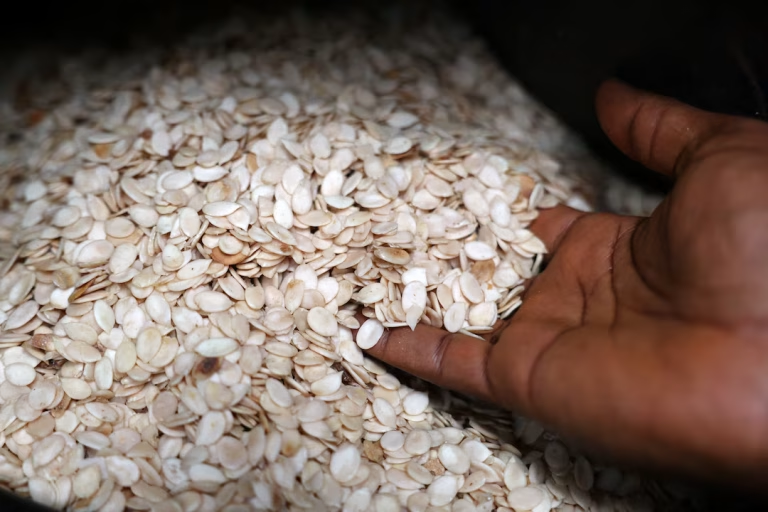
Egusi melon seeds, a staple ingredient in Nigeria’s beloved egusi soup, have made history after being sent to the International Space Station (ISS) for scientific research. The experiment is part of a project studying how food crops react to space conditions, with the long-term goal of ensuring astronauts have access to nutritious, culturally diverse meals during missions to the Moon, Mars, and beyond.
The seeds spent seven days orbiting Earth in the Crew-11 capsule launched from NASA’s Kennedy Space Centre on August 1. They were carefully packed in test tubes alongside heritage seeds from Costa Rica, Armenia, and Guatemala.
Nigerian space scientist Temidayo Oniosun, who handpicked the egusi seeds from markets in Oyo State, explained that the mission is about more than nutrition: “The goal is that in the next couple of decades, when people are living on the Moon, on Mars and they’re looking at growing food… foods that are native to Africa would be part of that.”
Egusi is valued not only for its cultural significance but also for its high protein content, making it a strong candidate for space farming. Florida-based scientist Wagner Vendrame, one of the researchers on the project, highlighted the importance of moving beyond the processed dried meals astronauts rely on today.
The seeds are now being distributed to laboratories for propagation and testing. Scientists aim to determine whether exposure to space altered their genetic makeup or nutritional quality.
“By looking at the changes in the plants and the seeds themselves, we can tell—are those plants still the same? Would they still provide the same level of nutrition to astronauts?”Vendrame said.
If successful, the experiment could pave the way for traditional African foods to be cultivated in extraterrestrial environments, ensuring both diversity and sustainability in future space diets.
As preparations intensify for the 2025 G20 Summit in Johannesburg, South Africa, on November 22–23, world leaders are focusing on new strategies to tackle the $4 trillion annual financing gap required to achieve the Sustainable Development Goals (SDGs). Africa alone accounts for $1.7 trillion of this shortfall—roughly 40 per cent of the global funding need.
The financing gap has nearly doubled from $2.5 trillion in 2015 to its current $4 trillion, creating a serious barrier to development across the continent. To address this, the G20’s Fourth International Conference on Financing for Development (FFD4) has placed Domestic Resource Mobilisation (DRM) at the centre of proposed solutions.
The African Tax Administration Forum (ATAF) highlighted that DRM can reduce Africa’s dependence on volatile external funding sources while restoring fiscal independence. In its latest report, ATAF noted that “the G20 under the South African Presidency has emphasised the importance of revisiting and prioritising Domestic Resource Mobilisation as a critical tool within the broader financing mix for achieving the SDGs.”
Currently, Africa’s tax-to-GDP ratio remains below the 15 per cent benchmark needed for sustainable development. However, ATAF estimates that raising this ratio by just one percentage point could generate an additional $35 billion each year—amounting to $350 billion by 2030—and significantly reduce the financing deficit.
Illicit Financial Flows (IFFs) remain one of the biggest threats to DRM. ATAF has called for comprehensive reforms, including better tax and trade policies, stronger tax and customs administrations, and broader tax bases. It also stressed the need to combat practices such as transfer mispricing and trade mis-invoicing, which strip African economies of critical revenues.
To boost cross-border cooperation, ATAF recommended measures such as unique taxpayer identifiers, stronger anti-corruption frameworks, and the automatic exchange of tax and customs information. Under South Africa’s G20 Presidency, efforts to tackle IFFs have gained traction, with the Development Working Group (DWG) now tasked with drafting voluntary, non-binding high-level principles to address the issue.
Funding constraints—including declining Official Development Assistance (ODA), insufficient public resources, and the heavy cost of borrowing—continue to slow SDG progress. The G20 DWG acknowledged that development financing is a shared concern for both finance and development ministers.
ATAF concluded that effective tax systems are not only critical to bridging Africa’s funding gap but also to advancing inclusive growth. It noted that reforms promoting gender equality and empowering women are central to sustainable DRM, making taxation a tool for broader social and economic transformation.
The Nigeria Immigration Service (NIS) has announced a fresh upward review of passport application fees, raising concerns on affordability and government priorities.
Effective September 1, 2025, Nigerians applying within the country will now pay ₦100,000 for a 32-page passport with a five-year validity, and ₦200,000 for a 64-page passport with ten-year validity.
This change comes just a year after the last adjustment in September 2024, when the 32-page passport rose from ₦35,000 to ₦50,000, and the 64-page option increased from ₦70,000 to ₦100,000. The latest increment has doubled costs in less than 24 months, raising concerns about its impact on ordinary Nigerians.
Meanwhile, the fee for Nigerians in the diaspora remains unchanged at $150 for the 32-page (five years) and $230 for the 64-page (ten years).
The Reason for the Increment
The NIS explained that the review was necessary to maintain the quality and integrity of the Nigerian passport, which is globally recognized as a security document. Officials highlighted the high cost of production, enhanced security features, and the need to sustain service delivery as factors behind the decision.
The agency also argued that the increment will help reduce pressure on the service’s operations by aligning fees with the realities of passport production and maintenance.
What the Federal Government is Saying
The Federal Government has backed the increment, insisting that the hike is part of broader efforts to reform public service delivery and reduce reliance on subsidies. Government officials maintain that Nigeria cannot continue to operate at a loss when producing international-standard passports.
At the same time, authorities claim that the revised pricing structure will discourage unnecessary passport applications, streamline demand, and ensure better service to genuine applicants. However, critics argue that the move comes at a difficult time when many Nigerians are already grappling with economic challenges.
Comparing Nigeria’s Passport Fees with Global Standards
As passport costs continue to rise in Nigeria, it is important to place the new fees within the context of what citizens in other parts of the world pay. While the Nigerian Immigration Service argues that the adjustment aligns with global realities, a closer look at international standards shows a mixed picture.
United States: First-Time Adult Passport Book (DS-11) costs $165 (₦253,210) with a 10-year validity.
United Kingdom: Adults (16 and over) pay £94.50 (₦194,072) for a standard 34-page passport online (£107 (₦220,909) if applied on paper). For the 54-page frequent traveller passport, the cost is £107.50 online or £120 (₦247,743) via paper application. Validity is 10 years.
Canada: Adult passports cost CAD 120 (₦133,920) for 5 years or CAD 160 (₦178,568) for 10 years.
Germany: An adult passport (24 years and above) is priced at €70 (₦125,335) for 10 years.
From these comparisons, Nigeria’s 10-year passport at ₦200,000 falls within the range of developed countries in terms of absolute figures. However, when adjusted for income levels and purchasing power, it becomes significantly more expensive for the average Nigerian.
How Nigeria Compares with Other African Countries
Looking at Africa, the differences in passport pricing are even more striking. Many African countries charge considerably lower fees, making Nigeria’s new rates among the highest on the continent.
Ghana: A standard passport costs about ₵350 (₦45,000).
Kenya: Ordinary passports are priced at KES 7,550 (₦89,674) for a 34-page booklet, KES 9,550 (₦113,000) for a 50-page booklet, and KES 12,050 (₦143,000) for a 66-page booklet.
South Africa: An ordinary passport costs about R1,200 (₦103,846) for a 32-page booklet and R2,400 (₦207,749) for a 48-page booklet.
Uganda: A 48-page passport with 10-year validity costs UGX 250,000 (₦108,098).
In this regional context, Nigeria’s ₦200,000 charge for a 64-page, 10-year passport ranks as one of the most expensive, coming very close to South Africa’s 48-page option.
While the Nigerian government and the Immigration Service defend the new passport fees as necessary for quality assurance and sustainability, the figures place Nigeria well above most African nations. On the global stage, the prices may seem comparable to those in Western countries, but the disparity in living standards and income levels makes the burden considerably heavier for Nigerians.
The adjustment is therefore likely to remain a contentious issue, with debates focusing on whether the hike will genuinely improve service delivery or further restrict citizens’ access to a fundamental document of national identity.
With about 85 days to go, South Africa is entering the final stretch of preparations for the historic G20 Leaders’ Summit—the first time the event will take place on African soil on 22nd and 23rd of November, 2025.
As the host nation, South Africa is working around the clock to ensure a successful and impactful gathering, the summit aims to bring together global leaders under the theme “Solidarity, Equality, and Sustainability,” with a sharp focus on solving some of the world’s most pressing challenges.
So far, the country has successfully hosted 87 of the planned 132 G20 meetings across both the Sherpa and Finance tracks.
These meetings have laid the groundwork for the highly anticipated Leaders’ Declaration, which is expected to set the tone for global cooperation on economic recovery, climate action, and inclusive growth.
A final round of ministerial meetings in September will wrap up the preparatory process.
In a major step forward, President Cyril Ramaphosa has launched a high-level G20 task force dedicated to tackling global inequality and sovereign debt. This task force is chaired by Nobel Prize-winning economist Joseph Stiglitz and includes top financial thinkers from around the world. Its goal is to draft bold, actionable proposals that G20 leaders can adopt during the summit.
The focus areas include building fairer global tax systems, implementing effective debt relief strategies for low-income countries, and encouraging sustainable investments through innovative financing models.
The task force is expected to present its policy paper just weeks before the summit.
Tensions Rise Over Trump’s Attendance
One unresolved issue is whether U.S. President Donald Trump will attend the summit. Trump has publicly criticised South Africa’s domestic policies, particularly land reform, and has indicated he may send a representative instead. His potential absence has sparked diplomatic chatter, but South African officials are standing firm.
“We will proceed with the G20 Leaders’ Summit with or without President Trump,” said International Relations Minister Ronald Lamola. “This summit is not about individuals—it’s about collective action on global challenges.” The official U.S. position remains unclear, but the invitation stands.
Who’s Coming: Confirmed Attendees and Allies
Despite the uncertainty surrounding the U.S., many other G20 leaders have confirmed their attendance. These include German Chancellor Olaf Scholz, Indian Prime Minister Narendra Modi, Chinese President Xi Jinping, UK Prime Minister Keir Starmer, and the heads of Canada, Brazil, Japan, and the European Union.
International organisations such as the International Monetary Fund (IMF) and the World Bank will also be represented at the highest levels. India, which held the previous G20 presidency, has pledged strong support to South Africa, calling the summit “a milestone moment for the Global South.”
Europe’s elite learned their eight league-phase opponents on Thursday, August 28, after UEFA conducted the 2025/26 Champions League draw in Monaco. The revamped “league phase” means every club plays eight different opponents (four home, four away) between September and January, with the top eight advancing directly to the last-16 and 9th–24th going into a playoff. Matchdays run Sept 16–18 through Jan 28, 2026.
Real Madrid: Anfield, City and a marathon to Kazakhstan
Real Madrid’s headline ties include Liverpool away — always box-office — and Manchester City at the Bernabéu. They also host Juventus and Marseille, travel to Benfica and Olympiacos, and face a mammoth trip to Kairat Almaty in Kazakhstan. The schedule mixes glamour with grind: Anfield and Lisbon are hostile, Piraeus is notoriously fiery, and the Almaty trek is the longest of the league phase.
Barcelona
PSG at home, Chelsea away, and a testing night on Tyneside Barça’s draw pairs them with PSG at Montjuïc, a renewed rivalry rich in recent drama, plus Chelsea away. They also host Eintracht Frankfurt, Olympiacos and Copenhagen, and travel to Club Brugge, Slavia Praha and Newcastle United, where St James’ Park can tilt a tight night. It’s a balanced slate on paper, but the Chelsea and Newcastle trips stand out as potential swing games.
Bayern Munich: the heaviest average schedule?
Bayern landed a gauntlet: PSG away, Arsenal away, and Chelsea at home headline the board, with tricky trips to PSV and Pafos rounding it out. Early assessments peg Bayern’s slate among the toughest by average opponent quality, even if the Bavarians back themselves to lock down a top-eight berth.
Paris Saint-Germain (holders)
Star-studded home nights, awkward away days The champions welcome Bayern, Atalanta, Tottenham and Newcastle to Paris — four games that should feel like knockout nights. Away, they visit Barcelona, Bayer Leverkusen, Sporting CP and Athletic Club — an itinerary heavy on hostile atmospheres. On paper, it’s marquee-laden, but PSG’s depth should help them manage the load.
Manchester City: Real away, heavyweights at home
City’s headline is Real Madrid away, while the Etihad hosts Borussia Dortmund, Bayer Leverkusen and Napoli, three tests that should gauge City’s ceiling. They also travel to Villarreal, Bodø/Glimt and Monaco, with Galatasaray visiting Manchester. It’s a draw that looks navigable — but Real at the Bernabéu looms large.
Liverpool: a classic with Madrid plus hostile road trips
Anfield gets Real Madrid and PSV, while Arne Slot’s side goes on the road to Inter, Atlético Madrid, Eintracht Frankfurt and Galatasaray — a murderer’s row of atmospheres — and hosts Qarabağ. The blend of a superpower showdown and rugged away days should keep Liverpool sharp throughout the phase.
Arsenal: Kane’s Bayern to London; San Siro away
The Gunners welcome Bayern Munich and Atlético Madrid to the Emirates, play Inter at San Siro, and face useful barometers in Club Brugge (away) and Athletic Club (away). Home assignments against Olympiacos and Kairat Almaty should be must-take points in a slate that’s demanding but fair.
Chelsea: Barcelona at the Bridge, three tough road trips
Stamford Bridge will stage Barcelona, Benfica and Ajax, with Pafos rounding out the home set. Away, Chelsea must visit Bayern, Atalanta, Napoli and Qarabağ — a trio of heavyweight footballing exams plus a long haul to Azerbaijan. It’s a draw with plenty of jeopardy, offset by big-night potential in London.
Tottenham Hotspur: PSG in Paris, Dortmund in London
Spurs’ calendar features PSG away — a daunting night at Parc des Princes — while Borussia Dortmund and Villarreal come to London. They also travel to Eintracht Frankfurt, Bodø/Glimt and Monaco, and host Slavia Praha and Copenhagen. If Spurs hold serve at home, they’ll like their playoff odds.
Newcastle United: Barça at home, Paris and Leverkusen away
Newcastle’s headline is Barcelona at St James’ Park, with Benfica, PSV and Athletic Club also visiting. Away trips to PSG, Bayer Leverkusen, Marseille, and Union Saint-Gilloise make this one of the Premier League’s spikier slates, full of travel, tempo and intimidation.
Inter: English heavyweights at San Siro, yellow-wall away
Inter host Liverpool and Arsenal — two Premier League showpieces — and Slavia Praha and Kairat Almaty. Their road list sends them to Borussia Dortmund and Atlético Madrid, plus Ajax and Union Saint-Gilloise. The home field should be decisive for Simone Inzaghi’s side as they bed in after a turbulent summer.
Juventus: Bernabéu test and tricky travellers
Juve’s away days include Real Madrid, Villarreal, Bodø/Glimt and Monaco — none straightforward — while Borussia Dortmund, Benfica, Sporting CP and Pafos head to Turin. The blend of historical bogey teams and long-haul logistics means focus will be at a premium for Thiago Motta’s men.
Atlético Madrid: Road Grit Required
Atlético must visit Liverpool, Arsenal, PSV and Galatasaray, while hosting Inter, Eintracht Frankfurt, Bodø/Glimtand Union SG. It’s a draw that screams “Cholo-ball”: sturdy away performances will define their ceiling, with the Metropolitano expected to deliver points.
The Nigeria Immigration Service (NIS) has announced an upward review in the cost of obtaining the Nigerian Standard Passport, which will take effect from September 1, 2025.
In a statement released on Thursday by the Service Public Relations Officer, ACI AS Akinlabi, the agency clarified that the new charges will apply solely to applications processed within Nigeria.
According to the NIS, the decision to adjust the fees was made to maintain the quality and integrity of the Nigerian Passport.
Under the new pricing structure, a 32-page passport with a five-year validity period will now cost N100,000, while a 64-page passport with a 10-year validity will be priced at N200,000.
“The review which only affect Passport Application fees made in Nigeria, now set a new fee thresholds for 32-page with 5-year validity at N100,000 and 64-page with 10-year validity at N200,000,” the statement read.
“Meanwhile, Nigerian Passport Application fees made by Nigerians in diaspora remain unchanged at $150 for 32-page with 5-year validity and $230 for 64-page with 10-year validity.”
The NIS reaffirmed its commitment to providing efficient service delivery while ensuring that Passport services remain accessible to Nigerians both at home and abroad.
Access Holdings Plc has officially appointed Mr. Innocent Ike as its substantive Group Managing Director/Chief Executive Officer, effective August 29, 2025, after securing regulatory approval.
The announcement was made in a statement issued on Wednesday and signed by the company secretary, Sunday Ekwochi. It comes just hours after Roosevelt Ogbonna resigned from the company’s board in compliance with new corporate governance rules introduced by the Central Bank of Nigeria.
Ike succeeds Ms. Bolaji Agbede, who has been serving as Acting Group CEO for the past 18 months following the death of former Group CEO, Herbert Wigwe, in 2024. Agbede will now return to her position as Executive Director, Business Support.
Access Holdings Chairman, Aigboje Aig-Imoukhuede, said Ike’s appointment marks the beginning of a new chapter for the group.
He stated, “We are thrilled to welcome Mr. Innocent Ike as we move forward. At the same time, we want to express our deepest gratitude to Ms. Bolaji Agbede.
“Her outstanding contributions over the past 18 months have been invaluable, and we appreciate her dedication in navigating the Company through challenges and opportunities. While regulatory requirements necessitate this change, we are grateful for the strong foundation that has been laid.”
During Agbede’s tenure, the company recorded key achievements, including maintaining workforce stability, executing a N351bn rights issue, and successfully hosting two annual general meetings.
Reacting to his appointment, Ike said, “I am honoured to take on the role of Group Managing Director/Chief Executive Officer and excited to work alongside the talented team at Access Holdings.
“I look forward to building on the strong legacy established by Herbert Wigwe and Bolaji Agbede, and driving our vision forward, ensuring we continue to deliver exceptional value to our shareholders and stakeholders.”
Ike is an accomplished professional with a strong academic and professional background. A graduate of the University of Lagos, where he emerged as the Best Graduating Student in Accounting in 1988, he is a Fellow of both the Chartered Institute of Bankers of Nigeria and the Institute of Chartered Accountants of Nigeria, as well as a certified IFRS expert.
With more than 30 years of experience in banking and financial services, Ike previously worked at Access Bank for a decade, rising to the position of General Manager. He later served as Managing Director/CEO of Polaris Bank from 2020 to 2022, where he spearheaded the launch of VULTe, the bank’s award-winning digital platform.
Former Anambra State Governor and Labour Party presidential candidate, Peter Obi, has threatened legal action against rights activist and lawyer Deji Adeyanju over what he described as a series of defamatory statements published on social media.
In a formal demand letter issued by his legal representatives, Ejesimen & Co Madiba Chambers, Obi accused Adeyanju of deliberately damaging his reputation with false allegations. The letter, seen by journalists, gave Adeyanju notice to retract his posts and issue an apology or face a defamation suit in court.
What Deji Adeyanju Said That Triggered The Suit
The demand notice referenced Adeyanju’s repeated criticisms of Obi over the years, including an earlier account in which the activist alleged Obi once attempted to buy his loyalty after a private meeting.
“He tried to give me money and called it thank you for coming, it’s 100% true,” Adeyanju had claimed in a post on X, suggesting that Obi’s gesture was an attempt to compromise him.
More recently, on August 21, Adeyanju accused Obi of misusing public resources during his tenure as governor by allegedly investing Anambra State funds into a company linked to his family. This post, the lawyers argued, formed part of a deliberate smear campaign against Obi’s public image.
The Dispute Over Serah Ibrahim And Adeyanju’s Wife
The latest clash escalated after Adeyanju sued Obi’s female aide, Serah Ibrahim, accusing her of making defamatory remarks about his wife. According to Adeyanju, Ibrahim had described his wife as an “OnlyFans hoe” and published “unprintable things” after he criticised Obi online.
“We served his little errand girl, Serah, a letter to retract all her defamatory publications on Monday against my wife, and she ran to the leader of the mob for help,” Adeyanju said. “Obi cannot save her, and I am ready for him in court 100%.”
Ibrahim, however, denied calling Mrs Adeyanju a prostitute. “I only said she constantly posts pics of butt, the kind you’d typically see on OnlyFans wannabe,” she clarified. “I didn’t say she’s a whore. But if he wants to call his wife a whore, who am I to disagree?”
Adeyanju’s Mocking Response To Obi’s Demand Notice
Rather than retreating, Adeyanju openly mocked Obi’s legal threat in a Facebook post. “Just got this letter from Peter Obi, the religious bigot, demanding a retraction from me. I laughed so hard. I can’t wait to meet him in court finally. A fraud parading himself as a messiah,” he wrote.
The activist went further to argue that Obi’s legal step indirectly confirmed that his aides were behind defamatory attacks against opponents online. “It proves what we have always suspected; he is the one sending them to defame people online because they are his aides,” Adeyanju claimed.
Obi’s Lawyers’ Position And Demands
In their letter, Obi’s lawyers demanded Adeyanju publish a public retraction of his statements across the same platforms where he allegedly defamed Obi. They also asked for an unreserved apology, warning that failure to comply would result in immediate court proceedings.
The legal team emphasized that Obi’s reputation as a national political figure was at stake, and the activist’s persistent remarks were aimed at discrediting his image before Nigerians.
Adeyanju, a long-time critic of Obi, has consistently dismissed the Labour Party leader’s political ambition, insisting he will never become Nigeria’s president. He has also been in frequent clashes with Obi’s supporters, popularly known as Obidients, accusing them of intolerance and coordinated online attacks.
The ongoing legal tussle now extends that rivalry into the courtroom, potentially setting up a high-profile defamation case between one of Nigeria’s most vocal activists and a leading opposition figure.
Russian forces carried out a “massive” overnight assault on Kyiv on Thursday, unleashing strikes that killed at least four people and injured around 30 others, according to Ukrainian officials.
The attack occurred as Moscow and Kyiv exchanged blame over stalled diplomatic efforts toward a peace deal led by US President Donald Trump. AFP correspondents in Kyiv reported seeing powerful explosions lighting up the night sky, followed by plumes of smoke.
Ukraine’s Interior Minister, Igor Klymenko, confirmed that four people were killed and “about 30 people” wounded. Tymur Tkachenko, head of the city’s military administration, added that the dead included a 14-year-old girl, while five other children between the ages of seven and 17 sustained “injuries of varying severity.”
Kyiv Mayor Vitali Klitschko described the strikes as a “massive attack” that damaged several districts of the capital. Tkachenko further revealed that Moscow had launched ballistic and cruise missiles, as well as Iranian-made Shahed drones, from multiple directions in an attempt to “systematically” strike residential buildings.
AFP journalists witnessed red tracer bullets streaking across the night sky as Ukrainian forces attempted to intercept drones. At least one missile appeared to have been shot down. About 100 residents sought shelter in a subway station, with some lying in sleeping bags and others clutching their pets.
Klitschko also reported that a five-story residential building in the Darnytsky district had collapsed, while a shopping mall in central Kyiv was struck.
– Ukrainian Strikes on Russia –
The attack followed one of Kyiv’s deadliest assaults in the three-year war on July 31, which left more than 30 people dead, including five children. Ukrainian officials also confirmed a Russian strike in the southeastern Zaporizhzhia region on Thursday.
Meanwhile, Russian authorities claimed to have destroyed more than 100 Ukrainian drones overnight. Local officials said a Ukrainian drone attack caused a fire at an oil refinery in the Krasnodar region but reported no casualties.
In recent months, Russian forces have been slowly advancing on Ukrainian territory, even as diplomatic talks have intensified. Earlier this month, Trump hosted a high-profile summit with Russian President Vladimir Putin in Alaska, followed by a meeting with Ukrainian President Volodymyr Zelensky and European allies.
Despite these engagements, little progress has been made. Ukraine insists that any peace agreement must include security guarantees from the West to deter future Russian aggression. Moscow, however, has dismissed Kyiv’s demands as unrealistic and particularly opposed the idea of Western peacekeeping troops being stationed in Ukraine.
On Wednesday, Zelensky announced that his administration would meet with US officials in New York on Friday. He also criticized Moscow’s stance, saying he had seen “very arrogant and negative signals from Moscow regarding the negotiations,” and urged greater “pressure” to “force Russia to take real steps.”
President Bola Tinubu arrived back in Abuja on Thursday after concluding diplomatic engagements in Japan and Brazil.
In a statement released by his spokesperson, Bayo Onanuga, it was disclosed that the presidential jet departed Brasília International Airport Air Force Base at 12:57 pm (local time) on Wednesday and touched down in Abuja early Thursday morning.
During his time in Japan, Tinubu participated in the opening ceremony and plenary of the ninth Tokyo International Conference on African Development (TICAD9) on August 20. He also held bilateral meetings and wrapped up his visit with an interactive session with members of the Nigerian community.
After TICAD9, the President departed Yokohama with a stopover in Los Angeles before heading to Brasília, Brazil.
While in Brazil, Tinubu met with President Luiz Inácio Lula da Silva and senior officials. Both leaders held private discussions and presided over the signing of five Memoranda of Understanding covering aviation, foreign affairs, science and technology, and agriculture sectors central to Nigeria’s growth agenda.
On his return to Nigeria, the President was received by a delegation of dignitaries and government officials.
To provide the best experiences, we use technologies like cookies to store and/or access device information. Consenting to these technologies will allow us to process data such as browsing behaviour or unique IDs on this site. Not consenting or withdrawing consent, may adversely affect certain features and functions.
Functional
Always active
The technical storage or access is strictly necessary for the legitimate purpose of enabling the use of a specific service explicitly requested by the subscriber or user, or for the sole purpose of carrying out the transmission of a communication over an electronic communications network.
Preferences
The technical storage or access is necessary for the legitimate purpose of storing preferences that are not requested by the subscriber or user.
Statistics
The technical storage or access that is used exclusively for statistical purposes.The technical storage or access that is used exclusively for anonymous statistical purposes. Without a subpoena, voluntary compliance on the part of your Internet Service Provider, or additional records from a third party, information stored or retrieved for this purpose alone cannot usually be used to identify you.
Marketing
The technical storage or access is required to create user profiles to send advertising, or to track the user on a website or across several websites for similar marketing purposes.