Morocco made history on Thursday by becoming the first African team to secure qualification for the Round of 32 at the 2026 FIFA World Cup after defeating Haiti 4-2 in their final Group C encounter.
The Atlas Lions were forced to come from behind after an unfortunate own goal from goalkeeper Yassine Bounou handed Haiti an early lead. However, Captain Achraf Hakimi quickly restored parity to keep Morocco on track.
Haiti regained the advantage through Wilson Isidor, but Morocco responded once again before the break as Ismael Saibari found the net to make it 2-2.
The North Africans took full control in the second half, with Soufiane Rahimi and Gessime Yassine both getting on the scoresheet to complete an impressive comeback and seal all three points.
Morocco finished second in Group C behind Brazil, who secured top spot with a comfortable 3-0 victory over Scotland in the group’s other fixture.
Achraf Hakimi was officially named Man of the Match following his outstanding display in Morocco’s 4-2 victory over Haiti in their final Group C fixture at the 2026 FIFA World Cup.
The Morocco captain played a decisive role in the Atlas Lions’ success, scoring the team’s opening goal and later providing an assist as they completed an impressive comeback to secure all three points.
The win ensured Morocco’s place in the Round of 32, with the Atlas Lions finishing the group phase on seven points.
The Inspector-General of Police (IGP), Olatunji Disu, has prohibited officers of the Nigeria Police Force from creating, publishing, or monetising content on social media platforms while identifying themselves as police personnel.
The directive, contained in an internal police circular dated Monday applies to platforms such as TikTok, Facebook, Instagram, and YouTube. It was distributed to police formations and commands across the country.
According to the circular, the police leadership expressed concern over the increasing involvement of officers in social media content creation, describing it as a trend capable of damaging the image, professionalism, and effectiveness of the force.
Under the new order, officers are barred from creating, publishing, or sharing videos, photographs, skits, live streams, and related content while wearing police uniforms or operating within police facilities without obtaining written approval from the IGP or an authorised representative.
The directive also prohibits officers from operating personal or anonymous social media accounts for entertainment, commercial promotion, or brand endorsements connected to their status as members of the police force. In addition, officers are forbidden from publicly commenting on investigations, disciplinary matters, deployments, or other official police issues.
The circular further stated that officers must not accept sponsorships, endorsement agreements, or monetisation opportunities that rely on their identity as police personnel.
“The Nigeria Police Force is a disciplined institution whose effectiveness depends on public trust, institutional integrity, and the professional conduct of every officer,” the circular stated.
The IGP warned that officers who violate the directive could face severe disciplinary measures, including interdiction, forfeiture of salary during disciplinary proceedings, demotion, dismissal from service, and prosecution under applicable criminal or cybercrime laws.
The directive also places responsibility on senior officers, including commissioners of police, area commanders, and divisional police officers, to monitor compliance. Supervisors who fail to take action against offending personnel may also face sanctions.
Commissioners of police in all states have been directed to circulate the order to officers under their command within seven days and submit compliance reports through the Deputy Inspector-General of Police in charge of Operations within 14 days.
The latest directive comes weeks after Disu cautioned content creators and members of the public against recording and sharing police-related videos without proper context.
Speaking during an interactive session with crime correspondents in Abuja on May 31, 2026, the IGP warned that the circulation of police operation videos could undermine security efforts and affect the morale of officers.
“We urge members of the public and social media users to refrain from recycling old or manipulated videos capable of creating panic or undermining national security efforts,” he said at the time.
The new order also mirrors a similar policy introduced by former Inspector-General of Police Mohammed Adamu on June 17, 2020. That directive prohibited police officers from using photographs of themselves in uniform on personal social media accounts and from engaging in posts or discussions deemed political, religious, or damaging to the image of the force.
The 2020 policy also restricted officers from identifying themselves as police personnel online, except for authorised spokespersons and senior officers designated to communicate on behalf of the Nigeria Police Force.
The renewed restrictions reflect the police leadership’s effort to strengthen discipline, maintain public confidence, and regulate the online activities of officers as social media continues to play a growing role in public engagement and law enforcement accountability.
South Africa stunned the odds to reach the World Cup knockout stage for the first time in their history
Bafana Bafana overcame South Korea despite being heavily unfavoured by Opta’s supercomputer projections
Hugo Broos’ side recovered from a difficult start to secure a landmark achievement on the global stage
South Africa have rewritten their 2026 FIFA World Cup story after producing one of the tournament’s biggest surprises, defeating South Korea 1-0 to secure a place in the knockout stage of the tournament for the first time in their history.
South Africa have rewritten their 2026 FIFA World Cup story after producing one of the tournament’s biggest surprises, defeating South Korea 1-0 to secure a place in the knockout stage of the tournament for the first time in their history.
Few gave Bafana Bafana a realistic chance of progressing when the tournament began. Even fewer believed they would still be standing after a difficult start to their campaign. South Africa and South Korea fight for the ball during the FIFA World Cup 2026 match.
Yet Hugo Broos’ men ignored the predictions, silenced the doubters and delivered a historic result in Monterrey to advance as Group A runners-up. The decisive moment came courtesy of winger Thapelo Maseko, whose second-half strike earned South Africa a famous victory and secured one of the greatest achievements in the country’s football history
Maseko delivers historic moment The stakes could not have been higher heading into the final group-stage clash. Both teams knew defeat would likely end their hopes of progression, and the tension was evident throughout a fiercely contested encounter. South Africa began brightly despite playing in front of a crowd dominated by Korean supporters. Maseko threatened early before Thalente Mbatha forced a fine save from goalkeeper Kim Seung-gyu. Evidence Makgopa also came close as Bafana Bafana looked the more dangerous side during the opening exchanges.
South Korea responded after the break by introducing several attacking players, including captain Son Heung-min, as they searched desperately for a breakthrough. However, while the Asians controlled possession, South Africa remained disciplined and dangerous on the counterattack. Their moment finally arrived in the 63rd minute. Substitute Teshpang Moremi surged down the left flank before delivering a dangerous pass across the edge of the area. Maseko took one touch, shifted the ball onto his stronger foot and calmly slotted past Kim at the near post.
South Korea pushed forward in search of an equaliser, but Bafana Bafana stood firm to secure a memorable victory.
The result means South Africa will now face Canada in Los Angeles on June 28 in their first-ever World Cup knockout fixture. Bafana Bafana prove the supercomputer wrong South Africa’s achievement becomes even more remarkable when viewed against the predictions made before and during the tournament. According to Opta’s supercomputer projections before the World Cup, Bafana Bafana were expected to finish at the bottom of Group A.
Co-hosts Mexico were considered overwhelming favourites to advance, progressing in 87.2 per cent of simulations. South Korea were projected to qualify in 70.1 per cent of simulations, while Czechia were given a 64.2 per cent chance. South Africa were viewed as the weakest side in the group. Although they had a 48.9 per cent chance of reaching the round of 32 due to the expanded format, they were strongly tipped to finish fourth. The model gave them just a 19.3 per cent probability of ending as group runners-up, the exact position they surprisingly achieved.
Their path became even more difficult after an opening defeat to Mexico and a hard-fought draw against Czechia. Heading into the decisive match against South Korea, the numbers remained firmly against them. Opta’s 25,000 simulations suggested South Korea would win 56.2 per cent of the time. A draw was rated at 23.5 per cent while a South African victory occurred in only 20.3 per cent of simulations. But football is played on grass, not computers and South Africa delivered when it mattered most.
Historic achievement for South African football
The victory is a significant milestone for South African football. Before this tournament, Bafana Bafana had never progressed beyond the group stage in any of their previous World Cup appearances, per FIFA. Their success comes against a South Korean side boasting far greater World Cup pedigree. The Asians entered the tournament, making an 11th consecutive World Cup appearance, a streak stretching back to 1986. Only Brazil, Germany, Argentina and Spain had longer active runs of participation. South Africa, meanwhile, were making only their fourth appearance at football’s biggest tournament.
That gap in experience mattered little when the pressure intensified. Instead, Broos’ side displayed organisation and belief to grab a result that will be remembered for generations. Maseko’s winning goal also earned him a place in the history books. At 22 years and 225 days old, he became the second-youngest South African player ever to score at a FIFA World Cup.
Hugo Broos never lost faith
Hugo Broos remained optimistic even after South Africa’s difficult start to the tournament. The Belgian coach consistently argued that his team’s performances deserved more credit than the results initially suggested and pointed to the discipline and fighting spirit displayed by his players against stronger opposition, insisting they still had a chance of achieving something special
The Nigerian Senate has approved a constitutional amendment bill seeking the establishment of state police, a significant step toward restructuring the country’s security framework.
The bill was passed on Wednesday, June 24, 2026, after lawmakers considered and adopted all 26 clauses during the committee of the whole session. The proposed legislation provides the legal basis for states to establish and operate their own police services while retaining the existing federal police system.
Senate Leader Opeyemi Bamidele presented the bill as an executive proposal submitted by President Bola Tinubu. He described the measure as one of the most far-reaching constitutional reforms since Nigeria’s return to democratic governance.
According to Bamidele, Nigeria’s centralised policing structure is increasingly stretched by security challenges such as terrorism, banditry, kidnapping, communal conflicts, farmer-herder clashes, cybercrime, and organised criminal activities.
Under the proposed arrangement, any state interested in creating a police force would be required to enact relevant legislation through its House of Assembly and comply with standards prescribed by the National Assembly.
While state police would be responsible for enforcing state laws, maintaining public order, preventing crime, and protecting lives and property within their jurisdictions, the federal police would continue to oversee national security matters.
These responsibilities include counter-terrorism operations, cybercrime investigations, border security, arms trafficking cases, and policing activities within the Federal Capital Territory.
To address concerns about potential abuse of power, the bill includes provisions preventing governors from directing state police forces to target individuals, political opponents, groups, or organisations. It also prohibits the use of police authority for partisan, ethnic, religious, or personal interests.
Several lawmakers expressed support for the proposal while emphasising the need for strong safeguards.
Abia South Senator Enyinnaya Abaribe revealed that although he had previously opposed state policing, the worsening security situation across the country had changed his position. He stressed the importance of incorporating protective measures into the Police Act, particularly provisions that would prevent a president from taking control of a state police force for political purposes.
Abaribe also advocated constitutional guarantees for state police funding, suggesting that funds should be paid directly to state police commissions to prevent interference.
Sokoto South Senator Aminu Tambuwal, who has consistently supported the creation of state police, said the proposal would strengthen Nigeria’s federal system. He cited recurring bandit attacks in his constituency as evidence that alternative security solutions are urgently needed.
Tambuwal also emphasised the importance of building safeguards that would protect the system from potential abuse by future state governors.
Before the constitutional amendment can become law, it must receive approval from at least two-thirds of Nigeria’s 36 State Houses of Assembly. Once that requirement is met, the bill will be forwarded to the president for assent.
With the final round of group fixtures now under way the path to the World Cup final on 19 July is starting to take shape.
But with 32 of the 48 teams advancing to the knockout rounds, new tie-breaker rules, and a table of third-placed teams to keep track of, staying across the various permutations is far from simple.
As it stands, England, sitting top of Group L, and Scotland, who finished third in Group C, would be on the same path to meet in the last 16 in Mexico City (6 July, 01:00 BST) – but they would have to win last-32 ties first.
But Scotland’s 3-0 defeat by Brazil has left their hopes of going through as one of the best third-placed countries hanging by a thread.
There is lots still to be decided, so find out the results required to get teams through to the knockout rounds.
Let’s look at a projection tool that updates in-game to illustrate the schedule all the way to the final.
With dates and times listed alongside the fixtures, planning early morning alarms and potential all-nighters across three host countries and four different time zones has never been easier.
How does knockout qualification work?
Sixteen of the record 48 teams involved in the World Cup will be eliminated at the end of the group stage, leaving 32 nations in the mix for the trophy.
The top two teams from each of the 12 groups will advance to the last 32.
The remaining spots in the knockout stages are taken by the eight third-placed teams with the best records.
If two or more countries are level on points, head-to-head results are used as the first tie-breaker to determine positions.
If the teams remain tied, they are ranked on goal difference, goals scored, Fifa’s Team Conduct Score – a disciplinary metric for red and yellow cards, and finally whoever had the higher Fifa ranking in June’s published update.
These criteria are applied in the 12 groups of four and to determine the rankings of the 12 third-placed sides.
Group A
Co-hosts Mexico became the first nation to qualify for the knockout stage and won Group A with a 100% record.
El Tri will host a third-placed team from Group C, E, F, H or I in the last 32 on Tuesday.
South Africa beat South Korea 1-0 in their final group stage game to climb into second place and reach the knockout stage for the first time. They will play Canada in the last 32 in Los Angeles on Monday.
That result meant South Korea finished third in the group with three points and they must wait to see if that is enough to send them through.
Czech Republic‘s defeat to Mexico meant they finished bottom of the table with one point from their three matches.
Group B
Switzerland won the group on seven points with a 2-1 victory over Canada.
The Swiss clinched a last-32 tie against a third-placed team in Vancouver on Thursday, 2 July.
Canada finished as runners-up on goal difference with four points and face a date with South Africa in Los Angeles on Monday.
Bosnia-Herzegovina beat Qatar 3-1 to finish third on four points.
South Africa’s win over South Korea confirmed Bosnia would be one of the best third-placed teams.
Group C
Five-time winners Brazil topped the group on goal difference with seven points thanks to their 3-0 win over Scotland. They now play the runners-up of Group F in Houston on Monday.
Morocco went through in second place on seven points after they beat Haiti 4-2. The North Africans’ next opponents will be the winners of Group F in Monterrey on Monday.
Scotland finish in third on three points and goal difference of -3, which Opta says now gives a 38% chance of qualifying.
Steve Clarke’s men now face an anxious wait to see if they will get another game, or will head home. It might be a close run thing.
Haiti were already eliminated without scoring a point.
Group D
The United States have qualified for the knockout stages as Group D winners and will face a third-placed team from Groups B, E, F, I or J in the next round.
Australia and Paraguay are tied on three points and they meet on Friday (03:00 BST). The Socceroos have the goal difference advantage so only need to draw to progress in second.
Paraguay, however, must defeat Australia if they are to leapfrog their opponents into second place to play the runners-up from Group G.
A draw may well be enough to send Paraguay through in third on four points, and they will have a pretty good idea if that is the case when they play.
If either team loses it will be an anxious wait to discover if three points is enough.
Semi-finalists in 2002, Turkey cannot progress after losing to both Australia and Paraguay.
Group E
Germany have won the group and will face third place from either A, B, C, D, F.
Ivory Coast need a draw against Curacao on Thursday (21:00 BST) to secure second spot, which would set up a last-32 tie against second place from Group L.
Ecuador must beat Germany and hope Ivory Coast lose if they are to finish second. A victory to finish third on four points will probably be enough to go through, however.
Curacao will finish second if they win and Ecuador draw or lose.
If both Ecuador (-1) and Curacao (-6) both win then Ivory Coast would finish bottom, and goal difference would almost certainly send the South American nation through in second and Curacao through as a best third place.
Group F
Netherlands are guaranteed to finish in the top two ahead of their game against already-eliminated Tunisia on Friday (00:00 BST).
Japan still need a point against Sweden to ensure automatic progression, though four points is probably enough in third if they lose.
If both Netherlands and Japan win the top spot would be decided on goal difference, which is locked at +4 while the Dutch have scored one more. If both lose, goal difference would also determine second and third places.
If goal difference is identical it goes to the best disciplinary record (Japan 0, Netherlands -3), then the Netherlands would take it on Fifa world ranking.
The group winners will play Morocco in Monterrey and runners-up will come up against Brazil in Houston, both on Monday.
Sweden can only end up in the automatic places if they win, and they can top the group if the Netherlands suffer a defeat.
A draw would put them in a strong position for one of the eight-best third places, while defeat would leave them sweating to find out if their three points is enough.
Tunisia cannot progress after defeats by Sweden and Japan.
Group G
Egypt lead the group and will go through if they avoid defeat against Iran on Saturday (04:00 BST).
They will still go through automatically if they lose and Belgium do not beat New Zealand. At worst, they could finish third on four points – likely enough to progress.
The group winners play a third-placed team.
Iran will go through if they beat Egypt. If they draw, then a top-two finish is only possible if Belgium also draw.
The runners-up will take on second in Group D.
Belgium will progress in the top two if they beat New Zealand. They can also definitely go through in second with a draw if Egypt beat Iran.
If Belgium and Iran both win they will be tied for top spot, or for second if they draw.
As they drew with each other, placings would be determined on goal difference – which is level at zero.
If goal difference finishes up identical, positions will be determined first by the better disciplinary record (Belgium -7, Iran -2) and then by Fifa world ranking, which Belgium hold.
Neither team will qualify if they lose.
New Zealand must beat Belgium and hope Iran do not win against Egypt to finish in the top two, though they cannot win the group.
If New Zealand and Iran both win, New Zealand would be third on four points which will likely be enough.
Group H
Spain will progress as one of the top two sides if they avoid defeat against Uruguay on Saturday (01:00 BST).
Even if they lose, they will still finish inside the top two unless Cape Verde beat Uruguay. If that happens, Spain will finish third on four points, which is likely to be good enough.
Spain will top the group with a draw, unless Cape Verde win and overturn a goal difference deficit of four.
The group winners go on to play the runners-up of Group J.
Uruguay will be through if they beat Spain. If they draw, then a top-two finish is only possible if Cape Verde also draw.
Cape Verde will make the top two if they beat Saudi Arabia. They can also definitely go through with a draw if Spain beat Uruguay.
If Uruguay and Cape Verde both win they will be tied for top spot, or if they draw for second spot. As they drew with each other, placings would be determined on goal difference – which is level at zero.
If goal difference is identical, positions will be decided first by the better disciplinary record (Cape Verde -3, Uruguay -2) and then by Fifa world ranking, which Uruguay hold.
The second-placed team will face Argentina.
Neither team will qualify if they lose.
Saudi Arabia must beat Cape Verde, and will also need Spain to avoid defeat against Uruguay, to finish second. Four points would likely be enough in third anyway.
Group I
France and Norway have already qualified and meet each other to battle for top spot on Friday (20:00 BST).
As France have the better goal difference, Norway must get a victory to finish first.
The group winners will play a third-placed team and the runners-up meet second in Group E.
Senegal (-3) and Iraq (-6) have zero points and if there is a winner they must hope three points is enough for a best third-place spot.
As both have poor goal difference, as it stands, it looks a tough task to make it through.
Group J
Argentina have topped the group and will face the runners-up from Group H.
Austria and Algeria are tied on three points and they meet on Sunday (00.00 BST).
Austria have the goal difference advantage so need to draw to progress in second.
Algeria, however, must win if they to go through automatically.
A draw may be enough to send Algeria through in third on four points, and they will know if that is the case as this is the final group to complete.
The runners-up play the winners of Group H.
Jordan cannot progress.
Group K
Colombia have secured a top two spot and will win the group if they avoid defeat against Portugal on Sunday (00:30 BST).
The group winners will play a third-placed team.
Portugal must win to finish first, while a draw will lock second place.
Even if Portugal lose and DR Congo win, Roberto Martinez’s team are six goals better off in goal difference so would likely take second.
DR Congo‘s only chance of second is tobeat Uzbekistan and overhaul that goal difference. A win, however, will put them onto four points which will surely be enough in third.
Uzbekistan must win but can only finish third, and with goal difference of -7 the chances of taking a place in the next round on three points are slim.
Group L
England top the group ahead of Ghana on goal difference and face Panama in their final game on Saturday (20:00 BST).
Thomas Tuchel’s men must equal or better Ghana’s result against Croatia to remain at the summit and play a third-placed team.
If both games are draws, England win the group.
If both win, top spot would be decided on goal difference which sees England on +2 and Ghana +1, but the Three Lions have scored three more goals.
Should goal difference finish identical, it will go to disciplinary record (England -1, Ghana -2) and then England would secure it on Fifa world ranking.
Ghana will secure a top-two finish if they win or draw against Croatia.
The Africans will top the group if they better England’s result, or win by a big enough margin to overtake them on goal difference.
Ghana will finish third if they lose, but four points should be enough.
Croatia must beat Ghana if they are to secure automatic qualification. A Croatia win and England dropping points would see them top the group.
A draw is very likely to secure safe passage in third, but if they lose a heavy defeat could be damaging to their chances.
Panama, who are yet to open their account, are already eliminated.
How does third-place qualification work?
The eight third-placed teams with the best record will go through to the last 32.
The tiebreakers start with group points, and then goal difference, goals scored, disciplinary record and finally the Fifa world ranking.
The last 32 fixtures are determined by the precise combination of the groups which provide the eight qualifiers.
For instance, if groups B, F, G, H, I, J, K and L provide the third-placed teams, the United States (1D) would play Bosnia-Herzegovina (3B).
We started out with 495 possible outcomes, which will gradually reduce as the groups complete.
What are all the tiebreakers?
When teams are level on points, this is the order used to separate them:
Head-to-head points between the teams in question. If there are three teams involved, a mini-league is created removing the results against the fourth team
Head-to-head goal difference
Head-to-head goals scored
Group goal difference
Group goals scored
Fair play (yellow card -1, red card for two cautions -3, straight red card -4, yellow then straight red -5)
Fifa world ranking
Better position in progressively older Fifa world ranking
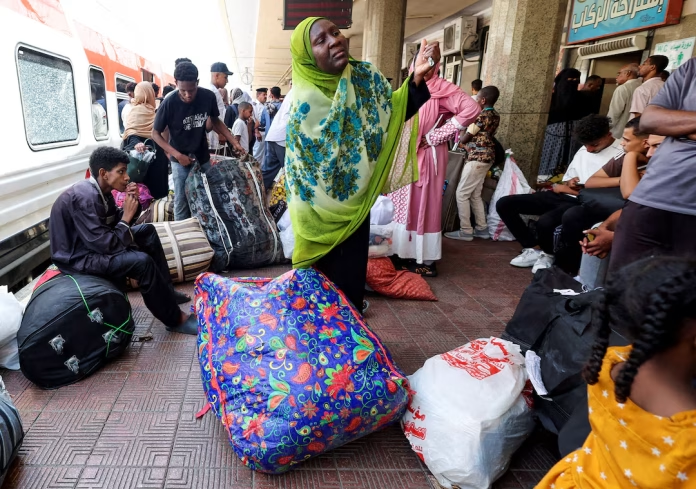
Thousands of Sudanese refugees who escaped their country’s civil war say they are facing a new ordeal in Egypt, where reports of mass detentions and deportations have increased sharply.
A Reuters investigation details accounts from refugees who describe overcrowded detention centres, poor living conditions and growing fears of being forcibly returned to Sudan despite the ongoing conflict. Human rights groups say more than 5,500 Sudanese have been deported since late 2025.
Some former detainees alleged they experienced abuse, inadequate food supplies and extortion while in custody. Others said they chose to return voluntarily to war-torn Sudan rather than risk arrest or separation from family members.
Egyptian authorities reject claims of systemic mistreatment, insisting that deportations are carried out according to legal procedures and highlighting the country’s long-standing role in hosting refugees. However, aid agencies and rights groups have expressed concern that recent policy changes could weaken protections for asylum seekers.
With Sudan’s conflict showing little sign of ending, humanitarian organisations are urging regional governments to provide greater support for those fleeing the violence.
Kenya has signed a major agreement worth $1.2 billion to expand Nairobi’s main international airport as the country seeks to strengthen its position as East Africa’s leading aviation hub.
The deal, signed with China Road and Bridge Corporation, will significantly increase the capacity of Jomo Kenyatta International Airport from 7.5 million passengers annually to approximately 22 million.
The project includes the construction of a new terminal, upgrades to existing facilities and improvements to airport operations. Kenyan officials say the expansion is essential to accommodate growing passenger numbers and maintain competitiveness against regional rivals.
The agreement revives plans that were previously shelved following the cancellation of an earlier airport deal in 2024. Financing for the project is expected to come from African development institutions.
Government officials believe the expansion will boost tourism, trade and investment while strengthening Kenya’s role as a regional transport gateway.
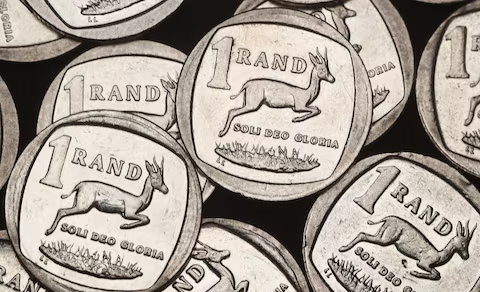
South Africa’s currency came under pressure on Wednesday as investors reacted to a stronger U.S. dollar and expectations that American interest rates could remain elevated for longer.
The rand weakened during early trading, reflecting broader concerns among investors about riskier emerging-market assets. Analysts say recent signals from the U.S. Federal Reserve have encouraged investors to move money toward safer dollar-based investments.
The stronger dollar has weighed on several developing-world currencies, with South Africa among the countries feeling the impact.
Financial markets are closely monitoring upcoming economic data and central bank decisions for clues about the future direction of global interest rates.
For South Africa, a weaker rand could increase import costs and place additional pressure on inflation, although it may provide some support for exporters.
French health authorities have confirmed the country’s first Ebola case connected to the ongoing outbreak in the Democratic Republic of Congo.
The patient, a doctor who recently returned from a humanitarian mission in Congo, was immediately placed in isolation and is receiving specialist care. Officials said the risk to the wider public remains low.
French authorities have launched contact-tracing efforts and are monitoring anyone who may have been exposed to the virus. Individuals identified as close contacts could face a 21-day observation period.
The case comes as Congo battles one of the fastest-growing Ebola outbreaks on record, with health officials warning that conflict, displacement and weak healthcare systems have complicated containment efforts.
Despite concerns, experts stress that Ebola is not airborne and spreads primarily through direct contact with infected bodily fluids.
At least 20 people have been killed in a fresh attack on a community in Nigeria’s Plateau State, highlighting the continuing insecurity in the country’s Middle Belt region.
According to police, armed attackers struck a village in Bokkos district during the weekend. Security forces later engaged the assailants in a gun battle, forcing them to retreat from the area.
Eighteen victims were reportedly killed at the scene, while two others later died from their injuries in hospital.
The attack is the latest in a series of violent incidents that have affected Plateau State in recent years. The region has experienced recurring clashes involving farming and herding communities, as well as attacks by armed groups.
Police have announced additional security deployments to the area as authorities attempt to prevent further violence and reassure local residents.
The latest killings are expected to renew calls for stronger security measures across Nigeria’s troubled Middle Belt.
To provide the best experiences, we use technologies like cookies to store and/or access device information. Consenting to these technologies will allow us to process data such as browsing behaviour or unique IDs on this site. Not consenting or withdrawing consent, may adversely affect certain features and functions.
Functional
Always active
The technical storage or access is strictly necessary for the legitimate purpose of enabling the use of a specific service explicitly requested by the subscriber or user, or for the sole purpose of carrying out the transmission of a communication over an electronic communications network.
Preferences
The technical storage or access is necessary for the legitimate purpose of storing preferences that are not requested by the subscriber or user.
Statistics
The technical storage or access that is used exclusively for statistical purposes.The technical storage or access that is used exclusively for anonymous statistical purposes. Without a subpoena, voluntary compliance on the part of your Internet Service Provider, or additional records from a third party, information stored or retrieved for this purpose alone cannot usually be used to identify you.
Marketing
The technical storage or access is required to create user profiles to send advertising, or to track the user on a website or across several websites for similar marketing purposes.