
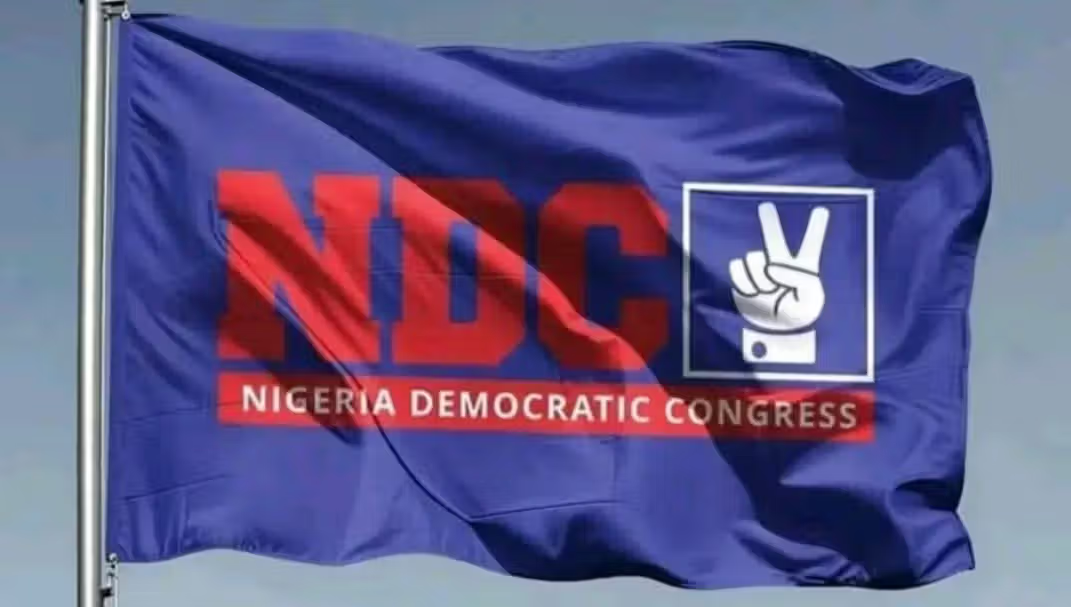
The Federal High Court in Abuja has dismissed a suit filed by the National Democratic Congress (NDC) challenging key provisions of the Electoral Act 2026, ruling that the disputed sections are constitutional and lawfully regulate disputes relating to the qualification of candidates seeking elective offices.
Delivering judgment on Tuesday, Justice Muhammed Umar held that the case, marked FHC/ABJ/CS/635/2025, lacked merit, stating that the provisions of the Electoral Act complement the 1999 Constitution rather than conflict with it.
The NDC had instituted the suit against the Attorney General of the Federation, the Clerk of the National Assembly, Senate President Godswill Akpabio and the Independent National Electoral Commission (INEC), asking the court to declare Sections 138 and 77(5) of the Electoral Act 2026 unconstitutional.
The party also sought a declaration that issues concerning the qualification of candidates could still be contested after elections had been concluded.
Court Upholds Preliminary Objections
Justice Umar upheld the preliminary objections raised against the suit, ruling that the plaintiff was essentially asking the court to interpret constitutional and statutory provisions.
“The plaintiff is invoking the interpretative jurisdiction of this honourable court in respect of the provisions of the Electoral Act 2026 on the one hand and the 1999 Constitution on the other hand,” the judge held.
The court also rejected the NDC’s claim that the matter qualified as a pre-election case merely because INEC’s election timetable was attached to the originating summons.
“The fact that the defendant’s timetable is attached cannot make the case within the contemplation of Section 285… there is no deposition… that raises questions as to the timetable,” Justice Umar said.
Suit Against National Assembly Clerk Struck Out
The judge struck out the case against the Clerk of the National Assembly after finding that the NDC failed to serve the mandatory pre-action notice before commencing legal proceedings.
According to the court, the failure to comply with this legal requirement rendered the suit incompetent against the second defendant.
Candidate Qualification Must Be Challenged Before Elections
On the substantive issues, Justice Umar held that while the Constitution outlines the qualifications and disqualifications for elective offices, the Electoral Act provides the procedure and timeline for resolving disputes arising from party primaries.
“Any aggrieved party who intends to challenge any candidate that emerged at the primary election of a political party on grounds of disqualification… must do so at the pre-election level,” he said.
The court ruled that Section 138 of the Electoral Act is consistent with the Constitution and strengthens its provisions by establishing a clear framework for resolving disputes before elections are conducted.
“The provision of Section 138 of the Electoral Act 2026 complements the provision of the Constitution, but is not in conflict with it. The contention of the plaintiff that Section 138 is inconsistent with the Constitution is of no merit,” Justice Umar ruled.
Court Declines to Nullify Section 77(5)
The court also dismissed the NDC’s request to invalidate Section 77(5) of the Electoral Act, noting that the issue had already been settled by the Court of Appeal.
Justice Umar stated that the appellate court’s decision remains binding on lower courts under the doctrine of judicial precedent.
The ruling is seen as a major judicial endorsement of the Electoral Act 2026, reaffirming that disputes over the qualification of candidates must be resolved before elections and not after results have been declared.
Discover more from LN247
Subscribe to get the latest posts sent to your email.

