
Student-led unrest in Paris and Tirana looks unrelated. It isn’t: education decay, youth exclusion and protest met with force first, answers second.
Two European capitals, one month, one script
In France, what began in late September as a high-school protest over teacher shortages and education funding at Créteil swelled into a national revolt. On 6 October, more than 250,000 people marched. On 17 October, roughly 550,000 did — the CGT union claimed 800,000 — and the day closed with 1,800 arrested, a record 855 in Paris, torched vehicles, looted shops and a historic town hall in flames. A resident told AFP it “was like we had a war.” More than 6,600 arrests have been made since late September.
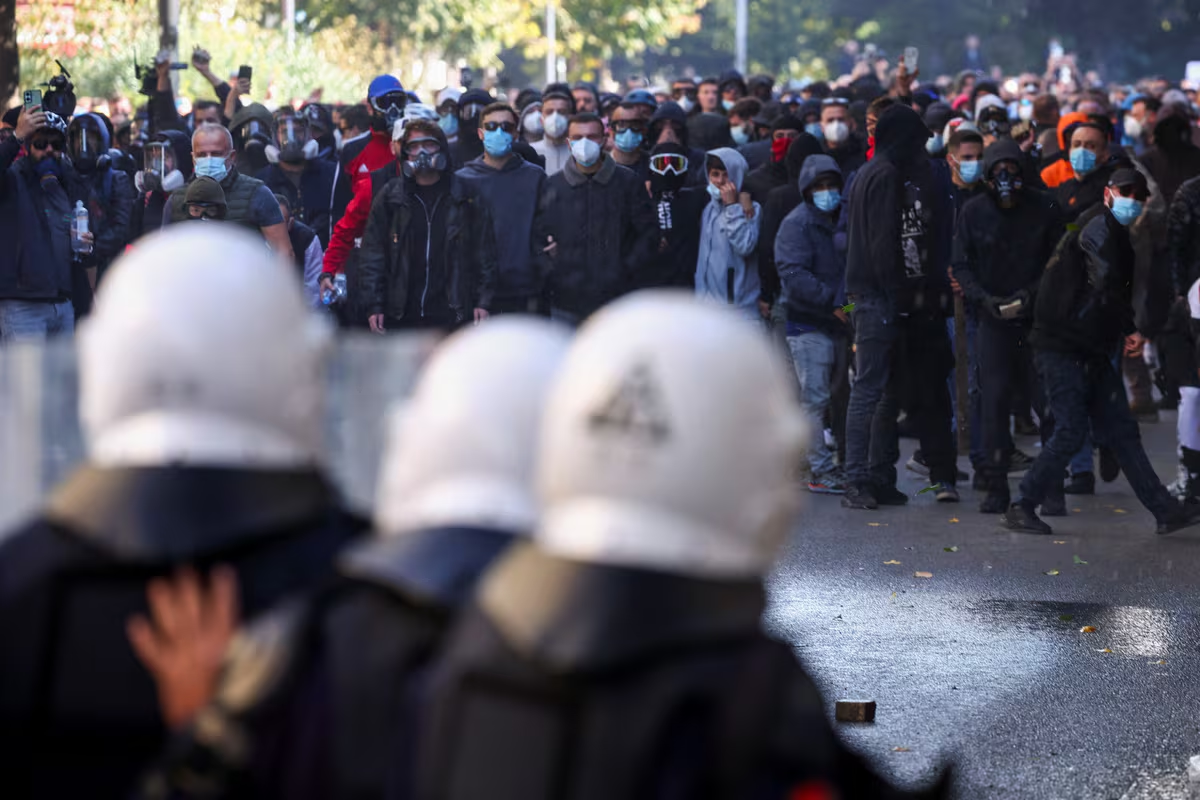
In Tirana, students took to the streets on 13 October over university conditions, tuition fees, jobs and corruption, and by 18 October the demonstrations had run six consecutive days. Rocks, molotov cocktails and pyrotechnics met rubber bullets, water cannon and tear gas; government buildings and banks were set alight. Police say 388 people have been charged.

The connection is structural, not coincidental
Both movements are youth-led, both were ignited by education disinvestment, and both mutated within days from a specific policy grievance into a broader verdict on the political class. France’s trigger — teachers leaving the profession for better opportunities, classrooms unmanned, funding flat — is the same teacher-exodus story playing out across the continent. Albania’s students named it directly: poor education standards, no jobs, and a corruption they see consolidated in a single man.
Both governments reached for the same two reflexes: securitise, then externalise
France’s Interior Minister Laurent Nuñez attributed the riots to “groups clearly instigated by the far left,” noting violence “started right from the beginning.” Albania’s Edi Rama blamed “a foreign hand,” citing an attempted drone attack on his office. In both capitals, the diagnosis of the protest is framed as infiltration rather than representation. That framing is politically efficient and analytically fatal: it converts negotiable grievances into a security operation with no negotiable terms.
Rama went further, performing a rhetorical inversion that deserves attention: “I am not being challenged… a path is being challenged, a mission is being challenged,” he said, asking Albanians whether they wanted the protests “or the EU.” Protest against the government was relabelled as protest against European accession. It is a highly effective device where EU membership is the national promise — and it is also why Tirana’s government sees little cost in waiting the movement out.
Why the violence escalates daily
Escalation is not a mood; it is a mechanism.
First, radicalisation of repertoires. When large, visible, disciplined marches produce no concession, the marginalised tactic — the masked front line, the burning barricade — becomes the only tactic observed to generate a response. Violence acquires a track record.
Second, tactic diffusion by video. Paving stones pulled up in Tirana, molotovs, first-aid stations in a lawyer’s office: these are now transferable techniques, not local improvisations. Excavators removing cobblestones outside Rama’s office before Sunday’s protest — dismissed by one resident as preparation for police protection, not prevention — proves the state reads the playbook too.

Third, composition drift. Students were the fuse. France’s Interior Ministry described organised far-left groups; Tirana’s ranks now include non-students, and the Mirror and Daily Mail reported hooded, non-student fronts in Italy. As the modal protester stops being a pupil with a school to return to, the risk ceiling rises.
Fourth, a record high of violence as context, not consequence. France’s Interior Ministry reported public-space violence at an unprecedented 20,000 incidents in September, roughly 700 a day, up 7 per cent on August. The student movement arrived after the powder was laid, not before.
Fifth, escalation symmetry. Rubber bullets appeared in Tirana for the first time on day five. Each new tool by police is read by protesters as proof of legitimacy, and by police as proof of necessity. The loop has no internal brake.
Why demands have not been met — because in each case, meeting them was structurally impossible
France’s demands are legible and mostly material: education funding, staffing, the reversal of budget pressure. They are unfunded against a tightening budget and an election in six months, and the outgoing Macron government’s negotiating authority is already spent. Worse, the movement’s demand stack has fused with a political one — the anti-establishment register makes any cash concession look like a surrender to a demand it cannot price. Prime Minister Sébastien Lecornu lamented the violence; Macron addressed the nation on Sunday. Both words, no cheque.
Albania’s central demand — Rama’s resignation — is by definition non-negotiable. A leader who has governed since 2013 and won a fourth term cannot concede it without validating the corruption charge at the root of the movement, and the movement cannot accept anything less without collapsing. Note also the sequencing: the unrest followed months of largely peaceful protest against a luxury coastal development tied to Jared Kushner. That is not a fringe grievance; it is a conflict of material interests. Rama’s answer — “we are tackling corruption as never before” — cannot be tested while he remains the arbiter of that test. Analysts note Albania’s recurring image problem as a hub for gangs laundering drug and weapons money.
Both governments are also facing a term-limit-of-trust problem: Macron is in his final months, and Rama’s fourth term has no institutional runway left to spend on concession.

Will this sweep Europe?
Careful here — the temptation is to declare a continental wave off two data points.
The evidence for convergence is real. Italy saw water cannon and hooded clashes in the same fortnight, and the cost-of-living unrest has been reported across Portugal, Belgium and Spain. The underlying drivers — underfunded education, teacher flight, youth unemployment, real-income erosion, corruption perception — are shared across the OECD, not nationally owned. So is the tactic: occupy the street, blockade the school, force the broadcast.
The evidence against domino contagion is also real
There is no coordinating structure, no shared leadership and no common demand list; French students want funding, Albanian students want a prime minister gone. Welfare buffers, union architectures and police doctrine differ sharply. Governments learn crowd-control faster than protesters learn solidarity — Tirana’s paving-stone removal is the proof. And in much of Western Europe, electoral channels still absorb pressure that the Western Balkans, where accession is the only political currency, cannot.
The realistic forecast
This becomes a Europe of repeating, unconnected explosions on a shared fault line — not one movement. The contagion is of framing and technique. Watch Italy, Spain, Belgium and Greece for the next flare, and the Western Balkans, where EU-promise politics gives every grievance an existential edge. What turns parallel unrest into one movement is a single unifying demand. No government has yet given them one.
Discover more from LN247
Subscribe to get the latest posts sent to your email.

