Home Blog Page 113

Former President Muhammadu Buhari’s Body Arrives Daura

The remains of former President Muhammadu Buhari have arrived in Daura, Katsina State, for final burial rites, following his death in London at the age of 82.

The presidential jet carrying Buhari’s body touched down at the Umaru Musa Yar’Adua International Airport in Katsina around 1:59 p.m. on Tuesday. The late president’s body, draped in the Nigerian national flag, was received by President Bola Tinubu on the tarmac, alongside Vice President Kashim Shettima and the Chief of Staff, Femi Gbajabiamila. Several members of Buhari’s family also accompanied the body on the journey from London.

The former president passed away on Sunday at approximately 4:30 p.m. at The London Clinic after battling an undisclosed illness. In response to the news of his death, President Tinubu dispatched Shettima and other top officials to London to escort the late leader’s remains back home.

At the airport, a solemn military farewell was conducted by Nigerian Armed Forces personnel before the body was transported to Daura for interment in accordance with Islamic rites.

Among the dignitaries who gathered at the airport to pay their final respects were First Lady Remi Tinubu—who was seen comforting former First Lady Aisha Buhari—as well as Katsina State Governor Dikko Radda, members of the Katsina State Executive Council, and Deputy Senate President Barau Jibrin.

Muhammadu Buhari holds a significant place in Nigeria’s history, having first ruled as a military head of state from January 1984 to August 1985, and later serving as the country’s democratically elected president from 2015 to 2023, making him Nigeria’s second-longest-serving leader.

His burial in his hometown of Daura marks the end of an era in Nigerian politics and governance.

Iran Set To Engage Chinese And Russian Officials

Iran has announced plans to meet separately with China and Russia on the sidelines of an upcoming summit hosted by the Shanghai Cooperation Organization (SCO), as it seeks regional backing in the aftermath of last month’s 12-day military confrontation with Israel.

“We will have bilateral meetings with the Chinese foreign minister, which naturally has its own importance in the current situation, as well as with the Russian foreign minister,” Iranian Foreign Minister Abbas Araqchi said on Telegram.

The diplomatic gathering, hosted in Tianjin in northern China, marks the 25th meeting of SCO foreign ministers. The SCO is a regional alliance composed of 10 member states, including China, Russia, India, Pakistan, and Iran, with a focus on political, economic, and security cooperation.

Back in June, Israeli and U.S. forces conducted strikes on Iranian nuclear-related targets, alleging the facilities were part of a weapons development programme. Iran has consistently rejected these claims, maintaining that its nuclear activities are for peaceful purposes.

Iran’s foreign partnerships with China and Russia have grown significantly, especially following renewed sanctions imposed by the United States during Donald Trump’s administration. These alliances have been cemented through long-term strategic agreements: a 20-year deal with Moscow, and strong trade ties with Beijing, which currently purchases the vast majority of Iran’s oil exports.

“The SCO is gradually opening up its place in the global arena, meaning it is gradually going beyond the regional arena, and it has many different issues on its agenda, including in the economic, political and security fields,” Araqchi wrote.

UK Overhauls Trade Rules To Boost African Exports And Consumer Access

Entrepreneurs and exporters across Africa are poised to gain from a newly announced UK trade initiative aimed at deepening commercial relationships with developing nations. This initiative, titled Trade for Development, seeks to streamline trade processes and ease entry into the UK market.

One of the most significant changes involves simplified rules of origin, which will allow countries under the Developing Countries Trade Scheme (DCTS) including those with more advanced manufacturing sectors like Nigeria to source raw materials and components from across the continent without losing their tariff-free status when exporting to the UK.

This reform is also expected to enhance intra-African commerce by supporting broader integration with the African Continental Free Trade Area, potentially tapping into its estimated $3.4 trillion market.

In 2023 alone, goods worth over £3.2 billion entered the UK from African nations under preferential access agreements offered through UK development-focused trade frameworks.

UK Minister for Development, Jenny Chapman said, “The world is changing. Countries in the Global South want a different relationship with the UK as a trading partner and investor, not as a donor. These new rules will make it easier for developing countries to trade more closely with the UK. This is good for their economies and for UK consumers and businesses.”

UK Minister for Trade Policy, Douglas Alexander added that, “no country has ever lifted itself out of poverty without trading with its neighbours. Over recent decades trade has been an essential ingredient in lifting hundreds of millions of people out of poverty around the globe.”

Alongside changes to DCTS, the UK government plans to deliver targeted assistance that will help African suppliers comply with UK import standards and smoothly navigate customs clearance processes.

The reforms will also open the door for easier trade in services—including digital, legal, and financial sectors by reinforcing upcoming trade agreements and building long-term market connections.

These developments fall under the broader Trade for Development framework, aimed at supporting economic expansion in partner countries while ensuring UK households and companies benefit from greater access to competitively priced, high-quality imports.

The changes also complement the UK’s modernised Trade Strategy, which focuses on fostering international growth through sustainable, forward-looking partnerships.

K-Drama Star Kang Seo-ha’s Dies At 31: What You Should Know About Stomach Cancer

6

South Korean actress Kang Seo-ha, known for her roles in the K-dramas “Heart Surgeons” and “First Love Again,”has passed away at 31 years old after battling stage four stomach cancer. She died at approximately 1:30 p.m. on Sunday, July 13, according to a report by Korean media outlet Sports Kyunghang.

A close acquaintance announced the sad news on social media, sharing a heartfelt tribute: “Eonni (older close friend), I hope you’re happy and pain-free up there. I miss you so much.”
The acquaintance also recalled how Kang remained gracious and kind despite her suffering.
“Even while relying on painkillers, she kept saying she was grateful things weren’t worse. I felt ashamed hearing that,” the post read. “She suffered so much. I hope she finds only happiness now.”

What Is Stomach Cancer?

Stomach cancer, also known as gastric cancer, occurs when there is an abnormal growth of cells that begins in the stomach. The stomach is located in the upper middle part of the abdomen, just below the ribs, and plays a vital role in breaking down and digesting food.
Stomach cancer can develop in any part of the stomach, but in most parts of the world, it usually occurs in the main body of the stomach, known as the stomach body.
When stomach cancer spreads to other areas of the body, it is referred to as metastatic stomach cancer.

This can lead to various symptoms depending on where it spreads. For instance, if it spreads to the lymph nodes, it may cause lumps noticeable under the skin. If it reaches the liver, it can result in yellowing of the skin and the whites of the eyes. When it spreads within the abdomen, it might lead to a build-up of fluid in the belly, causing it to appear swollen.

Causes Of Stomach Cancer

The exact cause of stomach cancer remains unclear. However, medical experts believe that most stomach cancers begin when something damages the inner lining of the stomach. Common examples include stomach infections, chronic acid reflux, and a diet high in salty foods. It’s important to note that not everyone with these risk factors develops stomach cancer.
Other contributing factors include a diet low in fresh fruits and vegetables, alcohol consumption, obesity or being overweight, pernicious anaemia (a condition characterized by low red blood cells), and a family history of stomach cancer.

Symptoms Of Stomach Cancer

In its early stages, stomach cancer often shows no symptoms. When symptoms do appear, they may include indigestion and pain in the upper abdomen. In many cases, symptoms only become noticeable when the cancer has advanced. Advanced stomach cancer may present with symptoms such as extreme fatigue, unintentional weight loss, vomiting blood, and black stools.
Other signs and symptoms may include:

  • Trouble swallowing
  • Belly pain
  • Feeling bloated after eating
  • Feeling full after eating small amounts
  • Lack of appetite even when you expect to feel hungry
  • Heartburn
  • Indigestion
  • Nausea
  • Vomiting
  • Unintentional weight loss
  • Feeling extremely tired
  • Black stools

Types Of Stomach Cancer

The type of stomach cancer is determined by the kind of cell where the cancer originated. Common types include:

  • Adenocarcinoma: This type begins in the cells that produce mucus and is the most common form of stomach cancer. Nearly all stomach cancers are adenocarcinomas.
  • Gastrointestinal Stromal Tumors (GIST): GIST starts in special nerve cells found in the walls of the stomach and other digestive organs. It is classified as a soft tissue sarcoma.
  • Carcinoid Tumors: These cancers begin in neuroendocrine cells, which have characteristics of both nerve cells and hormone-producing cells. Carcinoid tumors are a type of neuroendocrine tumor.
  • Lymphoma: This cancer originates in the immune system’s cells. Although the immune system primarily fights infections, lymphoma can develop in the stomach when immune cells are sent there to combat infection. Most stomach lymphomas are types of non-Hodgkin’s lymphoma.

Treatments

Treatment for stomach cancer depends on factors such as the type, size, location, whether it has spread, and the patient’s overall health. Standard treatments typically include surgery and chemotherapy. Additional treatments may involve radiotherapy and targeted therapy with specific medicines.

Prevention

To help reduce the risk of stomach cancer, you can:

  • Eat plenty of fruits and vegetables: Incorporate a wide variety of colorful fruits and vegetables into your daily diet.
  • Limit salty and smoked foods: Reducing these in your diet helps protect your stomach lining.
  • Quit smoking: If you smoke, take steps to quit. If you don’t smoke, don’t start. Smoking significantly raises the risk of stomach and other cancers. Consult your healthcare provider for assistance if needed.
  • Inform your healthcare provider about your family history: If stomach cancer runs in your family, discuss screening options. Screening tests can detect stomach cancer before symptoms arise.

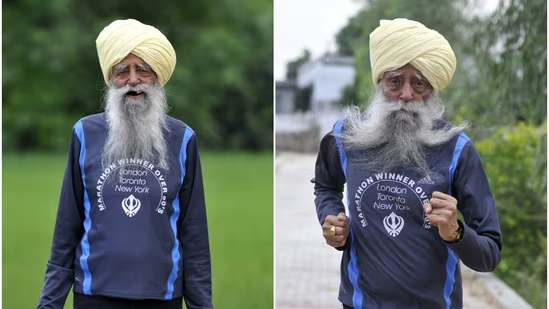
Legendary Marathon Runner Fauja Singh Dies At 114 After Road Tragedy In India

Fauja Singh, the celebrated British-Indian athlete widely regarded as the oldest person to complete a marathon, has died at the age of 114 after a tragic hit-and-run accident in his native Punjab.

Authorities reported that Singh was attempting to cross a street in the village of his birth when he was struck by an unknown vehicle. He was rushed to a nearby hospital by bystanders but unfortunately did not survive.

Known around the world for his remarkable endurance, Singh earned admiration for running marathons well into his centenarian years. He began his athletic journey at 89 and participated in nine full marathons from 2000 until his retirement in 2013.

His running group, Sikhs In The City, announced plans to dedicate their upcoming events in Ilford—where Singh had lived since 1992—to commemorate his legacy.

The fatal accident occurred on Monday while Singh was walking through Beas Pind, the village near Jalandhar where he was born.

“A search is under way, and the accused will be caught soon,” said Harvinder Singh, a top district police officer.

News of his passing sparked a wave of emotional responses from around the globe.

Indian Prime Minister Narendra Modi called him an “exceptional athlete with incredible determination”.

Harmander Singh, who coached Singh through much of his late-life running career, confirmed his death in a public statement from the running group.

The statement said: “It is with great sadness that we can confirm our icon of humanity and powerhouse of positivity Fauja Singh has passed away in India.

“His running club and charity Sikhs In The City will be devoting all of its events until the Fauja Singh Birthday Challenge on Sunday 29 March 2026 to celebrate his life of success and achievements.

“We will be doubling the efforts to raise funds to building the Fauja Singh Clubhouse on the route in Ilford where he used to train.”

When he was visited in June, Singh remained lively and mobile, maintaining a daily walking routine.

“I still go for walks around the village to keep my legs strong. A person has to take care of his own body,” he said.

A symbol of resilience, Singh was selected as a torchbearer for the London 2012 Olympics. One of his most extraordinary feats was completing a full marathon at age 100 in Toronto in 2011—an achievement that drew international attention.

Although Guinness World Records declined to certify his title due to lack of a 1911 birth certificate, Singh’s British passport listed his birthdate as 1 April 1911, and he had even received a letter from the Queen marking his 100th birthday.

His coach, Harmander Singh, explained that official birth documents weren’t issued in India at the time of Singh’s birth.

Guinness World Records officials said they would have loved “to give him the record”, but that they could only “accept official birth documents created in the year of the birth”.

As a child in Punjab, Singh struggled with mobility, often teased for his frail legs and only learning to walk properly at the age of five.

“But the same boy, once mocked for his weakness, went on to make history,” he told BBC Punjabi in June.

Before turning 40, Singh had already witnessed both World Wars and the partition of India.

“In my youth, I didn’t even know the word ‘marathon’ existed,” Singh told BBC Punjabi. “I never went to school, nor was I involved in any kind of sports. I was a farmer and spent most of my life in the fields.”

His introduction to running came through personal tragedy.

After losing his wife Gian Kaur in the early 1990s, he relocated to London to live with his oldest son. However, during a later visit to India, he witnessed his younger son Kuldeep’s fatal accident, which left him emotionally shattered.

He began isolating himself near the site of his son’s cremation, prompting concerned villagers to advise his family to return him to the UK.

Back in London, a visit to the gurdwara led him to discover a group of elderly runners, one of whom introduced him to his future coach, Harmander Singh.

“Had I not met Harmander Singh, I wouldn’t have got into marathon running,” he said in June.

He ran his first London Marathon just weeks before his 89th birthday, participating on behalf of a charity supporting premature babies. His slogan read: “Oldest running for the youngest! May they live as long as him.”

Singh insisted on wearing his turban during the race despite pushback.

“I refused to run without my turban. Eventually, the organisers allowed me to run with it, and for me, that’s my biggest achievement,” he said.

His debut marathon took him nearly seven hours, but with each race, he improved. By his third appearance in London, he had trimmed almost 10 minutes from his time.

In 2003, he achieved his personal best in Toronto, completing the race in 5 hours and 40 minutes—more than an hour faster than his previous time.

“I don’t remember my timings; it is my coach, Harmander Singh, who keeps the record of all my timings. But whatever I have achieved is all because of his training, and I sincerely followed his schedule,” Singh said in June.

“In London, he used to make me run uphill, and because of that, I kept on improving,” he added. “Almost after every training session in London, I used to go to the gurdwara, where my diet was taken care of. Everyone there motivated me to run long distances.”

He rose to international fame in 2003 when he was featured in Adidas’s Impossible is Nothing campaign alongside global icons like Muhammad Ali.

He was later invited to run the first Lahore Marathon by Pakistan’s Prime Minister in 2005, and the following year, he received a special visit to Buckingham Palace at Queen Elizabeth II’s request.

Among his treasured possessions back in Punjab was a framed photograph of that royal encounter.

Nicknamed the “Turbaned Tornado,” Singh competed into his 100s, donating most of his sponsorship earnings to charity.

“I was the same Fauja Singh before I entered the world of running – but running gave my life a mission and brought me global recognition,” he recalled.

He ran his final long-distance race in 2013, completing a 10km event in Hong Kong in just over 90 minutes.

He attributed his remarkable longevity to simplicity and discipline.

“Eating less, running more, and staying happy – that is the secret behind my longevity. This is my message to everyone,” he said in June.

In his later years, he spent time between the UK and India, maintaining close ties with his children and his longtime coach.

When last interviewed, Singh said he hoped to visit London again soon to reconnect with loved ones.

British MP Preet Kaur Gill shared a photo with him, writing: “A truly inspiring man. His discipline, simple living, and deep humility left a lasting mark on me.”

Jas Athwal MP said Singh “inspired millions across the world”. He wrote on X: “His spirit and legacy of resilience will run on forever.”

Enugu Implements New Approach To Optimize Health Sector Budget Planning

0

‎The Enugu State Government has initiated the development of Annual Operational Plans to be incorporated into the 2026 health sector budget.

‎This effort aligns with the Nigeria Health Sector Renewal Investment Initiative (NHSRII), a nationwide programme focused on overhauling the health system through enhanced infrastructure and broader health insurance coverage.

‎During a four-day training workshop on NHSRII Leadership and Health Systems Strengthening for Managers, which commenced on Monday in Enugu, the State Commissioner for Health, Emmanuel Obi, explained that the NHSRII is a comprehensive, sector-wide initiative designed to unify all stakeholders in the health sector under a single coordination framework to track and improve sector-wide performance indicators.

‎The training is themed, “Towards Rational, Realistic, Pragmatic and Comprehensive Plan that informs Health Budget for the People of Enugu State”.

‎According to Obi, “Through the State-Wide Approach (SWAp) reform, the Federal Ministry of Health is trying to bring together every single player in the health sector under one coordinating umbrella to monitor the sector indices across board.”

‎He stated that the SWAp approach will provide the country’s health sector with a unified plan, a centralized monitoring and evaluation system, and a well-coordinated framework.

‎“This workshop is the beginning of the step down of a capacity building for master trainers who are involved in the entire health sector of Enugu State towards producing a one-sector annual operational plan that will be integrated into the 2026 health sector budget for Enugu State,” Obi added.

‎The training participants include senior and programme managers, officials from various agencies, and key stakeholders in Enugu State’s health sector.

‎Commissioner Obi urged the participants to approach the exercise with utmost commitment, emphasizing the importance of developing a detailed plan that will guide the state’s health budget.

‎Francisca Ewoh, the SWAp Desk Officer for Enugu State, highlighted that the core objective of the SWAp programme is to promote coordination and consistency within Nigeria’s health system.

‎“What is happening in the health sector, unlike before, is no longer business as usual, whereby the partners come in with their own activities. SWAp wants to ensure that states prioritise activities based on evidence-based,” she said.

‎Mrs. Ann Oguejioffor, Head of Health Planning, Research, and Statistics at the Enugu State Ministry of Health, stated that the training is aimed at aligning and streamlining the state’s planning process in preparation for the 2026 health sector budget.

‎“With the SWAp programme, the state is going to have one plan in the sense that what the partners are offering should not duplicate with what the state government is doing,” she added.

‎The creation of Annual Operational Plans is anticipated to enhance the state’s health sector by fostering collaboration among all stakeholders toward a unified objective.

‎The plan is also expected to prevent fragmentation and overlap within the health system, while promoting the efficient allocation of resources.

FG Opens Recruitment Portal For Paramilitary Agencies: How To Apply, All You Need To Know

0

The Federal Ministry of Interior has launched a nationwide recruitment drive for four major paramilitary agencies: the Nigeria Immigration Service (NIS), Nigerian Security and Civil Defence Corps (NSCDC), Federal Fire Service (NFS), and Nigerian Correctional Service (NCS).

‎The recruitment portal, officially opened on Monday, July 14, 2025, offers Nigerians aged 18 to 35 an opportunity to serve in these critical agencies.

‎The recruitment exercise aims to fill 30,000 vacancies across the four paramilitary agencies, as announced by the federal government in June 2025.

‎The Civil Defence, Correctional, Fire and Immigration Services Board (CDCFIB) oversees the process, ensuring transparency and fairness.

‎Initially scheduled to begin on June 26, 2025, the recruitment was postponed to July 14, 2025, to allow for better preparation and public awareness.

‎The initiative is part of the government’s efforts to strengthen national security and public safety by bolstering the workforce of these agencies.

‎Interested applicants are encouraged to apply promptly through the official portal to secure a chance to contribute to Nigeria’s safety and security framework.

‎Here’s a comprehensive guide to the recruitment

The Application Process

To apply for positions in the NIS, NSCDC, NFS, or NCS, candidates must follow these steps:

Visit the Official Portal: Applications are exclusively accepted through the CDCFIB’s official recruitment website, recruitment.cdcfib.gov.ng. No other platforms or third-party websites are authorized for this process.

Create an Account: Applicants need to register on the portal with a valid email address and phone number. Ensure all personal details provided are accurate, as they will be verified during the recruitment process.

Complete the Application Form: Fill out the online application form with your personal information, educational qualifications, and preferred agency. Ensure you select the correct agency (NIS, NSCDC, NFS, or NCS) based on your qualifications and interests.

Upload Required Documents: Candidates must upload scanned copies of relevant documents, such as educational certificates, birth certificates, and a valid means of identification (e.g., National ID, voter’s card, or international passport).

Submit And Print Confirmation: After submitting the application, print the confirmation slip, which will include your application reference number. This number is crucial for tracking your application status and may be required during subsequent stages, such as physical screening.

Monitor Updates: Regularly check the portal and the Federal Ministry of Interior’s official website (www.interior.gov.ng) for updates on shortlisted candidates, screening dates, and other recruitment stages.

‎The ministry has emphasized that the application process is free of charge, and no payments should be made to any individual or organization for recruitment purposes.

Eligibility Requirements

To qualify for the recruitment, candidates must meet the following criteria:

Citizenship: Applicants must be Nigerian citizens by birth.

Age: Candidates must be between 18 and 35 years old at the time of application.

Educational Qualifications: Depending on the position applied for, candidates must possess a minimum of a Senior Secondary School Certificate (SSCE) or higher qualifications, such as a National Diploma (ND), Higher National Diploma (HND), or Bachelor’s degree from a recognized institution.

‎Specific educational requirements vary by agency and position, so applicants should consult the portal for details.

Physical and Medical Standards: Candidates must meet minimum physical and medical requirements, including height (minimum of 1.65m for males and 1.60m for females), good eyesight, and overall fitness.

‎A medical certificate of fitness may be required during the screening process.

Character: Applicants must have no criminal record and must provide a certificate of good conduct from their local government or a recognized authority.

Gender: The recruitment is open to both male and female candidates.

‎Additional requirements, such as specific professional certifications or skills, may apply to certain roles within the agencies. Detailed guidelines are available on the CDCFIB portal and the Ministry of Interior’s website.

‎Recruitment Stages

The recruitment process will consist of several stages, including:

Online Application: Submission of applications via the official portal.

Shortlisting: The CDCFIB will review applications and shortlist candidates based on eligibility and qualifications.

Screening: Shortlisted candidates will undergo physical and document verification to confirm their eligibility.

Aptitude Test: Depending on the agency, candidates may be required to take a computer-based test to assess their knowledge and skills.

Physical and Medical Examinations: Candidates will undergo fitness tests and medical evaluations to ensure they meet the physical and health standards.

Interview: A final interview may be conducted to assess candidates’ suitability for specific roles.

Training: Successful candidates will undergo mandatory training at designated paramilitary training schools.

‎Applicants are advised to prepare adequately for each stage and adhere to all instructions provided by the CDCFIB.

How To Avoid Recruitment Scams

The Federal Ministry of Interior has warned applicants to be vigilant against fraudsters who may exploit the recruitment exercise. Here are key tips to avoid falling victim to scams:

Use Only The Official Portal: Submit applications only through recruitment.cdcfib.gov.ng. Avoid third-party websites or individuals claiming to facilitate the process.

No Payment Required: The recruitment process is entirely free. Do not pay anyone for application forms, processing fees, or promises of guaranteed placement.

Verify Information: Rely only on information from the Federal Ministry of Interior’s website (www.interior.gov.ng) or the CDCFIB portal. Beware of unsolicited emails, text messages, or social media posts claiming to offer recruitment assistance.

Protect Personal Information: Do not share sensitive details, such as bank account numbers or passwords, with anyone claiming to represent the recruitment board.

Report Suspicious Activity: If you encounter suspicious individuals or websites, report them to the authorities or contact the CDCFIB through official channels.

‎The ministry has assured applicants that the recruitment process is designed to be transparent and merit-based, with no shortcuts or favoritism.

Dates And Contact Information

-Portal Opening: Monday, July 14, 2025
‎- Application Portal:
recruitment.cdcfib.gov.ng
‎- Official Website: www.interior.gov.ng
‎- Contact: For inquiries, candidates can reach out to the CDCFIB through the contact details provided on the official portal or the Ministry of Interior’s website.

‎Applicants are urged to act promptly, as the application window may close once the required number of applications is received. Ensure all documents are prepared, and follow the guidelines meticulously to increase your chances of success.

‎This recruitment exercise is a call to service for Nigeria’s youth. By joining the NIS, NSCDC, NFS, or NCS, successful candidates will play a pivotal role in shaping a more secure and prosperous Nigeria.

Former President Buhari’s Body Arrives Katsina Airport

The plane carrying the remains of the former President Buhari arrives at the Katsina airport.

Vice President Kashim Shettima on Monday paid a condolence visit to Aisha Buhari, widow of late Buhari and his visit was in line with President Bola Tinubu’s directive following the announcement of Buhari’s death on Sunday at about 4:30 p.m. in a London hospital.

Details Unfolding…

First Lady, Remi Tinubu, Amaechi Arrive Daura

Nigeria’s First Lady, Remi Tinubu, has arrived in Daura, Katsina State, for the funeral of former President Muhammadu Buhari.

Mrs. Tinubu was accompanied by the wives of some top politicians, including the wife of the Speaker of the House of Representatives, Fatimah Abbas; the wife of the Deputy Senate President, Laila Barau; and the wife of the National Security Adviser, Zarah Ribadu.

Former Transport Minister Rotimi Amaechi also arrived early for the burial of his former “boss”.

Amaechi, who was turbaned as Dan Amanar Daura in 2022, still holds this title, which is a significant honor in the former president’s hometown.

Dignitaries, former government officials, and political heavyweights began arriving in Katsina State for the final burial rites.

‎Among the early arrivals were former Vice Presidents Yemi Osinbajo and Atiku Abubakar; former Senate President Ahmad Lawan; and former Governors Aminu Bello Masari (Katsina), Aminu Tambuwal (Sokoto), Yahaya Bello (Kogi), Kayode Fayemi (Ekiti), Ibikunle Amosun (Ogun), Aliyu Wamakko (Sokoto), and Ali Modu Sheriff (Borno), who also served as a one-time National Chairman of the Peoples Democratic Party.

‎Others in attendance include billionaire businessman Aliko Dangote; former Minister of Communications and Digital Economy, Isa Pantami; and former Minister of Women Affairs, Pauline Tallen.

‎A heavy security presence was observed in and around Daura, with personnel from the Department of State Services, Nigeria Police Force, and Nigerian Army stationed at strategic locations.

‎Traffic diversions and crowd control measures were also in place to ensure smooth movement as thousands of mourners thronged Daura to pay their last respects.

‎The funeral, led by Katsina State Governor Dikko Radda, follows Islamic rites, with Buhari’s body, accompanied by Vice President Kashim Shettima, arriving from London around midday.

‎President Bola Tinubu, Senate President Godswill Akpabio, religious leaders, and traditional rulers are also expected to attend in the coming hours as the funeral proceedings continue.

‎A public holiday was declared on July 15, 2025, as part of a seven-day national mourning period to honor Buhari’s legacy.

Heightened Security In Daura As Citizens Await Buhari’s Body

‎On Tuesday, security personnel were deployed around the Daura residence of the late former President Muhammadu Buhari, as burial preparations entered an advanced stage.

‎Operatives from the Department of State Services and the Nigerian Army were positioned at the main entrance, while officers from the Nigeria Police and the Nigeria Security and Civil Defence Corps maintained surveillance at key locations around the area.

‎A section of the compound specifically a garden next to the main building has been designated as Buhari’s burial site.

‎Several men, believed to be family members, were seen digging the grave.

‎Journalists and members of the public were barred from entering the area where the grave was being prepared, as security agents enforced tight access control.

‎President Bola Tinubu is expected to personally receive Buhari’s remains at the Umaru Musa Yar’Adua Airport in Katsina.

‎Previously, Tinubu had instructed Vice President Kashim Shettima and Chief of Staff Femi Gbajabiamila to travel to the United Kingdom to accompany the body back to Nigeria.