Home Blog Page 128

Jamb Releases More Results, Calls For Full Compliance With Process And Procedure

JAMB Releases Results of MOP-UP Examination

The Joint Admissions and Matriculation Board (JAMB) has released the results of the mop-up examination held on Saturday, June 28, 2025.

Out of the 96,838 candidates scheduled for the mop-up exercise, the results of 11,161 who were present have been released.
Candidates who are not able to access their results have been found not to have fully complied with the instruction to send “UTMERESULT” (as one-word text) to 55019/66019 from the same phone number (SIM) with which they registered for the UTME.

Update on Fake Admission Letter Syndicate

You will recall that a joint press conference between the PPRO of the Nigeria Police Force and the Joint Admissions and Matriculation Board was convened on 13th April 2024. It was the outcome of the complaint by JAMB that a syndicate had engaged in the fabrication of JAMB Admission Letters for interested candidates in exchange for a fee, following which a comprehensive investigation was launched.

With the assistance of the Nigeria Police Force National Cybercrime Centre (NPF-NCCC), the police successfully apprehended the five ring-leaders behind the scam.
The five arrested ring-leaders confessed to producing the fake admission letters and are currently being prosecuted at the FHC, Abuja in the case between:

Inspector General of Police Vs Effa Leonard and four (4) others

Following the confession from the syndicate, a total of 17,417 candidates were flagged as beneficiaries.
Between 2024 and May 2025, when the Board submitted an update to the Federal Ministry of Education, a total of 6,903 candidates who were asked to rectify their minor discrepancies were cleared, leaving behind 10,514 who had been referred to their nearest designated police investigation offices. Among the 10,514 candidates, 5,669 were confirmed to have outrightly procured forged letters, while 4,832 candidates whose admissions were then undisclosed to JAMB and who were being processed for condonement by their confessing institutions under a (2017–2020) ministerial waiver, impatiently engaged the syndicate to side-step the process.

Thirteen others were found to have been flagged due to one act of omission/commission or the other on the part of the candidates. Twelve of the thirteen candidates registered in 2017 when CAPS was established.

Of the thirteen candidates, two each are from both Bayero University Kano (BUK) and Enugu State University of Science and Technology (ESUT), while one each is from:
• Ramat Polytechnic, Maiduguri
• Federal University of Technology, Akure (FUTA)
• Ekiti State University, Ado-Ekiti (EKSU)
• Yaba College of Technology (YABATECH)
• Olabisi Onabanjo University, Ago Iwoye
• Osun State Polytechnic, Ire
• Benson Idahosa University, Benin City
• Obong University, Obong Ntak
• University of Ilorin

In continuation of the screening process, the management of the Board, at its meeting on 5th July 2025, decided that the 13 candidates flagged through one act of commission/omission or the other on the candidates’ part should be requested to rectify their specific anomalies and proceed to print their new letters of admission, as they belong to the batch of 6,903 earlier condoned.
In addition, a total of 1,532 candidates, whose essential defence (though difficult to believe) was that they were not party to the commissioning of the syndicate which helped facilitate their admission letters, are hereby warned and condoned because their institutions had eventually processed their condonement of initially undisclosed admission—a procedure the candidates initially attempted to side-step.

Thus, 3,300 candidates who were not processed for illegitimate or undisclosed admission by their claimed institutions remain under investigation.

The Board’s screening processes continue, and any candidate found to have employed or solicited assistance from examination and certificate fraudsters or deviated from laid-down procedures for registration, examination or admission would continue to face the consequences, which include prosecution under the Examination Malpractices Act, which prescribes appropriate punishment even for the under-aged and their culpable mentors, guardians or parents.

Fabian Benjamin, Ph.D.
PCA, JAMB

Peter Rufai: Football Stars, Nigerian Leaders, Others Mourn Goalkeeper

2

Nigeria’s football community was thrown into grief on Thursday following the death of former Super Eagles goalkeeper Peter Rufai, fondly known as “Dodo Mayana.” 

Rufai, who was Nigeria’s first-choice goalkeeper during the 1994 and 1998 FIFA World Cups, both of which saw the Super Eagles reach the Round of 16 passed away in Lagos at the age of 61 after a prolonged illness.

After retirement, Rufai remained close to the game, mentoring young talents and serving as a coordinator for Nigeria’s U23 national team. His influence, both on and off the pitch, left a lasting legacy.

Nigerian Football Community Reactions

the Nigeria Football Federation (NFF) wrote on X.

“This is really, really shocking. Peter Rufai dead? What happened? I am perplexed. We did not even know that he had been ill. We earnestly pray to the Almighty God to grant him eternal rest and to comfort all his loved ones as well as the entire Nigeria football family,” said Dr. Mohammed Sanusi, NFF General Secretary.

Former NFA Secretary General, Hon. Sani Ahmed Toro, added:

“What a great loss. Peter Rufai was a reliable and committed player for the Super Eagles from 1990 to 1998… A complete gentleman. My condolences to his family and the entire football family.”

Super Eagles captain Ahmed Musa paid tribute on X:

“Can’t believe I’m typing this, a post to bid farewell to a true giant of Nigerian football, Peter Rufai. Your heroic reflexes and unwavering presence between the posts brought us moments of pride on the world stage.”
“Though you’ve left us, your legacy soars higher than any trophy. Fly high, Dodo Mayana.”

Nigerian Leaders React To Peter Rufai’s Passing

President Bola Tinubu mourned the death of Peter Rufai in a statement released by his Adviser on Information and Strategy, Bayo Onanuga. 

He described Rufai as one of the patriotic sportsmen who “wrote their names in gold” in the history of Nigerian and African football.

“I recall with fond memories the heroic contributions of Peter Rufai in the historic victory of the Super Eagles at the 1994 edition of the Africa Cup of Nations in Tunisia as the first-choice goalkeeper, followed up with Nigeria’s equally epoch-making, first appearance at the FIFA World Cup competition, dubbed USA ’94.

Rufai was also a strong member of the team at the subsequent edition of the competition in France in 1998.

Having started his career with Stationery Stores of Lagos in 1980, Rufai was one of the earliest footballers in Nigeria to go professional, playing in many European countries including Belgium, Spain, Portugal and the Netherlands, bringing honour to the nation and opening a new window of opportunities for young footballers in Nigeria.

After he retired from active football, Peter, a Prince of the Royal House in Idimu, Lagos, set up the Staruf Football Academy, where he continued to inspire, mentor and nurture young footballers.”

President Tinubu offered prayers for comfort to the bereaved and for the peaceful repose of Rufai’s soul.

Lagos State Governor Babajide Sanwo-Olu also paid tribute, describing Rufai’s passing as a significant loss for Nigeria, particularly its football community.

Former Vice President Atiku Abubakar expressed deep sorrow, calling the news a “profound loss to the global football community.”

Fan’s Reactions 

@SundayOOliseh took to his X page to express his sadness calling Peter a roomate,team mate and a friend.

@dosu_john paid his tribute on X and thanked Peter Rufai for giving him his first coaching job. 

Key Features Of Trump’s “Big Beautiful Bill”, How It Got Passed

President Donald Trump has officially signed into law a sweeping budget and tax reform legislation popularly dubbed the “Big Beautiful Bill”—a cornerstone of his second-term agenda and the largest Republican-led economic overhaul since the 2017 Tax Cuts and Jobs Act.

The bill, passed narrowly by both chambers of Congress, promises widespread tax relief while tightening access to federal assistance programs.

Signed on Independence Day, the nearly $4.5 trillion legislative package touches nearly every aspect of the U.S. economy—from tax code adjustments to healthcare, food assistance, clean energy, and immigration-related funding.

How the Bill Was Passed: A High-Stakes Political Process

After months of negotiation and political standoff, the bill made it through the U.S. Senate on July 1 in a razor-thin 51–50 vote, with Vice President J.D. Vance casting the deciding vote.

The House of Representatives approved the final version on July 3 by a slim 218–214 margin.

The legislative success was achieved through budget reconciliation—a process that bypasses the 60-vote filibuster threshold in the Senate—allowing Republicans to advance the bill without bipartisan support.

Key Features of the “Big Beautiful Bill”

Permanent Extension of Trump’s 2017 Tax Cuts

A major highlight of the bill is the permanent extension of the individual and corporate tax cuts introduced during Trump’s first term.

The law maintains lowered tax rates across income brackets and boosts the standard deduction by $1,000 for single filers and $2,000 for married couples, effective until 2028.

Critics argue the extension disproportionately benefits high earners, with estimates showing the top 1% will receive over $60,000 annually in tax relief, while average middle-class households will see savings between $380 and $1,800.

No Tax on Tips, Overtime, and More

Fulfilling a high-profile campaign promise, the bill exempts tips and overtime earnings from federal income tax—though the benefit phases out for individuals earning over $150,000 and couples earning over $300,000. This provision will remain in effect until 2028.

The legislation also raises the child tax credit from $2,000 to $2,200 and boosts deductions for senior citizens.

Retirees aged 65 and older earning under $75,000 can now claim up to $6,000 in additional tax deductions.

State and Local Tax (SALT) Deduction Increase

Addressing long-standing grievances from residents of high-tax states, the bill raises the cap on SALT deductions from $10,000 to $40,000 for a five-year period.

After 2030, the cap reverts to its previous level. This provision was a critical negotiation point, particularly among House Republicans from urban districts.

Steep Cuts and New Rules for Medicaid

In a controversial move, the bill introduces significant structural changes to Medicaid. Among the most debated is a work requirement for childless adults, mandating at least 80 hours of work or volunteering per month to retain benefits.

Additionally, re-enrollment must now occur every six months, with added income and residency checks.

The provider tax rate—used by states to help fund Medicaid—is being reduced from 6% to 3.5% by 2032.

In response to backlash from rural legislators, the Senate included a $50 billion fund to support rural hospitals.

The Congressional Budget Office (CBO) warns that nearly 12 million Americans could lose coverage by 2034 due to these changes.

Changes to Food Assistance (SNAP)

The Supplemental Nutrition Assistance Program (SNAP), which supports over 40 million low-income Americans, will see new restrictions. States with high error rates in benefit distribution will be required to shoulder 5% to 15% of program costs starting in 2028.

New work requirements are also imposed on able-bodied adults without dependents who rely on SNAP, mirroring similar Medicaid reforms.

Partial Relief on Social Security Taxes

While Trump initially promised to fully eliminate taxes on Social Security income, the bill stops short of that. However, it does offer temporary deductions of up to $4,000 for seniors aged 65+ between 2025 and 2028, with the Senate version extending this to $6,000 for low-income retirees.

Debt Ceiling Raised by $5 Trillion

The bill raises the federal debt ceiling by a staggering $5 trillion—higher than the $4 trillion approved by the House earlier this year.

This move ensures the government can meet existing financial obligations, though it has drawn criticism for significantly widening the national deficit, which the CBO projects to increase by more than $3.3 trillion over the next decade.

Clean Energy Tax Incentives Rolled Back

Another key section of the bill phases out federal clean energy tax credits introduced under the Biden administration. While the House had pushed for an immediate end, the Senate allowed a more gradual reduction.

Companies beginning construction of solar or wind facilities in 2025 can still qualify for full credits. That drops to 60% in 2026, 20% in 2027, and ends completely in 2028. Companies with links to “foreign entities of concern,” such as China, are barred from receiving these incentives.

Massive Boost to Immigration Enforcement

The law allocates over $100 billion to border security and immigration enforcement. This includes $45 billion for detention centers, $46 billion for border wall upgrades and construction, and $14 billion for deportation efforts.

An additional $100 fee will now apply to asylum applications.

The bill also funds 10,000 new ICE agents, marking a significant expansion of immigration enforcement capacity.

The signing of the “Big Beautiful Bill” marks a pivotal moment in Trump’s second term, consolidating his economic and social agenda into a single legislative milestone.

While hailed by Republicans as a triumph of conservative governance, Democrats and many policy analysts have criticized the bill’s impact on social safety nets and its implications for fiscal responsibility.

As provisions begin to take effect in 2025, the real-world consequences of this legislation will begin to unfold—reshaping how millions of Americans experience healthcare, taxes, welfare, and national policy in the years to come.

Ethiopia Secures $1 Billion World Bank Funding To Support Economic Reforms And Growth

The Ethiopian government announced on Friday that it has signed a $1 billion financing agreement with the World Bank to support its ongoing economic reform programme and stimulate national growth.

According to the Ministry of Finance, the funds will be directed toward stabilizing the financial sector, enhancing trade competitiveness, and strengthening domestic resource mobilization. The announcement was made through an official statement shared on the ministry’s Facebook page.

In a separate statement, the World Bank confirmed that the financing package includes a $650 million grant and a $350 million concessional loan.

Both parties have held extensive discussions aimed at deepening cooperation across key sectors of the Ethiopian economy, including agriculture and energy.

The World Bank also revealed that, subject to board approval and availability of resources, its concessional lending arm the International Development Association (IDA) plans to provide Ethiopia with approximately $5 billion in new funding over the next three fiscal years.

This development comes just days after the International Monetary Fund (IMF) approved the latest review of Ethiopia’s $3.4 billion loan programme, unlocking an additional $262.3 million for the country.

The IMF-supported reforms include the floating of the Ethiopian birr in 2024 and efforts to liberalize the economy, allowing greater participation from the private sector.

The IMF has emphasized the importance of further policy actions, including improving the foreign exchange market, increasing domestic revenue generation, restoring external debt sustainability, and enhancing fiscal transparency.

These financial commitments from both the World Bank and IMF reflect growing international confidence in Ethiopia’s reform agenda, aimed at creating a more resilient and inclusive economy.

Key Changes To Nigeria’s Tax Laws, Impact On Household Incomes

Nigeria’s Tax Act 2025 introduces a major shift from what many have termed a “colonial tax structure” to a more modern, people-focused system aimed at improving efficiency and boosting revenue.

The reform exempts individuals earning ₦800,000 or less annually and small businesses with turnovers under ₦100 million, offering relief to many households. However, with Nigeria’s tax-to-GDP ratio at just 13.5%, critics question whether such broad exemptions are sustainable while targeting ₦50 trillion in revenue and addressing a 70% tax gap.

Larger corporations now face steeper obligations, with capital gains tax rising from 10% to 30% and a new 4% development levy introduced. While the goal is to tax high earners more fairly, there are concerns about the impact on investment and job growth.

Additionally, the VAT distribution formula has been revised, reducing the Federal Government’s share to 10% and increasing states’ to 55% raising questions about how this shift will play out across regions.

Massive Explosion At Fuel Station In Rome Leaves Nearly 30 Wounded

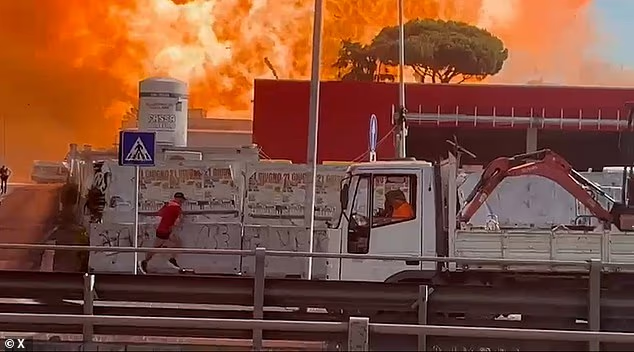
A violent explosion at a fuel station in Rome has left at least 29 individuals injured, following a series of blasts that caused major destruction in the city’s Prenestino district.

According to early reports, first responders were already present on Friday morning when a fuel tanker reportedly struck a pipeline during a maneuver. This caused gas to escape, leading to an initial minor explosion around 08:00 local time (07:00 BST).

Shortly after, a second, far more powerful detonation erupted, igniting a fire and sending flames and debris through the area. At least nine police officers were among those hurt, as confirmed by the city’s mayor, Roberto Gualtieri.

Videos taken during the incident captured the moment a towering blaze erupted, with thick plumes of smoke billowing into the sky. The force of the explosion was so intense it was heard across large parts of the city and caused buildings and windows to shake.

Upon arriving at the affected location, Gualtieri described the destruction as “terrible” and confirmed that the explosion resulted in “enormous damage” — including multiple injuries from burns and one victim in critical condition.

One of those hurt had to be pulled from a vehicle engulfed in flames by rescue teams who arrived on-site.

Visual evidence from the aftermath revealed scorched buildings and completely burned-out vehicles littering the scene.

Emergency crews continue to manage the situation, stabilizing the area and preventing further risk.

The mayor explained that soon after the first explosion, surrounding structures including a local sports complex were evacuated promptly by emergency personnel. He noted this swift action prevented what he called a “much more serious tragedy”.

One person who witnessed the event, Massimo Bartoletti, shared his account: “I saw the first explosion with the classic fireball. Shortly after came the second one which was hellish.”

He added, “A fiery mushroom formed in the sky. It made the whole area shake. It looked like hell, everything was flying in the sky.”

Balzani Fabio, who manages the now-destroyed sports facility nearby, said the first signs of the fire appeared just before 07:30 local time (06:30 BST).
“If it had happened at 08:30 or later it would have been a massacre, a catastrophe,” he stated.

He noted that around 60 children were scheduled to arrive for a summer camp that morning, with over a hundred others expected to use the swimming pool facility.

Italy’s Prime Minister Giorgia Meloni is reportedly receiving constant updates on the situation.

In a message posted on X, she stated: “I express my closeness to all those who are injured including law enforcement officers, firefighters and health workers and I extend my heartfelt thanks to those involved in the rescue and safety operations”.

State of the Nation: Making Nigeria Work Again

Nigeria’s ongoing leadership crisis continues to spark debate, especially in a country of over 200 million where many believe the same faces are recycled in power.

The reported agreement by President Bola Tinubu to reinstate Governor Siminalayi Fubara on the condition that he won’t seek re-election in 2027 raises questions about democratic integrity and the influence of political powerbrokers.

With many positions seemingly inaccessible without the backing of entrenched interests, it’s no surprise that citizens are beginning to question whether the electoral process truly reflects their voice.

From tax reform efforts linked to true federalism, to suggestions of a unicameral legislature and part-time lawmakers, there is growing demand for a governance system that prioritizes accountability and efficiency. To truly make Nigeria work again, it’s not just about changing leaders, it’s about transforming the system that produces them.

ECOWAS Bank Approves $100m For Lagos-Calabar Coastal Highway Project

0

‎The ECOWAS Bank for Investment and Development (EBID) has approved a $100 million funding package for the construction of a 47.7-kilometer stretch of Nigeria’s ambitious Lagos-Calabar Coastal Highway, marking a significant step toward enhancing regional connectivity and economic growth.

‎The funding approval was part of a larger set of commitments unveiled during EBID’s 92nd Ordinary Session, where the bank announced a total allocation of €174 million and $125 million for infrastructure and social development initiatives across West Africa.

‎The decision was reached during the bank’s Board of Directors’ meeting held on June 30, 2025.

‎The funding, allocated for Section 1, Phase 1 of the 700-kilometer highway project, will support construction starting from Ahmadu Bello Way in Lagos.

‎The Lagos-Calabar Coastal Highway, a flagship initiative of President Bola Tinubu’s administration, aims to connect nine Nigerian states—Lagos, Ogun, Ondo, Edo, Delta, Bayelsa, Rivers, Akwa Ibom, and Cross River—enhancing access to seaports, agro-industrial zones, and coastal communities.

‎The project is designed to boost trade, tourism, and industrial development along Nigeria’s southern economic corridor.

‎Anita Somda-Dala, Head of Communications at EBID, described the highway as a “strategic investment” that will unlock new regional value chains.

‎“This project will link nine Nigerian states, improve access to seaports and isolated agro-industrial areas, and contribute to the emergence of a regional value chain to help coastal communities,” she said in a statement.

‎The funding is part of a broader €174 million and $125 million package approved by EBID to support infrastructure and social development projects across West Africa, aligning with the United Nations Sustainable Development Goals (SDGs) for industry, innovation, and infrastructure.

‎Construction of the highway began in March 2024, with Hitech Construction Company Limited overseeing the initial phase. President Tinubu commissioned the first completed 30-kilometer section from Ahmadu Bello Way to Eleko Village in Lagos on May 31, 2025, hailing it as a milestone in Nigeria’s infrastructure development.

‎However, the project has not been without controversy, with critics, including former Vice President Atiku Abubakar, questioning the lack of public bidding for the contract and raising concerns about environmental and social impacts, particularly the demolition of properties along the route.

‎The Federal Government has allocated over ₦3 trillion for various segments of the highway, with Section 1 awarded at ₦1.068 trillion, Section 2 at ₦1.6 trillion, and Sections 3A and 3B at ₦1.33 trillion.

‎The Minister of Works, David Umahi, has defended the project’s cost and execution, emphasizing its potential to transform Nigeria’s economy by improving connectivity and reducing cargo turnaround times.

‎The government has also paid ₦18 billion in compensation to affected property owners, though concerns persist about the adequacy of environmental and social impact assessments (ESIAs).

‎The $100 million injection from EBID is expected to accelerate progress on the highway, which is projected to be completed by 2028 at an estimated total cost of ₦14–15.6 trillion.

‎Stakeholders, including the Nigerian Ports Authority and local communities, have called for transparency and inclusive engagement to ensure the project delivers on its promise of economic transformation without displacing residents or harming biodiversity hotspots.

‎The Lagos-Calabar Coastal Highway, bolstered by ECOWAS funding, stands as a pivotal project in driving trade, connectivity, and sustainable development across the nation’s coastal corridor.

Anti-Govt Protest: Calls For President Ruto To Step Down

0

On June 25th, 2025, streets across Kenya were filled with thousands of protesters demanding the resignation of President William Ruto and an end to police brutality. The protests, which marked the one-year anniversary of a major uprising against Ruto’s controversial tax bill in 2024, were meant to honour those who lost their lives during that earlier movement.

However, what began as a commemorative demonstration turned violent, with reports confirming the deaths of at least 10 people, further deepening public outrage.

While protesters described the march as a demand for justice and accountability, Kenya’s Interior Minister painted a different picture, calling the protest “terrorism disguised as dissent” and an “unconstitutional attempt” to unseat the government.

He denied any excessive use of force by the police and instead praised the security agencies for their “remarkable restraint” and swift action in what he described as a foiled coup attempt. The sharp divide in narratives reflects Kenya’s growing political tension, as citizens continue to push for reforms and leaders seek to maintain order and control.

Michael Madsen: Remembering Hollywood’s Outlaw Poet And Icon

Michael Madsen, a 67 year old poetic soul, and one of Hollywood’s most distinctive screen tough guys, passed away on Thursday, July 3, 2025, at his home in Malibu, California, from cardiac arrest.

Best known for his roles in Reservoir Dogs, Kill Bill, and Donnie Brasco, Madsen was more than just a cinematic heavy.

He was a poet, photographer, and father who brought vulnerability and authenticity to every project he touched.

With over 300 screen credits, Madsen’s career spanned four decades and included some of the most iconic collaborations in modern cinema.

Madsen’s Early Life And Roots In The Midwest

Born on September 25, 1957, in Chicago, Illinois, Michael Madsen was the son of Calvin Madsen, a firefighter, and Elaine Madsen, a writer and Emmy-winning filmmaker.

He grew up in a working-class neighborhood where resilience and grit were a way of life, qualities that would later shape his characters.

After a series of odd jobs, including working as a car mechanic and hospital orderly, Madsen found his true calling in acting.

He began his acting career at Chicago’s prestigious Steppenwolf Theatre Company, where he trained under the legendary John Malkovich. It was here that Madsen began developing his signature style, intense, grounded, and emotionally raw.

Breakthrough: Mr. Blonde And The Tarantino Era

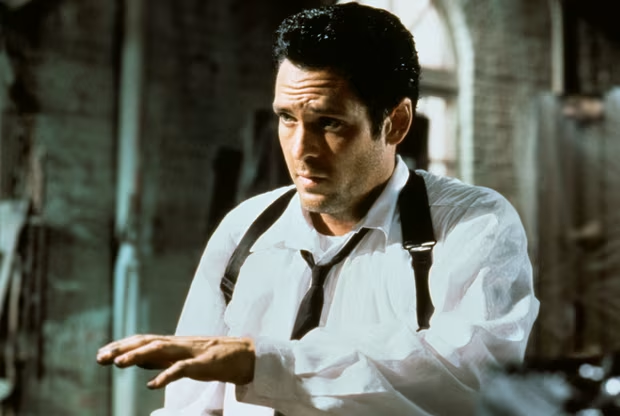
Michael Madsen In Reservior Dogs

While Madsen appeared in films like The Natural and WarGames in the early 1980s, his breakthrough came in 1992 with Quentin Tarantino’s Reservoir Dogs.

His portrayal of the sadistic yet charismatic “Mr. Blonde” (aka Vic Vega) became one of cinema’s most unforgettable performances.

The now-legendary torture scene set to “Stuck in the Middle with You” became a defining moment in independent film history.

Tarantino once described Madsen as “a guy who could kill you with a smile.”

Their collaboration would continue across multiple films, including:

  • Kill Bill: Volumes 1 & 2 – as Budd, a disillusioned assassin
  • The Hateful Eight – as Joe Gage, the quiet cowboy with hidden motives
  • Once Upon a Time in Hollywood – where he made a cameo appearance

Madsen was originally Tarantino’s top pick to play Vincent Vega in Pulp Fiction, but a scheduling conflict cost him the role. It eventually went to John Travolta, whose career was revived by the film.

Hollywood’s Icon Versatile Career And Iconic Roles

Madsen In Sin City

Michael Madsen’s acting range extended far beyond Tarantino’s crime sagas. He appeared in blockbusters, cult films, and indie gems, playing everything from lawmen to hitmen, loving fathers to psychotic killers.

Selected Filmography Highlights:

  • Thelma & Louise (1991) – as Susan Sarandon’s charming love interest
  • Free Willy trilogy – as the caring foster father
  • Donnie Brasco (1997) – as a volatile mobster alongside Al Pacino and Johnny Depp
  • Sin City (2005) – as Bob, the rough-around-the-edges cop
  • Die Another Day (2002) – as a CIA agent in the James Bond universe
Madsen In Donnie Brasco

He also lent his unmistakable voice to video games, including GTA III, DRIV3R, Dishonored, and Call of Duty, bringing his persona to new generations of fans.

Other Interesting Career

Off-screen, Madsen was an artist at heart. A deeply reflective and expressive writer, he authored several volumes of poetry and prose, including:

  • Burning in Paradise
  • American Badass
  • Expecting Rain
  • The Complete Poetic Works of Michael Madsen: Vol. I (1995–2005)

His writing revealed a side of him often hidden beneath his tough-guy roles, a man grappling with pain, fatherhood, fame, addiction, and redemption.

In his final years, he completed a new poetry collection titled Tears for My Father: Outlaw Thoughts and Poems, which is expected to be published posthumously.
He was also an avid photographer, capturing raw, black-and-white snapshots of life on the road, on set, and in solitude.

Madsen’s Personal Life: Love, Loss, And Resilience

Michael Madsen was married multiple times and was the father of five sons, including Christian Madsen, who followed in his father’s footsteps and starred in Divergent (2014).

His life was not without turbulence. Madsen faced struggles with substance abuse, legal troubles, and personal setbacks. In 2022, he suffered a devastating blow with the death of his son Hudson Madsen, who died by suicide at the age of 26 while serving in the U.S. Army.

The tragedy deeply affected him, and he later spoke publicly about the need for mental health support for veterans and grieving families.

Despite the hardship, Madsen remained devoted to his family, particularly his aging mother Elaine and his sister Virginia, a successful actress in her own right (Sideways, Candyman).

Final Days And Sudden Passing

In June 2025, Madsen was recovering from a horseback riding accident that injured his shoulder. Though in pain, he was reportedly in good spirits and active in preproduction for a new Western film.

On the morning of July 3, 2025, he was found unresponsive by his assistant at his Malibu home.

He was pronounced dead shortly after. The cause of death was determined to be cardiac arrest.
His death sent shockwaves across the entertainment world.

Hollywood And World Reactions

Tributes have poured in from co-stars, directors, fans, and fellow artists:

  • Virginia Madsen (sister): “Michael was thunder and velvet. He was my big brother and my protector. A poet disguised as an outlaw.”
  • Harvey Keitel: “We’ve lost another great American poet. His words were just as powerful as his performances.”
  • Vivica A. Fox and Stephen Baldwin: “Heartbroken doesn’t begin to describe it. Hollywood just got a little dimmer.”
    Fans worldwide took to social media to share memories, quotes, and tributes, many recalling his legendary “Mr. Blonde” scene and others praising his overlooked poetry and emotional depth.

Michael Madsen defied stereotypes. He wasn’t a polished leading man, nor was he a one-note villain. He was a cinematic outlaw, fiercely authentic, unpredictable, and unforgettable.

With his deep voice, expressive eyes, and raw emotional power, he left a legacy that spans genres, generations, and mediums.

His story is a testament to the power of second chances, self-expression, and staying true to one’s roots. He was a poet of pain and passion, a father who bore scars, and a man who gave everything to his art.

Michael Madsen died as he lived on his own terms, with a legacy that can’t be boxed in. Whether as Mr. Blonde wielding a razor, a quiet cowboy watching the door, or a father penning verses about life’s harshness, Madsen will be remembered not only for what he did on screen but for what he poured into his art.

He leaves behind a filmography that will inspire, a body of poetry that will endure, and a legend that will never fade.