Home Blog Page 139

FIFA Club World Cup: Chelsea Secure Round of 16 Spot

Chelsea’s second string side sealed a place in the Round of 16 at the FIFA Club World Cup with a convincing 3-0 victory over Esperance de Tunis in their final Group D clash on Tuesday. Goals from Tosin Adarabioyo, Liam Delap, and Tyrique George ensured progression for the Blues.

Meanwhile, Group D leaders Flamengo were held to a 1-1 draw by LAFC, finishing on seven points just one ahead of Chelsea. Esperance concluded third with three points, while LAFC finished bottom with a single point.

Chelsea are now set to face Group C winners Benfica on Saturday at the Bank of America Stadium in Charlotte. Flamengo will take on Group C runners up Bayern Munich on Sunday in Miami.

Despite the high stakes, Chelsea manager Enzo Maresca opted to rest several key players, including Cole Palmer and goalkeeper Robert Sánchez. Striker Nicolas Jackson was also unavailable as he continues to serve a two-match suspension following a red card in Chelsea’s previous defeat to Flamengo.

Delap, a £30 million signing from Ipswich Town, came close to scoring in the 20th minute with a header that was cleared off the line. Although Chelsea dominated possession in a quiet first half, their attack lacked sharpness. Delap missed another clear opportunity in the 30th minute, sending a shot wide from close range.

The breakthrough finally arrived in first-half stoppage time when Adarabioyo headed home a precise finish into the bottom left corner. Just moments later, Delap netted his first Chelsea goal, calmly slotting the ball into the far corner after collecting a loose ball inside the box.

Chelsea maintained their dominance throughout the second half, controlling play and defending with composure. The win was capped off in added time as substitute Tyrique George rifled in a third goal from the edge of the area.

Benfica Make History with First Win Over Bayern to Claim Group C Lead

Benfica topped Group C with a 1-0 win over Bayern Munich on Tuesday, securing their first ever victory against the German giants in scorching conditions. Andreas Schjelderup’s early goal proved decisive for the Portuguese side.

With the result, Benfica advance to face Chelsea in the Round of 16. Bayern, who finished second in the group, will now meet Flamengo.

We didn’t perform well in the first half, admitted Bayern manager Vincent Kompany. The heat and pitch conditions disrupted our rhythm. We had chances but didn’t take them, and in football, that often costs you.

Schjelderup scored in the 13th minute, converting Fredrik Aursnes’ low cross after a defensive lapse by Bayern. With qualification already assured, Bayern fielded a rotated squad and lacked urgency in the opening period.

They improved after the break and thought they had equalised when Joshua Kimmich found the net, only for the goal to be ruled out due to Harry Kane being offside in the buildup.

Benfica goalkeeper Anatoliy Trubin delivered a standout performance, making key saves to deny Aleksandar Pavlovic and Leroy Sané. He was deservedly named man of the match.

It was a full team effort against a world-class opponent, said Trubin.The heat was intense, but we stayed focused and finished the job.

Manager Bruno Lage praised his squad’s belief and execution, We came into the game confident, despite our history with Bayern. We played aggressively, created better chances, and finishing first in the group means everything. Everyone was talking about Boca Juniors needing a big win, but they overlooked us we made our statement.

No one thought we could beat Bayern, Lage added, but we believed in our process, and it showed on the pitch.

Kenya Marks Anniversary of Deadly Protests with New Clashes and Gunshot Injuries

0

Fresh violence erupted in Kenya on Wednesday as thousands of citizens took to the streets to mark the one-year anniversary of the 2024 anti-tax protests, which ended in tragedy and ignited ongoing outrage over police brutality. At least 10 people were hospitalised with gunshot wounds during this year’s commemorative rallies, according to a hospital source and a report by Citizen Television.

The protests, held in Nairobi and several other towns across the country, were intended to honour the lives lost during last year’s demonstrations, where over 60 people died, many allegedly at the hands of security forces. The renewed unrest has brought attention once again to Kenya’s growing concerns over human rights violations, police violence, and lack of accountability.

It remains unclear who fired the shots that injured protestors on Wednesday. Kenyan police spokesperson Muchiri Nyaga did not respond to requests for comment, while the Kenyatta National Hospital in Nairobi confirmed it had received 11 patients with gunshot injuries.

The situation in the capital turned tense early in the day, with police deploying tear gas and water cannon to push back crowds attempting to reach the Central Business District the same area that saw the storming of parliament last year on June 25. Roads into the city center were barricaded, and the Communications Authority of Kenya ordered a halt to live broadcasts of the protests, drawing sharp criticism from rights groups and media watchdogs.

Isolated clashes were also reported in Mombasa, Kisii, Kitengela, Matuu, and Nyeri, suggesting the discontent has spread beyond the capital. Despite the heavy police presence, many protesters remained peaceful, including groups that laid wreaths outside parliament in memory of those who died during the 2024 unrest.

This year’s demonstrations were further fueled by the recent death of 31-year-old blogger and teacher, Albert Ojwang, who died in police custody earlier this month. His death has become a symbol of the struggle against police violence, triggering a wave of anger among young Kenyans. On Tuesday, six people, including three police officers, were charged with murder over Ojwang’s killing. All have pleaded not guilty.

“We are fighting for the rights of our fellow youths and Kenyans and the people who died since June 25… we want justice,” said protester Lumumba Harmony, speaking from the heart of the demonstrations in Nairobi.

The mass protests of June 25, 2024, where demonstrators breached barricades and entered parliament under a hail of gunfire marked the most serious crisis of President William Ruto’s administration and drew sharp rebukes from Kenya’s international partners.

Although Ruto later withdrew the controversial tax proposals that sparked last year’s unrest, public frustration remains high, particularly around state violence, unsolved disappearances, and a perceived lack of police reform. As Kenya continues to grapple with these deepening grievances, Wednesday’s scenes serve as a sobering reminder that the wounds of last year have yet to heal and the calls for justice are far from over.

Heatwave Sends Dozens To Hospital Across Eastern North America

An intense surge of summer heat has landed heavily across eastern parts of the continent, sending multiple people to hospitals with heat-related conditions.

In Paterson, New Jersey, over 150 attendees at an outdoor school graduation fell ill on Monday due to the sweltering temperatures. The city’s mayor responded by declaring a state of emergency to address the growing health crisis.

Meanwhile, in Washington D.C., six concertgoers required medical attention during a live performance by the South Korean music group ‘Stray Kids’.

Heat advisories are in effect across a vast area stretching from the Midwest through the eastern United States and into Canadian provinces like Ontario, Quebec, and Nova Scotia. The blistering conditions are expected to affect more than 160 million people throughout the week.

Further down the East Coast, several individuals in North Carolina also suffered from heat exposure. Reports indicate that at least 41 patients, including minors, were admitted to hospitals in the region.

In New Jersey, the high number of medical emergencies during two separate graduation events led officials to classify the situation as a “mass casualty” event. As a result, some local ceremonies were called off.

Following the incident, Paterson’s Mayor Andre Sayegh issued an emergency declaration, ordering the suspension of all outdoor recreational activities and opening public cooling stations for relief.

Meteorologists are cautioning that high humidity levels combined with sustained high temperatures could severely increase the likelihood of heat exhaustion and stroke.

One of the most alarming features of this weather pattern is its prolonged nature—nighttime temperatures in some eastern cities are forecast to stay above 80°F (27°C), offering little relief from the daytime heat.

Although the summer has just officially begun, forecasters say this heatwave may set all-time records in certain areas. Some cities may experience their hottest June days ever.

By Thursday, the Mid-Atlantic is predicted to bear the brunt of the heat, followed by the eastern parts of the Ohio Valley on Friday. The consecutive days of extreme warmth are expected to amplify public health risks across these zones.

The US National Weather Service (NWS) has warned people to “take action when you see symptoms of heat exhaustion and heat stroke”.

Health officials are advising residents to avoid direct sunlight during peak hours, remain hydrated, and check on at-risk individuals, particularly seniors and those with underlying health issues.

Though extreme summer heat is common in the region, meteorologists believe this particular spell could break June records in several states.

In New York City, temperatures on Tuesday could hit 101°F (38°C), potentially matching a record high from June 1966.

Utility companies along the East Coast have urged households to reduce energy use amid rising concerns of power outages, as millions turn up their air conditioners to combat the brutal heat.

Nigeria and Brazil Seal $1 Billion Deal To Boost Agriculture

Nigeria and Brazil have signed a significant $1 billion agreement to enhance cooperation across agriculture, food security, energy, and defence, according to Nigeria’s Vice President, Kashim Shettima.

In a post on his official X account, Shettima revealed that the partnership would see the deployment of over $1 billion toward supplying mechanised farming equipment, establishing training programs, and setting up service centres across the country.

“Our goal is to transition from subsistence farming to large-scale, mechanised agriculture,” Shettima stated. “In the energy sector, we are also making long-overdue moves to attract significant investment in gas production, refining, and renewable energy.”

Farming in Nigeria remains largely subsistence-based, with land commonly held by families or individuals. This structure presents major obstacles to scaling up commercial agriculture. Despite a population of over 200 million, Nigeria still relies heavily on imported food.

The deal was formalised in Abuja during the official visit of Brazil’s Vice President, Geraldo Alckmin, as both countries move to strengthen their bilateral relationship.

During the engagement, Vice President Shettima also pointed to the ongoing economic reforms under President Bola Tinubu’s administration, noting that they are aimed at restructuring the economy for long-term stability.

Nigeria has set an ambitious target to expand its economy to $1 trillion by 2030, focusing on reforms in agriculture, energy, education, and public finance. As part of these efforts, the government has instructed banks to recapitalise in order to increase investor confidence and draw in more foreign direct investment.

Senegal’s Debt Burden Deepens As Fiscal Gaps Widen

Fresh data from the finance ministry indicates that Senegal’s national debt surged by the end of March 2025, highlighting the government’s ongoing difficulties in managing public finances amid continuous fiscal strain.

Debt servicing payments jumped significantly—rising by 44.5% in the final quarter of 2024 to 822.32 billion CFA francs ($1.4 billion)—and saw an additional 23.98% increase in the first quarter of 2025 compared to the same time last year, reflecting mounting domestic and foreign repayment responsibilities.

Reports revealed that about two-thirds of Senegal’s outstanding debt is owed to banking institutions, with the remaining part linked to unsettled operational arrears such as overdue supplier invoices and tax obligations. These findings were part of delayed quarterly budget reports released on Monday.

The same reports show that Senegal generated 1,027.82 billion CFA francs in revenue during the first quarter of 2025, amounting to 21.44% of its yearly fiscal goals. Meanwhile, total government spending reached 1,419.45 billion CFA francs, covering both regular expenses and investment projects.

External grant receipts saw a severe decline, falling 71.49% year-on-year to 8 billion CFA francs—a reflection of the country’s struggle to attract foreign donor support.

Despite official promises to improve debt control and implement financial reforms, Senegal continues to face difficulties such as dwindling foreign aid, rising debt repayments, and accumulated arrears—challenges that weigh heavily on its economic prospects.

Last year, the International Monetary Fund (IMF) halted its disbursements to Senegal after the government acknowledged misreporting on debt and budget deficit figures. The IMF, whose funding is considered vital for economic stability and investor confidence, stated that discussions for a new program will remain suspended until these discrepancies are resolved.

A February audit of state accounts by Senegal’s court of auditors revealed that budget deficits had been understated by as much as seven percentage points of GDP annually, causing the debt-to-GDP ratio at the end of 2023 to climb to roughly 100%—far above the previously declared 74%.

Government revenue in the last quarter of 2024 was stronger than anticipated, reaching 4,005.21 billion CFA francs—3.91% above the revised projection. On the expenditure side, spending rose to 6,506.16 billion CFA francs, representing a steep 61.29% increase over the same quarter in the prior year.

However, this period also exposed notable unpaid obligations, including 146.3 billion CFA francs in fuel subsidies and 105.2 billion CFA francs owed to building contractors.

($1 = 588 CFA francs)

Trump Rebukes Israel And Iran Hours After Ceasefire

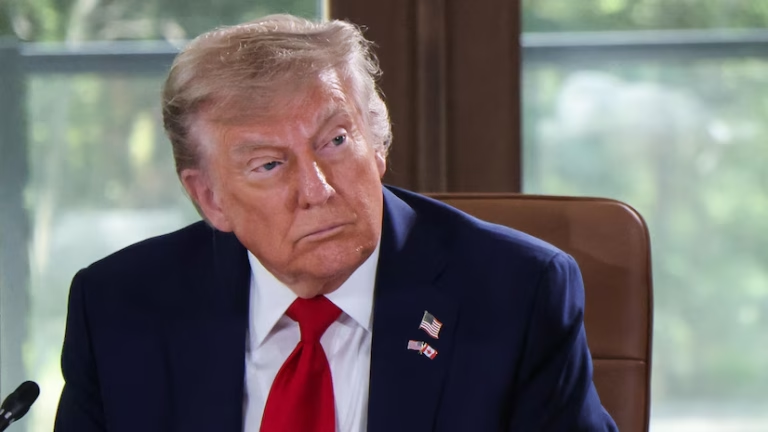
President Donald Trump on Monday declared what he called a “complete and total” ceasefire between Israel and Iran, announcing an end to what he termed the “12 Day War.” The truce, which Trump said would take effect early Tuesday morning, was meant to halt escalating hostilities between the two longtime rivals.

“I would like to congratulate both countries, Israel and Iran, on having the stamina, courage, and intelligence to end what should be called the ‘12 Day War,’” Trump wrote on Truth Social. Expressing optimism, the president stated that the ceasefire was “unlimited” and expected to last “forever.”

However, within hours of the announcement, tensions flared again, casting doubt over the durability of the fragile peace. On Tuesday morning, Israel accused Iran of violating the ceasefire by launching missiles toward its territory. The Israeli military claimed it had intercepted two missiles fired from Iran and warned of a forceful response to what it described as an “utter violation” of the agreement.

In contrast, Iranian officials firmly denied breaching the ceasefire. A senior Iranian security official stated that no missiles had been fired since the truce began around midnight ET. “If Israel makes a mistake, all occupied territories will be attacked, just like an hour before the war stopped,” the official warned, but insisted that Iran had not acted aggressively since the ceasefire came into effect.

The conflicting statements deepened uncertainty about the agreement’s future. International observers greeted Trump’s ceasefire announcement with cautious relief, acknowledging the fragile nature of such truces in the region. Some regional leaders welcomed the development, while others remained skeptical of its longevity given the volatile history between Israel and Iran.

Despite the optimism surrounding the ceasefire, Trump expressed frustration over the behavior of both nations, particularly Israel. Speaking before departing for a NATO summit in the Netherlands, Trump criticized Israel for allegedly launching attacks immediately after the truce was brokered.

“Israel, as soon as we made the deal, came out and dropped a load of bombs, the likes of which I’ve never seen before,” Trump said. “I’m not happy with Israel. You don’t go out in the first hour and drop everything you have. I’m not happy with Iran either.”

The president echoed this dissatisfaction in a post on Truth Social, warning: “ISRAEL. DO NOT DROP THOSE BOMBS. IF YOU DO IT IS A MAJOR VIOLATION. BRING YOUR PILOTS HOME, NOW!”

In another post from Air Force One en route to the NATO summit, Trump sought to calm tensions further, stating, “ISRAEL is not going to attack Iran. All planes will turn around and head home, while doing a friendly ‘Plane Wave’ to Iran. Nobody will be hurt, the Ceasefire is in effect!”

Speaking with reporters earlier at the White House, Trump also boasted about the effectiveness of recent U.S. strikes on Iran’s nuclear facilities, claiming they left the sites beyond repair. “Iran will never rebuild itself. That place is under rock, that place is demolished,” he said, crediting the success to U.S. pilots he described as performing “better than anybody could even imagine.”

Meanwhile, questions lingered about the ceasefire’s connection to other regional conflicts, particularly the war in Gaza. Some Israeli opposition figures and families of hostages called on leaders to extend the ceasefire momentum to resolve the Gaza conflict as well.

As of Tuesday afternoon, the ceasefire technically remained in place, but mutual distrust and contradictory accusations left the region—and the world—watching anxiously for the next development.

Wildfires Rage On Greek Island As State of Emergency Declared

A state of emergency was put in place as massive wildfires entered their third consecutive day on Chios Island.

By early Tuesday, efforts to control the spreading fires involved 444 firefighters, 85 engines, 11 helicopters, and two planes dropping water, according to the local fire service.

Additional teams were deployed from Athens, Thessaloniki, and the neighboring island of Lesbos. Police on Chios also received reinforcements, and military presence on the island has been doubled.

An arson investigation unit has arrived to determine if the fires were deliberately set.

Climate crisis and civil protection minister Giannis Kefalogiannis said late on Monday that authorities were “very seriously examining the possibility of an organised criminal act”.

Wildfires

“Whoever thinks that they can play with the lives of citizens and cause chaos with premeditated actions will be led to court,” he added. “Arson is a serious crime and will be dealt with as such.”

Mr Kefalogiannis further noted that crews were battling “simultaneous fires in multiple, geographically unconnected parts of the island”, stressing that such occurrences “cannot be considered coincidental”.

The fires erupted Sunday at three different points near the island’s main town, Chios, before merging into a large blaze that has swept through forest areas and farmland.

Warnings to evacuate were issued for two regions close to Chios town early Monday.

Emergency alerts were also pushed to mobile phones, ordering residents and visitors in 16 villages and settlements near the town to leave immediately.

While summer wildfires are a frequent threat in Greece’s dry and hot climate, officials have raised concerns that climate change is contributing to the growing intensity and frequency of these fires.

Last summer, similar wildfires forced residents and tourists to evacuate the island of Kos.

In 2023, wildfires in northern Greece claimed at least 20 lives and displaced 19,000 people on the island of Rhodes.

10 Feared Dead In Ibadan Accident

0

More than ten people were reportedly feared dead in a tragic accident that occurred on Tuesday morning along the Lagos-Ibadan Expressway in Oyo State.

The crash involved three Nissan Micra taxis and three articulated trucks.

According to eyewitness accounts, all the vehicles were coming from the Iwo Road axis before the fatal collision.

As of press time, rescue officials were still recovering mutilated bodies from the wreckage.

Officials of the Federal Road Safety Corps (FRSC), the Police, and Amotekun were present at the scene of the crash, which occurred on June 24, 2025. | Credit: Ademola Adegbite.

The Oyo State Sector Commander of the Federal Road Safety Corps, Rosemary Alo, confirmed the incident in Ibadan.

She stated, “The accident involved seven vehicles. Four were killed while one is currently receiving treatment at the hospital.”

She also called on motorists to exercise caution while on the road.

“The injured victims were rescued by Sanyo Police Station while the corpses were deposited at Adeoyo morgue, Ring Road, Ibadan, while other victims didn’t sustain injury and found their way to their destinations.

“Meanwhile, Sanyo Police DTO Oluwole Adesina take charge of the accidented vehicle, while one of the corpses was handed over to the relative with the express permission of the Sanyo Division Police Officer,” the sector commander confirmed.

Amazon Plans £40bn UK Expansion with New Sites and Jobs

0

Amazon has unveiled plans to pour £40bn into its UK operations over the coming three years, a move expected to generate thousands of jobs and see the opening of four major warehouses.

Two enormous fulfilment hubs are set for development in the East Midlands, targeted for completion by 2027. The precise areas where these will be built remain undisclosed.

Additionally, previously announced facilities in Hull and Northampton are scheduled to open sooner—one later this year and the other by 2026—each promising around 2,000 new roles.

Already employing roughly 75,000 people across the UK, Amazon ranks as one of the nation’s largest private-sector employers.

The company’s expansion plans also include adding two office buildings at its London headquarters, enhancing delivery stations, improving its transport systems, and redeveloping Bray Film Studios in Berkshire, which was acquired last year.

The £40bn commitment also covers the bulk of an £8bn pledge made in 2024 to build and maintain data centres in the UK, along with employee pay and benefits.

Prime Minister Sir Keir Starmer described this as a “massive vote of confidence in the UK as the best place to do business”.

“It means thousands of new jobs – real opportunities for people in every corner of the country to build careers, learn new skills, and support their families,” said Sir Keir.

The Chancellor, Rachel Reeves, also welcomed the announcement, calling it a “powerful endorsement of Britain’s economic strengths”.

Andy Jassy, Amazon’s chief executive, highlighted the wider impact the investment would have nationwide.

“When Amazon invests, it’s not only in London and the South East,” he said.

“We’re bringing innovation and job creation to communities throughout England, Wales, Scotland and Northern Ireland, strengthening the UK’s economy and delivering better experiences for customers wherever they live.”

Despite this ambitious growth, concerns persist among some groups regarding Amazon’s influence. Critics have raised alarms over working conditions in its facilities—claims which the company has firmly rejected. Furthermore, a recent investigation was opened by the UK’s grocery regulator into alleged breaches related to supplier payments.

Court Overturns Ban on German Far-Right Publication

A judicial panel in Leipzig has ruled to reverse a ban previously placed on Compact, a well-known far-right publication in Germany.

While some interpret the verdict as a setback in efforts to curb extremist ideologies, others see it as a reaffirmation of the nation’s strong commitment to civil liberties and freedom of speech.

The magazine had been outlawed by the interior ministry in July 2024 on grounds that it posed a threat to constitutional values and promoted hostile rhetoric targeting minority groups.

“It is a central mouthpiece of the right-wing extremist scene,” said German Interior Minister Nancy Faeser at the time. “This magazine incites unspeakable hatred against Jews, against people with a migration background, and against our parliamentary democracy.”

Authorities have previously connected the publication to the far-right Alternative for Germany (AfD) party. It has also been labeled as extremist by the country’s domestic intelligence service.

In their ruling on Tuesday, the court acknowledged that Compact had disseminated messages that could be considered hostile to the constitution. However, the judges concluded that this alone did not provide sufficient justification to outlaw it entirely.

Many remarks in the magazine may be deemed “exaggerated but permissible criticism,” presiding Judge Ingo Kraft told the court. “The constitution guarantees freedom of expression and freedom of the press, even towards enemies of the constitution.”

Following the judgment, the publication’s chief editor, Jürgen Elsässer—who previously characterized the outlet as “democracy’s assault gun”—claimed that the ruling was a win not only for his team but for the AfD as well. He argued that if Compact could not legally be suppressed, neither could the party.

The decision arrives amid intense national debate over whether banning the AfD could backfire by reinforcing its narrative of political persecution. Though classified as a far-right extremist entity by security services, some critics of the party argue that outlawing it might further fuel its support.

Over recent months, German authorities have taken action against various organisations deemed hostile to the country’s democratic framework, including those with links to far-right networks. Figures within these movements argue they are being unfairly targeted by state power.

Voices aligned with former U.S. President Donald Trump have also weighed in, accusing Germany of suppressing dissent. At a major international security gathering earlier this year, U.S. Vice President JD Vance stunned attendees with a scathing criticism of German leadership, alleging that political forces were marginalizing the AfD and cracking down on freedom of speech.

Despite such claims, AfD representatives regularly appear in televised debates and have equal speaking rights alongside mainstream political parties in the federal legislature.

Germany’s painful historical experiences under Nazi and communist dictatorships have shaped its modern approach to regulating speech. Legal thresholds for outlawing publications or political groups remain intentionally high.

Many such cases are brought before the courts, and rulings—such as this one allowing Compact to resume operation—are often beyond the reach of government appeal.