Home Blog Page 165

Why Was Premier League Referee David Coote Suspended?

David Harry Coote (born 11 July 1982) is an English former professional football referee. Affiliated with the Nottinghamshire Football Association, Coote was part of the elite Select Group 1 of referees who officiate in the Premier League. His career, once marked by steady progression through the ranks of English football, came to an abrupt end following a string of controversies in late 2024.

Coote began refereeing at the age of 16, officiating in lower-tier leagues such as the Notts Alliance League, Northern Counties East Football League, Northern Premier League, and Conference North. He was later promoted to the Football League as an assistant referee, officiating his first match in that capacity in a League Two clash between Stockport County and Hereford United.

In 2010, he was elevated to the role of Football League referee. A career milestone came in May 2014 when he took charge of the League One Play-off Final between Leyton Orient and Rotherham United at Wembley Stadium.

Coote made his Premier League debut on 28 April 2018, officiating the match between Newcastle United and West Bromwich Albion, which ended in a 1–0 win for the visitors. Ahead of the 2018–19 season, he was promoted to the Select Group 1.

He further solidified his standing with a high-profile appointment to the 2023 EFL Cup Final between Manchester United and Newcastle United, held on 14 February 2023. Manchester United won the match 2–0.

What Led to David Coote’s Suspension?

Coote’s fall from grace began in November 2024, when the Professional Game Match Officials Limited (PGMOL) suspended him after the leak of a highly controversial video. In the footage, Coote is seen referring to then-Liverpool manager Jürgen Klopp as an “arrogant German cunt.” The clip allegedly dated back to the 2020–21 season, during the infamous Merseyside derby in which Liverpool defender Virgil van Dijk suffered a season-ending injury. At the time, Coote was serving as the Video Assistant Referee (VAR).

While Coote initially denied the authenticity of the video, he later admitted it was real. Just days later, a second video emerged—this time showing Coote allegedly snorting a white powder, which he later confirmed was cocaine. The incident reportedly took place in a hotel room during UEFA Euro 2024, with the accommodation expenses covered by UEFA.

Following these revelations, UEFA swiftly suspended Coote from officiating duties and, in February 2025, handed him a 16-month ban. The official statement cited violations of “the basic rules of decent conduct” and declared that Coote had brought “the sport of football, and UEFA in particular, into disrepute.”

Further damage to his reputation came with the launch of a betting investigation by the Football Association (FA). The probe centered around a 2019 match between Leeds United and West Bromwich Albion, after allegations surfaced that Coote had received a message from a friend requesting a yellow card for Leeds player Ezgjan Alioski. Coote has denied any involvement in or knowledge of such an incident.

Once a rising star among Premier League referees, David Coote’s career has now ended in disgrace. A combination of unprofessional conduct, substance abuse, and allegations of impropriety has not only led to his suspension but also tarnished his legacy within the world of football officiating.

Pop Star Jessie J Reveals Early-Stage Breast Cancer Diagnosis to Fans

Music artist Jessie J has disclosed to her followers that she is currently facing a breast cancer diagnosis.

The 37-year-old performer shared that she’s preparing for an upcoming medical procedure and emphasized that her condition was detected at an early stage.

The performer, known to fans as Jessica Ellen Cornish, announced the news via a personal video update on Instagram. In her words, she has “been in and out tests.”

“I was diagnosed with early breast cancer,” she revealed Wednesday. “I’m highlighting the word early. Cancer sucks in any form but I’m holding on to the word early.”

She also shared her upcoming schedule and said, “I am going to disappear for a bit after Summertime Ball (where she will be performing on June 15) to have my surgery. And I will come back with massive tits and more music.”

Although she wrestled with whether to speak publicly, she ultimately chose transparency. “I just wanted to be open and share it. One because selfishly I do not talk about it enough – I’m not processing it because I’m working so hard.”

She added, “I also know how much sharing in the past has helped me with other people giving me their love and support and also their own stories. I’m an open book. It breaks my heart that so many people are going through so much. Similar and worse – that’s the bit that kills me.”

In her video caption, Jessie J explained that the diagnosis has shifted how she views life, calling it “the most incredible perspective,” but confessed: “Your girl needs a hug.”

Statistics from the World Health Organization show that 2.3 million women received a breast cancer diagnosis around the world in 2022, and 670,000 women lost their lives to the disease that year. The organization highlights that detecting the illness in its early stages improves the chances of successful treatment.

Jessie J has previously been candid about personal health matters. In 2021, she opened up about losing a pregnancy. Today, she is a mother to a two-year-old son, whom she shares with professional basketball player Chanan Colman.

Mali Protests Intensify Amid Political Crackdown

0

Protests have surged across Mali following the military junta’s controversial decision to dissolve all political parties and suspend political activities, a move announced by President Assimi Goïta on May 13, 2025. This action is part of the junta’s efforts to consolidate power amid ongoing political instability after the 2020 coup that ousted former President Ibrahim Boubacar Keïta.

The dissolution of political parties has been widely condemned both domestically and internationally. Opposition leaders, activists, and civil society groups view this as a blatant attempt to suppress dissent and undermine the democratic process. Several prominent opposition figures, including Mamadou Traoré—leader of the anti-junta coalition—have been detained and face trials under charges of inciting unrest.

Human Rights Watch and other organizations have reported arbitrary arrests, disappearances, and restrictions on freedom of expression and assembly. Despite heavy security crackdowns, thousands of protesters have continued to take to the streets in Bamako and other cities, demanding a return to civilian rule and the establishment of a clear timetable for elections by December 2025, as initially promised by the junta.

Regional bodies like ECOWAS (Economic Community of West African States) and the African Union have expressed concern over Mali’s political trajectory and urged the junta to respect democratic principles and human rights. However, negotiations between the junta and opposition have stalled, raising fears of prolonged instability.

Who Is Lee Jae -Myung, The New South Korean President?

Lee Jae-myung the newly inaugurated 14th President of South Korea, is a politician and lawyer who previously held office as the sixth governor of Gyeonggi Province from 2018 to 2021, as the leader of the Democratic Party and as the member of the National Assembly for Gyeyang B from 2022 to 2025.

He was born to a poor family in Andong on the 8th of December in 1963.

Lee became a factory worker after primary school and sustained a severe arm injury in a factory accident, resulting in a lifelong disability. He earned middle and high school equivalency diplomas and studied at Chung-Ang University, earning his law degree in 1986.

He became a human rights lawyer, advocating for labor rights and social justice and as a human rights and labour lawyer, Lee organized with Minbyun and advocated for opening a new hospital in Seongnam.

Family & Early Life

Lee Jae-myung is the fifth of seven children and grew up in a humble household. Due to his family’s financial struggles, he often missed out on social activities and depended on his school’s generosity to attend field trips and other extracurricular programs.

He fondly recalls fishing along the creek with friends as one of his favorite pastimes. His first-grade report card described him as quite stubborn, with average grades, but noted that he got along well with his classmates.

When Lee graduated from elementary school, public education in South Korea was no longer free, making it difficult for poor families like his to continue schooling. His father spent much of the family’s income on gambling, prompting the family to leave Andong in search of work.

Work & Struggles

Like many children from underprivileged backgrounds in Korea, Lee began working at a young age instead of attending middle school. He found employment in a handmade necklace factory. After the factory went bankrupt, he moved on to work at a rubber company called Dongma. At the time, he was underage and worked under various pseudonyms to avoid legal issues.

Tragically, he suffered a finger injury at Dongma, and later another serious injury at Daeyang Industry, this time on his wrist joint. The latter injury was never properly treated and led to a permanent disability in his arm. This ultimately exempted him from military service and resulted in his registration as a disabled person.

Education & Career

Despite these hardships, Lee’s determination shone through. He performed exceptionally well in his entrance exams and was admitted to Chung-Ang University on a scholarship. There, he pursued a legal education and went on to pass the bar exam, launching a career as a human rights and labor lawyer.

Frustrated by the limitations of effecting change solely through legal advocacy, Lee shifted his focus to politics.

His political journey began as the Mayor of Seongnam (2010–2018), followed by his tenure as the Governor of Gyeonggi Province (2018–2021)

He reached the peak of his political ambitions
when he became the 14th President of South Korea on June 4, 2025.

Public And World Leaders Reactions

President Lee’s victory follows the impeachment and removal of former President Yoon Suk-yeol, who had declared martial law in December 2024.

His election is seen by many as a restoration of democratic norms and his promises to address economic inequality and pursue diplomacy have resonated with a significant portion of the electorate.

X user, Hikari tweeted: “Lee Jae Myung was stabbed in the neck while holding press conference and last December he climbed into the parliament hall just to vote to end the martial law. Yeah he deserves to win President.”

The prime minister of India Narendra Mondi also wished the president congratulations on X saying: “Congratulations to Mr Lee Jae-Myung on being elected as the President of the Republic of Korea. Look forward to working together to further expand and strengthen the India-ROK Special Strategic Partnership.”

President Lee Jae-myung’s rise from factory worker to president reflects a life shaped by hardship, resilience, and public service. His leadership marks a return to democratic stability in South Korea, and his story continues to inspire both hope and scrutiny at home and abroad.

WAEC Debunks Rumour Of English Language Exam Cancellation

The West African Examinations Council (WAEC) has dismissed viral claims that it cancelled the English Language paper written on Wednesday, May 28, during the ongoing 2025 WASSCE for school candidates.

The rumour had sparked widespread concern following the unusual nighttime administration of the paper, which was reportedly due to a suspected leak. WAEC, in response, explained that it acted swiftly to preserve the integrity of the examination by adjusting the schedule.

In a statement issued by the council’s acting Head of Public Affairs, Moyosola Adesina, WAEC debunked a fake press release dated May 30, 2025, which falsely claimed that the paper was cancelled and would be rescheduled.

“The attention of the West African Examinations Council (WAEC), Nigeria, has been drawn to a purported press release by the council, spreading across various social media platforms. According to the press release, dated Friday, May 30, 2025, ‘The English Language paper written on Wednesday, May 28, 2025, in the ongoing WASSCE for School Candidates, 2025 has been cancelled, and a new date for the conduct of the examination will be announced soon’.”

WAEC emphasized that the statement did not originate from the council and urged the public to disregard it.

“The management of the West African Examinations Council would like to state that the press release being circulated did not emanate from the council. The said examination has not been cancelled. Although the source of that information cannot be ascertained yet, the council is certain that the false claim is being peddled by mischief-makers who are bent on bringing the council to disrepute to cause confusion and panic for candidates who sat the examination.”
The council also reminded the public that all official information from WAEC is shared only through verified channels.

“The council would like to use this avenue to inform the general public and all stakeholders that pieces of information from the council are disseminated via our official and verified social media handles, as well as accredited media platforms across the country. In the same vein, all press releases are issued and signed by the Public Affairs Department of the council on behalf of the Head of National Office

Ghana Marks 46th Anniversary of June 4 Revolution

0

Ghanaians across the country are commemorating the 46th anniversary of the June 4 Revolution, a defining moment in the nation’s political history. The event, which occurred on June 4, 1979, was led by then Flight Lieutenant Jerry John Rawlings and marked the overthrow of the Supreme Military Council II, headed by General F.W.K. Akuffo.

The uprising was sparked by widespread dissatisfaction with corruption, economic mismanagement, and military indiscipline. It ushered in a short-lived Armed Forces Revolutionary Council (AFRC), which implemented radical reforms, including the public execution of senior military officers and a purge of the public service. Though controversial, many citizens recall the period as one of accountability and national awakening.

Today, political figures, activists, and the general public have taken to social media and various platforms to reflect on the legacy of the revolution. Events across the country include wreath-laying ceremonies, lectures, and community forums focused on anti-corruption and democratic values.

Former President John Mahama issued a statement urging Ghanaians to “hold fast to the principles of integrity, patriotism, and sacrifice,” which the revolution sought to enshrine. Meanwhile, Rawlings’ widow, Nana Konadu Agyeman-Rawlings, in a quiet remembrance, called for honest leadership and the protection of Ghana’s democratic gains.

As Ghana continues to grapple with modern governance challenges, the anniversary serves as a reminder of a turbulent yet transformative period in its national story.

Ukraine Strikes Crimean Bridge Again with Underwater Explosives

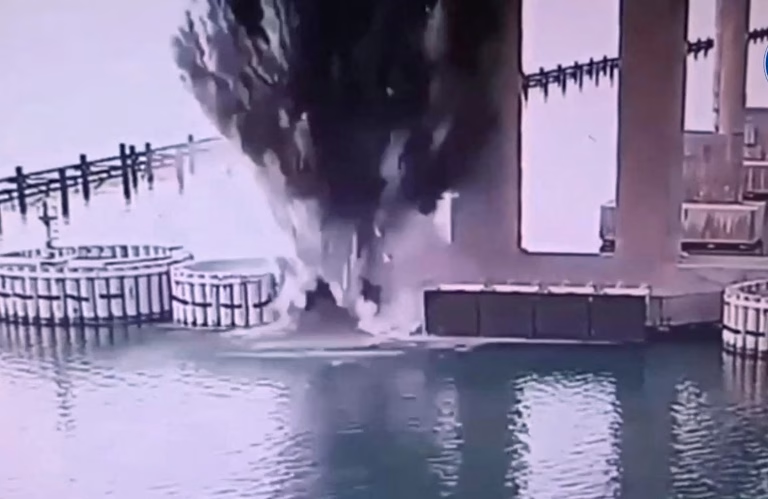
Ukrainian intelligence forces have claimed responsibility for a fresh sabotage mission targeting the bridge connecting Crimea to mainland Russia via the Kerch Strait—an attack that follows a high-profile drone assault on Russia’s bomber fleet just days prior.

According to a statement, video, and photo posted on the agency’s official Telegram channel, the planning and execution of the bridge mission had been underway for several months. “SBU agents mined the supports of this illegal facility,” the statement read. “And today, without any civilian casualties, at 4:44 am the first explosive device was activated.”

The SBU described major structural harm beneath the waterline, stating, “The underwater supports of the piers were severely damaged at the bottom level — 1,100 kg of explosives in TNT equivalent contributed to this. In fact, the bridge is in a state of emergency.”

SBU director Vasyl Malyuk added, “Previously, we hit the Crimean Bridge twice in 2022 and 2023. So, today we continued this tradition under water.”

Bridge administrators reported a temporary closure of the crossing following the incident. Official Russian responses, including from the Defense Ministry, had not been issued at the time of the statement.

Elsewhere, ongoing Russian strikes on Ukrainian urban areas killed at least eight civilians and left more than 50 injured overnight. According to Ukrainian authorities, 112 drones were launched across the country, 75 of which were intercepted before causing damage. Affected areas included 11 separate locations.

The most serious casualties were reported in regions near the front lines. In Sumy, local officials said four people were killed and 28 others hurt in a cluster rocket attack, with multiple explosions occurring in a busy part of the city. “Savage strike” and “fully deliberate attack on civilians” were the words President Volodymyr Zelenskyy used to describe the incident in a social media post.

In Kharkiv, shelling took three lives and injured six others, while one death and 13 injuries were reported in Kherson due to Russian fire. Authorities also confirmed five people were wounded in Chernihiv and five more in the coastal city of Odesa.

Zelenskyy commented that Russia’s actions show a lack of real intent to find a peaceful resolution, despite current diplomatic efforts. Delegations from both Ukraine and Russia met for renewed talks in Istanbul this week, marking their second round of face-to-face negotiations since May and the first since spring 2022.

Kyiv is requesting a full one-month truce to enable focused peace discussions. Prior to the talks, Zelenskyy reiterated that Ukraine wants all prisoners released and abducted Ukrainian children returned from Russia. He also signaled willingness to eventually speak directly with President Vladimir Putin.

Russia, in turn, presented a set of demands that echo its earlier positions from the beginning of the war. In its “peace memorandum,” Russia proposed that Ukraine fully exit four territories Moscow claims—Zaporizhzhia, Kherson, Donetsk, and Luhansk—even those where its troops do not maintain full control. The Kremlin also insisted on Ukraine halting all foreign weapons imports and ending military mobilization, conditions Ukraine has firmly dismissed.

Additionally, Russia is calling for restrictions on Ukraine’s military size, a permanent ban on joining NATO, international recognition of its control over annexed Ukrainian land, lifting of sanctions, and an end to demands for reparations.

Following the Istanbul meeting, a Kremlin representative confirmed that no meaningful advancements had been made, remarking, “It would be wrong to expect any immediate decisions or breakthroughs here. But work is ongoing.” He also downplayed the likelihood of a summit involving Putin, Zelenskyy, and Donald Trump happening soon.

Meanwhile, Dmitry Medvedev, now serving as deputy head of Russia’s Security Council, used Telegram to emphasize that the negotiations were not about compromise. He said the goal was “not meant to achieve a compromise peace based on some imaginary and unrealistic conditions invented by others, but rather to secure our swift victory and the complete destruction” of Zelenskyy’s government.

In a fresh statement, Zelenskyy stressed, “it is obvious: without global pressure — without decisive actions from the United States, Europe, and everyone in the world who has the power — Putin will not agree even to a ceasefire.” He continued, “Not a single day goes by without Russia striking Ukrainian cities and villages.”

“Every day, we lose our people to Russian terror. Every day, Russia gives new reasons for tougher sanctions and stronger support for our defense. I am grateful to everyone around the world who is promoting exactly this agenda: sanctions for aggression and the killing of people, and assistance in defending the lives of Ukrainians.”

That same night, Ukraine conducted strikes deeper inside Russian territory. Russia’s Defense Ministry claimed its forces brought down eight Ukrainian drones during the night.

This came on the heels of Ukraine’s latest long-range assault targeting Russian military infrastructure. In that earlier mission, drones hidden in transport vehicles struck several key airfields within Russia. Zelenskyy characterized that effort as a “strategic operation” in an interview, saying it “is definitely reducing Russia’s potential, and demonstrates that Ukraine is working on certain steps.”

“Unless they will stop, we will continue,” he stated.

Responding to questions about the level of American support, Zelenskyy said, “We are looking for very strong steps on the part of President Trump to support the sanctions and to force President Putin to stop this war, or at least proceed with the first stage of putting an end to this war — that is the ceasefire.”

Aid Deliveries Halted in Gaza Amid Intensifying Conflict

On Tuesday, aid efforts across Gaza came to a standstill after military officials declared that all roads leading to distribution locations would be treated as “combat zones,” prompting deepening concern for both relief workers and the besieged population.

An organization responsible for coordinating relief in the area said it had suspended operations to allow for “update, organisation and efficiency improvements works.” Still, observers questioned the reasoning and timing behind the halt, suggesting it could conceal more troubling motives related to safety and access.

Tragic scenes unfolded near one of the humanitarian sites when, according to local authorities affiliated with Hamas, 27 individuals were fatally shot. This was reportedly the third lethal occurrence in recent days around these food and aid points.

Military representatives stated that troops had fired their weapons after “identifying suspects who moved towards them, deviating from the designated access routes.” The statement did not include details confirming the threat posed by those shot.

“This is becoming a pattern of impunity,” stated one aid worker affiliated with a medical relief group. “People are starving and risking their lives just to collect flour. Now even that has become a death sentence.”

Meanwhile, in another area of southern Gaza, an airstrike devastated a school being used as emergency shelter by families fleeing earlier violence. The attack reportedly left eight dead and several more injured. First responders described chaotic conditions as they navigated debris-strewn roads in search of survivors.

Warnings have repeatedly been issued by humanitarian leaders demanding that safe corridors for aid be established and respected. With over a million people displaced and no consistent access to essentials, the worsening crisis has triggered growing alarm. Officials have cautioned that without rapid support, famine could set in imminently.

Those managing the main relief operations have already come under fire for allegedly working too closely with military forces and for failing to maintain impartiality in distributing supplies. The most recent shutdown, coupled with surging violence, has brought their practices into sharper focus.

Critics worldwide have begun urging greater accountability from both the forces conducting military operations and the countries that support them. But for those trapped in Gaza, the political rhetoric offers little relief. Each passing day without basic necessities like food, water, and safety deepens the desperation and the risk.

U.S. Drastically Increases Steel and Aluminum Import Taxes

President Donald Trump has approved a sharp rise in tariffs on imported steel and aluminum, pushing the levy from 25% to a new high of 50%.

This policy shift marks the second time tariffs on these metals—integral to industries like automotive and food packaging—have increased since March.

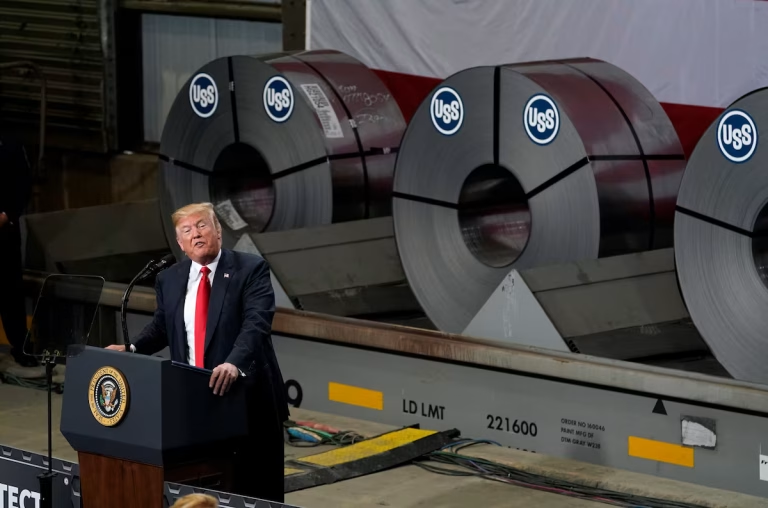
Trump defended the measure, stating on Wednesday that it is designed to bolster the domestic steel sector.

Still, the decision has stirred alarm among critics, who argue it may disrupt overseas metal producers, trigger retaliation from other countries, and place a heavy burden on American companies that depend on these imports.

Many businesses caught in the crossfire were stunned in the lead-up to the move. They hoped the hike might be a bluff or part of a broader negotiation rather than a permanent change.

One notable exception to the hike was the United Kingdom, which retained the previous 25% rate. Trump said this was a result of “ongoing trade discussions” between the two nations.

“Always the question with Mr Trump is, is this a tactic or is this a long-term plan?” said Rick Huether, head of Independent Can Co, a Maryland manufacturer that turns imported European steel into decorative tins and packaging.

Following earlier tariff increases, Huether put expansion plans on hold and raised prices. He feared the rising costs might push his customers toward alternative packaging materials like paper or plastic.

“There’s a lot of chaos,” he said.

Globally, the U.S. is one of the top consumers of steel, ranking just behind the EU. It sources much of its supply from countries including Mexico, Brazil, Canada, and South Korea.

Trump’s administration originally introduced 25% steel and 10% aluminum tariffs during his first term, invoking national security concerns.

However, exemptions were eventually extended to various trade allies and companies, softening the overall impact.

In March, Trump withdrew many of those exemptions, expressing dissatisfaction with how the previous framework had been diluted.

While speaking at a U.S. Steel site on Friday, Trump expressed his intent to make imported steel so expensive that domestic buyers would have no choice but to turn to U.S. suppliers.

“Nobody’s going to get around that,” he said of the 50% rate. “That means that nobody’s going to be able to steal your industry. It’s at 25% – they can get over that fence. At 50%, they can no longer get over the fence.”

International Concerns and Fallout

Despite the increased tariffs, recent data shows little change in the U.S. steel production rate compared to the same time last year. But steel imports dropped sharply—falling 17% between March and April—and more declines are anticipated as the new rates take hold.

Canada and the EU, both affected by previous U.S. tariff moves, have already signaled their readiness to retaliate.

An EU trade official said on Tuesday that “We’re negotiating hard to try and make good deals,” as conversations between the two sides continue.

“We really hope that the Americans will roll back on this latest tariff threat, as they have done on others, but that remains to be seen.”

In the UK, the announcement has intensified pressure to finalize a trade deal with Washington, especially one that would shield British industries from further disruptions.

UK Trade Secretary Jonathan Reynolds recently met with U.S. Trade Representative Jamieson Greer in Paris.

Afterward, his office shared optimism about the talks, saying it was “pleased” that British steel was spared the full tariff.

“We will continue to work with the US to implement our agreement, which will see the 25% US tariffs on steel removed,” he said.

Gareth Stace, who leads UK Steel, noted that many of the organization’s members had already experienced canceled orders due to the 25% tariff set earlier this year.

He warned the newly announced 50% level could devastate the UK’s steel exports to the United States, which currently account for around 7% of their total.

“The introduction of 50% tariffs immediately puts the shutters up,” he said. “Most of our orders, if not all of them, will now be cancelled.”

Backlash at Home

U.S. industries are also bracing for the impact. Analysts predict rising prices across multiple sectors as manufacturers pass on the cost increases to consumers.

A previous study from 2020 estimated that while Trump’s earlier tariffs supported about 1,000 new jobs in steel, they resulted in approximately 75,000 job losses across industries like construction and manufacturing.

Erica York of the Tax Foundation believes the effects this time could be even worse.

“Some of the strongest evidence is against tariffs on intermediate inputs like steel and aluminium, finding they are much more harmful because they increase the cost of production in the United States,” she said. “It’s just very foolish to double down on this type of tariff in particular.”

One of the many American manufacturers now feeling the pinch is Drill Rod & Tool Steels, a small Illinois-based business run by a family.

Chad Bartusek, the company’s supply chain director, said they import around 800,000 pounds of Austrian steel annually—grades that aren’t made domestically.

Earlier this year, he expected to pay roughly $72,000 in tariffs. Now, that bill has nearly doubled to $145,000.

“I woke up Saturday morning, looked at the news and my jaw dropped,” he said of Trump’s announcement.

The company had recently upped prices by between 8% and 14% to stay afloat. As orders began slowing, they were forced to reduce employee hours.

“It’s one punch after the other,” he said. “Hopefully, this settles down quickly.”

Judiciary Strike Suspended After CJN Intervention

The Judiciary Staff Union of Nigeria (JUSUN) has officially suspended its indefinite strike following high-level intervention from the Chief Justice of Nigeria (CJN), Justice Kudirat Kekere-Ekun, and other key stakeholders. This comes after several days of court closures across Abuja, including the FCT High Court, Federal High Court, and the Court of Appeal.

In a communiqué signed on Monday by JUSUN National Vice-President, Mustapha Laminu, and other senior judiciary officers, the union instructed all judiciary staff to resume duties by Wednesday, June 4, 2025.

The union cited a one-month commitment period agreed upon by the CJN and the Minister of Labour and Employment, Muhammad Dingyadi, to press the Federal Government for the release of withheld judiciary funds. According to the communiqué:

“That the JUSUN oblige the noble intervention of the Honourable Chief Justice of Nigeria, Justice Kudirat Kekere-Ekun; the Honourable Minister of Labour and Employment, Muhammad Dingyadi; NLC and other stakeholders.”

“Consequent upon the commitment of the Chief Justice of Nigeria, JUSUN and its organs after due consideration agreed to suspend the ongoing industrial strike action.”

JUSUN emphasized that the suspension is conditional. The union expects that once funds are released, the following demands will be implemented immediately:

The new N70,000 minimum wage and arrears

The 25–35% salary increment outlined in the 2025 Appropriation Act

Five months’ worth of unpaid wage awards

What Led to the Strike?

The strike, which commenced on June 2, was driven by judiciary staff’s frustration over the Federal Government’s delay in honoring key wage agreements. According to union leaders, workers across the judiciary—particularly in the FCT—had not received:

  • The approved minimum wage increase
  • The 25/35% salary adjustment
  • And a five-month wage award arrears

These issues were compounded by what JUSUN described as “unproductive meetings” with the Minister of Labour and Employment, culminating in a total shutdown of several courts. The Supreme Court and the National Judicial Council notably did not participate in the strike.

JUSUN leaders insisted the action was not political but a necessary move to compel the government to honor its promises.

What Comes Next?

With a one-month grace period in place, attention now shifts to the CJN and the Labour Ministry’s ability to deliver on their commitment. If no concrete progress is made, the judiciary could face renewed disruptions.

For now, courtrooms will reopen—but the conversation around fair wages and proper funding for Nigeria’s judicial system is far from over.