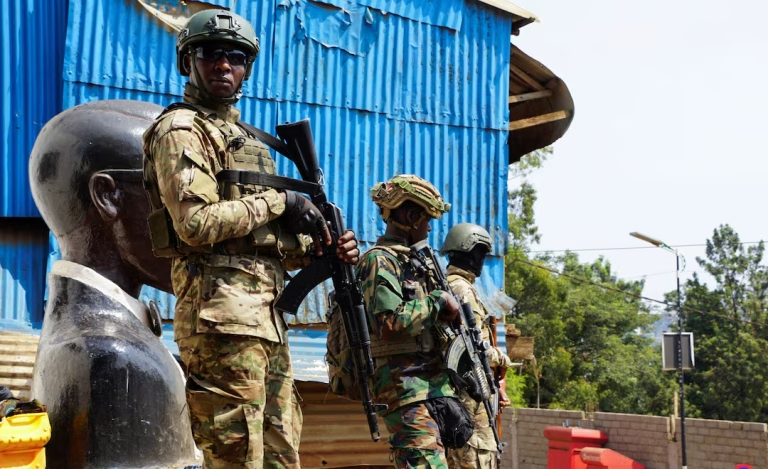
According to officials from the UN’s refugee organization, more than four million individuals have been forced to escape Sudan’s civil unrest since the conflict erupted in 2023. Many of those who fled are now enduring harsh conditions, with limited access to shelter due to insufficient financial support.
“Now in its third year, the 4 million people is a devastating milestone in what is the world’s most damaging displacement crisis at the moment,” U.N. refugee agency spokesperson Eujin Byun told a Geneva press briefing.
She warned, “If the conflict continues in Sudan, thousands more people, we expect thousands more people will continue to flee, putting regional and global stability at stake.”
Sudan, which plunged into internal warfare in April 2023, is geographically connected to seven neighboring nations: Egypt, Libya, Chad, the Central African Republic, South Sudan, Eritrea, and Ethiopia.
Chad alone has taken in over 800,000 people escaping the violence, and conditions there remain critical. Limited funding has worsened the situation, with only a fraction of the needed support received—just 14% of financial appeals have been fulfilled, according to Dossou Patrice Ahouansou of the refugee agency.
“This is an unprecedented crisis that we are facing. This is a crisis of humanity. This is a crisis of … protection based on the violence that refugees are reporting,” he said.
Ahouansou recounted stories of severe trauma and violence faced by those displaced. He described meeting a child in Chad—a seven-year-old girl who had suffered severe injuries during an assault on the Zamzam displacement camp.
The same incident claimed the lives of her father and two brothers. During the journey to safety, she had to undergo a leg amputation. Her mother, he added, had already been lost in a previous attack.
Additional survivors shared haunting accounts of their escape. Armed militias reportedly seized their animals and, in the chaos, forced them to transport injured or elderly family members in makeshift carts as they fled the country.
The Messi-Ronaldo era is gradually giving way to a new generation of elite footballers. With stunning performances across Europe’s top leagues, players like Ousmane Dembele are beginning to turn heads. Who are the names we should watch out for as future Ballon d’Or winners?
1. Ousmane Dembélé – The Rebirth of a Maestro
Current Club: Paris Saint-Germain
Why He Stands Out: Dembélé has redefined his game under manager Luis Enrique, evolving from a mercurial winger to a clinical central striker. This positional shift has yielded an impressive 33 goals and 15 assists in 49 appearances across all competitions.
His standout performances were instrumental in leading PSG to a historic treble—winning the Champions League, Ligue 1, and the French Cup. Dembélé’s transformation and consistency have made him the odds-on favourite to win the 2025 Ballon d’Or.
2. Kylian Mbappé – The Natural Successor
Current Club: Real Madrid
Pedigree: World Cup winner, consistent top scorer, global superstar.
Why He’s a Strong Contender: Mbappé had a prolific individual season with 31 league goals for Real Madrid.
However, his first year at Real Madrid lacked major team successes, potentially dampening his Ballon d’Or chances. A strong performance in upcoming international tournaments could bolster his candidacy.
3. Jude Bellingham – Midfield Dynamo With a Midas Touch
Current Club: Real Madrid
Rise to Stardom: From Birmingham to Dortmund to dominating in La Liga.
Why He’s Unique: Bellingham’s mature gameplay, leadership, and goal-scoring ability from midfield set him apart. In the Champions League, he played 11 matches, scoring 3 goals and providing 2 assists, with a passing accuracy of 90.55%.
If he continues to lead Madrid’s midfield and plays a key role in England’s international campaigns, he’s a real threat for the Ballon d’Or.
4. Erling Haaland – The Goal Machine
Current Club: Manchester City
Why He’s Feared: Haaland’s goal-scoring prowess is unmatched. In the 2024/25 season, he scored 21 goals in 28 Premier League appearances and 8 goals in 9 Champions League matches.
Despite his individual brilliance, Manchester City’s lack of major trophies this season could impact his Ballon d’Or aspirations. However, if he maintains his scoring rate and secures significant titles, he remains a strong contender.
5. Vinícius Júnior – The Brazilian Flair Reimagined
Current Club: Real Madrid
Why He Captivates: Vinícius’s skill, speed, flair, and growing maturity have been pivotal for Real Madrid. He became the youngest player to score in two Champions League finals, registering six goals and five assists in Madrid’s trophy-winning campaign.
His performances have earned him the UEFA Champions League Player of the Season award. A Copa America win with Brazil or a Ballon d’Or-worthy UCL campaign could push him over the edge.
Honourable Mentions: Players on the Radar
Mohamed Salah – Liverpool’s talisman had an outstanding season, scoring 29 goals with 18 assists, leading them to a Premier League title.
Lamine Yamal – Barcelona’s 17-year-old prodigy dazzled with his relentless style, scoring 19 goals and winning LaLiga, the Spanish Cup, and the Spanish Super Cup.
Khvicha Kvaratskhelia – Contributed significantly to Napoli’s Serie A success and later PSG’s Champions League campaign.
The Ballon d’Or is no longer a two-horse race. With new stars rising, it’s a thrilling time for football. Whether it’s Dembélé’s flair, Bellingham’s intelligence, or Haaland’s brutal efficiency, fans have every reason to be excited for the next chapter.
The Dutch ruling alliance has come undone after Geert Wilders, the leader of the far-right Freedom Party, abruptly pulled his party out of the government.
This dramatic exit, triggered by disagreements over immigration policy, is expected to lead to early national elections.
A final effort to salvage the coalition took place Tuesday morning when Prime Minister Dick Schoof attempted to negotiate with coalition partners. However, the meeting collapsed in under a minute when Wilders left the room, effectively ending the government.
Wilders had demanded ten new asylum-related restrictions, such as suspending asylum intake, ceasing the development of refugee shelters, and restricting the reunification of migrant families.
“No signature for our asylum plans. PVV leaves the coalition,” said Wilders on X, referring to his Freedom Party.
The announcement stunned the political sphere. Many leaders expressed disbelief, pointing out that several of Wilders’ asylum policies were already agreed upon in the coalition pact, and his party had the means to pursue them without further conflict.
A number of the extra measures Wilders proposed had previously been excluded during coalition negotiations, with legal implications cited as the primary concern.
With this move, Wilders has dismantled a fragile government that was only formed in July 2024, following extended talks that emerged from the election the year prior.
Although Wilders’ PVV held the most seats, it governed in partnership with three others still officially part of the coalition: the VVD (a right-leaning liberal party), the BBB (Farmers’ Citizen Movement), and the centrist NSC (New Social Contract).
Critics from within the alliance say Wilders orchestrated the collapse. VVD’s Dilan Yesilgoz described the withdrawal as “super irresponsible,” and added: “This wasn’t about asylum at all.”
“I think Wilders is betraying the Netherlands,” said deputy Prime Minister Mona Keijzer from the BBB.
Opposition figures, meanwhile, celebrated the fall of the government. The Socialist Party’s Jimmy Dijk said the country had been “liberated from a political hostage situation”, and labeled the coalition “four right-wing quarrelsome parties that achieve nothing”.
Economists weighed in on the situation, noting that the outgoing government had “barely made any concrete plans” during its tenure, suggesting the economic repercussions of its collapse would be limited.
There was also strong criticism of how the government was handled, with one outlet describing it as a cabinet “that was supposed to stand up for the citizens [but] was destroyed by amateurism and incompetence.”
Analysts believe Wilders may have welcomed the collapse, as his party’s popularity has been slipping in recent polls. His decision to trigger the crisis over asylum matters likely signals a strategy to center his next campaign around immigration.
Still, since the PVV has managed asylum policy over the past year, it remains uncertain whether voters will rally behind his latest tactic.
Government ministers are expected to hold urgent discussions this afternoon, after which Prime Minister Schoof will likely submit the cabinet’s resignation to King Willem-Alexander before the day ends.
Speculation suggests new elections might be scheduled for the fall.
Alternatively, Schoof could remain in charge of a minority administration, but that would require complex cooperation between center-right factions and progressive parties to advance any legislation—a scenario many believe improbable. Frans Timmermans of the Labour-Green alliance has already pushed for a new election.
With a NATO summit set to take place in The Hague later this month, the current ministers are expected to continue temporarily in a caretaker role until the country heads back to the ballot box.
A recent investigation has found that at least 21 civilians were executed over a two-day period in February by M23 rebels, who are allegedly supported by Rwanda, in the eastern Congolese city of Goma.
The documented events took place between February 22 and 23 in one of Goma’s communities, capturing a grim snapshot of the turmoil intensifying in the region’s long-standing conflict.
“Commanders and combatants who directly ordered or carried out abuses should be held criminally accountable,” the report stated.
The rebel group, known as M23, has taken control of both Goma and Bukavu—eastern Congo’s largest urban centers—following an aggressive campaign that began in January. This offensive has reportedly resulted in thousands of deaths and widespread displacement.
On February 22, six men and a woman were reportedly executed with gunshots to the head near the Katindo military facility in Goma. A witness account pointed to M23 responsibility.
Another episode involved victims whose remains were discarded at a construction area within close proximity—less than 100 meters—from the military base. One of the victims was a 15-year-old boy who had been forcibly removed from his residence; his body was later recovered at the scene, according to statements from both a relative and a neighbor.
The Kasika area of Goma was singled out, according to the report, due to its history as a location for Congolese military installations.
Violence continued on February 23 when approximately 20 young men were apprehended by the group at a sports ground nearby. One eyewitness recounted that the rebels accused the group of being associated with national security forces. Three individuals attempting to flee were gunned down.
An M23 commander responded to the accusations by indicating the group would launch an internal inquiry and make their conclusions public.
“HRW gives us an opportunity to mirror ourselves. We respect this organization despite its past accusations which proved to be false,” said M23 leader Bertrand Bisimwa.
The actual number of lives lost during the Goma violence may be greater than documented. Medical responders in the area noted that over 50 deceased individuals were retrieved from Kasika alone during the two-day span.
Previous accounts from other groups have detailed similar atrocities linked to the ongoing unrest since M23 began its territorial campaign.
In one report from March, rebels were said to have invaded medical facilities in Goma in search of wounded Congolese troops, abducting over 130 people, including hospital workers. Many of those taken were reportedly subjected to torture, and some have yet to be located.
Another organization recorded a dramatic increase in sexual assaults, with five times more rape cases reported across dozens of medical sites in February compared to previous months. Nearly one-third of those victims were minors.
In one particularly disturbing account, a woman disclosed that all six of her daughters—one as young as 12—were raped by armed men who raided their home while scavenging for food.
The origins of this prolonged violence can be traced back to the aftermath of Rwanda’s 1994 genocide and the fierce competition for Congo’s immense mineral wealth. While Rwanda has been accused of supporting the M23 group, it denies the claims, asserting that its military actions are purely defensive responses to threats from Congo’s forces and their allied militias.
A South African court on the 30th of May, 2025 convicted and sentenced to life in prison, Racquel Smith, also known as Kelly Smith, for kidnapping and trafficking her daughter, Joshlin earlier this month.
The 35-year-old mother of three was sentenced along with her boyfriend Jacquen Appollis and their friend Steveno van Rhyn.
The conviction and sentencing at a hearing in Saldanha Bay, near Cape Town, was handed down to Joshlin’s mother who is a drug addict and believed to have sold her for money.
Who Is Joshlin Smith
Joshlin Smith, a six-year-old girl from the seaside town of Saldanha Bay in South Africa’s Western Cape, disappeared on 19 February 2024.
Known for her soft spoken nature and distinctive green eyes, Joshlin’s absence ignited a national outcry over child trafficking and failures in child protection systems.
Described by her teachers as a neat and quiet learner, Joshlin was one of three siblings living with her mother, Racquel “Kelly” Smith.
While little is publicly known about her personal life, her disappearance and the revelations that followed have horrified the country.
What Happened
After Joshlin vanished in February last year, her mother reported that she had left the child in the care of her boyfriend, Jacquen Appollis.
Initial assumptions were that the child had gone missing under unclear circumstances but the case triggered widespread search efforts by local authorities and community volunteers.
A reward of one million rand was even posted in the hopes of encouraging tips.
However, as the investigation progressed, what unfolded was a story far darker than a missing child.
Weeks into the investigation, three individuals Kelly Smith, Jacquen Appollis, and their friend Steveno van Rhyn were arrested and charged with kidnapping and human trafficking.
Court testimonies and witness accounts revealed that Kelly had allegedly agreed to sell her daughter for R20,000 (approx. $1,118) to a traditional healer, popularly known as sangoma in South Africa, who reportedly expressed interest in the child due to her light complexion and green eyes.
In May 2025, all three were convicted and sentenced to life imprisonment for human trafficking and an additional 10 years for kidnapping.
The sentencing took place in a local community sports hall, ensuring that the public could bear witness to the judicial process.
Although the court delivered justice through sentencing, Joshlin’s body is still not found, and her exact fate remains unknown.
Social media reactions
The case has stirred powerful reactions across social media. The hashtag #JusticeForJoshlin trended nationwide as South Africans expressed heartbreak and anger. Thousands of users shared messages of sympathy and condemnation, while others called for stronger measures to fight child trafficking and ensure better protection for children in at-risk communities.
Some expressed disappointment that despite the life sentences, the child remains missing. “Apparently South Africa doesn’t have the death penalty otherwise there’s absolutely no reason for that vile person, who claimed to be a “mother”, to remain alive. What happened to eye for an eye?… no pun intended,” an X user named LadyPatriot tweeted.
Apparently South Africa doesn’t have the death penalty otherwise there’s absolutely no reason for that vile person, who claimed to be a “mother”, to remain alive. What happened to eye for an eye?… no pun intended
Another tweet by X user Hazel Lang read: “Wish it her being burnt worst mother ever..cold hearted person is Kelly Smith she must rot in prison and her other kids given for adoption..”
Wish it her being burnt 😪 worst mother ever..cold hearted person is Kelly Smith 💔 she must rot in prison and her other kids given for adoption..
Police have also warned against misinformation spreading online, urging the public to rely on verified updates and not interfere with ongoing investigations.
The Government’s Response To Child Trafficking
South African authorities responded swiftly following the convictions, using the case to reaffirm the state’s position against human trafficking and crimes against children.
In an official statement, the Department of Justice said: “These acts were despicable. We will not tolerate the exploitation of children under any circumstances. These sentences must serve as a deterrent to those who believe they can profit from innocent lives.”
Western Cape Premier Alan Winde added: “This case has shaken us all. The justice system has spoken, and now we must work even harder to prevent such tragedies in the future. Protecting our children must always be our top priority.”
The Department of Social Development also called for improved child monitoring and awareness campaigns in vulnerable communities, especially where economic desperation might make families susceptible to coercion or exploitation.
For the people of Saldanha Bay, Joshlin’s absence remains a gaping wound.
Her school has left her seat unfilled, while community vigils continue to be held in her memory.
Despite the convictions, hope remains that someday, answers about her final moments or her possible whereabouts will surface.
Joshlin’s story is not only a tale of personal betrayal, but also a warning. It highlights the grim realities of child exploitation in South Africa and the urgent need for vigilance, education, and systemic reform.
According to police statistics, a child goes missing every five hours in South Africa.
On Monday, Annalena Baerbock, who previously served as Germany’s foreign minister, was chosen through a confidential vote to preside over the 80th session of the United Nations General Assembly.
As part of the UN’s rotation tradition among regional groups, the Western European and Other States Group was due to provide this session’s president. Baerbock emerged as the nominee and received 167 votes in favor.
“it is fitting that in this milestone 80th year of the General Assembly, leadership should fall to someone whose career has been defined by an unwavering commitment to multilateralism,” said Philemon Yang, the current President of the General Assembly’s 79th session.
Although the election was conducted by secret ballot at Russia’s request, the outcome had been expected, as Baerbock stood unopposed in the race for the one-year leadership role.
She won a decisive endorsement from the member states, earning nearly twice the minimum threshold required.
In this new capacity, Baerbock will be responsible for coordinating the General Assembly’s discussions, bringing together representatives from its 193 member nations, and acting as the Assembly’s public face in international affairs.
Her term begins at a moment when multiple global conflicts continue to unfold.
“Today, we live in challenging times. We are walking on a tightrope of uncertainty. At the birth of the United Nations, 80 years ago, reminds us we have lived through difficult times before, and it’s up to us to take on these challenges.” Annalena Baerbock said during a speech to the General Assembly.
Her appointment marks the fifth time a woman has been chosen to lead the UN’s primary decision-making chamber.
The Federal Government of Nigeria has declared Friday, June 6, and Monday, June 9, 2025, as public holidays to mark this year’s Eid-el-Kabir celebrations.
This announcement was made by the Minister of Interior, Olubunmi Tunji-Ojo.
Eid-el-Kabir, also known as Eid al-Adha or the Feast of Sacrifice, is one of the most significant festivals in Islam.
It commemorates the willingness of Prophet Ibrahim (Abraham) to sacrifice his son in obedience to God’s command. In remembrance of this act of faith, Muslims around the world, including Nigeria, perform the ritual of animal sacrifice, typically of sheep, goats, or cows. The meat is then distributed among family, friends, and the less fortunate — emphasizing the values of charity, community, and devotion.
In his official remarks, Minister Olubunmi Tunji-Ojo stated:
“Muslims should continue to imbibe the spirit of sacrifice and faith as exemplified by Prophet Ibrahim (peace be upon him).”
He urged Nigerians to take advantage of this holiday not only for celebration but for spiritual and national reflection, adding:
“This is a time to pray for a peaceful and prosperous Nigeria.”
He further highlighted the government’s commitment to national progress:
“The people-oriented reforms and initiatives carried out, in furtherance of the Renewed Hope Agenda of President Bola Tinubu’s Administration, are to restore Nigeria on the path of progress.”
The Minister concluded with a national call to action:
“Let us all join hands with the present administration in its efforts to restore the glory of Nigeria as a great nation.”
Upcoming Public Holidays in Nigeria
Beyond Eid-el-Kabir, several other public holidays are scheduled in Nigeria for the rest of 2025:
June 12 – Democracy Day
Democracy Day is observed annually on June 12 to commemorate the restoration of democratic governance in Nigeria in 1999. It also honors the 1993 presidential election, which is regarded as the freest and fairest in Nigeria’s history.
June 27 – Al-Hijra (Islamic New Year)
Al-Hijra marks the beginning of the Islamic New Year. It commemorates the migration (Hijra) of Prophet Muhammad from Mecca to Medina. As with all Islamic holidays, the exact date depends on lunar sightings.
September 5 – Eid-el-Maulud (Prophet Muhammad’s Birthday)
This day celebrates the birth of Prophet Muhammad. It’s a time for Muslims to reflect on his teachings and life. The date may vary depending on moon sighting.
October 1 – Independence Day
On this day in 1960, Nigeria gained independence from British colonial rule. It is marked with parades, patriotic speeches, and national celebrations across the country.
December 25 – Christmas Day
Celebrated by Christians across Nigeria, Christmas commemorates the birth of Jesus Christ. It’s a time of joy, family gatherings, and religious reflection.
December 26 – Boxing Day
The day after Christmas, Boxing Day is traditionally a time for charity and gift-giving. In Nigeria, it is also a public holiday, observed with leisure activities and extended family time.
Nigeria’s public holidays span various religious and cultural backgrounds, reflecting the country’s rich diversity and deep traditions. As we approach these significant dates, it’s a time to embrace the spirit of unity and shared values that these celebrations represent.
The Technical and Vocational Education and Training (TiVET) programme has received an overwhelming response, with over 95,000 applications received nationwide within 72 hours of its official launch. The Minister of Education, Dr. Maruf Alausa, disclosed this via his official X account.
The TiVET initiative, launched on May 29, 2025, aims to equip millions of young Nigerians with practical, industry-relevant skills to drive national development. The programme has three flagship components: Master6, Master12, and Technical College Track, each with 80% practical and 20% theoretical training.
The training is scheduled to begin in August 2025 across Vocational Enterprise Institutes, Skills Training Centres, and Federal and State Technical Colleges. The programme offers standardised skills certification, free education at public technical schools, monthly stipends, and access to starter packs and low-interest loans for entrepreneurship.
The TiVET programme will offer training in 25 skill areas nationwide. With the huge response, the programme is set to make a significant impact on the country’s human capital development and economic growth.
Nollywood, Nigeria’s dynamic film industry, is one of the largest in the world by volume and cultural influence. As the industry grows, so does its need to recognize excellence and this has led to the rise of major award platforms like the Africa Magic Viewers’ Choice Awards (AMVCA), Africa Movie Academy Awards (AMAA), and Best of Nollywood (BON) Awards.
These events shine a spotlight on the hard work of filmmakers, honoring achievements in acting, directing, writing, and technical production. They provide a moment of recognition for creatives and help elevate careers, open doors to new opportunities, and sometimes even influence trends in the industry.
However, while the applause is well-deserved, there is a growing conversation around how these awards can evolve. Many voices in the industry are now calling for more diversity in recognition highlighting the need to spotlight emerging talents, underrepresented voices, and unique storytelling styles that push the boundaries of traditional filmmaking.
Celebrating excellence should be inclusive and transparent, ensuring that Nollywood’s award culture not only honors achievement but also inspires innovation, growth, and the next generation of storytellers.
On Monday, Prime Minister Keir Starmer declared that the United Kingdom would move toward a heightened state of military preparedness, pledging the construction of as many as 12 advanced attack submarines. This initiative is part of a broader strategic overhaul aimed at reinforcing the country’s defense posture amid a global landscape he described as increasingly volatile.
“The threat we now face is more serious, more immediate and more unpredictable than at any time since the Cold War,” Mr. Starmer stated during a press event, highlighting mounting risks such as “war in Europe, new nuclear risks, daily cyberattacks,” and “growing Russian aggression,” both in the air and at sea near British territory.
“I believe that the best way to deter conflict is to prepare for it,” he added while speaking from a production site in Glasgow, just prior to the anticipated release of a comprehensive defense policy review. The plan includes initiatives to boost drone manufacturing and bolster reserves of essential military hardware.
The decision to significantly enhance Britain’s defense capabilities comes as the war in Ukraine intensifies, U.S. commitment to European stability appears to wane, and overall geopolitical tensions rise. Starmer’s announcement came only hours after Ukrainian forces reportedly executed one of the largest aerial attacks of the conflict by deploying drones against Russian military airfields.
The defense review, commissioned shortly after Starmer’s election win, was spearheaded by George Robertson, a former NATO chief. The urgency of the review was further escalated by perceptions of President Trump’s wavering stance on safeguarding Europe and his unusually cordial rapport with President Vladimir V. Putin.
While the full details of the review are expected later in the day, some of its core recommendations have already been revealed. These include the acquisition of up to 7,000 domestically manufactured long-range missiles and the establishment of a new national cyber defense unit. Additionally, £1 billion has been earmarked for upgrading digital capabilities across the armed forces.
Part of the strategy involves shoring up Britain’s vulnerable undersea infrastructure and expanding its drone fleet—technologies that have proven crucial in recent military operations, especially in Ukraine.
An extra £1.5 billion will also be directed toward improving military accommodation, part of a broader effort to address the decline in army recruitment and retention, which has pushed personnel numbers to historic lows not seen since the early 19th century.
Officials emphasized that defense spending could stimulate the British economy, though concerns persist about the feasibility of funding these ambitions during a period of economic constraints.
To finance this expansion, Starmer has pledged to raise defense spending to 2.5% of the country’s gross national product, partially by reallocating funds from foreign aid. In a broadcast interview, he affirmed the need to eventually reach 3%, though he admitted that a definitive timeline depends on identifying sustainable revenue sources.
The expansion of the submarine fleet will be carried out under a trilateral security pact with the U.S. and Australia, which seeks to counterbalance China’s increasing assertiveness in the Indo-Pacific. This pact will see the deployment of up to 12 conventionally armed, nuclear-powered submarines.
Government officials have described this pivot as a “landmark shift in our deterrence and defense: moving to warfighting readiness to deter threats and strengthen security in the Euro Atlantic area.”
In his Monday remarks, Mr. Starmer reaffirmed the U.K.’s deep-rooted allegiance to NATO and its enduring alliance with North America, which he has sought to solidify by engaging closely with Mr. Trump on matters of security and commerce.
Among the bold proposals in the review is a call to explore the purchase of aircraft capable of launching tactical nuclear arms—raising questions about Britain’s reliance on the U.S. for extended nuclear deterrence.
On social media, Liberal Democrat MP and military veteran Mike Martin suggested that the direction of the review signals a diminishing confidence in the U.S. role in European defense.
He wrote: “The drop dead giveaway is the air dropped nuclear weapons,” adding that “this is a key capability that the US provides that enables nuclear escalation without going all the way up to destroying Moscow with nuclear weapons fired from our submarines.”
The United Kingdom has maintained a tradition of publishing major defense policy reviews roughly every ten years. The previous one was carried out in 2021, then refreshed in 2023.
This most recent review was guided by Lord Robertson, who was joined by Fiona Hill—formerly a key advisor in the first Trump administration—and Richard Barrons, once deputy head of Britain’s defense command. Hill, known for her expertise on Russian affairs, has publicly criticized Trump’s approach to Putin since her resignation from the U.S. National Security Council in mid-2019.
Observers expect the tone of this review to differ substantially from its predecessor, which, under Boris Johnson’s leadership, emphasized stronger U.S.-U.K. ties in a post-Brexit world. That vision has since been replaced by Starmer’s attempt to reforge relationships with the European Union.
To provide the best experiences, we use technologies like cookies to store and/or access device information. Consenting to these technologies will allow us to process data such as browsing behaviour or unique IDs on this site. Not consenting or withdrawing consent, may adversely affect certain features and functions.
Functional
Always active
The technical storage or access is strictly necessary for the legitimate purpose of enabling the use of a specific service explicitly requested by the subscriber or user, or for the sole purpose of carrying out the transmission of a communication over an electronic communications network.
Preferences
The technical storage or access is necessary for the legitimate purpose of storing preferences that are not requested by the subscriber or user.
Statistics
The technical storage or access that is used exclusively for statistical purposes.The technical storage or access that is used exclusively for anonymous statistical purposes. Without a subpoena, voluntary compliance on the part of your Internet Service Provider, or additional records from a third party, information stored or retrieved for this purpose alone cannot usually be used to identify you.
Marketing
The technical storage or access is required to create user profiles to send advertising, or to track the user on a website or across several websites for similar marketing purposes.