Home Blog Page 183

UK and EU Chart a New Course in Relations Following Brexit

After intense late-night negotiations, European Union diplomats announced on Monday that both sides had come to an agreement aimed at re-establishing cooperation with the United Kingdom, addressing several contentious issues.

Member nations within the EU gave the green light to three key documents, with a strong focus on defense matters and a last-minute consensus on the long-disputed fishing rights.

Prime Minister Starmer has been advocating for improved relations between the UK and its European neighbors. The Labour administration maintains that the previous agreement made by the Conservative-led government with the EU “isn’t working for anyone.”

However, despite taking office following the general election last July that ended Conservative rule, Starmer has outlined clear boundaries that he does not intend to compromise on.

Certain demands from the EU remain unresolved, and the Conservative opposition has labeled the renewed cooperation effort as a “surrender.”

An insider involved in the negotiations told AFP that there had been a “late breakthrough last night (and) still steps to take.”

The primary outcome of Monday’s discussions is the signing of the “Security and Defence Partnership” during a meeting between Starmer and top EU figures including Ursula von der Leyen, Antonio Costa, and Kaja Kallas.

In addition to that, two further documents are expected: a joint declaration underscoring unity between the EU and UK, and a Common Understanding outlining shared priorities on matters such as trade, youth mobility, and fisheries.

According to diplomats, the final arrangement includes the UK allowing continued access to its waters for EU fishing fleets for 12 years beyond the expiration of the current agreement in 2026. In exchange, the EU has agreed to permanently reduce bureaucratic barriers on food imports coming from the UK.

When it comes to youth mobility, negotiators settled on a broad framework, postponing detailed discussions to a later stage.

This issue remains a sensitive one, with UK officials concerned that any new youth mobility system might resemble the previous freedom of movement between the UK and EU.

The talks are taking place at a time when both sides are ramping up defense capabilities amid ongoing concerns over Russia and uncertainty about whether the US, especially under a possible second Trump presidency, would remain committed to defending Europe.

The newly agreed defence partnership envisions more consistent security coordination, possible UK participation in EU military operations, and future access for Britain to a €150 billion defense fund under development by the bloc.

However, many specifics are yet to be determined.

Granting full access to British defense firms and involvement in EU defense projects will require additional negotiation.

Given that the UK already shares strong defense links with 23 EU countries through NATO, reaching a defense pact was widely expected to be the least contentious part of the talks.

“I think we should keep our sense of the importance of this relatively tempered,” said Olivia O’Sullivan, director of the UK in the World programme at the Chatham House think-tank.

“It’s the next step in closer cooperation… but not a resolution of many of the outstanding questions,” she told AFP.

While Starmer has dismissed the possibility of the UK rejoining the EU’s single market or customs union, he appears open to regulatory alignment on agricultural and food-related goods.

“Red tape, all the certifications that are required, we absolutely want to reduce that,” Europe Minister Nick Thomas-Symonds, the UK’s chief negotiator, told the BBC on Sunday, citing instances of food waste caused by prolonged customs delays.

Although Starmer remains opposed to reinstating freedom of movement, he supports a targeted youth mobility arrangement that would permit some individuals aged 18 to 30 from both regions to study and work across the UK and EU.

His cautious stance reflects the growing popularity of Reform UK, led by Nigel Farage, which strongly opposes immigration and supports a hardline Brexit agenda.

Thomas-Symonds described any potential youth mobility framework as “smart and controlled.”

He also mentioned the UK’s goal of creating a streamlined customs process for its citizens traveling to EU countries.

“We want British people who are going on holiday to be able to go and enjoy their holiday, not be stuck in queues,” he said.

Nigeria’s Security Crisis Demands Action, Not Summits

0

Nigeria is under siege. In May 2025, a relentless wave of violence has swept through Borno, Benue, and Plateau, claiming over 40 lives. Boko Haram and its splinter group, ISWAP, have unleashed deadly assaults in Borno, deploying armed drones and roadside explosives. In Benue and Plateau, herder-farmer clashes and cattle rustling have fueled bloodshed, driven by ethnic and religious tensions. The United Kingdom’s High Commissioner, Richard Montgomery, has called Nigeria’s security situation “worrisome,” pointing to spillovers from conflicts in Sudan and Niger. As the Senate proposes a national security summit, skepticism looms: Is this a step toward solutions or just political posturing?

A Month of Bloodshed

In Borno, the violence has been unrelenting. On May 7, Boko Haram attacked the Izge community in Gwoza, killing an army captain and a soldier. On May 12, the 153 Task Force Battalion in Marte was overrun, with armored tanks burned and ammunition seized—an attack that echoes the deaths of 22 soldiers in Malam-Fatori weeks earlier. The use of drones and explosives signals a dangerous escalation, exposing gaps in Nigeria’s military capacity.

In Benue, the herder-farmer conflict continues to devastate communities. Between May 9 and 13, at least 23 people were killed across Guma, Logo, Ukum, and Kwande. In Ukum’s Jootar town, eight farmers were slain on May 10, with attacks linked to tensions over land and resources, worsened by climate pressures and a lack of effective land-use policies.

In Plateau’s Riyom LGA, between May 12 and 14, at least 10 people were killed in retaliatory attacks sparked by cattle rustling and farm destruction. Over 100 cattle were lost, and several others were injured in communities like Dayan, Danchindo, Darwat, and Wereng Kam. These incidents underscore the persistent ethnic and resource-driven conflicts plaguing the region.

A Regional Crisis

The UK High Commissioner’s warning highlights a broader regional threat. Instability in Sudan and Niger has fueled the flow of arms and fighters across Nigeria’s porous borders, amplifying insecurity. The UK’s collaboration with Nigeria’s National Security Adviser and investments in security infrastructure are welcome, but stronger regional cooperation through the Multinational Joint Task Force is critical to stem cross-border threats.

The Senate’s Summit: Action or Theater?

On May 6, the Nigerian Senate resolved to hold a two-day national security summit to address the crisis, following a motion led by Senator Jimoh Ibrahim. Senate President Godswill Akpabio tasked an ad hoc committee with organizing the event, but doubts persist. The Federal Government, through Defence Minister Mohammed Badaru, has prioritized a new military strategy over the summit, arguing it’s more urgent. Past summits have produced reports that gather dust—any new effort must deliver a clear, time-bound action plan with measurable goals, such as increased funding for intelligence and border security. Given the ethnic and religious complexities of Nigeria’s insecurity, inclusive representation from affected communities is essential to ensure legitimacy.

A Path Forward

President Bola Tinubu has directed security chiefs to end the violence in Borno, Benue, Plateau, and Kwara, emphasizing community involvement and coordination with state governors. National Security Adviser Nuhu Ribadu’s “total war” approach focuses on enhanced intelligence, regional cooperation, and curbing small arms proliferation. An effective strategy must go further: strengthening intelligence to preempt attacks, fostering community-led peacebuilding, and tackling root causes like poverty and land disputes. Without accountability for military abuses and inclusive governance, Nigeria risks perpetuating this cycle of violence.

The Stakes

Nigeria’s security crisis demands more than summits or rhetoric—it requires decisive action. The bloodshed in Borno, Benue, and Plateau is a call to overhaul the national security framework. The government must act swiftly to restore hope, proving its resolve is stronger than the forces tearing the nation apart.

TRCN Board Chair Endorses PQE as Vital to Professionalizing Teaching

The Chairman of the Teachers Registration Council of Nigeria (TRCN) Governing Board, Dr. Saliu Mustapha, has described the Professional Qualifying Examination (PQE) as a crucial step in sanitising and professionalizing Nigeria’s teaching profession.

Speaking during a monitoring visit to the May 2025 PQE at the National Open University of Nigeria (NOUN) CBT Centre in Abuja, Dr. Mustapha emphasized the need to ensure that only qualified teachers are allowed in classrooms.

He noted ongoing reforms in the education sector, including the development of an IT-driven platform by the Federal Ministry of Education to verify teachers’ qualifications.

This system, he explained, will enable parents to confirm the certification status of their children’s teachers, holding both educators and institutions accountable.

The initiative, he said, is part of Education Minister Dr. Morufu Alausa’s broader effort to eliminate unqualified teachers through technology.

Dr. Mustapha commended the smooth nationwide conduct of the PQE and applauded the impressive turnout of candidates, stressing that professional exams like the PQE are essential to upholding standards, particularly in private schools.

TRCN’s Acting Registrar, Stella Maria Nwokeocha, revealed that about 13,700 candidates sat for the exam nationwide, with 594 at the Abuja centre.

She noted the exercise went largely without hitches, though adjustments were made in a few states due to scheduling conflicts with the rescheduled UTME.

Also speaking, the Minister of Education’s representative, Ismaila Adiatu, expressed satisfaction with the conduct of the exam, praising its organization and transparency.
His remarks reaffirmed the government’s support for TRCN’s mission to maintain professionalism in teaching.

Meanwhile, TRCN’s Director of Certification and Licensing, Dr. Jacinta Ezeahurukwe, announced that the PQE results will be released within a week pending final collation and approval.

She also highlighted the need for increased funding to strengthen the council’s operations and sustain regulatory standards.

PDP’s Breaking Point: Wike, Fubara, and the Fight for 2027

The People’s Democratic Party (PDP) is teetering on the edge of a political abyss, its once-mighty machinery creaking under the weight of defections, internal rifts, and a high-stakes power struggle that could define its fate in the 2027 elections. The PDP governors’ meeting on Sunday, May 11, 2025, in Abuja was billed as a lifeline—a chance to stem the bleeding and unify a fractured party.

But with key players absent and old wounds festering, the gathering exposed just how deep the cracks run. At the heart of this drama lies the explosive feud between Rivers State Governor Siminalayi Fubara and his former mentor, FCT Minister Nyesom Wike, whose reconciliatory overtures raise more questions than answers. Is the PDP capable of pulling itself together, or is it hurtling toward irrelevance?

A House Divided: The Governors’ Meeting and Its Fault Lines

Convened by PDP Governors’ Forum Chairman Governor Bala Mohammed, the Abuja meeting brought together heavyweights like Seyi Makinde (Oyo), Ademola Adeleke (Osun), and, surprisingly, Nyesom Wike. The agenda was clear: tackle the wave of defections—like Delta State’s Governor Sheriff Oborevwori and Senator Ifeanyi Okowa to the APC—resolve leadership disputes, and chart a path for the 2027 elections. Yet, the absence of governors like Siminalayi Fubara (Rivers) and Umo Eno (Akwa Ibom) spoke volumes.

Fubara, sidelined by a six-month suspension under President Tinubu’s state of emergency in Rivers, is increasingly isolated, caught in a bitter feud with Wike. Eno’s absence fuels rumors of his own flirtation with the APC. These no-shows signal a party struggling to hold its ranks together, with factionalism threatening to unravel its national ambitions.

The governors’ focus on leadership disputes, such as the roles of Acting National Chairman Umar Damagum and the contested National Secretary position, is both a necessity and a potential distraction. The South-East PDP’s threat to exit if Udeh-Okoye isn’t recognized as National Secretary underscores regional tensions that could further splinter the party.

While stabilizing the leadership is critical to presenting a united front, these internal battles risk diverting energy from broader goals—like crafting a compelling narrative to challenge the APC’s dominance. The PDP must balance these priorities or risk being consumed by its own dysfunction.

Fubara’s Gambit: Peace or Posturing?

On the same day as the governors’ meeting, suspended Rivers State Governor Siminalayi Fubara took a different stage. Speaking at a service of songs honoring elder statesman Edwin Clark, Fubara declared he was “not desperate” to return to office, emphasizing peace and the interests of Rivers State over personal ambition.

His measured tone contrasts sharply with the aggressive rhetoric of his supporters, who demand his reinstatement amid a Supreme Court battle challenging Tinubu’s emergency rule. Is Fubara’s stance genuine, or is it a calculated bid to maintain public sympathy while his legal fight unfolds?

Fubara’s absence from the governors’ meeting highlights his precarious position within the PDP. Caught between loyalty to the party and his fallout with Wike, he risks alienation from both the party’s mainstream and his own base. The PDP’s credibility hinges on its ability to defend democratic principles, particularly in Rivers, where Tinubu’s state of emergency has been criticized as overreach.

The Supreme Court case is a flashpoint—not just for Fubara, but for the PDP’s ability to rally against perceived authoritarianism. The party must mediate this crisis without taking sides, lest it further inflame tensions with Wike’s powerful faction.

Wike’s Chess Game: Reconciliation or Control?

Enter Nyesom Wike, the PDP’s enigmatic powerhouse. During a media parley on Monday, May 12, 2025, Wike dropped a bombshell: Fubara, accompanied by two unnamed APC governors, had visited him to broker peace. Wike’s confirmation of this reconciliatory meeting, coupled with his attendance at the PDP governors’ meeting alongside figures like Bukola Saraki, underscores his enduring influence. Yet, his commitment to PDP unity is complicated by his alignment with the APC-led federal government and his hardline stance on controlling Rivers’ political structure—a key flashpoint with Fubara.

Is Wike’s peace overture sincere, or is it a tactical maneuver to tighten his grip on Rivers’ PDP? His dual strategy—mending internal rifts while flexing dominance—keeps the party on edge. Wike’s critics, like the Conference of Professionals in the ADP, demand his expulsion for “unrelenting outbursts” against the party and his work with the APC. Yet, his defenders argue that no PDP governor delivered as much as Wike did in 2023, securing victories across Rivers despite not backing Atiku Abubakar. The PDP faces a dilemma: embrace Wike’s influence to stabilize its base, or risk further division by sidelining him. Either way, his dominance is both a lifeline and a liability.

The Road to 2027: Defections, Elections, and Survival

The PDP’s survival hinges on its ability to address defections, win key elections, and resolve internal conflicts. The loss of figures like Oborevwori and Okowa is a body blow, particularly in Delta, a traditional PDP stronghold. To prevent further hemorrhaging, the party must strengthen grassroots mobilization, offer clear incentives for loyalty, and address regional grievances—like the South-East’s demand for the National Secretary role.

A Saraki-led reconciliation committee, announced at the governors’ meeting, is a step toward outreach, but its success depends on navigating Wike’s influence and Fubara’s isolation.

Off-season elections in Anambra, Ekiti, and Osun are critical tests. Victories here could rebuild momentum, signaling to voters that the PDP remains a viable alternative to the APC. The party’s strategy—mobilizing resources, galvanizing support, and possibly exploring coalitions with other opposition parties—must be executed with precision. Failure risks ceding more ground to a resurgent APC, which is already capitalizing on PDP’s disarray.

Can the PDP Rise Again?

The PDP stands at a crossroads, its path to 2027 fraught with peril and possibility. The Wike-Fubara feud, leadership disputes, and defections are not just internal squabbles—they are existential threats. The party must act decisively: mediate the Rivers crisis, unify its leadership, and present a bold vision that resonates with Nigerians weary of APC’s governance. Wike’s influence, for better or worse, cannot be ignored, but neither can Fubara’s plight or the broader party’s aspirations.

As the PDP navigates this turbulent terrain, one thing is clear: unity is not a luxury, but a necessity. The governors’ meeting was a start, but words must become action. The PDP’s ability to rise from its current malaise will determine whether it can challenge Tinubu in 2027—or fade into political oblivion. The clock is ticking, and Nigeria is watching.

Russian-Ukraine Peace Talks: Matters Arising

For the first time in over three years, Russian and Ukrainian negotiators gathered face-to-face on Friday at Istanbul’s historic Dolmabahçe Palace in a fresh attempt to revive peace talks amid the deadliest conflict in Europe since World War II. The meeting, mediated by Türkiye, comes amid mounting international pressure, particularly from U.S. President Donald Trump, to bring the war to a diplomatic end.

Friday’s summit marked the first direct engagement between both sides since March 2022, shortly after Russia’s full-scale invasion of Ukraine. The trilateral talks, hosted by Turkish Foreign Minister Hakan Fidan, brought together Russian, Ukrainian, and Turkish representatives in a 1-hour-45-minute closed-door session.

“We must seize this opportunity to advance on the path to peace,” Fidan urged in his opening statement, signaling Türkiye’s enduring role as a peace broker in the conflict.

Delegation Line-up and Leadership Absence

Though billed as high-stakes, the meeting lacked direct participation from either President Vladimir Putin, President Volodymyr Zelensky, or U.S. President Donald Trump.

Putin reportedly opted out of the summit to attend a scheduled military strategy session in Moscow, emphasizing Russia’s ongoing “security priorities.” Zelensky, on the other hand, declined to attend due to security concerns and frustration over what he perceived as Russia’s lack of genuine commitment to peace. Trump, despite his vocal interest, was absent due to his ongoing campaign activities in the U.S. and a scheduled diplomatic visit to the Middle East.

Russia’s delegation was led by presidential advisor Vladimir Medinsky, along with key military and foreign ministry officials, including Deputy Foreign Minister Mikhail Galuzin and Deputy Defense Minister Aleksandr Fomin.

Ukraine was represented by Defense Minister Rustem Umerov and senior intelligence officials. Turkish intelligence chief İbrahim Kalın was also present, underlining the country’s central role in mediation.

The U.S. was represented by a special envoy delegation led by Deputy Secretary of State for Political Affairs Victoria Nuland and Lt. Gen. James Glynn of the Pentagon, underscoring Washington’s strategic interest in the region.

Zelensky criticized Moscow’s decision to send what he called “stand-in props,” calling the move unserious. In response, Russia accused Ukraine of staging a political performance.

Stalemate and a Glimmer of Progress

While broader ceasefire efforts remain stalled, both nations reached a significant humanitarian agreement: a mutual exchange of 1,000 prisoners of war — the largest such swap since the war began.

However, hopes for a ceasefire were dashed when Ukraine’s proposal for a full, unconditional 30-day truce was outright rejected by Moscow. Instead, Russia reiterated new demands, including the withdrawal of Ukrainian troops from contested regions, which Ukraine dismissed as “unacceptable.”

Trump Influence and Global Pressure

U.S. President Donald Trump cast a long shadow over the talks. Speaking before and during the summit, Trump declared that “nothing’s going to happen” without a personal meeting between himself and President Putin. He reiterated his belief that such a meeting was essential to break the deadlock.

“Progress will stall unless I speak directly with Putin,” Trump told reporters, pledging to meet the Russian leader after his Middle East trip.

U.S. Secretary of State Marco Rubio, who attended the talks, echoed this sentiment, cautioning that “a major breakthrough is unlikely” without top-level dialogue.

Meanwhile, European leaders from France, Germany, and the UK issued a joint statement condemning Russia’s demands and called for renewed international unity in addressing the conflict’s humanitarian toll.

The peace talks ended with mixed signals. The agreement on the prisoner exchange offered a glimmer of hope, yet the absence of top leaders and the rejection of ceasefire proposals underlined the ongoing stalemate.

Despite calls for diplomacy, the road to peace remains obstructed by deeply entrenched positions. As the war grinds on, the global community continues to watch for signs (and leadership) that could shift the tide from battlefield to negotiation table.

Chief of Defence Staff Visits Borno Following Wave of Terrorist Attacks

0

The Chief of Defence Staff, General Christopher Musa, has arrived in Borno State amid heightened military tensions following a series of deadly attacks on military bases by Boko Haram and Islamic State West Africa Province (ISWAP) terrorists.

Sources confirm that four military formations came under coordinated assault this week, prompting urgent high-level security assessments in the region. Specifically, military bases in Rann, Gajiram, Dikwa, and Marte in Borno State were targeted, resulting in the deaths of at least four soldiers and an undisclosed number of casualties and missing personnel.

Additionally, on May 5, Boko Haram insurgents attacked the 27 Task Force Brigade in Buni Yadi, Gujba LGA of Yobe State, killing four soldiers and destroying multiple assets.

General Musa’s visit is aimed at boosting troop morale, evaluating on-ground operations, and coordinating a reinforced response to the renewed insurgent threats in Nigeria’s troubled northeast.

During his visit to Maiduguri, the Borno State capital, the CDS met with stakeholders, military commanders, and frontline troops to address the security breaches and recent attacks.

Speaking after a closed-door meeting with heads of military formations and commanders in the state, General Musa stated, “Actions are being taken to address the recent series of attacks. We have a new theatre commander assigned here, and other commanders have also been redeployed. A lot of equipment has been brought into the theatre.”

He attributed the resurgence of Boko Haram attacks in Borno State to growing instability in Sahel countries such as Mali, Chad, and Niger.

“If you look at the entire Sahel region, you’ll realise that the pressure in Mali, Chad, and Niger has significantly impacted Nigeria. That is why we’ve seen these recent attacks, but we are taking them very seriously and addressing them,” He said

General Musa assured that the resurgence of attacks was temporary, emphasizing, “Whatever is happening now is just for a short while. We have responded drastically, and going forward, there will be positive results from the theatre.”

“As we speak, our troops are out there in Sambisa and Timbuktu conducting operations.”

The CDS revealed that more equipment and air assets were being deployed, with additional actions underway to suppress the insurgents.

On the challenges of asymmetric warfare, he noted, “This type of warfare is very difficult because, unlike conventional warfare where you can bomb a whole community, here we have to respect human rights and protect civilians who are not combatants.”

“It requires time and precision. But I can assure you we are heading in the right direction and will continue to do more.”

General Musa also commended the resilience of Borno State residents and reaffirmed the military’s commitment to safeguarding lives and property.

“I want to assure the people of Maiduguri, the North-East, and Nigerians in general that the Armed Forces of Nigeria are determined, willing, and capable of restoring peace and security.

“We are working tirelessly toward that goal.”

He appealed to journalists for balanced reporting to avoid emboldening insurgents, saying, “Let us be fair and balanced in our reports. If our stories focus solely on what the insurgents are doing, we empower them psychologically and motivate them to continue.

“Let us uplift our troops through our reporting.”

The visit comes as part of a broader effort by service chiefs to address the deteriorating security situation across Nigeria’s North-East and North-West.

The Chief of Air Staff, Air Marshal Hasan Abubakar, has been touring strategic locations in Zamfara, Kano, and Katsina, while the Chief of Army Staff, Lt. Gen. Olufemi Oluyede, visited the headquarters of Operation Hadin Kai in Borno to lead operations and encourage troops.

A senior military official confirmed, “The service chiefs have been working very hard to ensure the attacks witnessed in recent times are reduced to the barest minimum.

“They are not sitting idle; they’re all actively engaged.”

Security experts have expressed concern over the increasing frequency of attacks.

Retired officer Chris Andrew emphasized the need for greater deployment of technology,

“A few months before Jonathan left office, the Boko Haram terrorists were effectively tackled by mercenaries who came with drones and other technologies, they succeeded by about 99 percent.”

Security analyst Oladele Fajana described the loss of military equipment to insurgents as alarming and warning.

“For such attacks to succeed, it points to a failure in intelligence gathering. That system needs urgent improvement.”

Further details of General Musa’s itinerary and operational updates are expected as the visit unfolds.

At Least 30 Killed in Separatist Attack on Okigwe-Owerri Road in Imo State, Nigeria

0

A deadly attack by suspected separatist gunmen on May 8, 2025, along the Okigwe-Owerri Road in Imo State has left at least 30 travelers dead and more than 20 vehicles burned, according to Amnesty International.

The vicious assault, which targeted commuters in Nigeria’s volatile southeastern region, has drawn widespread condemnation and renewed calls for action to address the escalating violence linked to the Biafra separatist movement.

The attack occurred in the early hours of Thursday, with gunmen blocking the highway between Umuna in Onuimo Local Government Area and parts of Okigwe Local Government Area.

According to reports, the assailants opened fire on commuters, set vehicles ablaze, and engaged security forces in a gunfight.

The Imo State Police Command confirmed the incident, attributing the attack to suspected members of the proscribed Indigenous People of Biafra (IPOB) and its armed wing, the Eastern Security Network (ESN).

However, IPOB has vehemently denied involvement, labeling the attack a “state-sponsored terrorist assault” and accusing Amnesty International Nigeria of aligning with government narratives to discredit the group.

Amnesty International strongly condemned the attack, describing it as a “callous disregard for the sanctity of life” and urging Nigerian authorities to conduct a transparent investigation to bring the perpetrators to justice.

“International law requires the Nigerian government to promptly investigate unlawful killings,” the rights group stated in a post on X.

The Imo State Police, led by Commissioner Aboki Danjuma, have launched a “coordinated manhunt” for the attackers.

Police spokesperson Henry Okoye reported that one gunman was killed during the clash, and a stolen Toyota Corolla and a laptop were recovered at the scene.

Efforts to apprehend the fleeing suspects are ongoing, with joint security teams, including the Nigerian Army and State Security Service, deployed to restore calm.

The attack has reignited concerns about the deteriorating security situation in Nigeria’s southeast, where separatist tensions have simmered since the Biafra civil war of 1967–1970, which claimed over one million lives, many due to starvation.

The Indigenous People of Biafra, led by detained leader Nnamdi Kanu, has been at the forefront of renewed calls for an independent Biafra state, encompassing the southeast and parts of the south-south.

While IPOB insists it pursues a non-violent agenda, Nigerian authorities frequently blame the group for deadly attacks in the region, a charge IPOB consistently denies.

In a statement, IPOB criticized Amnesty International Nigeria’s “hasty conclusion” linking the group to the attack, arguing that it undermines the organization’s credibility.

The group pointed to past incidents, such as the 2021 Owerri prison break, which it claims were orchestrated by the government to frame IPOB and justify crackdowns.

“The Nigerian government uses its paid agents to falsely accuse IPOB and ESN, thereby preventing any real inquiry into these incidents,” IPOB stated.

The Okigwe-Owerri Road attack is the latest in a series of violent incidents in Imo State, where security has deteriorated in recent years.

In March 2024, gunmen ambushed and killed two police officers in Okigwe, and in May 2024, a separate attack in Aba claimed the lives of six civilians and five soldiers.

These incidents, often attributed to separatists, have heightened fears among residents and disrupted daily life, with farmers caught in the crossfire and schools operating on reduced hours in areas like Okigwe and Orlu.

The violence comes amid broader regional challenges, including the continued detention of Nnamdi Kanu, who faces terrorism and treason charges in Abuja, and Simon Ekpa, another prominent separatist leader held in Finland.

The Nigerian government has stated it is in talks with Finnish authorities regarding Ekpa’s alleged role in regional unrest but has not yet initiated extradition proceedings.

As the investigation into the May 8 attack continues, residents of Imo State are grappling with fear and uncertainty.

The incident has underscored the urgent need for a comprehensive approach to address the root causes of separatist violence, including longstanding grievances over marginalization and economic disparities in the southeast.

For now, the Okigwe-Owerri Road, a vital artery for commuters, remains a grim reminder of the region’s fragile security.

Mozambique’s Parliament Passes Landmark Law to Foster Peace and Reconciliation

0

In a historic step toward national reconciliation, Mozambique’s parliament unanimously passed a landmark law on April 2, 2025, aimed at restoring peace through inclusive national dialogue and constitutional reform.

The legislation, a cornerstone of a peace agreement signed on March 5 between President Daniel Chapo and all political parties, seeks to address longstanding political tensions exacerbated by the disputed October 9, 2024, general elections, which sparked protests resulting in approximately 360 deaths over five months.

The new law, titled the Political Commitment for an Inclusive National Dialogue, outlines three primary objectives: restructuring the state to enhance governance, depoliticizing institutions to curb partisan influence, and decentralizing political, economic, and financial power to grant greater regional autonomy.

Key reforms include revisions to presidential authority and the governance framework, as well as pardons for peaceful demonstrators convicted during post-election unrest.

The legislation is seen as a response to calls for electoral integrity and democratic accountability, particularly from opposition leader Venâncio Mondlane, who has contested the 2024 election results.

The passage of the law follows a significant meeting on March 23 between President Chapo and Mondlane, marking a potential breakthrough in easing political hostilities.

The ruling Mozambique Liberation Front (Frelimo), which holds 171 of the 250 parliamentary seats, hailed the law as a “historic opportunity to contribute to Mozambique’s renewal.”

Frelimo representative Feliz Sílvia emphasized its role in fostering trust among political actors and reducing instability.

However, opposition parties expressed cautious optimism. The Democratic Movement of Mozambique (MDM), with eight seats, welcomed the law but criticized the government’s delayed response to electoral fraud concerns.

“It took months of protests and bloodshed before those in power realized democracy cannot be sustained by force,” said MDM leader Fernando Bismarque.

The Optimist Party for the Development of Mozambique (Podemos), holding 43 seats, called the agreement a “turning point” but urged inclusivity, with leader Sebastião Mussanhane stressing that “young people should be political participants, not just electoral tools.”

The Mozambican National Resistance (Renamo), with 28 seats, voiced skepticism, citing a history of unfulfilled political agreements.

The law also includes provisions for justice system reform, such as mechanisms for appointing independent judicial heads, and electoral system changes to enhance transparency.

Human Rights Watch noted that the legislation aims to create platforms for broad societal dialogue, emphasizing the need for diverse representation and accountability for security forces implicated in post-election violence.

Political analysts caution that the law’s success hinges on genuine implementation.

“This is a step toward peace, but it requires commitment from all sides,” said a Maputo-based analyst.

The legislation builds on Mozambique’s history of peace accords, including the 1992 General Peace Agreement and the 2019 Maputo Accord, which ended decades of civil conflict but faced challenges in addressing systemic inequalities.

As Mozambique navigates this critical juncture, the international community is watching closely. The law’s passage signals hope for stability in a nation grappling with political divisions and economic challenges, but its impact will depend on translating promises into tangible reforms.

For now, Mozambicans await the next steps in this delicate process of rebuilding trust and fostering lasting peace.

Trump Finalizes AI Semiconductor Deal with UAE as Part of $1.4 Trillion Investment Push

President Donald Trump has unveiled a new AI chip agreement with the United Arab Emirates (UAE), forming part of a broader $1.4 trillion initiative aimed at deepening technological cooperation between the two nations.

On Friday, Trump announced a major development in technology and trade relations with the UAE, granting the country access to high-end artificial intelligence (AI) semiconductors produced by American firms.

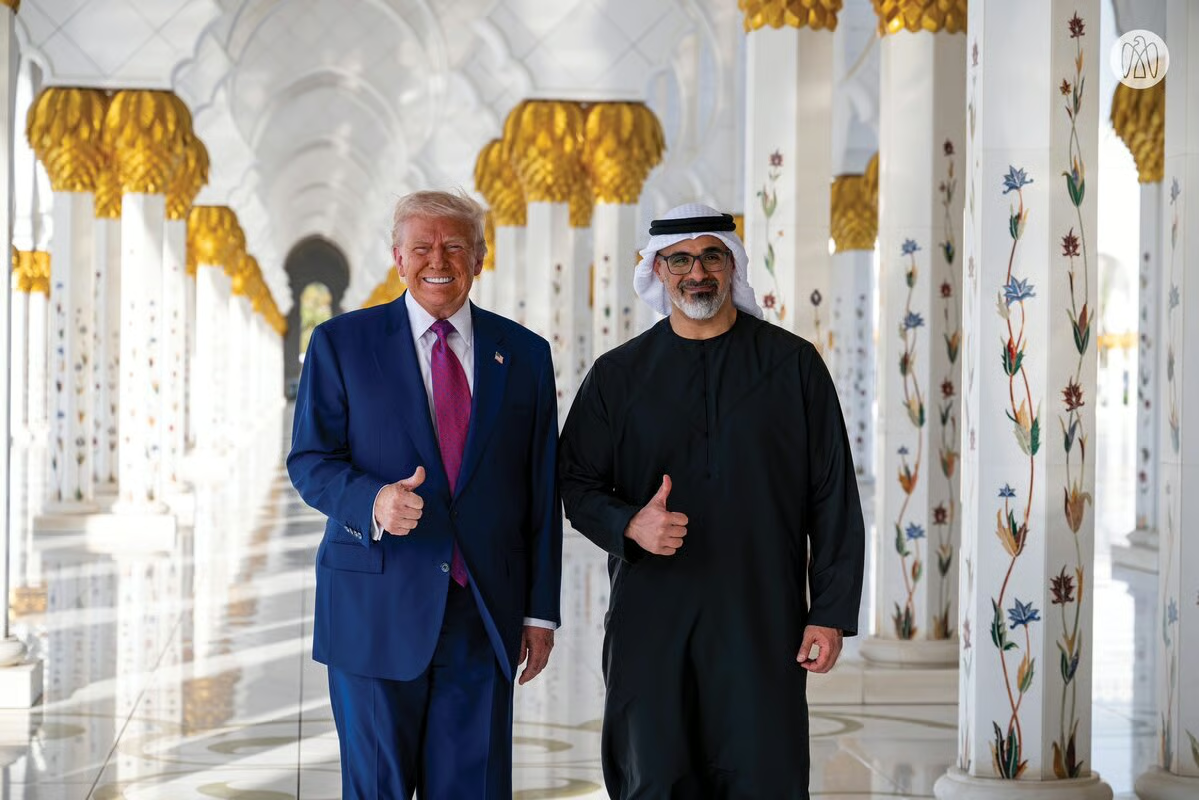
This announcement follows Trump’s recent visit to Abu Dhabi, where the deal was finalized. It marks a significant step forward both diplomatically and economically. The agreement comes at a time when the UAE is carefully balancing its longstanding relationship with the United States while expanding economic engagement with China, its top trading partner.

This arrangement is seen as a substantial advancement for the UAE’s goal of becoming a prominent force in AI innovation. Trump mentioned that safeguards would be in place to ensure proper handling of the chips, including American oversight of data centers involved.

“We’re making great progress for the $1.4 trillion that UAE has announced it intends to spend in the United States,” Trump said during his concluding stop on a tour of the Gulf region, which included Saudi Arabia and Qatar.

“Yesterday, the two countries agreed to create a path for UAE to buy some of the world’s most advanced AI semiconductors from American companies — a very big contract,” he added.

This deal is expected to contribute billions to both economies and tighten bilateral economic links. It also supports the UAE’s previously declared plan from March to invest $1.4 trillion in various U.S. industries over the next ten years, including energy, AI, and manufacturing.

“This deal will accelerate the UAE’s plans to become a really major player in artificial intelligence,” Trump noted.

The agreement also reflects the Trump administration’s strong belief in U.S. tech supremacy and its willingness to collaborate with global partners on cutting-edge innovations in a secure environment.

Nigeria’s Growing Debt Crisis: How Did We Get Here?

Nigeria’s debt has risen to concerning levels, with projections indicating that the total public debt could hit ₦187.79 trillion by the end of 2025. This alarming increase stems largely from persistent budget deficits, which the government has covered through extensive borrowing to fund infrastructure, support public spending, and maintain basic services.

Several factors have fueled the crisis, including heavy reliance on both domestic and external loans, currency devaluation, and weak financial governance. As of mid-2024, domestic borrowing made up 53% of the total debt, while external debt stood at around ₦63 trillion.

Debt servicing costs have surged. In the past year alone, Nigeria spent $4.66 billion on foreign debt payments, with $1.63 billion going to the IMF. These high repayments have triggered concerns about the sustainability of the debt and its long-term impact on economic development.

In response, the government has launched several fiscal reforms, such as fuel subsidy removal and exchange rate unification, aimed at improving revenue and cutting deficits. The World Bank has backed these reforms with a $2.25 billion loan to help mitigate the effects of inflation and support economic restructuring.

However, while fiscal reforms are important, Nigeria must go beyond borrowing. Corruption and poor governance have contributed to the rising debt, with funds sometimes borrowed for projects that are unnecessary or poorly executed. Mismanagement of resources continues to deepen the crisis and weaken public trust.

To truly reduce debt dependence, the country must invest in critical infrastructure such as power, transport, and manufacturing and boost local production to reduce imports and increase exports. Supporting agriculture is also essential; by increasing the value of agricultural products and expanding agro-processing industries, Nigeria can create jobs, feed its population, and earn more foreign exchange.

A sustainable solution will require fiscal discipline, diversified revenue sources, and a strong commitment to economic self-reliance. Only then can Nigeria move toward lasting stability and growth.