Home Blog Page 30

US Democrats Request Andrew Windsor To Testify About Epstein Ties

4

Democratic members of the United States Congress have called on Andrew Mountbatten Windsor to provide testimony as part of their ongoing inquiry into the activities of convicted financier Jeffrey Epstein.

In a letter sent to Royal Lodge, the Windsor estate Andrew was directed to vacate after losing his princely title on 30 October, members of the House Oversight Committee requested his cooperation in their investigation.

Although the committee lacks the authority to compel his appearance, it stated that it wishes to question Andrew about Epstein’s associates and wider network, citing the pair’s “longstanding” relationship.

Andrew lost his royal titles following growing public and political pressure over his association with Epstein. He has consistently denied any misconduct.

The Oversight Committee, currently led by Republicans, has not expressed support for the Democrats’ request for Andrew to appear before them.

The letter, endorsed by sixteen Democratic lawmakers, urged Andrew to participate in a “transcribed interview” with the committee investigating the Epstein case.

“The committee is seeking to uncover the identities of Mr Epstein’s co-conspirators and enablers and to understand the full extent of his criminal operations,” the letter read.

“Well-documented allegations against you, along with your long-standing friendship with Mr Epstein, indicate that you may possess knowledge of his activities relevant to our investigation.

“In the interest of justice for the victims of Jeffrey Epstein, we request that you co-operate with the committee’s investigation by sitting for a transcribed interview with the committee.”

UK Prime Minister Sir Keir Starmer commented that the decision was one for Andrew to make “personally.”

“My view, and this is not about the individual case, more broadly, is that anybody who has relevant information should always be willing to give it to whatever inquiries need that information.

“But the individual decision is a matter for him.”

Spencer Kuvin, an attorney representing several of Epstein’s victims, said he doubted Andrew would “put himself at risk” by appearing before Congress.

He explained that anyone testifying before Congress must swear an oath to tell the truth and could face prosecution for “lying under oath.”

Still, Kuvin added that by identifying people he saw at Epstein’s properties and “validating” claims made by accusers, Andrew could assist in revealing possible co-conspirators.

Liberal Democrat leader Sir Ed Davey said it was “right” for Andrew to appear before Congress regarding his Epstein ties.

“He should also give evidence to our Parliament. The public deserve answers and full transparency about this scandal,” he wrote on X.

In late October, Buckingham Palace confirmed that Andrew would no longer hold the title of “prince” and would vacate Royal Lodge due to the ongoing controversy surrounding his relationship with Epstein.

This followed Andrew’s earlier statement that he had chosen to relinquish his titles, including Duke of York.

“I have decided, as I always have, to put my duty to my family and country first,” he said, noting that the decision came after consulting with the King.

In her posthumous memoir released in October, Virginia Giuffre, one of Epstein’s most prominent accusers reiterated claims that she was forced to have sex with Andrew three times as a teenager. Andrew has denied these allegations.

The committee referenced those accusations in its letter, urging Andrew to agree to an interview “given these recent events and the appalling allegations that have come to light from Ms Giuffre’s memoir and other reliable sources.”

Several lawmakers had already stepped up demands for Andrew to answer questions about his connection to Epstein shortly after he was stripped of his royal titles.

North Korea Launches Ballistic Missile Off Its Eastern Coast

1

North Korea on Friday launched a ballistic missile toward the sea on its eastern side, according to statements from South Korea and Japan. The launch follows a string of similar missile tests over the past two weeks and comes shortly after U.S. President Donald Trump extended another invitation to resume dialogue with Pyongyang.

Officials from South Korea’s military reported that the projectile, believed to be a short-range ballistic missile, was fired from the country’s northwestern area close to the Chinese border and covered a considerable distance before descending into the sea.

Both South Korean and U.S. surveillance systems reportedly identified preparations ahead of the launch and monitored the missile throughout its flight, sharing the data with Japan.

Japan’s government confirmed that the projectile appeared to be a ballistic missile and stated that it likely landed outside the country’s exclusive economic zone. Prime Minister Sanae Takaichi said there were no immediate reports of damage.

During a recent visit to South Korea, Trump reiterated his readiness to hold direct talks with North Korean leader Kim Jong Un, suggesting that a last-minute meeting might still occur. Although no meeting ultimately took place, Trump stated he remained open to returning to the region for another face-to-face discussion.

Trump and Kim previously met at the Panmunjom border village in 2019, during Trump’s first term, when he traveled to the Korean Peninsula.

Kim has not officially responded to Trump’s renewed proposal but has in the past remarked that he holds “fond memories” of their previous encounters, adding that there was no reason to refuse dialogue if Washington ceased demanding that Pyongyang abandon its nuclear arsenal.

On Thursday, North Korea’s foreign ministry accused the Trump administration of “antagonizing” the country through new sanctions targeting officials and institutions over alleged financial crimes, warning that it would issue a response without providing details.

Earlier in the week, U.S. Defense Secretary Pete Hegseth, while visiting the region, reaffirmed America’s commitment to its defense partnership with South Korea. He emphasized that U.S. forces stationed there remain primarily focused on deterring North Korean aggression, even as military strategies evolve to allow greater “flexibility” in addressing regional threats.

Last month, North Korea conducted several weapons tests, including launches of short-range ballistic missiles, a claimed hypersonic missile, and sea-to-surface cruise missiles, all preceding visits by Trump and Chinese President Xi Jinping to South Korea for a regional summit.

Banker Sentenced To One Year In Prison Over N8.56bn Fraud Case

0

The Lagos State Special Offences Court in Ikeja has sentenced banker Samuel Asiegbu to one year in prison for his involvement in an alleged N8.56 billion fraud, with no option of fine. According to a statement released on Wednesday by the Economic and Financial Crimes Commission (EFCC), the fraud occurred within a first-generation bank whose name was not disclosed.

Justice Rahman Oshodi delivered the judgment after Asiegbu changed his plea from not guilty to guilty. He was initially arraigned on 23 June alongside several others on four counts of conspiracy, stealing, and unauthorised access to a computer system with intent to commit fraud, contrary to Sections 409 and 386 of the Lagos State Criminal Law, 2011.

Following his change of plea, the court convicted him and imposed a sentence of 10 months and 8 days on count three and one year and eight months on count four, both without an option of fine. The court struck out counts one and two. With the sentences running concurrently, Asiegbu will serve one year in prison, the longer of the two terms.

The case was adjourned to 14 November for continuation of trial involving the remaining defendants.

This sentencing is separate from the charges pending at the Federal High Court, where Asiegbu and six others are also standing trial over the same alleged N8.56bn fraud scheme. Previously, the EFCC arraigned three bankers, Asiegbu, Fabian Onyeimachi, and Kingsley Ejim Kelechi along with Hannah Okunlola Adesokan, Hamza Zakariya, Achionu Ubaku, and Sunday Osademe on eight counts of conspiracy and obtaining money under false pretence.

The EFCC alleged that the group manipulated the bank’s internal systems and altered vital banking data in January 2025, resulting in a loss of N8,568,090,500. They were also accused of collaborating with others still at large to execute the fraudulent transactions, an offence contrary to Section 27(1)(a) of the Cybercrimes Act, 2015.

All defendants pleaded not guilty. EFCC counsel Aso Peters requested a trial date and asked that the accused be remanded in Nigerian Correctional Service (NCoS) custody. Although counsel for Ms Okunlola sought that she remain in EFCC custody due to health concerns, Justice Daniel Osiagor granted the prosecution’s request and scheduled trial for 6 June.

Five defendants were remanded in NCoS custody, Kelechi continued on his earlier bail, and Ms Okunlola was ordered to remain in EFCC custody pending further proceedings.

Typhoon Moves Toward Cambodia After Claiming At Least 193 lives In The Philippines And Vietnam

6

At least 188 people have died in the Philippines and another five in Vietnam following the impact of Typhoon Kalmaegi, based on the most recent official updates from both nations.

The massive storm is now advancing westward toward Cambodia and Laos after sweeping across central Vietnam on Thursday, bringing winds that reached speeds of up to 149 km/h (92 mph).

By Friday morning, towns along Vietnam’s central coastline were strewn with wreckage after enduring the storm’s full force through the night.

Powerful gusts ripped trees from their roots, stripped roofs off houses, and shattered large glass panes. Thousands took refuge in schools and community shelters as soldiers were dispatched to manage the aftermath.

Authorities in Vietnam have cautioned residents about potential flooding in low-lying regions. The central part of the country has already suffered from record-breaking rainfall over the past week, which has taken 50 lives.

Earlier in the week, the same system ravaged several regions in the Philippines, where intense downpours triggered deadly mudslides that crashed through communities. Floodwaters swept through some underdeveloped areas, leaving them completely destroyed.

The confirmed fatalities rose sharply to 188 from 114 reported a day earlier, with another 135 individuals still missing.

The government in the Philippines has declared a nationwide state of calamity as another storm begins to strengthen over the Pacific Ocean.

In preparation for Typhoon Kalmaegi’s arrival, Vietnam’s military mobilized more than 260,000 personnel on Thursday, along with over 6,700 vehicles and six aircraft, to support emergency operations.

Several airports and major highways were closed, while hundreds of thousands of residents were relocated to safer zones.

Once the typhoon hit land at 19:29 local time (12:29 GMT), emergency calls flooded in from Dak Lak province, according to local reports.

Dak Lak, located roughly 350 km (215 miles) northeast of Ho Chi Minh City, was among the hardest hit.

Residents reported that their homes had been washed away or destroyed as unrelenting winds and rain continued to batter the province.

Local reports also indicated that the Vietnamese Prime Minister, Pham Minh Chinh, conducted a virtual meeting to oversee rescue and relief coordination.

“We must reach isolated areas and ensure people have food, drinking water, and essential supplies,” he was quoted as saying.

“No one should be left hungry or cold.”

Before reaching Vietnam, the typhoon—referred to locally as Tino—had already caused catastrophic damage in the Philippines.

At least 188 lives were lost and tens of thousands of people were forced to flee, particularly from central regions such as the heavily populated island of Cebu, where floodwaters carried away vehicles.

Kalmaegi unleashed rainfall equivalent to a full month’s worth in a single day on the island, sending torrents of mud and debris cascading down hillsides and through city streets.

Those who managed to escape to higher elevations watched in horror as buses and shipping containers were swept away by the violent waters.

The storm obliterated entire neighborhoods in poorer areas, where structures were fragile and easily destroyed.

In Talisay City, one of the worst-hit communities, Mely Saberon stood heartbroken before the ruins of her home.

“We don’t have any home anymore,” she said. “We weren’t able to salvage anything from our house.

“We didn’t expect the surge of rain and wind. We’ve experienced many typhoons before, but this one was different.”

Residents have since begun the exhausting process of scraping away thick mud and searching the debris for anything salvageable.

On Thursday morning, Philippines President Ferdinand Marcos Jr. proclaimed a state of emergency, citing the large-scale loss of life, severe destruction of property, and disruption of daily life and livelihoods across affected regions.

FEC Approves Biometric Flight Boarding And Port Harcourt Airport Concession

43

‎The Federal Government has authorized the concession of the Port Harcourt International Airport to private operators, stating that this action will enhance efficiency and minimize financial losses from the running of underperforming terminals nationwide.

‎Minister of Aviation and Aerospace Development, Festus Keyamo, disclosed this information to State House correspondents after Thursday’s Federal Executive Council meeting in Abuja, also assuring aviation workers that the concession plan would not result in job losses.

‎Keyamo affirmed, “This is a message to the unions: we will engage them. Nobody will lose their job. I’m making this very clear because there has been all kinds of misinformation to the union members. I am pro-union, pro-workers, and I know the kind of pressure they have been putting on me, including people within the system instigating them against these concessions.”

‎”They will not dictate policies of the government. I repeat, no worker will lose his job as a result of concessions,” Keyamo reiterated.

‎The minister mentioned that the Federal Government had previously struggled to attract interest in the Port Harcourt Airport during the last administration. However, a revitalized investor confidence under the Tinubu-led government reversed the situation.

‎”Before we came in, Port Harcourt was a no-go area. Almost all the investors shunned Port Harcourt. But since this government came to power, more than six people were scrambling and falling over themselves to get to Port Harcourt. We now have a business case approved,” he stated.

‎Keyamo announced that the FEC approved all eight memos presented by the Ministry of Aviation. These approvals encompass the procurement of 15 new firefighting vehicles, which will be deployed at the nation’s five international airports: Abuja, Lagos, Kano, Port Harcourt, and Enugu.

‎”This is in tune with ICAO standards. The International Civil Aviation Organisation regularly audits our airports to determine whether they meet global standards. One of the key requirements is adequate fire-fighting equipment,” he explained.

‎Also sanctioned was the procurement and installation of tertiary power supply at all airports and 14 Very High Frequency remote stations managed by the Nigerian Airspace Management Agency (NAMA). He said this measure aims to guarantee continuous support for air navigation systems.

‎Keyamo further noted that the Council approved the full business case for a biometric verification system across all Nigerian airports.

‎”Too many anonymous people board aircraft using fake identities. That is not good for national security. With this system, your NIN will be linked to boarding data. We will verify that you are truly the one flying. This meets ICAO standards,” the Minister emphasized.

‎The Council additionally sanctioned the construction of a permanent headquarters for NAMA in Abuja, following its move from Lagos. The minister clarified that the agency is currently operating from rented facilities in the Federal Capital Territory.

‎Keyamo also declared that all properties belonging to the Federal Airports Authority of Nigeria (FAAN) both within and around airports have been officially excluded from being sold to private individuals.

‎”This is a public announcement to those who purported to have bought airport properties: we will not give those properties to them,” he proclaimed.

‎”Airports are high-security zones. We need quarters for emergency personnel like the fire service and security staff. The President has now approved a memo to that effect,” he detailed.

‎He pointed out that the previous sales, conducted by a presidential committee under former President Olusegun Obasanjo, had been the source of longstanding security issues at multiple airports.

‎Finally, the Council also approved contracts within the ministry’s 2024 budget for runway and perimeter lighting, allowing for late-night operations at selected airports.

‎”Some airports close as early as 6 pm because there are no lights for night operations. We want airlines to fly till 10 or 11 pm to increase capacity and revenue,” Keyamo announced.

Crystal Palace Topples AZ Alkmaar As Conference League Heats Up

3

At a packed Selhurst Park, Crystal Palace delivered a decisive performance, edging AZ Alkmaar 3‑1 to kick‑start their Conference League campaign in style.

Right off the bat, Palace looked a little uneasy; a penalty awarded early was wasted by Jean‑Philippe Mateta (saved by AZ keeper Rome‑Jayden Owusu‑Oduro).
But the hosts didn’t let that stumble define the night:

  • Maxence Lacroix broke the deadlock with a fierce volley (after a lengthy VAR check) around the 22nd minute.
  • Then, just before half‑time, Senegal international Ismaïla Sarr slid in for the second, giving Palace the two‑goal cushion they craved.
  • AZ tried to fight back early in the second half via Sven Mijnans (deflected strike), but Sarr was quick to respond, slotting home his second and Palace’s third around the 57th minute.

What this result gave Palace: their first home win in a main stage European competition. It moves them into contention, offers momentum and – crucially – lifts a weight after their earlier group‑stage stumble.

Tactical takeaways:

  • Palace’s set‑piece dominance stood out: the Lacroix goal and Sarr’s first both stemmed from dead‑ball situations.
  • AZ, despite possessing more of the ball (64.7 % possession by some reports), struggled to convert pressure into goals and were punished on the break and via quick transitions.
  • Sarr’s pace and off‑ball movement proved decisive – he created constant problems, even when he didn’t score.

Implications:
Palace now has six points from three games (according to table tracking) and sit in a more favorable position to aim for the knockout phase.
For AZ, the loss exposes vulnerability away from home and makes their road to qualification much harder.

Other Notable Fixtures & Storylines

While Palace’s win takes the spotlight, Matchday 3 served up several other intriguing results across the competition:

  • AEK Athens vs Shamrock Rovers ended 1‑1: The Irish side were so close to a historic win before conceding a late penalty after a VAR review.
  • NK Celje edged out Legia Warsaw 2‑1, picking up a valuable win in a tight group.
  • KuPS Kuopio defeated Slovan Bratislava 3‑1, boosting their hopes of advancing.
  • FC Noah fell to Sigma Olomouc 1‑2 at home, leaving them with work to do in their group.

These games reinforce one recurring theme of the Conference League: small margins, big consequences. A single set‑piece, offside check, or moment of concentration can tilt a group in favour of one side.

Closing Thoughts

The night belonged to Crystal Palace – not just because of the scoreline, but because of the statement they made. After the early penalty miss, they didn’t panic. Their set‑pieces worked, Sarr stepped up, and the clean transitions and defensive maturity were there for all to see.

For AZ Alkmaar, the game highlights how quickly opportunities can slip away when your opponent defends resolutely and counters sharply.

As the group phase continues, teams will look back at nights like this and think: we either took our chance or we wasted it. Palace made theirs count; others must now respond.

Godswill Udoh, Sunday Jackson, Others Awaiting Trial For Over Ten Years

0

‎Godswill Udoh, an aluminum window-frame maker, was arrested in 2010 while returning home with ₦96,000 in savings. Police allegedly beat him, seized his money, and forced him to sign a false confession to armed robbery.

‎He spent 11 years in detention as prosecutors failed to present any witnesses, evidence, or an investigating officer. When a judge finally struck out the case in 2021, Udoh regained his freedom but found his business ruined and his family life shattered beyond repair.

‎Sunday Jackson, another victim, a university student arrested in 2015 for allegedly killing a herdsman, spent a decade on death row awaiting judgment. During that time, his wife left, his second daughter was born without him ever meeting her, and his home was destroyed. In 2025, the Supreme Court upheld his death sentence. a grim reminder of how delayed justice can become its own form of execution.

‎Mansur Ismail spent five years in detention simply for being near a group of men smoking cigarettes. Though eventually acquitted, the ordeal left deep scars, his reputation destroyed, and former customers too afraid to associate with him.

Jamiu Adedokun, a 17-year-old apprentice tailor, was arrested by a police task force while walking home late at night because he couldn’t afford transport fare. Accused of “breach of public peace,” he spent months in Kirikiri Prison until volunteer lawyers secured his release

These are just a few of the over 66% of inmates, about 53,000 to 70,000 people, awaiting trial in ‎Nigeria’s correctional system.

The system is in crisis, with many languishing for years without legal representation.

Alleged ‎widespread corruption, police abuse, and a slow judiciary have turned prisons into holding cells for the poor, prompting urgent calls for a state of emergency over this human rights disaster.

‎What Obtains in Nigeria Without Trials

‎Nigeria’s justice system today operates as justice without trial, fueled by corruption, inefficiency, and the neglect of due process.

‎Over 66 percent of the inmate population are awaiting trial, far exceeding the number of convicted persons. This has resulted in deplorable conditions within correctional facilities, the spread of chronic diseases, and, in some cases, death among detainees.

‎Police officers are alleged to frequently abuse their powers through indiscriminate raids, framing poor suspects for fabricated crimes such as armed robbery, and seizing their belongings. Many victims are beaten and forced to sign false confessions without access to legal counsel.

And the inability to afford legal representation, which can cost between ₦50,000 and ₦100,000, remains the greatest barrier to freedom. While wealthy suspects can secure their release, the poor are left to languish indefinitely in detention.

‎In an interview with LN247 Digital, Barrister Don Akaegbu explained that the persistent delays in Nigeria’s justice system are the result of deep-seated inefficiencies and poor implementation of existing laws.

‎“Trials drag for years mainly because of systemic inefficiencies. You have constant adjournments, witnesses not showing up, poor investigations, and overloaded court dockets. Sometimes judges are transferred or promoted, and the new judge has to start the case all over again—that alone can waste years.

‎Another problem is the lack of technology. Most of our courts still operate manually.. So the real issue is not the absence of laws, but the poor implementation of the ones we already have.

What the Law Says

‎‎The grim reality across Nigeria’s correctional system stands in stark violation of the country’s own laws and constitutional safeguards.

‎Constitutional Right to Counsel

‎Section 36(6)(c) of the 1999 Constitution guarantees every accused person the right to legal representation and a fair hearing within a reasonable time. This right, meant to protect the vulnerable, is routinely denied to thousands who remain behind bars without counsel.

‎Presumption of Innocence

‎By law, every Awaiting Trial Inmate is presumed innocent until proven guilty. Yet, they are often subjected to the same harsh and degrading conditions as convicted criminals, stripped of dignity and due process.

‎The Legal Aid Mandate

‎The Legal Aid Act of 2011 requires the Legal Aid Council of Nigeria (LACON) to offer free legal services to indigent citizens. In practice, the agency is severely underfunded and overstretched, leaving countless detainees without access to justice.

‎Speedy Trial Legislation

‎The Administration of Criminal Justice Act (ACJA) 2015 was designed to ensure faster trials and reduce the number of awaiting trial inmates. However, enforcement has remained weak, and the law’s promise of timely justice continues to be undermined by poor implementation and systemic neglect.

What The Government Has Been Up To

‎‎Government actions have largely centered on welfare measures rather than fixing the systemic legal failures that sustain Nigeria’s justice crisis. As a result, civil society groups continue to bear the burden of securing justice for detainees.

‎Focus on Welfare

‎Authorities have increased the daily feeding allowance for inmates from ₦750 to ₦1,150, with lawmakers pushing for a further rise to ₦4,000. Budgetary allocations for upgrading correctional facilities have also been expanded, though conditions remain dire in most prisons.

‎Judicial Commitment

‎The Attorney General of the Federation and other senior officials have made public pledges to fast-track judicial processes and reduce the population of awaiting trial inmates. However, progress remains slow and uneven across the states.

‎Reliance on NGOs

‎In reality, the bulk of efforts to secure the release of detainees comes from non-governmental organizations.
Godswill Udoh regained freedom through the intervention of the Headfort Foundation, while Jamiu Adedokun was released by the Take It Back Movement Legal Aid.

The Public and Private Development Centre (PPDC) has also provided free legal services to more than 20,900 detainees, describing the situation as “intolerable.”

‎Insufficient Interventions

‎Barrister Don Akaegbu observed that while the government has made attempts to decongest prisons, the measures remain inadequate due to weak resource allocation and poor implementation.

‎“To be fair, the government has made some efforts. We’ve seen prison decongestion exercises where minor offenders and people detained beyond lawful limits are released. The Legal Aid Council and some NGOs also try to help indigent defendants get legal representation.

‎But the truth is, these efforts are not enough. Legal aid is underfunded, there are too few lawyers and judges, and the prison system is overstretched… Until the government invests more in judicial infrastructure, legal aid, and technology, we’ll keep having people languishing in jail for years without trial.”

The Road Ahead

‎‎Stakeholders insist that Nigeria must go beyond welfare measures and confront the structural roots of its justice crisis. They are calling on the President to declare a state of emergency to fast-track the release of detainees held for minor or unproven offenses and to ensure that justice is no longer delayed or denied.

‎A key priority is proper funding for the Legal Aid Council of Nigeria (LACON) to enable it to recruit and train enough lawyers to represent the more than 53,000 awaiting trial inmates. The judiciary must also embrace digital case management and virtual hearing systems to curb the endless delays caused by manual processes and administrative bottlenecks.

‎Equally critical is the need to hold law enforcement accountable through independent oversight that investigates and punishes officers involved in torture, extortion, and wrongful arrests. Without dismantling these deep-rooted injustices and enforcing due process, Nigeria’s justice system will continue to betray the very citizens it was meant to protect.

Senate Approves 14-year Jail Term For Lecturers Who Harass Students Sexually

0

‎A powerful rebuke of power abuse in Nigeria’s universities resonated through the Senate chamber on Wednesday as lawmakers passed a historic bill imposing up to 14 years in prison for lecturers found guilty of sexually harassing students.

‎The approval of the Sexual Harassment of Students (Prevention and Prohibition) Bill, 2025 marked a defining step in confronting sexual exploitation in higher institutions — an issue long murmured about in elite circles but rarely addressed with action.

‎Sponsored by Senate Leader Opeyemi Bamidele (APC, Ekiti Central), the bill aims to dismantle what he called a “culture of coercion and silence” that has undermined the trust between students and educators.

‎Bamidele explained that the law was designed to “protect students from all forms of sexual misconduct and abuse within academic environments,” while promoting respect for human dignity and ethical conduct in teaching.

‎“This law safeguards the sanctity of the student-educator relationship built on authority, dependency, and trust,” he told lawmakers. “It ensures that no educator ever uses that trust as a weapon of exploitation again.”

‎Under the new Act, any educator convicted of sexual harassment will face a minimum of five years and a maximum of 14 years in prison, with no option of a fine.

‎Lesser related offences carry between two and five years of imprisonment, also without a fine.

‎The law classifies as offences: demanding or coercing sex from a student or prospective student; making unwelcome sexual advances or creating a hostile environment; touching, kissing, hugging, or pinching a student in a sexual manner; sending sexually explicit images or remarks; stalking, or making sexually suggestive jokes or comments.

‎Even indirect involvement, such as aiding or encouraging someone else to commit sexual harassment, now carries criminal liability.

‎The Act further eliminates consent as a defence, declaring that “it shall not be a defence that a student consented” to the act. Only a legally recognised marriage between both parties is exempted.

‎Students or their representatives — including family members, guardians, or lawyers — can now submit a written petition of sexual harassment directly to the Nigerian Police Force, the Attorney-General, or the institution’s Independent Sexual Harassment Prohibition Committee.

‎All tertiary institutions will be required to establish such committees, which will have the authority to investigate and issue binding decisions in line with the law.

‎However, once a case proceeds to court, no internal disciplinary panel may continue handling the same matter to prevent jurisdictional overlap.

‎The passage sparked debate. Senator Adams Oshiomhole (APC, Edo North) commended the objective but argued that the legislation should also apply to workplaces and public offices.

‎“There is no need to restrict this law to students,” he said. “Sexual harassment exists everywhere — in offices, factories, and even politics. We should give this bill universal application.”

‎Deputy Senate President Barau Jibrin (APC, Kano North), who presided, clarified that because the bill originated from the House for concurrence, substantial changes could not be made.

‎He further noted that existing laws already address harassment in workplaces, emphasizing that this legislation specifically targets the education sector, where such cases have become disturbingly frequent.

‎For years, Nigerian universities have been plagued by “sex-for-grades” scandals, many of which ended without justice. The Senate’s action, analysts believe, signals a new zero-tolerance stance against such abuses.

‎The passage of the bill represents not only a legal breakthrough but also a cultural shift — an effort to restore higher education as a space of mentorship rather than manipulation.

‎“This law gives voice to the voiceless,” said one female lawmaker after the session. “No student should ever have to trade dignity for a degree.”

‎With concurrence secured, the bill now awaits the President’s assent to become law — a step expected to set a new moral standard in Nigeria’s tertiary education system.

Cameroon’s 92-year-old Biya Takes Oath For Eighth Term

1

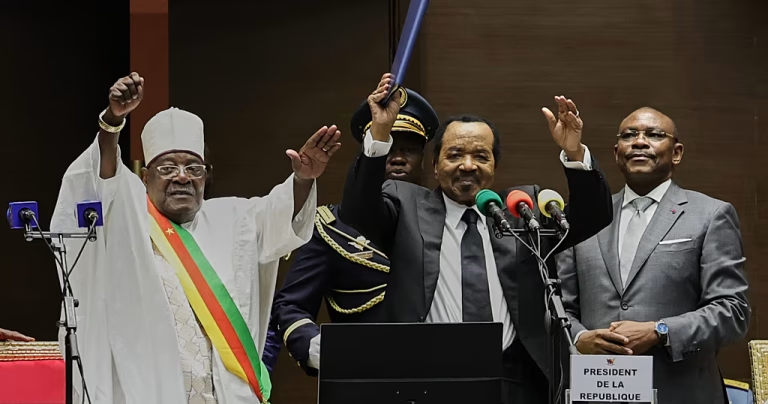
‎Cameroon’s President Paul Biya, the world’s oldest sitting leader, was sworn in on Thursday for an eighth term, extending his 43-year rule after a disputed election that triggered widespread protests and a violent crackdown that left several demonstrators dead.

‎The 92-year-old leader secured victory in the October 12 election with 53.7 percent of the vote, according to official figures, defeating his main rival, former government minister Issa Tchiroma Bakary, who garnered 35.2 percent.

‎Biya took the oath of office during a parliamentary ceremony in Yaounde, marking the beginning of another seven-year tenure at the helm of the Central African nation.

‎“I will spare no effort to continue to be worthy of this trust,” Biya declared at the event, which was attended by domestic political figures but no foreign dignitaries.

‎“I fully understand the gravity of the situation our country is going through. I understand the number and severity of the challenges we face and I understand the depth of frustrations and the scale of expectations,” he added.

‎Tchiroma, once a close ally of Biya who later joined the opposition, captured strong support among young voters yearning for change and maintains that he was the legitimate winner of the election.

‎“There are now two presidents — the president elected by the Cameroonian people (me) and the president appointed by the Constitutional Council (whom you know),” he posted on social media on Wednesday.

‎He has persistently called on his followers to challenge the official outcome, which turned out to be tighter than many had anticipated.

‎Several fatalities were reported when security forces violently dispersed opposition demonstrations shortly before and after Biya’s victory was officially announced on October 27.

‎– Political Standoff –

‎Tchiroma has since called on citizens to observe “dead city” protests, urging businesses to close and public life to pause.

‎Reactions have varied across the country; the movement gained traction in Garoua and Douala, while in Yaounde, most shops stayed open, students attended classes, and workers reported to their jobs.

‎Following the announcement of results, Tchiroma was placed under house arrest in Garoua, though a spokesperson told AFP on Tuesday that he was “on the move.”

‎Authorities have announced plans to prosecute the opposition leader, accusing him of making “repeated calls for insurrection.”

‎The government has admitted that people lost their lives during the unrest but has yet to disclose an official casualty count.

‎“With neither side willing to back down, the risks of worsening unrest are high,” the International Crisis Group (ICG) warned in an October 29 report.

‎Both the European Union and the African Union have condemned the government’s violent suppression of protests, while the UN High Commissioner for Human Rights has demanded an investigation into the incidents.

‎Since Cameroon’s independence from France in 1960, Biya has been only the nation’s second president.

‎He has maintained power through authoritarian rule, stifling political dissent and armed opposition while navigating persistent social unrest, economic disparity, and separatist conflicts.

Hilda Baci Celebrates Second Guinness World Record For Largest Jollof Rice Pot

1

Nigerian celebrity chef, Hilda Baci, has officially received her second Guinness World Record plaque, recognising her achievement for cooking the world’s largest pot of jollof rice. According to Guinness World Records, Baci prepared an astonishing 8,780kg (19,356 pounds) of jollof rice during a Lagos cookout in September, a milestone now confirmed as the biggest ever recorded.

This latest accomplishment comes just over a year after her first Guinness title for completing a 93-hour, 11-minute cooking marathon in May 2023. With two major titles to her name, Baci becomes Nigeria’s most decorated chef and the first to hold multiple Guinness World Records.

Sharing photos of her new plaques on Instagram, Baci described the experience as a journey of “faith, fire, and history.”She wrote, “Our plaques are finally here !!! Two records. Two plaques. One story of faith, fire, and history. Twice, God showed up for me. Twice, we made history for Nigeria.”

She added, “And not just any records, two of the biggest culinary records ever set… I’m a two-time world record holder, someone pinch me.”

Baci also quoted Isaiah 61:7, saying her story reflects the promise that “instead of shame, you will receive a double portion… and everlasting joy will be yours.”

Her jollof rice cookout attracted over 20,000 attendees, including food lovers, celebrities, and influencers. In line with Guinness World Records standards, every serving of the massive dish was distributed to guests and charity organisations, sealing the authenticity of the achievement.