
President Bola Tinubu is preparing for high-level diplomatic engagement with United States President Donald Trump “in the coming days” to address explosive allegations of a “Christian genocide” in Nigeria, the Presidency announced on Sunday.
The meeting potentially at the State House in Abuja or the White House in Washington, aims to clear the air on terrorist attacks that Trump claims target Christians exclusively, while Nigeria insists they affect citizens of all faiths.
Daniel Bwala, Tinubu’s Special Adviser on Policy Communication, broke the news on X, stressing the two leaders’ “shared interest in the fight against insurgency.”
Bwala highlighted Trump’s earlier approval of arms sales to Nigeria, which he said Tinubu has “adequately utilised… with massive results to show.” Any differences over the religious dimension of the violence, Bwala added, “would be discussed and resolved” face-to-face.
The announcement follows Trump’s Friday redesignation of Nigeria as a “Country of Particular Concern” (CPC) and his threat of military airstrikes or troop deployment if Abuja fails to halt alleged systematic killings of Christians.
Tinubu swiftly rejected the label, insisting Nigeria’s constitution guarantees religious freedom and that insecurity cuts across faiths.
A senior Presidency source told SaharaReporters late Sunday that a standalone Washington visit originally floated for November 4 has been shelved.
Instead, Tinubu now eyes a sideline encounter with Trump at the G20 Summit in Durban, South Africa, on November 20—provided Trump attends. “Conversations are ongoing, but a bilateral White House sit-down is not yet locked,” the source said.
Presidential spokesman Bayo Onanuga dismissed weekend rumours that Tinubu would meet U.S. Vice President J.D. Vance, calling them “fabricated.”
He reiterated that any White House trip would involve Trump himself. Meanwhile, former Jigawa Governor Sule Lamido urged Tinubu to convene all living ex-leaders for a national security summit before any foreign trip.
On X, Nigerians are divided. Hashtags #TinubuTrump and #TrumpNigeria trend with memes mocking a possible snub, while others praise Tinubu for “standing tall.”
One viral post quipped: “From White House to G20 sidelines still better than Zoom.” Security analysts warn that failure to de-escalate could trigger U.S. sanctions or aid cuts, further straining Nigeria’s counter-terrorism efforts.
As troops intensify patrols in the North-East and diplomatic phones ring off the hook, one thing is clear: the next 17 days will decide whether Africa’s most populous nation faces its sternest foreign-policy test since the Boko Haram surge or emerges with a stronger U.S. partnership.
For now, the world watches two strong-willed leaders circle each other, with Nigeria’s sovereignty hanging in the balance.
Tinubu Set For Emergency Meeting With Trump Amid Christian Genocide Claims

Trump Is Not After Nigeria but China — The Hidden War for Nigeria’s Soul

I am following with deep interest the ongoing debates that are erupting over Donald J. Trump’s designation of Nigeria as a Country of Particular Concern (CPC) for religious freedom violations.
Many Nigerians, including analysts I respect, are rushing to interpret that decision through the narrow lens of Western imperialism or anti-Islam bias. Others are dismissing it as another of Trump’s theatrics; a foreign leader speaking loudly to his conservative Christian base.
But, as someone who is studying policy, governance, and environmental security, and as a Nigerian who loves his country deeply, I am insisting that President Trump is not after Nigeria. He is after China. And Nigeria, whether we are realising it or not, is standing today as one of the hidden battlegrounds in the long-running strategic rivalry between the United States and China.
Trump’s Silence on China and His Sudden Shift to Nigeria
What is capturing my attention is how Trump is behaving immediately after his meeting with the Chinese President in Tokyo just a few days ago. He said nothing too detailed about the content of the meeting. Instead, he is stepping out and talking about Nigeria — about the mass killings of Christians, the destruction of rural communities, and the rise of religiously-motivated violence in the Middle Belt.
To a casual observer, that shift looks random. But in the language of global diplomacy, it is a signal. You don’t move from Tokyo to Nigeria in one breath unless there is a linking thread. Trump’s intelligence briefings are showing that Nigeria’s crisis is being tied to Chinese economic interests. That is what many of us are failing to see.
China’s Deep Hand in Nigeria’s Bloody Mining Economy

We are not deceiving ourselves when we say Nigeria is sitting on gold. Real gold. And not just gold — we are sitting on columbite, tantalite, lithium, and other rare earth minerals that are vital to modern technology: electric cars, smartphones, satellites, even weapons. Whoever is controlling the supply of these resources is controlling the future of global power.
China is dominating global rare-earth production and refining, but as its domestic reserves are depleting, it is expanding into Africa — and Nigeria, with a weak regulatory system and persistent insecurity, is looking like a prime target.
Across Zamfara, Niger, Nasarawa, Plateau, Benue, and Taraba states, illegal mining is exploding. Beneath the surface of that chaos is a powerful network of Chinese-backed miners, local collaborators, and militia protection rackets. In some communities, entire villages are being emptied out by attacks so that the land is being “freed up” for mining.
A visit to some communities in Benue, Plateau, and Nasarawa, where the soil is carrying visible scars of reckless excavation. Locals are speaking of strange foreigners arriving at night and trucks loaded with ore moving under military escort. These are not fairy tales; they are the daily reality of a nation losing its wealth to foreign hands under the cover of terror.
Terrorism as a Tool for Resource Control

We often view terrorism in Nigeria as purely ideological, a religious war, or a clash of civilizations. But when we look closely, we are seeing that terrorism is becoming a deliberate tool for resource control.
Groups that label themselves as herders, bandits, or insurgents are aligning with illegal miners. They are attacking Christian farming communities, killing or displacing the inhabitants, and leaving behind ungoverned zones/spaces ready for exploitation. Chinese middlemen and local cartels are moving in to dig, extract, and export. The minerals are leaving Nigeria illegally, ending up in Dubai, Hong Kong or Shanghai — enriching foreign economies while Nigeria bleeds.
When Trump is talking about Christian persecution in Nigeria, many people are thinking he is pandering to faith-based voters. But he is also responding to strategic intelligence. His government is discovering that China is using Nigeria’s instability as a shield for illegal extraction — and that thousands of Christian lives are not being lost randomly, but as collateral damage in a global economic war.
The Buahri Waterways Bill — China’s Trojan Horse

We are remembering how, under President Buhari, the Water Resources Bill was being pushed. Nigerians from every corner resisted it and rightly so. On the surface, the bill seemed like an administrative reform to bring all inland waterways and adjoining lands under federal control. But beneath that surface was something far more sinister.
Those waterways; rivers, streams, and wetlands are not just water routes; they are mineral corridors. Many of Nigeria’s richest alluvial gold and rare earth deposits are located along these river systems. By centralising control of the lands, the bill if pass was paving the way for foreign interests, especially Chinese-linked companies to gain access through federal licences, bypassing state governments and local communities.
I believe Chinese advisers and investors were quietly lobbying for that bill. They were seeing it as a legal shortcut to Nigeria’s mineral heartlands. Fortunately, Nigerians resisted it fiercely. But the attempt itself exposed how deeply Chinese mining ambitions are penetrating our policymaking corridors.
Trump’s Intelligence Briefing and the Bigger Picture

Now imagine Trump sitting in the Oval Office, reviewing a classified intelligence briefing ahead of his meeting with the Chinese President. The report might read:
“China is funding illegal mining operations in Nigeria through proxies. Minerals are being smuggled to China. Terrorist groups are clearing Christian farming zones to open mining fields. Nigeria’s government is aware but failing to act.”
If I put myself in Trump’s shoes — a man obsessed with America First, economic nationalism, and confronting Chinese influence, I see why he is doing what he is doing.
That explains why after his meeting with the Chinese President he is saying nothing about the trade war or Huawei. Instead, he is focusing on Nigeria. He is not only expressing moral outrage, he is sending a geostrategic message to Beijing and Abuja alike: “We see what you’re doing in Nigeria, and we are watching.”
The CPC designation thus becomes a diplomatic weapon; not just to defend religious freedom, but to pressure Nigeria’s leadership to confront internal terrorism, regulate its mining sector, and cut off China’s exploitation routes. It is also telling China that the U.S. will not silently allow Africa’s mineral corridors to slip into Beijing’s hands.
The Blood of the Poor, the Gold of the Powerful
As a development professional, I am telling ourselves that underdevelopment is not accidental. It is a system maintained for the benefit of those who profit from chaos. The violence ravaging Nigeria’s north and middle belt follows an economic logic. It is driving farmers away from ancestral lands, weakening resistance, and clearing the field for predatory extraction.
In many of these regions, the victims are overwhelmingly Christian farmers. Their lands sit on mineral deposits. Their displacement often labelled as “herder-farmer clashes” is enabling illegal mining. Every truckload of gold leaving Zamfara or Niger without record is carrying stolen wealth plus the blood of innocent people.
When Trump is referring to “Christian genocide,” it may sound dramatic to some. But to me it is truthful. He is naming what the rest of the world is refusing to name: a systematic campaign of dispossession combining religion, resource greed, and geopolitics.
Nigeria at the Crossroads of Global Power Politics

Nigeria is now standing at a dangerous crossroads. On one side is China — aggressive, patient, and comfortable operating in the shadows. On the other side is the United States — loud, moralistic, and determined not to lose strategic ground. Both are seeing our country as strategic: China for minerals; America for influence.
For Beijing, Nigeria is a silent goldmine. For Washington, Nigeria is a partner slipping away. And for Nigerians like us, we are caught in the middle — a proud nation being turned into a chessboard for foreign powers.
The truth is uncomfortable: our leaders allowed it. Through negligence or complicity, they permit foreign powers to profit from our insecurity. Every village burned in Benue or Plateau, every displaced farmer in Nasarawa, every illegal mining pit in Niger is part of the same global script — the conversion of African lives into raw material for foreign profit.
What Trump’s Move is Actually Signalling
Trump’s move is not hostile toward us. It is a wake-up call. He is using America’s legal and diplomatic tools, like the CPC designation, to jolt our leadership into action. He is highlighting the shootings in Plateau, Benue, and Southern Kaduna not just out of empathy, but because those regions sit atop mineral deposits that feed China’s industrial machine.
When he says “The persecution of Christians must stop,” he is also meaning “Nigeria must stop enriching our biggest rival through the corridors of instability.” His message, though blunt, aligns with what every patriotic Nigerian should demand: a state that protects its people, its land, and its resources.
Nigeria Must Wake Up
Nigeria cannot continue to live in denial. We must stop pretending our insecurity is purely domestic. It is not. It is being sponsored, exploited, and sustained by global powers who see profit in our pain.
We must press for urgent reforms — a national mining framework that shuts down illegal foreign operators; a security architecture that protects communities; and leadership that understands that when a Nigerian village falls, the nation’s sovereignty is being stripped.
We must draw the connections from the blood on our farmlands to the gold in Chinese vaults. From Christian families fleeing in the Middle Belt to the wealth fueling Asian factories. From the failed waterways bill to the shadowy corridors of global mining diplomacy.
Conclusion
President Trump is not after Nigeria. He is after China and Nigeria is just one of the theatres where this global confrontation is playing out. His warnings about Christian killings and religious freedom carry more than moral weight; they are linked to strategic intelligence.
As a Nigerian, I accept his message not as an insult, but as a challenge, a reminder that sovereignty lies not only in our flag, but in how we protect our people, our land, and our resources.
If we fail to act, the silent war between the United States and China will keep being waged on our soil, not with tanks or missiles, but with shovels, mineral flows, and human suffering.
It is time for Nigeria to wake up.
Written by Anngu Orngu.
Anngu Orngu writes from Koti-Yogh, Ute, Vandeikya Local Government Area of Benue State.
At Least 20 Dead, Over 500 Injured As Powerful Earthquake Strikes Northern Afghanistan
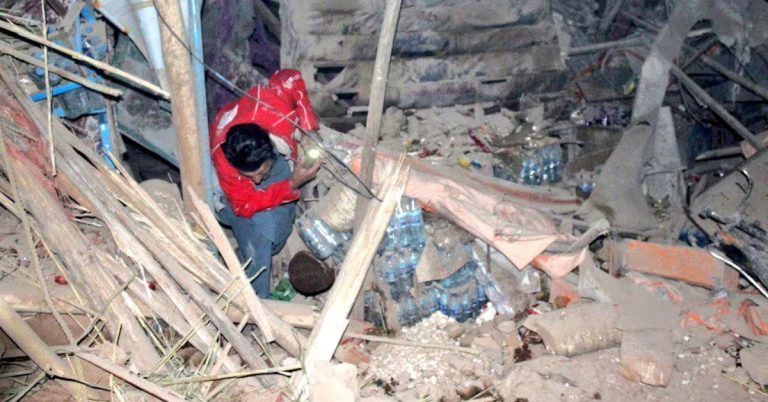
A powerful earthquake has killed at least 20 people and injured more than 500 others in northern Afghanistan, authorities confirmed on Monday, just months after another devastating tremor rocked the country.
The 6.3-magnitude earthquake struck overnight at a depth of 28 kilometres (17 miles), with its epicentre near the city of Mazar-i-Sharif, according to the US Geological Survey (USGS).
“Based on the information we have so far, 534 people have been injured and more than 20 fatalities have been taken to hospitals in Samangan and Balkh provinces,” said Health Ministry spokesman Sharafat Zaman.
In Mazar-i-Sharif one of Afghanistan’s largest northern cities residents rushed into the streets in panic as the ground shook violently.
The city’s iconic Blue Mosque, a 15th-century landmark famed for its striking turquoise tiles, suffered visible damage.
Pieces of the historic structure, including parts of one of its minarets, broke off and were seen scattered across the mosque’s courtyard, one of Afghanistan’s few remaining tourist attractions.
Correspondents in Kabul, about 420 kilometres to the south, also reported feeling the tremor.
Poor communication networks and difficult terrain have long hampered Afghanistan’s disaster response efforts, often delaying rescue operations in remote mountain villages for hours or even days.
The Defence Ministry confirmed that emergency teams had managed to reopen the main road connecting Mazar-i-Sharif and Kholm, rescuing several stranded residents overnight.
“Numerous homes have been destroyed, and significant material losses have been incurred,”
wrote Hamdullah Fitrat, deputy spokesman for the Taliban authorities, on X (formerly Twitter), without providing further details.
The recent quake adds to a string of natural disasters that have hit the country since the Taliban took power in 2021. The government has faced three major earthquakes in that time, even as international aid, once the backbone of Afghanistan’s economy has sharply declined.
In August, a shallow 6.0-magnitude quake in eastern Afghanistan leveled entire mountainside villages, killing more than 2,200 people. The World Bank later estimated damages from that disaster at $183 million, mostly from the destruction of homes and critical infrastructure.
Earthquakes are frequent in Afghanistan, particularly along the Hindu Kush mountain range, where the Eurasian and Indian tectonic plates meet. Large tremors in Herat (2023) and Nangarhar (2022) also claimed hundreds of lives and left thousands homeless.
Many Afghan homes often made of mud bricks and poorly reinforced are unable to withstand strong quakes, especially in rural areas long devastated by conflict.
The ongoing humanitarian crisis in Afghanistan has been worsened by drought, economic sanctions, and the forced return of millions of refugees from neighbouring Iran and Pakistan.
Humanitarian agencies, including the United Nations, have repeatedly warned that hunger and displacement are rising, urging for renewed international assistance.
URGENT ALERT: TRUMP DROPS THE HAMMER ON NIGERIA

President Trump SLAMS the Nigerian regime with a BRUTAL ultimatum: END the GENOCIDE of Christians NOW—or the U.S. will INSTANTLY CRUSH every dime of aid and UNLEASH HELL with a “guns-a-blazing” invasion to OBLITERATE the Islamic terrorists in a SAVAGE, LIGHTNING-FAST strike.
“Fast. Vicious. SWEET. Just like the monsters butcher our CHERISHED Christians!”
🇺🇸 NIGERIA: DEFY US AND FACE “GUNS BLAZING” Intervention.
THE COUNTDOWN BEGINS NOW.

Hundreds Reportedly Killed As Election Protests Escalate Across Tanzania
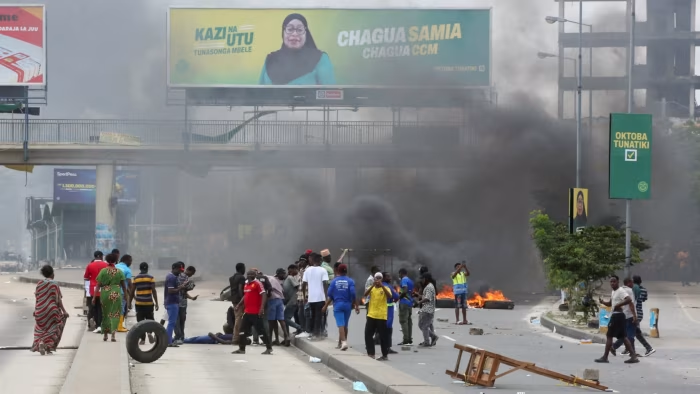
Hundreds of people are feared dead in Tanzania following three days of violent protests triggered by Wednesday’s general election, according to the country’s main opposition party.
A spokesperson for the Chadema party told the AFP news agency that “around 700” people had been killed during clashes with security forces. However, an ongoing nationwide internet shutdown has made it difficult to verify reports or obtain accurate casualty figures.
A diplomatic source in Tanzania said there was credible evidence suggesting that at least 500 people may have lost their lives.
Protests have erupted in several major cities, with many young demonstrators denouncing the election as unfair, after key opposition candidates were barred from running against President Samia Suluhu Hassan.
Widespread unrest despite army warnings
Demonstrations continued on Friday in Dar es Salaam, particularly in the Salasala, Yombo, and Tegetaneighbourhoods, as protesters defied stern warnings from the military.
“Some people went to the streets on 29 October and committed criminal acts. These are criminals and the criminal acts should be stopped immediately,” said Gen Jacob John Mkunda on state TV on Thursday, adding that the army had “controlled the situation.”
Authorities have sought to downplay the scale of the violence, instead extending a nationwide curfew to contain the unrest.
Due to the internet blackout, journalists and human rights groups are struggling to independently verify the reports of fatalities.
Hospitals have reportedly refused to disclose casualty figures. A source at one referral hospital in Dar es Salaam told the BBC that it had been “overwhelmed with casualties” since Thursday and that other hospitals and morgues in the city were also full.
The United Nations has urged Tanzanian security forces to avoid the use of excessive force in responding to the demonstrations.
“We are alarmed by the deaths and injuries that have occurred in the ongoing election-related protests in Tanzania. Reports we have received indicate that at least 10 people were killed.”
Reuters quoted UN human rights spokesperson Seif Magango as saying on Friday that the ambassadors from several foreign embassies have also engaged the Tanzanian government, urging restraint and dialogue in handling the protests.
By late Friday afternoon, the electoral commission had announced results from about 80 of the country’s 272 regions, according to the state broadcaster, TBC.
International observers have reported extremely low voter turnout during the polls held on Wednesday.
President Samia Suluhu Hassan is widely expected to retain power under the Chama Cha Mapinduzi (CCM) party, which has ruled Tanzania since independence in 1961. Official results are expected to be released on Saturday.
Zanzibar election, flight disruptions, and communication blackout
On Zanzibar, the semi-autonomous island that elects its own president, CCM’s Hussein Mwinyi was declared the winner with nearly 80% of the vote. The opposition, however, alleged “massive fraud”, according to the Associated Press (AP).
The protests and internet shutdown have caused significant travel disruptions, leaving tourists stranded at airports across the country.
A Kenyan publicist, Anyiko Owoko, described her ordeal after being trapped in Tanzania for three days due to the communications blackout.
“Internet, shops, petrol stations, email, social media, everything was down. Total disconnect. No international or regional calls in or out. No text messages in or out. There were no Ubers or Bolts available because there was no network,” Owoko posted on Instagram after returning home on Friday via a Kenya Airways flight.
“Many flights were cancelled, and Tanzania’s national airline was grounded. There were so many people stranded at the airport who couldn’t book tickets or reschedule flights because of the connectivity blackout,” she added.
Protesters accuse the government of undermining democracy, citing the detention of key opposition leader Tundu Lissu, who is currently facing treason charges, which he denies. His party boycotted the vote in protest.
Another major opposition figure, Luhaga Mpina of the ACT-Wazalendo party, was disqualified on legal grounds, leaving only 16 minor parties, none with significant popular support to contest the election.
President Samia Suluhu Hassan, who became Tanzania’s first female leader in 2021 following the death of John Magufuli, was initially commended for loosening restrictions on political dissent. However, in recent months, critics say her administration has tightened control, with increased arrests, intimidation, and abductions of political opponents.
FCT Resident Doctors Set To Begin Indefinite Strike

The Association of Resident Doctors of the Federal Capital Territory Administration (ARD-FCTA) has announced plans to embark on an indefinite strike beginning 12 midnight on Saturday, November 1, 2025, citing persistent welfare and administrative challenges affecting its members.
The decision, disclosed in a letter dated October 30, 2025, was addressed to the Minister of the Federal Capital Territory, Nyesom Wike, and signed by the association’s President, Dr. George Ebong, and General Secretary, Dr. Agbor Affiong.
The letter, made available to journalists on Friday by Dr. Ebong, stated that the strike aligns with the national directiveof the Nigerian Association of Resident Doctors (NARD), which also declared an indefinite industrial action on the same date.
However, the ARD-FCTA emphasized that it would continue its own strike action independently, even if the national body suspends or ends its ongoing strike, until all FCT-specific grievances are resolved.
According to the association, the strike became necessary following the government’s failure to address long-standing issues, despite several meetings and engagements.
The impending industrial action is expected to worsen healthcare delivery in the FCT, as resident doctors make up a large percentage of the medical workforce across public hospitals.
The ARD-FCTA represents doctors working in 14 district and general hospitals, including those in the Department of Public Health under the FCT Administration.
The letter explained that the decision followed an emergency congress meeting held on Wednesday, October 29, 2025, where members unanimously voted to join the national strike in full.
“This is to formally notify all relevant stakeholders of the impending indefinite strike action declared by our parent body, the Nigerian Association of Resident Doctors (NARD), scheduled to commence from 12 midnight on Saturday, 1st November 2025.
“Following this declaration, the Supreme Congress of ARD-FCTA, after its Emergency Congress Meeting held on Wednesday, 29th October 2025, deliberated extensively on the state of our unresolved local issues. The Congress unanimously voted to fully join the NARD-declared indefinite strike in its entirety.
“It is, however, important to note that even if NARD suspends or calls off its strike, ARD-FCTA will continue with its own indefinite strike action until all demands peculiar to our centre have been satisfactorily met,” the letter partly stated.
The letter, which was received and acknowledged on October 31, 2025, by several offices, including those of the FCT Minister, Head of Service, and the Health Services and Environment Secretariat, signals possible disruptions across FCT-owned hospitals.
The doctors’ demands include:
Immediate payment of outstanding salary arrears for members employed since 2023.
Commencement of recruitment of new doctors with a written, time-bound commitment to conclude before the end of 2025.
Immediate payment of the 2025 MRTF for doctors’ medical training.
Correction of erroneous salary deductions and irregular payments.
Documented timelines for skipping and conversion to be concluded within one month.
Signing of a Memorandum of Understanding (MoU) mandating skipping within three months of employment.
Other key demands include: Conversion of post-Part II Fellows to Consultant cadre within six months.
Release of promotion timelines and full payment of arrears within one month, payment of wage award arrears, similar to colleagues at the federal and state levels, and settlement of arrears from the 25/35 per cent CONMESS review.
Renovation and upgrading of all FCTA hospitals to global standards.
Payment of 13 months’ hazard allowance arrears.
Settlement of all arrears owed to 2025 external residents.
With the strike set to begin, medical services across FCT hospitals are expected to experience significant delays and disruptions if urgent interventions are not made.
NAF Redeploys 25 Senior Officers In Major Leadership Reshuffle

This The Nigerian Air Force (NAF) has announced the redeployment of 25 senior officers to key command and staff positions as part of a broad restructuring effort aimed at boosting operational efficiency and aligning with the strategic vision of the newly appointed Chief of the Air Staff, Air Marshal Sunday Aneke.
According to a statement released on Friday by the Director of Public Relations and Information, Air Commodore Ehimen Ejodame, the reorganization seeks to improve decision-making, strengthen coordination across commands, and enhance the service’s readiness to tackle evolving national security challenges.
The latest shake-up saw 19 officers receive new appointments within the Air Force, while six others were posted to various defence and inter-service establishments.
Under the new postings, Air Vice Marshal (AVM) Abubakar Abdullahi becomes Chief of Policy and Plans, while AVM Adeniran Ademuwagun takes over as Commandant of the Air Force Institute of Technology (AFIT), Kaduna. AVM Ibitayo Ajiboye was named Group Managing Director of the NAF Investment Limited Group of Companies.
AVM Precious Amadi is now Chief of Operations, just as AVM Nnamdi Ananaba assumes the role of Chief of Air Intelligence. AVM Ebimobo Ebiowe becomes Superintendent of Standards and Evaluation, and AVM Ahmed Daritakes charge as Chief of Training. The Transformation and Innovation Branch will now be headed by AVM Mohammed Ibrahim.
“In the logistics and engineering domains, AVM Olufemi Ogunsina has been appointed Chief of Aircraft Engineering, and AVM Michael Onyebashi assumes command as Air Officer Commanding, Mobility Command. AVM David Pwajok is now Chief of Communication and Information Systems, while AVM John Ukeh takes charge as Air Provost Marshal.
“Further reinforcing NAF’s administrative and welfare structures, AVM Simon Peter has been appointed Managing Director, NAFIL Housing and Construction Company, while AVM Chidiebere Obiabaka becomes Air Secretary.
AVM Anthony Martins now serves as Chief of Administration, AVM Abubakar Sule takes over as AOC, Logistics Command, and AVM Abdulrasheed Kotun has been appointed Managing Director, NAF Farms. The new Chief of Civil-Military Relations is AVM Edward Gabkwet, while AVM Osichinaka Ubadike has been named Deputy Commandant, AFIT,” the statement added.
The statement further noted that other senior officers including AVMs Ahmed Bakari, Albert Bot, Idi Sani, Muhammed Suleiman, Jibrin Usman, and Japheht Ekwuribe have been deployed to various defence and inter-service establishments to enhance joint military operations.
The new Air Chief, Air Marshal Sunday Aneke, assumed office on Thursday, and the redeployment exercise followed a day later. His decision to restructure the service’s top hierarchy came just 24 hours after his counterpart in the Nigerian Army also announced a major reorganization of senior commanders.
The second edition of The African Public Square (APS).

The APS, which debuted in London in 2023, provides a platform for public debate on Africa’s global agency and regional development issues.
The Abuja edition is featuring discussions on ECOWAS’ achievements, challenges, and the recent withdrawal of three member states, effective January 2025.

International development and public policy experts are expected to present insights on strengthening regional cooperation and promoting a people-centred integration agenda.
Speakers at the event are also highlighting ECOWAS’ milestones, including introducing the ECOWAS Passport and protocols on the free movement of persons, goods, and services.
ln247
Military Uncovers N45 Billion In NDDC Accounts Linked To Alleged Coup

In a deepening investigation into an alleged coup plot against President Bola Tinubu’s administration, the Nigerian military has uncovered a suspicious financial trail involving over ₦45 billion disbursed from the Niger Delta Development Commission (NDDC).
The Defence Intelligence Agency (DIA), leading the probe, has linked these funds to politically exposed persons and detained soldiers suspected of orchestrating the conspiracy. Security sources revealed that the discovery has intensified scrutiny on high-level transactions within the commission, raising fears of widespread financial misconduct.
The probe gained momentum following the detention of 16 Nigerian Army officers earlier this month, initially tied to a routine exercise but now connected to subversive activities.
Investigators, working with the Nigerian Financial Intelligence Unit (NFIU) and the Economic and Financial Crimes Commission (EFCC), traced the funds to a ₦54 billion shoreline protection contract awarded under a previous administration.
A portion, estimated at ₦20 billion in mobilization fees, was allegedly diverted to support the plot, with transfers reaching accounts linked to the suspects.
At the center of the storm is former Bayelsa State Governor and ex-Minister of State for Petroleum, Timipre Sylva, whose Abuja residence was raided by Army personnel last Saturday. Although Sylva was abroad at the time, his younger brother and a driver were arrested during the operation.
Sylva’s camp has vehemently denied any involvement, labeling the allegations as politically motivated attempts to tarnish his reputation amid ongoing rivalries in the Niger Delta.
Compounding the tension, NDDC Managing Director Dr. Samuel Ogbuku was arrested by DIA operatives on Wednesday and is currently under interrogation. Sources claim Ogbuku allegedly authorized illicit transfers from the shoreline project, co-sponsoring the coup through these channels.
NDDC spokesperson Seledi Thompson-Wakama has declined comment, citing directives to maintain silence, while insiders describe an atmosphere of panic at the commission’s headquarters as executives brace for further summons.
The military’s inquiry extends beyond the NDDC, forming part of a broader intelligence operation to track unusual public fund movements.
Senior security officials confirmed that interrogations of top NDDC executives focus on the origins, beneficiaries, and utilization of the ₦45 billion, with fears that the probe could expose a network of corruption involving contractors and politicians from both southern and northern Nigeria.
The Federal Government has reiterated its commitment to democratic stability, dismissing coup rumors while vowing thorough accountability.
As the investigation concludes, findings are set to be submitted to President Tinubu, potentially leading to a General Court Martial and public disclosure of involved parties.
This scandal underscores persistent challenges in Nigeria’s public sector, where development funds meant for regional upliftment are allegedly siphoned for destabilizing ends. Stakeholders urge swift reforms to prevent future vulnerabilities, emphasizing the need for transparent oversight in agencies like the NDDC.
Eight dead, Including policeman, In Lagos-Ibadan Expressway Truck Collision

A devastating multiple-vehicle crash on the Kara Bridge along the Lagos-Ibadan Expressway has claimed at least eight lives, including a police inspector, leaving commuters stranded amid severe gridlock. The incident, which unfolded late Wednesday night into Thursday morning, involved five articulated trucks, one of which was a fuel tanker.
Eyewitnesses described a chaotic scene where one truck veered off the road, crashed into the bridge barricade, severed on impact, and plunged into the Kara River below. Two other vehicles collided and burst into flames, while a fourth spilled cartons of biscuits across the highway, exacerbating the blockage inward Mowe.
Preliminary investigations by the Lagos State Police Command point to brake failure on one of the trailers as the primary cause, a recurring issue on Nigeria’s busy highways.
Commissioner Olanrewaju Ishola, who visited the scene early Thursday, confirmed the tragedy struck the police advance team responding to the initial call.
”It’s very unfortunate that we lost one of our police inspectors who came with our advance team to salvage the situation,” Ishola stated, vowing to prosecute those responsible for vehicle maintenance lapses.
Rescue operations, involving the Federal Road Safety Corps (FRSC) and LASTMA, have been underway since 5 a.m., with three injured individuals evacuated to nearby hospitals.
The crash has triggered a massive traffic backlog stretching from Kara Bridge to Ogunnusi Road and the Berger axis, forcing some motorists to drive against traffic on the Lagos-bound lane.
Commercial drivers exploited the chaos, hiking fares on routes like Berger-Oshodi from ₦1,000-1,200 to ₦2,000-2,500, stranding scores of workers and students. A towing van dispatched to separate the wreckage was also struck, complicating efforts.
LASTMA urged alternative routes, noting the fire outbreak from the fuel tanker posed additional risks.
This accident comes less than 24 hours after a separate truck plunge on the Otedola Bridge, highlighting Nigeria’s persistent road safety crisis driven by poor vehicle upkeep and reckless driving.
Ishola warned articulated vehicle operators: “If they are not reckless in their driving habits, we won’t have this kind of accident.”
As evacuation continues, authorities emphasize stricter enforcement, calling for mandatory brake checks and driver training to avert future disasters on this vital corridor.
