
In a dramatic escalation of national security concerns, armed military personnel raided the residences of former Bayelsa State Governor Timipre Sylva in Abuja and Yenagoa early Wednesday morning.
The operations, conducted under the cover of dawn, involved heavily armed soldiers who cordoned off the properties and searched for evidence linked to an alleged coup plot against President Bola Tinubu’s administration.
Sources close to the matter described the raids as swift and methodical, with no arrests made on the spot but several documents and electronic devices seized.
Sylva, a prominent chieftain of the All Progressives Congress (APC) and a vocal critic of the ruling party’s internal dynamics, was reportedly absent from his Abuja home during the incursion.
His spokesperson, Peretu Minimah, confirmed the raid in a terse statement, calling it “politically motivated harassment” and denying any involvement in subversive activities.
”Chief Sylva is a patriot committed to democratic principles,” Minimah said, urging the public to disregard “baseless rumors” being peddled by political opponents.
The raids stem from intelligence reports suggesting a network of disgruntled military officers and civilian allies were plotting to destabilize the government amid ongoing economic hardships and security challenges.
Investigators believe Sylva’s name surfaced during interrogations of a media director arrested last week for disseminating “anti-government propaganda.”
The plot allegedly involved coordinated strikes on key federal installations, though details remain classified to prevent further leaks.
Eyewitnesses in Yenagoa recounted a tense scene as military vehicles blocked access roads to Sylva’s family compound, where relatives were briefly detained for questioning before being released.
Local residents expressed shock, with one neighbor noting, “We’ve known Chief Sylva for years; this feels like a witch hunt.” The operation has fueled speculation about internal power struggles within the APC, particularly as Sylva eyes a potential return to Bayelsa politics.
President Tinubu’s office swiftly distanced itself from the raids, with a presidential aide emphasizing that “no sacred cows exist in the fight against treason.”
The presidency reiterated its commitment to rooting out threats to democracy, referencing recent sackings of over 50 senior military officers as part of broader reforms. Security analysts warn that such high-profile actions could deepen divisions in the armed forces.
Opposition leaders have condemned the military’s involvement, accusing the administration of using security agencies to silence dissent.
The Peoples Democratic Party (PDP) called for an independent probe, while human rights groups like Amnesty International urged restraint to avoid eroding civil liberties. Sylva’s allies in the Niger Delta have mobilized, planning protests to demand transparency.
As investigations continue, the nation watches closely. The Economic and Financial Crimes Commission (EFCC) has been looped in to examine financial trails potentially tied to the alleged plot.
For now, Sylva remains at large but cooperative, vowing to clear his name through legal channels. This incident underscores Nigeria’s fragile political landscape, where whispers of coups echo louder than ever.
Military Raids Ex-Governor Sylva’s Home Over Alleged Coup Plot

Senate Confirms General Olufemi Oluyede As Chief Of Defence Staff

The Senate on Wednesday officially confirmed General Olufemi Oluyede as Nigeria’s new Chief of Defence Staff, following a swift screening session held at the National Assembly complex in Abuja. The confirmation came less than an hour after Oluyede and other nominated service chiefs arrived under tight security for their vetting.
Senate President Godswill Akpabio, while welcoming the nominees, described the screening as “a constitutional duty to ensure that only the most competent and patriotic officers are entrusted with safeguarding our national security.” He added, “Today’s exercise is in keeping with our constitutional duty to provide oversight and ensure that only the most competent, patriotic, and disciplined officers are entrusted with the task of safeguarding our national security and territorial integrity.”
The screening, chaired by Akpabio and conducted by the Committee of the Whole, followed President Bola Tinubu’s request for “expeditious consideration” of the nominees. The newly confirmed officers include General Olufemi Oluyede (Chief of Defence Staff), Major General Waheedi Shaibu (Chief of Army Staff), Rear Admiral Idi Abbas (Chief of Naval Staff), Air Vice Marshal Kennedy Aneke (Chief of Air Staff), and Major General Emmanuel Undiendeye (Chief of Defence Intelligence).
The confirmation marks a key step in Tinubu’s ongoing efforts to reform Nigeria’s military structure and strengthen coordination across the armed forces and intelligence community.
Nigeria’s Rare Earth Opportunity In The US-China Tariff Context

As the United States and China reach a tentative agreement on rare earth mineral and magnet exports, Nigeria is seizing a major opportunity to enter the global supply chain.
The Federal Government recently approved a landmark $400 million Foreign Direct Investment (FDI) to establish Africa’s largest rare earth and critical minerals processing plant in Nasarawa State.
This initiative positions Nigeria as a potential key player in the rare earth market, an industry vital to global technology and clean energy production. Beyond industrial growth, it offers the chance to reduce dependence on foreign imports, attract global partnerships, and drive domestic economic transformation.
The success of this venture will depend on how effectively Nigeria executes strategies around infrastructure, regulation, and sustainability to compete in this high-stakes global sector.
Niger Declares Two-Day Public Holiday Ahead Of LG Elections

The Niger State Governor, Mohammed Bago, has declared Thursday, October 30, and Friday, October 31, 2025, as public holidays ahead of the state’s local government elections scheduled for Saturday, November 1, 2025.
The announcement was contained in a statement released on Tuesday by the Information Officer in the Office of the Secretary to the State Government, Tanko Lawal, who noted that the directive was issued by the SSG, Abubakar Usman.
According to the statement, the two-day work-free period is intended to allow eligible voters ample time to travel to their polling units and participate in the election. “Niger State Governor, Mohammed Bago, has declared Thursday, 30th, and Friday, 31st October, 2025, as state-wide work-free days to enable citizens across the state to fully participate in the forthcoming Local Government Elections on Saturday, 1st November, 2025,” it read.
The SSG further stated that markets, banks, financial institutions, and government offices would remain closed during the holidays, while movement of persons and vehicles would be restricted except for those on essential duties.
“Government is encouraging citizens to come out en masse and perform their civic responsibilities on Saturday, 1st November, 2025. This election provides yet another opportunity for Nigerlites to elect capable leaders who will champion development and represent our collective interests at the grassroots level,” Usman added.
Governor Bago also directed all security agencies in the state to ensure that the elections are conducted peacefully and orderly, reaffirming his administration’s commitment to a safe and transparent electoral process.
U.S. Revokes Nobel Laureate, Wole Soyinka’s Visa

Nobel laureate Professor Wole Soyinka has revealed that the United States of America has revoked his visa, preventing him from entering the country. Soyinka made this known during a media briefing at Kongi’s Harvest Gallery, Freedom Park, Lagos Island, on Tuesday.
“It is necessary for me to hold this conference so that people in the United States who are expecting me for this event or that event do not waste their time. I have no visa; I am banned, obviously, from the United States. And if you want to see me, you know where to find me,” he told journalists.
The reason behind the visa revocation remains unclear, as Soyinka said he was unaware of any wrongdoing that could have prompted such action. According to him, the U.S. Consulate informed him of the decision in a letter dated October 23, 2025.
“This letter serves as official notification by the United States Consulate General in Lagos that the nonimmigrant visa listed below has been revoked pursuant to the authority contained in U.S. Department of State regulations,” part of the letter, issued by the NIV Section of the Consulate, read.
Expressing surprise, Soyinka added, “I’m still looking into my past history… I don’t have any past criminal record or even a felony or misdemeanour to qualify for the revocation. I’ve started looking back, have I ever misbehaved toward the United States of America? Do I have a history? Have I been convicted? Have I gone against the law anywhere?”
In a previous interview with PM News on September 10, 2025, Soyinka had said he would not honour an invitation from the U.S. Consulate in Nigeria for a visa re-interview. He revealed that the letter initially appeared suspicious to him, as he thought it was a scam or AI-generated message.
“I thought it came from scammers who prey on those eager to get visas elsewhere, promising to deliver them for a certain amount. I thought they had simply picked my name among others… So, by the time I came to terms with the fact that the letter was genuine, my mind went to my relationship with individual ambassadors, Consuls General, and Cultural Attachés. As you know, it has always been a courteous relationship,” he said.
Soyinka’s revoked visa was a B1/B2 type, a temporary, non-immigrant visa for business or tourism. The U.S. government has recently intensified measures to manage migration and strengthen visa regulations.
Meet 92 Year Old Paul Biya, Cameroon’s Longest Serving President

Cameroon’s long-time leader, Paul Biya, has been re-elected for an eighth consecutive term, extending his 43-year rule and solidifying his position as Africa’s and the world’s oldest serving head of state. The 92-year-old president was officially declared the winner by the country’s Constitutional Council with 53.7% of the vote, ahead of his closest challenger, Issa Tchiroma Bakary, who secured 35.2%.
The announcement brought an end to a tense post-election atmosphere marked by speculation, opposition claims of victory, and sporadic protests in parts of the country. For many Cameroonians, however, the result—though expected—has left mixed feelings about what another seven years under Biya’s leadership will mean for the nation.
Early Life and Political Rise

Born on February 13, 1933, in Mvomeka’a, in Cameroon’s South Region, Paul Biya rose through the ranks of public service following his education in France. After returning home, he joined the presidency in the 1960s under Cameroon’s first president, Ahmadou Ahidjo, quickly earning a reputation for discipline and administrative efficiency.
He served as Director of the Civil Cabinet, then as Prime Minister from 1975 to 1982. When Ahidjo unexpectedly resigned, Biya constitutionally succeeded him as president—marking the beginning of a political era that has now stretched across more than four decades.
Biya’s Years in Power and Achievements

Since assuming office, Biya has maintained a tight grip on Cameroon’s political structure, winning every election since 1984. Supporters credit him with preserving national unity in a country marked by linguistic and regional diversity. His administration has managed to avert major economic collapse despite pressures from international creditors and periods of social unrest.
Under Biya, Cameroon has seen relative macroeconomic stability, the expansion of infrastructure projects, and increased foreign partnerships—particularly with China. His diplomatic approach has positioned Cameroon as a stable player in Central Africa, even as the region has faced waves of political upheaval.
Over the years, Biya’s rule has also taken on a more symbolic tone. Many view him less as an active decision-maker and more as a constitutional figurehead, delegating daily governance to senior officials while maintaining ultimate control.
Challenges and Growing Criticism
Despite his longevity in office, Biya’s leadership has been shadowed by rising discontent and questions about accountability. His frequent and extended stays abroad—often in Geneva—have fueled public frustration and speculation about his health. Critics argue that his absence from domestic affairs has weakened public trust and hindered policy direction.
The most severe challenge to his rule has come from the Anglophone crisis, a violent conflict in the North-West and South-West regions rooted in grievances over marginalization. Biya’s slow response when protests first broke out in 2016 allowed tensions to escalate into a separatist movement that continues to threaten national unity.
Additionally, the country’s young population faces high unemployment, stagnant economic growth, and limited political freedom, contributing to mounting calls for change. Yet, Biya’s political machinery and divided opposition have consistently ensured his hold on power.
Public Response to Biya’s New Term

As Biya embarks on another term, reactions among Cameroonians remain divided. Loyalists of the ruling Cameroon People’s Democratic Movement (CPDM) celebrate his re-election as a sign of continuity and peace. However, many citizens, especially the youth, express growing fatigue with a system that offers little real political competition or generational renewal.
In the northern city of Garoua, crowds had earlier rallied behind opposition candidate Issa Tchiroma Bakary, viewing him as a potential agent of change. His loss has reignited frustration among opposition supporters, with sporadic unrest reported in Douala and Yaoundé following the results.
With no clear successor and internal rivalries brewing within his party, the question of succession looms large. While speculation occasionally points to his son, Franck Biya, there has been no formal indication of a transition plan.
Lamido Shuns consensus Arrangement For PDP Chairmanship

The race for the Peoples Democratic Party (PDP) national chairmanship intensified on Monday as former Jigawa State Governor Sule Lamido publicly rejected the endorsement of Kabiru Tanimu Turaki as the consensus candidate, vowing to contest the position at the party’s upcoming convention in Ibadan.
Lamido, a founding member and former Minister of Foreign Affairs, announced his bid via a Facebook post, emphasizing his commitment to restoring the party’s “old glory.”
His declaration came amid growing dissent from North West stakeholders, who accused PDP governors of bypassing consultations in selecting Turaki, a former Minister of Special Duties from Kebbi State.
The controversy erupted after northern PDP governors, including Zamfara’s Dauda Lawal and Adamawa’s Ahmadu Umaru Fintiri, endorsed Turaki following stakeholder meetings.
Lawal defended the process as constitutional, noting that consensus is a legitimate selection method under party rules, and described the backlash as “normal political dynamics.”
However, PDP chapters in Katsina and Jigawa, led by figures like Publicity Secretary Sani Dododo and National Organising Secretary Umar Bature, rejected the arrangement, insisting the North West zone deserves an open contest.
Fintiri, as NCOC Chairman, clarified that the endorsement does not bar other aspirants, but the rift has deepened party divisions ahead of the November 15-16 convention.
Turaki’s camp moved swiftly to solidify his position, submitting his expression of interest and nomination forms at the NCOC Secretariat in Abuja on the deadline day, October 27.
Accompanied by allies like Umar Sani, Turaki’s team confirmed the documents were acknowledged, awaiting screening. Sani dismissed Lamido’s grievances, stressing that consultations involved all relevant parties and that Turaki harbors no personal animosity, even citing a recent phone call between the two.
”This is a party matter, not personal,” Sani told reporters, underscoring Turaki’s long-standing loyalty to the PDP without prior elective ambitions beyond the presidency.
Lamido’s attempt to purchase his form at Wadata Plaza met with frustration, as no officials were available, leaving him visibly displeased. Speaking to journalists, the veteran politician accused the party of deliberate exclusion, labeling it “unacceptable and undemocratic.”
He warned of immediate legal action if denied access before the convention, stating, “If I am not able to get the form, I will go to court, simple.”
This echoes broader PDP tensions, including a failed court bid by Nyesom Wike loyalists to halt the convention, which a Federal High Court dismissed on October 9.
The PDP’s 102nd NEC meeting in August zoned the chairmanship to the North—specifically the North West—while reserving the 2027 presidential ticket for the South, a decision broadly supported but not without opposition.
Current Chairman Umar Damagun from Yobe State faces replacement amid calls for fresh leadership to unify the opposition ahead of 2027 polls.
Analysts warn that the chairmanship feud could spill into litigation, further eroding PDP cohesion at a time when it grapples with defections and internal rifts.
As the party suspends aspirant screenings until further notice—originally set for October 28—eyes remain on whether Lamido secures his form or heads to court.
Turaki’s backers express confidence in his unassailable lead, but the impasse highlights PDP’s struggle to balance zoning traditions with democratic openness. With the Ibadan convention looming, stakeholders urge dialogue to avert a full-blown crisis that could weaken the party’s electoral prospects.
CCB Investigates Ministers, Perm Secs’ Assets; Finds Discrepancies

The Code of Conduct Bureau announced that its recently created Financial Investigation and Fraud Analysis Unit has examined over 500 asset declaration forms.
Bureau Chairman Abdullahi Bello disclosed this in a statement issued on Tuesday, signed by the Bureau’s Director of Special Duties, Moses Atolagbe, highlighting his accomplishments after one year in office.
“The investigation, which is the first major initiative of the Bureau’s FIFAU, uncovered discrepancies that would aid enforcement actions against defaulting public officers and promote integrity within the public service.
“The asset declaration forms of at least nine ministers, 43 permanent secretaries, and 40 federal directors had been verified, ensuring high-level accountability across key government roles.”
“At least 199 CCB personnel have been trained in investigation, verification, forensic analysis, and ethical governance to strengthen the Bureau’s capacity and expertise.
“The Bureau has set up zonal offices, each headed by a Director, to handle intelligence gathering and investigations, assist in prosecutions, and oversee state operations for more efficient enforcement,” he said.
To enhance its enforcement authority, Bello stated that the CCB has formed collaborations with domestic and international anti-corruption organizations, including the EFCC, ICPC, DSS, NFIU, and foreign embassies.
He mentioned that the Bureau is participating in international events such as the Cambridge Economic Crime Forum and the U.S. IVLP 2025, demonstrating Nigeria’s anti-corruption commitments and gaining global backing.
According to him, the CCB leadership has also been accepted into the Association of Commonwealth Heads of Anti-Corruption Agencies in Africa, bolstering Nigeria’s role in regional anti-corruption efforts.
Bello explained that his leadership philosophy is summarized in the Bureau’s revamped mission, expressed through the motto, “Declare or Forfeit”.
He therefore urged public officials to submit their asset declarations, maintain openness about their finances, and avoid corrupt practices.
Bello took office on October 23, 2024, following his appointment as CCB Chairman by President Bola Tinubu.
Upon taking office, he pledged to transform the Bureau’s operational framework, reinforce institutional honesty, boost operational effectiveness, and further the country’s anti-corruption goals.
Nigeria Six State Creation: What You Should Know

The National Assembly Joint Committee on Constitution Review has approved the creation of an additional state in Nigeria’s South-East geo-political zone.
According to a statement from the committee’s media unit, the decision was reached on Saturday during a two-day retreat in Lagos, where lawmakers reviewed 55 proposals for state creation across the country.
The session, chaired by Deputy Senate President Barau Jibrin and co-chaired by Deputy Speaker of the House of Representatives Benjamin Kalu, resolved that, “in the spirit of fairness and equity,” the Federal Government should establish another state for the South-East.
Kalu, who has been a strong advocate for the move, said the creation of a new state would “give the people a sense of belonging.” When approved, the South-East will have six states, matching the South-South, South-West, North-Central, and North-East zones, unlike its current five: Abia, Anambra, Ebonyi, Enugu, and Imo.
The statement added that Senator Abdul Ningi (Bauchi Central) moved the motion for the new state, seconded by Ibrahim Isiaka (Ifo/Ewekoro, Ogun State), and that “the motion received the unanimous support of committee members and was adopted.”
Additionally, the committee set up a sub-committee to review 278 proposals for creating new states and local government areas nationwide.
Deputy Senate President Jibrin urged members to build consensus among lawmakers to ensure the resolutions succeed during voting, saying,
“We need to strengthen what we have started so that all parts of the country will key into this process. By the time we get to the actual voting, we should already have the buy-in of all stakeholders from both chambers and the state Houses of Assembly.”
Why The Six States Were Created

One of the core reasons for the demand is a long-standing sense of marginalisation by many in the region. These potential new states would bring Nigeria’s number of states from 36 to 42.
Some leaders argue that the South-East’s five-state structure places it at a disadvantage compared to zones with more states and federal representation.
Senator Ned Nwoko, asserted that “the problem in the South-East has to do with perceived injustice by successive governments,” and that creating a new state would help restore a sense of belonging.
According to the joint committee, one new state will be created in each of the six geopolitical zones: North West, North East, North Central, South West, South East, and South South.
What It Could Mean For The Economy
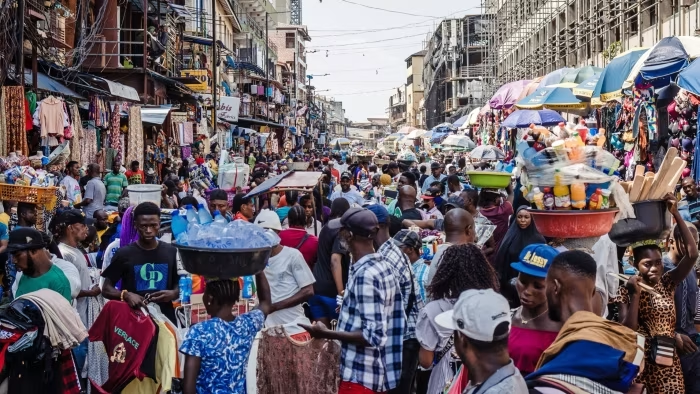
The state creation can stimulate development by bringing government closer to citizens, improving service delivery, and boosting local investment. A study on the proposed Anioma State found that 78 % of respondents believed new statehood would enhance economic development, and 81 % thought it would improve public service delivery.
Yet, there are warnings that many of Nigeria’s 36 existing states are already financially stretched and heavily dependent on federal allocations, raising concerns about the viability of adding more states.
On the opportunity side, a new state could generate jobs (through public service, infrastructure, and local agencies), direct federal projects to underserved areas, and increase regional investment.
However, the risks are significant: more states mean higher overheads (administrative costs, recurrent expenses), and if the new unit cannot raise sufficient Internally Generated Revenue (IGR), the extra burden falls on the national purse. Experts caution that “adding 31 more states will increase financial pressure on the federal government.”
Why Rice Prices Are Falling: What It Means For Nigerians

Rice prices in major markets in Lagos have taken a sharp dive, providing much-needed relief for households but triggering losses for traders who stocked up during the price surge earlier in the year.
A 50-kilogram bag that previously sold for between ₦80,000 and ₦85,000 now sells for between ₦55,000 and ₦70,000, depending on the brand and market.
The reduction, which represents as much as 35 percent in some cases, has been recorded across key markets such as Mile 12, Oyingbo, and Arena in Oshodi.
Why Rice Prices Are Dropping
The drop is the result of a convergence of supply and policy factors. Recent import inflows through land borders have increased market supply, following a temporary duty waiver granted by the Federal Government on essential food commodities, including rice.
This policy, combined with fresh local harvests from northern producing states, has flooded the market with both imported and locally milled rice.
Analysts say timing played a crucial role. Many shipments arrived just as traders were holding large stocks purchased at record prices, creating a sudden oversupply. With demand unable to keep pace, market forces quickly pushed prices downward. The relative stability of the naira in recent weeks has also helped reduce transport and import costs, further contributing to the decline.
Who Benefits from the Price Decline

Consumers are the immediate winners. For many Lagos households, the lower prices have brought long-awaited relief from months of food inflation.
“With rice now cheaper, we can finally stretch our budgets,” said a shopper at Mile 12 Market, who noted that the change has eased the strain on family spending.
Restaurants, caterers, and small retailers are also benefiting from reduced costs, allowing them to maintain steady prices or expand sales volumes. Retail traders who depend on quick turnover are seeing higher demand as consumers buy more at the lower price points.
Who Bears the Impact
While consumers rejoice, the story is different for wholesalers and local producers. Traders who stocked up when prices were high now face significant losses.
“We’re selling below cost just to recover our capital,” said a dealer at Oyingbo Market.
“The fall was too sudden; many of us are struggling to stay afloat.”
Local rice millers and farmers are equally affected. The influx of cheaper imported rice has weakened demand for domestic brands, forcing some producers to sell at near break-even prices. With input costs still high, from fertiliser to energy, profit margins have thinned dangerously, raising fears that smaller millers could shut down if the trend persists.
What This Means for the Nigerian Economy

The price crash highlights the Federal Government’s ongoing policy dilemma: balancing short-term consumer relief with the long-term health of domestic agriculture. While temporary import waivers have succeeded in easing food prices, they risk undermining Nigeria’s drive toward self-sufficiency in rice production.
Economists warn that if the current glut is not managed, the market correction could reverse once existing stocks are exhausted, especially ahead of the festive season when demand typically spikes. “Nigeria risks eroding years of progress toward rice self-sufficiency if local farmers and millers cannot compete with imports,” said an industry analyst.
To sustain stability, experts are urging a consistent policy direction, one that supports local production while keeping staple foods affordable.
Strengthening storage systems, improving logistics, and ensuring access to affordable credit for farmers remain key to preventing further market shocks.
