
President Bola Tinubu has restructured the leadership of the Service Chiefs to advance the Federal Government of Nigeria’s drive to reinforce the nation’s security framework.
He dismissed multiple high-ranking military officers in a sweeping overhaul intended to fortify Nigeria’s national security system. This information was outlined in a statement released by Sunday Dare, the President’s Special Adviser on Media and Public Communication. The new appointments take effect right away.
General Olufemi Oluyede has been designated the new Chief of Defence Staff, taking over from General Christopher Musa. Major-General W. Shaibu has been appointed Chief of Army Staff, Air Vice Marshal S.K. Aneke becomes the new Chief of Air Staff, and Rear Admiral I. Abbas assumes command as Chief of Naval Staff. Major-General E.A.P. Undiendeye remains in his role as Chief of Defence Intelligence.
“President Bola Tinubu has made changes in the hierarchy of the Service Chiefs in furtherance of the efforts of the Federal Government of Nigeria to strengthen the national security architecture.
“The President appointed General Olufemi Oluyede to replace General Christopher Musa as the new Chief of Defence Staff.
“The new Chief of Army Staff is Major-General W. Shaibu. Air Vice Marshall S.K Aneke is Chief of Air Staff while Rear Admiral I. Abbas is the new Chief of Naval Staff. Chief of Defence Intelligence Major-General E.A.P Undiendeye retains his position,” the statement read in part.
President Tinubu extended his heartfelt thanks to the departing Chief of Defence Staff and the other service chiefs for their steadfast service and guidance.
He urged the newly appointed leaders to honor the trust reposed in them by fostering professionalism, readiness, and unity within the armed forces.
President Tinubu Dismisses Chief Of Defence Staff, Names New Military Leaders

Trump Halts Trade Discussions With Canada
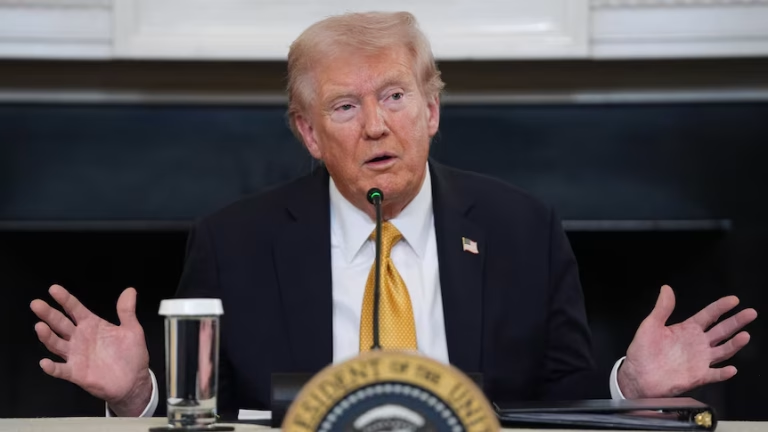
President Donald Trump announced that the United States has suspended all ongoing trade negotiations with Canada, citing what he described as a fraudulent television advertisement featuring former President Ronald Reagan speaking critically about tariffs.
“The Ronald Reagan Foundation has just announced that Canada has fraudulently used an advertisement, which is FAKE, featuring Ronald Reagan speaking negatively about Tariffs,” Trump wrote on his Truth Social platform late on Thursday.
“The ad was for $75,000. They only did this to interfere with the decision of the US Supreme Court, and other courts,” Trump wrote.
“Based on their egregious behavior, ALL TRADE NEGOTIATIONS WITH CANADA ARE HEREBY TERMINATED,” Trump added.
Earlier that day, the Ronald Reagan Presidential Foundation & Institute posted a statement online saying that a television commercial produced by the government of Ontario in Canada “misrepresents the ‘Presidential Radio Address to the Nation on Free and Fair Trade’ dated April 25, 1987.”
The foundation further clarified that Ontario had not been granted authorization “to use and edit the remarks” of the former U.S. president.
It also confirmed that it was “reviewing legal options in this matter” and encouraged the public to view the original, unaltered recording of Reagan’s address.
Ontario’s Premier Doug Ford acknowledged earlier in the week that the ad — which showed Reagan condemning tariffs on imports and warning they could spark trade wars and job losses — had drawn Trump’s attention.
“I heard that the president heard our ad. I’m sure he wasn’t too happy,” Ford said on Tuesday.
In a separate social media post, Ford shared the ad alongside the message: “Using every tool we have, we’ll never stop making the case against American tariffs on Canada. The way to prosperity is by working together,” he said.
Trump’s decision to end the trade talks came shortly after Canadian Prime Minister Mark Carney reiterated his government’s goal to expand exports beyond the U.S. market in response to the economic risks posed by new U.S. tariffs.
Carney also emphasized that Canada would resist granting the U.S. preferential market access if current negotiations failed to reach a fair outcome.
The two countries had been negotiating a potential agreement for several weeks following Trump’s earlier imposition of tariffs on Canadian steel, aluminum, and automobiles — measures that prompted Canada to impose retaliatory duties.
Officials from the Canadian prime minister’s office have not yet issued a public statement in response to Trump’s announcement that all trade discussions have been terminated due to the disputed advertisement.
Currently, more than 75% of Canadian exports are directed to the United States, with an estimated 3.6 billion Canadian dollars ($2.7 billion) worth of goods and services exchanged between both nations each day.
Senate Acts To Resolve Ongoing Downstream Petroleum Sector Crisis

The Senate has voiced worries about the ongoing issues in the downstream petroleum industry and has decided to conduct a thorough probe to reinstate efficiency, transparency, and industrial peace.
This came as the House of Representatives condemned the unchecked rent hikes in Nigeria, demanding that increases be capped at no more than 20 per cent of the current rent, regardless of infrastructure upgrades or other considerations.
In a statement yesterday, Chairman of the Senate Committee on Petroleum (Downstream), Kawu Sumaila (Kano South), revealed that the planned hearing stemmed from decisions made at the committee’s recent retreat and is included in its Strategic Action Work Plan (Q4 2025 – Q4 2026).
He said the hearing would scrutinize operational inefficiencies, policy inconsistencies, and industrial disputes that are weakening the sector’s performance.
He outlined the hearing’s primary focus areas to include: the condition of private and government-owned refineries; disputes involving the Petroleum and Natural Gas Senior Staff Association of Nigeria (PENGASSAN), the National Union of Petroleum and Natural Gas Workers (NUPENG), and other labour groups; allegations of crude supply shortfalls, regulatory overlaps, and transparency gaps in the sector.
Sumaila added that the findings would help the Senate redefine the roles of key regulatory bodies under the Petroleum Industry Act (PIA), address systemic bottlenecks and strengthen oversight mechanisms.
“Our goal is to safeguard workers’ rights, promote industrial harmony, and enhance Nigeria’s energy security, transparency, and competitiveness,” he said.
THE House deliberation followed a motion by the member representing Calabar Municipality/Odukpani Federal Constituency, Bassey Akiba, on the Need to Regulate Arbitrary Rent Increase and Protect Tenants from Exploitation.
The House is urging the Federal Government to prioritise investing in affordable housing initiatives, ensure access to low-cost housing for citizens, and reduce pressure on the rental market.
Meanwhile, the House has passed a resolution asking the Inspector-General of Police (IGP) and the Controller-General of the Nigeria Security and Civil Defence Corps (NSCDC) to direct policemen operating at checkpoints in plain clothes to be fully equipped with proper identification.
The lawmakers expressed concern that the lack of identification for security officials was not in line with international best practices and did not facilitate officer accountability. Worried by the arbitrary rent increases in Lagos State, the Lagos State House of Assembly in April called on the Attorney-General and Commissioner for Justice to enforce the full implementation of the Tenancy Law of Lagos State 2015.
It also urged the Commissioner for Information and Strategy, Gbenga Omotoso, to intensify public awareness campaigns to educate residents on the provisions of the Tenancy Law. According to the Lagos lawmakers, the reason was part of efforts to address the persistent issue of arbitrary rent increases by landlords across the state.
The resolutions followed a motion moved by Sa’ad Olumoh, who stressed the need to curb excessive rent increments that are worsening the housing crisis in the state.
He cited Section 37 of the Tenancy Law, which prohibits unreasonable rent hikes and provides legal recourse for tenants subjected to such increments.
Board Dismisses 10 Immigration Officers, Penalizes 21

The Civil Defence, Correctional, Fire and Immigration Services Board has taken disciplinary action against 31 personnel of the Nigeria Immigration Service over varying degrees of professional misconduct.
This was disclosed in a statement released on Friday in Abuja by Assistant Comptroller of Immigration (ACI) Akinsola Akinlabi, who serves as the Service Public Relations Officer.
Akinlabi explained that the disciplinary decisions followed a review of recommendations presented by the Board’s Disciplinary and General-Purpose Committee (BDGPC), which convened on July 11, 2025.
He noted that the sanctions reflect the board’s firm commitment to promoting discipline, accountability, and integrity among officers within its agencies.
“Eight officers were dismissed for serious misconduct and violation of Service Regulations, while five others were compulsorily retired for offences bordering on misconduct.
“Additionally, eight officers were demoted by one rank, and five were issued written warning letters.
“The board also reviewed appeals by two dismissed officers but upheld their dismissal after finding no merit in their cases.
“However, one officer was reinstated following a successful appeal, while two others were exonerated of all charges,” he said.
In a separate case, Akinlabi reported that two junior officers were also dismissed after being found culpable of criminal conspiracy involving acts of stealing, unlawful possession of firearms, and kidnapping.
“Their dismissal followed internal disciplinary proceedings concluded on April 14 and September 4, 2025, respectively,” he stated.
According to Akinlabi, the entire process was carried out under the supervision of the Chairman of the CDCFIB and Minister of Interior, Dr. Olubunmi Tunji-Ojo, alongside the Comptroller-General of Immigration, Kemi Nandap.
He emphasized that the Service remains unwavering in its determination to uphold professionalism and ethical standards at all levels.
“The disciplinary actions will be implemented without fear or favour and in strict compliance with extant rules and regulations,” he assured.
Earlier in July, Comptroller-General Nandap had disclosed that the Service’s legal department was already handling disciplinary cases involving officers accused of issuing green passports to non-Nigerians.
Court Adjourns Nnamdi Kanu’s Trial To October 27

The Federal High Court in Abuja has adjourned the trial of Nnamdi Kanu, the detained leader of the Indigenous People of Biafra (IPOB), to Monday, October 27, to allow him time to retrieve his case file and prepare his defence in the terrorism charges filed against him.
Justice James Omotosho made the decision on Friday after Kanu informed the court that his former legal team, led by ex-Attorney General of the Federation and Minister of Justice, Chief Kanu Agabi (SAN), had yet to release his case file.
At the resumed hearing, Adegboyega Awomolo (SAN) appeared for the Federal Government and reminded the court that the session was scheduled for Kanu to begin his defence. However, no counsel represented the defendant.
Kanu, appearing in court with a bundle of documents, personally addressed the judge, saying his dismissed legal team had withheld his case file.
He said, “My lord, my counsel left the case yesterday, and I have not received the file from them.”
He requested an adjournment to retrieve and review the documents and also informed the court of plans to call 23 witnesses, both local and foreign. He further asked that the Department of State Services (DSS) allow his foreign witnesses access to him and that his lawyers be permitted to visit on non-working days, a request the judge granted.
Counsel to the Federal Government, Awomolo, described Kanu’s complaint as “strange,” noting that the defendant had spent several hours in court with his previous lawyers. He urged the court to uphold its earlier directive giving Kanu six days to open and close his defence.
Awomolo said, “I’m aware that there is a standing order for the defendant to defend himself within six days. The defendant wasted yesterday. This is the second day, my lord. I urge your lordship to keep to the standing order of the number of days given to the defendant.”
In his ruling, Justice Omotosho acknowledged that Kanu’s claim about the withheld file was “strange and difficult to believe,” but still granted a short adjournment in the interest of justice. He warned against further delays, noting that other cases had been affected by the drawn-out proceedings.
The matter was subsequently adjourned to Monday, October 27, for Kanu to open his defence.
Court Grants Sowore, Nnamdi Kanu’s Lawyer, And 11 Others Bail

A Magistrate’s Court sitting in Kuje, Abuja, has granted bail to human rights activist and publisher, Omoyele Sowore, as well as Aloy Ejimakor, one of the lawyers representing the detained leader of the Indigenous People of Biafra (IPOB), Nnamdi Kanu; Prince Emmanuel Kanu, the IPOB leader’s younger brother; and ten other defendants.
The court on Friday approved bail in the sum of ₦500,000 each, with two sureties in like sum, after the thirteen defendants were arraigned for inciting public disturbance and breach of peace linked to the #FreeNnamdiKanuNow protest held on Monday, October 20, 2025, in Abuja.
According to reports, Ejimakor, Emmanuel Kanu, and the other protesters were arrested during Monday’s rally and subsequently remanded at the Kuje Correctional Centre, while Sowore was arrested three days later, on October 23, at the Federal High Court in Abuja, where he had gone to show solidarity during Kanu’s ongoing terrorism trial.
All thirteen defendants were charged under sections relating to public order and unlawful assembly. They have since met their bail conditions, with legal representatives confirming that the release process is underway.
The development follows days of public criticism over the arrests, with civil rights advocates accusing security operatives of violating the constitutional right to peaceful protest. The case has reignited debates over civic freedom and the government’s handling of dissent, especially as the IPOB leader’s continued detention remains a point of national tension.
Tinubu Swears In Amupitan As New INEC Chairman

President Bola Tinubu on Thursday swore in Professor Joash Amupitan, a Senior Advocate of Nigeria, as the new Chairman of the Independent National Electoral Commission at a brief ceremony held in the Council Chamber of the Presidential Villa, Abuja.
The oath of office was administered at exactly 1:50 p.m. by the President, who urged the incoming electoral chief to safeguard the integrity of Nigeria’s elections and bolster the institutional strength of the commission ahead of future polls.
Amupitan, a 58-year-old professor of law from Kogi State, arrived at the State House earlier in the morning dressed in a crisp white agbada and gold cap. He exchanged pleasantries with presidential aides, dignitaries, and guests before proceeding to the chamber for the formal investiture.
His appointment marks the end of a transitional period at INEC following the expiration of Professor Mahmood Yakubu’s ten-year tenure on October 7.
The swearing-in comes one week after the Senate confirmed Amupitan’s nomination on October 16, following a rigorous screening session where he outlined an ambitious reform agenda.
Addressing lawmakers, he pledged to restore public trust in the electoral process by ensuring outcomes so credible that “even the loser will congratulate the winner and say, ‘You won fairly.’
” He emphasized tightening provisions in the Electoral Act, enhancing transparency in election timelines, and improving result management systems to eliminate doubts that have plagued recent cycles.
Amupitan is also committed to strengthening INEC’s operational independence and collaborating with technology partners to resolve persistent glitches, particularly with the INEC Result Viewing Portal (IReV), which faced widespread criticism during the 2023 general elections.
He promised a comprehensive audit of the platform and closer coordination with agencies like the Nigerian Communications Commission and National Identity Management Commission to guarantee reliable biometric and digital infrastructure for future votes.
During the screening, senators pressed the nominee on allegations linking him to President Tinubu’s legal team in the 2023 election petition case. Amupitan firmly denied any involvement, stating unequivocally, “I never appeared before the Presidential Election Tribunal or the Supreme Court for any of the parties.”
He stressed his commitment to neutrality, a declaration that appeared to satisfy the upper chamber, paving the way for his unanimous confirmation.
The new chairman succeeds Yakubu as the sixth substantive head of INEC since its establishment. His nomination had earlier received the endorsement of the National Council of State on October 9. Immediately after the oath-taking, Amupitan is expected to proceed to the INEC headquarters in Abuja to assume full duties and initiate a smooth leadership transition.
The appointment has generated cautious optimism among civil society groups and political stakeholders, many of whom see it as an opportunity to implement long-overdue reforms before the 2027 general elections.
Youth and women’s advocacy organizations have particularly welcomed Amupitan’s focus on inclusivity and technological reliability, citing the ongoing surge in voter registration, over eight million online pre-registrations recorded in the first week of the current exercise, as evidence of growing public interest that must be protected.
As Nigeria navigates a complex electoral calendar, including the Anambra governorship poll on November 8 and the FCT area council elections in February 2026, all eyes will be on Amupitan to deliver on his promise of elections that not only meet legal standards but also command universal acceptance across the political divide.
FG Approves Release of ₦32.9 Billion To Primary Health Centres

The Federal Government has authorized the release of ₦32.9 billion through the updated Basic Health Care Provision Fund (BHCPF) Guideline 2.0 to bolster Primary Health Care services nationwide.
The funds are scheduled for distribution by the end of October 2025 via all implementation channels, including the National Primary Healthcare Development Agency (NPHCDA) and the National Health Insurance Authority (NHIA), among others, with the goal of enhancing health outcomes through performance-driven execution, transparency, and accountability in health fund management.
During the 12th Ministerial Oversight Committee (MOC) Meeting in Abuja, the Minister of Health, Prof Muhammad Ali Pate, reiterated the government’s dedication to fortifying Nigeria’s health systems, broadening access to quality care, and attaining Universal Health Coverage via ongoing reforms and collaborative implementation.
He noted that the BHCPF seeks to provide sustainable financing for primary health care and ensure access to quality essential health services for all Nigerians, especially the poor and vulnerable.
The minister, who launched the Universal Basic Health Care Provision Fund (BHCPF) 2.0 Revised Guideline, a critical instrument for enhancing accountability and efficiency in health financing, emphasized the importance of reinforcing Oversight and Transparency in the health sector through MOC reforms.
Key decisions from the meeting include the National Emergency Medical Treatment Committee (NEMTC) launching a comprehensive digital platform within two weeks to improve emergency response efficiency and reporting. In addition, State Social Health Insurance Agencies (SSHIAs) are directed to develop systems for monitoring claims processing within two weeks and present updates at the next MOC meeting.
Moreover, the National Centre for Disease Control and Prevention (NCDC) and the states have been directed to identify and record implementation challenges. The Coordinating Minister will consult with the relevant governors to resolve these issues.
To maintain the accuracy of beneficiary data, states must provide the list of beneficiaries and their National Identification Numbers (NIN) to NHIA by the end of December 2025. Meanwhile, the DHSS is to work with Chief Medical Directors (CMDs) to ensure prompt reporting of disease outbreaks via public health systems, with NCDC offering technical assistance.
The Basic Health Care Provision Fund (BHCPF) is a cornerstone of Nigeria’s healthcare framework, created under Section 11 of the National Health Act (NHAct) 2014. Its main objective is to fund the Basic Minimum Package of Health Services (BMPHS) and strengthen overall health sector financing.
BHCPF receives funding from various sources, including:
Federal Government Grant: An annual allocation from the Federal Government of Nigeria, amounting to at least one per cent (one per cent) of its Consolidated Revenue Fund (CRF).
International Donor Partners: Significant grants from international donor partners support BHCPF funding.
Private Sector and Other Sources: BHCPF accepts contributions from the private sector and additional funding sources to expand its resources and effectiveness.
NEMA Confirms 39 Dead In Niger State Fuel Tanker Explosion

The National Emergency Management Agency (NEMA) has confirmed that 39 people lost their lives and more than 60 others sustained severe burns following a petrol tanker explosion in the Essan community, Katcha Local Government Area of Niger State.
The incident occurred around 3:45 p.m. on Tuesday, October 21, 2025, along the Bida–Badegi–Agaie road. In a post shared on its X handle on Wednesday, NEMA stated, “The explosion, which happened around 3:45 p.m. along the Bida–Badegi–Agaie road, claimed 39 lives and left over 60 persons with severe burns, including men, women, and children. The victims were reportedly among those attempting to scoop fuel from a fallen tanker when the explosion occurred.”
Following the tragedy, NEMA’s Director-General, Mrs. Zubaida Umar, directed the Head of its Minna Operations Office, Mr. Hussaini Isah, to deploy an emergency response team to the scene in coordination with the Niger State Emergency Management Agency (NSEMA) and other rescue units. “NEMA’s team, working alongside NSEMA, the Police, NSCDC, FRSC, DSS, local vigilantes, and community volunteers, successfully evacuated the injured victims to nearby health facilities, including the Essan Primary Health Centre, Idris Private Hospital, and the Federal Medical Centre, Bida, for emergency treatment. The multi-stakeholder rescue team has commenced detailed assessment of damages in the affected community,” it added.
While consoling the families of the victims, Umar urged Nigerians to avoid scooping fuel from accident scenes, describing it as a deadly and recurring practice that often leads to tragedy. Governor Mohammed Bago of Niger State also expressed condolences to the bereaved families.
Fuel tanker explosions remain a recurring national concern, often caused by unsafe attempts to collect spilled fuel. Similar incidents in recent years have occurred in Rivers, Benue, Ogun, and Niger states, claiming dozens of lives and leaving many injured.
NEMA Welcomes 147 Stranded Nigerians Back From Libya

The National Emergency Management Agency (NEMA) has received 147 stranded Nigerians repatriated from Libya under the Assisted Voluntary Return initiative, a programme supported by the International Organisation for Migration (IOM) in partnership with the Federal Government.
In a statement shared on Wednesday via its official X handle, NEMA announced that the returnees arrived at the Cargo Terminal of Murtala Muhammed International Airport, Lagos, aboard an Air Libya Airlines flight (registration number 5A-BAE) at about 5:15 p.m. on October 21, 2025. The exercise was coordinated by NEMA’s Lagos Operations Office in collaboration with the National Commission for Refugees, Migrants and Internally Displaced Persons.
According to the agency, the group comprised 100 adults (32 males and 68 females), 34 children (18 males and 16 females), and 13 infants (5 males and 8 females). Officials of the Nigeria Immigration Service (NIS) were present to conduct biometric registration and documentation to aid proper identification and reintegration.
“In line with the Federal Government’s commitment to ensuring the safe, dignified, and humane return of its citizens, the returnees were provided with food, potable water, medical care, ambulance services, and counselling, alongside logistical support to facilitate their transition. The entire reception process was well-coordinated, efficient, and centred on the welfare and dignity of all returnees,” NEMA stated.
This latest arrival is part of Nigeria’s ongoing reintegration efforts under the IOM’s Assisted Voluntary Return and Reintegration (AVRR) programme, which supports migrants stranded abroad to voluntarily return home safely.
The IOM had earlier revealed that a total of 4,760 stranded Nigerians were repatriated in 2024 through the AVRR scheme. According to its 2024 Annual Report, the figure included 2,435 men and 2,324 women, many of whom faced economic hardship and psychological distress. Libya, Niger, Chad, Mali, and Côte d’Ivoire were listed as the main host and transit countries, with 1,101 of the returnees identified as victims of trafficking — mostly from Edo, Delta, Ogun, Imo, and Lagos states.
