Home Blog Page 6

What You Should Know About Nigeria’s Nominated Defence Minister, General Christopher Musa

0

President Bola Ahmed Tinubu has nominated retired General Christopher Gwabin Musa as Nigeria’s new Minister of Defence, stepping into the role at a time of heightened insecurity marked by banditry, insurgency, and mass kidnappings.

The announcement was made on Tuesday, December 2, a day after the sudden resignation of former Defence Minister Mohammed Badaru Abubakar, who stepped down citing health concerns.

The Senate is expected to screen Musa today, with expectations of a swift confirmation to ensure continuity and stability in the nation’s security leadership.

Musa’s return to public service comes barely a month after his retirement as the 18th Chief of Defence Staff (CDS), a position he held from June 2023 to October 2025. His nomination has drawn support from former senior military officers, many of whom describe him as a disciplined strategist capable of driving reforms, strengthening inter-agency coordination, and restoring public confidence in the defence sector.

Early Life

Born on December 25, 1967, in Sokoto, Musa hails from Zangon Kataf in Southern Kaduna. He completed his primary and secondary education in Sokoto, including Federal Government College, Sokoto, where his interest in national service began to take shape.

After a brief study period at the College of Advanced Studies, Zaria, he was admitted into the Nigerian Defence Academy (NDA) as part of the 38th Regular Combatant Course in 1986.
He graduated in 1991 with a Bachelor’s degree and was commissioned into the Infantry Corps as a Second Lieutenant, marking the start of a distinguished military career spanning more than three decades.

Career Path

In his early years, Musa focused on infantry operations, training, and staff duties. He steadily rose through the ranks, serving in key positions such as Commanding Officer of the 73 Battalion and General Staff Officer in charge of Training and Operations at the 81 Division.

His national prominence grew during the fight against Boko Haram.
From 2019 to 2021, he simultaneously commanded Sector 3 of Operation Lafiya Dole and Sector 3 of the Multinational Joint Task Force (MNJTF), coordinating major multinational offensives across Nigeria, Niger, Chad, and Cameroon.

He later became Theatre Commander of Operation Hadin Kai in the Northeast, where he led critical anti-terrorism missions, boosted troop morale, and strengthened civil-military relations.
In 2022, he was appointed Commander of the Nigerian Army Infantry Corps, overseeing training, doctrine development, and operational readiness.

His Tenure as Chief of Defence Staff

Appointed Chief of Defence Staff on June 23, 2023, Musa led the Armed Forces with a focus on professionalism, joint operations, and a humanitarian-driven approach to security.

Under his leadership, operations against bandits in the Northwest intensified, and coordination between the military and civilian authorities improved.
He also pushed for reduced military involvement in political VIP escorts, arguing that frontline operations should be prioritized.

Although he retired in October 2025 during a broad military reshuffle, his swift nomination back into the nation’s security architecture highlights the administration’s confidence in his experience and leadership.

Awards and Recognition

General Musa has received several honours, including:

  • Officer of the Order of the Federal Republic (OFR)
  • Colin Powell Meritorious Award for Soldiering (2012)
  • Nigeria Service Awards – Lifetime Achievement Award (2023)
  • Grand Service Star and Field Command Medal of Honour

His Atyap community in Kaduna also conferred on him the chieftaincy title “Tswung Atyap” (Pillar of Atyap) in recognition of his contributions to peace and unity.

What His Nomination Means for Nigeria

With multiple security challenges stretching Nigeria’s defence capabilities, expectations surrounding Musa’s nomination are high. Analysts say his wealth of experience in counter-insurgency operations and troop management could inject renewed urgency into policy execution at the Ministry of Defence.

Former colleagues describe him as calm, thorough, and detribalized—qualities many believe Nigeria urgently needs in its security leadership.

If confirmed, General Christopher Gwabin Musa will be one of the youngest Nigerians to head the Defence Ministry since the return to democracy, and potentially a pivotal figure in efforts to restore stability and protect vulnerable communities nationwide.

Death Toll From Indonesia Floods And Landslides Passes 700

Authorities announced that fatalities from severe flooding and landslides in Indonesia have surpassed 700, as emergency teams race to reach isolated communities and restore vital access routes.

The number of people killed by floods and landslides on Indonesia’s Sumatra island rose to 708 on Tuesday, the disaster agency said, as authorities rushed to repair infrastructure and deliver aid to cut-off areas.
Officials explained during a late-Tuesday briefing that the confirmed death toll had reached 708 since last week, noting that earlier online figures were higher but offering no explanation for the inconsistency.

The agency in a press conference late on Tuesday said 708 people had been killed since last week, a figure lower than the 753 reported on its website earlier in the day. It did not give a reason for the discrepancy.
Nearly 900 people have now lost their lives in devastating floods and landslides across Indonesia, events that come after a season of harsh and destructive weather across Southeast Asia, including multiple storms that hit neighbouring countries and exacerbated widespread flooding.

Close to 900 people have been killed in floods and landslides that have wreaked havoc in Indonesia, and , which follow months of adverse and deadly weather in Southeast Asia, including successive typhoons that struck the Philippines and Vietnam and added to frequent and prolonged flooding elsewhere.
Specialists and local authorities say large-scale clearing of forests on Sumatra has amplified the scale and deadliness of the disaster.

Environmental experts and local officials have said deforestation on Sumatra has led to a disproportionately deadly toll
The disaster agency reported that response teams are focusing on delivering supplies by land, sea, and air, reopening roads blocked by debris, and fixing critical infrastructure.

The Indonesian disaster agency said teams were prioritising distributing aid via land, sea and air, clearing blocked roads and repairing damaged infrastructure.
“We hope to accelerate the flow of logistical support,” spokesperson Abdul Muhari stated.

“We do hope that we can speed up the logistics distribution,” spokesperson Abdul Muhari said.

Nigeria Set To Start Producing Aircraft Components – Tinubu

0

Nigeria is set to begin producing aircraft components as part of President Bola Ahmed Tinubu’s initiative to make the country the aviation hub for West and Central Africa.

Represented by the Secretary to the Government of the Federation (SGF), George Akume, at the Nigerian International Airshow yesterday, Tinubu stated that revenue from the aviation industry could reach $2.56 billion by 2029.

He described the airshow as “a historic event that places Nigeria firmly on the global aviation map and also signifies the country’s entry into the league of nations hosting world-class aviation showcases such as Farnborough, Paris, and Dubai.”

Tinubu praised the steady growth of the sector, saying Nigeria’s aviation industry had progressed from “humble beginnings to global ambitions.”

He revealed that passenger traffic, which stood at 15.89 million in 2023, is projected to rise to 25.7 million by 2029, while annual industry revenue is expected to reach $2.58 billion.

He added that the Federal Government is vigorously upgrading aviation infrastructure, including a N712 billion renovation of the Murtala Muhammed Airport in Lagos and ongoing enhancement works across six major airports and multiple runways.

He noted that Nigeria now holds the top position in Africa for adherence to international aviation standards, with its Cape Town Convention score improving from 49.5 percent to 75.5 percent.

“This achievement allows airlines to access low-cost aircraft financing and boosts investor confidence,” he said.

Tinubu further disclosed that Nigeria has concluded deals with Boeing and Cranfield University to establish advanced Maintenance, Repair and Overhaul (MRO) facilities in the country.

The move is aimed at reducing the $200 million spent annually on foreign aircraft maintenance.

“Aero Contractors and XEJet are leading this transformation with new hubs in Lagos and Abuja,” he added.

In his message in the Airshow’s inaugural magazine, Minister of Aviation and Aerospace Development, Festus Keyamo, called the event “historic” and a major step toward securing Nigeria’s place on the global aviation exhibition network.

“This Airshow is more than an event; it is a statement of intent. It is a bold declaration that Nigeria is ready to lead, innovate, and compete on the global stage,” Keyamo said.

Kenyan Lawmakers Accuse British Troops Of Abuse And Environmental Harm

0

Kenya’s national assembly has levelled allegations that British military personnel have committed years of sexual assaults, killings, human rights abuses, and serious environmental damage during their training activities in the country.

The findings included emotional accounts from residents of Laikipia and Samburu counties living near the training camps.

Investigators say the British contingent repeatedly avoided responsibility by declining to participate in the parliamentary probe.

The UK High Commission in Kenya said it regretted that its submission was not reflected in the report’s conclusions and affirmed its readiness to investigate the allegations “under our jurisdiction fully, once evidence is provided”.

British Army Training Unit in Kenya (Batuk) personnel have operated in the central region for decades, but their activities have long been dogged by claims of misconduct and rights violations.

More than a thousand Kenyan service members undergo training with British instructors annually, while thousands of UK troops rotate through the country for joint exercises.

A two-year inquiry, summarised in a 94-page document, concluded that Batuk had engaged in ongoing ethical violations, human rights abuses, environmental negligence, and questionable labour practices.

The committee based its findings on testimony from affected civilians, victims, community figures, civil society groups, and public institutions.

During the investigation, local communities reported killings, assaults, maimings, bar brawls, and fatal road incidents involving Batuk soldiers.

The report said that Batuk was “increasingly seen as an occupying presence rather than a development partner, with affected residents drawing parallels to colonial injustices”.

One of the most prominent cases referenced was the 2012 killing of Agnes Wanjiru, whose remains were discovered in a hotel septic tank in Nanyuki nearly three months after she was last seen with British soldiers.

The panel said the “pursuit of justice has been slow and fraught with frustration”.

“It was submitted that the process of investigation has faced undue interference and obstruction, allegedly by Batuk personnel, which continues to hinder the delivery of justice,” it added.

A former British soldier linked to Wanjiru’s murder was arrested last month due to a warrant issued in the UK and is now subject to extradition proceedings. He has denied wrongdoing, and his legal counsel plans to challenge the transfer.

Another cited case involved the “unlawful killing” of herder Tilam Leresh allegedly by a Batuk sergeant in 2012, “yet no arrest or prosecution has taken place in either Kenya or the UK”.

The UK has previously expressed regret over Leresh’s shooting by an on-duty British soldier, but in a statement to the parliamentary committee in October, the Ministry of Defence noted that British prosecutors had concluded there was insufficient evidence to bring charges. The UK said it remained open to considering any new evidence that might emerge.

The report also noted “disturbing trends of sexual misconduct by Batuk personnel” and claimed that survivors of sexual violence reported cases being dropped or mishandled by local authorities, with “many victims denied access to justice”.

It cited “compelling evidence” of widespread sexual violence perpetrated by Batuk soldiers particularly against women from the Samburu and Maasai communities.

“Cases of rape and sexual violence by Batuk soldiers remain unresolved, and justice has not been served to the victims.”

Victims recounted how soldiers allegedly targeted local women while they were carrying out daily tasks such as fetching water, tending cattle, or gathering firewood.

One of the most horrific events described in the report was a 1997 attack in Archer’s Post, where “30 women were gang-raped at knife-point”, including some within their own homes.

Batuk said it had “zero tolerance for sexual exploitation and abuse” and took any such allegations very seriously.

Witnesses also recalled multiple incidents of soldiers behaving indecently in public places—exposing themselves, acting aggressively while intoxicated, and engaging in violent or sexually threatening behaviour.

The inquiry also recorded accounts of children left behind by foreign troops.

“Dozens of children have been fathered by British soldiers who returned home, leaving behind single mothers facing stigma and financial hardship,” it stated.

Lawmakers further accused Batuk of failing to conduct mandatory environmental and social impact assessments for its exercises, raising fears about the alleged use of white phosphorus, described as “notorious for the severity of the injuries it causes”.

Communities reported health complications such as breathing problems and miscarriages, as well as livestock deaths linked to toxic fumes and abandoned military materials.

One ranger reportedly died after unknowingly taking unexploded ordnance home from a Batuk testing range, while a child was said to have lost both arms and an eye after finding another device.

In its defence, Batuk said that independent environmental audits showed high levels of compliance with Kenyan regulations.

The committee said Batuk had “persistently” declined to appear before the committee and instead “invoked claims of diplomatic immunity”.

The British defence ministry said it had responded to the issues highlighted during the inquiry and “outlined the actions taken to address the concerns raised”.

In a statement, the UK High Commission said it was prepared to investigate “where new allegations have come to light in the committee’s report”.

“We deeply regret the challenges which have arisen in relation to our defence presence in Kenya,” it said.

The report concluded that the current defence cooperation framework between the two nations was “structurally flawed”, noting that key offences were not properly addressed within the agreement.

It noted that “the offence of murder, despite its gravity, is not explicitly listed… as an offence deemed outside the course of official duty”.

The committee said this omission posed a “significant obstacle to justice,” and criticised the existing oversight structures as largely ineffective.

It recommended changing the agreement to include a stricter code of conduct for visiting forces, stronger policies against gender-based violence, environmental safeguards, and a system for citizen oversight.

The panel also urged Kenya’s defence ministry to negotiate with the UK government on establishing firm procedures to enforce child support obligations involving Batuk soldiers.

PDP Presents Expulsion Certificates To Wike, Fayose, Anyanwu, And Others

0

The Peoples Democratic Party (PDP) announced that it has issued certificates of expulsion to the Minister of the Federal Capital Territory, Nyesom Wike, as well as 10 other previously expelled members of the party.

The National Chairman of the party, Tanimu Turaki, revealed this to journalists after the PDP National Working Committee (NWC) meeting held in Abuja on Tuesday.

He stated that the affected individuals include the embattled National Secretary, Sen. Samuel Anyanwu, the Legal Adviser, Kamarudeen Ajibade, and former Ekiti State Governor, Ayodele Fayose.

Also on the list are Sen. Mao Ohuabunwa, Austin Nwachukwu, Abraham Amah Nnanna, George Turna, and Chief Dan Orbih, who were expelled during the party’s National Convention in Lagos.

Turaki added that the original certificates had been sent to the affected members via courier services as evidence of their expulsion from the PDP.

“We have taken note of the fact that Nigerian law frowns on dual membership of political parties, and so we have sought to make it easy for them.”

“Now that they are no longer members of our party, and now that the National Convention, which is the highest decision-making organ of our party, has expelled them, we have decided to issue them certificates of expulsion.”

“So, when they go to register with other political parties in Nigeria, they will show these certificates as proof that they are no longer members of the PDP.”

“By that, those parties will not accuse them of trying to belong to more than one political party,” he said.

He urged the Independent National Electoral Commission (INEC) and security agencies, such as the Nigeria Police, the Department of State Services (DSS), and other relevant institutions, to take note of the development.

“Very soon, members of the society will be informed via proper disclaimers that any person henceforth who decides to do business with them, any or all of them, does so at his or her own risk.”

“They are no longer members of the PDP. They have been expelled,” he added.

He further explained that the NWC reviewed several cases involving the party, including those filed by and against the PDP, especially matters regarding the “unlawful and illegal” closure of the party’s national Secretariat, the Legacy House, and the Wadata Plaza.

He noted that the party’s legal team reported strong progress and expressed confidence that justice would soon be served.

Turaki affirmed that the NWC is fully ready to carry out its duties as Nigeria’s major opposition force.

“We are going to provide a credible alternative to Nigerians. We are going to provide credible leadership to Nigerians by the special grace of God from 2027,” he said.

NMMA 2025: LN247 Journalists Nominated For Prestigious Awards

0

LN247 is celebrating the nominations of two of its standout journalists, Zoe McDarlington Esadah and Yemisi Lanre-Idowu, for the prestigious Nigeria Media Merit Awards (NMMA) 2025, the highest honour in Nigeria’s broadcast industry.

This year’s nominees highlight excellence across television, radio, and print, and LN247 proudly stands among the top contenders.

Zoe McDarlington Esadah has been nominated for Presenter of the Year, a recognition of her compelling delivery, clarity, and strong on-air presence that has positioned her as one of the station’s leading voices.

Yemisi Lanre-Idowu’s nomination for FIRS Tax Reporter of the Year underscores her exceptional work in financial journalism, breaking down complex tax issues and producing impactful reports that resonate with viewers nationwide.

For LN247, these nominations reaffirm the station’s rising influence and commitment to high-quality journalism. As the countdown to the award ceremony begins, the LN247 family celebrates Zoe and Yemisi, two journalists whose dedication continues to inspire, inform, and elevate broadcasting standards in Nigeria.

Breaking: Tinubu Nominates General Christopher Musa As Nigeria’s New Defence Minister

0

President Bola Ahmed Tinubu has nominated General Christopher Musa as Nigeria’s new Minister of Defence, following the resignation of former minister Alhaji Mohammed Badaru Abubakar, who stepped down for health-related reasons.

The nomination was announced in a statement by Bayo Onanuga, Special Adviser to the President on Information and Strategy, titled: “President Tinubu Nominates General Christopher Musa as the New Minister of Defence.”

According to the statement, the nomination was conveyed in a letter addressed to Senate President Godswill Akpabio.

General Musa, who will turn 58 on December 25, previously served as Chief of Defence Staff from 2023 until October 2025. He is a highly decorated officer and recipient of the 2012 Colin Powell Award for Soldiering.

President Tinubu expressed full confidence in Musa’s capacity to strengthen Nigeria’s defence operations and enhance the country’s security architecture amid rising security challenges.

Brief Profile of General Musa

General Musa was born in Sokoto in 1967 and completed his primary and secondary education in the state. He proceeded to the College of Advanced Studies in Zaria before enrolling in the Nigerian Defence Academy (NDA) in 1986. He graduated in 1991 with a Bachelor of Science degree and was commissioned as a Second Lieutenant the same year.

Over the years, he has held several strategic positions, including:

  • General Staff Officer 1, Training/Operations, HQ 81 Division
  • Commanding Officer, 73 Battalion
  • Assistant Director, Operational Requirements, Department of Army Policy and Plans
  • Infantry Representative/Member, Training Team, HQ Nigerian Army Armour Corps

In 2019, he served as Deputy Chief of Staff (Training/Operations) at the Infantry Centre and Corps, Commander of Sector 3 under Operation Lafiya Dole, and later Commander of Sector 3 of the Multinational Joint Task Force in the Lake Chad region.

In 2021, he was appointed Theatre Commander of Operation Hadin Kai. He later commanded the Nigerian Army Infantry Corps before his appointment as Chief of Defence Staff by President Tinubu in 2023.

Musa’s nomination comes shortly after President Tinubu declared a national security emergency, directing the Armed Forces, Nigeria Police Force, and the Department of State Services (DSS) to begin large-scale recruitment and redeployment of personnel.

The President also approved the immediate deployment of trained forest guards and authorised the DSS to recruit additional officers to secure forested areas, stating that terrorists and bandits will have “no more hiding places.”

Tinubu further commended security agencies for the rescue of 24 schoolgirls in Kebbi State and 38 worshippers in Kwara State, reaffirming his commitment to securing the release of remaining abductees, including the students still held in Niger State.

He urged the Armed Forces to remain committed, disciplined, and uncompromising in restoring peace across all operational zones, assuring them of full government support to achieve national security goals.

FG And ASUU Agree On 40% Salary Rise

0

The Academic Staff Union of Universities (ASUU) appears set to accept the Federal Government’s new pay offer as both sides move closer to sealing a long-awaited agreement aimed at averting another nationwide shutdown of public universities.

According to a negotiation document signed by ASUU President Chris Piwuna, the union is considering a 40 per cent salary increase proposed by the government during talks with the Yayale Ahmed-led committee in Abuja.

The deliberations, which began on November 24 and ended on November 25, were part of last-ditch efforts to prevent a full strike following ASUU’s one month ultimatum that expired on November 29.

The document shows that ASUU’s decision to accept the offer was influenced by the government’s refusal to shift ground and the union’s concern over years of wage stagnation.

After prolonged back-and-forth, both sides settled on a salary table comparable to, though slightly varied from, the Nimi Briggs Committee recommendation. ASUU’s NEC agreed it was in the union’s best interest to accept the deal to avoid further stagnation of earnings.

A key highlight of the emerging agreement is the decision to peg earned academic allowances at 12 per cent of each university’s appropriated academic staff wage bill.

This means that universities will receive an additional 12 per cent of their annual salary budget specifically for earned allowances. Both sides also agreed to a three-year cycle for reviewing the agreement.

The document further notes that the Federal Government and ASUU will jointly sponsor new tax-related bills to ensure sustainable funding for the tertiary education sector, while the President is expected to issue executive orders to support the initiative.

On university autonomy, the parties reaffirmed that institutions must operate strictly according to their enabling laws and statutes.

They also agreed that governing council appointments must follow the Universities (Miscellaneous Provisions) Act, while vice-chancellors must be selected strictly on merit, rejecting the growing practice of insisting on candidates from host communities.

The deal additionally guarantees that academic staff salaries will automatically rise whenever there is a general increase in public-sector wages, while all parties involved in the negotiation process will be protected from victimisation.

Despite the progress, ASUU’s branch leaders are expected to brief members before the union formally writes to the Federal Government to finalise the agreement.

Across campuses, anxiety remains high. ASUU has insisted that issues such as outstanding salaries, earned allowances, and revitalisation funds must be fully addressed to prevent another round of industrial unrest.

The Minister of Education, Dr. Tunji Alausa, however, maintains that the government has met most of the union’s demands and is committed to keeping universities open, in line with President Bola Tinubu’s directive.

The Nigeria Labour Congress has thrown its weight behind ASUU, warning that it will step in if the government fails to meet its obligations.

Meanwhile, the conversation around unstable funding and unfulfilled agreements continues to draw criticism.

The Vice-Chancellor of Delta State University, Abraka, Prof. Samuel Asagba, faulted the Federal Government for what he described as its persistent mishandling of ASUU agreements.

He argued that failure to implement negotiated welfare packages has made Nigerian universities unstable and unattractive, urging the President to adopt a structured, periodic salary review for lecturers similar to that of the military.

As ASUU and the government return to the negotiation table next week, expectations are high that a final agreement may be reached, potentially averting another crippling strike in Nigeria’s university system.

African Union Suspends Guinea-Bissau After Military Coup

0

The African Union (AU) has suspended Guinea-Bissau from its activities following a military coup, reaffirming its stance against unconstitutional changes of government.

In a resolution adopted on Friday by the AU Peace and Security Council, the organization declared it maintains “zero tolerance on unconstitutional changes of government” and directed the “immediate suspension of the Republic of Guinea-Bissau from participating in all AU activities, organs, and institutions until constitutional order is restored.”

Guinea-Bissau, one of the world’s poorest nations, has a long history of political instability, including coups and attempted coups since gaining independence from Portugal over 50 years ago. The country, with a population of about 2.2 million, is also a known hub for drug trafficking between Latin America and Europe, a factor experts say has contributed to its recurring political crises.

The West African regional bloc, ECOWAS, also suspended Guinea-Bissau from its decision-making bodies on Thursday until the constitutional order is reinstated.

The military takeover occurred on Wednesday, shortly after presidential and legislative elections held on Sunday, in which both incumbent President Umaro Sissoco Embaló and opposition candidate Fernando Dias claimed victory. Following the coup, Embaló fled to neighboring Senegal on a flight arranged by the Senegalese government.

After the takeover, Guinea-Bissau’s military high command appointed former army chief of staff, Gen. Horta Inta-a, as head of the military government, which is expected to oversee a one-year transitional period, according to a broadcast on state television.

South Africa Hands Over G20 Presidency to the U.S.

0

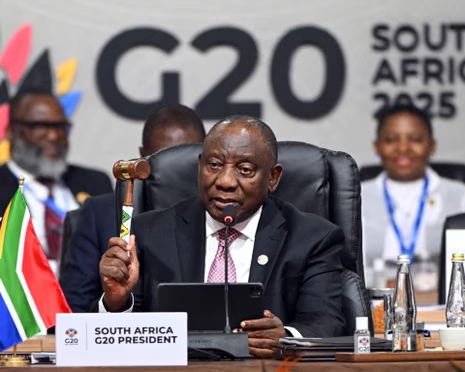
South Africa has officially handed over the G20 presidency to the United States in a subdued ceremony at the Department of International Relations and Cooperation in Pretoria, amid strained diplomatic relations with U.S. President Donald Trump.

The handover follows Trump’s boycott of the recent G20 Leaders Summit in Johannesburg, citing controversial allegations against South Africa that were widely dismissed by Pretoria. South African officials insisted the transfer be conducted at a senior diplomatic level, rejecting Washington’s request to delegate the responsibility to a junior envoy.

President Cyril Ramaphosa, in closing remarks at the summit, emphasized that Africa’s priorities had taken center stage during South Africa’s G20 term and hailed the summit as a success despite the absence of the U.S. leadership.

Tensions between the two nations intensified after Trump publicly accused South Africa of mistreating its white minority, leading to a freeze on certain U.S. aid and a threatened exclusion from the 2026 G20 summit in Miami. Ramaphosa dismissed the claims as “blatant misinformation” while reaffirming South Africa’s commitment to multilateralism and global cooperation.

The quiet handover reflects the diplomatic rift between Pretoria and Washington, leaving questions about the cohesion of the G20 under U.S. leadership in 2026 as global eyes turn toward next year’s summit.