The conflict in the Middle East intensified after an Israeli airstrike struck Yemen’s capital, Sanaa, killing Ahmed al-Rahawi, the prime minister of the Houthi-controlled government, along with several ministers and senior officials. The strike hit a villa in Beit Baws where a government workshop was being held. At the time, Houthi leader Abdul-Malik al-Houthi’s speech was being broadcast on television.
Following the attack, senior Houthi leader Mahdi al-Mashat declared that the group would retaliate, calling al-Rahawi a martyr and urging foreign companies to leave Israel. The funeral in Sanaa drew thousands of mourners who denounced Israel and its allies.
Israeli officials described the strike as a major blow against the Houthis, emphasizing that this marked the beginning of a campaign aimed at dismantling their leadership. Analysts noted that Israel’s shift from targeting infrastructure to striking at the command structure shows an escalation in strategy.
In response to the killing, the Houthis detained multiple United Nations personnel during raids on UN offices in the capital, signaling growing hostility toward international institutions. The rebels also fired a missile at an Israeli-owned tanker in the Red Sea, though no casualties were reported.
Two days later, the Houthis confirmed al-Rahawi’s death and named Deputy Prime Minister Muhammad Ahmed Miftah as acting prime minister, signaling continuity in their political leadership even as tensions in the region continue to rise.
A shocking incident occurred in Niger State where a female food vendor, identified as Amaye, was attacked and burnt alive after being accused of making blasphemous comments against Prophet Muhammad. The tragedy unfolded on August 30 in Kasuwan-Garba, Mariga Local Government Area, following a verbal exchange that spiraled out of control.
According to eyewitnesses, the altercation began in Igwama community when a young man, said to be Amaye’s nephew, jokingly told her he intended to marry her to “fulfil the Sunnah.” Reports suggest Amaye responded with remarks that some locals deemed insulting to the Prophet.
The issue was subsequently taken before the District Head of Kasuwan-Garba. During questioning, the woman allegedly repeated the remarks, leading the traditional ruler to hand her over to security operatives for further action. However, tensions escalated rapidly.
As security officers attempted to escort her, a mob of enraged youths demanded her execution. Despite the intervention of security personnel, the crowd reportedly overpowered them, stoned the woman, and eventually set her ablaze. Witnesses described the scene as chaotic and deeply disturbing.
The Niger State Police Command condemned the act, describing it as an unlawful resort to jungle justice. Police spokesman, Superintendent Wasi’u Abiodun, confirmed that officers had received reports of the alleged blasphemy around 2pm and rushed to the scene, but the mob carried out the attack before reinforcements could restore order.
He stressed that investigations are ongoing and promised that those behind the killing would be tracked down and prosecuted. The command also appealed for calm, urging residents to avoid taking laws into their own hands.
Niger State police command says it has intensified efforts and investigations to arrest the perpetrators of the recent alleged blasphemy that led to the gruesome death of food vendor, Amaye.
Through its spokesman, SP Wasi’u Abiodun, the police reiterated their stance against jungle justice and assured that every effort is being made to apprehend, investigate, and prosecute the culprits, while restoring peace and normalcy to the affected area.
Ukraine has announced plans to carry out new strikes deep into Russian territory following a wave of overnight drone attacks that cut power to 60,000 people across the country. President Volodymyr Zelenskyy revealed the decision on Sunday after meeting with his top commander, Oleksandr Syrskii, stressing that Ukraine would respond to Moscow’s growing assaults on energy and civilian infrastructure.
In recent weeks, both Kyiv and Moscow have escalated their air campaigns. Russia has intensified attacks on Ukraine’s energy grid, transportation network, and major cities, while Ukraine has targeted oil refineries and pipelines inside Russia.
According to private energy company DTEK, Russian drones struck four facilities in Ukraine’s Odesa region overnight, leaving 29,000 people without electricity. Chornomorsk, a port city near Odesa, was the hardest hit, with one reported injury and vital infrastructure now relying on generators, said regional Governor Oleh Kiper. Ukraine’s military reported that Russia launched 142 drones in total, with 132 intercepted.
On the other side, the Russian Defense Ministry claimed on Sunday that its forces had downed 112 Ukrainian drones within 24 hours.
Kremlin spokesperson Dmitry Peskov shifted blame to Europe, accusing the EU of prolonging the war and obstructing peace efforts proposed by U.S. President Donald Trump. His remarks followed a recent Russian strike in Kyiv that killed at least 23 people and damaged EU diplomatic facilities.
As diplomatic pressure mounts, German Chancellor Friedrich Merz warned that the war, now stretching into its fourth year, could drag on for a long time. He insisted that peace negotiations must not come at the cost of Ukraine surrendering.
European Commission President Ursula von der Leyen, speaking from Poland alongside Prime Minister Donald Tusk, branded Vladimir Putin a “predator” who could only be restrained through strong deterrence. She also pledged additional EU funding for border states facing direct threats from Russia and Belarus, calling border defense a “shared responsibility.”
Meanwhile, Russia continues to inflate its battlefield claims. General Valery Gerasimov asserted that Russian forces had captured 3,500 square kilometers and 149 settlements since March. However, the U.S.-based Institute for the Study of War disputed these figures, saying Moscow exaggerated its territorial gains by about 1,200 square kilometers and 19 settlements.
A devastating earthquake struck eastern Afghanistan late Sunday night, followed by powerful aftershocks that ripped through mountainous regions. The tremors, felt as far as Kabul and even Islamabad, reduced entire villages to rubble and sparked a massive rescue effort.
In Kunar province, more than 800 people were confirmed dead, with about 2,500 others injured. Nangarhar province also reported fatalities, including at least 12 deaths and over 250 injuries. Officials warn the toll could climb as rescuers reach remote areas cut off by landslides and blocked roads.
Traditional mud-brick homes, common in the region, collapsed under the quake’s force, leaving families buried beneath the debris. Survivors have been forced into the open air, facing harsh conditions without shelter, food, or clean water. Many hospitals are overwhelmed as injured victims continue to pour in.
Authorities declared a state of emergency and launched large-scale rescue operations. The defence ministry confirmed that helicopters have been deployed to evacuate the injured and deliver supplies. Local residents are also clearing blocked roads to allow aid to reach stranded villages. Witnesses described scenes of terror, with people screaming as buildings crumbled around them.
The disaster has intensified calls for urgent international assistance. Aid agencies are mobilizing emergency relief, but access to remote regions remains a major challenge. Survivors continue to plead for food, tents, and medical supplies, as fears grow of disease outbreaks among the displaced population.
The earthquake has once again exposed Afghanistan’s vulnerability to natural disasters, worsened by fragile infrastructure and limited resources. Rebuilding efforts are expected to take months, if not years, as families mourn their dead and communities struggle to recover.
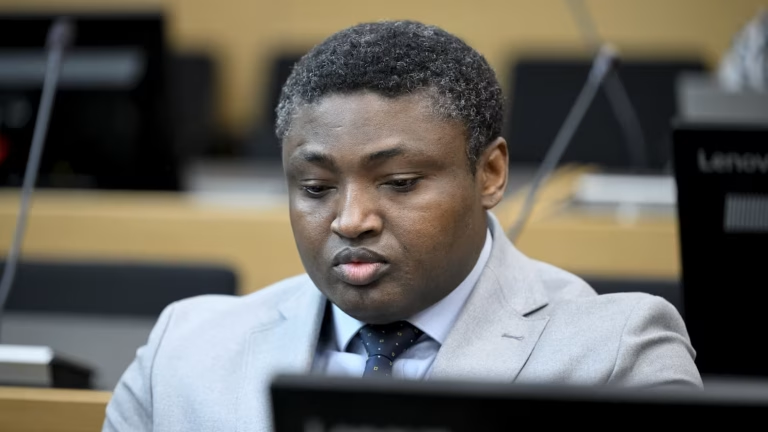
A Finnish court has sentenced Simon Ekpa, a Finnish citizen of Nigerian descent, to six years in prison after convicting him of multiple terrorism-related offences on Monday, August 26, 2025. The court found that Ekpa attempted to promote the independence of Biafra—Nigeria’s south-eastern secessionist region—through illegal means.
Between August 2021 and November 2024, Ekpa used his social media platforms to incite violence and urge followers to commit crimes in Nigeria. According to the court’s unanimous ruling, he also equipped armed groups with weapons and explosives through a network of contacts.
In addition to terrorism charges, Ekpa was convicted of aggravated tax fraud. He has denied all charges, and it remains unclear whether he will appeal the ruling.
Diplomatic Tensions Rise as Nigeria Seeks Extradition
The Nigerian government has repeatedly demanded Ekpa’s extradition to face justice at home, labeling him a key figure behind a wave of deadly unrest in the country’s southeast. While Finnish authorities arrested him at his home in Lahti in February 2023, they have yet to approve any extradition request.
Ekpa, a former local councillor in Finland, previously claimed leadership of a faction within the Indigenous People of Biafra (IPOB), a separatist group banned in Nigeria. IPOB was initially formed in 2012 as a peaceful movement but launched an armed wing in 2020, citing a need to defend the Igbo ethnic group.
A Legacy of Violence and a Nation Still Divided
Since IPOB’s shift to militancy, Nigeria’s south-east has suffered widespread violence, including attacks on government institutions and civilians. Critics accuse the group of causing enormous suffering, while supporters view it as a response to decades of marginalization.
Ekpa rose to prominence in 2022 as an online propagandist for the movement, often calling for civil disobedience and armed resistance. His conviction in Finland could mark a turning point in how countries handle diaspora-based activism that crosses into incitement and extremism.
As the Nigerian government awaits a decision on his possible extradition, families affected by the violence continue to seek justice, and Finland finds itself at the center of a diplomatic and legal storm.
The family of Big Brother Naija Season 7 winner, Ijeoma Josephina Otabor, popularly known as Phyna, has been thrown into mourning following the death of her younger sister, Ruth Otabor.
Ruth passed away in the early hours of Sunday, August 31, 2025, at about 6:30 a.m., weeks after she was involved in a tragic accident in Auchi, Edo State.
Her death was confirmed in a statement issued by Eko Solicitors & Advocates on behalf of the family and later shared by Phyna on her Instagram handle.
“With a heavy heart, the family regrets to announce the passing on to glory of their daughter, sister, and mother on this 31st Day of August, 2025, at about 06:30Hrs,” the statement read. The family also requested privacy while they grieve, adding that burial arrangements would be announced in due course.
Ruth’s death came just over two weeks after she was hit by a truck linked to the Dangote Group near Auchi Polytechnic, an incident that left her critically injured.
Ruth’s Condition Before Her Passing
Before her death, Phyna had repeatedly taken to Instagram Live to cry out about the worsening health of her sister and delays in her evacuation abroad for treatment.
She revealed that beyond her amputated leg, Ruth had suffered extensive internal injuries that left her in a fragile condition.
“Her lungs have fluid. Her reproductive organ is crushed. Her bladder is busted. We are praying every day for her to get to the next day. And you’re trying to outsmart me… I cannot use my sister’s life to gamble,” Phyna lamented.
In another video, she criticized the perceived delays in getting swift medical intervention for Ruth.
“If Dangote’s child is sick, do they wait for medical reports to say she cannot be treated in Nigeria before flying her out? Why then are they stressing me? My sister’s lungs have fluid, her bladder is busted, and her reproductive organ is crushed. We are praying for her to survive each day, and they are wasting precious time with paperwork. This is heartbreaking.”
Family’s Reaction to Her Death
Confirming the sad development, the family expressed heartbreak at the loss, describing Ruth as not just a daughter and sister but also a loving mother.
“The family is presently grieving and will appreciate being given a private moment to mourn the departed. The funeral arrangement will be communicated to the public in due course,” the family said in their statement.
Relatives also shared memories of Ruth, recalling her warmth and affectionate nature. A family source told reporters:
“We will miss her. We had thought she would survive after she started recuperating. She was very loving to be with. We used to call her Bobo, which was her nickname.”
Dangote Group’s Position
Following the accident, Dangote Group had taken responsibility for Ruth’s medical expenses, stating that it was committed to her care in line with its welfare policy.
After her passing, representatives of the company were contacted and reportedly evacuated her remains to the mortuary. A family source disclosed that they expect the company to also handle her burial expenses.
The group, in earlier statements, noted that its team engaged with law enforcement officials, visited the accident scene, and supported the family during her treatment. It pledged full medical assistance and compensation while investigations into the incident continue.
Ruth Otabor’s death closes a heartbreaking chapter for the Otabor family, who had held on to hope despite her critical condition.
For many, her story also raises renewed conversations about emergency medical responses, corporate accountability, and the need for urgent reform in Nigeria’s road safety systems.
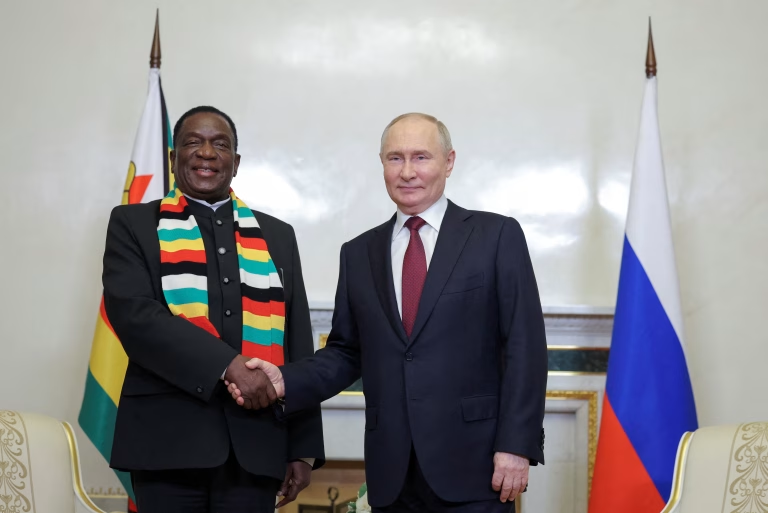
Zimbabwean President Emmerson Zimbabwean President Emmerson arrived in Beijing on Monday, August 25, 2025, joining a growing list of world leaders—including Russia’s Vladimir Putin and North Korea’s Kim Jong Un—for a grand military parade marking the 80th anniversary of World War Two’s conclusion.
Beijing Hosts Parade While Geopolitical Power Bloc Expands
Simultaneously, a quieter yet highly strategic event is unfolding in northern China. Leaders from the Shanghai Cooperation Organization (SCO)—a 10-member alliance including China, Russia, India, Iran, and Pakistan—have convened for a pivotal summit.
In his opening remarks, President Putin positioned the SCO as a driving force behind a new global order. “Our organization is consistently increasing its influence… and is a powerful driver of global development processes and the establishment of genuine multilateralism,” he said.
Over the past two decades, the SCO has grown into a formidable alternative to Western alliances. Originally created to counter U.S. influence in Central Asia, it has steadily expanded. India and Pakistan joined in 2017, Iran in 2023, and Belarus in 2024, giving the group greater geopolitical weight.
SCO Marks Strategic Shift from Western Dominance
The Shanghai Cooperation Organization’s (SCO) diverse membership is particularly noteworthy. It brings together major global players like India and China—nations with historically complex and sometimes strained relations with Washington—alongside open adversaries of the West such as Iran and Belarus. Although the alliance receives limited attention in Western media, it now represents almost half of the world’s population and is steadily influencing international norms beyond traditional Western frameworks.
Moreover, experts suggest that the SCO’s growing influence is largely driven by widespread discontent with U.S.-centric policies on trade, security, and foreign conflicts. For example, recent tariffs imposed by the U.S. on China and India, along with continued military and financial support for Ukraine, have encouraged several member states to forge alternative alliances and promote a new model of multilateral cooperation.
In addition, by hosting both the military parade and the SCO summit, China is clearly asserting its ambition to lead on both the military and diplomatic fronts. From Beijing’s perspective, this is not merely a show of strength—it is a deliberate attempt to reshape global diplomacy and elevate alternative power centers.
At the same time, as Western nations contend with internal political divisions and foreign policy fatigue, the emergence of the SCO and China’s assertive leadership present a growing challenge to established international power structures.
Seattle Sounders FC produced a ruthless, disciplined performance to beat Inter Miami 3–0 in the 2025 Leagues Cup final at Lumen Field, a victory that crowned the Sounders champions in front of a reported club-record crowd of 69,314.
Osaze De Rosario opened the scoring with a header, Álex Roldán converted from the spot in the second half, and Paul Rothrock wrapped things up in stoppage time as Seattle controlled the decisive moments and left little margin for error. The win not only delivered the Leagues Cup trophy to Seattle, it completed a sweep of major North American honours for the club.
Key moments and the flow of the game
The match’s pattern was straightforward: Seattle struck first through a well-timed header (De Rosario), and when Miami pushed men forward in search of an equaliser they left spaces that Seattle exploited. Roldán’s penalty—given after a foul that handed Seattle renewed control—dented Miami’s hopes, and Rothrock’s late finish punctured any realistic route back into the game. Miami created some half-chances but repeatedly failed to turn possession into real goal threat; Seattle’s finishing and game management proved clinical.
Messi’s night: threat without the reward
Lionel Messi, the obvious headline attraction, had his moments but ultimately finished the night without the goal that could have swung momentum. Reports and match footage show Messi squandering at least one gilt-edged opportunity—described by several outlets as a “sitter”—and more than one clear chance that went begging; those misses were pivotal in a game where Miami could not fashion a sustained, cutting attack. Rather than rescuing his side, Messi’s chances went begging and the Sounders defended him effectively when it mattered most.
Tactics: how Seattle neutralised a superstar and a star-studded XI
Tactically, Seattle’s blueprint was high intensity, smart compactness in the middle, and rapid exploitation of counters. Youth and energy on the flanks — combined with disciplined defensive work from the midfield and full-backs — limited Inter Miami’s time on the ball in dangerous areas. Obed Vargas (and Seattle’s wider pressing structure) repeatedly disrupted Miami’s build-up, forcing rushed passes and preventing the normal interplay that gives Messi space to operate. The Sounders’ structure turned quality possession into high-value chances while keeping Miami’s finishing options quiet.
Post-match fallout: a brawl and disciplinary questions
The match’s story did not end with the final whistle. Video and eyewitness reports captured a heated altercation after the game involving several players and staff. Most seriously, footage circulated showing Luis Suárez apparently spitting at a Seattle security official; the episode followed a physical confrontation in which Suárez grabbed an opponent and tensions spilled over. The brawl has generated immediate calls for review and possible sanctions, and both clubs and tournament authorities are expected to probe the incident. The on-field defeat and off-field controversy combined to make a fraught night for Inter Miami.
What the result means: trophies, qualification and the narrative around Messi
Seattle’s victory secures the Leagues Cup title and with it a place in the CONCACAF Champions Cup (and the associated continental privileges) — a tangible sporting reward for the club’s planning and consistency. For Inter Miami, the loss raises immediate footballing questions about finishing and cohesion in big matches, and reputational questions as officials examine the post-game conduct. For Messi personally, the defeat is a missed chapter in an otherwise dazzling tenure in MLS; it’s the kind of big-match night that will be parsed repeatedly in the media and by fans as he seeks more silverware with Miami.
The death of former Inspector-General of Police and immediate past Chairman of the Police Service Commission, Dr. Solomon Ehigiator Arase, has drawn tributes from across the country. He passed away on Sunday at the age of 69 after a brief illness at Cedarcrest Hospital, Abuja.
President Bola Tinubu, the Inspector-General of Police, Kayode Egbetokun, state governors, and eminent Nigerians paid glowing tributes, describing Arase as one of the most reform-minded leaders the Nigerian Police Force ever produced.
His first son, Solomon Arase Jnr., confirmed the news of his passing, noting that his father “served the country with distinction.”
Who Was Solomon Arase
Born on June 21, 1956, in Owan West Local Government Area of Edo State, Arase’s academic pursuits reflected his deep interest in law, governance, and justice.
He studied Political Science at Ahmadu Bello University, earned a Law degree from the University of Benin, and later obtained a Master’s and Ph.D. in Public Law. He was also a Fellow of the Defence College and a member of the prestigious Body of Benchers.
Arase joined the Nigeria Police Force in 1981 and rose steadily through the ranks. Over his 35-year career, he held several strategic positions, including Commissioner of Police in Akwa Ibom, Principal Staff Officer to three successive IGPs, Assistant Inspector-General of Police in charge of the Force Intelligence Bureau, and Deputy Inspector-General at the Force Criminal Investigation Department. His appointment as IGP in April 2015 marked the culmination of a distinguished career before his retirement in June 2016.
Even after retirement, he continued his service to the nation, most notably as Chairman of the Police Service Commission (PSC), where he pushed for greater accountability and professionalism in the force.
5 Key Achievements of Arase as Inspector-General of Police
1. Institutionalizing the Police Complaints Response Unit (CRU)
Under Arase’s leadership, the Police Complaints Response Unit was strengthened as a platform for citizens to report misconduct and rights abuses by officers. This initiative boosted public confidence in the force, promoted transparency, and reinforced accountability in police operations.
2. Promotion of Community Policing
Recognizing the importance of collaboration between law enforcement and citizens, Arase deepened community policing strategies nationwide. He emphasized partnership with traditional rulers, local vigilantes, and civil society organizations to improve intelligence-gathering and build trust in communities.
3. Welfare and Housing for Police Officers
During his tenure, he prioritized the welfare of police personnel by initiating housing schemes and improving conditions of service. His focus on welfare was aimed at boosting morale and reducing the vulnerability of officers to corruption.
4. Enhancing Intelligence-Led Policing
With his background in intelligence, Arase championed intelligence-driven policing over brute force. He modernized the operations of the Force Intelligence Bureau and encouraged data-driven strategies to combat crimes such as kidnapping, armed robbery, and terrorism.
5. Improved Human Rights Compliance
Arase was widely respected for promoting human rights standards within the force. Drawing from his legal training and international experience, he emphasized respect for the rule of law, discouraged torture in interrogations, and engaged with human rights organizations to monitor police conduct.
Dr. Solomon Arase’s death marks the close of a remarkable chapter in Nigeria’s security history. His reforms and leadership ethos continue to influence the Police Force, and he will be remembered as a disciplined officer, a scholar, and a patriot who sought to modernize policing in the country.
President Tinubu summed up the national sentiment in his condolence message: “Arase’s service to the police force and the country brought lasting changes. His passing is not just a loss to his family but to the entire nation.”
Between August 21 and August 28, 2025, Kenyan authorities uncovered 32 more bodies in mass graves at Kwa Binzaro village, Kilifi County, adding to the growing death toll linked to the Good News International Church. Led by controversial preacher Paul Mackenzie, the cult coerced followers to starve themselves in a twisted promise of salvation. The latest discovery pushes the total number of confirmed deaths past 450.
According to Dr. Richard Njoroge, a government pathologist, the recent exhumations began with five bodies and scattered remains. As the investigation progressed, that number climbed to 32. The site, located approximately 30 kilometers from the infamous Shakahola Forest, is believed to harbor at least 27 more mass graves. Authorities have now paused the operation to conduct forensic analyses and DNA identification.
Authorities Under Fire Over Delayed Action and Cult Links
Police Spokesperson Michael Muchiri confirmed the temporary suspension of exhumations, citing the need for careful forensic work. “This is a tragedy of unimaginable scale,” he said. “We are committed to uncovering the full extent of these atrocities and ensuring justice.”
Meanwhile, eleven former cult members have been arrested in connection to the Kwa Binzaro graves and are expected to appear in court. Investigators also believe that Mackenzie, despite being imprisoned, continues to influence his followers—possibly by communicating through a smuggled mobile phone. These revelations have sparked renewed scrutiny into why law enforcement failed to act on earlier warnings about Mackenzie’s activities.
Across social media platforms like X (formerly Twitter), hashtags such as #JusticeForShakahola have gone viral. Kenyans are expressing collective anger over the government’s inaction and demanding accountability. “How did the police miss this for so long?” one user posted, reflecting the broader sense of betrayal.
This public outrage has also reignited debate about the need for stricter oversight of religious groups. Similar cult-related abuses have emerged in other parts of Africa, highlighting a continental pattern of vulnerable communities being manipulated by rogue religious leaders.
Poverty, Public Pressure, and the Long Road to Justice
The tragedy comes at a time when Kenya faces serious economic and humanitarian challenges. Four counties are currently grappling with malnutrition crises, and there are shortages in special food aid for children. In August 2025, inflation surged to 4.4%, driven by rising food and transport costs.
According to human rights lawyer Jane Wambui, the cult preyed on economic desperation. “This cult exploited vulnerable people in a time of hardship. The government must address both the crime and the conditions that enabled it,” she stated. Experts now warn that systemic poverty and weak social safety nets could leave more communities exposed to similar tragedies.
Paul Mackenzie remains in custody, facing multiple charges including terrorism, manslaughter, and child torture. Some court cases have been adjourned as new evidence from Kwa Binzaro emerges. Meanwhile, families of victims are still waiting for DNA results to confirm the identities of their loved ones before proceeding with burials.
The Kenyan public, legal system, and human rights organizations now closely watch how the government handles the aftermath. As pressure mounts for justice and reform, this tragedy serves as a painful reminder of the urgent need for stronger laws, better enforcement, and community protection against extremist ideologies.
To provide the best experiences, we use technologies like cookies to store and/or access device information. Consenting to these technologies will allow us to process data such as browsing behaviour or unique IDs on this site. Not consenting or withdrawing consent, may adversely affect certain features and functions.
Functional
Always active
The technical storage or access is strictly necessary for the legitimate purpose of enabling the use of a specific service explicitly requested by the subscriber or user, or for the sole purpose of carrying out the transmission of a communication over an electronic communications network.
Preferences
The technical storage or access is necessary for the legitimate purpose of storing preferences that are not requested by the subscriber or user.
Statistics
The technical storage or access that is used exclusively for statistical purposes.The technical storage or access that is used exclusively for anonymous statistical purposes. Without a subpoena, voluntary compliance on the part of your Internet Service Provider, or additional records from a third party, information stored or retrieved for this purpose alone cannot usually be used to identify you.
Marketing
The technical storage or access is required to create user profiles to send advertising, or to track the user on a website or across several websites for similar marketing purposes.