The Nigeria Labour Congress (NLC) has given the Federal Government a seven-day ultimatum to return allegedly diverted workers’ funds from the Nigeria Social Insurance Trust Fund (NSITF) and to immediately set up the Governing Board of the National Pension Commission (PenCom). The union warned that failure to act would trigger a nationwide strike.
The ultimatum was part of resolutions from the NLC’s Central Working Committee (CWC) meeting held on Wednesday, August 13, 2025, in Abuja, presided over by its president, Joe Ajaero.
NSITF Funds Dispute
The CWC accused the Federal Government of diverting 40% of workers’ NSITF contributions into government coffers as “revenue,” describing the action as illegal and a direct violation of the fund’s establishing laws. It also condemned alleged moves to amend the NSITF Act to grant the government full control over the funds, warning that such steps undermine workers’ rights and international labour standards.
PenCom Board Vacancy
The NLC criticised the continued absence of a PenCom Governing Board, saying it breaches the commission’s Act and exposes pension funds to possible mismanagement and political interference. It stressed that pension funds are “deferred wages” and must be protected from government overreach.
Edo Council Dissolution
The CWC ratified the dissolution of the NLC Edo State Council over allegations of unethical conduct and anti-union activities. A caretaker committee will oversee its affairs until fresh elections are conducted.
Economic Concerns
The union also decried worsening economic hardship in the country, citing inflation, unemployment, hunger, insecurity, and the collapse of public services. It blamed these issues on “anti-people neoliberal policies” and called for a people-centred development model.
Ultimatum Conditions
The NLC demanded that the Federal Government:
Refund all allegedly diverted NSITF funds.
Constitute the PenCom Board in full compliance with the law.
Provide a detailed report on the status of pension funds.
It warned that if these demands are not met within seven days, it would no longer guarantee industrial peace in the country.
Two-time CHAN champions Morocco reignited their Group A campaign with a decisive 3–1 victory over Zambia at the Nyayo National Stadium in Nairobi. The Atlas Lions, who suffered a setback against hosts Kenya earlier in the tournament, took control just before half-time when captain Mohamed Hrimat rose above his marker to nod home Youssef Mehri’s pinpoint corner. The goal shifted the momentum firmly in Morocco’s favour heading into the break.
Zambia thought they had levelled the score in the 65th minute through Happy Nsiku, but the effort was ruled out by VAR for an infringement in the build-up. The disallowed goal proved costly, as Morocco immediately doubled their lead through Oussama Lamlaoui. Although Andrew Phiri pulled one back for Zambia in the 70th minute, any hopes of a comeback were dashed in stoppage time when Sabir Bougrine fired in a third for Morocco. The result lifts the North Africans to six points, keeping their quarter-final hopes alive.
DR Congo Edge Angola In Vital Win
In the other Group A fixture, DR Congo kept their own qualification chances alive with a hard-fought 2–0 victory over Angola. After a goalless first half, the Leopards stepped up the intensity and found their breakthrough when Jephté Kitambala powered home a header. Mokonzi Katumbwe then added a second, also from the air, sealing a win that eliminated Angola from the competition.
The result moves DR Congo level on points with Morocco, setting up a high-stakes clash between the two former champions in the final group game. Both sides know that victory will guarantee a spot in the quarter-finals, while a draw could complicate the qualification picture depending on Kenya’s result.
Group A Showdown Looms
With Kenya currently leading the group, the final round of fixtures promises to deliver drama. Morocco’s confidence will be buoyed by their commanding win over Zambia, while DR Congo will take heart from their solid performance against Angola. For both teams, Sunday’s meeting is more than just a battle for bragging rights, it’s a direct ticket to the knockout stage, and potentially the beginning of another title run.
The revelation that ₦6.9 trillion was allocated for constituency projects in Nigeria’s 2025 budget has reignited concerns about transparency and accountability in public finance. BudgIT, a civic tech organization dedicated to promoting fiscal openness, uncovered over 11,000 projects inserted into the budget, many without justification, some far outside the mandates of the agencies tasked with executing them, and most shrouded in secrecy.
While the report initially sparked outrage among well-meaning Nigerians and stakeholders, months later, public attention has waned, leaving citizens uncertain about the next steps. The questions remain: how did we get here, who truly benefits, and how can this entrenched practice be dismantled?
At its core, budget padding undermines fiscal responsibility and distorts national development priorities. Public institutions risk becoming “project warehouses” for political patronage, leading to inefficiency, waste, and a cycle of incomplete or abandoned initiatives.
On Wednesday, August 13, 2025, just six days after her graduation from Auchi Polytechnic, Ruth Otabor, sister of Big Brother Naija Season 7 winner Phyna, suffered a life-altering accident near Auchi Polytechnic, Edo State. A heavy-duty truck linked to the Dangote Group crushed her leg before a bystander managed to stop it. The severity of her injuries forced the amputation of her leg, an outcome that triggered nationwide shock and sympathy.
Phyna, known for her bold presence and outspoken nature since winning BBNaija’s “Level Up” edition in 2022, immediately turned her platform toward demanding justice, condemning what she described as negligence, and pledging not to let the tragedy fade into obscurity.
Dangote Pledges Support For Victim
Following the accident, Dangote Group issued an official statement:
“Following the recent road accident in Auchi, Edo State, involving one of our trucks, which sadly resulted in injury to Mrs. Ruth Otabor, senior officials from Dangote Cement Plc, together with our insurance team, promptly visited the scene, engaged with law enforcement authorities, and visited the victim and her family at Irrua Specialist Teaching Hospital, Edo State.
This action reflects our unwavering commitment to the well-being of those affected. We are ensuring full support for Mrs. Otabor, including comprehensive medical care and appropriate compensation, in line with Dangote Group’s welfare policy.
Our thoughts remain with Mrs. Ruth Otabor and her loved ones, and we wish her a full and speedy recovery.”
Five Major Incidents Involving Dangote Trucks
Nyanya Bridge Inferno, Abuja – March 19, 2025
A heavily loaded Dangote cement trailer lost control near Nyanya Bridge, crashing into stationary vehicles, igniting a devastating fire that engulfed 14 vehicles and claimed the lives of six victims.
Brake-Failure Crash, Epe – November 2024
A Dangote truck suffered brake failure while descending from Ita-Opo, colliding with a tricycle and a Toyota Camry at Ayetoro Junction. The crash killed three individuals, including two students from Manpower Technical School.
Alleged 20 Deaths, Imo State
A heavy-duty truck reportedly owned by Dangote rammed into three mini-buses at the Imo State University junction, killing at least 20 people.
Kugbo–Nyanya Incident, FCT – May 2025
A Dangote-linked truck (registration KPF 305 XA) reportedly had brake failure, colliding with a dispatch rider and a J5 bus along Kugbo–Nyanya expressway. Fortunately, no fatalities were reported—only three people sustained serious injuries.
Multiple Fatalities, Ibese–Itori Road, Ogun State – August 2022
A Dangote cement truck travelling along the Ibese–Itori road lost control and rammed into several vehicles and motorcycles. The impact killed seven people instantly and left many others injured, prompting renewed calls for stricter enforcement of safety measures for heavy-duty vehicles.
Sanctions And Accountability Measures
Despite repeated tragedies linked to Dangote trucks, there is no public record of formal sanctions, such as government fines or regulatory penalties, specifically imposed on Dangote Group over these accidents.
In some cases, the company has denied ownership of trucks involved in fatal crashes, clarifying that they only carried Dangote-branded products. In other situations, police investigations have absolved the company of fault, attributing the accidents to mechanical failures or other factors.
Dangote has, however, partnered with the Federal Road Safety Corps (FRSC) to establish an articulated truck driving school aimed at improving driver training, as part of efforts to reduce road accidents involving its fleet.
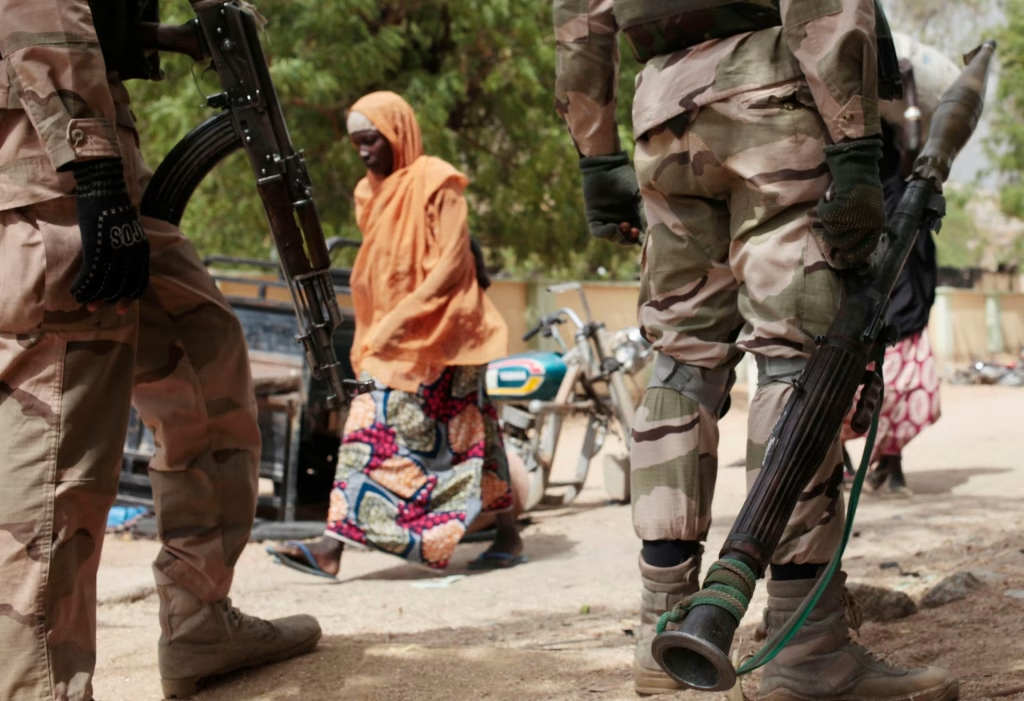
Authorities in Mali have arrested several people, including two army generals and a French national, for allegedly planning to destabilise the country and remove the current military government from power.
Security Minister General Daoud Aly Mohammedine made the announcement on national television, saying the suspects were involved in criminal actions against the state and that the situation is now completely under control.
The arrests follow several days of rumours about high-ranking officers being detained, which raised concerns about possible unrest within Mali’s armed forces.
The minister said the government had stopped the group’s plan, describing the suspects as a small number of “marginal elements” from both the military and civilian sectors.
He added that the plot began on August 1, and that the group had received help from foreign governments, aiming to weaken the institutions of the republic and disrupt the transition process.
French Spy Suspected; Generals Had Clashed With Leadership
A French national, identified as Yann Christian Bernard Vezilier, was among those arrested and is suspected of working with French intelligence services to support the alleged coup attempt in Mali.
The government claims the French man helped bring together political figures, civil society groups, and members of the military to support efforts to destabilise the country’s leadership.
One of the generals arrested, Abass Dembele, was previously the governor of Mali’s Mopti region and had clashed with the army leadership earlier this year.
He was removed from his position in May after calling for an investigation into reports that the Malian army killed civilians in the village of Diafarabe.
The second general, Nema Sagara, is a well-known military figure who was praised in the past for her role in fighting rebel groups during the 2012 crisis.
Tensions Grow as Mali Extends Military Rule
Mali has faced ongoing security problems since 2012, with violence from armed groups linked to al-Qaeda and ISIS, along with attacks by local criminal gangs across the country.
Since taking power through a coup in 2020, President Assimi Goita and his military government have moved away from Western allies, especially France, in favour of closer ties with Russia.
The government says this shift is part of a plan to strengthen national independence and end foreign interference in Mali’s affairs.
In June, Mali’s transitional council voted to extend Goita’s time in power for another five years, breaking an earlier promise to return to civilian rule by March 2024.
This decision has caused concern both inside Mali and among international observers, who worry that the country is moving further away from democratic rule.
The Federal Government has approved a seven-year suspension on the creation of new federal universities, polytechnics, and colleges of education, citing the unchecked spread of under-utilised institutions, overstretched resources, and declining academic standards.
This decision, approved during Wednesday’s Federal Executive Council (FEC) meeting chaired by President Bola Tinubu at the Presidential Villa in Abuja, followed a presentation by the Minister of Education, Dr. Tunji Alausa. Despite the freeze, the FEC still approved the establishment of nine new universities.
Speaking to State House correspondents after the meeting, Alausa explained that Nigeria’s main challenge in the tertiary education sector was no longer access but inefficiency, inadequate infrastructure, lack of qualified staff, and low enrolment levels in many institutions. “Several federal universities operate far below capacity, with some having fewer than 2,000 students. In one northern university, there are 1,200 staff serving fewer than 800 students. This is a waste of government resources,” he stated.
He revealed that 199 universities received fewer than 100 applications through the Joint Admissions and Matriculation Board (JAMB) last year, with 34 recording zero applications. Out of the 295 polytechnics in the country, many attracted fewer than 99 applicants, while 219 colleges of education also had poor enrolment rates, including 64 that received no applications at all.
Alausa cautioned that the uncontrolled growth of under-subscribed institutions could produce poorly prepared graduates, damage the global reputation of Nigerian degrees, and worsen unemployment. He noted that the moratorium would allow the government to concentrate on improving facilities, recruiting qualified personnel, and expanding the capacity of existing schools.
“If we want to improve quality and not be a laughing stock globally, the pragmatic step is to pause the establishment of new federal institutions,” he said. Currently, Nigeria has 72 federal universities, 42 federal polytechnics, and 28 federal colleges of education, alongside hundreds of state-owned and private institutions, as well as specialised colleges of agriculture, health sciences, and nursing.
The minister clarified that the nine newly approved universities were private institutions with applications that had been pending for as long as six years and had undergone full evaluation by the National Universities Commission (NUC).
“When we assumed office, there were 551 applications for private universities. Many had been stuck due to inefficiencies at the NUC. We deactivated over 350 dormant applications and set new, stricter guidelines. Of the 79 active cases, nine met the criteria and were approved,” Alausa said.
He added that billions of naira had already been invested in infrastructure for these approved universities. The moratorium, he stressed, also applies to new private polytechnics and colleges of education to curb further under-enrolment.
Praising the President’s support, Alausa described the reform as a “reset button” for Nigeria’s tertiary education. “Mr President believes fervently in education and has given us the mandate to ensure every Nigerian has access to the highest quality of education comparable to anywhere in the world,” he added.
NAFDAC’s Director-General, Professor Mojisola Adeyeye, sought to reassure Nigerians that genetically modified (GMO) foods “are not bad for us,” so long as safety checks are in place and proper labelling is enforced.
While these assurances may sound comforting, they raise deeper questions: do we truly understand the long-term health and environmental impacts of GMOs? Are Nigeria’s regulatory agencies genuinely acting in the public interest, or are they working in alignment with the very corporations promoting these products? The debate is not only about science, it’s also about trust, transparency, and who ultimately shapes our food systems.
Although global bodies like the UN’s Food and Agriculture Organization have declared certain GMOs safe, sceptics argue that the evidence is far from conclusive, especially in the context of Nigeria’s agricultural realities. Food safety is not a privilege, it is a right. Protecting that right means holding decision-makers accountable, demanding open and independent research, and ensuring that public health takes precedence over corporate profit. In the end, if Nigerians do not control their food, they risk losing control over their future.
France, Germany, and the United Kingdom have informed the United Nations that they are prepared to reimpose sanctions on Iran if it does not resume negotiations over its nuclear programme.
In a joint letter sent on Tuesday, the foreign ministers of the three countries known as the E3, warned they could trigger the “snapback” mechanism unless Iran acts before the end of August 2025. They said Iran had so far ignored an offer for a limited extension to allow direct talks between Tehran and Washington.
The E3, along with China and Russia, remain parties to the 2015 nuclear agreement, which lifted sanctions on Iran in exchange for restrictions on its nuclear activities. The United States withdrew from the deal in 2018.
The warning follows recent talks in Istanbul, described by the ministers as “serious, frank and detailed” the first in-person meeting since Israeli and U.S. strikes targeted Iranian nuclear sites in June.
In response, senior Iranian lawmaker Manouchehr Mottaki said parliament would move to withdraw from the nuclear Non-Proliferation Treaty (NPT) within 24 hours if the E3 reinstates sanctions. He added that lawmakers could also approve Iran’s exit from the 2015 nuclear deal under the same circumstances.
Iran has previously signalled that such steps were being considered, particularly during its 12-day conflict with Israel in June. The NPT, ratified by Iran in 1970, permits civilian nuclear energy development but prohibits the acquisition of nuclear weapons, under the oversight of the International Atomic Energy Agency (IAEA).
The new Premier League campaign is almost here and there are a whole host new things to look out for in 2025/26.
From rule changes to new grounds, we examine what you can expect over the next nine months as we gear up for our opening match on 15th August 2025..
Eight-Second Rule
One of the biggest rule changes to the Premier League season sees goalkeepers punished for holding onto the ball for longer than eight seconds.
Should a goalkeeper exceed the time limit set by the new rules, a referee will give a corner to the opposing team. Referees have been instructed to warn goalkeepers with a five-second countdown.
The law is aimed at clamping down on time wasting and is a rule that has been implemented across football worldwide.
Captains Only
Another law that has been implemented is that only captains of each club will be allowed to approach the referee during the 90 minutes of play.
Yellow cards will be given out to players who do not have permission to speak with the referee or behave in a disrespectful manner. If the goalkeeper is the one with the armband, then the team can nominate one outfield player to speak with the referee.
Other Rule Changes
As per most Premier League seasons, subtle rule changes have been made. In addition to the rules above, a player will be allowed to retake a penalty if they accidentally touch the ball twice when kicking their spot kick. This rule only applies if the effort goes in.
An indirect free-kick will be awarded if a player, substitute or coach off the pitch touches the ball before it goes out of play.
A drop ball will be given to a team that did not touch the ball last before play was stopped, so long as the referee believes that team would have gained possession.
Finally, while offsides are judged on the passing player’s first point of contact with the ball, in 2025/26, goalkeepers will only be judged on their last point of contact, including a throw or kick.
Promoted Sides
Following the relegation of Leicester City, Ipswich Town and Southampton back to the Championship, three more sides are gearing up for a return to the Premier League.
Burnley, managed by Scott Parker, have returned to the top flight at the first time of asking, having been relegated in 2023/24.
Leeds United were promoted as Championship winners, finishing on 100 points last season to make a return to the Premier League after two seasons away.
Lastly, Sunderland have returned to the Premier League after being relegated in 2016/17. In that time, the Black Cats have been down to League One and back, clinching their spot in the top flight with a dramatic 2-1 playoff final win over Sheffield United.
Managers And Players
As ever, the transfer window is a busy time in the football calendar, with players and managers coming and going all over the country.
Millions of pounds have been exchanged, with a host of new faces getting ready to make their Premier League bows.
Starting with the managers, there will be two new faces gracing the dugouts with Brentford’s Keith Andrews and Sunderland’s Regis Le Bris gearing up for their first Premier League matches.
Andrews steps up from set-piece coach to head coach following Thomas Frank’s departure to Tottenham. Le Bris becomes the ninth Frenchman to be in charge of a Premier League club after guiding Sunderland to the top flight via the playoffs.
In terms of players, Newly promoted Burnley have been the busiest in the window, recruiting 13 players ahead of the new campaign.
New Stadium
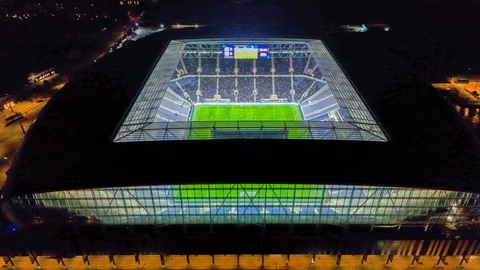
In 2024/25, Everton waved goodbye to Goodison Park, their home since 1892, as they prepared to move into their new ground, the Hill Dickinson Stadium.
Situated on Bramley-Moore Dock on the Liverpool waterfront, the first competitive match at the stadium comes on Sunday, August 24, against Brighton & Hove Albion.
The stadium is the 62nd venue to host Premier League football.
Referees
There will be six new faces joining the Professional Game Match Officials (PGMO), who have been added to a supplementary list for the Select Group 1, which serves both the Premier League and EFL for 2025/26.
These include Lewis Smith, Farai Hallam, Adam Herczeg, Tom Kirk, Ruebyn Ricardo and Ben Toner. Smith already has experience within the Premier League, having had the whistle for nine top-flight matches already when part of the PGMO’s Development Group.
As well as those on the pitch in charge of matches, former FIFA official Kevin Blom has also joined PGMO in the role of VAR performance coach for 2025/26.
Blom is a former referee, having officiated matches in UEFA and FIFA competitions, as well as operating as a video match official at EURO 2020.
Fantasy Football
Fantasy Football grips supporters, season in, season out as players around the world look to build their perfect squads for 2025/26.
There are a couple of things to take into consideration this time around when constructing your side to beat friends and rivals alike.
Outfield players will now be rewarded with points for ‘defensive contributions’. Any defender who reaches a combined total of 10 clearances, blocks, interceptions and tackles (CBIT) in a single match will score two FPL points.
There are also opportunities for midfielders and forwards to get in on the act. In addition to their clearances, blocks, interceptions and tackles, their ‘ball recoveries’ will also count towards their total of defensive contributions (CBIRT). This means they have the chance to make 12 defensive contributions to earn their two FPL points, instead of 10.
There will also be two sets of chips awarded for each player, meaning you can go twice with your triple captain, free hit, wildcard and bench boost during 2025/26. The assistant manager chip will not be returning after one season.
Tweaks to the assist rule, extra transfers during the Africa Cup of Nations and bonus points criteria also feature in a slew of changes.
U.S. President Donald Trump believes Ukraine should be directly involved in any discussions over territory as part of a potential truce with Russia, French President Emmanuel Macron said on Wednesday.
Macron’s remarks suggest that Kyiv and its European allies have successfully pressed their position ahead of Trump’s planned meeting with Russian President Vladimir Putin in Alaska on Friday.
The statement offers some reassurance to Ukraine and its partners, who have been concerned that a U.S.–Russia deal could bypass Kyiv’s interests and involve concessions over its land. Trump has previously said that ending the war might require both sides to exchange territory.
The conflict, now in its fourth year, is the largest in Europe since World War Two, with tens of thousands killed and millions displaced. European leaders fear that any land deal could see Russia retain nearly 20% of Ukraine, effectively rewarding years of aggression and encouraging further expansion westward.
Speaking on Wednesday, Macron said Trump made clear that “territories belonging to Ukraine cannot be negotiated and will only be discussed by the Ukrainian president.” He also noted that no formal land-swap proposals are currently under consideration.
German Chancellor Friedrich Merz said Trump’s priority for Friday’s talks would be securing a ceasefire, stressing there was no plan to legally recognise Russian-held areas.
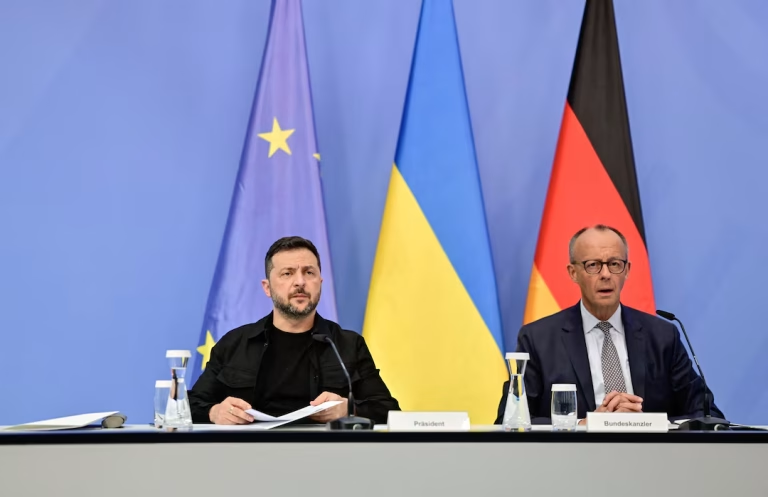
Ukrainian President Volodymyr Zelenskiy called for a three-way meeting between himself, Trump, and Putin. Merz added that while Ukraine is open to discussing territorial matters, it will not agree to legal recognition of Russian occupation.
“If the U.S. works towards a peace agreement that protects both European and Ukrainian interests, it will have our full backing,” Merz said alongside Zelenskiy.
To provide the best experiences, we use technologies like cookies to store and/or access device information. Consenting to these technologies will allow us to process data such as browsing behaviour or unique IDs on this site. Not consenting or withdrawing consent, may adversely affect certain features and functions.
Functional
Always active
The technical storage or access is strictly necessary for the legitimate purpose of enabling the use of a specific service explicitly requested by the subscriber or user, or for the sole purpose of carrying out the transmission of a communication over an electronic communications network.
Preferences
The technical storage or access is necessary for the legitimate purpose of storing preferences that are not requested by the subscriber or user.
Statistics
The technical storage or access that is used exclusively for statistical purposes.The technical storage or access that is used exclusively for anonymous statistical purposes. Without a subpoena, voluntary compliance on the part of your Internet Service Provider, or additional records from a third party, information stored or retrieved for this purpose alone cannot usually be used to identify you.
Marketing
The technical storage or access is required to create user profiles to send advertising, or to track the user on a website or across several websites for similar marketing purposes.