
Home Blog Page 89

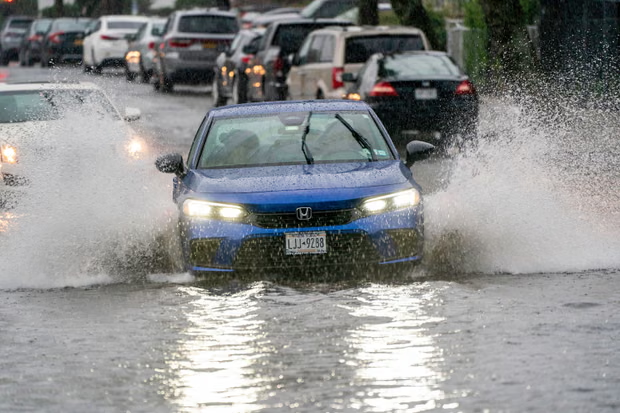
Flooded Streets And Subways As Powerful Storms Slam U.S. East Coast

Severe storms swept through the U.S. East Coast on Thursday and Friday, leaving major cities battling widespread flooding, transportation disruptions, and power outages. Heavy rainfall overwhelmed drainage systems in multiple states, flooding streets, subways, and homes from Washington, D.C. to Boston.

New York City was among the hardest hit. More than four inches of rain fell in under three hours during the early morning commute, swamping subway tunnels, halting dozens of train lines, and stranding thousands of commuters. Videos posted online showed waist-deep water gushing into subway stations in Brooklyn and the Bronx. The Metropolitan Transportation Authority (MTA) suspended several lines and warned riders to avoid unnecessary travel.

This is one of the most intense flash flooding events we’ve seen in recent years, said NYC Emergency Management Commissioner Zach Iscol. Our first responders are working around the clock to rescue stranded passengers and support impacted communities.

Elsewhere along the East Coast, cities reported similar scenes of chaos. In Philadelphia, several neighborhoods saw up to six feet of water on streets, prompting evacuations and swift water rescues. In Washington, D.C., the National Mall and surrounding areas experienced temporary closures due to pooling water and lightning threats.

More than 300,000 customers lost power across the region, according to utility companies, with restoration efforts expected to continue through the weekend. Air travel was also affected, with major delays and cancellations reported at JFK, LaGuardia, and Reagan National airports.

Meteorologists with the National Weather Service (NWS) say the storms were fueled by an unusually moist air mass combined with a stalled frontal boundary, leading to localized downpours and dangerous flash floods. A flood watch remains in effect for parts of the Northeast through Friday evening, with additional rainfall expected.

“We are urging residents to stay off the roads unless absolutely necessary,” said NWS meteorologist Lisa Kern. “Turn around, don’t drown floodwaters are extremely dangerous.”

State and local governments in New York, New Jersey, and Pennsylvania have declared states of emergency, unlocking federal assistance and activating National Guard support.

As the East Coast braces for further storms in the coming days, officials continue to assess damage and prepare for ongoing recovery operations.

Takeouts From 2025 19th International Human Rights Summit

16

The 19th International Human Rights Summit, held at the United Nations Headquarters in New York City from July 24–26, 2025, convened youth leaders, diplomats, educators, and civil society advocates under the theme “Education for Peace.” 

The gathering underscored how human rights education, grounded in the Universal Declaration of Human Rights, can serve as a powerful tool for transforming societies. Discussions highlighted the importance of promoting tolerance, dismantling discrimination, and empowering youth-driven initiatives that bring real change to local communities.

Across the three days, delegates explored urgent global issues such as human trafficking, systemic inequality, and violent conflict, stressing that education is central to building resilience and shaping a culture of peace. The summit also emphasized collaboration, calling on governments and international institutions to prioritize human rights education as a sustainable pathway to addressing injustice and fostering inclusive development worldwide.

President Tinubu Endorses Ward-Level Strategy To Address Poverty

‎President Bola Tinubu has given approval to a ward-level development plan aimed at stimulating economic growth and reducing poverty across Nigeria’s 8,809 wards.

‎The Renewed Hope Ward Development Programme (RHWDP) was endorsed at the 150th National Economic Council (NEC) meeting held on Thursday at the State House in Abuja.

‎This programme is a component of the larger Renewed Hope Agenda, which aspires to build a $1 trillion economy by 2030.

‎During the NEC meeting, Tinubu called on state governors to focus on improving the welfare of citizens at the grassroots level.

‎“I want to appeal to you; let us change the story of our people in the rural areas. The economy is working. We are on the path of recovery, but we need to stimulate growth in the rural areas,” he said.

‎The Renewed Hope Ward Development Programme (RHWDP) is designed as a unified intervention framework targeting poverty reduction, food security, rural infrastructure, electricity access, and employment generation.

‎The plan sets baseline targets for economic activities, 1,000 in smaller wards and 2,000 in larger ones with supervision by a National Steering Committee, while the Ministry of Budget and Economic Planning will serve as its secretariat.

‎Budget and Economic Planning Minister Abubakar Atiku Bagudu presented the initiative to the Council, stating that it would involve collaboration across all three levels of government for effective implementation.

‎To aid the rollout, President Tinubu ordered the transfer of the Office of the Surveyor-General of the Federation to the presidency and advocated for the expansion of the national school feeding programme to boost school attendance and tackle child poverty.

‎He also instructed NEC to establish a committee to fast-track critical infrastructure projects, including the Lagos-Calabar and Sokoto-Badagry highways.

‎Drawing from the 1999 Constitution and the Fifth Alteration Act, the programme is anchored in national policy directives that aim to enhance productivity and secure food systems.

‎During the same meeting, NEC urged state governments to reinforce their emergency management agencies and directed the Federal Ministry of Finance to disburse emergency funds to mitigate potential flood risks, following a briefing by Zubaida Umar, Director-General of the National Emergency Management Agency.

Zelensky Urges Tougher Sanctions After Deadly Russian Strikes Kill 31

Ukrainian President Volodymyr Zelensky has renewed his call for tougher international sanctions against Russia following a devastating missile and drone attack on Kyiv that killed at least 31 people, including five children—the youngest just two years old. Another 159 individuals were wounded, among them 16 children.

“Sanctions do work despite what the Kremlin claims,” Zelensky said. “They must not only be maintained but significantly strengthened.”

The capital city observed a day of mourning on Friday after Thursday’s attack left a trail of destruction, collapsing a residential building and damaging a hospital, a school, a nursery, and a university.

Ukraine’s air force reported that Russia launched over 300 drones and eight cruise missiles in what was one of the deadliest assaults on Kyiv since the full-scale invasion began in February 2022.

U.S. President Donald Trump strongly condemned Russia’s actions, calling them “disgusting,” and signaled that additional sanctions against Moscow could soon follow.

Speaking to reporters, Trump stated: “Russia, I think it’s disgusting what they’re doing.” In July, he warned that President Vladimir Putin had 50 days to end the war or face sweeping tariffs, particularly targeting Russia’s oil exports. This week, he shortened that deadline, now set to expire on August 8.

At the UN Security Council on Thursday, senior U.S. diplomat John Kelley urged both Russia and Ukraine to pursue a ceasefire and work toward a lasting peace. “It is time to make a deal,” he said.

Ukrainian officials reported receiving “positive signals” from Washington about the possibility of new sanctions, especially targeting Russia’s energy sector and secondary markets.

Foreign Minister Andrii Sybiha praised Trump’s “generosity and patience” but emphasized that “now is the time to apply maximum pressure on Moscow.”

Meanwhile, Germany has pledged to deliver two additional U.S.-made Patriot air defense systems to Ukraine in the coming days.

President Zelensky revealed that in July alone, Russia launched over 5,100 glide bombs, 3,800 Shahed drones, and 260 missiles—including 128 ballistic missiles.

Every single day counts, Zelensky said. This terror can only be stopped through united efforts from America, Europe, and all responsible global partners.

2027 Elections: INEC To launch Online Voter Pre-Registration

9

‎The Independent National Electoral Commission (INEC) has declared that the nationwide Continuous Voter Registration (CVR) will begin with online pre-registration on August 18, 2025.

‎INEC Chairman, Professor Mahmood Yakubu, made the announcement during a courtesy visit by the management team of the National Orientation Agency to the Commission’s headquarters in Abuja.

‎“The nationwide continuous voter registration is scheduled to commence in about three weeks, with the online pre-registration of voters scheduled for the 18th of August,” Yakubu said.

‎He revealed that physical (in-person) registration will commence one week after the online exercise begins.

‎Yakubu explained that the CVR is part of INEC’s wider preparations for the Anambra State governorship election scheduled for November 8, 2025, as well as the 2027 general elections.

‎During the visit, INEC and the National Orientation Agency (NOA) reaffirmed their commitment to strengthening collaboration on voter education, public awareness, and the use of artificial intelligence (AI) tools in the lead-up to the 2027 polls.

‎The INEC Chairman described the visit as part of the Commission’s ongoing stakeholder engagement efforts, highlighting NOA’s key role in grassroots voter mobilisation and sensitisation.

‎“I am particularly glad that this meeting is at the instance of the DG in furtherance of the longstanding partnership between INEC and the National Orientation Agency,” Prof. Yakubu said.

‎Earlier, NOA Director-General Malam Lanre Issa-Onilu stated that the agency is undergoing a significant transformation to better align with and support democratic goals.

‎He noted that NOA has overhauled its outreach approach by integrating both traditional and digital platforms, including weekly newsletters, AI-powered feedback systems, and a network of more than 818 local offices across the country.

Impact Of Banning Fuel Imports On Nigeria’s Economy

7

Aliko Dangote has urged the Nigerian government to halt petrol and diesel imports, arguing they are undermining local refineries and the wider economy. Citing his refinery’s recent performance over 1.3 billion litres of petrol exported in under two months he insists Nigeria has the capacity to meet its own demand if government policy fully backs domestic production.

Fuel marketers, however, caution that banning imports could hand Dangote a monopoly, driving up prices and creating supply risks. While such a move might strengthen local refining, it could also trigger inflation and limit competition. The real challenge lies in finding a balance between promoting local industry and protecting Nigerian consumers.

NAF Sets Up Forward Operating Base In Akwa Ibom

2

‎The Nigerian Air Force (NAF) has set up a Forward Operational Base (FOB) in Akwa Ibom to strengthen its operations in the South-South region.

‎The Akwa Ibom State Government provided a parcel of land for the FOB’s establishment.

‎Chief of the Air Staff (CAS), Air Marshal Hasan Abubakar, revealed this during a courtesy visit to Governor Umo Eno in Uyo.

‎This was stated in a release issued on Friday in Abuja by the NAF Director of Public Relations and Information, Air Commodore Ehimen Ejodame.

‎According to Abubakar, the FOB will improve air power deployment and bolster maritime security across the Gulf of Guinea axis.

‎He commended the state government’s support, calling it a significant contribution to national security and a move that could also attract commercial activity, investment, and tourism to the area.

‎“The base will further assure the safety and security of persons and property and foster Akwa Ibom as a destination for investment and tourism,” he said.

‎The Chief of the Air Staff (CAS) reiterated the Nigerian Air Force’s dedication to protecting lives and property, noting that the newly established FOB would strengthen current security frameworks and boost investor trust in the area.

‎Governor Umo Eno, in his response, said the visit underscored Akwa Ibom’s growing importance within Nigeria’s security framework.

‎He assured the NAF of ongoing support, emphasizing that sustainable development is anchored on a secure environment.

‎“We believe that a safe and secure society is the bedrock of development, and we are glad to partner with the NAF to achieve that objective,” he said.

State VS National: The Electricity Tariff Tangle

7

Enugu State’s decision to reduce electricity tariffs for Band A customers from N209/kWh to N160/kWh, starting August 1, 2025, has ignited controversy in Nigeria’s power sector.

While the Enugu Electricity Regulatory Commission (EERC) argues the cut is cost-reflective and factors in federal subsidies, GenCos, DisCos, and the Nigerian Electricity Regulatory Commission (NERC) insist the move is “arbitrary” and could destabilize an already fragile market.

At the heart of the debate is the Electricity Act 2023, which empowers states to regulate their own electricity markets. Enugu’s move is seen by some as a bold step towards decentralization, but critics warn it may set a risky precedent. The challenge now is balancing consumer relief with the financial survival of GenCos and DisCos, while ensuring tariffs remain truly cost-reflective and the national grid stable.

LASU Shuts Down As ASUU, SSANU Launch Indefinite Strike

11

‎Academic and non-academic staff of Lagos State University (LASU) have commenced an indefinite strike over welfare-related concerns and other unresolved issues with the university management.

‎In a letter addressed to the Vice Chancellor, Professor Ibiyemi Olatunji-Bello, and dated July 31, 2025, leaders of the institution’s four staff unions declared that the strike would not be suspended until all their demands were fully addressed.

‎The unions, operating under the Joint Action Committee—which includes the Academic Staff Union of Universities (ASUU), the Senior Staff Association of Nigerian Universities (SSANU), the Non-Academic Staff Union of Educational and Associated Institutions (NASU), and the National Association of Academic Technologists (NAAT)—said the decision to begin the indefinite strike was taken during an Emergency Congress of the committee.

‎The statement instructed all staff of the university, including those at Lagos State University College of Medicine (LASUCOM), Ikeja, and the Epe campus, to immediately cease all duties and vacate their official duty posts.

‎The letter, titled “Notice of Indefinite Strike Action” and signed by Prof. Ibrahim Bakare (Chairman, ASUU-LASU), Sylvester Idowu (Secretary, ASUU-LASU), Oluwaseyi Lawal (Chairman, SSANU-LASU), and Waheed Majekodunmi (Secretary, SSANU-LASU), stated: “Sequel to the decision reached at the Emergency Congress of the Joint Action Committee of the Lagos State University Staff Unions (ASUU-LASU, SSANU-LASU, NAAT-LASU & NASU-LASU) that an INDEFINITE STRIKE ACTION should commence effective from Thursday 31st July, 2025, we write to notify you that the indefinite strike action has COMMENCED in Lagos State University.

‎“The strike action will be in force INDEFINITELY until all the demands of Staff Members are met by the appropriate authorities.

‎“Consequently, all members of staff of the University and its affiliate Campuses (LASUCOM and LASU Epe Campus) are hereby DIRECTED to withdraw their services and vacate their official duty post with immediate effect.

‎“While we thank you for your kind gesture and support always, accept, please, the assurances of the Unions’ kindest regards.’’

Israel Faces Diplomatic Fallout Amid Deepening Famine Crisis in Gaza – Report

Israel is reportedly heading towards a major diplomatic collapse as the humanitarian situation in Gaza worsens, with famine spreading rapidly across the besieged territory.

The report claims that the government of Prime Minister Benjamin Netanyahu disregarded repeated international warnings about an escalating famine in Gaza. On March 2, Israel’s Security Cabinet reportedly decided to block the entry of food aid into the enclave, despite assessments from Israeli security officials and urgent appeals from international humanitarian organizations.

The move was not based on strategic or security concerns, but rather stemmed from political pressure by far-right ministers Itamar Ben Gvir and Bezalel Smotrich.

Including Gen. Ghassan Alian, Israel’s Coordinator of Government Activities in the Territories had warned that Gaza was on the brink of famine. Despite this, the Israeli government allegedly continued to obstruct aid, putting thousands of Palestinian lives at risk.

The report also indicates that both the European Union and the administration of U.S. President Donald Trump issued warnings to Israel over the deteriorating crisis. The EU reportedly threatened to suspend its partnership agreement with Israel, while Washington, despite its longstanding support for Tel Aviv, urged Netanyahu to take action. The Israeli leader, however, was said to have “wasted time and hesitated.”

The Israeli government has plunged the country into a dual crisis, a humanitarian disaster in Gaza and a looming diplomatic collapse.

Since October 7, 2023, Israel has conducted a relentless military campaign in Gaza, resulting in the deaths of more than 60,000 Palestinians, the majority of whom were women and children. The offensive has decimated much of the enclave’s infrastructure and exacerbated food shortages.

In November 2024, the International Criminal Court (ICC) issued arrest warrants for Prime Minister Netanyahu and former Defense Minister Yoav Gallant, citing war crimes and crimes against humanity committed in Gaza. Israel is also currently facing genocide charges at the International Court of Justice (ICJ).
