

Yemen’s Iran-aligned Houthis said on Monday they attacked Saudi Arabia’s East-West crude oil pumping stations and Riyadh’s King Khalid International Airport, as the Saudi-led coalition struck back inside Yemen and Saudi, Turkish and Pakistani officials met Iranian officials in Tehran.
The claim and the counter-claim arrived within hours of each other, and neither can yet be verified from the other side.
Yemen’s Houthi movement said on Monday it had attacked Saudi Arabia’s East-West crude oil pumping stations and King Khalid International Airport in Riyadh. Riyadh offered no immediate confirmation. That absence matters: the group has previously claimed strikes on Saudi energy and civilian infrastructure that went unverified, and the pipeline named here had already been shut as a precaution in September, after a drone attack that Riyadh and Baghdad attributed to Iraq.
The Saudi-led coalition had spoken first. It said it destroyed two ballistic missile launchers in Sanaa, one of which had been used to fire at Riyadh, in an attack its forces intercepted.
Spokesperson Turki al-Maliki said a separate operation destroyed five tunnels used to store ballistic missiles, four launchers and a missile storage facility, and also hit Houthi supply lines, fighters and equipment along front lines inside Yemen, pledging continued “deterrent operational measures” to protect civilians.
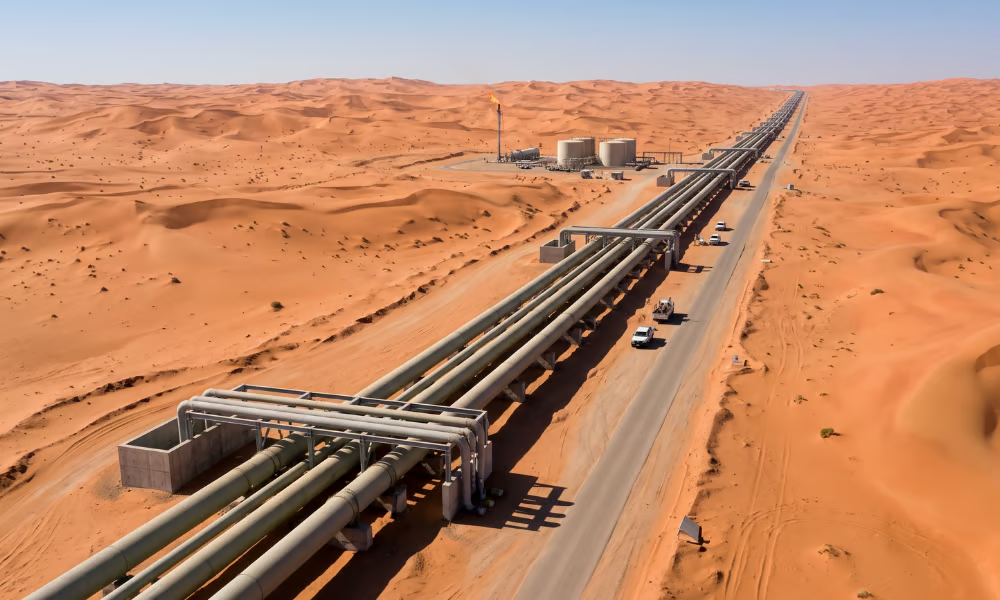
The military reason the Houthis keep naming this particular pipeline is geographic. Saudi Arabia’s 1,200-kilometre East-West line carries Gulf crude across the peninsula to Red Sea ports, bypassing the Strait of Hormuz — which has been largely shut by the wider war with Iran for months. Iran’s parliament speaker has said the strait will not reopen until seven conditions set out in a June memorandum of understanding with the United States are met.
With the strait unusable, the pipeline became the region’s principal export workaround. It is also the workaround Riyadh must now defend at 1,200 kilometres of exposed pump stations, which is precisely why it is on a target list. The Houthis said on Saturday they had hit the pipeline, its crude pumping stations, an Aramco facility at Yanbu and the Rabigh refinery. Again, no Saudi confirmation.
Riyadh’s escalation has been driven by ground losses, not only by incoming fire. Saudi strikes intensified after the Houthis seized strategic areas along Yemen’s Red Sea coast last month, advancing towards the Bab el-Mandeb Strait — the shipping lane on the other side of the peninsula from Hormuz, and the route Gulf oil depends on while the gulf is closed. The latest fighting has effectively ended a UN-brokered truce that had held since 2022.

Brent crude reached its highest level since May as the Houthis struck Saudi airports and oil fields, closing near $106 a barrel in mid-October. The United States has ordered non-essential diplomatic staff and their families out of Saudi Arabia; Aramco evacuated personnel from its Dhahran headquarters after its building was seriously damaged by a missile, and two people were killed at Dammam’s King Fahd airport.
Senior Saudi, Turkish and Pakistani officials — the Mecca Pact bloc — sat down with Iranian officials in Tehran, the first contact at that level between Iran and all three since Saudi Arabia came under escalating Houthi attack. Pakistan’s defence minister has already promised to defend Saudi Arabia by “whatever means are available.”
Regional powers are therefore negotiating with the state the Houthis answer to, while that state’s proxies are claiming strikes on the Kingdom’s airports and oil lines, and the Kingdom is bombing inside Yemen. Whether Tehran talks de-escalate this or merely re-draw the lines around a wider war will be settled before the truce’s remains are cold.
Discover more from LN247
Subscribe to get the latest posts sent to your email.

