
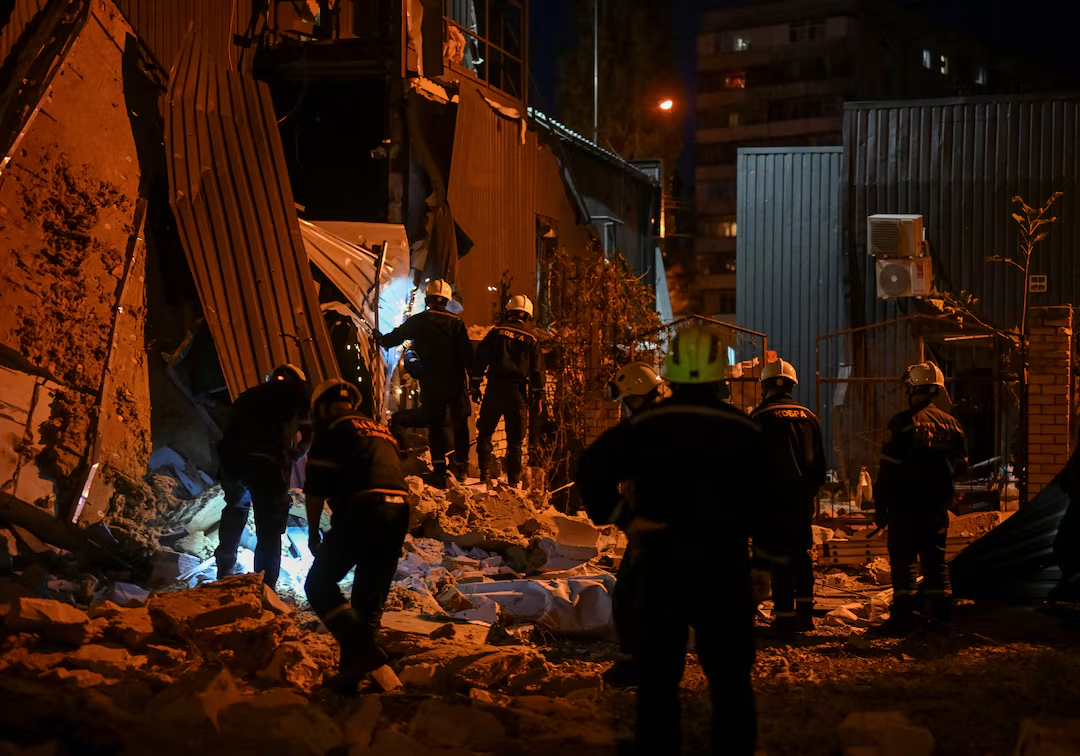
Russian strikes on Ukraine injured four people in Zaporizhzhia and two in Chernihiv region overnight, officials said Monday, while Moscow said it hit power stations in Kharkiv and Khmelnitsky and port infrastructure at Chornomorsk — as Kyiv sets conditions for halting refinery strikes.
On Monday, Ukrainian officials reported six injured. Regional governor Mykhailo Semikin said a Russian strike on Zaporizhzhia, the south-eastern city that has absorbed near-continuous pressure, left four people hurt.
Ukraine’s emergency service said two more were injured in Chernihiv region, north of Kyiv near the Belarusian border. Neither report described the weapons used or the condition of the wounded.
Moscow’s account was broader and deliberately infrastructural. The Russian defence ministry said it struck a power station in Kharkiv, Ukraine’s second-largest city, a warehouse in the surrounding region, and another power station in Khmelnitsky region in the west — the area hosting Ukraine’s only nuclear plant.
It also claimed hits on port infrastructure at Chornomorsk, a Black Sea outbound point for grain and cargo, and on a cargo vessel en route to Odesa that it asserted had been used for military purposes.

The latter claim matters commercially: attacks on vessels in the western Black Sea have escalated sharply this month, and Romania has already blamed Moscow for a strike on shipping in the area.
The military headlines, however, sit inside a political squeeze. Washington has pressed Kyiv to suspend its long-range strikes on Russian oil refineries, on the argument that they contribute to elevated energy prices — an awkward position for the Trump administration with midterm elections on 3 November.
That pressure has not arrived alone. Over the past two weeks Kyiv has also reported throttled access to Starshield, the military variant of Starlink that Ukrainian drone and interceptor operations depend on, and what Zelensky described as an absence of US early warning before a Russian missile barrage struck Kyiv power plants on 19 October. Zelensky’s aides have characterised the pattern as coercion; Trump has at various points urged Elon Musk to lift the speed cap and, on other occasions, criticised Kyiv outright.

The Ukrainian president answered on Sunday, in an interview aired by western media, and framed the concession as conditional. For Kyiv to halt refinery strikes, he said, Moscow must stop hitting Ukrainian power infrastructure.
Failing that, he offered two alternatives: the United States should permit Starshield operations over Russian territory, which would let Ukraine detect missile launch sites before they fire, or it should supply Patriot missiles to intercept what is already in the air.
Russia is targeting the grid that keeps Ukrainian cities lit. The US is targeting the incentives that keep Ukrainian long-range strikes affordable. And Kyiv’s ask — satellites over Russian soil, or the interceptors to survive the response — is a request to be trusted with escalation, made at precisely the moment Washington most wants the war to stop making headlines before it goes to the polls.
Discover more from LN247
Subscribe to get the latest posts sent to your email.

