
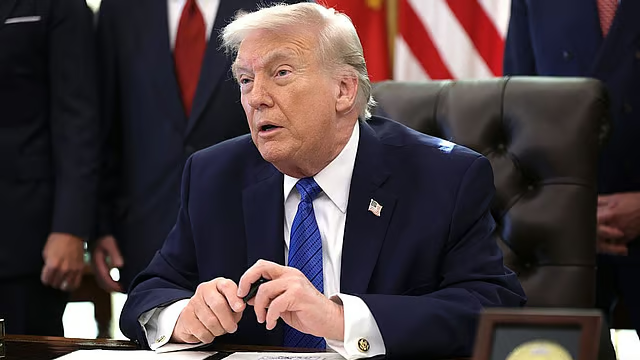
US President Donald Trump has instructed the Pentagon to “substantially reduce” joint military exercises with South Korea, citing the cost of the drills, Seoul’s position on the US conflict with Iran and his relationship with North Korean leader Kim Jong Un.
The announcement came as the annual Ulchi Freedom Shield exercises began on Monday, August 17, despite Trump’s call for them to be scaled back. South Korea’s Joint Chiefs of Staff confirmed that the drills had started as scheduled and are expected to run until August 27, with about 18,000 South Korean troops participating.
Trump said on Truth Social that the exercises were expensive and argued that they sent an inappropriate and hostile signal to North Korea, while pointing to what he described as his “very good relationship” with Kim.
“These exercises are not only costly, with much of these costs paid for by the United States of America (as usual!), but send a signal that is totally inappropriate and hostile,” Trump posted.
He also linked his decision to South Korea’s refusal to participate in US efforts concerning Iran.
“While somewhat unrelated (?), I recently asked the President of South Korea if they would like to join us in the Denuclearization of the Islamic Republic of Iran, and they said, ‘No thanks!’”
South Korea’s government said it was reviewing Trump’s remarks but indicated that it wanted to preserve close military coordination with Washington. The presidential Blue House also expressed hope that Trump’s relationship with Kim could eventually create an opportunity for meaningful dialogue between Washington and Pyongyang.
Ulchi Freedom Shield is designed to strengthen the ability of US and South Korean forces to operate together in the event of a conflict on the Korean Peninsula. This year’s exercises incorporate training for threats including drones, GPS disruption, cyberattacks and other capabilities that have become increasingly important in modern warfare.
The exercises are not simply about large-scale troop movements. Over recent years, the allies have increasingly shifted towards computer-simulated exercises and scenarios designed to test command, communication and responses to missile and cyber threats.
About 28,500 US troops remain stationed in South Korea, making the American military presence an important part of Seoul’s defence strategy.
North Korea, meanwhile, routinely describes the exercises as preparations for an invasion. Pyongyang recently condemned the latest drills as particularly provocative and warned that it would strengthen its nuclear deterrence.
Trump’s announcement comes against a backdrop of heightened military activity from Pyongyang.
North Korea launched a ballistic missile from the Wonsan area towards the sea off its eastern coast on August 11, just days before the US-South Korea exercises. The launch followed another missile test from the same area on August 6.
North Korea has also continued developing its nuclear and missile programmes and has strengthened military ties with Russia, including sending troops to support Moscow’s war in Ukraine. US officials have warned that North Korean forces returning from the conflict may bring battlefield experience that could influence Pyongyang’s military capabilities.
Trump’s latest position is not entirely new.
During his first presidency, Trump suspended major US-South Korean military exercises following his 2018 summit with Kim Jong Un. At the time, he described the drills as “provocative” and argued that cancelling them would save the United States money.
The exercises were later scaled back during the COVID-19 pandemic before eventually returning in a larger form as diplomacy with North Korea stalled.
Trump has continued to emphasise his personal relationship with Kim since returning to office. His latest comments suggest that he may once again see reductions in military exercises as a possible way to create space for negotiations with Pyongyang.
However, analysts have questioned whether reducing the exercises would actually produce meaningful diplomatic gains.
“US-South Korea combined defence exercises are essential for military forces to be ready and capable of doing their jobs,” said Leif-Eric Easley, a professor at Ewha University in Seoul.
“Scaling them back can damage alliance coordination, slow the process of South Korea taking on greater responsibility for its own defence, and weaken deterrence against possible conflicts in Asia.
“The cost savings from downsizing drills are marginal, while the diplomatic benefits for relations with North Korea are doubtful.”
For President Lee Jae Myung’s government, Trump’s announcement presents both an opportunity and a challenge.
Seoul has previously encouraged greater engagement with Pyongyang, and Lee recently called for renewed talks aimed at replacing the Korean War armistice with a lasting peace arrangement.
That means Trump’s willingness to use his relationship with Kim could potentially support Seoul’s push for dialogue.
At the same time, South Korea remains heavily dependent on the US security alliance and has to ensure that any reduction in exercises does not undermine its military readiness.
South Korean officials have therefore signalled that they intend to continue consultations with Washington on the combined defence posture and military exercises.
Trump’s reference to Iran adds another layer to the disagreement.
The president said South Korea had declined to participate in US efforts aimed at the “denuclearisation” of Iran. Seoul, however, has indicated that discussions over possible military contributions need to take into account its defence responsibilities on the Korean Peninsula as well as domestic legal procedures.
Trump has also criticised other US allies for being reluctant to become directly involved in the Iran conflict.
This suggests that Washington’s expectations of its allies are increasingly being tied not only to their commitments in their respective regions but also to whether they support broader US military priorities.
The immediate question is how far the proposed reduction will go. The current exercises began as planned, and it remains unclear what specific elements of future drills the Pentagon would cut.
Any significant reduction could affect the readiness and coordination of US and South Korean forces, particularly at a time when North Korea is expanding its missile and nuclear capabilities and adapting lessons from modern conflicts.
There is also a diplomatic calculation. Trump may believe that reducing what Pyongyang considers hostile military activity could make Kim more willing to return to negotiations.
But North Korea has so far shown little indication that it is prepared to abandon its nuclear ambitions. Its recent criticism of the exercises and threats to strengthen nuclear deterrence suggest that Pyongyang continues to view military strength as central to its security strategy.
For Seoul, the challenge will be to pursue Trump’s preferred diplomatic approach without weakening the military alliance that has underpinned South Korea’s security for decades.
The latest development therefore leaves the US-South Korea relationship at an important crossroads: Trump is signalling greater emphasis on diplomacy with Kim Jong Un and a reduced appetite for expensive military exercises, while South Korea must balance the prospect of renewed dialogue with the continuing security threat posed by North Korea.
Discover more from LN247
Subscribe to get the latest posts sent to your email.

