
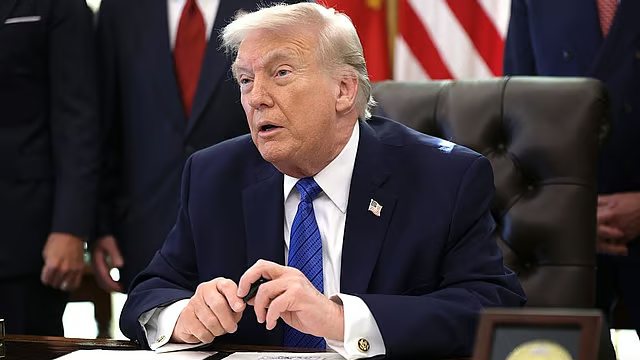
President Donald Trump has vowed to launch what he described as the “most crushing” financial operation as the United States prepares to impose fresh economic sanctions targeting Iran and countries that continue to trade with Tehran.
Iran has responded by threatening to halt oil exports from the Gulf if what it called an ongoing “economic war” continues.
Although the United States and Iran have avoided direct military strikes against each other for several weeks, there have been no significant negotiations aimed at resolving the six-month-old conflict.
Thousands of people have been killed since the United States and Israel began strikes on Iran on February 28. Most of the casualties have been reported in Iran and Lebanon, while the conflict has also severely weakened much of Iran’s conventional military capacity and caused significant economic disruption.
The latest escalation has unsettled financial markets as investors await details of Washington’s new strategy to isolate the Iranian economy.
Oil prices fell on Monday, with both major crude benchmarks declining by 2.3 per cent. Brent crude was trading at around $92 per barrel.
Asian markets were also largely lower during early trading, with South Korea’s technology-heavy Kospi index falling 1.4 per cent after Samsung Electronics announced an $80 billion share buyback following weeks of volatile trading.
Global Markets Watch AI Sector
Investors are also focused on the artificial intelligence sector, with Nvidia, the world’s most valuable company, expected to release its latest earnings report this week.
The company’s results are being closely watched for signs of whether the rapid growth in AI investment can continue as the technology expands into more areas of the global economy.
“The spending machine is still running, but the bill is getting heavier,” said Stephen Innes of SPI Asset Management.
“Nvidia must now show that the most expensive investment boom in modern market history can still pay its bills.”
Chinese technology giant Alibaba is also drawing attention after announcing plans to raise $10.2 billion through a new share offering in Hong Kong to finance its global AI ambitions.
The company, which is known for its open-source “Qwen” AI models, has invested heavily in artificial intelligence, with investors increasingly looking for evidence that those investments can generate significant returns.
Tokyo, Shanghai, Taipei and Wellington recorded losses on Monday, while Sydney, Jakarta and Bangkok gained. Manila and Kuala Lumpur were largely unchanged.
Hong Kong’s Hang Seng Index dropped more than two per cent despite fast-fashion company Shein announcing that it would make its long-awaited market debut in the city on September 1.
The listing is expected to value Shein at approximately $27 billion.
US Steps Up Pressure On Iran
Attention is also on US Treasury Secretary Scott Bessent, who is expected to provide more details on Monday about Washington’s plans to increase economic pressure on Iran.
The United States has urged its allies and China to support Trump’s latest campaign as the Middle East conflict approaches the six-month mark.
Vice President JD Vance described the strategy as a “delicate dance”, acknowledging that Iran could attempt to respond by placing economic pressure on the United States.
Asked whether Washington would put additional pressure on China, Bessent told CNBC that “many conversations are best to have in private”, while urging Beijing “to get with the programme”.
The growing tensions have added another layer of uncertainty to global markets, particularly as traders monitor energy prices and the potential impact of disruptions to oil supplies from the Gulf.
Investors Await Jackson Hole Meeting
Markets are also looking ahead to the annual gathering of central bankers, economists and finance officials in Jackson Hole, Wyoming, where investors hope to gain clearer signals about US monetary policy.
The meeting comes after the US Treasury purchased its own bonds last week in an effort to reduce borrowing costs following a rise in the 30-year yield to levels last seen in 2007.
Bond yields have climbed amid concerns about inflation and rising government debt, with US federal debt recently surpassing $40 trillion.
Key Market Figures
Around 0215 GMT, Tokyo’s Nikkei 225 was down 0.3 per cent at 65,799.25, while Hong Kong’s Hang Seng Index fell 2.1 per cent to 25,455.95.
Shanghai’s Composite Index declined 0.5 per cent to 3,887.81.
The dollar traded at 158.82 yen, compared with 159.03 yen on Friday, while the euro rose to $1.1684 from $1.1679. The pound also strengthened slightly to $1.3651 against the dollar.
West Texas Intermediate crude fell 1.9 per cent to $85.39 per barrel, while Brent crude dropped 1.8 per cent to $92.68 per barrel.
Discover more from LN247
Subscribe to get the latest posts sent to your email.

