
The United States and Iran have announced a breakthrough agreement aimed at ending months of conflict that has destabilised the Middle East, disrupted global energy markets, and heightened fears of a wider regional war.
The deal, expected to be formally signed in Switzerland, includes an immediate ceasefire, the reopening of the strategically important Strait of Hormuz, and the launch of further negotiations on unresolved issues such as Iran’s nuclear programme and sanctions relief. While world leaders have welcomed the development, significant questions remain about how the agreement will be implemented and whether it can deliver lasting peace.
What Agreement Was Reached Between The US And Iran?
According to officials from both countries, the framework agreement calls for the immediate cessation of military operations and the reopening of the Strait of Hormuz, one of the world’s most important oil shipping routes. The agreement is also expected to halt hostilities on multiple fronts, including tensions linked to Lebanon.
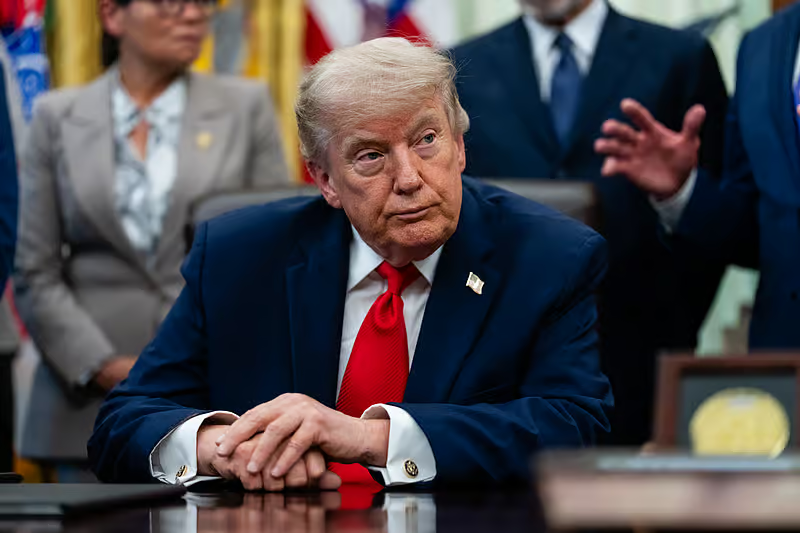
US President Donald Trump announced the breakthrough on his Truth Social platform, stating:
“The Deal with the Islamic Republic of Iran is now complete.”
He further declared:
“Ships of the World, start your engines. Let the oil flow!”
Iran’s Deputy Foreign Minister, Kazem Gharibabadi, described the agreement as bringing an “immediate end” to the war and confirmed that further talks would take place within two months to negotiate a more comprehensive settlement.
Why The Strait Of Hormuz Matters
One of the most significant aspects of the agreement is the planned reopening of the Strait of Hormuz.
The narrow waterway serves as a major route for global oil exports, with roughly one-fifth of the world’s oil supply moving through it. The conflict had severely disrupted shipping and contributed to rising fuel prices across international markets.
The announcement immediately affected global markets:
- Oil prices fell by more than 4 percent.
- Asian and European stock markets recorded gains.
- Investors reacted positively to the prospect of restored energy flows.
What Happens Next?
Although the ceasefire framework has been agreed upon, many of the most difficult issues remain unresolved.
The deal reportedly creates a 60-day negotiation window during which both sides will attempt to reach a final agreement covering:
- Iran’s nuclear programme
- Uranium enrichment activities
- Sanctions relief
- Frozen Iranian assets
- Long-term regional security arrangements
President Trump indicated that discussions are still ongoing regarding how long Iran would suspend uranium enrichment activities.
According to reports, Washington is considering a suspension period of between 15 and 20 years as part of a future arrangement.
Iran’s Position On The Deal
Iranian officials have presented the agreement as an opportunity to end hostilities while opening the door for broader negotiations.
Gharibabadi said the ceasefire would create conditions for talks aimed at achieving a “final agreement” covering broader political and economic issues.
Iranian media reports have also suggested that negotiations may involve discussions over frozen Iranian assets and sanctions relief, although Washington has not officially confirmed those reports.
Before the agreement was announced, Iran had repeatedly warned that any renewed military action could trigger wider instability across the region and further disruptions to global energy markets.
Trump’s Position And The US Response
The Trump administration has portrayed the agreement as a major diplomatic achievement after months of conflict.
Trump not only confirmed the deal but also authorised the removal of the US naval blockade and supported the reopening of shipping routes through the Strait of Hormuz.
US Vice President JD Vance said the agreement could help lower energy costs and boost economic stability across the region.
He stated:
“What we’re going to be able to do is drive down the cost of energy, not just now but for the long term, and create a real engine of prosperity in the Middle East.”
Israel’s Reaction to the US-Iran Agreement
Israel’s response has been noticeably more cautious.
Israeli Defence Minister Israel Katz said Israel would maintain its military presence in territories it currently controls, including areas in Lebanon, Syria and Gaza, despite the ceasefire framework.
Katz also warned that if Iran retaliates against Israeli operations in Lebanon, Israel would respond with “great force.”
Meanwhile, Israeli Finance Minister Bezalel Smotrich strongly criticised the agreement.
In comments posted on X, Smotrich described the deal as: “bad for Israel and for the entire free world”
He argued that Israel would need to continue efforts to prevent Iran from obtaining nuclear weapons regardless of the agreement.
International Reactions
World leaders and international organisations have broadly welcomed the announcement.
United Nations Secretary-General António Guterres described the agreement as a “critical step” toward ending the conflict.
The governments of the United Kingdom, France, Germany and Italy also expressed support, signalling readiness to work with both sides to pursue a long-term diplomatic settlement.
Pakistan, which played a key mediating role in the negotiations, praised the breakthrough and confirmed that military operations would cease across all fronts covered by the agreement.
Major Questions Still Unanswered
Despite the optimism surrounding the agreement, several critical issues remain unresolved:
- The full text of the deal has not been made public.
- The future of Iran’s nuclear programme remains under negotiation.
- Details regarding sanctions relief have not been finalised.
- Israel remains sceptical about the long-term effectiveness of the agreement.
- Congressional approval may still be required for elements of any future nuclear arrangement.
What This Means For The Middle East
If successfully implemented, the agreement could mark the most significant de-escalation in the Middle East since the conflict began earlier this year.
The reopening of the Strait of Hormuz could stabilise global oil markets, ease inflationary pressures, and reduce the risk of a wider regional war. However, with key issues still unresolved and tensions between Iran and Israel remaining high, analysts say the next 60 days of negotiations will determine whether the current ceasefire evolves into a lasting peace agreement.
Discover more from LN247
Subscribe to get the latest posts sent to your email.

