Home Blog Page 101

Jigawa Governor Approves Appointment Of Eight Permanent Secretaries

0

Governor Umar Namadi of Jigawa State has approved the appointment of eight new Permanent Secretaries and the redeployment of four existing ones across various Ministries, Departments, and Agencies.

This was disclosed in a statement signed by the State Head of Service, Muhammad Dagaceri, and released to journalists on Wednesday in Dutse, the state capital, by the Public Relations Officer in the Office of the Head of Civil Service, Ismaila Dutse.

According to the statement, the changes are intended to strengthen the state’s civil service and promote efficient governance.

The redeployments include:

Sagir Muhammad Sani, moved from the Ministry of Basic Education to the Ministry of Budget and Economic Planning.

Muhammad Yusha’u, transferred from the Ministry of Budget and Economic Planning to the Ministry for Local Government.

Lawan Muhammad Haruna, redeployed from the Ministry of Higher Education to the Local Government Service Commission.

Engineer Musa Alhassan Arobade, moved from the Ministry of Power and Energy to the Directorate of Manpower Development and Training under the Office of the Head of Civil Service.

The newly appointed Permanent Secretaries and their respective postings are:

Garba D. Muhammad – Ministry of Higher Education, Science and Technology

Fatima Aliyu Hadejia – Directorate of Salary and Pension, Office of the Head of Civil Service

Baffa Abubakar – Ministry of Basic Education

Bello Datti – Directorate of Special Services/Council Affairs

Ibrahim Hassan – Ministry of Finance

Nasiru Haruna – Ministry of Power and Energy

Umar Isah – Civil Service Commission

Mahmud Isah Ringim – Ministry of Commerce and Industries

The Head of Service emphasized that the newly assigned officers are expected to bring their expertise and professionalism to bear in their new roles, thereby contributing meaningfully to the development of the state.

He also urged all affected officers to assume their new responsibilities with dedication and a strong sense of duty.

The statement added that the postings take immediate effect and directed the officers to report to their new stations without delay.

ICAD 2025: Aisha Yesufu Calls For Electoral Integrity, Labels Rigged Elections A ‘Civilian Coup’

0

Renowned activist Aisha Yesufu has decried the lack of credibility in Africa’s electoral systems, calling it a “civilian coup” when political mandates are stolen from the people. Speaking at ICAD 2025 panel session on the theme “The African Path to Electoral Integrity: Rethinking Elections Through Afro Best Practices”, Yesufu emphasized that democracy begins with a free, fair, and violence-free electoral process.

“When elections are rigged, it’s no different from a civilian coup. The people lose their power, and we begin to see impunity thrive,” she said.

Yesufu lamented that Nigeria’s institutions, particularly the judiciary, have become complicit in undermining democracy. She cited the alarming trend of judicial shopping, where litigants bypass local jurisdictions to seek favorable rulings in distant states.

“Today, people leave places like Agbede in Edo State to file cases in Jigawa, all in search of biased judgments. Even when courts issue rulings, they sometimes merely give opinions rather than clear, categorical judgments,” she stated, referencing discrepancies in high-profile rulings like that of Natasha Akpoti.

The activist stressed that such failures in the judicial and electoral systems are signs of deep institutional capture. According to her, reforms must be comprehensive, extending beyond elections to restoring citizen agency and strengthening all arms of government.

“The judiciary is no longer the last hope of the common man. It now bows to corrupt politicians,” she said. “But no Nigerian is more Nigerian than another. We must rise together to reclaim our democracy.”

Michelle Alozie’s Stoppage Time Winner Sends Nigeria To WAFCON Final

0

Nigeria’s Super Falcons secured their place in the final of the Women’s Africa Cup of Nations (WAFCON) with a thrilling 2-1 victory over South Africa’s Banyana Banyana in a tense semi-final encounter on Tuesday.

The match was played at a high tempo, with both teams showing determination from the outset. Nigeria broke the deadlock just before halftime when Rasheedat Ajibade confidently converted a penalty in the 45th minute, giving the Falcons a 1-0 lead heading into the break.

South Africa were dealt an early blow in the 26th minute when forward Hildah Magaia was forced off due to injury. Thubelihle Makhubela was brought on as her replacement.

Banyana Banyana came out strong in the second half and were rewarded for their efforts when Linda Motlhalo equalised from the penalty spot in the 60th minute, making it 1-1 and setting the stage for a dramatic finale.

Just when the game looked destined for extra time, Michelle Alozie delivered a moment of magic. In the 94th minute, she latched onto a well-timed assist from Esther Okoronkwo and calmly slotted home the winner, sparking wild celebrations among the Nigerian contingent.

Both sides made several substitutions that increased the intensity and physicality of the contest, but it was Nigeria’s composure and resilience in the dying moments that proved decisive.

With the victory, the Super Falcons continue their dominant run in African women’s football and move one step closer to reclaiming the continental crown.

Their opponents in the final will be tournament hosts Morocco, who overcame Ghana in a dramatic penalty shootout. After a 1-1 draw in regular time at the Olympic Stadium in Rabat, Morocco held their nerve to win 4-2 on penalties. Sakina Ouzraoui Diki cancelled out Stella Nyamekye’s first-half strike during regulation time, and Ghana faltered in the shootout with misses from Evelyn Badu and Comfort Yeboah.

Nigeria and Morocco will now clash in what promises to be a pulsating final at the same venue on Saturday.

WAFCON 2024: Morocco Edge Ghana On Penalties To Set Up Final Clash With Nigeria

Tournament hosts Morocco booked their place in the final of the 2024 Women’s Africa Cup of Nations (WAFCON) after edging Ghana 4-2 on penalties following a 1-1 draw in a dramatic semi-final encounter at the Olympic Stadium in Rabat.

The Atlas Lionesses came from behind in regulation time, with Sakina Ouzraoui Diki cancelling out Stella Nyamekye’s first-half opener, before holding their nerve in the shootout. Morocco, who were runners-up in the 2022 edition, will now face nine-time champions Nigeria in the final at the same venue on Saturday.

Ghana struck first in the 26th minute when Nyamekye capitalised on a goalkeeping error by Khadija Er-Rmichi to slot home from close range after a corner caused confusion in the Moroccan box. It was another high-profile mistake from Er-Rmichi, who has come under scrutiny throughout the tournament.

Despite appearing shaky as the first half progressed, Morocco regrouped after the break. Ten minutes into the second half, the outstanding Ouzraoui Diki—one of the stars of the tournament—levelled the score with a composed left-footed finish after collecting a deflected ball inside the area.

The match had begun with Ghana showing attacking intent. Early threats came from Nyamekye, Chantelle Boye-Hlorkah, and Josephine Bonsu, all of whom tested Er-Rmichi, while Doris Boaduwaa twice came close to extending Ghana’s lead before the break.

Morocco, however, responded strongly in the second half. Cynthia Konlan was kept busy in the Ghana goal, producing key saves to deny Najat Badri and Ghizlane Chebbak, while Sanaa Mssoudy and Ibtissam Jraïdi also threatened as the Lionesses grew into the game.

Despite their dominance, Morocco couldn’t find the winner in regulation time. Ghana also came close in the dying moments, with Alice Kusi and Princella Adubea both narrowly missing late chances.

Extra time brought more drama, though few clear chances, with the most significant moment being an injury to Moroccan substitute Fatima Tagnaout, who was stretchered off with ice applied to the back of her knee.

In the penalty shootout, Morocco were flawless. Hanane Aït El Haj, Ibtissam Jraïdi, Kenza Chapelle, and Anissa Lahmari all converted confidently. Ghana’s Bonsu and Alice Kusi scored their first two spot kicks, but pressure mounted as Evelyn Badu dragged her effort wide. Er-Rmichi, in a moment of redemption, saved Comfort Yeboah’s weak attempt to seal victory for the hosts.

Morocco now advance to their second consecutive WAFCON final, where they will face Nigeria, who earlier defeated South Africa 2-1 in Casablanca thanks to a dramatic stoppage-time winner from Michelle Alozie.

Kenyan Man Freed After Spending A Decade On Saudi Death Row

After over ten years on death row in Saudi Arabia, Kenyan national Stephen Abdukareem Munyakho has finally returned home, following a complex and deeply emotional legal and diplomatic journey. Munyakho, who had been sentenced to death in 2013 for the alleged murder of a Yemeni colleague, was granted his freedom after a $1 million blood money (diya) payment was facilitated by the Muslim World League, allowing his release under Islamic law.

His case had long captured the attention of human rights advocates, legal experts, and the Kenyan public. From the outset, Munyakho maintained that the act was one of self-defense, a stance echoed by his family and supporters throughout the years.

In 2014, a Saudi court recognized some mitigating circumstances and downgraded the severity of the charge. However, the death sentence was upheld pending either clemency or a diya agreement with the victim’s family.
A key figure in the fight for his release was Munyakho’s mother, Dorothy Kweyu, whose tireless advocacy and emotional appeals kept the case in the public spotlight and mobilized widespread support. Over the years, she worked closely with government officials, faith leaders, and humanitarian organizations to seek justice for her son.

Kenya’s Ministry of Foreign Affairs played a critical role in the eventual outcome. Through sustained diplomatic engagement with Saudi authorities, the ministry successfully negotiated two postponements of Munyakho’s execution in 2024. These reprieves bought crucial time for continued appeals and for securing the blood money settlement.


The final breakthrough was publicly acknowledged in March during an Iftar dinner at State House in Nairobi, where the Muslim World League’s role in brokering the diya was formally recognized. Shortly after his release, Munyakho performed Umrah, a minor Islamic pilgrimage, as an expression of gratitude and spiritual renewal.

Foreign Affairs Principal Secretary Korir Sing’Oei confirmed the development, describing it as a powerful example of diplomacy, faith, and perseverance working hand in hand. “This is a deeply human story that reminds us of the value of second chances, and of the power of communities, nations, and families coming together to uphold justice and mercy,” he said.


Now back in Kenya, Munyakho’s return marks the end of a decade-long ordeal and the beginning of a new chapter. His case also serves as a reminder of the complex legal challenges faced by migrant workers abroad and the importance of sustained diplomatic protection for nationals in distress.

N81bn N-Power Backlog: What You Should Know

0

After months of protests, petitions, and growing tension among thousands of unpaid N-Power beneficiaries, the Nigerian government has now confirmed its intention to clear the N81 billion owed in backlogged stipends. The Senate, following a closed-door meeting held on Tuesday, revealed that payment plans are already being set in motion, bringing renewed hope to many young Nigerians who served under the N-Power programme between 2022 and 2023.

This development came after Deputy Senate President Barau Jibrin convened a dialogue between federal officials and legal representatives of the aggrieved beneficiaries. The meeting resulted in an agreement that payments would begin soon, prompting the suspension of planned legal action against the government.

What’s the N-Power Programme?

The N-Power programme is one of Nigeria’s major youth empowerment initiatives introduced in 2016 to tackle youth unemployment and develop a skilled workforce. Managed under the National Social Investment Programme (NSIP), N-Power offers temporary work placements in sectors like education, health, agriculture, and digital services. Beneficiaries are mostly young graduates who receive monthly stipends while gaining work experience to improve their employability.

However, in recent years, the programme has struggled with funding issues, poor communication, and delays in stipend payments, resulting in widespread dissatisfaction and protests.

How the N81bn Backlog Came About

The N81 billion backlog is a result of unpaid allowances from 2022 and 2023. While the funds were supposedly captured in the national budgets for those years, they were never disbursed. The matter worsened when the 2024 and 2025 budgets failed to include provisions for these outstanding payments. This created a financial and emotional burden for many beneficiaries, some of whom relied solely on the stipends to survive.

The delay sparked protests, legal threats, and public outcry, as many believed they had been abandoned by the same government programme they faithfully served under.

What the Federal Government Is Saying

Deputy Senate President Barau Jibrin, who played a key role in mediating between both parties, confirmed that the government is now actively working to resolve the issue. According to him, the government has shown a clear willingness to pay and has secured approval through the service-wide vote system.

Minister of Humanitarian Affairs, Professor Nentawe Yilwatda, further explained that the arrears were carried over from previous years and left unfunded. He acknowledged the government’s debt to the beneficiaries and promised that the matter will be settled within the current fiscal year.

Legal counsel to the beneficiaries, Abba Hikima, and the group’s chairman, Kehinde James, both confirmed the government’s commitment and appreciated the Senate’s intervention, which led to the suspension of any further legal action.

What’s the Schedule for Payment?

While no specific date has been announced, government officials have indicated that payments will begin once the 2025 budget implementation kicks off. This suggests that disbursement of funds is expected within the 2025 fiscal year, most likely before the end of the year.

For many affected N-Power beneficiaries, this update marks a turning point and offers a glimmer of hope after years of silence and frustration. The government has reiterated its stance that no one will be denied their rightful dues, especially under the Renewed Hope Agenda of President Bola Tinubu.

Digital Transformation: FME Unveils New Platform for Educator Development

The Federal Ministry of Education has unveiled a new digital platform aimed at enhancing continuous professional development for teachers across Nigeria.

Launched under the Committee of Practice (CoPs), the initiative is designed to help educators stay updated with evolving trends in the education sector, while promoting innovation, mentorship, and collaboration among teachers nationwide.

Speaking at the launch event in Abuja, the Minister of State for Education, Professor Suwaiba Sa’id Ahmad, described the platform as a critical step in revitalizing the country’s education system. She explained that the platform would offer access to teaching resources, mentorship opportunities, and collaborative learning spaces for educators to share experiences and best practices.

“This platform promotes innovation, collaboration, and professional growth. For instance, a biology expert can share new teaching methods with peers. The platform ensures that teachers stay informed and supported by DECS officers and coordinators,” the minister said.

The programme will begin with 80 selected teachers from six Federal Unity Colleges who have been trained as coordinators and subject experts. Hosted initially on the Telegram platform, these trained teachers will play a key role in onboarding others from both public and private schools nationwide.

Professor Ahmad emphasized that the initiative is inclusive and open to all educators, not just those in federal schools. “Every teacher—from state to private institutions—will have access. We’re creating an inclusive community for all educators,” she added.

Also speaking at the event, the Project Lead for CL4STEM, Professor Mustapha Mohammed Tajudeen, said the platform would empower teachers across diverse regions to connect, exchange knowledge, and adopt improved teaching strategies using digital tools.

“It’s designed to foster equity and inclusion while encouraging teachers to exchange experiences and classroom innovations,” he said, noting that teacher participation would be monitored to assess impact and progress.

The platform’s launch was accompanied by a four-day workshop to equip the first cohort of participants with the skills and tools needed to navigate and effectively use the system.

FG Plans Full CBT Transition For SSCE By 2026, Lauds NECO’s Trial

The Federal Government has announced plans to fully deploy privately-owned and public Computer-Based Test (CBT) centres for the conduct of school-based Senior School Certificate Examinations (SSCE) starting next year.

This was disclosed by the Minister of Education, Dr. Marufu Tunji Alausa, during a monitoring exercise of a pilot CBT SSCE conducted by the National Examinations Council (NECO) at Sascon International School in Maitama, Abuja.

Dr. Alausa commended NECO for the smooth execution of the pilot phase, describing it as a significant step toward reforming the examination process. He said future school-based SSCEs will no longer be conducted within school premises but at designated CBT centres across the country.

The minister praised NECO’s level of preparedness and expressed confidence in the Council’s ability to successfully implement the full transition to CBT examinations.

Speaking to journalists after inspecting the ongoing NECO exams at Government Secondary School, Maitama, the Registrar of NECO, Professor Ibrahim Dantani Wushishi, reiterated the Council’s readiness for the transition. He disclosed that a total of 1,367,210 candidates registered for the 2025 SSCE — the highest in the Council’s history. Of this number, 685,551 are male while over 681,300 are female.

Professor Wushishi was accompanied during the inspection by members of the Senate Committee on Basic and Secondary Education, led by Vice Chairman, Senator Ekong Samson.

Kano State recorded the highest number of registered candidates, with over 137,000, while Kebbi State had the lowest, just above 5,000.

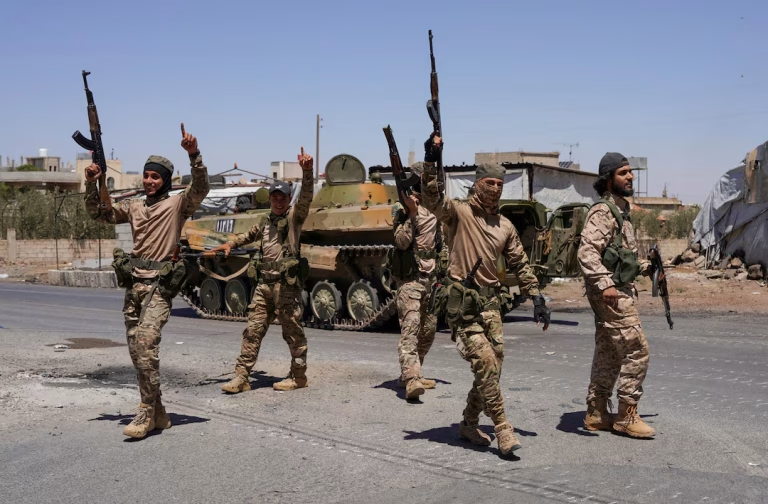
Israel, Syria In Discussions Following Ceasefire That Eased Sweida Unrest

Fresh discussions have reportedly been initiated between Israeli and Syrian officials in the aftermath of recent deadly clashes, which included military actions by the IDF in Damascus and the southern Sweida region.

As per emerging reports, Turkey and the United States are said to be facilitating the renewed talks, while an Israeli team is expected to visit Baku, Azerbaijan, where key terms with Syria may be finalized.

Despite this development, Israel is reportedly maintaining its right to carry out military operations in Syria. It is also pressing for a demilitarized buffer area along its border, in addition to retaining military oversight in the zone it captured following the collapse of Bashar al-Assad’s administration last December.

Israeli authorities have not yet released an official statement on the matter.

Before the recent airstrikes, there were indications that both parties were engaged in “advanced talks” to de-escalate tensions, with strong encouragement from the Trump administration to move toward a broader normalization agreement.

Earlier in July, Israel entered the conflict in Syria, intervening in support of the Druze minority, a community it considers closely aligned and which has members serving in the Israeli military.

Israel laid blame on forces loyal to Syria’s interim leader, Ahmed al-Sharaa, for their alleged involvement in violent assaults by Bedouin tribes targeting the Druze community in Sweida. The violence reportedly came to a halt after a ceasefire, which was arranged with the assistance of Washington, was declared over the weekend.

On Monday, White House press secretary Karoline Leavitt remarked that Trump was “caught off guard” by the IDF’s offensive in Syria.

Her remarks followed anonymous reports from U.S. officials expressing dissatisfaction with Prime Minister Benjamin Netanyahu’s handling of the strikes, fearing the military actions could destabilize the new Syrian leadership that the U.S. hopes to support for regional recovery.

Meanwhile, the U.S. envoy for Syrian affairs, Tom Barrack, also voiced concern on Monday, calling Israel’s intervention ill-timed and suggesting it might hinder ongoing stabilization efforts.

Historically, Israel and Syria have found themselves on opposing ends of Middle Eastern geopolitical conflicts, often clashing directly.

With Assad’s departure in December, Syria’s new Islamist-led government is reportedly seeking to soften its global image and gain diplomatic traction in Western spheres.

“Africa Must And Will Be Governed By Africans” — PLO Lumumba At ICAD 2025

1

Prof. PLO Lumumba, while delivering a special address at the International Conference on Africa’s Democracy (ICAD) 2025 at the NAF Conference Centre in Abuja, Nigeria, has challenged African leaders and Africans to rethink governance through an Afrocentric lens, free from colonial and foreign influence.

Professor Lumumba spoke passionately on the theme, “Afro-Democracy: Building A Governance System That Works In Africa, For Africans,”

He stressed that coups and poor governance are not uniquely African problems and cautioned against judging the continent too harshly.

He also reminded the audience, from countries like Ghana, Niger Kenya amongst participants, of Africa’s history of resisting colonial domination and slavery, insisting that the future of the continent must be shaped by Africans themselves.

“We must rethink the way we govern ourselves. What is it that different parts of Africa are doing that cannot be fused into a system that works for us? Are we children of a lesser God?” he asked.

Lumumba emphasized that Africa’s youth hold a critical role in shaping the future of governance, but warned against dismissing the wisdom of the elderly.
“Age does not guarantee wisdom. If you are old and foolish, you are simply an old fool; if you are young and foolish, then you are a young fool,” he said.

He called for immediate action, urging Africans to decolonize their minds from the systems and structures imposed by colonial rulers, including the electoral processes and artificial borders.

Lumumba highlighted the continent’s power crises, health challenges, and technological gaps, insisting that Africa’s unity and progress will only come when its people take responsibility beyond government intervention.

“Africa must regenerate and take charge. The time is now. You are the eagle, and I am urging you to fly,” Lumumba declared.