
The Lagos State Government has announced plans to reinstate mandatory psychiatric evaluations for commercial drivers to enhance road safety and reduce accidents caused by mental health issues.
The initiative, set to commence in August 2025, aims to ensure drivers are mentally fit to operate vehicles, addressing a critical public safety concern in Nigeria’s commercial hub.
The decision, confirmed by the Lagos State Ministry of Transportation, revives a policy previously implemented but suspended due to logistical challenges and public pushback.
Commissioner for Transportation Oluwaseun Osiyemi stated that the tests would target drivers of commercial buses, tricycles, and taxis, with a focus on detecting conditions like substance abuse, stress-related disorders, and other mental health issues that could impair driving.
“Our goal is to protect lives and property on Lagos roads,” Osiyemi said, citing data linking 20% of road accidents in the state to driver-related factors, including mental health.
The program will be rolled out in collaboration with designated public and private health facilities across Lagos, with drivers required to obtain a psychiatric clearance certificate before renewing or obtaining their licenses.
The Lagos State Drivers’ Institute (LASDRI) will oversee compliance, integrating the tests into its driver certification process. Non-compliant drivers risk fines or suspension of their operating permits.Public reactions are mixed.
Transport unions, including the National Union of Road Transport Workers (NURTW), have expressed concerns about the cost and accessibility of the tests, urging the government to subsidize fees for low-income drivers.
“We support safety, but the government must consider our members’ financial constraints,” said NURTW Lagos Chairman Musiliu Akinsanya.
Conversely, commuters like Adeola Ogunleye welcomed the move, stating, “It’s about time. Some drivers behave erratically, endangering passengers.
”The policy aligns with broader safety measures, including the Lagos State Transport Master Plan, which emphasizes stricter regulations for commercial transport.
The government has promised to address concerns through public awareness campaigns and stakeholder consultations to ensure a smooth rollout.
Lagos To Resume Mandatory Psychiatric Tests For Commercial Drivers

Ons Jabeur Announces Break From Tennis To Focus On Well-being
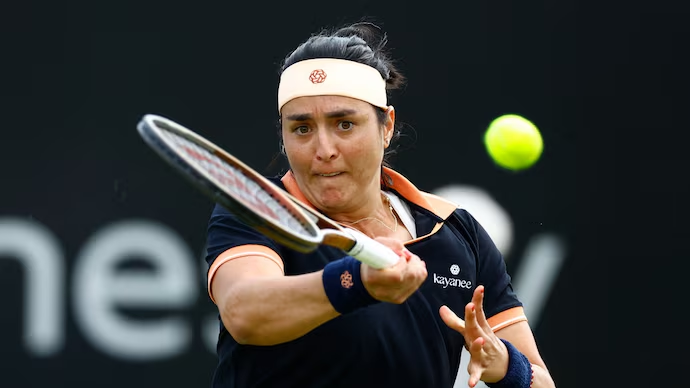
Three-time Grand Slam finalist Ons Jabeur has announced she is stepping away from competitive tennis, citing the need to prioritize her health and happiness.
The 30-year-old Tunisian made the announcement in a heartfelt statement shared on social media on Thursday.
Jabeur, who made history as the first Arab woman to reach a Grand Slam final, has faced a challenging season, failing to progress beyond the third round at any major tournament this year. Her most recent campaign at Wimbledon ended in disappointment when she was forced to retire from her opening-round match against Viktoriya Tomova due to physical difficulties, following an extended medical timeout.
A former world number two, Jabeur has long battled with asthma and suffered breathing issues earlier this year at the Australian Open. Despite her cheerful demeanor and the nickname “Minister of Happiness,” she revealed that she has been struggling to find joy on the court.
“For the past two years, I’ve pushed myself relentlessly playing through injuries and dealing with numerous challenges,” she wrote. “But deep down, I haven’t truly felt happy on the court for a while now.”
“While tennis is a beautiful sport, I believe it’s time for me to step back to breathe, to heal, and to reconnect with the simple joy of living.”
Jabeur, who is married to former fencer and coach Karim Kamoun, has previously expressed her desire to start a family.
She concluded her message with gratitude to her supporters: “Thank you to all my fans for your understanding. Your love and encouragement mean the world to me I carry them with me always.”
Why First Bank Transaction Sparks Financial Market Speculation

A massive N323.4 billion ($211.7 million) share transaction involving First HoldCo Plc, the parent company of First Bank of Nigeria, has set the Nigerian financial market abuzz with questions and guesses.
This deal, one of the biggest in the history of the Nigerian Exchange Limited (NGX), happened on July 16, 2025, involving the sale of 10.43 billion shares, which is about 25% of all First HoldCo’s shares, at N31 per share.
Unlike regular stock market trades, this was done privately through 17 “off-market” deals, meaning they were negotiated directly between the buyers and sellers.
The size of the deal, combined with uncertainty about who bought the shares and why, has everyone talking about what it means for First Bank, Nigeria’s oldest bank, and its future.
The shares were sold by two big players: Oba Otudeko, a former chairman of First HoldCo, and Tunde Hassan-Odukale, another ex-chairman.
Otudeko sold 7.79 billion shares through companies he controls, like Barbican Capital Limited (5.87 billion shares), Peace Account GASL Nominee (1.52 billion shares), and RAML/MEF9 (392.9 million shares).
Hassan-Odukale sold 2.28 billion shares through his companies, including Leadway Holdings Limited (1.03 billion shares) and Leadway Assurance Company (432.3 million shares), plus other pension and investment firms he’s linked to.
The buyer was listed as First Securities Ltd, a brokerage firm, and the deal was handled by several other firms like Cardinal Stone Securities and Meristem Stockbrokers.
The big question is whether Femi Otedola, the current chairman of First HoldCo and a wealthy businessman, bought these shares to gain more control of the bank.
According to reports, his ownership could have jumped from 11.8% (as reported in 2024) to as much as 36.7% or even 40%, making him the most powerful shareholder in First Bank and among Nigeria’s top banks.
But there’s a conflicting story suggesting a company called RC Investments Management Limited, possibly acting for the Nigerian government, bought the shares instead.
This confusion, along with no official announcement from First HoldCo or the NGX, is driving the speculation.
Why It Caused Speculations

Several reasons explain why this deal has everyone guessing about what’s happening:
Who Bought The Shares?
Nobody knows for sure who the buyer is. Many believe Otedola, who has been buying First HoldCo shares since 2021, is behind it. If true, he could now control up to 40% of the bank, giving him huge influence.
However, one report claims RC Investments Management Limited, linked to someone named Samuel Babatunde Sule and possibly the government, was the buyer.
The NGX rules say any deal involving 5% or more of a company’s shares must be publicly announced, but as of July 18, 2025, neither First HoldCo nor the NGX has said anything. This silence is fueling suspicions.
First Bank’s History Of Fights
First Bank has had years of drama among its big shareholders. Otudeko was chairman from 2012 to 2021 but was removed by the Central Bank of Nigeria (CBN) for breaking rules, like giving his own companies huge loans (one was N456 billion!).
He’s also facing a lawsuit from the Economic and Financial Crimes Commission (EFCC) over a N12.3 billion fraud case. Some say First HoldCo’s current leaders, led by Otedola, pushed Otudeko to sell his shares to avoid more legal trouble.
This deal gave Otudeko over N300 billion, letting him walk away from the bank’s problems.
Hassan-Odukale, who also fought for control in 2021, sold his shares too, possibly to invest in other businesses. These exits suggest a big shift in who runs the bank, making investors wonder what Otedola’s plans are.
New Government Rules
The CBN, which oversees banks in Nigeria, made new rules on June 13, 2025, called the Single Obligor Limit.
These rules stop banks from lending too much money to one person or company and require banks like First HoldCo to raise N500 billion in new capital by March 2026 to stay strong.
First HoldCo has raised N346 billion so far but still needs N154 billion. Some experts think this share deal was a way to reorganize the bank’s ownership to follow these rules, not just Otedola buying more shares. But without clear information, people are left guessing.
Big Market Reaction
After the deal, First HoldCo’s share price shot up by 9.9% to N32.2 on July 16 and climbed to N35.40 by July 18, a 20% increase in two days. This pushed the bank’s total value to over N1.3 trillion.
Investors are excited because Otedola has a good track record of turning around companies like Forte Oil and Geregu Power.
They hope he can fix First Bank’s problems, like its N1 trillion in bad loans (money lent out that might not be paid back).
But some smaller shareholders worry that if Otedola owns too much (like 30% or more), he could make decisions that favor him over them.
Earlier this year, these shareholders protested a N350 billion share sale plan, thinking it was Otedola’s way to take over quietly.
First Bank’s Challenges
First HoldCo is struggling with big issues, like its N1 trillion in bad loans and the need to raise more money to meet CBN rules. There are speculations because they want to know if Otedola, or whoever bought the shares, can solve these problems.
The CBN is also watching to make sure smaller shareholders aren’t pushed out, adding pressure to clear up the confusion.
Financial Outlook
This N323.4 billion deal could be a turning point for First HoldCo, potentially ending years of fights and instability.
If Femi Otedola now controls up to 40%, his experience could help fix First Bank’s bad loans and meet the CBN’s new rules. But the lack of clear information about who bought the shares and why, is making investors nervous.
The NGX and CBN need to share details soon to calm the market and protect smaller shareholders.
As Nigeria’s banks work to raise more money and follow new rules, this deal shows how powerful businessmen, government rules, and market hopes are shaping First HoldCo’s future.
Until there’s an official announcement, the speculation will keep growing, and everyone will be watching to see what happens next at Nigeria’s oldest bank.
Can Crypto Lift Nigeria Out Of Economic Woes?

With the recently enacted ISA 2025, cryptocurrency in Nigeria has moved from uncertainty into a clearly regulated space, now supervised by the Securities and Exchange Commission (SEC).
From exchanges to custodians, there’s finally a legal and structured framework guiding operations within the digital asset ecosystem. However, the bigger question remains will Nigerian banks and brokers embrace this opportunity early, or will they hesitate until global players dominate the space?
As the crypto industry begins to take shape under this new legal backing, many are watching to see how banks, brokers, and investors respond. The SEC’s oversight is expected to boost investor confidence and offer stronger protections, yet risks still exist from market volatility to regulatory compliance issues. Whether crypto can play a meaningful role in addressing Nigeria’s economic woes will depend not just on regulation but also on how effectively local financial institutions adapt and leverage the opportunities within this evolving market.
Ghana’s Central Bank Governor Urges Economic Recovery Strategies

During an urgent gathering of the Bank of Ghana’s Monetary Policy Committee (MPC), the governor encouraged members to explore how best to aid the nation’s ongoing economic revival, while avoiding actions that might destabilize recent progress, according to comments shared with reporters on Friday.
Ghana, recovering from one of its worst economic downturns in recent memory, saw stronger-than-expected growth in early 2025 and experienced a drop in inflation to its lowest point since December 2021.
Thursday’s emergency session was called to assess the current economic indicators and shifts in the financial markets.
Ultimately, no immediate changes were made to the central bank’s policy interest rate. Governor Johnson Asiama later explained that the committee would reconvene for its standard meeting in roughly ten days.
“The key question is whether the current macroeconomic configuration permits a recalibration of the policy stance,” Asiama told the MPC at the beginning of Thursday’s session.
“With inflation expectations more firmly anchored, external buffers strengthened, and confidence returning, we must assess how to support the recovery without compromising the gains achieved,” he added.
Highlighting recent progress, the governor pointed to Ghana’s strong trade performance, which produced a $5.6 billion surplus in the first half of the year, alongside a broader current account surplus of $3.4 billion.
He further mentioned the Ghanaian cedi’s over 40% gain against the U.S. dollar since the start of the year, as well as improved reserve levels. However, he cautioned that the legacy of last year’s budget shortfall and global economic unpredictability continue to pose potential challenges.
NYSC Holds 2025 Batch B Pre-Orientation Workshop in Lafia

The National Youth Service Corps (NYSC) successfully conducted its 2025 Batch B Pre-Orientation Workshop in Lafia, Nasarawa State, on July 16, 2025, as part of preparations for the upcoming orientation course for prospective corps members.
The workshop, themed “Maintaining the Integrity of the Orientation Course in the Face of Competing Interests,” underscored the scheme’s commitment to ensuring a seamless and credible mobilization process.
The event, held at the Lafia Youth Centre, brought together key stakeholders, including NYSC officials, security agencies, and representatives from various state ministries.
The Inspector-General of Police, represented by Assistant Inspector-General of Police (AIG) Musa Garba, emphasized the importance of collaboration between the NYSC and security agencies to safeguard corps members during the orientation period.
He reiterated the Nigeria Police Force’s commitment to providing adequate security at orientation camps nationwide.
In his keynote address, the NYSC Director-General, Brigadier-General Yusha’u Dogara Ahmed, stressed the need to uphold the integrity of the orientation course, which serves as the foundation for the one-year mandatory national service.
“The orientation course is not just a ritual; it is a critical phase where corps members are equipped with the skills, values, and discipline needed to serve the nation effectively,” he said.
He urged all stakeholders to resist external pressures that could compromise the process, including attempts to manipulate postings or bypass protocols.
The workshop featured interactive sessions on camp management, security awareness, and the integration of digital tools in NYSC operations.
A key highlight was the discussion on leveraging technology to streamline registration and deployment processes, following recent challenges faced by prospective corps members in accessing their call-up numbers.
The NYSC also reviewed feedback from the 2025 Batch A orientation to address logistical issues and improve the experience for Batch B corps members.
Participants commended the NYSC for its proactive approach, with the Nasarawa State Commissioner for Youth and Sports Development, Hon. Jibrin Bala, pledging continued support from the state government.
“Nasarawa State is proud to host this workshop, and we assure the NYSC of our commitment to providing a conducive environment for corps members,” he said.
The 2025 Batch B orientation course is expected to commence in late July, with thousands of prospective corps members set to report to camps across the country.
The NYSC has advised participants to verify their call-up numbers and print their green cards promptly to avoid delays.
The scheme also reiterated its zero-tolerance policy for fraudulent activities, warning against fake recruitment messages circulating online.
As the NYSC prepares to welcome the new batch, the Lafia workshop has set a tone of accountability and preparedness, ensuring that the orientation course remains a cornerstone of national unity and youth development.
NIMASA Closes Two Fuel-loading Terminals Due To Security Violations

The Nigerian Maritime Administration and Safety Agency (NIMASA) has sealed off ShellPlux and TMDK Terminals, both situated in the Ijegun-Egba axis of Lagos, for breaching the International Ship and Port Facility Security (ISPS) Code.
In a statement issued on Thursday, NIMASA’s Head of Public Relations, Osagie Edward, said the enforcement was carried out in line with the agency’s responsibility as the designated authority for ISPS Code implementation in Nigeria.
The ISPS Code—an amendment to the SOLAS Convention—was established by the International Maritime Organisation to improve security at ports and terminals engaged in global trade.
Edward stated that the shutdown followed “persistent non-compliance by the facilities with the provisions of the ISPS Code, despite several formal warnings.
”The move aligns with global best practices and is by Section 79(f) of the ISPS Code Implementation Regulations (2014), which mandates the closure of any facility that remains in violation for over three calendar months,” Edward said.
Commenting on the development, NIMASA Director-General, Dr. Dayo Mobereola, reaffirmed the agency’s dedication to securing Nigeria’s maritime environment.
“In wielding the big stick, we acted only as a last resort. Our primary goal is to enforce safety and security practices across Nigerian ports and jetties.
At a time when we are collaborating with the United States Coast Guard to lift the conditions of entry on vessels from Nigeria, we cannot afford lapses that jeopardise our progress,” Mobereola said.
He noted that the terminals would resume operations once they fully meet all compliance standards, acknowledging their significant contribution to service delivery and trade facilitation.
The NIMASA Director-General also highlighted the commitment of the Minister of Marine and Blue Economy, Adegboyega Oyetola, to promoting sustainable trade within a secure and enabling maritime environment.
Middle East Crisis: Why The War Is Escalating

The Middle East is seeing a surge in violence, and tensions are higher than ever. From Israeli airstrikes in Syria to clashes between Syrian government forces and local militias, the region feels like it’s on the edge of a bigger conflict. This takes us to the question: Why is this happening?
Below is the break down of the recent developments and the reasons behind this escalation.
What’s Happening in the Middle East?
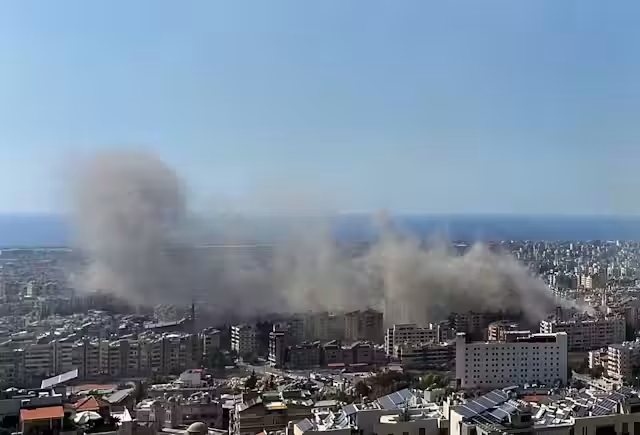
- Israeli Airstrikes in Syria: Recently, Israel launched airstrikes on Damascus, Syria’s capital. These attacks hit military sites, killing at least one person and injuring 18 others. Israel said the strikes were to stop weapons from reaching groups they see as threats, like Hezbollah, a militia group backed by Iran. These strikes aren’t new, but they’re happening more often and hitting bigger targets, raising fears of a wider war.
- Clashes in Southern Syria: In Syria’s south, fighting has broken out between the Syrian government and Druze militias in the Suweida region. The Druze, a religious minority, are clashing with government forces over local control and rights. Syria’s new president, Ahmed al-Sharaa, has promised to protect the Druze to avoid a full-blown conflict, but the situation is tense, and a fragile ceasefire is barely holding.
- Iran’s Role and Regional Tensions: Iran, a major player in the region, supports groups like Hezbollah in Lebanon and militias in Syria. Israel and some Arab countries see Iran’s influence as a threat, leading to frequent attacks on Iranian-linked targets. This back-and-forth is pulling in other countries, like the U.S., which supports Israel, and Russia, which backs Syria’s government.
- Refugee Crisis and Economic Strain: The fighting is pushing more people out of their homes. Millions in Syria are already displaced, and new clashes are making things worse. Countries like Lebanon and Jordan are struggling to handle refugees, while economic problems, like rising food and fuel prices, are fueling anger and unrest.
Why Is the War Escalating?
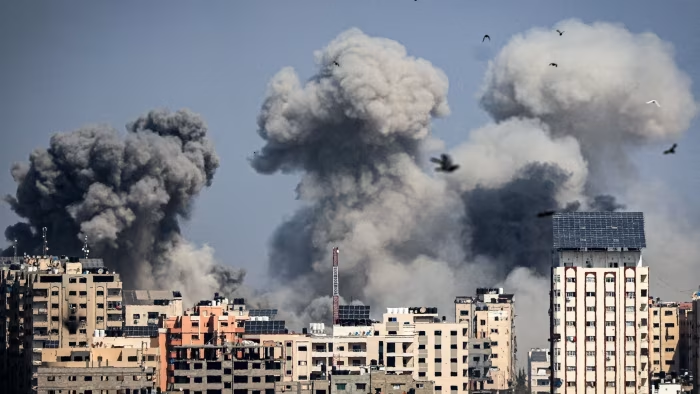
So, why is this all heating up now? Here are the main reasons, explained simply:
- Power Struggles Between Countries: The Middle East has long been a battleground for big powers. Israel wants to limit Iran’s influence, while Iran is trying to expand its reach through allies like Hezbollah. The U.S. and Russia are also involved, backing different sides. Each country is pushing its own agenda, and that’s creating a cycle of attacks and counterattacks.
- Weak Governments and Chaos: Syria’s government is struggling to control the country after years of civil war. When a government is weak, groups like militias or neighboring countries step in to fill the gap. This leads to more fighting as everyone tries to grab power or protect their people.
- Old Rivalries and New Weapons: The Middle East has deep-rooted rivalries, like between Israel and Iran or Sunni and Shia Muslim groups. These tensions go back decades, but now, with advanced weapons like drones and missiles, small conflicts can quickly turn deadly and spread.
- Economic Pain and Anger: People in the region are suffering. Jobs are scarce, prices are high, and many can’t afford basics like food or medicine. When people are desperate, they’re more likely to join militias or protest, which can spark violence. Governments, under pressure, sometimes use force to keep control, making things worse.
- Outside Interference: Countries outside the Middle East, like the U.S., Russia, and even Turkey, are involved in the region’s conflicts. They send weapons, money, or troops to support their allies. This outside involvement often makes local fights bigger, as foreign powers have their own goals, like controlling oil or gaining influence.
What’s Next?
The situation is shaky. If Israel keeps striking Syria or Iran-backed groups, it could pull Lebanon or other countries into the fight. If the Syrian government can’t calm things down in Suweida, more militias might rise up. The world is watching, but peace feels far off because the reasons for fighting: power, fear, and survival, are so deeply rooted.
To stop the escalation, leaders would need to talk, not fight. But with so much distrust, that’s easier said than done. For now, the Middle East remains a powder keg, and every new strike or clash risks setting it off.
NNPCL’s Proposed Sale Of Refineries: Matters Arising

Femi Falana, a Senior Advocate of Nigeria, maintains that the NNPCL lacks the legal power to sell Nigeria’s public refineries, arguing they belong to the federation, federal, state, and local governments as provided by Section 44(3) of the Constitution. He also highlights concerns about transparency and accountability in the management of these assets.
Falana further raises allegations of missing funds, calling for an investigation into the $2.9 billion earmarked for refinery rehabilitation and noting that $18 billion has been spent on turnaround maintenance for the Port Harcourt, Warri, and Kaduna refineries without results. He also questions the NNPCL’s stake in the Dangote Refinery, pointing out the Federal Executive Council approved $2.76 billion for a 20% stake in 2021, but Aliko Dangote recently claimed only 7.2% was acquired, prompting calls for the EFCC to investigate.
Nigeria To Face Argentina At U-19 Women’s Basketball World Cup

No longer in contention for the title, Nigeria’s Junior D’Tigress will take on Argentina today (Friday) in the classification round of the ongoing FIBA U-19 Women’s Basketball World Cup in Brno, Czechia.
Led by coach Juliana Akhere, the Nigerian side suffered a 77-51 defeat to Hungary in the round of 16 on Wednesday, ending their hopes of lifting the trophy. However, there is still pride on the line as they battle the South Americans at the Starez Arena Vodova Hall for a place among the 9th–16th spots.
Making their debut at the tournament, Nigeria have posted commendable stats, averaging 61.8 points, 42.3 rebounds, and 11.8 assists per game. Their shooting efficiency includes a 65.8% success rate from the free-throw line, 33.1% for two-point field goals, and 21.2% from beyond the arc.
In contrast, Argentina have struggled throughout the competition, averaging just 46.5 points, 32 rebounds, and 12.3 assists per game. Their shooting metrics include a 64.6% free-throw conversion rate, 39.2% on two-point attempts, and 22.6% on three-pointers.
Nigeria began their Group B campaign with a historic win over China but followed up with losses to Canada and Portugal, finishing third in the group with a 1-2 record. The subsequent defeat to Hungary in the knockout stage relegated them to the classification matches.
Argentina, meanwhile, are still winless in the tournament. They opened with a 68-47 loss to Spain, were beaten 77-49 by hosts Czechia, then fell 83-44 to Japan in the group stage. Their round of 16 match ended in a heavy 95-46 defeat to Australia.
Toby Nweke has been Nigeria’s standout performer, averaging 11.5 points per game with back-to-back double-digit outings. Argentina’s top scorer is Nerea Lagowski, averaging nine points per game.
The winner of today’s clash will face either Brazil or South Korea in the next round of classification fixtures.
