
Home Blog Page 115

Two Killed As Iranian Missile Strike Hits Near Tel Aviv

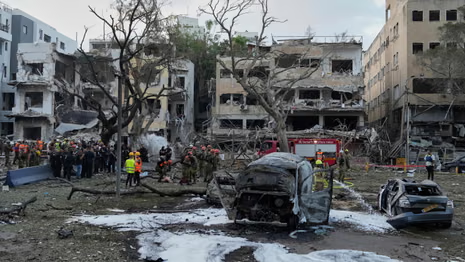
At least two people have been killed following an Iranian missile attack targeting central Israel, with impacts reported near the commercial hub of Tel Aviv.

Emergency responders confirmed the fatalities on Wednesday after a barrage of missiles struck multiple locations overnight, triggering widespread air raid sirens across the region. The latest casualties bring the total number of deaths from missile attacks on Israel since the escalation of the Middle East conflict to 14.

Authorities said falling munitions hit several sites, including Ramat Gan, where a residential building was reportedly struck by a cluster bomb.

Cluster munitions, which Iran and Israel have previously accused each other of using, explode in mid-air and scatter bomblets across a wide area.

Police spokesman Dean Elsdunne described the incident, stating that the munition “collapsed the roof in on an elderly couple that were in their room. Unfortunately, this couple did not go to the safe room when the alarm sounded, and as a result, we have this unfortunate tragedy,” Elsdunne said.

A resident identified as Omer recounted the moment of impact, saying “we heard like a streak of booms… it was not just one, it was a splitting missile”.

Footage from the scene showed emergency workers, police officers, and military personnel navigating streets covered in debris and rubble.

Israel’s emergency medical service, Magen David Adom, confirmed that two victims were found dead at the site.

“We saw smoke rising from a building with extensive damage and shattered glass,” said a statement from the medics.

In Bnei Brak, another individual sustained minor injuries from shrapnel, according to medical officials.

Images released by emergency responders showed widespread destruction, including burning vehicles, damaged buildings, and debris scattered across multiple locations.

The Israeli police said bomb disposal units were deployed to several impact sites within the Tel Aviv district to handle munition debris.

The attack also disrupted transportation, with Israel’s national railway reporting that shrapnel damaged infrastructure at Tel Aviv’s main station, forcing a temporary suspension of train services nationwide. Operations later resumed in most areas.

Search and rescue teams from the military’s Home Front Command were dispatched to affected areas, working across multiple sites where missile impacts were reported.

In a statement, Iran’s Revolutionary Guards said the missile strike was carried out “in revenge for the blood of martyr Dr Ali Larijani and his companions”.

The development follows Israel’s announcement that it had killed senior Iranian figure Ali Larijani earlier in the conflict.

The Israeli military reported that additional waves of missiles were launched from Iran after the initial deadly barrage, setting off alerts across central and southern parts of the country.

The latest escalation underscores the intensifying conflict, with both sides continuing to exchange strikes that are increasingly affecting civilian areas and critical infrastructure.

UN Maritime Body Holds Emergency Talks Over Middle East Shipping Crisis

0

The International Maritime Organization has convened emergency talks in London to address growing disruptions to global shipping caused by escalating tensions in the Middle East.

Opening the two-day meeting, IMO Secretary-General Arsenio Dominguez called for urgent and practical steps to safeguard commercial vessels and seafarers affected by the conflict.

“This situation is unacceptable and unsustainable,” Dominguez said, urging member states to focus on “practical measures” to resolve the crisis.

“Shipping has demonstrated time and again how resilient it is but geopolitics are testing the sector to the limit and every time that shipping is used as collateral damage in these conflicts, the whole world is negatively affected.”

The meeting, which includes participation from all 176 member states alongside non-governmental organisations and maritime industry groups, comes amid mounting concerns over safety in and around the Strait of Hormuz.

Iran’s retaliation to strikes by Israel and the United States has significantly disrupted maritime activities in the region, leaving an estimated 20,000 seafarers stranded on about 3,200 vessels, according to IMO data.

The council is expected to consider several proposals, including one aimed at creating a safe maritime corridor to enable the evacuation of stranded ships and crew in the Persian Gulf. However, any resolutions adopted would not be legally binding.

Several countries, including the United Arab Emirates, strongly criticised Iran’s actions during the session.

“The United Arab Emirates expresses its rejection and condemnation in the strongest terms of… Iran’s unprovoked, unjustifiable, indiscriminate and wholly unlawful attacks,” the country’s IMO representative said.

He added that the actions “constitute a serious breach of our sovereignty, territorial integrity” and were “a flagrant violation of fundamental rules and principles of international law”.

The tensions have raised alarm globally, particularly due to the strategic importance of the Strait of Hormuz, through which roughly one-fifth of the world’s crude oil and liquefied natural gas supplies pass. Disruptions in the area have already driven up oil prices and unsettled global markets.

According to the UK Maritime Trade Operations, at least 21 vessels have been attacked, targeted, or reported incidents since the conflict began.

Western nations including United Kingdom, France, and Germany have called on the IMO to adopt a declaration condemning what they described as “egregious attacks” on commercial shipping.

They argued that Iran has “threatened and attacked commercial vessels and seafarers, as well as civilian maritime infrastructure”, adding that such actions are “unjustifiable and must cease”.

They also raised concerns over what they described as Iran’s “purported closure of the Strait of Hormuz”.

In its response, Iran blamed the deteriorating maritime security situation on strikes carried out by Israel and the United States.

“The adverse maritime repercussions currently affecting shipping and seafarers are a direct and inevitable consequence of these unlawful actions and cannot be viewed in isolation from their underlying cause,” Iran stated.

Meanwhile, countries such as Japan, Panama, Singapore, and the United Arab Emirates have proposed measures to establish a coordinated framework for the safe evacuation of ships and seafarers from high-risk zones.

Maritime industry groups have also called for a unified global security approach, stressing that “seafarer welfare must be taken into account”.

They emphasised the need to ensure continued communication with families, facilitate crew changes and disembarkation, and maintain adequate supplies for those stranded at sea.

The outcome of the emergency talks is expected to shape the global response to one of the most significant maritime security challenges in recent years.

Iran’s Pars Gas Field Hit In U.S.–Israel Conflict

0

Iran’s key energy infrastructure has come under attack after its massive South Pars Gas Field in the Gulf was struck, marking a significant escalation in the ongoing conflict involving the United States and Israel.

The strike, reported on Wednesday, is the first known attack targeting Iran’s energy facilities in the Gulf since hostilities intensified. The gas field shared between Iran and Qatar is the largest natural gas reserve in the world.

Iranian state media said parts of a refinery and gas storage tanks were hit, prompting the evacuation of workers as emergency responders battled a fire at the site.

While Israeli media reports suggested the attack was carried out by Israel with U.S. backing, there has been no immediate official confirmation from the Israeli military.

Qatar, a close ally of the United States, described the strike as an Israeli operation and warned of its wider implications. A spokesperson for Qatar’s foreign ministry called it a “dangerous and irresponsible” escalation that threatens global energy stability.

Tensions escalated further after Iran’s Revolutionary Guards issued a warning to neighbouring Gulf countries, including Saudi Arabia and the United Arab Emirates, urging evacuation of key energy facilities.

“These centres have become direct and legitimate targets and will be targeted in the coming hours. Therefore, all citizens, residents, and employees ⁠are requested to immediately leave these areas and move to a safe distance without any delay,” Iranian state media cited authorities as saying.

The warning specifically mentioned critical facilities such as Saudi Arabia’s Samref Refinery and Jubail Petrochemical Complex, the UAE’s Al Hosn Gas Field, and Qatar’s Mesaieed industrial hubs.

The development marks a shift in the three-week conflict, during which both sides had largely avoided direct attacks on energy infrastructure due to fears of disrupting global supply chains. Analysts warn that such strikes could trigger retaliatory attacks on other major oil and gas producers, further destabilising global markets.

Meanwhile, the conflict has intensified on multiple fronts. In Beirut, Israeli airstrikes hit central districts, destroying buildings in some of the heaviest bombardments seen in decades.

Israel also claimed to have killed Iran’s intelligence minister, Esmail Khatib, a development later confirmed by Iranian President Masoud Pezeshkian. The strike followed the reported killing of senior security figure Ali Larijani a day earlier.

“No one in Iran has immunity and everyone is in the crosshairs,” said Israel’s Defence Minister Israel Katz, adding that military forces had been authorised to target senior Iranian officials without requiring further political approval.

In response, Iran launched missile attacks targeting Israeli cities, including Tel Aviv, Haifa, and Beersheba, as well as U.S. military bases across the Gulf region.

The escalating conflict has already begun to impact global energy markets. Fuel prices have surged, with diesel costs in the United States reportedly climbing above $5 per gallon for the first time since the 2022 inflation spike.

Beyond the battlefield, the humanitarian toll continues to rise. Reports indicate thousands have been killed in Iran since the conflict began, while hundreds of thousands have been displaced in Lebanon. Casualties have also been recorded in Israel and other parts of the region as the war expands.

The latest developments signal a dangerous new phase in the conflict, with critical energy infrastructure now in the line of fire and regional stability increasingly at risk.

Education Minister Unveils New Phase Of TVET Reforms During London Engagements

0

Nigeria’s Minister of Education, Maruf Alausa, has joined senior government officials in London to receive President Bola Ahmed Tinubu ahead of a series of high-level engagements focused on strengthening the country’s education and skills development sector.

The visit, which precedes the President’s official state engagements in the United Kingdom, is expected to centre on building strategic partnerships with international institutions, investors, and development organisations—particularly in the area of Technical and Vocational Education and Training (TVET).

In a statement issued on Wednesday, Alausa revealed that discussions would focus on advancing the second phase of Nigeria’s TVET reform programme in collaboration with global partners such as Big Win Philanthropy, alongside stakeholders in the creative and tourism sectors.

According to the minister, the Federal Government is working to reposition technical education as a key driver of youth employment and economic growth, amid growing concerns over graduate unemployment and skills mismatch in the country.

Nigeria has long struggled with an education system widely criticised as overly theoretical, often producing graduates without the practical skills required in today’s labour market. Data from the National Bureau of Statistics shows that youth unemployment and underemployment remain major challenges, with millions of young Nigerians either out of work or engaged in low-productivity jobs.

Experts have consistently called for a stronger focus on vocational and technical training to address the country’s skills gap, especially in sectors such as construction, manufacturing, ICT, and the creative industry.

“As part of the London engagements, the minister is also expected to meet with the leadership of the University of Birmingham to advance an ongoing partnership with the University of Lagos. The collaboration is aimed at strengthening research, faculty exchange, and institutional capacity.

“In a related development, discussions are also scheduled with Coventry University on plans to establish a full campus in Nigeria—an initiative that could expand access to international-standard higher education within the country,” the statement noted.

The initiative aligns with the Federal Government’s broader plan to internationalise Nigeria’s education sector, attract foreign investment, and reduce the rising trend of education migration.

Nigeria currently loses billions of naira annually as thousands of students seek admission in universities across countries like the United Kingdom, Canada, and other destinations. Stakeholders believe that attracting foreign institutions to establish campuses locally could help reverse this trend while strengthening domestic capacity.

The President’s visit is also expected to support Nigeria’s economic diplomacy drive, as the administration seeks to deepen bilateral relations with the United Kingdom and attract investment into critical sectors.

Officials say outcomes from the London meetings could shape the next phase of reforms in Nigeria’s education system, particularly in technical training, international collaboration, and infrastructure development.

Alausa expressed optimism about the engagements, noting that stronger global partnerships remain essential to achieving Nigeria’s long-term development goals.

Champions League Round Of 16: Arsenal Advance As Giants Fall

0

The UEFA Champions League returned on March 17, 2026, with the final second-leg fixtures of the Round of 16 producing unforgettable drama. From astonishing comebacks to heavy defeats for Premier League sides, the night reshaped the European football landscape.

Sporting CP Stages Incredible Comeback Against Bodø/Glimt

At the Estádio José Alvalade, Sporting CP overturned a 0–3 first-leg deficit to defeat Bodø/Glimt 5–0 after extra time, winning 5–3 on aggregate. Gonçalo Inácio opened the scoring in the first half, and Pedro Gonçalves added a second goal in the 61st minute to spark hope. Luis Suárez converted a penalty in the 78th minute to keep Sporting in contention. Extra time produced two more goals from Maximiliano Araújo and Rafael Nel, completing one of the most remarkable comebacks in recent Champions League history and sending Sporting into the quarter-finals.

Arsenal Control Leverkusen To Advance

Arsenal became the only English team left in the competition after a composed 2–0 win over Bayer Leverkusen at the Emirates Stadium, sealing a 3–1 aggregate victory. Eberechi Eze opened the scoring with a stunning long-range strike in the first half, and Declan Rice doubled the advantage early in the second. Arsenal’s disciplined performance and control over the match ensured a comfortable passage to the next stage while highlighting their growing European maturity.

PSG Rout Chelsea In London

Chelsea’s European hopes were crushed at Stamford Bridge as Paris Saint-Germain dominated 3–0, winning 8–2 on aggregate. Khvicha Kvaratskhelia’s early goal set the tone, and Bradley Barcola quickly added a second to put Chelsea on the back foot. Teenager Senny Mayulu capped the scoring in the 62nd minute. PSG’s speed, precision, and ruthless finishing left Chelsea unable to respond, marking a disappointing exit for the Premier League side.

Real Madrid Eliminate Manchester City

At the Etihad Stadium, Real Madrid defeated Manchester City 2–1 on the night, securing a 5–1 aggregate win. Vinícius Júnior converted a penalty in the 22nd minute after City’s Bernardo Silva was sent off, while Erling Haaland briefly equalized for City before halftime. Vinícius completed the scoring in stoppage time with a composed finish, confirming Madrid’s superiority over the two legs and reinforcing their reputation as European heavyweights.

English Teams Dwindle, Drama Continues In Europe

With both Chelsea and Manchester City eliminated, Arsenal are the lone Premier League team left in the Champions League. Sporting CP’s stunning comeback and the dominance of Paris Saint-Germain and Real Madrid have set up a tantalizing quarter-final stage, promising more excitement as Europe’s best sides vie for glory.

Explosions Rock Baghdad As Drone, Rocket Attack Targets US Embassy

0

Several loud explosions were heard Tuesday evening in Baghdad, with officials confirming that the United States Embassy in Baghdad was the target of a coordinated drone and rocket attack.

According to eyewitnesses and security sources, the blasts were linked to air defence systems intercepting incoming projectiles. One witness at a nearby restaurant said diners initially remained calm as the sounds echoed across the city, before it became clear that the explosions were interceptions.

Another resident reported seeing flames near the edge of the embassy compound from her balcony, with officials later confirming that the fire was caused by a drone strike.

“The embassy was the target of a drone and rocket attack,” a security official said, speaking on condition of anonymity.

Authorities also revealed that another drone aimed at a US diplomatic and logistics facility near Baghdad International Airport was successfully intercepted and shot down.

Shortly after the incident, the Iran-backed militia group Kataeb Hezbollah issued a statement calling for the withdrawal of foreign troops from Iraq.

“Iraq’s instability is due to the malicious American presence, and security will not be achieved until the last foreign soldier leaves Iraqi territory,” the group’s security chief, Abou Moujahed al-Assaf, said.

He added: “Either everyone enjoys security, or no one does.”

Iraq has long been caught in the middle of tensions between the United States and Iran, often serving as a proxy battleground for both powers.

In recent months, strikes have targeted Iran-aligned groups, which have in turn claimed repeated attacks on US interests across Iraq and the wider region.

Security sources say there has been a surge in such incidents in recent days, with multiple attacks targeting both the US embassy—located in Baghdad’s heavily fortified Green Zone—and American-linked facilities near the international airport.

On Monday night into early Tuesday, additional attacks were reported on the US diplomatic mission, while a separate drone incident saw a device crash into a luxury hotel frequently used by foreign diplomats.

Iran–Israel–US War Enters Day 18 With Escalation Across Region

The intensifying conflict involving Iran, Israel, and the United States has now entered Day 18 as of March 17, 2026, with no signs of a ceasefire and military operations continuing to expand across multiple fronts.

What began on February 28 as a rapid, high-impact strike campaign has evolved into a prolonged regional war, drawing in Gulf states, militias, and triggering global economic consequences.

Origins Of The Conflict And Early Shockwaves

The war erupted on February 28, 2026, when US and Israeli forces launched a massive coordinated air offensive targeting Iranian military, nuclear, and air defense infrastructure. Within the first 12 hours, nearly 900 strikes were carried out, marking one of the most intense opening assaults in modern warfare.

A defining early moment was the killing of Iran’s Supreme Leader, Ali Khamenei, in strikes on Tehran. Rather than ending the conflict, the attack triggered a sustained and widening retaliation from Iran and its regional allies.

Fresh Strikes Across Iran and Lebanon

In the latest phase of the war, Israeli forces have continued air raids on Tehran and other major Iranian cities, while also intensifying attacks in Beirut and southern Lebanon.

The conflict in Lebanon has become a major secondary front, with growing indications of expanded ground operations against Hezbollah. Civilian areas have been hit repeatedly, adding to an already rising casualty toll across the region.

Iran’s Retaliation Spreads Across The Region

Iran has intensified its response, launching missiles, drones, and coordinated strikes across the Middle East. Gulf countries have increasingly been affected, with attacks disrupting key areas including Dubai and surrounding regions.

In Baghdad, explosions have been reported near the US Embassy zone, underscoring the growing involvement of Iran-backed militias and the widening scope of the war.

Iran has also targeted strategic and economic assets, signaling a shift toward broader regional and economic warfare.

Strait Of Hormuz Crisis Raises Global Alarm

A critical flashpoint remains the Strait of Hormuz, through which roughly 20% of global oil supply passes. Iran’s threats to disrupt the strait have triggered volatility in global energy markets.

US President Donald Trump has pushed for a multinational naval coalition to secure the waterway, but several allies have resisted involvement, raising concerns about a wider global confrontation.

Rising Casualties And Strategic Pressure

The human cost of the war continues to grow rapidly. Over 1,300 people have reportedly been killed in Iran alone, with thousands more injured, while casualties have also been recorded in Israel, Lebanon, and across Gulf states.

The United States has confirmed that more than 200 of its troops have been wounded across multiple locations, highlighting the scale and intensity of the conflict.

Despite the losses, Iran maintains a defiant stance, insisting it is prepared for prolonged escalation.

Economic Shockwaves And Global Implications

The war is increasingly affecting the global economy. Oil prices have surged amid fears of supply disruption, particularly due to instability around the Strait of Hormuz.

Global shipping routes remain under threat, while energy-exporting nations benefit from rising prices. At the same time, uncertainty continues to weigh heavily on international markets.

Nigerians Caught In The Crossfire

As the conflict spreads across the region, Nigerians living abroad are increasingly being affected. In recent Iranian missile and drone attacks across parts of the Gulf, Nigerians were among the foreign nationals injured, highlighting the growing risks faced by the diaspora.

There are also growing concerns over Nigerians caught directly within Iran, particularly in cities experiencing heavy bombardment. While full official figures remain unclear, reports indicate casualties involving foreign nationals, raising fears that Nigerians may be among those affected.

Thousands of Nigerians living and working across the Middle East now face heightened uncertainty, with families back home anxiously awaiting updates as the war continues to expand beyond its original frontlines.

Diplomatic Deadlock And Uncertain Path Forward

Despite mounting global concern, diplomatic efforts have yet to produce any meaningful breakthrough. Calls for restraint from European leaders have not translated into concrete negotiations.

With both Iran and the US-Israel alliance signaling readiness for continued operations, the war appears set to extend further beyond its third week.

As the conflict reaches Day 18, the situation remains volatile and unpredictable. With expanding battlefronts, rising casualties including foreign nationals and deepening economic consequences, the coming days could prove decisive in determining whether the war stabilizes or escalates into a broader regional crisis.

Oyebanjo Urges Tinubu To Fast-Track Power Reforms With New Grid Agency (GAMCO)

0

A power sector professional and Managing Director/CEO of Idfon Power Engineering Consultants Limited, Idowu Oyebanjo, has called on President Bola Ahmed Tinubu to ensure the successful establishment and implementation of the proposed Grid Asset Management Company (GAMCO), describing it as a critical step toward fixing Nigeria’s long-standing electricity challenges.

In an open letter addressed to the President, Oyebanjo outlined persistent inefficiencies in Nigeria’s power sector, noting that despite an installed generation capacity of over 13,000 megawatts, the national grid rarely delivers more than 4,500–5,000MW to consumers.

He identified weak transmission infrastructure as a major bottleneck, which has left significant volumes of electricity stranded across government-owned power plants.

GAMCO Positioned As Key Solution

Oyebanjo described GAMCO as a strategic intervention by the Federal Government aimed at addressing structural gaps in the electricity value chain.

According to the proposal, the company will operate under the Ministry of Finance Incorporated as a commercial infrastructure entity focused on upgrading transmission networks and unlocking unused power capacity.

A pilot project targeting the Benin–Lagos transmission corridor is expected to play a central role.
“If implemented meritoriously, the project could unlock approximately 1,600MW of currently stranded electricity within 18–24 months, resulting in about a 30–35% increase in available power supply to the national grid.”

He added that such improvements would significantly reduce the frequency of grid collapses and enhance electricity supply to Nigeria’s industrial hubs.

Funding, Governance and Private Sector Role

Oyebanjo emphasised that mobilising capital must remain GAMCO’s primary focus, noting that inadequate funding continues to limit expansion and maintenance across the power sector.

He proposed a Public-Private Partnership governance structure, combining government ownership with private sector expertise.

“Mobilization of Capital should be GAMCO’s prime mission, since the key issue in the sector is lack of funding for expansion, upgrade, and maintenance.”
He also stressed the importance of financial discipline and project viability.

“In this regard, all investments by GAMCO should be technically, financially, and commercially justified through a systematic approach before funding is approved by the Board of GAMCO.”

He added that transparency, competitive bidding, and strong oversight mechanisms would be critical to the company’s success.

Focus on Transmission and Distribution Gaps

While transmission upgrades are central to the plan, Oyebanjo warned that improvements must be matched by stronger distribution networks.
“Transmission improvements alone will not guarantee increased electricity delivery.”

He called for close coordination between key stakeholders, including generation companies, distribution companies, and regulatory agencies, to ensure that additional power can be effectively delivered to end users.

Economic and Industrial Impact
Oyebanjo highlighted the broader economic benefits of improved electricity supply, particularly for industrial centres such as Lagos and Ogun states.

According to him, increased power availability would boost productivity, create jobs, and support long-term economic growth.

He also noted that the initiative could attract private investment and strengthen Nigeria’s energy infrastructure.

Call for Professional Leadership and Accountability

Oyebanjo stressed that GAMCO must be led by experienced professionals with deep knowledge of Nigeria’s power sector.

He recommended that project management teams be made up largely of Nigerian engineers with proven expertise in power infrastructure development.

“We believe that to achieve this laudable objective, GAMCO must be led by a competent power system professional with over 20 years of cognate experience in the workings of the Nigerian power sector.”

He further called for the adoption of advanced monitoring systems, regular performance evaluations, and strict compliance frameworks to ensure accountability.

Final Appeal to the Presidency

In his concluding remarks, Oyebanjo urged the Tinubu administration to learn from past power sector reforms that failed to deliver lasting results.

“Mr. President sir, over the years, we have seen the Nigerian power industry deteriorate with negative impacts on the society all because the gains made along the way were not sustained.”

He expressed support for the government’s broader reform agenda but warned that the success of GAMCO would depend on proper execution, transparency, and long-term commitment.

“Your RENEWED HOPE AGENDA in the NESI will be fully realized when this project is implemented meritoriously.”

Oyebanjo, who signed the letter in his capacity as Managing Director/CEO of Idfon Power Engineering Consultants Limited, said the recommendations were aimed at ensuring sustainable and long-term transformation of Nigeria’s power sector.

Court Bars Lagos State From Enforcing Mandatory Vaccination Without Consent

0

The Federal High Court sitting in Ikoyi, Lagos, has ruled that the Lagos State Government cannot compel residents to receive vaccines without their consent.

Delivering judgment in Suit No. FHC/L/CS/1854/24 – Equity International Initiative v. Lagos State Government & Others, Justice A. Lewis-Allagoa held that the claimant, Equity International Initiative, was right to approach the court and granted all the reliefs sought in the suit.

The court dismissed the preliminary objection filed by the Lagos State Government and proceeded to determine the substantive case in favour of the civil society organisation.

In its ruling, the court held that the Lagos State Government cannot compel the vaccination of any child or adult resident in the state. It further ruled that no child can be vaccinated without the prior written consent of a parent or guardian, while adults must also provide written consent before any vaccination is administered.

The court also restrained the state government from implementing vaccination directives contained in circulars issued in October 2024, or any similar circulars, without obtaining the prior written consent of parents, guardians or the individuals concerned.

Speaking to journalists after the judgment, counsel for Equity International Initiative, Mobisola Odimegwu, described the ruling as a landmark decision.

She said the judgment affirms the constitutional rights of residents and underscores the importance of informed consent in medical procedures.

Around the world vaccine without consent is been challenged. In December 2025, The U.S. Department of Health and Human Services HHS opened an investigation into a complaint that a Midwestern school illegally vaccinated a child with a federally provided vaccine without the parents’ consent by ignoring a religious exemption submitted under a state law.

Leading to The (HHS) announcing strong actions to protect the rights of parents within the practice of pediatric medicine.

With several reported cases of vaccine injuries especially during the post covid-19 era and other investigations by the U.S center for disease control CDC on the cause of autism in children it is only pertinent to pay attention to healthcare and have legitimate concerns about what goes into our bodies. 

The ruling by the Federal High court sitting in Lagos, could have broader implications for public health policy and vaccination campaigns in the country, particularly where questions arise about consent and government authority.

Lagos State officials have not yet indicated whether they will challenge the judgment, as no comment from the defendant was provided with regards to that.

Lawyers representing the Lagos State Government included Director of Civil Litigation, E.O. Akande, alongside A.T. Iyinade. They represented the Lagos State Government, the Lagos State Healthcare Board and the Attorney General of Lagos State in the proceedings.

The ruling is expected to have implications for the implementation of vaccination policies and public health directives in Lagos State.

Russia To Stop Recruiting Kenyans For Ukraine War

0

The government of Kenya says Russia has agreed to stop recruiting Kenyan nationals to fight in the war in Ukrainefollowing diplomatic talks held in Moscow.

Kenya’s Foreign Minister, Musalia Mudavadi, announced the development after meeting with Russia’s Foreign Minister, Sergei Lavrov.

Speaking alongside Lavrov, Mudavadi said both countries had reached an understanding that Kenyan citizens would no longer be enlisted through Russia’s defence structures.

“They will no longer be eligible to be enlisted,” he said.

Lavrov did not directly address the agreement but maintained that all foreign fighters currently serving with Russian forces joined voluntarily.

According to him, they had done so “in full compliance with Russian law”.

The issue gained attention earlier this year after Kenyan intelligence reports indicated that more than 1,000 Kenyan nationals may have been recruited to fight for Russia in Ukraine.

Some Kenyans who travelled abroad said they were misled with promises of well-paid civilian jobs, only to discover later that they had been sent to the battlefield.

Mudavadi has also been pushing for the repatriation of Kenyans currently involved in the conflict who wish to return home.

Earlier, he told the BBC that Kenyan authorities had shut down more than 600 recruitment agencies suspected of deceiving citizens with false overseas job offers.

Lawmakers in Kenya have also alleged that some rogue officials collaborated with human-trafficking networks to facilitate the recruitment of Kenyans to fight in the war.

So far, 27 Kenyan nationals who had joined Russian forces have been repatriated.

According to Mudavadi, authorities are providing psychological support to those returning home in order to help address trauma and assist in their rehabilitation.

However, the exact number of Kenyans who may have died while fighting remains unclear, and Russian authorities have not formally confirmed such reports.

Families seeking information have reportedly approached the Russian embassy in Nairobi but say they were unable to obtain clear answers.

Public pressure has also been mounting. In February, relatives of Kenyans believed to be involved in the conflict staged protests outside parliament in Nairobi, demanding government action and the safe return of their family members.

During his visit to Moscow, Mudavadi is also expected to negotiate agreements aimed at improving employment opportunities for Kenyans in Russia.

“We do not want for any reason our partnership with Russia to be defined from the lenses of the special operation [in Ukraine] agenda only,” he said. “The relationship between Kenya and Russia is much more broader than that.”

Estimates from Ukrainian intelligence suggest that more than 1,700 people from 36 African countries have been recruited to fight for Russian forces since the conflict began.

Earlier this year, South Africa repatriated 17 citizens who said they had been trapped in Ukraine’s Donbas after being deceived into joining Russian forces.

Ukraine itself has also faced criticism in the past for attempting to recruit foreign fighters, including Africans, to support its own military efforts.

The developments highlight growing concerns across Africa about recruitment networks linked to the ongoing war between Russia and Ukraine.
