Amid the teeming challenges Nigeria’s Education Sector is facing is a serious shortage of teachers. Without enough qualified educators, millions of children risk growing up without the skills they need for the future.
According to the Universal Basic Education Commission (UBEC), public primary schools alone need nearly 195,000 more teachers. Official figures show that of the roughly 694,000 teachers required at that level, only about 499,000 were available in the most recent major audit.
More recent data from the Federal Ministry of Education’s 2024/2025 Annual School Census paints a similar picture. Public schools serve around 31.5 million learners with roughly 585,000 to 592,000 teachers.
That works out to about 54 learners for every teacher on average. In some northern states the pressure is far higher with states like Kano reaching about 88 learners per teacher, and Katsina close behind.
Many classrooms are overcrowded for another reason too. The national learner-to-classroom ratio stands at about 60 to 1, well above the Universal Basic Education standard of 35.
Rural schools often suffer most. Some primary schools operate with only one or two teachers managing large groups of pupils.
The problem has built up over years and data from the Nigeria Union of Teachers shows that 18 states did not recruit new teachers for five consecutive years in the period around 2018–2023.
When teachers retire or leave, posts often stay empty. Low pay, delayed salaries, and poor working conditions push many educators out of the profession or abroad. At the same time, fewer young people are enrolling in colleges of education.
Quality is also a concern. Not every person standing in front of a class has the full professional training and registration required by the Teachers Registration Council of Nigeria.
The result is what education officials call “learning poverty.” Children who do not get proper teaching struggle with basic reading, writing and arithmetic. This weakens Nigeria’s ability to build a skilled workforce for the future.
Solutions exist, but they need consistent action. States must restart regular teacher recruitment and replace those who leave. Better salaries, housing support and incentives for rural postings would help keep teachers in the classroom.
Faster pathways for trained people to gain professional certification can expand the pool of qualified staff. Federal matching grants for basic education should be fully drawn down by states so schools can improve.
Nigeria has the young population and the ambition to succeed. The question is whether governments at every level will invest in the people who shape that future — the teachers. Without them, the next generation will pay the price.
Nigeria spent approximately $1.19 billion in foreign exchange on food imports during the first half of 2026, according to CBN figures.
Nigeria spent approximately $1.19 billion in foreign exchange on food imports during the first half of 2026, raising concerns about the country’s continued dependence on foreign food supplies.
The amount represents an 11.4% increase from the $1.07 billion recorded during the corresponding period in 2025.
Figures from the Central Bank of Nigeria (CBN) show that spending increased by approximately $121.52 million despite efforts to strengthen domestic agricultural production.
But why does a country with vast agricultural resources continue to depend heavily on imported food?
Why Does Nigeria Still Import So Much Food?
Nigeria has significant agricultural potential, but several challenges affect domestic food production.
Nigerian farmers harvesting crops, highlighting the importance of strengthening local agricultural production to reduce dependence on food imports.
Insecurity in farming communities, rising production costs, inadequate infrastructure and difficulties transporting agricultural goods can restrict local supply.
According to the Food and Agriculture Organisation (FAO), conflict has disrupted farming activities in several food-producing states, including Benue, Borno, Kaduna, Katsina, Niger, Plateau, Sokoto and Zamfara.
Some farmers have struggled to access their farmland because of attacks and restrictions on movement.
High fertiliser and fuel costs have also increased the financial burden on agricultural producers.
These challenges can reduce domestic food availability and make imports necessary to meet some market demands.
However, the latest import figures alone do not establish how much each factor contributed to the increase.
What Do the Latest Food Import Figures Show?
According to the CBN’s second-quarter statistical bulletin, foreign exchange spending on food imports increased year-on-year in five of the first six months of 2026.
Only February recorded a decline.
Meanwhile, separate data from the National Bureau of Statistics (NBS) showed that food and beverage imports were valued at ₦3.30 trillion in the first half of 2026.
That represents a 3.1% decline from ₦3.40 trillion during the corresponding period of 2025.
Although the figures appear different, they measure separate categories.
The CBN figures track foreign exchange used for food imports, while the NBS figures measure the naira value of a broader category of imported food and beverages.
Both datasets provide important information about Nigeria’s food import dependence.
How Does Food Import Dependence Affect Nigerians?
Imported food exposes consumers and businesses to international prices, exchange-rate movements and global supply disruptions.
When the cost of obtaining foreign currency increases, importers may face higher expenses.
Transportation, storage and distribution costs can also influence prices at local markets.
However, increased import spending does not automatically translate into an equivalent increase in retail food prices.
The wider food security challenge remains serious.
The FAO has warned about high levels of acute food insecurity affecting millions of Nigerians, particularly in conflict-affected regions.
What Can Nigeria Do to Reduce Food Imports?
Reducing long-term dependence on imported food requires more than increasing the amount of land under cultivation.
Improving security in farming communities could help farmers return to production and expand their activities.
Better rural roads, storage facilities, irrigation systems and access to agricultural inputs could also strengthen local food supply.
Investment in food processing would help reduce losses and increase the availability of locally produced goods.
Strengthening domestic production could reduce exposure to foreign exchange pressures over time.
What Happens Next?
The latest figures place renewed attention on Nigeria’s agricultural policies and efforts to improve food security.
Future CBN and NBS releases will help show whether import dependence is declining.
For now, the challenge is not simply the amount spent on imported food.
It is whether Nigeria can produce, process and distribute enough affordable food to meet the needs of its growing population.
DisCos collected approximately ₦1.2 trillion in the first half of 2026, while electricity supply growth remained limited compared with 2018.
Nigeria’s electricity distribution companies (DisCos) collected approximately ₦1.2 trillion in the first half of 2026, representing a 450% increase from the corresponding period in 2018.
However, electricity supplied to consumers increased by just 4.8% over the same period.
The figures raise an important question for Nigerian households and businesses: Why have electricity collections increased so sharply while growth in power supply remains limited?
According to an analysis of Nigerian Electricity Regulatory Commission (NERC) data published by Vanguard on October 19, the electricity sector continues to face major financial and operational challenges.
How Much Have DisCos Collected?
NERC figures show that DisCos collected ₦218.16 billion during the first six months of 2018.
By the first half of 2026, collections had increased to approximately ₦1.2 trillion.
However, electricity supply rose from 16,861 gigawatt-hours to 17,668 gigawatt-hours during the same period.
The figures represent a substantial increase in nominal revenue but relatively limited growth in the volume of electricity delivered.
Problems at any stage can affect the amount of power available to customers.
Importantly, a 450% increase in collections does not mean that every electricity customer’s bill increased by the same percentage.
Changes in tariffs, payment collection rates and other financial factors can influence total revenue.
Why Is Electricity Supply Still Struggling?
Nigeria’s electricity industry faces challenges across generation, transmission and distribution.
Electricity substation or transmission lines
Although distribution companies collect payments from consumers, electricity must first be generated and transmitted through the national network.
According to the NERC data analysed by Vanguard, average available generation capacity fell from approximately 7,565.5 megawatts in the first half of 2018 to 4,456 megawatts in the corresponding period of 2026.
This represents a decline of about 41%.
The figures highlight the need for stronger infrastructure, improved operational efficiency and sustained investment across the electricity supply chain.
What About the ₦700bn Collection Gap?
The same report showed that DisCos received electricity valued at approximately ₦1.9 trillion during the first six months of 2026.
However, they collected about ₦1.2 trillion from consumers.
This left a collection shortfall of approximately ₦700.53 billion.
The gap raises additional concerns about the financial sustainability of the sector.
Insufficient revenue recovery can weaken the ability of electricity companies to meet financial obligations and invest in infrastructure.
What Rights Do Electricity Consumers Have?
Nigerians have the right to challenge incorrect electricity bills and report poor service.
According to NERC, electricity customers are entitled to transparent billing and a formal complaints process.
Customers who believe they have been overcharged should submit a written complaint to their distribution company’s Customer Complaints Unit.
They should keep the acknowledgement and supporting evidence, including bills, payment receipts and meter details.
If the complaint remains unresolved or the response is unsatisfactory, customers can escalate the matter to the appropriate NERC Consumer Forum.
What Needs to Change?
The revenue figures highlight the importance of measuring electricity sector performance beyond the amount of money collected.
Improvements in generation availability, network reliability, customer metering and billing transparency remain essential.
For consumers, the central issue is whether electricity payments translate into more dependable service.
As the sector continues to face financial and operational challenges, attention will remain on how effectively increased collections support improvements in power delivery.
SERAP has sued INEC over alleged irregularities involving more than ₦126 billion allocated for electoral operations.
The Socio-Economic Rights and Accountability Project (SERAP) has sued the Independent National Electoral Commission (INEC) over alleged irregularities involving more than ₦126.46 billion in electoral funds.
But what happened to the money, what was it meant for, and why is the case important ahead of Nigeria’s 2027 general elections?
The lawsuit, filed at the Federal High Court in Abuja, is seeking answers to questions surrounding the management of funds meant for election materials, equipment, vehicles and other electoral operations.
The action follows findings cited from the Auditor-General of the Federation’s 2023 audit report, published on August 7, 2026.
What Was the ₦126bn Electoral Fund Meant For?
According to SERAP, the funds covered several aspects of election administration.
SERAP socio – Economic Rights & Accountability Project
These included ballot boxes, electoral devices, sensitive materials, result sheets, vehicles, accreditation equipment, digital archiving and consultancy services.
However, SERAP said the Auditor-General identified several transactions that raised concerns about procurement procedures, payments and accountability.
One of the biggest findings concerned more than ₦112 billion reportedly paid for election materials without evidence of competitive bidding or the required procurement approval.
Another involved approximately ₦1.06 billion for Toyota Prado vehicles, allegedly paid without the required competitive procurement procedures.
The audit findings cited by SERAP also questioned payments exceeding ₦9.24 billion for 22 contracts covering similar goods and services.
Does This Mean ₦126bn Was Stolen?
Not necessarily.
The lawsuit centres on allegations of irregular expenditure, missing documentation and possible mismanagement.
These findings raise serious accountability questions, but they do not establish that the entire ₦126.46 billion was stolen.
The court has not delivered a judgment establishing wrongdoing in the case.
A central question is whether INEC can provide documentation proving that the payments were properly authorised and that the goods and services were delivered.
What Does SERAP Want INEC to Explain?
SERAP is asking the court to compel INEC to provide detailed records showing how the money was released, spent and managed.
The organisation wants the commission to identify contractors, suppliers, payment beneficiaries and the individuals behind companies that received public funds.
It is also seeking evidence of the procurement and delivery of election materials.
SERAP wants the relevant assets preserved so that evidence needed for accountability is not lost or destroyed.
Why Does This Matter for the 2027 Elections?
Although the audit findings concern transactions mainly from 2022 and 2023, the legal action comes as Nigeria prepares for another general election.
INEC is responsible for organising elections, and public funds are essential to its operations.
Greater transparency over previous expenditure could help establish whether procurement procedures were followed and whether reforms are necessary.
The case therefore raises broader questions about public confidence in the institutions responsible for managing Nigeria’s elections.
What Happens Next?
The lawsuit is registered as FHC/ABJ/CS/2507/2026.
SERAP had earlier demanded an explanation from INEC in September before proceeding with legal action.
As of October 19, no hearing date had been announced.
The next developments to watch are the court’s directions, INEC’s formal response and any disclosure of procurement and payment records.
Those records will be important in determining whether the allegations can be substantiated.
The wreckage of the Nigerian Air Force aircraft that crashed in Igbokoda, Ondo State, on October 5, 2026, killing all 25 people on board.
What happened to the aircraft on October 5?
Two weeks after a Nigerian Air Force aircraft crashed in Ondo State, killing 25 people, investigators have reportedly not recovered the aircraft’s black box.
The development raises important questions about what caused the October 5 tragedy and how investigators can establish the sequence of events leading to the crash.
The aircraft went down in a swampy area of Igbokoda while travelling from Benin City to Lagos.
According to The Guardian’s October 19 report, recovery teams have located parts of the wreckage, but the flight recorders remain missing.
What Happened Before the Ondo Plane Crash?
The military aircraft lost contact with air traffic controllers at approximately 9:13 a.m. on October 5. The flight was carrying 19 military personnel and six civilians. All 25 people on board died. President Bola Tinubu subsequently ordered an investigation into the tragedy. However, the Nigerian Air Force has not publicly established the cause of the accident. The search for evidence continues as investigators attempt to determine what happened during the aircraft’s final journey.
Why the Black Box Is Important
An aircraft’s black box generally consists of two recording devices.
The Flight Data Recorder captures technical information about an aircraft’s operation, including flight performance and other relevant parameters.
The Cockpit Voice Recorder preserves cockpit conversations and sounds that could help investigators understand the circumstances surrounding an accident.
Together, these recorders can provide valuable evidence about an aircraft’s final moments.
Their recovery could help investigators determine whether operational, technical or other factors contributed to the crash.
The aircraft’s flight data recorder and cockpit voice recorder could provide crucial evidence to help investigators determine the cause of the crash.
Can Investigators Find the Cause Without It?
Yes, although the investigation may become more difficult.
Investigators can examine the aircraft’s wreckage, maintenance records, air traffic communications and other available evidence.
They may also study the aircraft’s flight history and information obtained from relevant personnel.
However, missing flight recordings can leave important gaps in the reconstruction of the accident.
The difficult terrain around the crash site has complicated recovery efforts.
The Guardian reported that specialists had been engaged to help locate the devices.
Recovery efforts continue as investigators seek the flight recorders from the fatal Nigerian Air Force plane crash.
What Are the Victims’ Families Saying?
Beyond the technical investigation, families of the victims are demanding clearer information about the tragedy.
In a Reuters report published on October 16, relatives expressed frustration over what they described as inadequate communication about recovery operations and the identification of remains.
Victor Anii, whose sister Esther was among those killed, questioned how the authorities communicated with grieving families.
Another relative, Damilola Folorunsho, said her family had not received sufficient information following the death of her brother, Sunday.
The Nigerian Air Force has said it intensified search and recovery operations and pledged support for affected families.
However, questions remain about the progress of the investigation and communication with relatives.
What Happens Next?
The recovery of the missing flight recorders remains an important objective.
Investigators must also assess the available physical evidence before reaching conclusions about the cause of the crash.
Families and the wider public are awaiting an explanation of what went wrong and whether additional safety measures are necessary.
Until the investigation is completed, any claim identifying the precise cause of the accident remains unconfirmed.
Former Delta State Governor Emmanuel Eweta Uduaghan, who died on October 19, 2026, aged 71.
Former Delta State Governor Emmanuel Eweta Uduaghan, a medical doctor who rose through public service to lead one of Nigeria’s major oil-producing states for eight years, has died at the age of 71.
His family announced his death on Monday, October 19, 2026, describing his passing as a profound loss to the family, Delta State and Nigeria.
Uduaghan, who was born on October 22, 1954, was just three days away from his 72nd birthday. The family did not disclose the cause of his death in its announcement.
His death marks the end of a political career that spanned healthcare administration, state government management and two terms as governor of Delta State between 2007 and 2015.
Who Was Emmanuel Uduaghan?
Born in Delta State to Chief Edmund and Cecilia Uduaghan, Emmanuel Eweta Uduaghan initially considered a career in accountancy before pursuing medicine.
Former Delta governor Emmanuel Uduaghan is dead
He attended Federal Government College, Warri, before proceeding to the University of Benin, where he obtained his medical degree in 1980. He also trained in anaesthesia.
Following his national youth service in Kwara State, Uduaghan began his medical career at the Delta Steel Company in Aladja. He subsequently worked in hospitals in Warri and Benin City and established a private medical practice, Abode Clinic, in 1994.
His professional experience in healthcare would later become a defining part of his public service career.
From Healthcare to Government House
Uduaghan’s entry into public office came in 1999 when then Delta State Governor James Ibori appointed him Commissioner for Health.
He served in the position until 2003, during which his responsibilities included healthcare administration and the management of state health facilities.
In June 2003, he became Secretary to the State Government, a position he held until 2007. The role placed him at the centre of government coordination and policy implementation.
That experience preceded his emergence as governor in 2007, succeeding Ibori.
Uduaghan won a second term in 2011 and remained in office until May 2015, when he was succeeded by Ifeanyi Okowa.
Eight Years as Delta State Governor
During his administration, Uduaghan promoted a development framework commonly associated with three priorities: peace and security, infrastructure development, and human capital development.
His government pursued road construction and rehabilitation, improvements to healthcare facilities and investments in public infrastructure across Delta State.
One of the initiatives associated with his administration was the free maternal and under-five healthcare programme, designed to improve access to medical services for pregnant women and young children.
The programme became a prominent part of his administration’s healthcare agenda, reflecting his professional background as a physician.
His tenure also included efforts to improve transportation infrastructure and develop facilities intended to support economic activity across the state.
As with other administrations, the scale and long-term impact of these projects remain matters for assessment against implementation records, public expenditure and the experiences of residents.
‘Delta Beyond Oil’ and the Diversification Agenda
Beyond infrastructure and healthcare, Uduaghan’s administration promoted the idea of building an economy that could depend on more than oil revenues.
The “Delta Beyond Oil” agenda sought to encourage economic activities outside the petroleum sector, including agriculture, tourism, investment and other productive industries.
The initiative reflected a broader challenge facing oil-producing states: how to turn petroleum wealth into sustainable jobs, stronger local businesses and a more diversified revenue base.
Delta State’s oil resources have long been central to its public finances, but dependence on oil revenues also exposes government spending to fluctuations in production, prices and federal allocations.
The diversification agenda was therefore an important part of Uduaghan’s development vision, even as the extent of structural economic change achieved during his tenure remains open to evaluation.
Life After Government House
After leaving office in 2015, Uduaghan remained involved in Nigerian politics.
In 2018, he left the Peoples Democratic Party (PDP) for the All Progressives Congress (APC). He subsequently returned to the PDP in 2020.
He also contested the Delta South senatorial seat in the 2019 general election but lost to incumbent senator James Manager.
In March 2022, Uduaghan announced his retirement from active politics, while advocating a greater role for traditional rulers in governance.
He later returned to the APC in 2025, demonstrating that his political affiliations continued to evolve even after his announcement of retirement.
The Legacy of a Physician-Turned-Governor
Uduaghan’s career brought together two distinct areas of public life: medicine and politics.
His experience as a doctor informed the healthcare programmes associated with his government, while his years as commissioner and Secretary to the State Government prepared him for executive office.
His administration’s record includes healthcare initiatives, infrastructure projects and the “Delta Beyond Oil” diversification agenda. A full assessment of his legacy, however, also requires examining project delivery, public spending, the sustainability of those initiatives and their effects on communities across the state.
For Delta State, his death closes a chapter in the political history of the Fourth Republic, particularly the period between 2007 and 2015.
He is survived by family members, including his wife, Roli Uduaghan, and children.
As tributes emerge, his life will be remembered through the public offices he held, the policies he pursued and the lasting impact of his years in government.
Emmanuel Uduaghan, the former governor of Delta state, has died aged 71.
Uduaghan, a two-term governor of Delta between 2007 and 2015, has been sick for some time.
He passed away on Monday, October 19 — three days before his 72nd birthday.
His death was announced in a statement issued by his family and signed by Toju Anire Uduaghan.
“It is with hearts weighed down by immeasurable grief and profound sorrow that we announce the passing to glory of our beloved Father, Brother, Uncle, and Patriarch, His Excellency, Dr. Chief Emmanuel Eweta Uduaghan, former Governor of Delta State, who departed this world on the morning of 19th October 2026,” the statement reads.
“His passing has left us devastated. Words can hardly express the depth of our sorrow at the loss of a man who meant so much to our family and whose life and service touched countless others across Delta State and Nigeria.
“He was a source of strength, a father figure, a beloved brother and uncle, and a respected elder. We will deeply miss his presence and forever cherish the memories and legacy he leaves behind.”
Uduaghan, born on October 22, 1954, served as Delta health commissioner between 1999 and 2003.
He was subsequently appointed as the secretary to the state government from 2003 to 2007.
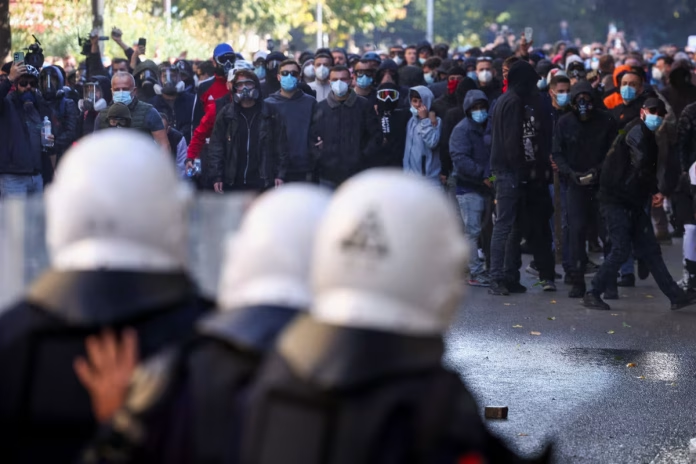
Demonstrators face riot police outside the Education Ministry in Tirana on 18 October 2026
Student-led unrest in Paris and Tirana looks unrelated. It isn’t: education decay, youth exclusion and protest met with force first, answers second.
Two European capitals, one month, one script
In France, what began in late September as a high-school protest over teacher shortages and education funding at Créteil swelled into a national revolt. On 6 October, more than 250,000 people marched. On 17 October, roughly 550,000 did — the CGT union claimed 800,000 — and the day closed with 1,800 arrested, a record 855 in Paris, torched vehicles, looted shops and a historic town hall in flames. A resident told AFP it “was like we had a war.” More than 6,600 arrests have been made since late September.
In Tirana, students took to the streets on 13 October over university conditions, tuition fees, jobs and corruption, and by 18 October the demonstrations had run six consecutive days. Rocks, molotov cocktails and pyrotechnics met rubber bullets, water cannon and tear gas; government buildings and banks were set alight. Police say 388 people have been charged.
Masked protesters clash with police in Paris on 17 October 2026
The connection is structural, not coincidental
Both movements are youth-led, both were ignited by education disinvestment, and both mutated within days from a specific policy grievance into a broader verdict on the political class. France’s trigger — teachers leaving the profession for better opportunities, classrooms unmanned, funding flat — is the same teacher-exodus story playing out across the continent. Albania’s students named it directly: poor education standards, no jobs, and a corruption they see consolidated in a single man.
Both governments reached for the same two reflexes: securitise, then externalise
France’s Interior Minister Laurent Nuñez attributed the riots to “groups clearly instigated by the far left,” noting violence “started right from the beginning.” Albania’s Edi Rama blamed “a foreign hand,” citing an attempted drone attack on his office. In both capitals, the diagnosis of the protest is framed as infiltration rather than representation. That framing is politically efficient and analytically fatal: it converts negotiable grievances into a security operation with no negotiable terms.
Rama went further, performing a rhetorical inversion that deserves attention: “I am not being challenged… a path is being challenged, a mission is being challenged,” he said, asking Albanians whether they wanted the protests “or the EU.” Protest against the government was relabelled as protest against European accession. It is a highly effective device where EU membership is the national promise — and it is also why Tirana’s government sees little cost in waiting the movement out.
Why the violence escalates daily
Escalation is not a mood; it is a mechanism.
First, radicalisation of repertoires. When large, visible, disciplined marches produce no concession, the marginalised tactic — the masked front line, the burning barricade — becomes the only tactic observed to generate a response. Violence acquires a track record.
Second, tactic diffusion by video. Paving stones pulled up in Tirana, molotovs, first-aid stations in a lawyer’s office: these are now transferable techniques, not local improvisations. Excavators removing cobblestones outside Rama’s office before Sunday’s protest — dismissed by one resident as preparation for police protection, not prevention — proves the state reads the playbook too.
Burnt barricades in central Paris on 18 October 2026, the morning after 1,800 arrests and a historic town hall destroyed.
Third, composition drift. Students were the fuse. France’s Interior Ministry described organised far-left groups; Tirana’s ranks now include non-students, and the Mirror and Daily Mail reported hooded, non-student fronts in Italy. As the modal protester stops being a pupil with a school to return to, the risk ceiling rises.
Fourth, a record high of violence as context, not consequence. France’s Interior Ministry reported public-space violence at an unprecedented 20,000 incidents in September, roughly 700 a day, up 7 per cent on August. The student movement arrived after the powder was laid, not before.
Fifth, escalation symmetry. Rubber bullets appeared in Tirana for the first time on day five. Each new tool by police is read by protesters as proof of legitimacy, and by police as proof of necessity. The loop has no internal brake.
Why demands have not been met — because in each case, meeting them was structurally impossible
France’s demands are legible and mostly material: education funding, staffing, the reversal of budget pressure. They are unfunded against a tightening budget and an election in six months, and the outgoing Macron government’s negotiating authority is already spent. Worse, the movement’s demand stack has fused with a political one — the anti-establishment register makes any cash concession look like a surrender to a demand it cannot price. Prime Minister Sébastien Lecornu lamented the violence; Macron addressed the nation on Sunday. Both words, no cheque.
Albania’s central demand — Rama’s resignation — is by definition non-negotiable. A leader who has governed since 2013 and won a fourth term cannot concede it without validating the corruption charge at the root of the movement, and the movement cannot accept anything less without collapsing. Note also the sequencing: the unrest followed months of largely peaceful protest against a luxury coastal development tied to Jared Kushner. That is not a fringe grievance; it is a conflict of material interests. Rama’s answer — “we are tackling corruption as never before” — cannot be tested while he remains the arbiter of that test. Analysts note Albania’s recurring image problem as a hub for gangs laundering drug and weapons money.
Both governments are also facing a term-limit-of-trust problem: Macron is in his final months, and Rama’s fourth term has no institutional runway left to spend on concession.
Students march in Tirana demanding free higher education, jobs and the resignation of Prime Minister Edi Rama, 16 October 2026.
Will this sweep Europe?
Careful here — the temptation is to declare a continental wave off two data points.
The evidence for convergence is real. Italy saw water cannon and hooded clashes in the same fortnight, and the cost-of-living unrest has been reported across Portugal, Belgium and Spain. The underlying drivers — underfunded education, teacher flight, youth unemployment, real-income erosion, corruption perception — are shared across the OECD, not nationally owned. So is the tactic: occupy the street, blockade the school, force the broadcast.
The evidence against domino contagion is also real
There is no coordinating structure, no shared leadership and no common demand list; French students want funding, Albanian students want a prime minister gone. Welfare buffers, union architectures and police doctrine differ sharply. Governments learn crowd-control faster than protesters learn solidarity — Tirana’s paving-stone removal is the proof. And in much of Western Europe, electoral channels still absorb pressure that the Western Balkans, where accession is the only political currency, cannot.
The realistic forecast
This becomes a Europe of repeating, unconnected explosions on a shared fault line — not one movement. The contagion is of framing and technique. Watch Italy, Spain, Belgium and Greece for the next flare, and the Western Balkans, where EU-promise politics gives every grievance an existential edge. What turns parallel unrest into one movement is a single unifying demand. No government has yet given them one.
Australian independent MP Helen Haines, who was critically injured in a vehicle attack in Wangaratta, Victoria.
Australian independent lawmaker Helen Haines is in critical condition after being deliberately struck by a vehicle outside her office in Wangaratta, Victoria, prompting a terrorism taskforce investigation.
Prime Minister Anthony Albanese said on Monday, October 19, that the motive for the attack remained unclear, as police continued investigating the incident and a 43-year-old suspect remained in custody.
The 65-year-old parliamentarian was airlifted to hospital following the incident, which occurred on Murphy Street, where her constituency office is located.
Victoria Police said a white Toyota Land Cruiser struck Haines. The driver was reportedly detained by bystanders who witnessed the incident, while a knife was found inside the vehicle.
Authorities described the incident as isolated and said there was no further threat to the public.
Why Is a Terrorism Taskforce Investigating the Attack?
Albanese confirmed that a terrorism taskforce would investigate the attack, although authorities have not established a motive or confirmed that it was terrorism-related.
The investigation comes amid growing international concern over threats, harassment and violence directed at elected officials.
Speaking after the incident, Albanese warned that the tone of political discourse had become increasingly hostile, particularly on social media, where anonymous users can make inflammatory comments they might not make in person.
He said Australians should be able to engage with elected representatives in public places, including streets, supermarkets and community forums, without fear of violence.
However, the prime minister cautioned against drawing conclusions about the motive before investigators establish the facts.
Australian Leaders Condemn the Attack
Opposition Leader Angus Taylor described the incident as a shocking day for Australia, warning that violent attacks against politicians must not become normalised.
Home Affairs Minister Tony Burke also highlighted the growing number of threatening and harassing incidents involving Australian lawmakers.
According to figures cited by Burke, such incidents increased to 1,067 over the past year, compared with 951 in the preceding period.
Haines’ family thanked members of the public who assisted her after the attack, alongside emergency responders and police.
Political leaders across the country have expressed concern for her condition and called for her recovery.
Rising Threats Against Politicians Around the World
The attack has renewed attention on the security risks facing elected representatives in Australia and elsewhere.
A February 2026 survey by the Inter-Parliamentary Union, an international organisation representing national parliaments, found that 71% of respondents reported experiencing violence from members of the public, particularly online.
Other countries have also experienced serious attacks against politicians and public figures.
In the United Kingdom, the killings of serving MPs in recent years have intensified debate over the protection of elected representatives. Security arrangements for high-profile public figures have also come under renewed scrutiny following the killing of a former minister in July 2026.
In the United States, assassination attempts against President Donald Trump have highlighted the dangers facing political leaders in an increasingly polarised environment.
While these incidents differ in their circumstances and motivations, they have raised wider questions about political hostility, online abuse and the safety of public officials.
Who Is Helen Haines?
Helen Haines is an Australian independent member of parliament representing the electorate of Indi in the state of Victoria.
Before entering politics, she worked in nursing and midwifery and pursued an academic career. She was elected to the Australian parliament in 2019.
Haines has been involved in policy debates on political donations, immigration detention and government support for fossil fuels.
Her work as an independent lawmaker has focused on representing her regional constituency and raising issues affecting local communities.
What Happens Next?
Police investigations are continuing, and authorities have yet to establish the suspect’s motive or determine whether the attack was politically or ideologically motivated.
The immediate priority remains Haines’ medical care, while investigators examine the circumstances surrounding the incident.
The case is also likely to renew debate in Australia over the protection of politicians, the impact of online hostility and the importance of ensuring that democratic participation remains safe.
For now, authorities have urged the public not to speculate as the investigation proceeds.
Delegations of the Alliance of Sahel States and ECOWAS meet in Dakar on 17 October 2026 for the first ministerial-level talks since Mali, Burkina Faso and Niger withdrew from the regional bloc in January 2025.
Mali, Burkina Faso and Niger agree to joint working groups with ECOWAS in Dakar — their first formal ministerial talks since leaving the bloc in January 2025, as jihadist violence spreads toward the coast.
DAKAR — For the first time since they walked out of the West African bloc, Mali, Burkina Faso and Niger sat down formally with ECOWAS. At a ministerial meeting in Dakar on Saturday, 17 October 2026, the two sides agreed to stand up joint thematic working groups to design a framework cooperation agreement that would govern their relationship after the split.
Burkina Faso’s Foreign Minister, Karamoko Traore, led the Alliance of Sahel States (AES) delegation, while Senegal’s Foreign Minister, Cheikh Niang, headed the ECOWAS team. It is understood to be the first official ministerial-level engagement since the three Sahelian states formally left ECOWAS in January 2025, having formed the AES and broken with the bloc over sanctions, governance and sovereignty. Technical-level contacts had continued intermittently since then.
In a joint statement issued Saturday evening, both sides welcomed the discussions, invoking fraternity, mutual respect and openness as guiding principles, and stressing good-neighbourly relations and respect for national sovereignty — language that signals a partnership between separate legal persons rather than a readmission process.
Why it matters: The security gap
The diplomacy runs against a deteriorating threat picture. Armed groups linked to al-Qaeda and the Islamic State have exploited weak state presence, porous borders and local grievances across the Sahel for more than a decade, and violence has pressed southward toward the coastal states — including northern Benin and Togo. In Mali, coordinated attacks on 25 April involving Jama’at Nusrat al-Islam wal-Muslimin (JNIM) and the Azawad Liberation Front struck multiple locations, and Defence Minister Sadio Camara was killed in the fighting. Burkina Faso and Niger have seen sustained pressure on both security forces and civilians. Nigeria, the region’s largest economy, is contending simultaneously with Boko Haram and Islamic State West Africa Province (ISWAP), banditry and mass kidnapping.
Because these groups operate across borders, friction between Nigeria and the AES states directly degrades intelligence-sharing and joint operations. Niger’s withdrawal from the Multinational Joint Task Force in March 2025 was the clearest signal of that collapse.
The joint statement issued after the talks cited fraternity, mutual respect and openness, and committed both sides to good-neighbourly relations and respect for national sovereignty.
The unresolved questions
The AES trio have pursued an independent security and political path, distancing themselves from France and deepening ties with Russia. Their exit has complicated exactly the cooperation the threat demands: shared intelligence, border control and coordinated military response. Diplomatic rows have been sharpened by allegations from Sahelian leaders that neighbouring countries and foreign powers are backing armed groups — claims that remain contested and should not be treated as established fact without independent verification.
It is not yet clear whether the renewed talks contemplate a return to the bloc. If reunion is off the table, ECOWAS faces a structural test: how a community founded on democratic governance norms conducts pragmatic diplomacy with junta-led neighbours while the threat spreads across their shared borders.
Key takeaways
1. First formal ministerial contact since the January 2025 exit; the outcome is working groups, not an agreement.
2. Sovereignty-first language points to an external partnership model, not re-entry.
3. Trade is the likely anchor: ECOWAS’s trade regime and port access for landlocked Sahelian exports (notably gold and uranium) are the hardest interests on the table.
4. Security cooperation remains the gap that the framework has to fill — including restoring channels damaged by Niger’s MNJTF exit.
5. Watch the coast: Benin and Togo are now on the front line, which is what pulls coastal states like Senegal into the negotiating chair.
To provide the best experiences, we use technologies like cookies to store and/or access device information. Consenting to these technologies will allow us to process data such as browsing behaviour or unique IDs on this site. Not consenting or withdrawing consent, may adversely affect certain features and functions.
Functional
Always active
The technical storage or access is strictly necessary for the legitimate purpose of enabling the use of a specific service explicitly requested by the subscriber or user, or for the sole purpose of carrying out the transmission of a communication over an electronic communications network.
Preferences
The technical storage or access is necessary for the legitimate purpose of storing preferences that are not requested by the subscriber or user.
Statistics
The technical storage or access that is used exclusively for statistical purposes.The technical storage or access that is used exclusively for anonymous statistical purposes. Without a subpoena, voluntary compliance on the part of your Internet Service Provider, or additional records from a third party, information stored or retrieved for this purpose alone cannot usually be used to identify you.
Marketing
The technical storage or access is required to create user profiles to send advertising, or to track the user on a website or across several websites for similar marketing purposes.