Home Blog Page 131

WEF 2026: Vice President Shettima Inaugurates Nigeria House At Davos

0

Vice President Kashim Shettima on Monday formally commissioned Nigeria House at the 2026 World Economic Forum in Davos, Switzerland, describing the country’s first-ever sovereign pavilion at the global meeting as a clear statement of Nigeria’s renewed seriousness, readiness and resolve to actively shape global economic conversations.

Speaking at the opening ceremony, Shettima said Nigeria’s future prosperity depends on deliberate and structured engagement with the global economy, stressing that nations do not thrive in isolation.

“For the first time in our nation’s history, Nigeria stands at Davos with a sovereign pavilion of its own,” the Vice President said.

“Nigeria House reflects our intention. It reflects our seriousness. Above all, it advertises both our readiness and our resolve to take a front-line seat in the discourse of the global economy, not as observers, but as participants with a clear sense of purpose and place.”

He described the inauguration of Nigeria House as a historic milestone in the country’s global economic engagement, noting that the platform was created to correct past lapses and project Nigeria as a confident and credible investment destination.

Shettima explained that although Nigeria House was conceived as a whole-of-government initiative, bringing together leadership across trade, investment, foreign affairs, energy, infrastructure, technology, climate and culture, its success would ultimately depend on the private sector.

“Government can open doors, create frameworks and de-risk environments. Only enterprise can animate growth, scale opportunity and translate policy into productivity,” he said.

“This House will thrive to the extent that it draws life from private capital, private innovation and private confidence.”

The Vice President said the opening of Nigeria House coincides with early dividends from the economic reforms of the Tinubu administration, describing the period as a turning point in Nigeria’s economic journey.

“The dividends of the difficult but inevitable reforms of recent years are beginning to show,” Shettima said, recalling that Nigeria’s economy grew by about 3.9 per cent in 2025, the fastest pace in over a decade, driven largely by a resilient non-oil sector.

According to him, services, agriculture, finance and technology are expanding, while non-oil revenues now account for nearly three quarters of government collections, marking a structural shift away from oil dependence.

He added that inflation, which stood above 30 per cent in late 2024, eased significantly by the end of 2025, while foreign reserves rose above 45 billion dollars and stability improved in the foreign exchange market.

Inviting the international business community to leverage the new platform, Shettima said Nigeria House would host conversations aimed at driving national and global progress.

“Nigeria is open for business, but more importantly, Nigeria is open for collaboration,” he said. “We are here to learn from you just as much as we are here to inform you of the opportunities that await in Nigeria. Progress is not a monologue; it is a dialogue.”

Earlier, the Minister of Industry, Trade and Investment, Dr Jumoke Oduwole, applauded the Vice President’s support for the realisation of Nigeria House, describing the project as a product of strong public-private partnership and a symbol of renewed national pride.

She said the initiative reflects a shift in how Nigeria engages the global business community and showcases the rejuvenation of the economy under President Bola Ahmed Tinubu.

According to her, investment playbooks launched at the event highlight opportunities in solid minerals, climate-smart agriculture, creative industries and the digital economy.

Nigeria, she said, is rebuilding trust, restoring credibility and positioning itself as a global hub for wealth creation and strategic partnerships.

Also speaking, the Permanent Secretary of the Ministry of Solid Minerals Development, Engr Faruk Yusuf Yano, said Nigeria House represents a deliberate effort to consolidate the gains of ongoing economic reforms by attracting investment into the non-oil sector.

He also called for fairer treatment of emerging markets in access to finance and global supply chains.

The Lead Execution Partner for Nigeria House, Omowunmi Imoukhuede, said the pavilion offers a rare opportunity to tell Nigeria’s investment story and showcase its unique economic potential to the world.

The commissioning of Nigeria House followed a Global Business Roundtable focused on building resilient supply chains for the energy transition.

Dignitaries at the event included the Minister of Science and Technology, Dr Kingsley Ude; the Minister of Foreign Affairs, Ambassador Yusuf Tuggar; heads of government agencies and captains of industry.

5 Key Things Martin Luther King Jr Stood For And The Reality Today

0

As the United States marks Martin Luther King Jr. Day on January 19, 2026, renewed debates over civil rights, historical memory, and public policy have placed the legacy of Dr. Martin Luther King Jr. back at the center of national conversation.

While King is widely celebrated as a symbol of equality and justice, questions persist about how fully the values he fought for are being upheld in modern America, particularly amid recent federal policy shifts and political polarization.

Who is Martin Luther King Jr.

Martin Luther King Jr. was a Baptist minister and the most prominent leader of the American Civil Rights Movement of the 1950s and 1960s.

He was born on January 15, 1929, in Atlanta, Georgia. King rose to national prominence in 1955 during the Montgomery Bus Boycott, a mass protest against racial segregation on public transportation sparked by the arrest of Rosa Parks.

A co-founder of the Southern Christian Leadership Conference (SCLC), King became known for organizing nonviolent protests against systemic racism and injustice.

He played a central role in historic events such as the 1963 March on Washington, where he delivered his famous “I Have a Dream” speech, and the 1965 Selma to Montgomery marches that helped lead to the passage of the Voting Rights Act.

In 1964, King became the youngest recipient of the Nobel Peace Prize, recognized for his commitment to nonviolent resistance inspired by Christian teachings and the philosophy of Mahatma Gandhi.

In his later years, King expanded his advocacy to include economic justice and opposition to the Vietnam War. He was assassinated on April 4, 1968, in Memphis, Tennessee, while supporting striking sanitation workers.

His life and work are commemorated annually on Martin Luther King Jr. Day, a federal holiday established in 1983.

Key Things He Stood For and the Reality Today

Martin Luther King Jr.’s philosophy and activism were rooted in a vision of a just society.

Here are five core principles he champione

  • Martin Luther King Jr. dedicated his life to racial equality and desegregation, fighting relentlessly against Jim Crow laws and institutional racism that enforced segregation in schools, housing, transportation, and public spaces. He envisioned a society where people would be judged by their character rather than the color of their skin. His campaigns across the American South challenged discriminatory laws and social practices, forcing the nation to confront the deep moral failure of racial inequality.
  • Central to King’s philosophy was nonviolent protest. He believed that meaningful social change must be achieved through peaceful means, drawing inspiration from Mahatma Gandhi and Christian principles. Through marches, boycotts, sit-ins, and civil disobedience, King sought to expose injustice without hatred or violence, convinced that love, discipline, and moral persuasion could transform both society and its oppressors.
  • In the later years of his life, King increasingly focused on economic justice and the fight against poverty. He argued that civil rights could not be separated from economic opportunity and that racial equality was incomplete without fairness in wages, jobs, and living conditions. This belief led to the launch of the Poor People’s Campaign in 1968, which demanded employment, housing, and dignity for all impoverished Americans regardless of race. His commitment to workers’ rights was underscored by his support for striking sanitation workers in Memphis, where he was assassinated.
  • Voting rights were another cornerstone of King’s struggle. He viewed the right to vote as fundamental to democracy and essential for achieving equality. His leadership in the Selma to Montgomery marches of 1965 exposed violent efforts to suppress Black voters and directly contributed to the passage of the Voting Rights Act of 1965, which outlawed discriminatory practices such as literacy tests and poll taxes.
  • King also became a strong advocate for international peace and opposition to war. In his final years, he spoke forcefully against militarism and the Vietnam War, linking foreign conflicts to domestic injustice. He argued that excessive military spending diverted resources from education, housing, and poverty reduction, and that violence abroad reinforced inequality at home. For King, peace, justice, and human rights were inseparable and mutually reinforcing.

What is upheld today

Nearly six decades after his assassination, the reality of King’s vision in 2026 remains mixed. Legal segregation has been abolished, yet deep disparities persist in wealth, education, housing, and the criminal justice system.

Recent federal actions under the Trump administration, including efforts to limit diversity, equity, and inclusion programs, have drawn sharp criticism from civil rights groups.

The removal of MLK-related exhibits and historical materials from national parks and public institutions has intensified concerns about the erasure of Black history.

In contrast, some states such as California have taken symbolic countersteps, including offering free access to state parks on MLK Day to reaffirm the holiday’s significance.

Nonviolent protest remains a protected right, and demonstrations continue nationwide on issues ranging from racial justice to economic inequality.

However, protests are often met with heightened policing and political rhetoric focused on law and order, echoing the resistance King faced during his lifetime. At the same time, community service initiatives tied to MLK Day continue to reflect his emphasis on peaceful action, service, and collective responsibility.

Economic justice remains one of the least realized aspects of King’s vision. Poverty and wage gaps continue to disproportionately affect Black and other minority communities.

While grassroots movements and state-level initiatives seek to address inequality, critics argue that federal policy priorities, including proposed cuts to social programs, fall short of the sweeping economic reforms King envisioned.

Voting rights are also increasingly contested. Although the Voting Rights Act remains in place, it has been weakened by court decisions and challenged by new state-level voting restrictions.

Civil rights advocates warn that stricter voter identification laws and voter roll purges risk undermining the hard-won gains secured during King’s era.

On international peace, King’s warnings about militarism remain strikingly relevant. The United States continues to devote significant resources to defense amid ongoing global conflicts, fueling renewed debates over national priorities.

Activists and faith leaders continue to invoke King’s message that true security is rooted not in weapons or war, but in justice, equity, and sustained investment in human well-being.

In 2026, Martin Luther King Jr.’s legacy stands as both a testament to progress achieved and a reminder of unfinished work.

While his ideals continue to inspire activism and public reflection, the gap between his vision and present realities underscores the enduring challenge of building a more just and inclusive society.

CAF Suspends Senegal Coach Pape Thiaw

0

The Confederation of African Football (CAF) has suspended Senegal’s head coach, Pape Thiaw, following a disciplinary review of the chaotic events during Sunday’s Africa Cup of Nations final.

Senegal claimed their second continental title after defeating hosts Morocco 1-0 in extra time at the Prince Moulay Abdellah Stadium in Rabat.

However, the victory was marred by Thiaw’s decision to order a mid-game walk-off, which CAF described as a serious breach of conduct that compromised the integrity of the tournament.

The controversy unfolded deep into second-half stoppage time when referee Jean-Jacques Ndala awarded Morocco a late penalty after a VAR review.

Angered by the decision, which came shortly after Senegal had a goal disallowed, Coach Thiaw instructed his players to leave the pitch.

The high-profile final faced a potential forfeiture and a delay of nearly 20 minutes until captain Sadio Mane intervened.

Mane successfully convinced his teammates to exit the dressing room and return to the field, allowing the match to reach its conclusion.

Senegal eventually secured the win with Pape Gueye’s decisive extra-time goal, but CAF acted quickly to impose sanctions on the technical staff.

CAF’s disciplinary committee stressed that such protests are unacceptable in professional football, regardless of disputes over officiating.

Thiaw later expressed regret for his actions, acknowledging that his emotions had gotten the better of him in the heat of the moment.

The suspension underscores CAF’s commitment to enforcing strict disciplinary standards as African teams prepare for future global competitions.

EU Moves To Limit Chinese Firms’ Role In Critical Infrastructure And Cybersecurity

0

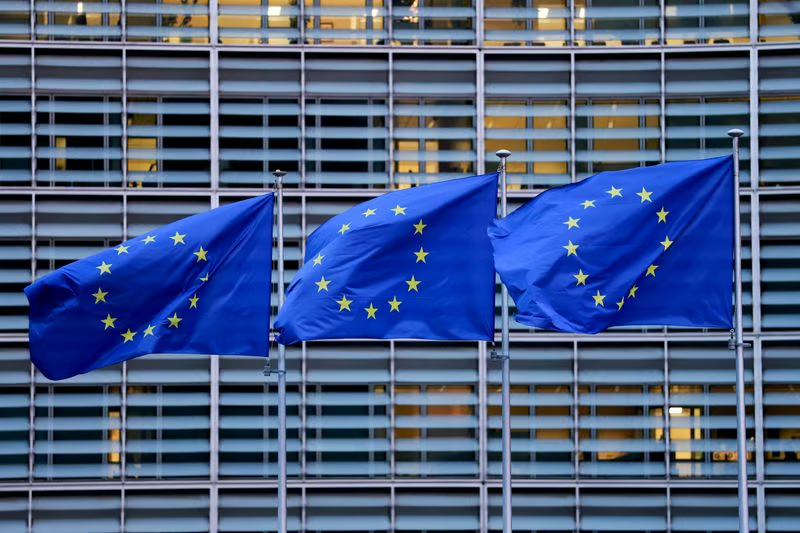
The European Union is set to announce new plans on Tuesday aimed at keeping “high-risk” Chinese suppliers out of Europe’s critical infrastructure, as Brussels steps up efforts to cut strategic dependencies on non-EU countries. The move comes amid increasingly strained relations between the EU and China, driven by trade disputes, concerns over what the bloc calls unfair competition, and growing security worries often echoed by the United States.

At the centre of the proposal is a revision of EU cybersecurity rules, which the European Commission will publish to tighten controls on foreign companies considered security risks. In 2023, the EU had already urged member states to remove Huawei and ZTE equipment from mobile networks, but officials now want to turn that guidance into a compulsory ban. Despite existing powers allowing national authorities to restrict suppliers, fewer than half of EU countries have acted so far.

If adopted, the mandatory restrictions could go beyond telecoms equipment to include other Chinese-made products, such as solar panels. The commission is also considering adding “sovereignty” criteria to the certification system for cloud services, a step that could exclude US companies that currently dominate the European market. France has been a strong supporter of this approach, though progress has stalled due to sharp divisions among the EU’s 27 member states.

Alongside the security proposals, the commission will unveil plans on Wednesday for a Digital Networks Act to modernise Europe’s telecoms sector. Brussels argues that fragmented national rules in sectors like telecoms and defence are holding back competitiveness and investment. However, funding remains a major challenge, with the EU estimating it needs €200 billion ($232 billion) to upgrade telecoms infrastructure.

A draft of the proposal seen by AFP does not include “fair share” payments from major tech firms for their heavy use of network bandwidth, a long-standing demand from telecoms companies. The idea lost momentum after last year’s EU-US tariff deal, which Washington said included a commitment by the EU not to introduce such fees.

The commission also plans to give member states until 2035 to phase out copper telecoms networks, allowing more time to transition to faster fibre systems. Both the cybersecurity revisions and the Digital Networks Act will still require approval from EU member states and the European Parliament before becoming law.

Court of Appeal President Holds Special Sitting In Lagos To Clear 360-Case Backlog

0

The President of the Court of Appeal, Justice Monica Dongban-Mensem, yesterday presided over a special sitting of the appellate court in Lagos, announcing that 360 appeals are scheduled for hearing before 16 panels established to expedite justice and reduce the growing backlog of cases.

The special session, held in Lagos, the birthplace of the Court of Appeal, also forms part of the court’s golden jubilee celebrations, marking 50 years since its establishment.

Justice Dongban-Mensem stated that the exercise reflects the court’s deliberate and ongoing commitment to improving efficiency in the administration of justice by addressing the increasing volume of appeals across its divisions.

She said, “This sitting is a reflection of the court’s deliberate commitment to enhancing efficiency in the administration of justice by addressing the growing number of appeals.”

The judge noted that Lagos, as Nigeria’s commercial hub, naturally produces a high volume of litigation, which places a heavy burden on the appellate system and necessitates decisive intervention.

“It has become both timely and necessary for the court to take proactive steps in being conscious of its docket of appeals.”

Justice Dongban-Mensem disclosed that 16 panels, comprising 40 Justices drawn from various divisions of the Court of Appeal nationwide, have been constituted for the exercise. According to her, the panels will sit throughout the week at both the Lagos Division of the court and the National Industrial Court (NIC).

“For this exercise, the court has constituted 16 panels made up of 40 honourable Justices drawn from different divisions of the court.”

She expressed profound appreciation to the Lagos State Government, particularly the office of the Attorney-General, for its collaboration and support, noting that the court’s limited resources alone could not have accommodated such a large number of Justices.

“I wish to express our profound appreciation to the Office of the Attorney-General of Lagos for collaborating with the court to ensure that this week happens. Otherwise, our slim resources would not be able to carry as many Justices as are here today.”

Justice Dongban-Mensem also acknowledged the consistent support of the National Industrial Court, which has provided both courtroom and residential facilities for the Court of Appeal.

The PCA urged counsel and litigants to ensure their cases are fully prepared for hearing, warning against avoidable delays.

“Counsel and parties are urged to take full advantage of this opportunity by ensuring readiness and strict compliance with the applicable rules of procedure.”

She lamented that many appeals could not be heard due to lack of preparation by lawyers.

“It was very painful for me because our limited resources had already been expended on air tickets, accommodation, and logistics, yet we could not hear most of the appeals because many counsel were not prepared,” she said.

While acknowledging Lagos’ appeal as a city, she emphasized that the special sitting is strictly a working session.

“It is always exciting to be in Lagos, but Justices do not have that much time for leisure travel. When time is set aside to work, we want to work. This is not a vacation.”

She further revealed that several Court of Appeal divisions have been temporarily deprived of Justices due to their deployment to Lagos, describing it as a significant sacrifice.

“Many divisions have been left without Justices to take their cases. In appreciation of this sacrifice, I appeal to all lawyers to take this session seriously.”

Justice Dongban-Mensem also called on lawyers, litigants, and the media to help maintain public confidence in the judiciary.

“If we do not encourage people to have faith in the judiciary, we may not be able to contain the lawlessness that will arise when people lose confidence.”

She reminded the public that justice delivery depends on evidence and active participation.

“Judges are not magicians. Law enforcement agencies are not magicians. They need evidence. They need people to come forward and say what they saw,” she said.

She urged journalists to ensure accuracy in reporting judicial proceedings.

“We appreciate your role in telling the world about the judiciary, but it is important that the correct information goes out. Where there is confusion, seek clarification,” she advised.

In her concluding remarks, the PCA encouraged all stakeholders to uphold integrity and professionalism as the Court of Appeal celebrates its golden jubilee.

“Justice must not only be done; it must manifestly be seen to be done.”

Speaking to the Bar, Senior Advocate of Nigeria, Mr. Ebun-Olu Adegboruwa, described the special sitting as historic and commended Justice Dongban-Mensem for the initiative.

“This is an auspicious occasion and a rare, unprecedented opportunity for members of the Lagos Bar to be blessed with an array of wise and learned Justices drawn from the various divisions of the Court of Appeal,” Adegboruwa said.

He assured the court of the Bar’s full cooperation in ensuring expeditious hearings.

“We, on behalf of the Bar, assure my Lords of our readiness to facilitate speedy and efficient hearing of all pending cases. It is in our interest and in the interest of our clients.”

Adegboruwa also congratulated the Court of Appeal on its 50th anniversary, praising its contributions to the nation’s justice system.

“We congratulate the Court of Appeal for contributing immensely to the administration of justice in our nation past, present, and future.”

However, he used the occasion to highlight ongoing funding and infrastructural challenges facing the judiciary, calling for improved financial support from the Federal Government.

“We are aware of the challenges confronting the judiciary, particularly in terms of inadequate funding. The Bar will continue to partner with the judiciary to ensure that this critical arm of government is properly funded.”

He further expressed optimism that efforts to improve facilities at the Lagos Division of the Court of Appeal would soon be realized.

“We are glad that my Lord is already working towards creating better facilities within the Lagos Division, and we pray that these efforts will soon materialise,” Adegboruwa added.

₦30bn Bodija Explosion Relief Fund: What We Know

0

On January 16, 2024, a devastating explosion occurred in the Old Bodija area of Ibadan, Oyo State, after illegally stored explosive materials detonated inside a residential building. The blast killed several residents, destroyed dozens of houses, displaced families, and caused structural damage across the neighbourhood. The scale of the disaster immediately drew national attention, prompting emergency response efforts from the Oyo State Government and intervention from the Federal Government.

President Bola Ahmed Tinubu-led Federal Government announced a major financial intervention to support victims, rebuild damaged infrastructure, and stabilise the affected community. Initial public communication suggested that as much as ₦50 billion had been approved for the Bodija explosion relief and reconstruction programme.

How Much Money Was Actually Released

While ₦50 billion was widely reported as the approved intervention sum, the Oyo State Government later clarified that only ₦30 billion was actually released by the Federal Government. Officials in the state government, including aides to Governor Seyi Makinde, insisted that claims of a ₦50 billion transfer were inaccurate and that the federal disbursement stopped at ₦30 billion.

According to the state government, the ₦30 billion was paid into a dedicated infrastructure support account domiciled with First Bank of Nigeria. The remaining ₦20 billion, though approved in principle, has not been released, and no formal explanation has been provided by federal authorities for the delay or withholding of the balance.

Why the Fund Has Not Been Spent

The Oyo State Government maintains that the ₦30 billion relief fund remains unspent. State officials argue that the decision to hold the money was deliberate and procedural. They explained that intervention funds of this nature are classified as capital grants and must be fully captured in the state’s budgetary framework before they can be lawfully expended.

Government sources also said the state chose not to begin spending the federal funds until there was clarity on the release of the outstanding ₦20 billion, citing the need for proper planning and coordination of the reconstruction effort. According to the government, spending part of the fund without certainty about the full scope of federal support could complicate long-term rebuilding plans.

What the State Says It Has Spent Instead

While the federal relief fund remains untouched, the Oyo State Government says it has relied heavily on its own resources to manage the aftermath of the explosion. The state claims it has spent over ₦24 billion from its coffers on emergency response, demolition of unsafe structures, compensation to victims, temporary housing arrangements, and other recovery efforts.

Officials also disclosed that several billions of naira were paid directly to affected residents as compensation, covering loss of property, relocation support, and medical assistance for injured victims. The government insists that these expenditures demonstrate its commitment to the welfare of Bodija residents, even in the absence of full federal funding.

Rising Controversy and Political Disputes

Despite these explanations, the handling of the ₦30 billion relief fund has become a major political and public controversy. The debate intensified after former Ekiti State Governor Ayodele Fayose publicly alleged that Governor Makinde had received ₦50 billion from the Federal Government. The Oyo State Government strongly denied this claim, reiterating that only ₦30 billion was released.

Opposition figures and critics argue that keeping such a large sum idle while victims continue to complain about inadequate compensation raises serious questions about transparency and prioritisation. Some have accused the state government of poor communication and failure to provide detailed public accounting of both state and federal expenditures related to the disaster.

Civil Society Petitions and EFCC Involvement

The controversy took a legal turn when the Human and Environmental Development Agenda (HEDA), a civil society organisation, petitioned the Economic and Financial Crimes Commission (EFCC). In its petition, HEDA alleged possible diversion, misapplication, and abuse of trust in the handling of the Bodija explosion intervention funds.

HEDA argued that holding ₦30 billion in a commercial bank for an extended period without clear utilisation or detailed public disclosure raises red flags and warrants investigation. The organisation called on the EFCC to examine the movement of funds, the decision-making process surrounding their use, and whether financial regulations were breached.

The Oyo State Government has rejected these allegations, maintaining that no diversion occurred and that the funds remain intact and traceable.

Public Sentiment and Victims’ Concerns

Beyond political and legal arguments, affected residents have continued to voice frustration. Some victims have told local media that compensation payments were insufficient compared to the scale of their losses, while others say rebuilding efforts have been slower than expected. Community members have repeatedly called for transparency and speedy deployment of all available funds to restore normalcy in Bodija.

Public opinion remains divided, with supporters of the state government defending its cautious approach, while critics argue that emergency relief funds should be deployed swiftly in disaster situations.

Where the Matter Stands

As of January 2026, the ₦30 billion Bodija Explosion Relief Fund remains unspent, according to the Oyo State Government. The remaining ₦20 billion approved by the Federal Government has yet to be released. The EFCC has not publicly disclosed whether it has commenced a formal investigation following HEDA’s petition.

What is clear is that the Bodija explosion relief fund has become more than a reconstruction issue. It is now a test case for transparency, intergovernmental coordination, and public accountability in disaster response, with implications that extend beyond Oyo State.

Global Markets Slide As Gold And Silver Surge After Trump’s New Tariff Warning

European stock markets declined on Monday, while gold and silver climbed to record levels, following fresh tariff threats from US President Donald Trump tied to his escalating push to acquire Greenland. Major European indices including Germany’s DAX, France’s CAC, and Italy’s FTSE MIB all fell by more than 1%, alongside losses in the pan-European STOXX 600. In the UK, the FTSE 100 dipped 0.4% to 10,194. At the same time, investors sought safety in precious metals, driving gold up 1.6% to $4,671 an ounce after hitting an all-time high of $4,689, while silver briefly surged to a record $94.08 an ounce.

Automakers were among the hardest hit, with shares of Volkswagen, BMW, Mercedes-Benz, and Stellantis sliding between 2% and 4%. US tech stocks listed in Europe also fell, despite US markets being closed for Martin Luther King Jr Day. The dollar weakened slightly, while analysts warned that renewed tariff uncertainty could disrupt investment and trade flows. “For businesses, the developments over the weekend mean another period of uncertainty around investments in and exports to the US,” said ING’s global head of macro analysis, Carsten Brzeski.

Trump’s comments over the weekend marked a sharp escalation, as he threatened tariffs of up to 25% on Denmark, Norway, Sweden, France, Germany, the UK, the Netherlands, and Finland unless the US is allowed to purchase Greenland. In a Truth Social post, he said a 10% tariff would begin on 1 February “on any and all goods sent to the United States of America,” rising to 25% by 1 June if no agreement is reached. Economists say markets have grown used to tariff threats being softened after negotiations, but warned the Greenland issue could prove harder to resolve.

Analysts also cautioned that new tariffs could dent European growth, with the UK potentially facing a sharper economic impact. EU officials are now preparing possible retaliatory measures, while geopolitical tensions continue to fuel demand for safe-haven assets. “With Trump throwing tariffs into the mix, it is clear that his threat to Greenland is real,” said StoneX analyst Matt Simpson, noting that the uncertainty has given gold another strong push upward.

China’s Population Declines As Birth Rate Hits Historic Low

0

China’s population continued its downward trend in 2025, shrinking for the fourth consecutive year as births fell to their lowest level in decades. Official data released on Monday showed the population dropped by 3.39 million to 1.405 billion, marking a sharper decline than in 2024 and underscoring the scale of the country’s demographic challenge.

Figures from the National Bureau of Statistics revealed that births fell to 7.92 million in 2025, down from 9.54 million the previous year, while deaths rose to 11.31 million from 10.93 million. China’s population has been declining since 2022 and is aging rapidly, complicating Beijing’s efforts to boost domestic consumption and manage rising debt as hundreds of millions of people approach retirement and pension systems come under strain.

The data also showed a sharp fall in marriages, which plunged by about 20% in 2024 to just over 6.1 million couples, the steepest drop on record. With marriage rates often seen as a key indicator of future birth trends, the decline adds to concerns about long-term population growth. However, demographers say there may be a brief uptick in births ahead after China eased marriage rules in May 2025, allowing couples to register marriages anywhere in the country rather than only in their place of residence.

IMF Boosts Global Growth Outlook But Warns Of Tariff Tensions And AI Market Risks

0

The International Monetary Fund (IMF) has raised its global growth forecast, projecting faster economic expansion this year while cautioning that rising trade barriers and geopolitical strains could still derail progress. In its latest quarterly outlook released on Monday, the IMF said the world economy is now expected to grow by 3.3%, up from an earlier estimate of 3.1%. The Fund also upgraded its U.S. growth outlook for 2026 to 2.4% from 2.1%, though it slightly trimmed its 2027 projection to 2%.

These forecasts are based on the assumption that tariffs and trade restrictions remain at December levels, an outlook the IMF admits is already under pressure. President Donald Trump recently announced plans to introduce 10% tariffs on goods from several European countries from February 1, rising to 25% by June, in a move aimed at forcing Denmark to sell Greenland to the United States. “There are, of course, risks still on the trade side and broadly geopolitical risks,” said IMF chief economist Pierre-Olivier Gourinchas, adding that “The effects of these would build over time.”

The IMF noted that recent economic resilience has been driven largely by massive investment in artificial intelligence and related infrastructure. While this surge has helped cushion the impact of higher trade costs, the Fund warned that overreliance on AI investment creates vulnerabilities. A sudden shift in investor confidence about AI’s real-world potential could spark sharp stock market losses, beginning with tech firms and spreading more widely, threatening household wealth and consumer spending.

According to the IMF, U.S. equity valuations are about half as overstretched as during the 2001 dot-com bubble, but today’s risks are amplified because stock market value now equals about 226% of economic output, far above the 132% level seen then. As a result, even a “moderate” market correction could drag global growth down to 2.9%, prompting central banks to consider cutting interest rates. Conversely, if AI adoption proves more productive than expected, global growth could rise to 3.6% this year and add up to 0.8 percentage points annually over time.

The report also highlighted mounting pressure on central bank independence, particularly in the United States. The IMF stressed that rate cuts should occur “only with robust evidence of inflation expectations remaining anchored and inflation returning toward target,” a stance that could deepen tensions between the Federal Reserve and President Trump. Emphasizing the importance of autonomy, Gourinchas said, “It’s really important that they remain independent… The expectation that they will do what is needed is absolutely critical in bringing inflation down.”

Finally, the IMF upgraded growth forecasts for major emerging economies, lifting China’s 2026 outlook to 4.5% and India’s to 6.4%. However, Gourinchas warned that widening growth gaps between regions could pose a longer-term risk to global economic stability.

Vice President Shettima Lands In Switzerland For World Economic Forum

0

Vice President Kashim Shettima has arrived in Davos, Switzerland, ahead of the 56th Annual Meeting of the World Economic Forum, where he will head Nigeria’s delegation to the global event scheduled for January 19 to 23, 2026.

According to a statement by his spokesman, Stanley Nkwocha, the Vice President arrived in Switzerland from Conakry, Guinea, after representing President Bola Ahmed Tinubu at the inauguration of Guinea’s President, Mamadi Doumbouya, on Saturday.

Shettima was welcomed in Davos by the Minister of Foreign Affairs, Ambassador Yusuf Tuggar, the Minister of Industry, Trade and Investment, Dr Jumoke Oduwole, and officials of the Nigerian Mission in Switzerland.

Nigeria’s presence at the 2026 forum is being highlighted by the launch of Nigeria House Davos, the nation’s first official sovereign pavilion at the high-level global event.

Situated along the Davos Promenade, the pavilion was set up by the Federal Government through a public-private partnership.

The facility is intended to function as a hub for ministerial engagements, investment talks and cultural interactions during the week-long forum.

During the WEF, the Vice President is expected to present Nigeria’s 2026 economic outlook to global policymakers and business leaders.

He will also take part in top-level discussions on emerging technologies, including the ethical application of artificial intelligence, quantum computing and breakthroughs in biotechnology.

In addition, the Vice President is scheduled to hold several bilateral meetings with fellow world leaders, multinational company executives and heads of international development finance institutions to deepen strategic partnerships.