Home Blog Page 132

The drama That Defined The 2025 AFCON Final

0

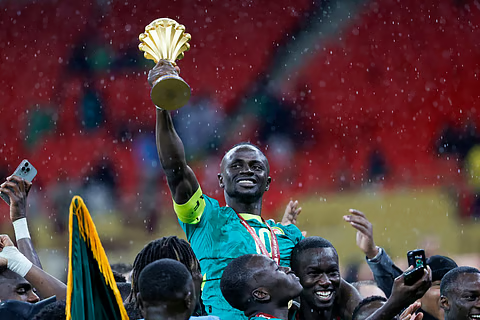
Senegal claimed their second Africa Cup of Nations title after defeating Morocco, but the final will be remembered as much for its chaos as for its football. The showpiece was overshadowed when the Senegalese players briefly refused to continue the match after the hosts were awarded a stoppage-time penalty while the score remained goalless.

Referee Jean-Jacques Ndala pointed to the spot in the 98th minute following a VAR intervention that sent him to the pitchside monitor to review El Hadji Malick Diouf’s challenge on Brahim Díaz. The decision sparked extraordinary scenes inside the stadium.

Still furious over an earlier call that had seen a Senegal goal ruled out, head coach Pape Thiaw instructed his players to leave the pitch in protest. Former Liverpool forward Sadio Mané remained on the field, urging his teammates to return and see the game through.

After a delay of approximately 17 minutes, play eventually resumed. Real Madrid attacker Brahim Díaz, the tournament’s leading scorer with five goals, stepped up to take the penalty. His attempted Panenka was comfortably caught by Senegal goalkeeper Édouard Mendy, and referee Ndala immediately blew the whistle to signal the end of normal time.

The decisive moment arrived early in extra time. Villarreal midfielder Pape Gueye struck in the fourth minute, sealing a 1-0 victory and securing Senegal’s second AFCON triumph in five years.
In the aftermath, Morocco head coach Walid Regragui condemned Senegal’s temporary walk-off, describing the incident as “shameful” and claiming it did not “honour Africa.” Thiaw’s scheduled post-match press conference was cancelled following a disturbance in the media room.

However, speaking to BeIN Sports, Thiaw later admitted his error. “We didn’t agree,” he said. “I don’t want to go over all the incidents. I apologise for football. After reflecting, I made them come back. You can react in the heat of the moment. We accept the referee’s mistakes. We shouldn’t have done it, but it’s done, and we apologise to football.”

Thiaw’s anger stemmed from Ndala’s earlier decision to disallow a goal by Ismaïla Sarr. The Crystal Palace forward had bundled the ball home from close range, but the goal was ruled out for a foul by Abdoulaye Seck on Achraf Hakimi in the build-up. The later penalty decision only intensified Senegal’s frustration.
Several Senegal players followed their coach down the tunnel, while some supporters threw objects and attempted to enter the pitch. Díaz, who was later substituted after Gueye’s goal, was left devastated as Morocco missed the chance to win their first AFCON title since 1976.

Speaking after the match, Mané stressed the importance of protecting the image of the game. “Football is something special. The world was watching, so we have to give a good image,” he said. “It would be crazy not to play because the referee gave a penalty. I would rather lose than see something like that happen to our football. It’s really bad. Football should not stop for 10 minutes, but the good thing is we came back and played.”

Mendy, now with Al-Ahli in Saudi Arabia, said he was proud of how the team responded. “What did we say to each other? That stays between us,” he said. “We did it together and came back together. That’s all that matters.”
Match-winner Gueye echoed those sentiments. “We felt a sense of injustice,” he explained. “Just before the penalty, we believed we had scored and the referee didn’t go to VAR. Sadio told us to come back, we refocused, Edouard made the save, and then we got the goal.”

Despite the thrilling football on display throughout the tournament, the chaotic ending left a sour taste. From the commentary box, the scenes were difficult to comprehend, with fans attempting to enter the pitch and staff members being separated in the technical areas as Senegal’s players walked down the tunnel.
In the weeks leading up to the final, refereeing decisions and the use of VAR had been heavily debated, with some fans and journalists suggesting Morocco had benefited from certain calls. Refereeing appointments themselves had become a talking point on social media, increasing pressure on officials ahead of key matches.

Senegal had also raised concerns prior to the final, including what they described as inadequate security when arriving in Rabat, issues with hotel conditions, limited ticket allocations, and the absence of a training pitch at Morocco’s base. The Senegal Football Federation said players and staff were put at risk after their team bus was surrounded by fans.

“What happened was not normal,” Thiaw said before the match. “With that number of people, anything could have happened. My players could have been in danger. That type of thing should not happen between two brother countries.”
Former Nigeria international Efan Ekoku criticised Senegal’s actions, saying their refusal to continue was “not a good look for African football,” while John Obi Mikel admitted he understood the frustration but did not support walking off the pitch.
Morocco were widely praised for the organisation of the tournament, including infrastructure, stadiums and transport links, with positive feedback from figures such as Mohamed Salah.

However, with four years remaining until they co-host the World Cup, the dramatic scenes surrounding the penalty will likely be the most enduring image of this AFCON.
Amid the controversy, Mané emerged with credit for his efforts to calm both teammates and supporters, urging restraint after full-time. In a turbulent finale, his actions stood out as a reminder of leadership and responsibility in the game.

2025 AFCON: Senegal Defeat Morocco To Become African Champions

0

In a dramatic and controversial climax to the 2025 Africa Cup of Nations (AFCON), Senegal emerged victorious over hosts Morocco in the final played on 18 January 2026 at the Prince Moulay Abdellah Stadium in Rabat, Morocco. After a tense 90 minutes with no goals, the match exploded into action in extra time and will be remembered as one of the most dramatic finals in recent AFCON history.

The decisive breakthrough came early in extra time when Pape Gueye produced a stunning strike to give Senegal a 1–0 lead, sparking jubilant celebrations among the away supporters.

The game had already been filled with controversy before that moment. Late in stoppage time of regular play, a VAR review awarded Morocco a penalty, prompting intense protests from Senegal’s players and coaching staff. Senegal briefly walked off the pitch in protest, leading to confusion and a lengthy interruption.

When play resumed, Moroccan forward Brahim Díaz stepped up but saw his Panenka-style penalty saved by Senegal’s keeper Édouard Mendy, keeping the score level and fuelling Senegal’s momentum.

Despite relentless pressure from Morocco in the closing stages of extra time, Senegal held firm to secure the title, their second AFCON championship, and dealt a heartbreaking blow to the hosts seeking their first continent-wide triumph since 1976.

The final was also marked by crowd unrest, with clashes between stewards and fans that required police intervention, adding to the dramatic finish of a tournament that had already captured wide attention across the continent.

Third and Fourth Place Play-Off: Nigeria vs Egypt

Before the final, the third-place match at the 2025 AFCON took place on 17 January 2026 in Casablanca, where Nigeria faced Egypt in a tightly contested battle for bronze.

The match ended 0–0 after regulation, with both sides struggling to find a breakthrough. The tie was then decided by a penalty shootout, where Nigeria held their nerve to win 4–2.

Goalkeeper Stanley Nwabali was the hero for the Super Eagles, saving crucial penalties, including attempts from Egypt’s Mohamed Salah and Omar Marmoush — to swing the shootout in Nigeria’s favour.

Ademola Lookman stepped up to convert the decisive penalty, sealing the victory and earning Nigeria the third place finish while Egypt settled for a fourth-place finish.

The 2025 AFCON tournament will be remembered for its high-quality football, passionate fan support, and the emergence of standout talents across the continent. As Senegal celebrate a historic triumph, attention now turns to the next chapter of African football, with nations already setting their sights on future continental and global challenges.

Unleashing Africa’s Creative Economy Potential

Africa’s cultural and technological revolution is accelerating, and with it comes the need for strong language infrastructure and systems-level thinking. The African Union’s unification agenda envisions a digitally empowered continent where African languages, stories, and creative expressions are not only preserved but positioned to resonate on a global stage.

Through a groundbreaking partnership, Plotwaver and the University of Lagos are building tools, systems, and training that empower creatives, students, investors, and the wider business ecosystem. By preserving Africa’s rich language heritage, this collaboration aims to drive innovation within Nigeria’s creative economy and amplify authentic African voices across the world.

Uganda Election: 81-Year-Old Yoweri Museveni Declared Winner

0

Uganda has officially declared President Yoweri Museveni the winner of the 2026 presidential election, extending his rule that has spanned more than three decades. The closely watched poll was conducted amid an internet shutdown and reported restrictions on civil society organisations.

The declaration was made by the Chairman of the Electoral Commission, Simon Byabakama, who announced that Museveni secured over 7.9 million votes, the highest total recorded among all candidates.

According to the commission, the veteran leader, who first came to power in 1986, surpassed the constitutional requirement by winning more than 50 per cent of the total valid votes cast.

“Having obtained the highest number of votes in the election and the votes cast in his favour being more than 50 per cent of the total valid votes cast, the Commission hereby declares Candidate Yoweri Museveni as the winner of the election,” Byabakama said.

Official results show that about 11.4 million Ugandans participated in the election held on Thursday, representing a voter turnout of 52.5 per cent of registered voters.

More details to follow.

Fact Check: Did Parallex Bank Breach The N7.15B FHT Transaction Trust?

0

Parallex Bank Limited has pushed back against claims that it breached trust agreement with FHT Mega Express Limited, in an ongoing legal dispute, insisting that its actions were lawful and preceded the multiple suits later filed by the company.

Background to the Dispute

The legal battle between Parallex Bank and FHT Mega Express spans multiple courts and centres on transactions dating back to 2023.

At the heart of the dispute is a sum of N7.15 billion deposited by FHT Mega Express with Parallex Bank in connection with international trade transactions involving letters of credit valued at about $7.31 million.
The disagreement has since resulted in parallel suits at the Federal High Court, the Lagos State High Court, and most recently, the Federal Capital Territory (FCT) High Court, Abuja.

While the Lagos State High Court did not grant the interim exparte order that FHT sought to obtain from it but struck out the FHT’s suit in November 2025, the FCT High Court however granted the same interim ex parte order (which was refused FHT in Lagos GUgu Court) in December 2025 directing the CBN and NDIC to freeze N7.15 billion linked to the bank, pending further hearing.
It is against this backdrop that allegations of abuse of court process have emerged.

Parallex Bank’s Position

Parallex Bank maintains that FHT abused the judicial process by the various multiple suits on the same subject matter and that it was, in fact, Parallex Bank that first approached the court in September 2025. According to court records referenced by the bank, Parallex instituted Suit No. FHC/L/CS/1774/2025 at the Federal High Court, Lagos, on September 4, 2025, seeking to recover over N4.5 billion it claims is owed by FHT Mega Express.

The bank argues that the Federal High Court matter was already pending, with parties reportedly ordered to maintain the status quo, before FHT went on to file a separate suit at the Lagos State High Court seeking ex parte orders to freeze the bank’s funds. That Lagos suit was later struck out by Justice A.T. Muyideen, who also ordered FHT to publish the court’s decision in three national newspapers.

According to a source familiar with the bank’s internal briefings, Parallex described FHT as a “debtor customer” who is owing the bank on the Letters of credit transaction that the bank issued on behalf of the company. FHT had requested the bank to issue letters of credit for its transactions offshore and gave the bank several letters of undertaking committing to pay any differentials that would arise in the transaction due movement in foreign exchange rates. When the goods arrived, FHT was called upon by the Bank to pay the foreign exchange differentials in line with its undertaking and commitments to the bank which it refused to honor till date.

Parallex Bank insist that the subsequent filings by the company, including the fresh action at the FCT High Court, amounts to re-litigating the same issues in different jurisdictions. The bank insists that its recovery action at the Federal High Court was legitimate and remains the proper forum for resolving the dispute.

Parallex has also stated that, because the matter is sub-judice, it is restrained from making extensive public comments, adding that its legal team is closely monitoring developments.

FHT Mega Express’ Claims

FHT Mega Express, on the other hand, contends that it is the aggrieved party. In affidavits filed before the FCT High Court, the company said it deposited N7.15 billion with Parallex Bank as cash collateral for the issuance of letters of credit to support its international trade transactions.

According to FHT, the bank issued an indicative offer of banking facilities in June 2023, assuring that the letters of credit would be issued once funds were provided and that foreign exchange sourcing would commence immediately. The company alleged that Parallex delayed foreign exchange purchases, exposing the transaction to adverse exchange rate movements.

FHT further claimed that when the goods arrived in Nigeria, the bank demanded additional funds to cover what it termed “FX differential” and allegedly refused to release the bill of lading when the demand was not met. The company said this led to the goods being stranded and eventually auctioned by the Nigeria Customs Service.
Citing fears that the funds might not be recoverable if judgment is eventually awarded in its favour, FHT said it approached the FCT High Court to preserve the N7.15 billion through an interim freezing order pending full determination of the case.

The Way Forward

With conflicting narratives from both parties, the dispute now hinges on how the courts will assess the claims of debt recovery versus breach of trust. The substantive hearing at the FCT High Court which will hold on February 4, 2026, is expected to determine the next phase of the legal battle.

Makoko Residents Protest Demolitions At Lagos Assembly

0

Residents of Makoko, the historic waterfront community on the Lagos Lagoon, on Thursday staged a protest at the Lagos State House of Assembly over the ongoing demolition of buildings in the area, accusing the state government of exceeding agreed safety limits and leaving thousands homeless.

The protesters, drawn from Makoko and Ilaje Aiyetoro Community in Yaba Local Council Development Area, blocked part of the road leading to the Assembly complex while carrying placards with messages such as “Please hear our cry,” “Spare our homes, save our families,” and “Limit demolition to 100 metres.”

Makoko is home to tens of thousands of residents, many of whom have lived on stilts over water for generations and depend largely on fishing and small scale trading for survival.

Residents allege breach of agreement

Community leaders and affected residents said the demolitions were initially presented as a safety exercise to remove structures built too close to high tension power lines that pass through the community and the nearby Third Mainland Bridge.

According to them, discussions with government officials led to several revisions of the setback distance. They said the demolition was first limited to a 30 metre setback, later adjusted to 50 metres, and eventually capped at 100 metres from the power lines.

However, residents alleged that since early January 2026, government bulldozers have gone far beyond the agreed limit, destroying homes as far as 200 metres away from the power lines.

“They have passed more than 100 metres. They are even going to 200 metres. They lied to us,” said Messou Abayomi, a community stakeholder.

Several residents said houses were demolished without notice. Micheline Sunnuvun, a woman in her sixties, said her home and goods, including bags of garri, were destroyed during the exercise.

“I have been staying outside beside the shore since the demolition. At night, I use clothes to cover myself and sleep. They destroyed everything I use to survive,” she said.

Another resident, Wusu John, a fisherman who has lived in Makoko for over 30 years, said he was assured his house was outside the demolition zone, only for it to be pulled down.

“I don’t have anywhere to go. This place has been my home for decades,” he said.

Residents also alleged that security operatives accompanying demolition officials fired teargas at people who attempted to resist the destruction of their homes.

Reported casualties

Civil society organizations monitoring the situation reported three deaths linked to the demolition operation. According to statements from the Corporate Accountability and Public Participation Africa (CAPPA), the Justice Empowerment Initiative (JEI), and the Makoko Community Youth Association:

•Two infants reportedly died from respiratory distress after inhaling teargas fired by security operatives. One of the infants was identified as five-day-old Epiphany Kpenassou Adingban.

•One elderly woman, 70-year-old Albertine Ojadikluno, allegedly died from shock and physical trauma immediately following the destruction of her home.

Iroko Temitope, leader of the Makoko Community Youth Association, confirmed these details to journalists, noting that the deaths occurred as police attempted to disperse residents protesting the bulldozers.

The Lagos State Police Command and State Government have not officially confirmed the fatalities, maintaining that the exercise is a “safety-first” operation.

These tragedies fueled the protest at the House of Assembly, with residents calling for investigations into the use of force during the demolition.

Civil society groups raise concerns

Civil society organisations, including the Justice Empowerment Initiative and Corporate Accountability and Public Participation Africa, condemned the demolitions, describing them as forced evictions that violate the rights of vulnerable residents.

The groups called on the Lagos State Government to halt demolitions beyond agreed safety setbacks and to provide alternative housing and support for displaced families.

They warned that repeated demolitions in Makoko, without resettlement plans, could worsen poverty and create a humanitarian crisis in the waterfront community.

Government insists on safety and legality

The Lagos State Government, however, defended the exercise, insisting it is purely about safety and security.

Speaking with journalists, the Commissioner for Information and Strategy, Gbenga Omotoso, said residents had been engaged by the government for over five years on the dangers of living under high tension power lines.

According to him, the law stipulates a 250 metre setback for buildings around power lines, adding that structures in Makoko were erected directly beneath the lines.

“Nobody can approve a house to be built under high tension wires, and no responsible government will accept that,” Omotoso said.

He explained that several meetings were held with community representatives, during which residents allegedly agreed to the removal of structures under the power lines and to a reduced setback of 100 metres, and at some point 50 metres.

“I have videos of the meetings and how they commended the government. If some people we are trying to save from themselves decide to protest, there is no basis for panic,” he said.

On whether the government would compensate displaced residents or provide alternatives, Omotoso said compensating illegal structures could encourage further illegality.

“If we begin to compensate for illegality, illegalities will thrive. We are losing the city, and if we continue to use sentiment, one day we will wake up to see buildings on the Third Mainland Bridge,” he added.

Assembly promises to review complaints

During the protest, a member of the Lagos State House of Assembly, Ogundipe S. Olukayode, addressed the demonstrators on behalf of the Speaker. He received their complaints and assured them that the House would deliberate on the matter.

Community spokesman Jude Ojo appealed to the state government to consider the community’s plight, noting Makoko’s long history and political participation.

“Makoko has always stood with the government. We ask that the government stand with us now in our hour of need,” he said.

As demolitions reportedly continue in parts of the community, residents say they are waiting for urgent intervention from the Lagos State House of Assembly and the state government to prevent further displacement and to find a lasting solution to the crisis.

Japan And US Deepen Missile Cooperation, Plan Expanded Joint Military Drills

0

Japan and the United States have agreed to strengthen cooperation on missile development and expand joint military drills, including a greater security presence in waters southwest of mainland Japan, amid rising regional tensions linked to China.

The agreement was reached on Friday during talks in Washington between Japan’s Defence Minister Shinjiro Koizumi and US Secretary of War Pete Hegseth. Both sides also committed to closer collaboration on defence supply chains, particularly those involving critical minerals.

Japan’s relations with China have become increasingly strained following comments by Prime Minister Sanae Takaichi in November suggesting Japan could consider military intervention if China were to attack Taiwan.

China, which claims Taiwan as its own territory, responded by restricting exports of so-called “dual-use” items to Japan. The move has heightened concerns in Tokyo that Beijing could limit access to essential rare earth materials.

Against this backdrop, Tokyo’s defence ministry said the two allies reaffirmed their commitment to one another, noting that as the “security environment is rapidly growing severe” in Asia, “the two ministers confirmed the Japan-US alliance remains absolutely unwavering.”

As part of the agreement, both countries will advance joint production of air-to-air missiles and surface-to-air interceptors, while also enhancing the scale and complexity of their military exercises.

They also agreed to pursue the expansion of “more sophisticated and practical joint drills in various locations, including the Southwest region,” according to the ministry’s statement.

Strengthening defence in the so-called Southwest region, which includes Okinawa and nearby islands, remains a key priority for Japan. Okinawa hosts the majority of US military bases in the country and is regarded by both governments as a strategic hub for monitoring China, the Taiwan Strait, and the Korean Peninsula.

Japan has also continued to ramp up its defence spending. In December, Prime Minister Takaichi’s right-leaning administration approved a record defence budget of nine trillion yen for the upcoming fiscal year.

During the meeting, Hegseth praised Japan’s approach, describing it as “hard-nosed realism; a practical, common-sense approach that puts both of our vital national interests together,” according to the US Department of War, which was recently renamed from the Department of Defense.

The talks were preceded by a joint workout session at a military gym, an unusual start to high-level defence discussions.

“The American military-style training was very tough,” Koizumi wrote on X.

“But I did my best to labour my way through it, telling myself, ‘This is all for the sake of strengthening the Japan-US alliance.’”

US approves $413m for Counter-insurgency Operations In Nigeria

0

The United States has authorised $413 million, estimated at N587 billion, for counter-insurgency and security efforts in Nigeria and other African nations in 2026, as insurgency and banditry continue to spread across West Africa.

The allocation is contained in the US National Defence Authorisation Act for 2026, which President Donald Trump signed into law on December 18, 2025.

The funds fall under the Operations and Maintenance budget for the United States Africa Command, known as AFRICOM. The command received the full amount it requested, although the Act does not specify how the money will be distributed among countries or operations.

The approval comes amid increased US military engagement in Nigeria. On Tuesday, AFRICOM supplied military equipment to Nigerian security agencies, only weeks after US forces carried out air strikes on terrorist hideouts in Sokoto State on Christmas Day.

Overall, the 2026 defence authorisation law approves $901 billion in US defence spending and provides a four per cent salary increase for American troops. It also marks the 65th consecutive year the United States has enacted an annual defence authorisation law.

Insecurity across the region continues to worsen
The AFRICOM allocation reflects growing insecurity across West Africa. Nigeria is battling insurgency in the North-East, banditry in the North-West and piracy in the Gulf of Guinea. In other parts of the region, jihadist attacks have escalated in Mali, while northern Benin is experiencing spillover violence from the Sahel.

Within the same operations and maintenance budget, the Act approved $385.7 million for the US European Command, $224.9 million for the US Southern Command, $77 million for US Forces Korea, $331.4 million for cyberspace operations and $550 million for cybersecurity. Spending on operating forces under this category totals nearly $40 billion.

Washington establishes new Africa-focused positions
In addition to military funding, the law creates the position of Assistant Secretary for African Affairs at the State Department and establishes a new Bureau of African Affairs.

The bureau will be responsible for managing US foreign policy and assistance across sub-Saharan Africa, underscoring Washington’s increasing attention to the continent.

The legislation also mandates a comprehensive review of Russia’s military strategy, troop deployment and overseas bases in Africa, as well as an assessment of how Moscow’s activities could influence US military planning under AFRICOM, Central Command and European Command.

‎Why Rivers State Lawmakers Are Pushing Back On Fubara’s Impeachment‎

0

In a dramatic twist to the ongoing political crisis in Rivers State, four lawmakers who had initially withdrawn their support for the impeachment of Governor Siminalayi Fubara made a surprising U-turn on Friday, January 16, 2026.
‎
‎The lawmakers, Minority Leader Sylvanus Nwankwo (Omuma constituency), Peter Abbey (Degema constituency), Barile Nwakoh (Khana I), and Emilia Amadi (Obio/Akpor II), announced their renewed backing for the impeachment during a live broadcast from the front of the Rivers State House of Assembly complex in Port Harcourt.
‎
‎This reversal comes just days after the same group publicly called for dialogue and a political resolution to the impasse. Nwankwo, speaking on behalf of the group, cited ongoing media attacks from the governor’s aides as the primary reason for their change of heart, stating that instead of pursuing peace, the executive had chosen confrontation.
‎
‎ The development has reignited momentum for the impeachment process, which was initiated last week over allegations of gross misconduct, including the demolition of the Assembly complex and unauthorized spending of public funds.
‎
‎The Rivers State House of Assembly, led by Speaker Martin Amaewhule, failed to reconvene on Thursday, January 15, 2026, amid rumors of an internal plot to oust the speaker himself.
‎
‎This absence fueled speculation of deepening divisions, but the lawmakers’ Friday announcement suggests a consolidation of support for proceeding against Fubara and his deputy, Prof. Ngozi Odu. Members emphasized that the process is constitutional and essential to resolving the state’s political instability.

Reasons Why the Lawmakers Are Pushing Back

‎The initial pushback against the impeachment of Governor Siminalayi Fubara stemmed from growing internal divisions within the Rivers State House of Assembly and mounting external pressures for peace and stability in the state.
‎
‎Between Monday, January 12, and Wednesday, January 14, 2026, four lawmakers Minority Leader Sylvanus Nwankwo (Omuma), Peter Abbey (Degema), Barile Nwakoh (Khana I), and Emilia Amadi (Obio/Akpor II), publicly withdrew their support for the proceedings.
‎
‎They cited the need to de-escalate tensions, prioritize dialogue, and avoid further polarization that could stall development and disrupt governance.
‎
‎The lawmakers acknowledged the allegations of constitutional breaches by Fubara and his deputy, Prof. Ngozi Odu, including failure to present the 2026 Appropriation Bill, extra-budgetary spending, and non-compliance with prior agreements brokered by President Bola Ahmed Tinubu but argued that impeachment should be tempered with mercy and restraint.
‎
‎They emphasized appeals from respected stakeholders, elders, and leaders within and outside the state, who urged a political solution over confrontation.
‎
‎Nwakoh and Amadi highlighted interventions by well-meaning figures calling for constructive engagement to restore trust and focus on service delivery rather than partisan disputes.
‎
‎Broader concerns included the risk of exacerbating the protracted rift between Fubara and former Governor Nyesom Wike, potential ethnic tensions, and the impact on the state’s progress amid ongoing interventions from groups like the Pan Niger Delta Forum (PANDEF), Rivers State Elders and Leaders Forum, and even the Rivers State Council of Traditional Rulers, which formed mediation committees.
‎
‎The withdrawals reflected fears that pursuing impeachment could undermine democracy, create uncertainty (especially with the Assembly’s failure to reconvene on January 15 amid rumors of a plot against Speaker Martin Amaewhule), and hinder legislative priorities like budget approval.
‎
‎However, this pushback proved short-lived. On Friday, January 16, 2026, the same four lawmakers reversed course during a live press conference, citing continued media attacks from the governor’s aides, lack of willingness for genuine dialogue, and perceived blackmail as reasons to recommit to the process.
‎
‎They insisted the impeachment is constitutional and necessary, signaling that initial calls for peace were unmet by reciprocal gestures from the executive.
‎
‎
‎Looking Ahead
‎
‎With the four lawmakers’ reversal, the impeachment process appears to have regained steam, potentially leading to a formal investigation panel if the Chief Judge complies with the Assembly’s request.
‎
‎Speaker Amaewhule has vowed to see it through, describing Fubara as a “mistake” and a threat to democracy, while no political solution will halt proceedings.
‎
‎However, ongoing mediations by elders and forums could still pivot toward dialogue, especially if federal interventions intensify.
‎
‎Critics warn that proceeding might deepen ethnic tensions, particularly among Ijaw communities supporting Fubara.
‎
‎ If impeachment advances, legal challenges are likely, given past court rulings on the Assembly’s legitimacy amid defections.
‎
‎Rivers State remains on edge, with clarity on reconvening and next steps expected soon, as public calls for stability grow louder.

NJC Nominates 35 Judges, Recommends Oyewole For Supreme Court

0

The National Judicial Council has put forward the Presiding Justice of the Court of Appeal, Enugu Division, Justice Joseph Oyewole, for elevation to the Supreme Court, along with 35 other nominees for different judicial positions across the country.

The decisions were reached during the Council’s 110th meeting held on January 13, 2026, under the leadership of the Chief Justice of Nigeria, Justice Kudirat Kekere-Ekun.

In a statement released on Wednesday, the NJC disclosed that it approved 27 nominees for appointment as High Court Judges in seven states, namely Borno, Niger, Benue, Taraba, Plateau, Delta and Ekiti, after a comprehensive screening exercise that included public petitions, interviews and strict adherence to the 2023 Revised NJC Guidelines and Procedural Rules.

The Council also endorsed the appointment of six Kadis to the Sharia Courts of Appeal in Niger, Taraba and Katsina states, as well as two Judges to the Customary Court of Appeal in Delta State.

“These recommendations followed a rigorous screening process, including the consideration of public complaints and interviews conducted by a seven-member Interview Committee, in line with the 2023 Revised NJC Guidelines and Procedural Rules for the Appointment of Judicial Officers,” the statement read.

In addition to appointments, the NJC extended the tenure of the Acting Chief Judge of Imo State, Justice I.O. Agugua, for another three months and advised the Imo State Governor to immediately begin the process of constituting the State Judicial Service Commission to facilitate the appointment of a substantive Chief Judge.

The Council emphasised that the timely appointment of a substantive Chief Judge was essential for maintaining judicial stability, independence and effective justice delivery in the state.

Among its major resolutions, the NJC exonerated the Chief Judge of Osun State, Hon. Justice Oyebola Ojo, from allegations relating to financial impropriety, fund diversion and judicial misconduct.

The Council said it fully adopted the findings of a three-member Investigation Committee set up to examine several petitions submitted against the Osun State Chief Judge.

The petitions were lodged by the Chairman of the Osun State chapter of the Judiciary Staff Union of Nigeria, Eludire Kunle; a staff member of the Osun Customary Court of Appeal and three others; the Speaker of the Osun State House of Assembly, Rt. Hon. Adewale Egbediran; Temitope Fasina; and a joint petition by the Osun State Attorney-General, Hon. Jimi Bada, alongside four individuals presented as members of the State Judicial Service Commission.

The complainants accused the Chief Judge of unilaterally suspending judiciary staff, engaging in selective promotions, halting training programmes, disobeying court orders and mismanaging funds, including alleged diversion of ₦7.4 million earmarked for judges’ and magistrates’ retreat, ₦5 million for robe allowances and revenue from e-affidavits.

The Council further determined that although the remaining petitioners had the legal standing to submit their complaints, the suspension of judiciary staff followed due process and did not constitute misconduct.

The committee also concluded that issues relating to staff promotion and training were within the statutory mandate of the State Judicial Service Commission and found no evidence that Justice Ojo diverted or personally benefited from any of the funds mentioned.

“The Committee sat on several occasions. All parties were represented by counsel and called witnesses in support of their respective cases.

“The Committee concluded that none of the allegations amounted to judicial misconduct or a breach of the Revised Code of Conduct for Judicial Officers. Accordingly, it recommended that all the petitions be dismissed—a recommendation the Council accepted in full,” the NJC stated.

In a related decision, the Council struck out a petition against a Judge of the Delta State High Court, Justice Gentu Timi, concerning a chieftaincy matter in Idumuje-Ugboko, after the petitioner, Prince Mbanefo Nwoko, withdrew the complaint following the resolution of the dispute by the Delta State Government.

The NJC also lifted the one-year suspension without pay previously imposed on Justice Jane Inyang of the Court of Appeal, Uyo Division, explaining that the petition was filed outside the six-month time limit prescribed by policy and that the judgment in question was already under appeal at the time.

Out of 39 petitions considered by the Preliminary Complaints Assessment Committees, the Council dismissed 26 for lack of merit, directed that seven be investigated further and issued warnings to two judicial officers, including one who delivered a judgment beyond the constitutionally required 90-day period.

The Council additionally constituted a committee to review a request submitted by nine dismissed judges of the Imo State Judiciary, while declining to consider a new petition filed against the Acting Chief Judge of the state.

It also approved the voluntary retirement of Umar Ibrahim Abdullahi, Acting Grand Kadi of the Plateau State Sharia Court of Appeal, and Hon. Justice Obientobara Owupele Daniel-Kalio of the Court of Appeal, Asaba Division, noting with regret that Abdullahi died shortly after submitting his retirement notice.

The NJC further announced the passing of Justice Oluwayemisi Adelaja of the FCT High Court and Justice U.I. Abdullahi of the Plateau State Sharia Court of Appeal, and expressed its condolences to their families and the Nigerian judiciary.