Home Blog Page 133

Kwankwaso Outlines Terms For Possible Return To APC

0

The National Leader of the New Nigeria People’s Party, Senator Rabiu Kwankwaso, has said he would not consider returning to the ruling All Progressives Congress without a clear understanding of the conditions attached to such a move.

In a video shared on Facebook by his aide, Saifullahi Hassan, Kwankwaso stated that any decision to rejoin the APC must rest on definite agreements, especially concerning his role and the future of his supporters.

“I will not go to the APC blindly,” Kwankwaso said. “I must be clearly informed of my role, the direction of the journey, and the fate of our plans for the common people, including the position of our supporters and the Kano State Government. That is my stand.”

The former two term governor of Kano State stressed that any political alliance must place the welfare of the people and the interests of his broad support base, particularly in Kano State, at the forefront.

He also made it clear that he opposed joining the ruling party without a properly defined agreement, adding that decisions of such importance should not be taken casually.

“I disagree with joining any party without reaching a clear agreement,” he said, emphasizing that clarity and mutual understanding must come before any political move.

His comments come amid reports that some political allies had been pressuring Kano State Governor Abba Yusuf and his political mentor, Kwankwaso, to move their supporters into the APC.

It was, however, learned that while Governor Yusuf reportedly gave in to the pressure, he did so contrary to Kwankwaso’s position.

The development has continued to spark political debate within Kano State and across the country, given Kwankwaso’s influence and strong grassroots following.

FCT Court Dismisses FG’s Criminal Case Against Senator Natasha

0

The Federal Capital Territory High Court in Abuja on Thursday dismissed the criminal charges brought by the Federal Government against Senator Natasha Akpoti-Uduaghan following the withdrawal of the case by the Office of the Attorney-General of the Federation.

Court documents indicated that the Attorney-General of the Federation submitted a Notice of Discontinuance, thereby terminating the criminal defamation and related allegations brought against the senator representing Kogi Central Senatorial District.

The action brought an end to a case that had drawn widespread public interest and triggered national conversations on freedom of expression and political accountability.

The charges stemmed from statements allegedly made by Senator Akpoti-Uduaghan during a televised interview.

The matter, with suit number FHC/ABJ/CR/195/2025, had been before the court for several months, while the Notice of Discontinuance dated December 12, 2025, was formally presented at the resumed hearing.

The presiding judge, Justice C. N. Oji, took note of the filing and accordingly struck out the case. In brief comments, he noted that the withdrawal highlighted the need for caution in the exercise of prosecutorial authority, especially in cases carrying significant public and political weight. He added that the decision could help reinforce respect for the rule of law and support democratic stability.

Counsel representing the Federal Government confirmed the development in open court, explaining that the decision to discontinue the prosecution was taken in accordance with the provisions of the Administration of Criminal Justice Act. The prosecution said the move was guided by the overall interest of justice and the need to maintain public trust in the legal system.

Speaking after the court proceedings, Senator Akpoti-Uduaghan described the outcome as a validation of her stance and a reaffirmation of her confidence in the judiciary. She stated that the ruling showed that the rule of law remains central to Nigeria’s democracy and added that she would continue to focus on her legislative responsibilities and service to the people of Kogi Central.

She also thanked her legal team and supporters for their consistent support throughout the case.

The case had sparked considerable controversy, with various civil society groups, legal analysts and political observers faulting the charges as an effort to stifle free expression and political opposition. Its dismissal is expected to reignite debates on the boundaries of criminal prosecution in political speech and the proper use of state power within a democratic system.

FG–ASUU Agreement: 10 Things You Should Know

0

‎In a landmark development for Nigeria’s tertiary education sector, the Federal Government (FG) and the Academic Staff Union of Universities (ASUU) formally signed a renegotiated agreement on January 14, 2026, in Abuja.
‎
‎This pact replaces the long-stalled 2009 agreement, ending a 16-year renegotiation impasse that has been marred by repeated strikes, disruptions to academic calendars, and ongoing disputes over welfare, funding, and autonomy.
‎
‎The unveiling ceremony, presided over by Education Minister Tunji Alausa, highlighted the Tinubu administration’s emphasis on dialogue and reform to foster stability and excellence in public universities.
‎
‎ASUU President Chris Piwuna commended the process but cautioned that lingering issues like government interference and inadequate research funding could undermine the gains.
‎
‎The agreement, effective from January 1, 2026, and set for review after three years, addresses core demands from ASUU while introducing structural changes aimed at curbing brain drain, boosting productivity, and enhancing global competitiveness.
‎
‎Below are key elements of the deal, drawn from the official provisions and statements from both parties.
‎
‎ 40% Salary Increase for Academic Staff
‎
‎ All academic staff in federal universities will receive a 40% upward review of their emoluments, effective January 1, 2026, as approved by the National Salaries, Incomes and Wages Commission (NSIWC).
‎
‎This includes the Consolidated University Academic Staff Salary (CONUASS) and a new Consolidated Academic Tools Allowance (CATA), which accounts for the bulk of the increment and supports essential activities like journal publications, conference attendance, internet access, learned society memberships, and book procurement.
‎
‎
‎‎ New Professorial Cadre Allowance
‎
‎For the first time, a dedicated allowance has been introduced for senior academics.
‎
‎Full-time professors will earn N1.74 million annually (equivalent to N140,000 monthly), while readers (associate professors) will receive N840,000 per annum (N70,000 monthly).
‎
‎ This recognizes their heavy administrative, scholarly, and research workloads, and is limited to full-time staff.
‎
‎
‎ Restructured Earned Academic Allowances (EAA)
‎
‎The EAA has been revamped into nine transparent components, strictly tied to performed duties. These include postgraduate supervision, fieldwork, clinical responsibilities, examination moderation, invigilation, and leadership roles.
‎
‎The restructuring aims to promote accountability, fairness, and productivity within the system.
‎
‎
Improved Pension Benefits for Retiring Professors
‎
‎ Professors retiring at age 70 will now receive pension benefits equivalent to their full annual salary at retirement. This enhancement addresses long-standing concerns about post-retirement welfare and is part of efforts to retain experienced academics.
‎
‎
‎‎ Revamped University Funding Model
‎
‎A new funding framework allocates dedicated resources for research, infrastructure development, libraries, laboratories, equipment upgrades, and staff training.
‎
‎This is designed to reverse sectoral decay and position Nigerian universities as hubs for innovation and national development.
‎
‎
‎‎Commitment to National Research Council (NRC)
‎
‎The FG has pledged to forward a bill to the National Assembly for the establishment of a National Research Council, with proposed funding of at least 1% of Nigeria’s GDP dedicated to research, innovation, and development. ASUU emphasized the urgency of this to prevent universities from becoming mere teaching institutions.
‎
‎
‎Reinforced University Autonomy and Academic Freedom
‎
‎The agreement strengthens institutional independence, including protections against government interference in governing councils and vice-chancellor appointments.
‎
‎ It also mandates elected academic leadership for deans and provosts, with eligibility restricted to professors to uphold meritocracy.
‎
‎
‎No-Victimization Clause
‎
‎Both parties agreed that no individual involved in the renegotiation process or past union struggles will face victimization or reprisals.
‎
‎This fosters trust and encourages open dialogue in future engagements.
‎
‎
‎‎Three-Year Review Mechanism

‎The entire agreement will be reviewed after three years to assess implementation and address any emerging issues, ensuring it remains adaptive to the evolving needs of the sector.
‎
‎
‎‎Implementation and Monitoring Structures
‎
‎An implementation committee will be established, alongside a monitoring unit within the National Universities Commission (NUC), to oversee compliance and resolve disputes promptly.
‎

The agreement also touches on broader reforms, such as curbing the “consultancy syndrome” in fund management and addressing irregularities in academic promotions, particularly in newly converted universities of education.
‎
‎Minister Alausa described the pact as “structural, practical, and transformative,” crediting President Tinubu’s direct involvement for its success.
‎
‎However, ASUU warned that national economic challenges, including inflation and insecurity, could erode the benefits if not tackled holistically.
‎
‎This deal comes amid ongoing fiscal commitments, with the FG allocating N3.52 trillion to education in the 2026 budget, including expanded student loans via NELFUND.
‎
‎Stakeholders hope it will usher in an era of uninterrupted learning, but ASUU remains vigilant, stating it will not hesitate to act if implementation falters.
‎

Why The US Stopped Visa Processing For 75 Countries Including Nigeria And Others

0

‎In a sweeping move to tighten immigration controls, the Trump administration announced on January 14 the indefinite suspension of immigrant visa processing for nationals from 75 countries.
‎
‎The pause, set to take effect on January 21, targets permanent residency applications and aims to prevent what officials describe as the “abuse” of America’s welfare system by incoming migrants.
‎
‎This development marks one of the broadest restrictions on legal immigration pathways under President Donald Trump’s second term, building on earlier measures like travel bans and reduced refugee caps.
‎
‎The US State Department confirmed the policy shift in a series of posts on X (formerly Twitter) and official statements, stating that consular officers have been instructed to halt approvals and issuances of immigrant visas from the affected nations.
‎
‎”The State Department will pause immigrant visa processing from 75 countries whose migrants take welfare from the American people at unacceptable rates,” the department posted.
‎
‎”The freeze will remain active until the U.S. can ensure that new immigrants will not extract wealth from the American people.”
‎
‎The suspension does not impact non-immigrant visas, such as those for tourists, business travelers, students, or temporary workers.
‎
‎Exceptions are made for dual nationals using passports from unaffected countries or applicants who can demonstrate that their entry serves an “America First” national interest.
‎
‎Visas already approved but not yet printed must be refused, according to an internal State Department cable
‎
‎This comes amid heightened scrutiny of immigration, with the US preparing to co-host the FIFA World Cup in June 2026 alongside Canada and Mexico. While short-term visitors remain unaffected, the policy has sparked concerns about America’s openness to international events and global relations.
‎
‎
‎Reason for the suspension
‎
‎The primary rationale cited by the administration is to enforce the “public charge” rule more stringently, a longstanding provision in US immigration law that bars entry to individuals likely to depend on government assistance for basic needs like food, housing, or healthcare.
‎
‎Officials argue that migrants from the listed countries disproportionately become a financial burden on American taxpayers upon arrival.
‎
‎”The Trump administration is bringing an end to the abuse of America’s immigration system by those who would extract wealth from the American people,” the State Department stated.
‎
‎The pause allows time to “reassess immigration processing procedures to prevent the entry of foreign nationals who would take welfare and public benefits.”
‎
‎This move follows a November executive order that expanded checks on potential immigrants’ financial self-sufficiency.
‎
‎Broader motivations include national security risks and economic protectionism, with the White House emphasizing that large-scale migration strains public resources, hinders integration, and poses vetting challenges from countries with unstable governments or high overstay rates.
‎
‎Critics, however, view it as part of Trump’s “America First” agenda, which has prioritized reducing both legal and illegal immigration to protect US jobs and resources.
‎
‎The policy aligns with campaign promises to curb what Trump has called “chain migration” and welfare dependency among newcomers.
‎
‎
‎List of Affected Countries
‎
‎The 75 countries span Africa, Asia, Latin America, the Middle East, Europe, and beyond, including war-torn nations like Afghanistan and Syria, as well as allies such as Brazil and Thailand. The full list, includes:
‎
‎•Africa (27)
‎Algeria, Cameroon, Cape Verde, Côte d’Ivoire, Democratic Republic of the Congo, Egypt, Eritrea, Ethiopia, The Gambia, Ghana, Guinea, Liberia, Libya, Morocco, Nigeria, Republic of the Congo, Rwanda, Senegal, Sierra Leone, Somalia, South Sudan, Sudan, Tanzania, Togo, Tunisia, Uganda, Yemen.
‎
‎•Asia (22)
‎Afghanistan, Armenia, Azerbaijan, Bangladesh, Bhutan, Myanmar (Burma), Cambodia, Georgia, Iran, Iraq, Jordan, Kazakhstan, Kuwait, Kyrgyzstan, Laos, Lebanon, Mongolia, Nepal, Pakistan, Syria, Thailand, Uzbekistan.
‎
‎•Europe (8)
‎Albania, Belarus, Bosnia and Herzegovina, Kosovo, North Macedonia, Moldova, Montenegro, Russia.
‎
‎•North America and Caribbean (14)
‎Antigua and Barbuda, Bahamas, Barbados, Belize, Cuba, Dominica, Grenada, Guatemala, Haiti, Jamaica, Nicaragua, St Kitts and Nevis, St Lucia, St Vincent and the Grenadines.
‎
‎•South America (3)
‎Brazil, Colombia, Uruguay.
‎
‎•Oceania (1)
‎Fiji.
‎
‎This diverse group includes nations with significant migration ties to the US, such as Nigeria, which saw over 7,000 immigrant visas issued in 2024 alone.
‎
‎
‎Impact on Nigeria and Other Nations
‎
‎For Nigeria, the suspension could delay at least 5,000 intending immigrants annually, based on recent US consulate data from Lagos and Abuja.
‎
‎In 2024, Nigeria received 7,308 immigrant visas, part of a total 70,621 visas issued to Nigerians, including non-immigrants.
‎
‎The policy compounds earlier restrictions, such as a December partial visa ban citing security challenges and high overstay rates, and a new $15,000 visa bond requirement for certain non-immigrant categories effective January 21, 2026.
‎
‎Similar effects are anticipated in other countries. In Haiti and Somalia, already under travel bans, the pause exacerbates barriers for family reunifications and skilled workers.
‎
‎Brazil and Russia, despite economic ties with the US, face disruptions in employment-based visas, potentially affecting businesses reliant on international talent.
‎
‎Globally, immigrant visa issuances rose to 612,258 in 2024 from 562,976 in 2023, but experts predict a sharp decline under these measures.
‎
‎This suspension is the latest in a series of aggressive policies. In June 2025, a full travel ban was imposed on 12 countries, expanded in November to include six more after a shooting incident involving an Afghan national.
‎
‎Refugee admissions hit a historic low of 7,500 for fiscal year 2026, prioritizing white Afrikaners from South Africa amid controversial claims of “genocide.”
‎
‎H-1B visa fees skyrocketed to $100,000 in September 2025 to protect US jobs.
‎
‎Deportations reached record levels, with over 605,000 removals and 1.9 million “self-deportations” in 2025, leading to net negative immigration for the first time in 50 years, per Brookings Institution analysis.
‎
Reactions
‎
‎Nigerian officials and analysts have voiced strong opposition. Former Ambassador Ogbole Amedu-Ode called it a “contradiction” to America’s globalization advocacy, urging diplomacy to remove Nigeria from the list.
‎
‎Ex-Ambassador Godknows Igali highlighted Nigerians’ contributions as “skilled and hardworking,” not liabilities.
‎
‎Analyst Charles Onunaiju warned of a “not normal time” in US politics, reflecting Trump’s anti-immigration stance.
‎
‎Internationally, the policy has drawn criticism for straining alliances and human ties.
‎
‎In the US, immigrant advocates decry it as discriminatory, while supporters praise it as safeguarding taxpayer dollars.
‎
‎No end date has been set, leaving thousands in limbo as the administration reviews procedures.

PlotWeaver Partners UNILAG To Build Africa’s Largest Yoruba Language AI

0

In a groundbreaking move, PlotWeaver, the African AI company behind STORM OS, has signed a landmark Memorandum of Agreement with the University of Lagos (UNILAG) through the Institute of African and Diaspora Studies (IADS).

This historic partnership marks a major milestone in the development of indigenous language technology, positioning Nigeria as a leader in African Language AI.

The collaboration will focus on building the largest professionally curated Yoruba language corpus, covering conversational speech, oral traditions, folklore, film dialogue, chants, tonal expressions, and music-driven prosody.

This ambitious project will not only preserve Nigeria’s linguistic and cultural heritage but also drive innovation in Yoruba NLP, tonal modelling, and applied LLMs.

“Our partnership with UNILAG is historic,” said Oluwole Fagbohun, CEO of PlotWeaver. “Together, we are building the linguistic backbone that will allow African stories, voices, films, and creativity to be understood anywhere in the world.

This is more than technology; it is cultural sovereignty.”

Prof Ayodele Yusuff, Director of the Institute of African and Diaspora Studies (IADS), University of Lagos, echoed this sentiment, “UNILAG is proud to collaborate with PlotWeaver on a groundbreaking project that unites research, innovation, and cultural preservation. Yoruba language and performance will now shape global AI models, not be shaped by them.”

This partnership is a game-changer for Africa’s creative and technological future, offering new opportunities for Nigerian students, researchers, and creatives to shape the future of AI.

With shared intellectual property and global participation, this collaboration will position Nigeria as a key contributor to the future of ethical and inclusive AI.

As PlotWeaver and UNILAG embark on this journey, they invite Nigerians to join the movement, celebrating the power of language, culture, and technology to transform the world.

Trump Introduces Targeted 25% Tariff On Advanced Semiconductor Chips

0

President Donald Trump has approved a new 25% tariff on select advanced computing chips, according to a White House fact sheet released on Wednesday. The measure applies to high-end processors such as Nvidia’s H200 and AMD’s MI325X, while chips imported to support the expansion of the US technology supply chain will be exempt.

However, the White House has not clarified the specific requirements companies must meet to qualify for these exemptions. A request for clarification from CNN was not immediately answered.

The fact sheet also cautioned that Trump “may impose broader tariffs on imports of semiconductors and their derivative products” in the near future, signaling that the current action could be expanded.

The tariff aligns with Trump’s broader strategy to strengthen domestic technology manufacturing and reinforce US leadership in artificial intelligence. Nvidia, whose chips play a critical role in powering AI-driven data centres, has been central to the AI surge and has drawn increased attention from the administration.

Trump cited national security concerns and invoked Section 232 of the Trade Expansion Act of 1962, which allows the president to impose tariffs on imports deemed a threat to national security.

Previously, Trump said Nvidia would be allowed to sell its H200 chip to China, but with the condition that the US would receive a 25% share of the transaction.

Reacting to the announcement, Nvidia said in a statement that it supports Trump’s “decision to allow America’s chip industry to compete to support high paying jobs and manufacturing in America.”

“Offering H200 to approved commercial customers, vetted by the Department of Commerce, strikes a thoughtful balance that is great for America,” the company said.

AMD also confirmed compliance, stating that it adheres “with all U.S. export control laws and policies.”

This is not the first time Trump has floated tariff exemptions to encourage domestic investment. In August, he warned of potential 100% tariffs on semiconductor imports but said companies committed to US-based manufacturing would be spared.

Artificial intelligence has become a key pillar of Trump’s second term, with several executive orders signed to accelerate AI development and roll back regulations. However, industry leaders including Nvidia CEO Jensen Huang have previously criticised strict export controls on China, arguing that such measures may instead accelerate innovation abroad.

These tensions have placed major chipmakers like Nvidia and AMD at the centre of US-China trade disputes. In August, both companies disclosed they would pay 15% of certain chip sales in China to the US government, an arrangement believed to involve older-generation chips.

Trump first signalled plans for a 25% semiconductor tariff in February, with implementation initially expected by April. The process advanced months later when a formal investigation into chip imports was launched an essential step before applying Section 232 tariffs. These measures are separate from other tariffs currently under legal review before the US Supreme Court.

Greenland Says “We Choose Denmark” Over The US

0

Greenland’s Prime Minister Jens-Frederik Nielsen has made a firm declaration that the semi-autonomous Arctic territory would choose Denmark over the United States “here and now” if given a choice, rejecting recent pressure from Washington over control of the island. 

Speaking at a joint press conference with Danish Prime Minister Mette Frederiksen in Copenhagen, Nielsen said his government faced a “geopolitical crisis” but remained clear about Greenland’s allegiance. 

“If we have to choose between the United States and Denmark here and now, we choose Denmark,” he said.
“Greenland does not want to be owned by the United States. Greenland does not want to be governed by the United States. Greenland does not want to be part of the United States.”

His remarks represent the strongest public response yet from Greenland’s leadership since former US President Donald Trump renewed interest in acquiring the strategically important island citing national security concerns and potential influence from Russia and China. 

Trump has previously suggested that the US “needs to have ownership” of Greenland and has not ruled out various means to achieve that goal, prompting alarm in Copenhagen and among European allies. 

Denmark and Greenland are preparing for diplomatic discussions in Washington with US Vice President J.D. Vance and Secretary of State Marco Rubio aimed at addressing the escalating dispute. 

Despite the pressure, both Greenlandic and Danish officials have reaffirmed their commitment to sovereignty, NATO ties and cooperation with the EU, resisting any suggestion that Greenland’s status should change without the full consent of its people. 

European leaders have also backed Denmark’s stance, asserting that decisions about Greenland must respect international law and the island’s self-determination. 

This diplomatic standoff underscores rising geopolitical competition in the Arctic, driven by Greenland’s strategic location and natural resources.

Why January 15 Is Nigeria’s Armed Forces Remembrance Day And Not Civil War Remembrance Day

0

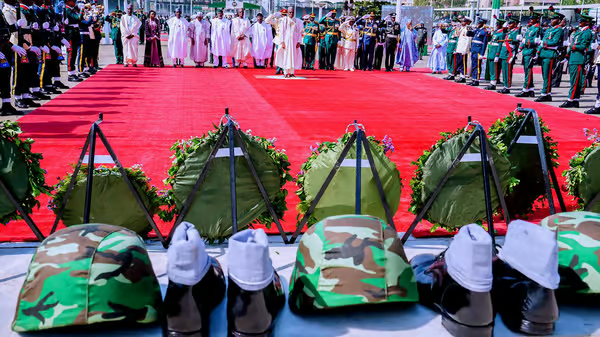
Every year on January 15, Nigerians across the country observe a national occasion set aside to honour servicemen and women of the country’s military. Officially known as Armed Forces Remembrance Day, recently renamed Armed Forces Celebration and Remembrance Day by the Defence Headquarters, the date carries deep historical significance in Nigeria’s modern past. But it also raises a question: Why does the Federal Government frame this day as a tribute to the Armed Forces rather than a formal Civil War Remembrance Day?

A Day Rooted in History

To understand the significance of January 15, we have to go back to 1970. After nearly three brutal years of conflict, the Nigerian Civil War, also known as the Biafran War, officially came to a close when Biafran forces surrendered to the Nigerian military on January 15, 1970. The instrument of surrender was handed over by Colonel Philip Effiong of the Biafran army to General Olusegun Obasanjo of the Federal Government, effectively bringing the war to an end and signalling the reunification of Nigeria.

This date was chosen over the previously observed November 11, the Remembrance Day linked to World Wars I and II in many Commonwealth countries — because of its domestic importance in Nigerian history. It marks the conclusion of the nation’s most defining internal conflict and the beginning of a hard-won peace and unity.

January 15: The Evolution of Nigeria’s Remembrance Tradition

Historically, Nigeria observed Remembrance Day on November 11 to coincide with the traditional Poppy Day across the British Commonwealth, a day established after World War I to honour soldiers who died in the conflict. Following independence and later the Civil War, Nigeria shifted this observance to January 15 so the nation could reflect on its own struggles and sacrifices, particularly those of Nigerian servicemen during the Civil War.

This shift reflects two key choices:

  • Recognition of internal sacrifice: By adopting January 15, Nigeria gives prominence to a date that resonates more closely with its own struggle for unity and peace rather than events abroad.
  • Honouring the military’s role: The day is designed to honour the courage, professionalism and sacrifices of members of the Nigerian Armed Forces, both past and present, as symbols of national unity and defenders of the country’s sovereignty.

In 2026, the Federal Government officially updated the name to Armed Forces Celebration and Remembrance Day to underscore that the day is not just about mourning, but also celebrating the living heroes who continue to protect the nation.

Why Not a Civil War Remembrance Day?

While January 15 is the day the Civil War ended, the Nigerian government has deliberately chosen not to label the occasion strictly as a Civil War Remembrance Day for several reasons:

  1. National Unity Over Division
    The civil war was deeply painful and divisive for Nigeria. Framing the day as solely a civil war commemoration could risk re-opening old wounds in a country still sensitive about that chapter of its history. Emphasising the armed forces offers a unifying theme, honouring those who fought for the peace and unity that eventually followed.
  2. Inclusivity of All Conflicts
    The armed forces are celebrated not just for their role in the Civil War but also for contributions in World War I and II, peacekeeping missions, and in maintaining internal security. This broader lens makes the observance more inclusive of all servicemen and women.
  3. Fostering Patriotism and Support for Soldiers
    Focusing on the military allows the nation to celebrate both the sacrifices of soldiers who have fallen and the dedication of those still serving. By honouring veterans and current personnel alike, the day promotes national pride and gratitude towards the forces tasked with protecting the nation.
  4. Avoiding Singular Narratives
    A Civil War Remembrance Day could be interpreted as aligning with a specific narrative or perspective about the conflict. In contrast, a military remembrance aims to transcend factional interpretations and celebrate the unity that followed the war’s end.

What Happens on January 15?

Every year, Nigerians observe the day with solemn ceremonies and symbolic acts of respect:

  • Military parades and wreath-laying ceremonies at the National Cenotaph in Abuja, state capitals, and memorial sites like Remembrance Arcade in Lagos.
  • 21-gun salutes, moments of silence, and prayers for soldiers who lost their lives serving the nation.
  • Public speeches that reflect on national unity, sacrifice, and the need to support veterans and active military personnel.

January 15 stands as a testament to Nigeria’s painful journey through civil strife and its desire for lasting unity. By framing it as Armed Forces Celebration and Remembrance Day, the Federal Government anchors the commemoration in themes of national defence, unity, and shared sacrifice, rather than anchoring it solely in the painful memory of internal conflict.

In doing so, Nigeria not only honours its soldiers but also sends a powerful message: that peace and unity, once broken, must be remembered and protected by all.

Somalia Scraps UAE Agreements Over Sovereignty And Unity Dispute

0

Somalia’s President Hassan Sheikh Mohamud has announced the cancellation of all agreements with the United Arab Emirates, citing concerns that the Gulf nation failed to respect Somalia’s sovereignty and national unity.

In a televised address, Mohamud said the federal cabinet approved the termination of agreements spanning economic infrastructure, security and defence cooperation. He explained that although relations with the UAE were initially founded on goodwill, Somalia was not treated as a single, unified state.

“The UAE did not treat us as a single, unified government with sovereignty and independence,” Mohamud said. “We repeatedly requested that they engage with us as one unified Somali government, but this did not happen.”

The president further accused the UAE of sidestepping federal authorities and meddling in Somalia’s internal affairs.

“They even engaged in illegal activities within the country by circumventing the federal government,” he added, noting that some actions were carried out without the full knowledge or approval of authorities in Mogadishu.

The decision comes amid rising regional tensions, particularly after Israel’s recognition of Somaliland, a self-declared breakaway region that Somalia considers part of its sovereign territory. The UAE’s long-standing investments in Somaliland’s Berbera port have heightened concerns in Mogadishu about foreign involvement that could undermine national unity.

Despite the federal government’s stance, at least three Somali regions have publicly opposed cutting ties with the UAE, highlighting persistent internal divisions over foreign relations and partnerships.

Somalia’s leadership maintains that the agreement cancellations are essential to safeguarding national sovereignty, as geopolitical rivalries in the Horn of Africa continue to attract increased regional and international influence.

Nigeria–UAE Trade Agreement Removes Tariffs On Thousands Of Products

0

Nigeria and the United Arab Emirates have concluded a Comprehensive Economic Partnership Agreement, signalling a significant advance in their bilateral economic relationship and ushering in a fresh phase of Nigeria’s integration into global trade.

The agreement was formalised in the presence of the Presidents of both countries and is structured to substantially open up trade in goods and services, remove tariffs on thousands of items, and broaden market access for Nigerian companies and professionals.

The signing took place in Abu Dhabi, with Nigeria represented by the Minister of Industry, Trade and Investment, Dr Jumoke Oduwole, and the UAE represented by the Minister of Foreign Trade, Thani bin Ahmed Al Zeyoudi.

The announcement was made yesterday by Nigeria’s Minister of Industry, Trade and Investment in a post shared on X, confirming that the Nigeria–UAE Comprehensive Economic Partnership Agreement was executed alongside UAE President Mohamed bin Zayed Al Nahyan.

“For Nigerians, this agreement is not abstract. It opens duty-free access for thousands of Nigerian products into the UAE, expands opportunities for our exporters, manufacturers, and service providers, and gives UAE investors clearer confidence to back Nigeria’s productive economy,” Tinubu said.

The Ministry described the pact as a landmark move that redefines Nigeria’s trade framework and enhances its position in global commerce.

Under the terms of the agreement, Nigeria will liberalise 6,243 products in total.

Tariffs on 3,949 of these products, representing 63.3 percent, will be removed immediately, while duties on the remaining 2,294 products, accounting for 36.7 percent, will be gradually eliminated over a five year period.

For the UAE, tariffs will be lifted at once on 2,805 of the 7,315 products covered by the agreement, amounting to 38.3 percent of the total.

Reacting to the development, the Minister of Industry, Trade and Investment noted that the agreement delivers a strong message of confidence to international investors and trading partners.