Home Blog Page 137

FG Clears Super Eagles’ AFCON 2025 Match Bonuses

0

The Federal Government has confirmed that the Super Eagles’ match bonuses for the ongoing 2025 Africa Cup of Nations (AFCON) have passed all required regulatory procedures and are now being processed for payment.

In a statement released on Thursday, the Minister of State for Finance, Doris Uzoka-Anite, disclosed that the payments would begin reflecting in the players’ domiciliary accounts “from today or tomorrow.”

Her clarification followed reports that the Super Eagles had on Wednesday threatened to boycott their journey to the venue of their AFCON quarter-final clash due to unpaid allowances. Nigeria is scheduled to face Algeria on Saturday in Marrakesh, approximately five hours from their current base in Fez, with travel planned for Thursday.

Players and team officials reportedly insisted they would not make the trip unless the outstanding bonuses were settled. The team is yet to receive allowances for all four matches played so far at the tournament.

This is not the first time financial issues have disrupted the national team. In November 2024, the Super Eagles boycotted training sessions during the African World Cup qualifiers over unpaid allowances. Shortly after, Nigeria lost to DR Congo, effectively ending their qualification hopes for the 2026 FIFA World Cup.

Explaining the delay, Uzoka-Anite attributed it to the “conversion process required to move funds into foreign currency,” noting that foreign currency payments were the players’ preferred option. She added that the process had now been accelerated, with final transfers already underway.

“The Federal Government, working with the Central Bank of Nigeria, has streamlined the foreign exchange process to ensure our players are paid without further delay,” she said.
“Going forward, this system will be fully optimised to allow for quicker and more predictable payments in line with international best practices.”

Earlier, Chairman of the National Sports Commission (NSC), Shehu Dikko, also confirmed that all financial entitlements of the players and officials had been resolved. His comments came amid reports of possible boycotts of training and travel ahead of Saturday’s encounter with Algeria.

Speaking to the News Agency of Nigeria (NAN), Dikko revealed that President Bola Tinubu approved the Super Eagles’ AFCON 2025 budget in November 2025, ensuring alignment between the NSC, the Nigeria Football Federation (NFF), and the players.

“The President approved the entire AFCON budget on November 14, 2025. From our side, funding has been fully cleared,” Dikko stated.

He, however, clarified that while approval had been granted, the processing and release of funds were separate stages, reassuring players that the money was already being disbursed.

On the pitch, the Super Eagles have delivered an impressive campaign, winning all four of their matches so far. Nigeria currently stands as the tournament’s highest-scoring team with 12 goals, having topped Group C before recording a dominant 4–0 victory over Mozambique in the round of 16.

The winner of Saturday’s quarter-final between Nigeria and Algeria will advance to face either Morocco or Cameroon in the semi-finals.

Blockchain Association President Steps Down After Transformative Tenure

Stakeholders in Nigeria’s blockchain and digital asset ecosystem are preparing for a leadership transition as Obinna Iwuno, President of the Stakeholders in Blockchain Technology Association of Nigeria (SiBAN), prepares to step down from office this January.

Iwuno, who has led the association through a period of structural reform and increased regulatory engagement, will hand over leadership following the completion of his tenure.
The transition comes after an internal electoral process In December, where Iwuno supervised a transparent internal election that produced a new executive leadership team, scheduled to be sworn in this January.

Although he is stepping aside from the presidency, Iwuno is expected to remain an influential figure within Nigeria’s blockchain ecosystem due to his role in shaping SiBAN’s institutional framework and policy posture.

SiBAN was reported to be largely a community-based association with limited structure and national visibility when Iwuno assumed leadership but over the course of his tenure, the organization evolved into a more formalized institution with defined governance systems, a permanent administrative structure, and strengthened relationships with regulators and industry stakeholders.

SiBAN was established to represent blockchain and digital asset stakeholders in Nigeria, particularly at a time when regulatory uncertainty and market volatility challenged the industry’s credibility. Under Iwuno’s leadership, the association increasingly positioned itself as a bridge between private-sector operators and public institutions.

During his tenure, Iwuno oversaw the adoption of a formal Code of Ethics, alongside constitutional and electoral reforms that strengthened governance, accountability, and democratic processes within the association. These reforms laid the groundwork for institutional continuity beyond individual leadership.

He also led the establishment of a functional Secretariat staffed with full-time employees to manage SiBAN’s day-to-day operations, marking a shift from volunteer-led coordination to professional administration. As part of this structural transformation, Iwuno facilitated the opening of SiBAN’s first physical office in Abuja, positioning the blockchain association closer to policymakers and regulators while reinforcing its national presence.

This outgoing administration led the professionalization of SiBAN by formalizing standard operating procedures and expanding the association’s membership base to include both global and local digital asset stakeholders. Under Iwuno’s leadership, SiBAN formed strategic partnerships with industry players such as Roqqu, aimed at advancing blockchain adoption, education, and regulatory engagement across Nigeria.

The association also strengthened collaboration with public institutions including the Securities and Exchange Commission (SEC), the Nigeria Financial Intelligence Unit (NFIU), and the National Information Technology Development Agency (NiTDA), contributing to clearer dialogue around digital asset oversight and compliance.

Beyond internal reforms, Iwuno represented SiBAN at high-level policy and compliance forums, including the NCMI Compliance Summit 2025, the FATF/GIABA Joint Experts Meeting 2025, partnered with Moonshot 2025 and the Nigeria Stablecoin Summit amongst others. These engagements reinforced the association’s role in regulatory discussions and blockchain policy development within Nigeria and across Africa.

SiBAN outgoing president, Obinna Iwuno is a Nigerian technology and blockchain professional with experience spanning digital asset innovation, ecosystem development, and policy engagement. He is the founder of CBC Blockchain Services, a growth, compliance and technical solutions partner in blockchain, and has participated in multiple industry and regulatory dialogues on blockchain compliance and responsible adoption.

Despite calls from some members to seek another term, Iwuno chose not to contest but rather, supervised the successful internal election that produced a new executive leadership team

“A leader’s greatest success is not in the length of his stay, but in the strength of the foundation he leaves behind,” Iwuno said in a statement.

Analysts and industry partners have credited SiBAN under Iwuno with elevating Nigeria’s blockchain ecosystem, pointing to the association’s governance reforms, regulatory engagement, and institutional partnerships as benchmarks for professional leadership in the sector.

As SiBAN prepares for a formal handover, the organization enters its next phase with a clearer governance framework, a permanent operational base, and stronger institutional relationships than it had at the start of Iwuno’s tenure.

Tinubu Commends NGX N100trn Milestone, Urges Local Investment

0

President Bola Tinubu has commended corporate Nigeria, citizens, and other stakeholders in the Nigerian capital market for surpassing the N100 trillion milestone on the Nigerian Exchange (NGX).

He described this achievement as an inspiration for the investing public operating in the money and capital markets.

Bayo Onanuga, Special Adviser to the President on Information and Strategy, stated that President Tinubu is calling on Nigerians to increase their investments in the local economy, emphasizing that 2026 is expected to deliver even greater returns as his administration’s economic reforms continue to generate stronger results.

“With the Nigerian Exchange (NGX) crossing the historic N100 trillion market capitalisation mark, the country is witnessing the birth of a new economic reality and rejuvenation. In 2025, while many of the world’s markets struggled with stagnation or tepid recovery, the NGX All-Share Index was on the ascent. It closed 2025 with a 51.19% return, higher than the 37.65% recorded in 2024. This performance ranks among the highest in the world. Year-to-date returns have significantly outpaced the S&P 500, the FTSE 100, and even many of our emerging-market peers in the BRICS+ group.

“Nigeria is no longer a frontier market to be ignored—it is now a compelling destination where value is being discovered. As the stock market reflects the entire economy, its stellar performance is a significant indicator of the country’s economic health and the confidence investors have in our economy.

“On the NGX, we have witnessed remarkable performances from listed companies across all sectors. From blue-chip industrial giants that have localised their supply chains, to a banking sector that has demonstrated resilience and technological innovation, Nigerian companies are proving that the country can deliver strong returns on investment.

“And we are just getting started. The pipeline for new and upcoming listings looks robust. More indigenous energy firms, tech unicorns, telecoms, and infrastructure-heavy entities are seeking to access the public market to fund their expansion. As these firms are listed, they will boost market capitalisation and deepen democratic ownership of the Nigerian economy.

“We are not celebrating the superlative stock market performance in isolation. We are also celebrating the microeconomic effects of our reforms. After the initial headwinds that followed our reforms, we are finally seeing a bend in the inflation curve. Crucial monetary tightening and the removal of distortionary ‘Ways and Means’ financing have restored stability to the Naira. Furthermore, investments in the agriculture sector have contributed to a consistent decline in inflation over the past eight months. From a 24-month high of 34.8% in December 2024, inflation decelerated to 14.45% as of November 2025, with projections indicating it will reach 12% in 2026. Indeed, inflation is likely to fall below 10 per cent before the end of this year, leading to improved living standards and accelerated GDP growth. The year 2026 promises to be an epochal year for delivering prosperity to all Nigerians.

“Also noteworthy is the status of our nation’s current account, a valid measure of our overall economic health. In 2024, Nigeria posted a surplus of $16 billion. According to the Central Bank of Nigeria (CBN), our current account balance is projected to rise to $18.81 billion in 2026, up from $16.94 billion in 2025.

“Under our administration, Nigeria is exporting more and importing less of what we can produce locally. Non-oil exports surged by 48% by the third quarter of 2025, totalling N9.2 trillion. Exports to Africa alone rose by 97% to N4.9 trillion. Manufacturing exports increased by 67% year-on-year in the second quarter of 2025, suggesting a strong close to the year.

“Nigeria’s foreign reserves have crossed the $45 billion mark, giving the Central Bank the firepower to maintain stability. The Naira has stabilised, moving away from the volatility that once fuelled speculation. The Central Bank of Nigeria, in its latest outlook, projects foreign reserves will cross the $50 billion threshold in the first quarter of 2026.

“We are also seeing an expansion of the rail networks, the completion of major arterial roads and the revitalisation of our ports. With the transformative Lagos-Calabar and Sokoto-Badagry superhighways, the nation’s infrastructure is growing.

“Our medicare facilities are improving, and medical tourism costs are declining. Our students benefit from the Nigeria Education Loan Fund (NELFUND), and universities are receiving increased research grants.

“Nation-building is a process, not a destination. Hard work, sacrifices, and the focus of its citizens build a nation. The N100 trillion market capitalisation is a signal to the world that the Nigerian economy is robust and productive.

“As your leader, I pledge to continue working unrelentingly to build an egalitarian, transparent, and high-growth economy that will be further catalysed by the historic tax and fiscal reforms that came into full implementation from January 1,” President Tinubu said.

NANS Sounds Alarm Over Welfare Of Nigerian Scholarship Students In Morocco

0

The National Association of Nigerian Students (NANS) has raised serious concerns about the alleged neglect of Nigerian students studying in Morocco under government-sponsored scholarship schemes.

The student body said it was responding to a viral video showing Nigerian scholarship beneficiaries stranded in Morocco, where they accused the administration of President Bola Tinubu of leaving them to face hardship, homelessness, and lack of medical care.

In a statement obtained by The Guardian on Wednesday, and signed by the Vice President (External Affairs) of NANS, Kenechukwu Aneke, the association demanded the immediate repatriation and welfare intervention for all affected Nigerian students in Morocco and in other countries experiencing similar challenges.

NANS also called for a thorough probe into the alleged mismanagement of scholarship funds and accountability for officials found culpable. The association further demanded the prompt payment of all outstanding stipends, accommodation fees, and allowances, alongside a comprehensive overhaul of the overseas scholarship programme to prevent a recurrence.

The statement read: “These students, sent abroad under scholarship programmes with allocated budgets, have been left to fend for themselves without adequate support, resulting in dehumanising conditions where they are forced to beg for money nightly to feed themselves. Tragically, one of the students, Bashir Malami, has reportedly died under these circumstances — a loss that underscores the grave consequences of neglect and administrative failure.

“NANS views this as a blatant betrayal of trust by the relevant authorities, including the office responsible for overseas scholarships under the Federal Ministry of Education. It is unacceptable that funds budgeted for these programmes are not being properly utilised, leaving young Nigerians, the future leaders of our nation exposed to hunger, destitution, and danger in a foreign land.

“The education and welfare of Nigerian students, whether at home or abroad, must not be treated with levity. The government has a sacred duty to protect its citizens, especially those it has sent abroad on national assignments. NANS stands in solidarity with these suffering students and their families. We will not relent until justice is served and their dignity is restored.”

While condemning the alleged neglect, Aneke urged President Bola Tinubu, the Minister of Education, Dr Tunji Alausa, the Federal Scholarship Board, and other relevant authorities to take immediate action.

He warned that sustained neglect of Nigerian students overseas could harm Nigeria’s international image and erode trust in government-funded education initiatives.

The statement emphasised that scholarship schemes are intended to offer opportunity and security, not subject beneficiaries to hardship and uncertainty. It also appealed to Nigerian diplomatic missions in Morocco and other affected countries to urgently engage with the students, provide emergency assistance, and submit accurate situation reports to the Federal Government.

In response, the Federal Government dismissed the claims as false, baseless, and deliberately misleading.

A statement issued by the Director of Press and Public Relations at the Federal Ministry of Education, Folasade Boriowo, maintained that no Nigerian student on a legitimate Federal Government scholarship had been abandoned.

“All beneficiaries duly enrolled under the Bilateral Education Scholarship (BES) Programme prior to 2024 have received payments up to the 2024 budget year, in line with the Federal Government’s obligations,” Boriowo stated.

She explained that any delays in outstanding payments were due to fiscal challenges and were being resolved through ongoing discussions between the Ministry of Education and the Ministry of Finance.

The statement also quoted the Minister of Education as saying that no new bilateral scholarship awards were granted in October 2025 or at any time afterward, adding that documents circulating online to suggest otherwise were fake, unauthenticated, and intended to mislead the public and discredit government policy.

Dr Alausa said the decision to end government-funded bilateral scholarships abroad followed an extensive policy review, which concluded that Nigeria’s universities, polytechnics, and colleges of education now have adequate capacity to offer the affected programmes locally.

AFCON 2025 Quarter-Finals: Tactical Battles That Will Define The Tournament

0

With the Round of 16 completed, the 2025 Africa Cup of Nations has entered its most unforgiving phase. Only eight teams remain, and the margins between glory and heartbreak are now razor-thin. The quarter-final fixtures are not just games, they are clashes of identity, history, and tactical philosophy.

Here is a breakdown of what to expect from each matchup and why these fixtures could define AFCON 2025.

Senegal vs Mali

On paper, Senegal enter this tie as favourites. They possess tournament experience, physical dominance, and players accustomed to elite European football. Their transitions from midfield to attack have been among the most efficient in the competition.

However, Mali represent the kind of opponent that thrives in knockout football. Compact, disciplined, and mentally strong, they are comfortable conceding possession and striking at the right moment. Their ability to frustrate opponents and control tempo could neutralize Senegal’s attacking rhythm.

Key battleground:
Midfield control. If Mali disrupt Senegal’s build-up play early, this match could drift into extra time — a scenario that favours the underdogs.

Morocco vs Cameroon — Home Advantage Meets AFCON Royalty

This fixture carries continental weight. Morocco, buoyed by home support, have played with confidence and tactical structure throughout the tournament. Their wide play and disciplined defensive shape make them difficult to break down, especially in familiar conditions.

Cameroon, however, are AFCON specialists. Five-time champions, they know how to survive tournaments even when performances aren’t perfect. Their physicality, aerial dominance, and game management could test Morocco’s composure under pressure.

Key battleground:
The flanks. Morocco’s wide overloads against Cameroon’s physical fullbacks could decide the game.

Nigeria vs Algeria — Pace, Power and High Stakes

Arguably the most anticipated quarter-final. Nigeria have looked sharp going forward, combining speed, directness, and confidence in front of goal. Their ability to stretch defenses and attack quickly makes them lethal in open play.

Algeria, by contrast, thrive on control. They are patient, tactically intelligent, and comfortable slowing games down before striking decisively. Their composure in tight moments has been a defining feature of their AFCON campaigns.

Key battleground:
Transition moments. Nigeria will look to exploit space; Algeria will aim to eliminate it

Egypt vs Ivory Coast — Experience vs Momentum

This fixture reads like an AFCON final replay waiting to happen. Egypt bring historical dominance and tournament savvy. They are masters of managing knockout games, often doing just enough to progress without expending unnecessary energy.

Ivory Coast, the defending champions, carry belief and attacking confidence. Their squad depth and physical strength allow them to maintain intensity across 90 minutes, and beyond if required.

Key battleground:
Game management. Egypt excel here, but Ivory Coast’s aggression could disrupt their rhythm.

What Makes These Quarter-Finals Special

  • No clear underdogs: Every team left has either pedigree or momentum.
  • Fine margins: One defensive lapse or moment of brilliance could decide each tie.
  • Psychological warfare: Experience, crowd pressure, and fatigue will matter as much as tactics.

This stage of AFCON is where tournaments are truly won, not by flair alone, but by discipline, decision-making, and nerve.

The AFCON 2025 quarter-finals promise more than entertainment; they promise definition. For some nations, this is a step toward legacy. For others, it is a test of belief. When the dust settles, only four will remain — and every minute from here on carries the weight of history.

Nigeria Banks Shut 229 Branches: What It Means for the Banking Industry and Customers

0

Nigeria’s banking landscape continues to evolve as digital transactions reshape how financial services are delivered.

Data from the Central Bank of Nigeria (CBN) shows that banks recorded a net closure of 229 physical branches in 2024, shrinking the total number nationwide from 5,373 to 5,144 across commercial, merchant and non-interest banks operating in the 36 states and the Federal Capital Territory.

This occurred even as the number of licensed banks rose from 33 to 35, underlining a clear shift away from brick-and-mortar banking toward digital and agent-led models.

Electronic payments expanded rapidly during the period, with Point of Sale (POS) transactions driving growth. Transaction volumes climbed by 33 per cent to 13.08 billion in 2024, while values more than doubled to ₦223.27 trillion.

By contrast, ATM usage recorded only marginal growth, reinforcing the dominance of POS terminals in day-to-day payments.

The momentum carried into 2025, with POS transaction values surpassing ₦88 trillion within the first eight months, reflecting exponential growth linked to wider agent networks and deeper mobile wallet integration. Branch distribution remained uneven across states.

Lagos continued to host the largest number with 1,521 branches, despite a slight decline, while Ebonyi experienced the steepest contraction, falling to just 31 outlets. Delta and Rivers bucked the trend by adding branches, reflecting local economic activity.

However, the transition has not been without friction. Cash shortages toward the end of 2024 led POS agents to significantly increase service charges, prompting the CBN to impose ₦1.35 billion in fines on nine banks over ATM service failures.

By mid-2025, leading institutions such as First Bank still maintained extensive branch networks, but overall figures point to a sustained national contraction as digital adoption deepens.

Implications for the Banking Industry

For banks, the closure of branches reflects a strategic effort to cut operating costs and redirect resources toward digital infrastructure, innovation, and partnerships with fintech firms.

Competition has intensified as fintech players such as OPay and Moniepoint continue to gain market share, outperforming traditional banks in customer experience metrics like speed, ease of use, and service expectations, according to the 2025 KPMG West Africa Banking Industry Customer Experience Survey.

The survey highlights stagnation or slight declines in customer experience among traditional banks, particularly in the SME and corporate segments, where rigid structures and frequent transaction failures remain challenges.

At the same time, recapitalisation efforts are strengthening balance sheets, with several banks meeting new capital thresholds.

The CBN projects a capital adequacy ratio of 11.60 per cent and liquidity levels of 65.00 per cent in 2026.

Despite these improvements, risks persist. Non-performing loans have risen to about 7.00 per cent, while cybersecurity threats continue to grow alongside digital expansion.

Regulatory changes around POS operations and the rollout of open banking frameworks are also reshaping competitive dynamics, forcing banks to innovate or risk losing relevance in an increasingly cashless environment.

What it means for Customers

For customers, the digital shift has brought greater convenience and broader access to financial services.

Mobile banking usage rose to 69 per cent on a weekly basis in 2025, up from 58 per cent the previous year, while total electronic payment values reached ₦1.07 quadrillion in 2024 and continued to climb in 2025.

Agency banking and POS services have improved proximity to banking services, especially in underserved areas.

However, customer expectations have risen sharply. Failed transactions, delays, and high service charges remain key pain points, particularly during periods of cash scarcity when fees reportedly doubled.

Trust has become a critical factor, as fraud losses climbed to ₦52.26 billion in 2024, leaving many users concerned about digital security despite the use of biometrics and transaction alerts.

Small and medium-sized enterprises have been particularly affected, with modest declines in customer experience driven by credit bottlenecks and service disruptions.

Many SMEs are increasingly turning to fintech platforms for quicker loans and more flexible support.

Meanwhile, rural users and individuals with low digital literacy face the risk of exclusion if infrastructure and education do not keep pace
With innovations

What next going forward

Looking ahead to 2026, the CBN projects stronger macroeconomic conditions, with GDP growth expected to rise to 4.49 per cent and inflation easing to 12.94 per cent, supported by exchange rate stability, oil production of 1.71 million barrels per day, and ongoing fiscal reforms.

Within the banking sector, the focus is expected to remain on digital resilience, open banking ecosystems, and the use of artificial intelligence to deliver more personalised and proactive services.

Digital payment volumes are projected to continue growing, although risks linked to global geopolitics, oil price volatility, and cybercrime could disrupt progress.

Industry analysts recommend sustained investment in cybersecurity, simplified customer journeys, and targeted SME support to strengthen trust and inclusion.

With initiatives such as EFEMS and PAPSS improving cross-border payment efficiency, Nigeria’s banking sector is positioned to play a larger role in economic growth, provided it successfully navigates the challenges of a rapidly digitising financial system.

Court Orders Interim Forfeiture Of 57 Properties Linked To Malami

0

The Federal High Court in Abuja has directed that 57 properties valued at about ₦213.2 billion be temporarily forfeited to the Federal Government.

The order followed an application filed by the Economic and Financial Crimes Commission (EFCC).

Justice Emeka Nwite issued the directive after considering an ex parte motion moved by EFCC counsel, Ekele Iheanacho, SAN.
The properties, which are currently under investigation, are suspected to be proceeds of unlawful activities allegedly connected to a former Attorney-General of the Federation and Minister of Justice, Mr Abubakar Malami, SAN.

The properties are spread across Abuja, Kebbi, Kano and Kaduna states.
Although the ruling was delivered on Tuesday, the News Agency of Nigeria (NAN) sighted a certified true copy of the order on Wednesday.

In delivering his decision, Justice Nwite stated:
“It is hereby ordered that an interim order of this honourable court is hereby made forfeiting to the Federal Government of Nigeria the properties described in Schedule 1 below, which are reasonably suspected to be proceeds of unlawful activities.”

The judge also ordered that the interim forfeiture be published in a national daily newspaper.

He directed that any individual or organisation claiming an interest in the listed properties should, within 14 days of publication, show cause why a final forfeiture order should not be granted.

The case was adjourned to a later date for the court to receive a report on compliance with the publication directive.

The properties listed in the court order include a luxury duplex on Amazon Street, Plot No. 3011, Cadastral Zone A06, Maitama, Abuja, bought in December 2022 for ₦500 million and later valued at about ₦5.95 billion after upgrades.

Also listed is a two-winged storey building at No. 3 Onitsha Crescent, Area 11, Garki, Abuja, formerly Harmonia Hotels Limited, purchased in December 2018 for ₦7 billion.

Another property is Plot 683 in Jabi District, Abuja, consisting of a five-storey building now operating as Meethaq Hotels Ltd with 53 rooms, acquired in September 2020 at carcass stage for ₦850 million, with an additional ₦300 million paid to secure possession.

Property No. 3130 in Asokoro District, Abuja, comprising terrace buildings, was purchased in January 2021 for ₦360 million.

A property at No. 3 Rhine Street, Maitama, Abuja, currently operating as Meethaq Hotels Ltd with 15 rooms, was bought in February 2018 for ₦430 million and later valued at about ₦12.95 billion after renovation.

Also included is Plot No. 1241B in Asokoro District, Abuja, acquired in July 2021 for ₦325 million.

The list further includes Shop No. C82 at Citiscape–Shariff Plaza on Aminu Kano Crescent, Wuse II, Abuja, purchased in March 2024 for ₦120 million.

A residential property at No. 4 Ahmadu Bello Way, Nasarawa GRA, Kano, was acquired in December 2022 for ₦300 million.

Plot 157 on Lamido Crescent, Nasarawa GRA, Kano, was purchased in July 2019.
A plaza with commercial facilities near Birnin Kebbi Market was bought in 2021 for ₦100 million.

One hundred hectares of land along the Birnin Kebbi–Jega Road were acquired in 2020 for ₦100 million.
A four-bedroom bungalow at Gesse Phase, Birnin Kebbi, was purchased in 2023 for ₦101 million.

Other properties include Shops A36 and B3 at Vegas Mall, Wuse II, Abuja, bought in July 2023 for ₦158 million.

A property at No. 26 Babbi Drive, BUA Estate, Abuja, was purchased in 2022 for ₦136 million.
Another property at No. 27 EFAB Estates Avenue, Gwarimpa, Abuja, was acquired in January 2016 for ₦120 million.

A four-bedroom bungalow with boys’ quarters at No. 10B Doka Crescent, Abakpa GRA, Kaduna, was bought in January 2018 for ₦40 million.

Plot No. 13 at IPENT 7 Estate, Karsana District, Abuja, was purchased in June 2018 for ₦85 million.
A bedroom duplex with boys’ quarters at No. 12 Yalinga Street, Wuse II, Abuja, was acquired in October 2018 for ₦150 million.

Two warehouse shops at Wuse Market, Abuja, were purchased in July 2020 for ₦50 million.
Twin houses at Apo Legislative Quarters, Gudu District, Abuja, were acquired between February and May 2017 for ₦250 million.

Also listed are properties acquired by Khadimiyya for Justice & Development Initiative at Academic Garden City, Birnin Kebbi.

These include nine three-bedroom bungalows, three two-bedroom bungalows and 5.4 hectares of land, purchased between February and September 2023 for ₦187 million.
Additional assets were included in the schedule attached to the court order.

Mr Malami, his wife, Hajia Bashir Asabe, and his son, Abubakar Abdulaziz, are currently facing trial before Justice Nwite over an alleged ₦8.7 billion money laundering case filed by the EFCC.

The charge, marked FHC/ABJ/CR/700/2025, lists the former minister, his wife, his son and an employee of a company linked to him as defendants.

The EFCC alleged that the defendants engaged in suspicious financial transactions and attempted to disguise the source of funds through bank accounts and property acquisitions in Abuja, Kano and Kebbi between 2015 and 2025.

All the defendants have pleaded not guilty, and the case is still pending before the court.
The interim forfeiture order does not constitute a final decision on ownership or guilt, as all parties retain the right to present their defence.

Dangote Withdraws ICPC Petition Against Farouk Ahmed

0

The Independent Corrupt Practices and Other Related Offences Commission (ICPC) has announced that it will press ahead with its investigation into Engineer Farouk Ahmed, the former Authority Chief Executive and Chief Executive Officer of the Nigerian Midstream and Downstream Petroleum Regulatory Authority (NMDPRA), even after the petition against him was withdrawn.

The anti-corruption agency revealed that it received a letter dated January 5, 2026, titled ‘Notice of Withdrawal of Petition against Engineer Farouk Ahmed,’ from Dr. O.J. Onoja, SAN and Associates, who serve as legal representatives to Alhaji Aliko Dangote.

This position was communicated in a statement issued late on Wednesday night by the ICPC’s Spokesperson and Head of Media and Public Communications, Okor Odey.

According to the Commission, the letter informed it that the petitioner had fully withdrawn the petition dated December 16, 2025, and noted that another law enforcement agency had assumed responsibility for the matter.

Odey said, “The letter from O.J Onoja SAN, states that the petitioner has withdrawn the petition dated 16th December, 2025, submitted against Engineer Farouk Ahmed, the immediate past ACE/CEO of the NMDPRA in its entirety and that another law enforcement agency has taken over.

“The ICPC wishes to state categorically that in line with the provisions of sections 3(14) and 27(3) of its enabling Act, the investigations in the interest of the Nigerian people and the Nigerian state have already commenced and are presently ongoing.

“The ICPC will therefore continue to investigate this matter in line with its statutory mandate and in the interest of transparency, accountability and the fight against corruption for the benefit of Nigeria.”

The Commission reiterated its resolve to discharge its anti-corruption responsibilities, stressing that the case would be handled strictly in line with the law and in the overall interest of the Nigerian state.

Balogun Market Tragedy Deepens As Demolition Follows Deadly Fire

0

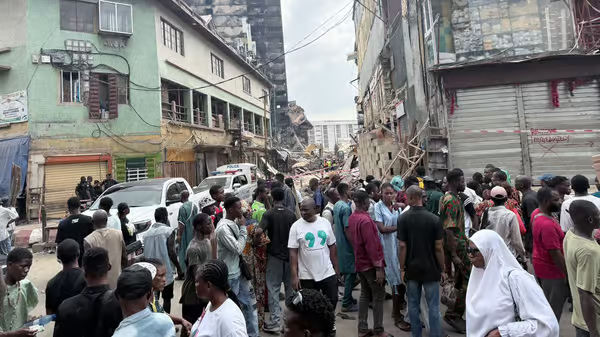
Fresh distress has engulfed hundreds of traders at Lagos’ historic Balogun Market following the sudden demolition of shops, allegedly carried out without prior notice. Bulldozers moved in while goods and personal belongings remained locked inside many of the structures, deepening the trauma of traders still recovering from the devastating Christmas Eve fire of December 24, 2025.

Viral videos circulating on social media show chaotic scenes at the market: heavy-duty machinery tearing through shops, clouds of tear gas hanging in the air, and distraught traders pleading with authorities for access to salvage their livelihoods. The development has shocked Nigerians nationwide, reigniting debates around urban renewal and government accountability.

In one emotional video, a female trader confronts officials amid tears, alleging that no notice was issued before the demolition. She claimed that many shop owners were away for the Christmas holidays when the operation began, leaving their goods trapped inside. According to her, tear gas was deployed, preventing traders from retrieving their belongings.

Another trader described the situation as a “double tragedy,” noting that many victims were only beginning to recover from the recent fire outbreak that destroyed properties worth billions of naira and claimed several lives. “Now, without any warning, our shops are being demolished with our goods inside,” the trader lamented.

The demolitions follow the tragic inferno at the 25-storey Great Nigeria Insurance (GNI) building, which reportedly killed at least eight people, trapped others beneath rubble, and caused massive economic losses. In response, Governor Babajide Sanwo-Olu ordered the demolition of the burnt structure and adjoining buildings deemed structurally unsafe, while sealing off the area to prevent further casualties.

However, traders insist that the ongoing demolition has extended beyond the officially declared unsafe zone, affecting additional shops and catching many off-guard during the post-holiday period. Balogun Market, one of Lagos’ oldest and busiest commercial centres, remains partially sealed, with traders warning that the prolonged closure has severely crippled their businesses.

Public outrage has since flooded social media, with calls for compensation, transparent engagement with traders, and a more humane approach to urban safety enforcement. Many Nigerians are questioning the timing and execution of the demolitions, especially so soon after the fire tragedy.

As the dust and tear gas settles, the Balogun Market crisis has once again brought national attention to critical issues of urban safety, trader welfare, and the need for compassionate urban renewal policies in Nigeria’s economic capital.

AA Rano Launches Nigeria’s First Fully Automated Unmanned Fuel Stations

0

AA Rano Nigeria, a major player in the country’s downstream petroleum sector, has announced the launch of Nigeria’s first fully automated and unmanned fuel stations, signalling a significant leap in the digital evolution of fuel retailing.

The development is the result of a strategic partnership between AA Rano and Petrosoft Limited, a Nigerian technology company known for its downstream oil and gas management solutions. Through this collaboration, Petrosoft will roll out its automated fuel station technology across AA Rano’s retail outlets nationwide.

In a statement released on Tuesday, the company revealed that the unmanned stations are expected to become operational in January 2026. The stations will provide 24-hour self-service fuelling, support contactless payment options, and feature real-time monitoring, removing the need for on-site fuel attendants.

AA Rano explained that the new stations are aimed at boosting transparency, cutting down operational inefficiencies, and ensuring customers receive the exact volume of fuel they pay for.

Commenting on the initiative, the General Manager, Retail at AA Rano Nigeria, Mohammed Sule, said the move underscores the company’s commitment to innovation and improved service delivery in a highly competitive market.

“Our commitment to excellence and innovation led us to Petrosoft. By introducing unmanned, automated stations, we are not just adopting technology; we are setting a new standard for reliability and speed in the Nigerian downstream sector. This project ensures our customers can fuel at any time with total confidence,” Sule said.

Petrosoft Limited will power the unmanned stations using its proprietary SmartPump technology, which combines retail automation, corporate fuel management, and inventory tracking.

The system supports self-service refuelling, automatic vehicle identification for corporate fleets, and real-time dispenser control. It also includes advanced tank gauging and cloud-based monitoring to track fuel levels, detect leaks, and prevent fuel theft.

Speaking on the partnership, the Chief Executive Officer of Petrosoft Limited, Dr Joshua Denila, said the project highlights the potential of homegrown technology to solve persistent challenges in Nigeria’s energy retail sector.

“We are proud to partner with AA Rano on this historic project. Our solutions are 100 per cent locally developed but meet global standards for IoT and automation. From retail outlets to large-scale corporate fuelling hubs, our goal is to eliminate inefficiencies and deliver a world-class experience for end users,” Denila said.

The launch positions AA Rano at the forefront of innovation in Nigeria’s downstream petroleum industry, setting a new benchmark for efficiency, transparency, and customer convenience.