Home Blog Page 136

AFCON 2025: Nigeria And Egypt March Into The Semi-Finals

0

Saturday’s action in the Africa Cup of Nations (AFCON) 2025 delivered everything a football fan could hope for, from dominant performances to edge-of-Your-seat finishes, and two teams booking their ticket to the semi-finals of Africa’s premier football championship.

Here’s how the drama unfolded on 10 January 2026.

Super Eagles Soar: Nigeria 2–0 Algeria

The Super Eagles of Nigeria stamped their authority on the quarter-final stage with a comprehensive 2–0 victory over Algeria in Marrakech. After a tense first half that saw chances come and go, Nigeria exploded right after the break.

Victor Osimhen opened the scoring with a powerful header early in the second half, converting a precise delivery that split the Algerian defence. Minutes later, Akor Adams put the game beyond doubt with a calm finish after a superb assist from Osimhen, a moment of clinical finishing that sealed Nigeria’s semifinal berth.

The Eagles dominated possession and territory, proving superior in every department, particularly in attacking transitions and pressing intensity. Algeria struggled to mount a meaningful response, managing few clear sights of goal, and ultimately bowed out without seriously irritating Nigeria’s resolute back line.

Highlight: Another strong display from Osimhen cemented his role as one of Africa’s most lethal attackers this tournament.

Pharaohs Edge A Thriller: Egypt 3–2 Ivory Coast

If the Nigeria game was clinical and controlled, the Egypt vs Ivory Coast showdown in Agadir was pure entertainment, a rollercoaster battle that pitted two African football giants against one another.

From the first whistle, Egypt seized the initiative. Within minutes, Omar Marmoush fired the Pharaohs ahead with a low, incisive strike, a goal that set the tone for a frantic affair. Ramy Rabia doubled the lead with a towering header to make it 2–0, and Egypt looked firmly in command.

However, Ivory Coast refused to roll over. A freak own goal by Egypt’s defender Ahmed Fatouh brought the score back to 2–1, infusing fresh hope into the defending champions’ campaign. Despite the setback, Egypt regained rhythm when Mohamed Salah netted a vital third, showcasing his trademark composure under pressure.

The Elephants rallied once more, with Guela Doué scoring to make it 3–2 and send fans roaring. Though time ran out before another equaliser could arrive, this match proved to be one of the most thrilling encounters of the tournament so far.

Key takeaway: Egypt’s ability to score early and keep belief alive under pressure was crucial, and Salah’s leadership again proved decisive.

Tactical Notes & What This Means

Nigeria’s Blueprint

Nigeria’s win highlighted their balance, attacking potency backed by disciplined structure. Osimhen’s aerial threat and the intelligent link-up play from midfield created meaningful overloads, while the defence wasn’t seriously tested. Their next challenge will be a tough semifinal tie against hosts Morocco, a side buoyed by home support and tactical depth.

Egypt’s Heart & Grit

Egypt’s quarter-final contest was a testament to tenacity. Against a defending champion side packed with talent, they showed belief even when conceding. Their creative movement in the final third gave them the slight edge in what was ultimately a five-goal spectacle.

Semi-Final Picture

With Nigeria and Egypt joining Morocco and Senegal in the final four, AFCON’s title race is shaping up for a thrilling conclusion, one that promises a blend of home advantage, attacking flair, and seasoned experience.

The AFCON semi-finals are set to take place later this week, and fans across the continent are already speculating on potential finals match-ups. With such high-quality teams left standing, every remaining match feels like a final in its own right.

Stay tuned for more updates as the road to the AFCON crown intensifies. Let the countdown to glory continue!

NCC, CBN Mandate Instant Refunds For Failed Airtime And Data Transactions

0

The Nigerian Communications Commission (NCC) and the Central Bank of Nigeria (CBN) have introduced a framework to tackle consumer complaints resulting from unsuccessful airtime and data transactions caused by network outages, system errors, or human mistakes.

This was announced on Thursday by Nnenna Ukoha, Head of Public Affairs at the NCC, who said the move reflects the consumer-focused goals of the commission and its partners.

According to the statement, the framework is the product of several months of collaboration between the NCC, the CBN, Mobile Network Operators (MNOs), Value Added Service (VAS) providers, Deposit Money Banks (DMBs), and other key stakeholders.

Ukoha explained that these discussions were prompted by a growing number of failed airtime and data purchases, where subscribers were debited without receiving the services and faced delays in having the issues resolved.

“The Framework represents a unified position by both the telecommunications and financial sectors on addressing such complaints. It identifies and tackles the root causes of failed airtime and data transactions, including instances where bank accounts are debited without successful delivery of services. It also prescribes an enforceable Service Level Agreement (SLA) for MNOs and DMBs, clearly outlining the roles and responsibilities of each stakeholder in the transaction and resolution process,” the statement said.

Under the framework, if a customer is debited but does not receive airtime or data—whether the issue occurs at the bank or with an NCC licensee—they are entitled to a refund within 30 seconds, except when a transaction is pending, in which case a refund may take up to 24 hours.

The framework also requires operators to send SMS notifications to consumers regarding the success or failure of each transaction. It addresses wrong recharges to ported lines, incorrect airtime or data purchases, and payments made to the wrong phone number.

Speaking on the initiative, the NCC’s Director of Consumer Affairs, Mrs. Freda Bruce-Bennett, revealed that the framework includes a Central Monitoring Dashboard jointly hosted by the NCC and CBN. She explained that the dashboard will allow regulators to track failures, identify the responsible parties, monitor refunds, and detect SLA breaches in real time.

“Failed top-ups rank among the top three consumer complaints, and in line with our commitment to addressing these priority issues, we were determined to resolve it within the shortest possible time,” she said.

“We are grateful to all stakeholders, particularly the Central Bank of Nigeria and its leadership, for their tireless commitment to resolving this issue and arriving at this framework, and for ensuring that consumers of telecommunications services receive full value for their purchases.

“So far, pending the approval of management of both regulators on the framework, MNOs and banks have collectively made refunds of over N10 billion to customers for failed transactions,” she added.

Bruce-Bennett noted that the framework’s implementation is expected to begin on March 1, 2026, following final approvals from both regulators and completion of technical integration by all MNOs, VAS providers, and DMBs.

Nigerian Army Alerts Public On Fake Social Media Accounts Posing As COAS

0

The Nigerian Army has cautioned the public against fraudulent social media accounts falsely presenting themselves as those of the Chief of Army Staff (COAS), Lt.-Gen. Waidi Shaibu.

The warning was issued in a statement released on Friday in Abuja by the Acting Director of Army Public Relations, Col. Appolonia Anele.

Anele stated that the Army has recorded a worrying increase in the number of fake online profiles created by criminal elements to impersonate the COAS.

She explained that the Chief of Army Staff does not operate any official social media account on any platform.

According to her, these fake accounts are used to defraud unsuspecting members of the public, solicit money, spread false information, and carry out other criminal activities under the guise of the COAS and the Nigerian Army.

She urged Nigerians to be cautious and vigilant, advising them not to interact with, respond to, or circulate content from such accounts.

Anele further warned that any appeal for funds or assistance allegedly made in the name of the COAS should be regarded as a scam.

She disclosed that efforts are ongoing to track down and arrest those responsible for the fake accounts, with plans to prosecute them in accordance with existing laws.

“The Nigerian Army reassured Nigerians of its continued commitment to protecting lives and property and defending the territorial integrity of the country in accordance with the Constitution of the Federal Republic of Nigeria,” she said. (NAN)

INEC Chair Pledges Credible, Technology-Driven 2027 Elections

0

The Chairman of the Independent National Electoral Commission, Prof. Joash Amupitan (SAN), has assured Nigerians that the 2027 General Election will be conducted in a free, fair, transparent and technology-driven manner, stressing that the Commission will not condone any form of misconduct in the electoral process.

Speaking in Lagos at the Commission’s 2026 Induction and Strategic Retreat, held from January 9 to 10, Amupitan said INEC was positioning itself to meet the demands of a fast-changing electoral environment and the rising expectations of Nigerians.

“We gather here today not merely as electoral administrators and leaders, but as the custodians of the will of the Nigerian people.
“This retreat serves as a bridge between our institutional experience and the innovative demands of a rapidly evolving electoral landscape,” he said.

He commended INEC staff for their conduct during the November 2025 Anambra State governorship election, describing it as a significant milestone at the start of his tenure.

Amupitan explained that preparations for the 2027 General Election would include key electoral activities such as the February 2026 FCT Area Council elections and the off-cycle governorship elections in Ekiti and Osun states.

“These elections are not just routine exercises; they are the testing grounds for our resolve and our readiness. They offer us the chance to refine our processes… ensuring that every technical and logistical gear is perfectly oiled before the grand national exercise of 2027,” he said.

The INEC chairman identified five core principles that would remain central to the Commission’s operations: free, fair, credible, transparent and inclusive elections.

“We are here to organise elections that are free from any form of interference; fair to all contestants and political parties; credible in the eyes of the global community; transparent in every process… and inclusive of every Nigerian, regardless of physical ability or location,” he said.

He drew attention to the growing influence of first-time voters in 2027, noting that young Nigerians would insist on openness and instant transparency.

“Millions of young citizens will be approaching the ballot box for the very first time. These are digital natives who demand transparency in real time and have little patience for opacity. It is our duty to prove to these tech-savvy, and often sceptical, young voters that INEC can be trusted,” he said.

On the legal framework guiding elections, Amupitan emphasised unwavering compliance with the law, declaring, “Let it be known that under my leadership, the rule of law is not a suggestion; it is our operating system.”

He disclosed that discussions at the retreat would cover 17 critical thematic areas, including logistics, ad-hoc personnel, transportation, voter registration, election security and political party administration.

“We must ensure that the Continuous Voter Registration and revalidation exercises are beyond reproach. We will discuss election security… and how to enforce internal democracy and transparency in party finances,” he stressed.

According to Amupitan, INEC now has a rare opportunity to redefine Nigeria’s electoral history by setting bold objectives for 2027.

“The 2027 General Election must be free and fair and be a watershed moment in Nigeria’s election history. Let it be said that under our watch, INEC became the best Election Management Body in Africa — a beacon of integrity, a model of technological efficiency, and a fortress of democratic values,” he declared.

He cautioned that violations of the Commission’s principles would not go unpunished.

“I reaffirm my commitment to your welfare, but I must also reiterate that any compromise on our values or processes will have consequences. There is no room for misconduct, whether by omission or commission.
“Let us use this retreat to break down silos, foster open communication, volunteer constructive feedback and emerge as a united front,” the INEC chairman said.

In his remarks, the Lagos State Resident Electoral Commissioner, Prof. Ayobami Salami, welcomed participants and described the retreat as an important step in the Commission’s ongoing development.

He said the programme was aimed at building leadership capacity and improving operational readiness, noting that public expectations of the electoral process were “higher than ever” and urging officials to meet those expectations.

Salami added that the retreat would enhance institutional knowledge and encourage peer interaction, providing an opportunity for collaboration and the exchange of ideas to strengthen INEC as a unified institution.

“As we advance towards the 2027 General Election, the importance of early planning, strategic coordination and institutional cohesion cannot be overstated,” Salami said.

Banks Yet To Meet CBN Recapitalization Requirements

0

With less than three months remaining until the Central Bank of Nigeria’s (CBN) March 31, 2026, recapitalization deadline, the Nigerian banking sector is in a state of heightened activity.

As of early January 2026, approximately 22 banks have successfully met the new minimum capital requirements, while around 14 others are still working to comply, raising the possibility of mergers, acquisitions, or license downgrades for those lagging behind.

Financial experts predict an acceleration in capital-raising efforts in the coming weeks, with some banks expected to announce compliance by the end of January.

What Led To The Recapitalization Exercise?

The CBN initiated the recapitalization program in March 2024 to bolster the resilience of Nigeria’s banking sector amid economic challenges, including inflation, currency volatility, and the need to support President Bola Ahmed Tinubu’s vision of a $1 trillion economy by 2031.

The directive requires banks to increase their minimum paid-up capital within a 24-month window, from April 1, 2024, to March 31, 2026.

This marks the first major recapitalization since 2005, aimed at enhancing banks’ capacity to absorb shocks, expand lending to the real sector, and align with global standards.

Capital thresholds vary by license type
Banks with international authorization ₦500 billion, National banks ₦200 billion, Regional banks ₦50 billion, Merchant banks ₦50 billion, Non-interest banks (national) ₦20 billion, Non-interest banks (regional) ₦10 billion

Banks can meet these requirements through rights issues, private placements, public offerings, mergers/acquisitions, or by downgrading their licenses.

The CBN has emphasized that the exercise will strengthen financial stability, deepen inclusion, and position banks for growth in key sectors like healthcare, transportation, and technology.

As of November 2025, only 16 banks had complied, but the number has risen steadily, reflecting strong investor confidence despite economic headwinds.

The process has not been without challenges. Some banks have faced delays in regulatory approvals, while others have pursued strategic divestments or capital injections from parent companies.

Industry analysts warn that non-compliance could lead to forced consolidations, echoing the 2005 exercise that reduced the number of banks from 89 to 25.

Banks That Have Met The Recapitalization Requirements

As of January 2026, market intelligence indicates that around 22 institutions have achieved compliance, including all major Tier-1 listed banks.

This includes recent additions like United Bank for Africa (UBA), which crossed the ₦500 billion threshold following a ₦178 billion rights issue, and First Bank of Nigeria, which met its requirement through a combination of rights issues, private placements, and divestments. Standard Chartered Bank Nigeria fulfilled its ₦200 billion national bank requirement in November 2025 via internal capital strengthening and balance sheet management.

A comprehensive list of banks that have met the required capital benchmarks, organized by license type according to verified reports:

International Banks (₦500 billion)
Access Bank, Zenith Bank, UBA, GTBank (GTCO), First Bank of Nigeria, Fidelity Bank

National/Regional Banks (₦200 billion / ₦50 billion)
Citibank Nigeria, Ecobank Nigeria, Globus Bank, Stanbic IBTC Bank, Sterling Bank, Wema Bank, PremiumTrust Bank, Providus Bank, Standard Chartered Bank Nigeria

Merchant Banks (₦50 billion)
FSDH Merchant Bank, Greenwich Merchant Bank, Nova Bank

Non-Interest Banks (₦10–20 billion)
Jaiz Bank, Lotus Bank, TAJBank, Alternative Bank

These banks have demonstrated robust strategies, with many exceeding requirements well ahead of schedule.

For instance, First Bank’s achievement was hailed by Chairman Femi Otedola as positioning the institution for accelerated growth and innovation.

Similarly, Ecobank and Stanbic IBTC leveraged parent group support to comply early. The CBN has commended the progress, noting it enhances the sector’s ability to support economic transformation.

List Of Banks That Have Not Met The Recapitalization Requirements

Despite the advancements, about 14 banks remain non-compliant as of early January 2026, with efforts ongoing to close their capital gaps.

These institutions are intensifying fundraising, with some exploring mergers or acquisitions to avoid penalties, such as license revocation or forced takeovers.

The list includes a mix of commercial, merchant, and non-interest banks, many of which have announced plans but await verification.

The banks yet to meet the requirements include:

International/National Commercial Banks (₦500 billion or ₦200 billion)
First City Monument Bank (FCMB), Unity Bank, Keystone Bank, Union Bank (post-merger with Titan Trust Bank), Polaris Bank.

National/Regional Commercial Banks (₦200 billion/₦50 billion)
Parallex Bank, SunTrust Bank, Signature Bank, Optimus Bank.

Merchant Banks (₦50 billion)
FBNQuest Merchant Bank (also referred to as FBH or FBN Merchant Bank), Rand Merchant Bank, Coronation Merchant Bank.

Non-Interest Banks (₦20-10 billion)
Taj Bank, Alternative Bank, and certain smaller regional non-interest players.

FCMB and Union Bank are reportedly in advanced stages of capital raises, while Keystone and Polaris have kept strategies under wraps, sparking speculation about potential mergers.

Analysts expect announcements from several of these banks soon, as the deadline pressure mounts.

In conclusion, the recapitalization exercise is reshaping Nigeria’s banking landscape, with compliant banks poised for expansion and non-compliant ones facing critical decisions.

The CBN continues to monitor progress closely, assuring stakeholders of a stable transition.

As the March 31 deadline nears, the sector’s evolution could lead to a more consolidated and resilient financial system.

Datti Baba-Ahmed Denies Declaring Interest In 2027 Presidency

0

The Labour Party (LP) vice-presidential candidate, Datti Baba-Ahmed, stated that he never expressed interest in contesting for the presidency in 2027.

Datti made the remarks on Friday during an interview, explaining that he only emphasized that he remains a member of the LP.

“I never declared to contest the presidency even though there could be a possibility of that happening. I certainly did not declare for the presidency. I simply reiterated my membership of the Labour Party,” he said.

“That is all and in the submissions I made, I clearly stated that one will have to wait for the INEC timetable and for the party to make the call for people to indicate their interest.”

He criticized social media users who spread sensational stories, accusing them of creating false narratives to manipulate emotional listeners.

His statement follows news of Peter Obi, the Labour Party presidential candidate in the 2023 election, aligning with the coalition African Democratic Congress (ADC).

“Today is an important day; today is the last day of 2025, so we are ending this year with the hope that, in 2026, we will begin a journey of the rescue of our country for proper socio-economic development that will be unifying and inclusive,” Obi said at an event in Enugu, where he and some South-East leaders formally declared for the ADC.

Datti and Obi ran on a joint ticket in that election, but Datti has remained with the LP, asserting that the party is strong enough to vie for Nigeria’s highest office.

The Kaduna-born politician added that Obi’s decision to join the coalition does not affect his relationship with the former Anambra State governor.

“I also said if Peter Obi does not get the ticket there in ADC, he is more than welcome back to the Labour Party. I will stand there and nobody will do anything bad to Peter Obi. It is better for him to come back than for him to do another type of agenda,” Datti stated.

He further urged Obi to submit his resignation letter and membership card to the LP, emphasizing that he “never heard him say defecting to ADC. I did not hear that, maybe I missed it but please find out if he said joining the coalition or joining the ADC.”

Jersey To Repatriate Over $9.5m In Recovered Corruption Proceeds To Nigeria

0

The Bailiwick of Jersey has signed a Memorandum of Understanding (MoU) with the Federal Government of Nigeria to return more than $9.5 million traced to proceeds of corruption, with the recovered funds set to support a key national infrastructure project.

The MoU was signed in December 2025 by His Majesty’s Attorney General for Jersey, Mark Temple KC, formally clearing the way for the repatriation of the funds to Nigeria.

The development was confirmed in a statement issued by the British High Commission, through Stephen Odekunle, which noted that the agreement was officially validated in Abuja on Friday, January 9, 2026.

The funds were forfeited following a ruling by the Royal Court of Jersey on January 12, 2024, which determined that the money held in a Jersey bank account was linked to corruption.

According to the court, the funds were “more likely than not” derived from a corrupt scheme involving third-party contractors who diverted public funds for the benefit of senior Nigerian officials and their associates.

The forfeiture proceedings were initiated under the Forfeiture of Assets (Civil Proceedings) (Jersey) Law 2018.

Commenting on the recovery, Temple said the case highlights the strength of Jersey’s anti-corruption laws and its cooperation with Nigerian authorities.

“This successful return demonstrates the strength of our civil forfeiture legislation as a powerful tool in the fight against corruption.

“I thank the Nigerian authorities for their cooperation and the Economic Crime and Confiscation Unit in my department for their unwavering commitment to recover the proceeds of crime,” he said.

The latest MoU builds on two earlier agreements between Jersey and Nigeria, under which more than $300 million has already been returned to fund major infrastructure projects, including the Lagos–Ibadan Expressway, the Second Niger Bridge, and the Abuja–Kano Road. The first two projects have since been completed.

Under the new agreement, the recovered $9.5 million will be applied to the final stages of the Abuja–Kano Road, a 375-kilometre highway regarded as a critical transport corridor linking Nigeria’s capital with its second-largest city.

Nigeria’s Attorney General of the Federation and Minister of Justice, Lateef Fagbemi (SAN), welcomed the development, describing it as a strong signal of the country’s resolve to pursue illicit assets abroad.

“The successful recovery and repatriation of the forfeited assets underscores the effectiveness of Nigeria’s collaborative efforts with its international partners in ensuring that there is no safe haven for illicitly acquired wealth or assets moved to foreign jurisdictions,” Fagbemi said.

He also expressed gratitude to Jersey authorities.

“On behalf of the Government of the Federal Republic of Nigeria, I thank the Bailiwick of Jersey for the cooperation accorded Nigeria during the recovery exercise.

“I further assure the Bailiwick of Jersey that the repatriated assets will further be judiciously utilised in line with the terms of the executed Memorandum of Understanding.”

Russia Launches Airstrikes On Kyiv As Ukraine Declares Missile Alert

0

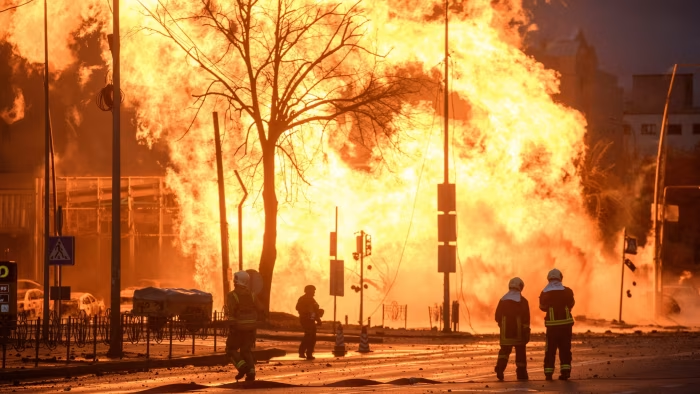
Russian forces carried out renewed airstrikes on Kyiv and its surrounding areas early Friday, killing at least three people and injuring several others, according to city officials, as Ukraine issued a countrywide missile warning.

Kyiv Mayor Vitali Klitschko confirmed the casualties in a statement shared on Telegram.

“Three people died in the capital. Six people were wounded. Three of them were hospitalised,” Klitschko said.

Residents were urged to remain indoors as air raid sirens sounded across multiple regions. Kyiv regional governor Mykola Kalashnyk called on civilians to stay in shelters until the alerts were lifted.

Ukraine’s air force escalated the warning, stating that the threat extended nationwide after detecting Russian bomber aircraft in the air.

“All of Ukraine is under a missile threat,” the air force warned.

In the western city of Lviv, officials reported damage to key facilities. Mayor Andriy Sadovy said the strikes hit vital infrastructure.

“Critical infrastructure” was hit, he said, adding: “All relevant services are working on the site, the fire is being extinguished.”

The latest attacks followed a warning issued Thursday by the US Embassy in Kyiv, which cautioned that a “potentially significant air attack” could take place at any moment over the coming days. Ukrainian President Volodymyr Zelenskyechoed the alert in his evening address to the nation.

The strikes also come amid heightened diplomatic tensions. Just hours before the barrage, Moscow criticised a proposed post-war plan involving European peacekeepers in Ukraine, accusing Kyiv and its allies of forming an “axis of war.”

Meanwhile, European leaders and US officials have been engaged in intense diplomatic efforts to bring an end to the conflict, now nearing its fourth year. The latest proposal reportedly includes post-war security guarantees for Ukraine, featuring a US-led monitoring mechanism and a European multinational force to be deployed after hostilities cease.

Zelensky said on Thursday that the agreement was nearing completion following talks in Paris.

He noted that the deal was “essentially ready for finalisation at the highest level with the President of the United States.”

However, key details including the size, mandate, and rules of engagement of the proposed force have yet to be made public.

Lagos Assembly Approves ₦4.4 Trillion 2026 Budget Into Law

0

The Lagos State House of Assembly has approved a ₦4.4 trillion budget for the 2026 fiscal year following the adoption of the report from the House Committee on Economic Planning and Budget.

Chairman of the committee, Sa’ad Olumoh, presented the report during Thursday’s plenary, detailing the assumptions, projections, and framework of the 2026 Appropriation Bill, dubbed the “Budget of Shared Prosperity.”

According to the report, this budget marks the third budget cycle of the current administration and is the final new-cycle budget for Governor Babajide Sanwo-Olu’s second term.

It aligns with the administration’s development agenda, which is built on four strategic pillars: human-centric development, modern and adaptive infrastructure, a thriving 21st-century megacity economy, and effective governance that surpasses citizens’ expectations.

Olumoh noted that the budget framework was guided by key macroeconomic indicators, including an exchange rate benchmark of ₦1,512 to the dollar, a projected inflation rate of 14.7 per cent, oil production of 2.06 million barrels per day, and a benchmark oil price of $64 per barrel.

The committee also reviewed the 2025 budget performance, reporting a cumulative achievement of 79 per cent as of November 2025. Capital expenditure performance was 75 per cent, recurrent expenditure stood at 87 per cent, and overall revenue performance reached 79 per cent.

For the 2026 fiscal year, the approved budget totals about ₦4.4 trillion, comprising a proposed recurrent expenditure of ₦2.052 trillion and capital expenditure of ₦2.185 trillion. The significant allocation to capital expenditure highlights the state government’s commitment to infrastructure development.

The budget includes provisions for personnel costs, overheads, debt servicing, and debt repayment, with a projected deficit of approximately ₦243 billion, to be financed through approved deficit financing measures.

During deliberations, lawmakers praised the budget, describing it as realistic and growth-oriented.

Aro Moshood revealed that an additional ₦171 billion was incorporated into the budget during the review process.

Femi Saheed stated that the size and structure of the budget demonstrate that Lagos State remains on a strong economic footing, provided all stakeholders fulfill their responsibilities.

Similarly, Gbolahan Yishawu, representing Eti-Osa Constituency II, stressed the importance of revenue reforms and prudent loan repayment strategies, noting that effective implementation would further enhance the state’s fiscal position.

The Assembly also received assurances from relevant officials that revenue-generating agencies would collaborate to meet—and possibly exceed—the projected revenues.

Following deliberations, the House adopted the committee’s report, conducted the third reading, and passed the 2026 Appropriation Bill into law.

Governor Babajide Sanwo-Olu had earlier submitted a ₦4.237 trillion spending proposal to the House on November 25, 2025, noting that the budget was designed to accelerate economic growth, deepen infrastructure development, and maintain fiscal responsibility.

He also disclosed that the budget anticipates total revenue of about ₦3.99 trillion, with ₦3.12 trillion expected from internally generated revenue and ₦874 billion from federal transfers, while the deficit financing plan is projected at approximately ₦243.3 billion.

Wike, Fubara, And Rivers Assembly Political Crisis

0

The political landscape in Rivers State, Nigeria’s oil-rich southern hub, has been engulfed in a prolonged political crisis since 2023, pitting former Governor Nyesom Wike against his successor, Siminalayi Fubara.

What began as a mentorship gone sour has escalated into repeated impeachment attempts, a state of emergency, and interventions by President Bola Tinubu.

The dispute has deeply entangled the Rivers State House of Assembly, most of whose members are aligned with Wike, and has implications for national politics, especially within the All Progressives Congress (APC) and the Peoples Democratic Party (PDP).

As of January 9, 2026, the standoff remains unresolved, with new impeachment proceedings once again bringing tensions.

What Is The Crisis

At its core, the Rivers State political crisis is a power struggle over control of the state’s governance, resources, and political machinery.

It involves allegations of betrayal, constitutional violations, and financial misconduct.

The Rivers State House of Assembly, largely controlled by lawmakers loyal to Wike, who is now the Minister of the Federal Capital Territory (FCT), has repeatedly moved to impeach Governor Fubara and his deputy, Ngozi Odu.

This has led to divisions within the assembly, legal battles, and disruptions to state administration.

Beyond the state, the crisis has fueled defections to the APC, sparked accusations of anti-party conduct, and intensified demands for federal intervention. It has also highlighted tensions between state autonomy and national political alliances, with President Tinubu’s peace accords failing to hold.

The latest escalation occurred on January 8, 2026, when the assembly initiated a third impeachment process against Fubara, citing gross misconduct such as unauthorized spending and demolition of the assembly complex.

The Root Cause

The roots trace back to the 2023 governorship election, where Wike, then Rivers Governor and a PDP leading figure, selected Fubara as his successor to maintain influence.

However, relations soured shortly after Fubara’s inauguration, with Wike accusing him of betraying a “peace agreement” that allegedly included not seeking a second term and allowing Wike’s allies to control key appointments.

Fubara has since moved to assert his autonomy, triggering disputes over budget approvals, the appointment of commissioners, and the control of local government funds.

The rivalry revolves around control of the PDP in Rivers State, fracturing the party and culminating in Fubara’s defection to the APC in December 2025. While the move strengthened the APC’s foothold in the state, it also deepened Wike’s resistance.

Wike has openly pledged to “correct the mistake of 2023” by preventing Fubara from securing a second term in 2027, arguing that such a victory would undermine his political legacy.

The crisis has been further inflamed by accusations of spending outside approved budgets, alleged refusal to release funds to the House of Assembly, and failure to comply with Supreme Court judgments affirming legislative autonomy.

Public exchanges have sharpened the rift, with Wike describing Fubara as a “mistake,” while the governor’s supporters counter with chants such as “Wike, you no be God,” framing the conflict as one driven by personal pride.

Political observers have characterised the standoff as a proxy battle, in which Wike is said to be using his federal cabinet role and loyal lawmakers to weaken Fubara, against the backdrop of wider national political manoeuvring.

The Events Shaping The Crisis

The Rivers State crisis has progressed through distinct stages, shaped by impeachment attempts, presidential interventions, and repeated breakdowns in reconciliation efforts.

Shortly after Fubara’s May 2023 inauguration, tensions emerged. In December 2023, Wike-loyal lawmakers attempted the first impeachment, citing gross misconduct. President Tinubu brokered a peace deal, but it quickly unraveled.

In March 2025, a second impeachment push prompted Tinubu to declare a six-month state of emergency in the state, leading to the suspension of Fubara, his deputy Ngozi Odu, and the entire House of Assembly. Retired Vice Admiral Ibok-Ete Ibas was appointed as administrator.

A fresh peace deal, again facilitated by Tinubu in June 2025, resulted in Fubara’s reinstatement in September, but disagreements over a supplementary budget and key appointments lingered.

Fubara’s defection to the APC in December 2025 triggered further political realignments, including defections by prominent figures such as former PDP national chairman Uche Secondus and ex-Governor Peter Odili. While this eroded Wike’s influence, it also intensified resistance from his allies.

The latest chapter unfolded on January 8, 2026, when the House of Assembly, led by Speaker Martins Amaewhule, cut short its recess and issued Fubara an impeachment notice endorsed by 26 lawmakers.

The allegations span eight counts of misconduct, including alleged financial recklessness and actions said to obstruct legislative activities.

The notice, controversially addressed to Fubara as “madam,” is required under Section 188 of the 1999 Constitution to be served within seven days.

The assembly also prevented the governor from presenting the 2026 budget pending the outcome of its probe. Around the same time, Fubara travelled abroad, reportedly to brief President Tinubu.

Under the constitution, the impeachment process involves the issuance of a notice, the setting up of an investigative panel, and a final two-thirds majority vote in the assembly for removal.

Different Perspectives From The Conflict

The crisis has produced sharply contrasting narratives, with key actors taking positions shaped largely by loyalty and political alignment

Wike

As FCT Minister and Fubara’s former mentor, Wike portrays the governor as ungrateful and untrustworthy.

He claims Fubara violated on agreements from Tinubu’s mediations, including not pursuing a second term and reinstating key allies like Sergeant Awuse as traditional rulers’ council chairman.

Wike has dismissed critics, calling himself “too strong” and accusing others of meddling in Rivers politics.

On his X handle (@GovWike), posts emphasize his governance legacy and subtly criticize disloyalty, though no direct recent statements on the impeachment . Supporters argue the crisis stems from Fubara’s “stolen mandate” and failure to honor pacts.

Fubara

Governor Fubara, via his X handle (@SimFubaraKSC), focuses on development and peace, urging Rivers residents to prioritize governance over conflict.

He denies reneging on agreements and accuses Wike of undue interference.

In a New Year’s message, Fubara pledged support for Tinubu without threats, emphasizing peaceful progress. His defection to APC was strategic to counter Wike’s leverage, with insiders noting it aimed to strengthen ties with Tinubu.

Fubara has remained silent on the latest impeachment but is reportedly seeking presidential intervention.

The Rivers Assembly

Led by Speaker Amaewhule (@rvhaofficial on X, though inactive in recent searches), the assembly insists the impeachment is constitutional, not Wike-influenced.

Amaewhule called Fubara a “mistake” and “threat to democracy,” citing budget refusals and assembly undermining. Lawmakers like Major Jack listed specifics: unconstitutional spending, illegal appointments, and fund seizures. They reject political solutions, vowing to proceed.

APC Governors And Leaders’ Perspectives

The APC Progressive Mandate Group condemned the impeachment as unconstitutional and a slap to Tinubu’s peace efforts, urging suspension.

Rivers APC, led by Chief Emeka Beke, rejected it as destabilizing, noting Fubara’s defection strengthened the party. However, some governors like Hope Uzodinma have backed Fubara, drawing Wike’s ire. National Chairman Nentawe Yilwatda expressed support for Fubara’s re-election, signaling Aso Rock backing.

Political Leaders’ Reactions

Reactions to the renewed impeachment proceedings against Governor Fubara have been sharply divided

The APC Leaders Forum and the Tinubu/Shettima Solidarity Movement called for Wike’s removal over alleged insubordination and anti-party activities, staging a protest at the APC headquarters in Abuja on January 7, 2026.

Likewise, the APC Progressive Mandate Group denounced the impeachment as unconstitutional and a direct challenge to President Tinubu’s peace efforts, urging immediate intervention.

APC National Secretary Ajibola Basiru publicly backed Fubara and demanded Wike’s resignation for interfering in party matters.

Several APC governors have reportedly rallied behind Fubara’s 2027 re-election campaign, viewing it as a strategic blow to Wike’s influence.

Bauchi Governor Bala Mohammed accused Wike of “terrorism” through EFCC investigations, drawing a sharp rebuttal from the minister.

John Mbata of Ohanaeze Ndigbo also criticized Wike, calling him “semi-illiterate,” which provoked strong responses.

Ethnic and regional organizations, including the Ijaw National Congress (INC) and the Ijaw Youth Council (IYC), condemned the impeachment attempt and urged a focus on governance rather than political squabbles.

Analysts like Ben Ukeji described the situation as a “distraction” that hampers development, while former militant Gabriel Asabuja called for resistance to what he termed Wike’s plot.

The Presidency has remained largely silent, with no official statements from aides such as Bayo Onanuga or Daniel Bwala, though past interventions suggest possible future involvement.

The crisis risks setting a “dangerous precedent” nationwide, with calls for National Assembly intervention.

As the proceedings continue, Rivers State’s political stability remains uncertain, underscoring the enduring influence of godfatherism in Nigerian politics.