Home Blog Page 147

Zelensky Finalises New Peace Plan, Rules Out Territorial Concessions To Russia

0

Ukraine is finalising a new peace proposal for Washington as President Volodymyr Zelensky insists that any settlement with Russia must not involve giving up Ukrainian territory.

Zelensky said Kyiv would submit an updated framework after again rejecting calls for territorial compromise, stating he has “no right” under the country’s constitution or international law to cede land. His comments followed meetings with European and NATO leaders aimed at preventing support for any deal that would leave Ukraine exposed to future aggression.

He told reporters a revised proposal could be sent to the United States as early as Tuesday.

Overnight, the city of Sumy in north-west Ukraine was left without electricity following a wave of Russian drone strikes targeting energy facilities. Regional authorities reported more than a dozen drones hit infrastructure sites, and emergency teams are assessing potential casualties.

In western Ukraine, the death toll from one of Russia’s most lethal strikes in the Ternopil region continued to rise. Officials confirmed two additional bodies were recovered after a missile attack last month, bringing the total number of victims to 38, including eight children.

Zelensky’s tour of Europe followed an intensive weekend of negotiations between Ukrainian and U.S. representatives, though those discussions failed to produce terms acceptable to Kyiv. The president was due to receive a detailed briefing from his chief negotiator, Rustem Umerov, who was involved in direct talks that also included Russian representatives.

“Russia is demanding we abandon our territory, but we are not prepared to surrender anything,” Zelensky said. He added that Ukrainian law, the constitution and broader international norms leave no legal or moral basis for land concessions. Any alteration to Ukraine’s borders, he said, would have to be approved through a national referendum.

Russia’s military leadership claimed on Tuesday that its forces were advancing across the front line and targeting Myrnohrad, near the strategic hub of Pokrovsk. Moscow has asserted control over the city, which it sees as a key step toward occupying the wider Donbas region. Ukraine disputes that claim, and Ukrainian commanders recently showed live footage of ongoing fighting inside the city.

Zelensky said a U.S.-drafted peace plan had been reduced from 28 points to 20 amid pushback from Ukraine and European governments, who viewed the initial version as overly favourable to Russia. He stressed that none of the provisions supporting Ukraine had been removed, and that there had been no movement on questions involving territory.

Control of the eastern Donbas and the Zaporizhzhia nuclear power plant remain among the most sensitive points in the talks. A leaked draft earlier suggested full Russian control over Donbas and a shared distribution of energy from Zaporizhzhia, despite the fact Russia has not captured the entire region after nearly four years of conflict.

European leaders say there has been progress in reshaping the proposal in recent weeks and have welcomed U.S. efforts to support a path toward ending the war. A high-level meeting in London on Monday — attended by leaders from the UK, France, Germany and Ukraine — was widely interpreted as a united show of backing for Kyiv amid concerns about pressure from Washington.

Officials said the discussions highlighted the need for a “just and lasting peace” backed by credible security guarantees for Ukraine. The structure of those guarantees remains a central unresolved issue, with work underway to form a broader coalition willing to provide long-term defence support.

Both the UK and France have signalled openness to deploying international forces in Ukraine as part of a security arrangement, while several European defence partners have raised doubts about that approach. The extent of future U.S. involvement also remains unclear.

After the London talks, Zelensky travelled to Brussels for meetings with NATO and EU leadership and is expected to hold discussions in Italy on Tuesday.

Moscow has also characterised its recent conversations with U.S. officials as constructive, though there has been no public indication that Russia intends to revise its wartime demands, which have remained unchanged since the invasion began in February 2022.

Trump, meanwhile, has portrayed Zelensky as the main obstacle to securing an agreement. He has made a swift end to the conflict a central foreign policy objective and has repeatedly claimed he could deliver a deal quickly. He said Moscow was “comfortable” with the proposal presented to both sides and expressed disappointment that Zelensky had not reviewed it in full.

Zelensky said he is awaiting Umerov’s direct briefing on the talks held over three days in Miami. “Some issues can only be handled face to face,” he said.

Trump Announces $12bn Support Package for Farmers Hit By Trade Disputes

0

President Donald Trump has rolled out a $12bn support plan aimed at assisting farmers facing low crop prices and disruption linked to recent trade conflicts.

According to the administration, roughly $11bn will be disbursed as one-time payments to producers of major row crops under the Farmer Bridge Assistance programme. Another $1bn is reserved for farmers growing products not covered under the scheme.

Although many in the agriculture sector remain politically aligned with Trump, farmers have faced significant market uncertainty during his second term, particularly due to trade tensions with China.

Trump also warned on Monday that Mexico could face an additional 5% tariff in a dispute over water access for farms in the United States.

Officials say the new package is designed to support farmers dealing with what the administration describes as “years of unjustified trade actions” and broader inflationary pressures.

Trump announced the initiative during an event at the White House, backed by Treasury Secretary Scott Bessent and Agriculture Secretary Brooke Rollins, as well as members of Congress and representatives of farming groups.

“Boosting domestic farm output is central to making life affordable again and lowering grocery bills,” he said.

Farmers growing crops such as sorghum and soybeans have been hit especially hard by the breakdown in trade relations with China, a major buyer of those commodities.

A White House official said the payments are meant to help farmers sell their current harvests, plan for the 2025 growing season, and act as a temporary measure until trade conditions improve.

Rollins noted that the remaining $1bn in funds will help assess the state of specialty crop production and guide future support decisions.

When asked about additional relief packages, Trump said future action would “depend” on how markets respond. “Farmers don’t want handouts; they want fair competition,” he added.

The announcement comes amid rising public concern over the cost of living — an issue Trump has sometimes downplayed — and frustration from farmers who lost access to Chinese markets due to new tariffs.

China, the world’s largest soybean consumer, sharply reduced imports from the U.S. earlier this year after the administration imposed new levies on Chinese goods.

Later the same day, Trump accused Mexico of breaching a decades-old water-sharing treaty and threatened a 5% tariff in response, saying American farmers deserve the resources promised under the agreement.

Some farmers say the government relief will provide short-term breathing room but won’t fix deeper challenges caused by high operating costs and shrinking export opportunities. Rising prices for seeds, fertilisers, and other inputs continue to weigh on profit margins.

Several farmers noted that previous support packages under Trump provided temporary assistance but did not reverse long-term pressure on the sector. Earlier aid programmes issued $22bn in 2019 and $46bn in 2020, including pandemic-related support.

Recent talks between Trump and China’s President Xi Jinping led to a pledge from Beijing to buy significant quantities of U.S. soybeans through 2028. Though current purchase volumes fall short of those targets, officials say the pace of imports is increasing and could meet near-term goals.

Explaining the rationale behind the new package, Treasury Secretary Bessent said American soybean producers had been used as leverage in trade negotiations and that the aid would help farmers plan ahead. He said the goal is to bridge the sector through a difficult period until market conditions improve.

Trump also signed an executive order over the weekend establishing task forces to strengthen food supply chains and investigate alleged anti-competitive behaviour within the agriculture industry.

Viral Fake Palm Oil Video: How To Identify Adulterated Palm Oil

0

A disturbing video circulating on social media has triggered national outrage after it showed a man mixing palm oil with concentrated dye to intensify its colour before selling it to unsuspecting consumers. The video, which surfaced in late November, captures the individual stirring the dye into a large container of palm oil as though it were a normal part of the production process.

Health professionals and consumer advocates have condemned the act, warning that such chemicals can cause serious harm over time. Influential medical doctor and health educator, Dr. Chinonso Egemba (Aproko Doctor), described the practice as “wickedness,” while linking it to larger public health challenges, including reduced life expectancy caused by consumption of contaminated food products.

According to medical experts, artificial dyes used in food adulteration can contain carcinogenic compounds—chemicals that may increase the risk of cancer and damage vital organs such as the liver and kidneys. Many consumers have also expressed frustration over weak regulation in open markets, where illegal and unregistered sellers often operate without oversight.

The viral video has now opened up a wider debate on the safety of food products, the enforcement capacity of regulatory agencies, and the need for Nigerians to be more vigilant when purchasing palm oil.

Health Risks: Why Adding Dye to Palm Oil Is Dangerous

Palm oil gets its natural red colour from carotenoids, especially beta-carotene. When adulterators use artificial dyes to intensify that colour, the product may look attractive, but it becomes significantly more dangerous.

Why the practice is harmful

Carcinogenic exposure: Some colouring agents, such as Sudan dyes, are classified as carcinogens, meaning they can increase the risk of cancer with frequent consumption.

Organ damage: Toxic dyes can damage the liver, kidneys, and blood, especially when consumed over long periods.

Chemical buildup: Because palm oil is widely used in everyday cooking, even small amounts of harmful chemicals can accumulate gradually in the body.

Misleading appearance: The bright red colour gives a false impression of quality, tricking consumers into paying for a product that has lost its natural nutrients.

Food safety experts warn that Nigerians should avoid palm oil that looks unnaturally bright or has a strange taste or smell. While cheap food may seem convenient, the long-term health cost can be devastating.

How To Identify Real vs. Adulterated Palm Oil

Although laboratory testing remains the safest way to confirm purity, consumers can use simple observation to detect suspicious palm oil when shopping in markets.

Below are five practical signs experts recommend looking out for:

  1. Deep, Unnatural Red Colour

Pure palm oil is red, but never excessively dark or neon-red. Fake palm oil often has an unnaturally deep or glowing red shade due to dyes like red oxide or Sudan III/IV. When the colour looks “too perfect,” it may be a sign of adulteration.

  1. Unpleasant Taste

Original palm oil has a familiar, rich taste that many Nigerians describe as similar to fresh banga. Adulterated oil may leave a bitter or chalky aftertaste, even after cooking, because the additives distort the natural flavour.

  1. Foul or Chalky Odour

Fake palm oil produces a strange smell when heated, usually harsh or chalky. The odour can linger longer than usual, especially when used in soups or frying.

  1. Smokes Too Quickly

Pure palm oil has a stable smoke point. Adulterated oil, however, smokes heavily within seconds of heating. If your kitchen becomes smoky almost immediately after the oil hits the pot, it may be fake.

  1. Bleaches Faster Than Normal

When heated, fake palm oil tends to bleach very fast, turning pale or looking like vegetable oil within seconds. This quick bleaching is caused by the chemical mixture breaking down under heat.

What NAFDAC Is Saying

NAFDAC (National Agency for Food and Drug Administration and Control) has consistently raised alerts and warnings about the adulteration of palm oil with illegal dyes, which is the likely issue highlighted in the recent viral video.

While there may not be a specific official press release directly referencing that exact viral video, their official position is clear and has been reiterated:

Adulteration Warning: NAFDAC has repeatedly warned the public and traders against the harmful practice of adding illegal dyes, particularly Azo dyes (often referred to as Sudan dyes like Sudan IV), to palm oil to make it appear redder and more attractive.

Health Risk: These Azo/Sudan dyes are not approved for use in food products because they are known to be carcinogenic (cancer-causing) and pose a serious risk to public health.

Enforcement: NAFDAC’s mandate includes ensuring that only safe and wholesome food products are available. They routinely carry out enforcement activities to seize and destroy unwholesome and adulterated products

100 Schoolchildren Rescued From Niger State Kidnapping

0

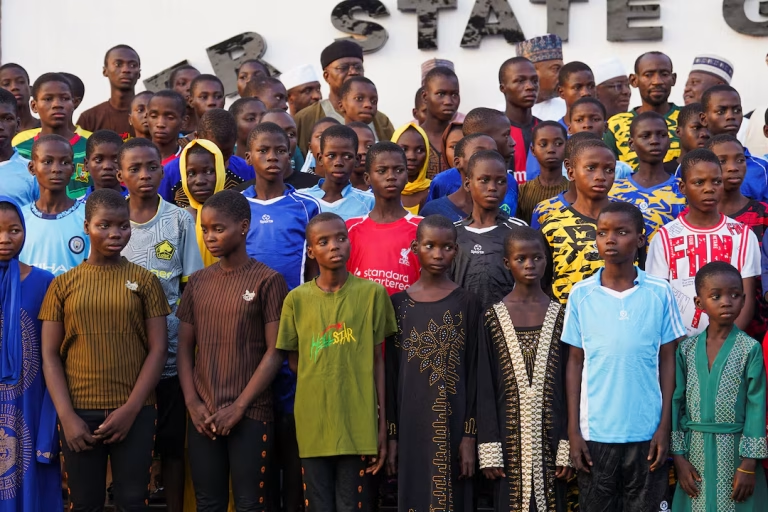
Hope and relief returned to Niger State on Monday as 100 children abducted from St. Mary’s Private Catholic Primary and Secondary School in Papiri, Agwara Local Government Area, regained their freedom nearly three weeks after being kidnapped by armed bandits.

The school was attacked on November 21, 2025, in one of the latest mass abductions targeting educational institutions in northern Nigeria. A total of 315 students, pupils, and staff were initially seized during the night raid. About 50 escaped earlier, leaving over 260 in captivity.

Local media confirmed the children’s safe return late Sunday, and by Monday evening, they were received in Minna by Niger State Governor Mohammed Umar Bago during an emotional ceremony attended by security officials, clergy, parents, and representatives of international organisations.

At exactly 5:30 p.m., the thin and visibly exhausted children — aged between five and ten — arrived in a convoy of military vehicles and marched into the Government House hall to thunderous applause. Some cried tears of relief while others clung tightly to caregivers.

Governor Bago, visibly moved by their condition, expressed gratitude to security agencies and President Bola Ahmed Tinubu for supporting rescue efforts.

“We want to thank Mr President for giving us the necessary inputs to rescue these children,” the governor said with a shaky voice. “We are emotionally broken seeing their sizes and their ages… but this joy gives us strength to continue. By the grace of God, in a very short time, we will recover the remaining children, Insha Allah.”

The governor also assured parents that medical teams had been mobilised to provide urgent care before the children are reunited with their families.

Handing over the children to state authorities, a representative of the National Security Adviser, Abdullahi Hong, reiterated the government’s commitment to securing the release of those still in captivity.

President Tinubu, in a statement issued by his media aide Bayo Onanuga, welcomed the development and vowed that no victim would be left behind.

“My directive remains that all the students and other abducted Nigerians must be rescued and brought back home safely,” the President stated. “From now on, our security agencies, working with the governors, must prevent future kidnappings. Our children should no longer be sitting ducks for heartless terrorists.”

Church leaders in Niger State also joined in thanksgiving while urging intensified rescue operations. The Christian Association of Nigeria (CAN), which runs the school, recently concluded a three-day statewide prayer and fasting for the safe return of the abductees.

“It will be a thing of joy if some of our children have been released,” said Bishop Bulus Yohanna of Kontagora Diocese, through his spokesperson Daniel Atori. “We have been praying and waiting for their return. If it is confirmed, then it is cheering news. However, until all our children are back, we will not rest.”

Despite the celebration, concerns remain for the 115 students and 12 staff members believed to still be held by the kidnappers. It also remains unclear whether their release was secured through negotiation, a military operation, or ransom — a practice banned by Nigerian authorities but widely believed to continue underground.

The attack on St. Mary’s adds to a troubling wave of kidnappings sweeping schools, churches, and rural communities across northern and central Nigeria. Analysts say criminal gangs, driven by profit, fuel an abduction industry that netted over $1.6 million between July 2024 and June 2025, according to research by SBM Intelligence.

As families reunite with their children in Papiri in the coming days, local communities remain gripped by fear and uncertainty.

Burkina Faso Detains 11 Nigerian Soldiers Over Alleged Airspace Violation

0

Burkina Faso’s military government has detained eleven Nigerian soldiers and seized a Nigerian Air Force C-130 transport aircraft after it made an emergency landing in Bobo Dioulasso on Monday, amid claims the plane violated the country’s airspace without clearance.

The development was confirmed in a statement issued by the Alliance of Sahel States (AES) — the confederation formed by Burkina Faso, Mali, and Niger after withdrawing from ECOWAS. According to the bloc, the aircraft was intercepted and forced to land following what was described as an in-flight emergency.

“The Confederation informs the public that a C130 aircraft belonging to the Air Force of the Federal Republic of Nigeria was forced to land today, 8 December 2025, in Bobo Dioulasso, Burkina Faso, following an in-flight emergency while operating in Burkinabe airspace,” the AES said.

Officials said the aircraft had two crew members and nine passengers, all members of the Nigerian Armed Forces, who were immediately taken into custody.

“The individuals were identified as members of the Nigerian Armed Forces and are currently being detained,” the statement noted.

Burkinabe authorities said a preliminary investigation showed the plane did not have the authorisation required to fly over the country, describing the incident as a serious breach of national sovereignty.

“The absence of authorisation to fly over Burkinabe territory constitutes a clear violation of our sovereignty, which we condemn with the utmost firmness,” the AES declared.

In a warning that signals escalating tensions in the region, the alliance said its air-defence units had been placed on maximum alert and granted the authority to “neutralise any aircraft” that breaches its protected airspace going forward.

A diplomatic source in Ouagadougou, reacting to the development, said: “The Sahel states are drawing a red line. Any military intrusion, real or perceived, will now be treated as a threat.”

The incident comes against the backdrop of deteriorating ties between Nigeria and the Sahelian juntas, who have repeatedly accused ECOWAS and its allies of attempting to undermine their regimes.

As of the time of filing this report, the Nigerian Air Force and the Federal Government have not issued any official comment regarding the detention of the soldiers or the status of the aircraft.

Constitution Amendment Bill Proposes 182 Additional Women Legislative Seats

0

Nigeria is approaching one of its most significant constitutional overhauls since returning to democracy, as the Reserved Seats for Women Bill advances through the National Assembly.

The proposal seeks to establish 182 additional legislative positions exclusively for women at both federal and state levels.

The bill originates from the House of Representatives and is sponsored by Deputy Speaker Benjamin Kalu alongside 12 others, including the late Oriyomi Onanuga, Jafaru Leko, Francis Waive, Blessing Onuh, Joshua Gana, Kama Nkemkanma, Chinwe Nnabuife, Amobi Godwin, Khadija Ibrahim, Jonathan Gbefwi, Tolani Shagaya, and Mohammed Hassan.

Officially titled, “A bill for an act to alter the provisions of the Constitution of the Federal Republic of Nigeria, 1999, to provide for seat reservation for women in the National and State Houses of Assembly; and for related matters,” it forms part of more than 40 proposed constitutional amendments to be decided by lawmakers.

Advocates of the bill say it aims to correct Nigeria’s extremely low and structurally hindered participation of women in politics, noting that women currently hold fewer than five percent of elected political positions nationwide.

If enacted, the legislation would amend seven sections of the 1999 Constitution, expand the Senate, House of Representatives, and all 36 state Houses of Assembly, and require the Independent National Electoral Commission (INEC) to create special constituencies for women-only elections for four electoral cycles, a 16-year period, before a mandatory review.

While the House supports adding 182 seats reserved for women, senators are pushing a counter-measure that would drastically reduce the number of women-only seats in the upper chamber from the proposed 37 to just six, one seat per geopolitical zone.

Details of the bill, seen by The Guardian on Saturday, show that the Senate would gain 37 new seats by replacing Section 48 of the Constitution, providing one extra female senator for each of the 36 states plus the FCT. This arrangement would be reassessed after 16 years.

The House of Representatives would mirror the expansion with 37 female-only seats, through a revised Section 49 that increases the chamber from 360 to 397 members, adding one special seat for women in every state and the FCT.

Under a new Section 71(2), INEC would be obligated to create dedicated senatorial districts for the women-only seats and designate each state as a federal constituency for the reserved House seats.

At the state level, Section 91 would be substituted to compel each House of Assembly to include three additional women-only seats. One for every senatorial district, amounting to 108 new positions nationwide and bringing the total number of reserved seats to 182.

Additional provisions in Sections 77 and 117 would define “special constituency” as districts exclusively for female representation. However, the Senate remains reluctant to support such a large expansion.

During a capacity-building workshop for the House of Representatives Press Corps in Abuja, Dr. Chidozie Ajah, Special Adviser (Legislative) to the Deputy Speaker, disclosed that senators are pushing an alternative proposal.

He explained that the Senate wants only six women-only seats, one per geopolitical zone, as an initial measure, instead of the 37 recommended by the bill.

Ajah noted that negotiations are still in progress and positions could change as lawmakers seek a middle ground.

He reiterated that the reserved seats initiative is not based on any assumption that women lack competitiveness but is meant to correct longstanding barriers that have systematically limited female political participation.

Ajah insisted the bill is not an act of benevolence or a way of shielding women from political contest.

According to him, the goal is to dismantle the “mountain of structural, cultural, and systemic barriers” that have sidelined women in leadership for generations.

He further revealed that lawmakers are considering a modification to Section 42: Nigeria’s anti-discrimination provision, to explicitly permit affirmative action, thereby preventing legal disputes.

Nigeria currently has one of the lowest rates of female political representation globally. Only three women serve in the 109-member Senate, and 17 women occupy seats in the 360-member House, placing national female representation at 4.7 percent and ranking Nigeria 184th in the world.

Ajah contended that even with 74 women added to the Senate and House, the country would achieve just 13.6 percent representation, still well below the African continental average.

The bill draws inspiration from other African nations that have successfully implemented gender quotas.

Speaking at the same event, Executive Director of the Gender Strategy Advancement International (GSAI), Adaora Sydney-Jack, highlighted the role of the media in the problem.

She criticized editorial practices, saying: “Women hardly make headline stories, not because their issues lack importance, but because editorial decisions push them aside.”

Sydney-Jack encouraged journalists to rethink how they cover policies affecting women.

For the Reserved Seats Bill to become law, it must pass the rigorous constitutional amendment process: approval by two-thirds of the Senate, two-thirds of the House of Representatives, and endorsement from at least 24 of the 36 state Houses of Assembly, before finally being transmitted to the President for assent.

16 Rivers Lawmakers, Including Speaker, Dump PDP For APC

0

‎Sixteen lawmakers in the Rivers State House of Assembly, under the leadership of Speaker Martin Amaewhule, have defected from the Peoples Democratic Party to the All Progressives Congress.
‎
‎Amaewhule disclosed their defection during Friday’s plenary, stating that the move was prompted by what he called a “division” within the PDP.
‎
‎He informed the House that he had officially notified his ward chairman of his departure from the PDP and had now joined the APC.
‎
‎He declared, “Distinguished colleagues, APC is my new party. I will do all that is needed to be done towards ensuring that the party card of the All Progressives Congress is issued to me in no time.
‎
‎“But as I speak today, I am a member of the All Progressives Congress. I am happy to be a member of APC so that we can join forces with Mr President. Mr President is doing so much for this country.”
‎
‎Amaewhule commended President Bola Tinubu’s leadership and said the President “means well for Nigeria’’ and has demonstrated “love to Rivers State.”
‎
‎He stated that backing the President from within the APC had become the lawmakers’ new focus, adding that the internal crisis within the PDP made staying in the party no longer viable.
‎
‎Rivers State has been experiencing a prolonged political crisis since late 2023, involving a power struggle between Governor Siminalayi Fubara and lawmakers aligned with his predecessor, Nyesom Wike.
‎
‎Amaewhule heads the faction believed to be loyal to Wike, and the Assembly has taken several steps — including an attempted impeachment — that have worsened tensions.
‎
‎The conflict has also led to contradictory court rulings on the legitimacy of the Amaewhule-led Assembly, with varying judgments recognizing either Amaewhule or Edison Ehie (now Chief of Staff to Governor Fubara) as Speaker at different times.
‎
‎At the national level, the PDP continues to struggle with internal divisions, including longstanding disagreements involving Wike and the party hierarchy.
‎
‎The lawmakers’ claim of “division” within the PDP reflects a broader pattern of defections driven by the party’s unresolved internal disputes.
‎
‎
‎

Thousands Flee Thai-Cambodia Frontier After Deadly Clashes

0

Communities along the Thai-Cambodian border emptied out on Monday as fresh fighting between the two countries left at least five people dead.

Bangkok and Phnom Penh blamed each other for triggering the latest violence, which marks the worst flare-up since the two sides agreed to a ceasefire in July.

Thai Prime Minister Anutin Charnvirakul said Thailand “never sought conflict” but would take “whatever steps are required to defend its territory.” Former Cambodian leader Hun Sen countered by accusing Thailand of acting like “invaders” and provoking a response.

More than 40 people have been killed since tensions rose in May, causing major disruptions to trade, cross-border travel, and imports.

On Monday, the Thai army reported returning fire after Cambodian forces allegedly attacked positions in Ubon Ratchathani Province, including through air operations along disputed areas. Cambodia’s defence ministry rejected that claim, insisting the Thai side launched strikes first in Preah Vihear Province.

Officials from both governments confirmed that one Thai soldier and four Cambodian civilians were among the dead, with dozens of people injured.

For Thai schoolteacher Siksaka Pongsuwan, the toll is not only measured in casualties. He said children growing up near the fighting are “losing opportunities and valuable time” compared to students in safer locations.

The education ministry said nearly 650 schools across five Thai provinces were ordered to shut down for safety reasons after tensions surged on Sunday.

Videos circulating online captured scenes of panic in Cambodian border towns, with parents racing to pull their children from classrooms.

This is not the first time students have faced disruption. Heavy fighting in July erupted during exam week, forcing Pongsuwan’s school to shift entirely online. Many students, however, could not participate due to limited internet access or a shortage of school tablets.

In Cambodia, former journalist Mech Dara posted several videos showing children fleeing classrooms and described the situation as deeply distressing.
“How many times must these kids experience such terrifying moments?” he wrote, calling the conflict a “nightmare” for young learners.

He also shared a photo of a boy eating a meal in a bunker while still wearing his school uniform. “Why should this child and his family be eating underground?” he asked.

Pongsuwan said gunfire can still be heard in his village, leaving families unsure whether it is safer to leave or remain.
“If you ask if we’re afraid — yes, we are,” he said. “Should we evacuate? Will we really be safer? Or should we stay where we are?”

Tinubu, Macron Discuss Nigeria’s Security Crisis As US Fact-finding Delegation Visits

0

President Bola Tinubu and French President Emmanuel Macron on Sunday discussed Nigeria’s worsening security situation, focusing on areas where both countries can strengthen cooperation.

Their conversation took place as a United States delegation, including the US Ambassador to Nigeria and senior officials, met with National Security Adviser Nuhu Ribadu in Abuja over alleged Christian persecution and ongoing violence.

In a post on X, Macron confirmed his discussion with Tinubu and reaffirmed France’s commitment to support Nigeria in tackling insecurity.

He wrote, “I spoke with President Tinubu of Nigeria, @officialABAT. I conveyed France’s solidarity in the face of the various security challenges, particularly the terrorist threat in the North.
“At his (Tinubu’s) request, we will strengthen our partnership with the authorities and our support for the affected populations.
“We call on all our partners to step up their engagement. No one can remain a spectator.”

Macron indicated that France will collaborate with the Nigerian government to provide assistance to vulnerable communities.

His remarks follow an escalation of attacks and abductions, especially in schools and rural areas across northern Nigeria, which have attracted global concern.

The French president’s message also came shortly after Tinubu swore in a new Defence Minister, retired General Christopher Musa, and tasked him with delivering urgent results.

On November 26, Tinubu declared a national security emergency, directing security agencies to recruit more personnel immediately and deploy thousands of forces.

He further instructed them to prioritize security for schools, farms, and worship centers while urging state governors to reinforce local intelligence systems.

Tinubu’s call with Macron also comes amid growing international scrutiny, particularly from US President Donald Trump, who recently accused Nigeria of allowing genocide against Christians and threatened intervention.

Trump again placed Nigeria on the list of Countries of Particular Concern for religious freedom issues and issued strong warnings about military action.

The Federal Government has repeatedly denied allegations of religious persecution, maintaining that insecurity affects Nigerians of all faiths.

Amid mounting pressure, Nigeria has turned to global partners for support.

On November 20, US Secretary of War Pete Hegseth hosted NSA Ribadu at the Pentagon for talks on addressing the crisis. That same day, the US House Subcommittee on Africa held a public hearing evaluating Nigeria’s designation as a Country of Particular Concern, followed by another briefing assessing its consequences.

Last Tuesday, US House Republicans warned about rising religious violence in Nigeria during a joint briefing initiated by Trump, who earlier directed Moore and the House Appropriations Committee to investigate what he termed mass killings of Christians.

Ribadu confirmed his recent meeting with the US delegation, describing it as part of ongoing consultations to strengthen security cooperation.

Posting on X, he said, “This morning, I received a US Congressional delegation on a fact-finding mission to Nigeria, following our earlier engagements in Washington, DC, on shared security priorities.”

He noted that the US Ambassador to Nigeria, Richard Mills, joined the meeting, adding that this showed how seriously both nations view the situation.

Ribadu stated that the talks focused on “counter-terrorism cooperation, regional stability” and ways to “strengthen the strategic security partnership between Nigeria and the United States.”

He expressed optimism that the engagement would enhance trust, collaboration and joint commitment to stability.

US lawmaker Riley Moore also confirmed his visit in a post on X, writing, “I came to Nigeria in the name of the Lord and on behalf of the American people.”

He added, “Just ending a very productive visit to Nigeria and rounds of meetings. More details to come. Happy Sunday. God is Great!” He did not provide further details regarding the officials he met.

In a related visit, the US Assistant Secretary of State and Ambassador Richard Mills traveled to Benue State on Saturday.

They met with Governor Hyacinth Alia in Makurdi and held discussions with the Catholic Bishops of Makurdi and Katsina-Ala Dioceses, Most Rev. Wilfred Anagbe and Bishop Isaac Dugu.

The delegation also paid a courtesy visit to the Tor Tiv, HRM Prof. James Ayatse, who leads the Benue State Traditional Council.

Although the official purpose was not disclosed, local reports link the visit to US concerns over religious persecution in Nigeria. Bishop Anagbe has twice briefed the US Congress this year about Christian-targeted attacks and insecurity in the country.

During Tinubu’s earlier visit to Benue after the Yelwata killings, the Tor Tiv described the situation as “nothing but genocide.”

However, Governor Alia recently told a forum in Abuja that claims of genocide are unfounded.

He said, “I am a Reverend Father, so being in governance does not take that away from me. In my state of Benue, we do not have any religious, ethnic, racial, national or state genocide. We do not have that.”

Alia’s spokesperson, Kula Terso, said the US officials informed the state that the visit was private.

He stated, “They told me it was a private visit. That is why the media was not invited to cover it. That is all I can say on that. Thanks.”

Meanwhile, Iorbee Ihagh, leader of Benue’s three main socio-cultural groups, said he believes the trip is connected to allegations of religious genocide.

He argued that although the state denied such claims, the delegation should have been taken to Yelwata and nearby internally displaced persons camps.

Ihagh, a retired Comptroller of Prisons, added, “Everyone in Benue State believes that the ongoing attacks and killings in the state amount to genocide. The Tiv paramount ruler, the Tor Tiv, made this declaration during President Bola Tinubu’s visit to the state following the Yelwata attack.

“The Catholic Bishop of Makurdi Diocese has visited the US Congress and presented papers on how Christians are being killed in the state and in Nigeria as a whole.”

More Than 100 Killed In Sudan Hospital Attack – WHO Chief

0

The head of the World Health Organization (WHO), Tedros Adhanom Ghebreyesus, has condemned a drone strike on a kindergarten and hospital in Sudan that left 114 people dead, calling the attack “senseless.”

The strike took place on Thursday in the town of Kalogi in South Kordofan. UN figures show that 63 children were among those killed.

The Rapid Support Forces (RSF), one of the two rival forces in Sudan’s civil war, has been accused of carrying out the attack by the army and a medical network.

In a separate statement, the RSF claimed to have taken control of Heglig, Sudan’s largest oil field.

Sudan has been engulfed in conflict since April 2023, when a power struggle between the RSF and the army erupted into war. The Kordofan region — which includes North, South, and West Kordofan — lies between Khartoum and Darfur and has become a major battleground as the army attempts to advance toward Darfur, currently held by the RSF. Nearly eight million people live across the three states.

Initial reports from local authorities indicated at least 50 deaths in Kalogi, including 33 children. Updated figures from the WHO’s monitoring system later confirmed 114 fatalities and 35 injured.

A local official in Kalogi said drones struck the kindergarten first, then hit the hospital, and attacked again as residents attempted to rescue children trapped in the rubble.

The RSF has not publicly commented on the incident. The group has previously denied targeting civilians, despite facing accusations of large-scale attacks in other areas of the country.

Tedros said survivors from the strike were transferred to a hospital in South Kordofan for urgent treatment, and that emergency calls for blood donations and medical supplies have been issued.

“Paramedics and responders came under fire while trying to move the injured from the kindergarten to the hospital,” he said.

He added that the WHO “condemns these senseless attacks on civilians and health facilities,” and again called for an end to the violence and greater access to humanitarian assistance.

While avoiding assigning blame for the attack, Tedros renewed his call for a ceasefire, saying: “Sudanese people have suffered far too much.”

The RSF described the capture of Heglig — near Sudan’s southern border — as a major development. Military personnel reportedly pulled back from the site to prevent damage to the oil facilities. Staff working at the field have also left the area.

Heglig contains the main processing infrastructure for South Sudanese oil exports, which represent a key source of revenue and are crucial for both countries’ access to foreign currency.