Home Blog Page 149

Cameroon’s Judicial Council Highlights Growing Distrust in Biya

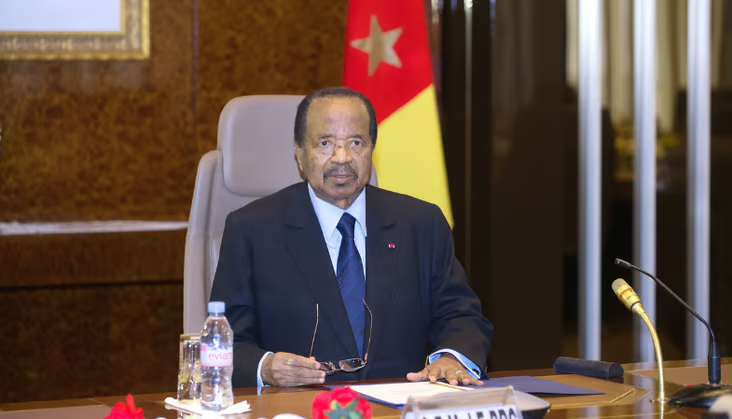
As Cameroon gears up for the 2025 presidential election, the country’s Higher Judicial Council has become a powerful symbol of growing public distrust in President Paul Biya’s leadership.

Once seen as an important check on executive power, the Council has remained inactive for nearly four years. Its prolonged silence has drawn criticism and reinforced perceptions that key institutions are being sidelined to strengthen Biya’s control over the political system.

Observers argue that the Council’s dysfunction is part of a broader trend in Cameroon, where electoral bodies and the judiciary are increasingly dominated by Biya loyalists. Constitutional changes over the years have also favored the ruling Cameroon People’s Democratic Movement, further eroding public confidence in the fairness of the country’s political process.

Cameroon’s political system presents the appearance of multiparty democracy, but many say the reality is a tightly managed structure with little room for genuine opposition. Institutions like the Constitutional Council and Elections Cameroon (ELECAM) are widely viewed as extensions of the regime, rather than neutral bodies that guarantee justice and fair play.

To many citizens across both the Francophone and Anglophone regions, the silence of the Higher Judicial Council has come to represent a deeper problem, the decline of democratic governance under Biya’s long rule. With elections approaching, the Council’s passivity only deepens public skepticism about the prospects for meaningful change.

Tehran Residents Flee as Trump Considers Military Action with Israel

Large crowds were seen escaping Tehran on Wednesday, following warnings from U.S. President Donald Trump urging citizens to leave the city. A reliable source revealed that Trump is weighing the possibility of joining Israeli efforts in targeting Iranian nuclear facilities.

Fresh waves of missile exchanges broke out between Iran and Israel soon after Trump demanded Tehran’s “UNCONDITIONAL SURRENDER!”

Residents of southwestern Tehran were told by Israel to vacate the area to clear the way for strikes on Iranian military targets. Reports indicated severe traffic jams as people rushed out of the city toward the northern provinces.

Fuel purchasing restrictions have been enforced across Iran. Oil Minister Mohsen Paknejad assured the public through state TV that these measures are designed to prevent shortages and that fuel availability for civilians remains stable.

Meanwhile, explosions shook Tel Aviv as Israel’s military confirmed that two series of Iranian missiles were launched into its territory early Wednesday.

Iran’s semi-official Mehr news agency shared that armed confrontations broke out between Iranian security forces and unknown attackers in Rey, a city south of Tehran. The report suggested that these assailants might be linked to Israel and were planning “terrorist operations in densely populated areas of the capital”.

Additionally, local Iranian media stated that Israel had launched strikes on a university associated with Iran’s Revolutionary Guards in the eastern region and also targeted the Khojir ballistic missile site near Tehran — a location that suffered similar strikes last October.

An Israeli military spokesperson revealed that 50 warplanes hit approximately 20 different targets in Tehran overnight. These sites reportedly included facilities responsible for producing essential materials, components, and systems required for missile production.

Iranian officials have so far confirmed no fewer than 224 deaths, primarily among civilians, though this number has not been revised in recent days. On the other side, Iran has launched about 400 missiles toward Israel since Friday. Around 40 of these penetrated Israeli defenses, killing 24 civilians, according to Israeli authorities.

In response to the escalating conflict, Israel began repatriating citizens stranded in foreign countries on Wednesday. A gradual evacuation by air was put into action after Israel’s unexpected military offensive against Iran left thousands of its nationals unable to return home.

26 Years Of Democracy: Unlocking Nigeria’s Promise For The People 

As Nigeria marks 26 years of democracy, the focus must shift from just holding elections to building institutions that truly serve the people. Despite improvements like the Electoral Act and BVAS, challenges such as vote-buying, weak governance, and judicial interference still undermine public trust. For democracy to be meaningful, it must address poverty, ensure accountability, and create opportunities for Nigeria’s growing youth population.

Economically, Nigeria remains heavily reliant on oil, which accounted for 88% of exports in 2024. Even with global oil prices averaging $75 per barrel, past windfalls have been lost to mismanagement. While the World Bank projects modest 3.8% growth, the government admits 7% is needed to cut poverty. 

Meanwhile, youth unemployment remains high at 33%, fueling frustration. Since the End SARS movement of 2020, young Nigerians have demanded not just reform, but real change. Democracy must now evolve into tangible economic and social impact for all.

Flights Disrupted As Volcano Erupts In Indonesia

Flight operations to and from Bali faced disruption after a volcano in Indonesia’s East Nusa Tenggara province erupted, prompting cancellations and delays of over 20 scheduled trips while three nearby airports were shut down.

Mount Lewotobi Laki-laki violently spewed ash up to 11 kilometres into the sky on Tuesday, pushing authorities to raise the hazard alert to its maximum level.

The mountain erupted again the next day, releasing another thick ash plume reaching about 1 kilometre high.

A total of 26 flights, both domestic and international, were either delayed or cancelled, impacting more than 14,000 travellers, according to the transport ministry.

Several flights from countries including India, Singapore, and Australia to Bali were among those disrupted.

“Forecasts show the ash cloud is expected to clear by later tonight,” JetStar said in a midday travel bulletin.

Air travel to nearby islands like Lombok and Labuan Bajo was also affected, with several scheduled services either postponed or scrapped.

For safety reasons, three airports, including Fransiskus Xaverius Seda in Maumere, suspended operations from Wednesday until Thursday, transport officials confirmed.

As a precaution, local disaster management teams evacuated dozens of residents from two communities close to the volcano, Avi Hallan from the disaster agency reported.

“Streets in the two villages were filled with thick ash, gravel, and sand,” she said, noting that no injuries or deaths had occurred.

The volcano had previously erupted in May.

Indonesia is situated along the Pacific Ring of Fire, a zone notorious for frequent volcanic and seismic activity caused by the shifting of tectonic plates.

Club World Cup Roundup: Inter Milan Held by Monterrey

Inter Milan were held to a 1-1 draw by Monterrey in their opening match of the FIFA Club World Cup on Tuesday night, marking their first competitive outing since their Champions League final loss.

Spanish veteran Sergio Ramos opened the scoring with a spectacular first-half header, energizing a largely pro-Mexican crowd in Southern California. It was also a successful debut for Monterrey’s head coach, Domènec Torrent.

Lautaro Martínez responded for Inter in the 42nd minute, tapping in a well worked set-piece move finished off by Carlos Augusto’s assist. Despite dominating possession with nearly 62%, Inter couldn’t find a winner, while Monterrey managed just one shot on target.

It was the managerial debut for Cristian Chivu, who fielded only seven players from Simone Inzaghi’s Champions League final squad. Striker Marcus Thuram, recovering from injury, came on early in the second half to replace 22-year-old Sebastiano Esposito, making his first appearance for Inter since 2020 after seven loan spells.

Ramos, who was named MVP of the match, acknowledged the challenge of playing against a Champions League finalist. It was a tough game against a top opponent. You’re never fully satisfied without a win. he told DAZN.

Martínez thought he had scored again in the 68th minute, but his effort was ruled out for offside. Both sides had chances in the final moments, and Martínez received a yellow card in stoppage time.

Looking ahead, Ramos said, We have to move on from this point and focus on our next match against River Plate. It’s crucial we get three points. River are a determined team that fights to the last minute, it’s in their DNA. We’ll give everything to come away with a good result.

River Plate start CWC with win over Urawa Red Diamonds

In the day’s earlier match, River Plate kicked off their Club World Cup campaign with a commanding 3-1 win over Japan’s Urawa Red Diamonds.

Facundo Colidio opened the scoring in the 12th minute, heading in a pinpoint cross from Marcos Acuña. It was important to start strong. We knew it would be a tough game, Colidio said.

Despite Urawa threatening before the break including a disallowed goal by Marius Hoibraten and a sharp effort from Takuro Kaneko River maintained their edge.

Sebastián Driussi doubled River’s lead early in the second half, intercepting a poor back-header from Hoibraten and lofting the ball over goalkeeper Shusaku Nishikawa. Driussi was later forced off with an injury.

Urawa narrowed the gap in the 58th minute through Yusuke Matsuo’s penalty, awarded after a foul by Acuña. But substitute Maxi Meza sealed the win for River with a 73rd-minute header from another Acuña assist, his second of the night.

I’m pleased with our start, River coach Marcelo Gallardo said. There were nerves, but the goals gave us composure. We know we can still improve moving forward.

River Plate will face Monterrey in their next Group E fixture on Saturday, while Urawa Red Diamonds take on Inter Milan.

LASG Suspends Planning Approvals For Lagos-Calabar Coastal Road

1

The Lagos State Government has declared an immediate halt to planning approvals along the Lagos-Calabar Coastal Road corridor.

In a statement released on Monday in Alausa, Dr. Oluyinka Olumide, the Commissioner for Physical Planning and Urban Development, announced the decision.

Olumide explained that pausing planning approvals was essential to mitigate the project’s effects on the state’s Physical Development Plans for the region.

He noted that the Lagos-Calabar Coastal Road project has notably disrupted the recently finalized Ode-Omi Action Area Plan, as well as the in-progress Ibeju-Lekki Model City Plan and Lekki Comprehensive Master Plan, which are at different stages of development.

“As a result of the effects of the Lagos-Calabar Coastal Road on our Development Plans, it is germane to review the situation on ground and align it with the Development Plans to forestall any further distortion now or in the nearest future.

“In this connection, it is equally important to temporarily suspend Planning Approvals in the axis until further notice, “ the commissioner said.

Olumide stressed that the Lagos State Physical Planning Permit Authority has been instructed to enforce this suspension until further directives are issued.

He reaffirmed the state’s dedication to fostering an organized, livable, inclusive, and sustainable built environment, while expressing confidence that Lagos is strategically positioned to capitalize on the numerous advantages of the inter-state Coastal Highway.

ECOWAS And Nigeria Advocate For Collective Effort To Combat Plastic Waste

1

As countries across the globe commemorated World Environment Day, the ECOWAS Commission and Nigeria’s Ministry of Environment partnered to draw attention to the pressing issue of plastic pollution throughout West Africa.

The celebration, which took place on Tuesday in Abuja, embraced this year’s theme, “Together, We Can Beat Plastic Pollution.” The event emphasized the importance of regional unity, environmental accountability, and the need for concrete action beyond mere rhetoric.

Representing the ECOWAS Commission, the Commissioner for Economic Affairs and Agriculture, Massandje Toure-Litse, delivered a goodwill message, underlining the importance of the event within the context of ECOWAS’s Jubilee Year, which celebrates five decades of regional cooperation.

“It is fitting that in this landmark year, we reaffirm our commitment to a clean, resilient, and sustainable environment for future generations.”

“Plastic pollution is not only a global menace but a regional and national crisis.

“There is growing recognition that plastic pollution is a transboundary problem that requires a coordinated regional response,” Toure-Litse said.

Citing World Bank data, Yao Bernard Koffi, Acting Director of Environment and Natural Resources representing the commissioner, stated that West Africa generates approximately eight million metric tonnes of plastic waste each year, with over 80 percent mismanaged, leading to severe impacts on human health, marine ecosystems, and economic stability.

To combat this issue, she highlighted that ECOWAS introduced a regional plastic management regulation in 2023, encouraging member states to align their laws and adopt effective practices.

“The ECOWAS Commission is supporting Member States to harmonise environmental standards and promote green industrialisation,” she said.

She recognized promising regional efforts, noting Ghana and Nigeria’s progress in circular economy initiatives, as well as Senegal and Côte d’Ivoire’s implementation of plastic bans and producer responsibility programs.

However, Toure-Litse emphasized the need for greater regional collaboration.

“Tackling plastic pollution is a test of our resolve to act together as governments, private sector actors, civil society, and citizens,” the commissioner stated.

She urged stakeholders to fund eco-innovation, back community-driven waste initiatives, enforce environmental regulations, and support youth-led climate efforts.

“The ECOWAS commission stands ready to work side-by-side with Nigeria and all partners to beat plastic pollution not tomorrow, but today,” she concluded.

At the event, Minister of Environment Balarabe Lawal addressed attendees with a sense of urgency and reflection, emphasizing the environmental, health, and economic challenges posed by plastic waste.

“Plastic pollution is a very serious issue that we must confront, and we must fight honestly.

“Linked to plastic pollution is chemical pollution. Climate change may be the most visible threat, but chemical waste is equally insidious and must also be addressed,” Lawal declared.

Lawal vividly described how improper waste disposal exacerbates flooding in Nigerian cities.

“Every minute, plastic waste is being dumped in our oceans, rivers, and land systems. We are blocking waterways, and that leads to flooding. Water must find its way. If you obstruct it, it will pass through your homes, your farms, your schools,” he said.

In a direct appeal to architects, he noted, “You are part of our problem. You design and approve construction on waterways. That must stop if we are serious about ending flooding.”

Lawal reaffirmed the federal government’s dedication, highlighting initiatives under the Renewed Hope Agenda, such as the National Policy on Plastic Waste Management and the Extended Producer Responsibility Programme.

The minister highlighted that proactive measures are being implemented to combat pollution comprehensively.

“Reduce, reuse, recycle, these three R’s are not just slogans. They are our path forward,” the minister stated.

Lawal pointed to the financial benefits of recycling, referencing a recent trip to Ghana where young people are gaining employment through plastic collection initiatives.

“This catastrophe of pollution can be turned into a resource. It can be good business for our youth,” he said.

He also stressed the importance of working together across government ministries, private sectors, and educational institutions to promote environmental awareness.

“We must create environmental clubs in schools. We must reach the youth. They have more years to live on this planet than us and they must be equipped to protect it.”

Looking back on efforts made and looking ahead to future actions, Lawal urged every Nigerian to embrace a united sense of duty.

“Throughout history, we have searched for alternatives to earth. But till today, there is none. We must protect what we have.

“Let this day serve as a wake-up call. Let us become ambassadors of environmental stewardship.

“Together, let us walk toward a Nigeria where our waterways are clean, our streets are free of plastic waste, and our ecosystems are protected for generations yet to come,” Lawal added.

The Ministry of Environment, in partnership with ECOWAS @50, hosted the event.

The gathering brought together top government officials, civil society groups, youth organisations, and international partners, all affirming a united front in the fight against plastic pollution—one of the region’s most urgent environmental issues.

IPMAN Urges Lagos To Reduce E-Call-Up Fee To ₦2,500

The Independent Petroleum Marketers Association of Nigeria (IPMAN) has appealed to the Lagos State Government to reduce the electronic call-up system parking charge from ₦12,500 to ₦2,500.

This appeal was made by IPMAN’s National Publicity Secretary, Mr. Chinedu Ukadike, during an interview with the News Agency of Nigeria (NAN) on Tuesday in Lagos.

Ukadike explained that the request is essential to prevent a possible increase in petrol prices at filling stations.

According to NAN, the Lagos State Government, through the Electronic Call-up Systems Company, recently raised the parking fee for trucks from ₦2,500 to ₦12,500.

The hike in charges led to a protest on Monday, during which truck drivers halted operations, disrupting supply from the Dangote Refinery and Lekki Deep Seaport.

Ukadike noted that stakeholders at a recent meeting collectively agreed that the fee should revert to ₦2,500, describing the current charge as too steep.

“The imposed amount is exorbitant and unbearable for marketers. It will inevitably lead to an increase in the pump price of petrol,” Ukadike stated.

He stressed that their primary objective is to maintain energy stability and national security.

At the same time, truck drivers under the Nigerian Association of Road Transport Owners (NARTO) and Petroleum Tanker Drivers also staged a protest along the Lekki-Epe axis.

NARTO’s National President, Yusuf Othman, confirmed that loading operations have been temporarily suspended in protest against the new charge.

“We’ve not declared a strike, only suspended loading at Lekki Port and Dangote Refinery because ₦12,500 per truck is too high,” he said.

Othman further explained that while the group supports the use of electronic call-up systems, the pricing must be affordable and practical.

He also mentioned that talks are ongoing with officials from the Lagos State Government to reach a mutually acceptable resolution.

Shettima Declares Nigeria Open For Business At The 2025 PPP Summit

0

On Monday, Vice President Kashim Shettima announced Nigeria’s readiness for global business opportunities during the opening of the Nigeria 2025 Public-Private Partnership Summit at the State House in Abuja.

The summit, hosted by the Infrastructure Concession Regulatory Commission, convened government and private sector leaders to discuss strategies for addressing Nigeria’s $2.3 trillion infrastructure deficit.

Representing President Bola Tinubu, Shettima emphasized, “We are not seeking investors to carry burdens; we are opening opportunities to create value. We want long-term partners ready to bridge our infrastructure gap with purpose, precision, and integrity.”

He highlighted that Nigeria cannot achieve a modern economy with outdated infrastructure and noted that depending solely on government funds for major projects is no longer viable.

Shettima pointed to the Tinubu administration’s reforms, including liberalizing the foreign exchange market, eliminating fuel subsidies, and bolstering the ICRC to encourage investment.

He remarked, “Policies alone don’t generate megawatts or build roads. What we need is collective action.”

The Vice President explained that the National Integrated Infrastructure Master Plan (2020–2043) aims to increase Nigeria’s infrastructure stock from 30–35% of GDP to at least 70% by 2043.

With a population exceeding 230 million, projected to reach 440 million by 2050, Shettima underscored Nigeria’s vast market potential, stating, “One out of every four Black people is a Nigerian. There is no African market like this.”

He encouraged investors to prioritize long-term value and meaningful impact.

Shettima urged, “Let this summit not be remembered for kind speeches; we’ve had those for decades, but for bankable projects, signed deals, and enduring progress.”

ICRC Director General Jobson Ewalefoh, in his opening remarks, reiterated the government’s commitment to bridging the infrastructure gap through strategic public-private partnerships.

Addressing the summit’s theme, “Unlocking Nigeria’s Potential: The Role of PPPs in Delivering the Renewed Hope Agenda,” Ewalefoh emphasized the importance of PPPs in driving sustainable development.

He highlighted ongoing initiatives like the Highway Development and Management Initiative, the Egini Medical Infrastructure Scheme, and the Dasin Hausa Dam as evidence of progress.

Ewalefoh affirmed, “ICRC is committed to ensuring that all PPP projects are legally compliant, economically viable, and socially impactful.”

He praised President Tinubu and Vice President Shettima for their focus on infrastructure and private-sector-driven growth, while also recognizing the contributions of partners such as AfDB, NESG, Afreximbank, IFC, and Africa50.

2025 National Youth Conference: What It Means For Nigerian Youths, How To Apply

0

The Federal Government has launched the official portal for the 2025 National Youth Conference, popularly known as the Youth Confab.

Slated to host a staggering 36,000 participants from across Nigeria and the diaspora, the initiative promises more than dialogue. It offers young Nigerians a seat at the policymaking table.

Themed “Next Gen Nigeria: Crafting Solutions, Owning the Future,” the Youth Confab is structured as a multi-stage national movement that goes beyond the traditional conference model. It seeks to mobilise the creativity, energy, and insight of Nigerian youth towards real policy development and implementation.

“This conference will provide young Nigerians from every ward, community, state, and the diaspora the opportunity to unite, engage and reshape the future of our nation,”
 Minister of Youth Development, Ayodele Olawande.

What’s The Conference All About?

The Youth Confab isn’t just a gathering it’s a nationwide consultative process. It kicks off with virtual engagements for Nigerians in the diaspora, ensuring no voice is left behind. This will be followed by 360 constituency consultations across Nigeria, feeding into zonal consultations within the six geopolitical regions.

The final act will be a national conference in Abuja, where curated recommendations from the consultations will be presented to government leaders.

The discussions will focus on six critical areas:

  • Governance, Leadership, and Political Participation
  • Economic Transformation, Entrepreneurship, and Job Creation
  • Education and Skills for the Future
  • Technology, Innovation, and Digital Transformation
  • Climate Change and Energy Transition
  • Social Inclusion and Security Who Can Apply?

If you’re between the ages of 18 and 35, whether a student, artisan, entrepreneur, creative, or professional in Nigeria or in the diaspora. This is your opportunity. Youth organisations, student unions, community-based groups, and even statutory youth bodies are all encouraged to register via the newly launched portal.

To ensure inclusivity, 90% of the delegates will be under 35, while the remaining 10% will comprise older participants to foster intergenerational collaboration.

A 50:50 gender balance will be maintained, and provisions have been made for persons with disabilities and marginalized communities, according to the National Planning Committee Chairman, Olubunmi Olusanya.

“The selection process will be merit-based and carefully structured to balance grassroots inclusion, sectoral expertise, and regional diversity,”
— Olubunmi Olusanya, Chairman, National Planning Committee.

Beyond the Talk: Turning Resolutions into Action
One of the most compelling features of the Youth Confab is its commitment to tangible outcomes.

According to Mr. Olusanya, resolutions from the conference will lead to:

  • Administrative actions, including policy reforms or presidential directives.
  • Legislative actions, involving new or amended laws.
  • Where needed, constitutional changes.

To track and enforce accountability, a Multi-Stakeholder Youth Confab Task Force will be created.

This group comprising representatives from government, youth-led groups, civil society, and the private sector will oversee implementation.

There’s also a plan to launch a Youth Confab Impact Index, which will monitor how far resolutions translate into real-world results.

A youth-led monitoring and accountability framework is also being developed to ensure that post-conference promises are not just paper commitments.

What Does This Mean For Nigerian Youths?

This isn’t just another government event. For millions of young Nigerians often dismissed as “leaders of tomorrow”, this conference represents a bold new chance to lead today. It invites young minds to bring their challenges and solutions to the centre of national discourse and co-create policies that affect their lives.

Portal for registration is now live.
To join the movement, participate in consultations, or register as a delegate, visit the official National Youth Conference 2025 portal.