The Council of Registered Builders of Nigeria (CORBON) and the Council for the Regulation of Engineering in Nigeria (COREN) have entered into a Memorandum of Understanding to address regulatory shortcomings in the construction industry, promote collaboration, enhance infrastructure quality, and uphold professional standards in Nigeria’s construction sector.
At the recent signing event in Abuja, CORBON Chairman Samson Opaluwah stated, “This signposts a milestone in our joint endeavours to foster professional excellence, collaborative delivery and the optimisation of human resources in the built environment.”
He further noted that the partnership seeks to “maintain the highest levels of professionalism and the deployment of the best expertise in the development and management of our country’s infrastructure.”
Under the MoU, the two councils will work together on sharing knowledge, conducting joint training programs, enforcing regulations, and promoting best practices within the building and engineering sectors.
COREN President Professor Sadiq Abubakar emphasized the need to close regulatory gaps, warning, “If we envisage that we are going to be competitors and we’re going to be confronting ourselves, Nigeria is going to lose. Nigerians will lose. Our economy will go down.”
The MoU is expected to deliver benefits such as improved training for registered professionals, enhanced research cooperation, better oversight of industry standards, and a cohesive approach to ensuring compliance.
Addressing the issue of building collapses, Abubakar highlighted the absence of laws to hold developers accountable, stating, “Eighty per cent of what’s happening is not captured in the legislation. It has to do with the developers. With the signing of the MoU, we are going to change that.”
He also mentioned that COREN is working on legislative amendments to broaden its regulatory authority, saying, “We will sit down with CORBON and request input on that. We want to fast-track that process so that before the end of this year, we are in the National Assembly.”
Abubakar further revealed plans to incorporate CORBON-certified professionals into COREN’s Enforcement and Regulatory Monitoring framework across Nigeria’s states and the Federal Capital Territory, adding, “When we go out, we go as a solid group.”
He stressed that this collaboration will bolster efforts to combat unprofessional practices in the industry.
Both leaders pledged to foster cooperation rather than rivalry, with Opaluwah declaring.
“Today, we embark on a new chapter of cooperation and collaboration towards mutual growth, rather than competition and confrontation,” and Abubakar affirming, “We are not competing. We should synergise and work as a team to improve the nation and to improve our lot.”
The event concluded with the exchange of mementos, symbolizing mutual respect and a shared commitment to advancing Nigeria’s built environment.
The US State Department directed diplomatic posts worldwide to “resume processing” Harvard University student and exchange visitor visas on Friday, following a judge’s decision to block President Donald Trump’s recent effort to restrict international students from attending the institution.
The new directive superseded earlier instructions from the same week, which had ordered posts to deny visa applications for Harvard-bound students and researchers, in response to the temporary restraining order (TRO) issued by US District Judge Allison Burroughs.
“Effective immediately, consular sections must resume processing of Harvard University student and exchange visitor visas,” the cable states, adding that “no such applications should be refused” as the presidential proclamation had ordered.
The cable, signed by Secretary of State Marco Rubio, confirms the department’s compliance with the judge’s ruling by reverting to “standard processing,” as outlined in the TRO.
Concerns persist about whether foreign consulates are properly processing student visas for Harvard applicants in line with court orders, amid the ongoing legal battle between Harvard and the Trump administration.
Harvard previously reported to Judge Burroughs that visa applicants faced obstacles.
Although Burroughs noted concerns about some US embassies denying visas to prospective Harvard students weeks ago, she has now broadly directed the administration to preserve the status quo for the university’s international student community, with another key court hearing scheduled for next week.
The Nigerian National Petroleum Company Limited (NNPC) has alerted the public of fraudsters posing as company representatives and requesting payments from investors.
In a statement, NNPC spokesperson Olufemi Soneye cautioned that these scammers are demanding fees for supposed meetings with NNPC board members, executives, and management staff.
The NNPC advises citizens to be wary of individuals or entities falsely claiming to act on its behalf. Soneye stressed that such activities are unauthorized and against the law.
The company specifically urges foreign investors and international businesses to stay alert and promptly report any suspicious activities to the relevant authorities.
The NNPC reaffirms that all genuine interactions with the company are conducted solely through its official channels or business units.
The company emphasizes its dedication to transparency, integrity, and safeguarding its stakeholders, encouraging the public to remain vigilant, share the warning, and collaborate to combat scams.
The statement reads: “The general public is advised to beware of individuals and companies falsely claiming to represent NNPC Limited. Their tactics include soliciting fees for meetings with the NNPC board of directors, executives, and management staff. These actions are unauthorised and illegal.
“Foreign investors and international business entities are especially urged to remain cautious. If approached, report the incident to the appropriate authorities immediately.”
The Take It Back Movement has called for a nationwide protest on June 12, 2025, Nigeria’s Democracy Day, to address worsening economic hardship, insecurity, and what it describes as oppressive governance under President Bola Tinubu’s administration. The group is mobilizing citizens to demand accountability, better living conditions, and economic reforms, urging Nigerians to “reclaim the soul of the country.”
In a statement, the movement expressed outrage over soaring costs and stagnant wages. “Fuel subsidy is gone. Power tariffs are up. Prices are up. Wages are stagnant. Let’s take our anger to the streets,” the statement read. “Petrol is ₦900, the dollar is ₦1,500, and food is unaffordable. How are we surviving? It’s time to fight back.”
Juwon Sanyaolu, the National Coordinator of the movement, highlighted the dire state of security and welfare, citing an Amnesty International report that over 10,000 Nigerians have died due to insecurity since Tinubu assumed office.
“Over 133 million Nigerians are multidimensionally poor. Thousands have been displaced from their homes due to forced evictions and insecurity,” Sanyaolu said in an interview.
“In Benue State alone, over 40,000 people are displaced, while in Plateau, the figure is about 68,000.”
The group also accused the government of stifling dissent. “Under this administration, the civic space is under attack. Freedom of speech is under threat as government critics and opposition voices are being hounded,” Sanyaolu added, emphasizing that the protest aims to reaffirm Nigerians’ constitutional rights.
The movement urged citizens to reject a system that normalizes hardship. “Enough is enough. Insecurity, poverty, and oppression cannot be normalised. Be part of this nationwide call for change. Hardship is not normal. Suffering is not destiny,” the group declared.
Sanyaolu warned security agencies against repressing protesters, noting that the right to protest is constitutionally protected.
“To the security agencies, we want to state categorically that they must protect protesters, not repress them. Nigerians have the right to protest, and the police must ensure protesters are safe,” he said.
The protest is expected to draw large crowds across multiple cities, with the movement announcing convergence points nationwide:
Abuja: Eagle Square, 8:00 a.m.
Lagos: Agbara, Badagry, Maryland, and Toll Gate, 7:00 a.m.
Rivers: University of Port Harcourt Main Gate, 9:00 a.m.
Delta: Amukpe Roundabout (Sapele); Summit Junction and Koka Junction (Asaba); Otovwodo Junction (Ughelli); Effurun Roundabout, PTI Junction, and DSC Roundabout (Warri); Police Station Junction (Abraka), 8:00 a.m.
The Lagos State government has announced a stringent crackdown on unauthorized land reclamation activities. Mr. Dayo Alebiosu, the Commissioner for Waterfront Infrastructure Development, revealed that Governor Babajide Sanwo-Olu has approved this new directive.
Alebiosu stated that any illegal reclamation, especially those that encroach upon or constrict the state’s waterways, will lead to the automatic forfeiture of half the reclaimed land to the Lagos State government, alongside substantial fines based on open market value.
According to Alebiosu, “This is not just policy on paper; it’s an active deterrent. We want to stop the tide of illegal reclamation that is threatening our marine life, obstructing navigation, and damaging the environment.”
He highlighted collaboration with agencies like the ICT Ministry and the eGIS team to monitor waterways remotely.
“Some of these illegal activities are perpetrated when everyone has gone to sleep, not only that, we can’t be on waters 24-7, but with this new technology, we can monitor to see what is going on from our various offices.”
He emphasized the lagoon’s critical role, describing it as a cornerstone of Lagos’ ecosystem and economy. “We live on the lagoon. It feeds us — with seafood, fresh fish, even the water in our boreholes. But there’s been a tendency to abuse it: illegal dredging, dumping, reckless reclamation. When we disturb the lagoon, nature fights back.”
Alebiosu reaffirmed the government’s commitment to enforcement, stating, “Some still challenge government authority, but we are not relenting. We are monitoring constantly — by boat and by road. Since I became Commissioner, we have not stopped enforcement.”
He also addressed the environmental impact of human activities, noting, “Laws may not change the hearts of men, but they can reshape their habits. That’s why we are pairing enforcement with advocacy and sustained community engagement.”
He added, “Our boats are ready, our vehicles are on the road, and more are coming. I approach issues like a fixer — no problem is unsolvable, except death.”
Aligning with the 2025 World Ocean Day theme of sustainability and responsible marine interaction, Alebiosu declared,
“With the 2025 World Ocean Day theme focused on sustainability and responsible interaction with marine ecosystems, we are leading by example — sending a strong message that the age of impunity around our waterways is over.”
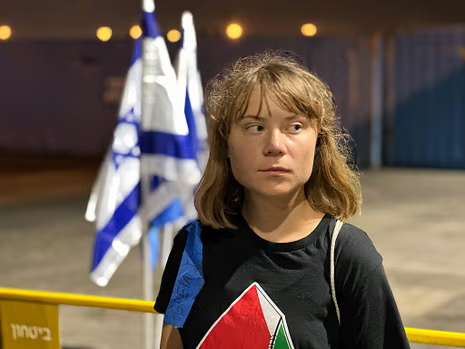
Swedish climate activist Greta Thunberg has been deported from Israel, a day after the aid vessel she was aboard — headed toward Gaza in defiance of Israel’s maritime blockade — was intercepted by Israeli forces in the Mediterranean.
The Freedom Flotilla Coalition (FFC), the activist group behind the voyage, said the small yacht The Madleen was intercepted early Monday while carrying what it called a “symbolic” quantity of humanitarian aid, including baby formula and medicine, in an attempt to draw global attention to the dire humanitarian situation in Gaza.
Thunberg and 11 others were on board the vessel, which the FFC said was intercepted in international waters, about 185 km (115 miles) west of Gaza. According to the group, the yacht was surrounded by quadcopter drones, sprayed with a white irritant substance, and had its communications jammed before being boarded.
In a pre-recorded video released after the interception, Thunberg said:
“If you see this video, we have been intercepted and kidnapped in international waters by Israeli occupational forces or forces that support Israel. I urge all my friends, family and comrades to put pressure on the Swedish government to release me and the others as soon as possible.”
On Tuesday morning, the Israeli Foreign Ministry announced that Thunberg had left Israel on a flight to Sweden via France, after agreeing to be deported. A photo shared by the ministry showed her sitting on a plane.
Other passengers aboard the Madleen included nationals from France, Brazil, Germany, the Netherlands, Spain, and Turkey. According to French Foreign Minister Jean-Noel Barrot, six French citizens were among the detainees. One agreed to leave voluntarily, but five refused to sign deportation orders and are now facing judicial proceedings in Israel.
The French nationals include MEP Rima Hassan and two journalists: Omar Faiad from Al Jazeera and Yanis Mhamdi from French investigative platform Blast. Reporters Without Borders confirmed both were documenting the voyage.
The Israeli Foreign Ministry dismissed the mission as a “gimmick” and described the Madleen as a “selfie yacht.” It insisted that the Gaza blockade is legal under international law and said the intercepted aid would be delivered “through real humanitarian channels.”
“We continue to demand the immediate release of all volunteers and the return of the stolen aid,” the FFC said in a statement. “Their kidnapping is unlawful and a violation of international law.”
Video footage released by the FFC showed the activists seated with their hands raised as Israeli forces boarded. Israel, for its part, shared footage showing the detainees being handed food and water, insisting all were “safe and unharmed.”
The yacht set sail from Catania, Italy, on 1 June, with the FFC stating its mission was to deliver aid and bear witness to what it called Israel’s “illegal and genocidal blockade” of Gaza.
Israel, which has imposed a strict land, sea, and air blockade on Gaza since Hamas seized control of the territory in 2007, maintains that the blockade is necessary to prevent weapons smuggling. Israeli Defence Minister Israel Katz reiterated that stance on Sunday, saying the naval blockade helps stop arms from reaching Hamas.
Israel fully halted aid and commercial deliveries to Gaza on 2 March, resuming its military campaign two weeks later after the collapse of a temporary ceasefire.
As legal proceedings unfold for some of the activists, the incident has once again stirred debate about Israel’s blockade, humanitarian access to Gaza, and the international response to ongoing hostilities in the region.
General Sani Abacha, who served as Nigeria’s seventh military head of state from 1993 to 1998, is widely regarded as one of the most controversial figures in the country’s history.
He came to power through a bloodless coup that overthrew the interim civilian government, led by late Ernest Shonekan in 1993.
During his rule, Abacha governed Nigeria with a strict and authoritarian approach. Both Nigeria’s domestic and foreign policies experienced significant setbacks under his leadership.
Although some remember him as a nationalist who defended Nigeria’s economic interests, his legacy is largely overshadowed by widespread human rights violations, massive embezzlement of public funds, and the oppressive control he exerted over the nation.
Loot claims against my husband are all lies – Maryam Abacha
Maryam Abacha, the former First Lady, in a recent interview, refuted accusations that her late husband, General Sani Abacha, embezzled Nigeria’s treasury during his tenure as military Head of State from 1993 to 1998.
She firmly stated that these allegations are entirely unfounded.
During an interview broadcast on TVC on Sunday, 8th June 2025, commemorating 27 years since Abacha’s death in office on June 8, 1998, she reiterated that the funds were not stolen, explaining that her husband’s financial transactions were intentionally misrepresented.
Over the years, several Nigerian administrations have retrieved hundreds of millions of dollars from foreign accounts, commonly known as the “Abacha loot.” These monies, repatriated from nations such as Switzerland, the United States, and the United Kingdom, have been allocated to different social investment initiatives.
She challenged those making the accusations to provide reliable proof.
The former First Lady stated: “Who is the witness of the monies that were being stashed? Did you see the signature or the evidence of any monies stashed abroad? And the monies that my husband kept for Nigeria, in a few months, the monies vanished.
“People are not talking about that. Why are you blaming somebody for something? Is that tribalism or a religious problem? Or what is the problem with Nigerians? I pray for Nigerians. I pray for all of us.
“I pray that we should have goodness in our hearts. We should stop telling lies and blaming people. Why are we so bad towards each other? Because somebody is a Northerner or a Southerner, somebody is a Muslim or a Christian, or somebody is nice. “It’s not fair. I think the press should try. You, the press, should try to educate the people. “You are here to educate the people, to inform the people, and to entertain. You are here to help the country. You are not here to bastardise people.”
But who was General Sani Abacha?
Early Life Of Abacha
Born in Kano in 1943 into a prosperous family, General Sani Abacha did not come from the humble beginnings common to many other military leaders.
His father owned a successful transport business, and the family was well-established in Kano. Abacha married Maryam Abacha in 1971, and together they had seven children.
After joining the Nigerian Army, Abacha rapidly advanced through the ranks and by 1983 had attained the rank of brigadier. That same year, he played a key role in assisting former Nigeria’s head of state, Ibrahim Babangida to overthrow Shehu Shagari, who was then serving his second presidential term.
Muhammad Buhari became Nigeria’s leader following the coup, but just two years later, Babangida overthrew Buhari and took power for himself, with Abacha serving as his second-in-command.
Abacha participated in several coups that significantly shaped Nigeria’s political landscape.
General Abacha eventually seized power on November 17, 1993, through a palace coup that removed the interim national government led by Chief Ernest Shonekan, a civilian administrator appointed just 82 days earlier to oversee the country’s transition to democracy.
A Regime Of Fear
Abacha’s rise to power ushered in one of the most oppressive regimes in Nigeria’s history. His rule was marked by the ruthless suppression of political opponents and a pervasive atmosphere of fear.
In 1995, Time Magazine labeled him “Thug of the Year,” reflecting the international community’s condemnation of his government. Under the command of Major Hamza al-Mustapha, Abacha’s secret police crushed any form of opposition. Journalists, pro-democracy activists, and political figures were either imprisoned or forced into exile.
His regime gained notoriety for its secret executions and the mysterious disappearances of dissenters.
Abacha feared no one and tolerated no dissent. He deposed the Sultan of Sokoto and imprisoned former Head of State Olusegun Obasanjo along with his deputy Shehu Musa Yar’Adua on fabricated treason charges. Yar’Adua did not survive the harsh conditions and died in prison in December 1997.
Even General Ibrahim Babangida, who had relinquished power to Abacha, remained silent throughout the brutal four-and-a-half-year reign.
The regime’s severe human rights abuses reached a peak with the execution of the ‘Ogoni 9’ activists, including the celebrated playwright and environmentalist Ken Saro-Wiwa, on November 10, 1995.
This event made Nigeria synonymous with state-sponsored repression. Abacha banned all political activities, dismissed a significant portion of the military, imposed strict control over the press, and built a personal security force of about 3,000 men.
Although he supported ECOWAS and its military wing ECOMOG in deploying troops to restore democracy in Liberia and Sierra Leone, he violently crushed dissent within Nigeria.
Notable political figures such as Moshood Kashimawo Olawale (MKO) Abiola and Olusegun Obasanjo, a former military ruler of Nigeria (1976–79), were imprisoned on charges of treason.
Wole Soyinka, Nigeria’s Nobel laureate, was also accused of treason after he voluntarily left the country.
In addition to these repressive actions, Abacha was notorious for looting vast sums of public funds, siphoning billions of dollars into secret foreign accounts, an act that further tarnished his legacy.
Beyond corruption and repression, his regime was responsible for many more abuses and excesses that left a lasting impact on Nigeria’s political and social fabric.
Abacha’s Death
On June 8, 1998, General Sani Abacha died suddenly in Abuja, fueling widespread speculation about the cause of his death. Official reports stated that he suffered a heart attack, but rumours persisted that he was poisoned, possibly by political rivals or foreign agents. His death was met with celebration across Nigeria, as people took to the streets to mark the end of his brutal rule.
In the aftermath of his death, Major-General Abdulsalami Abubakar took power and swiftly initiated a transition to civilian rule. This led to the election and swearing-in of Olusegun Obasanjo, marking the end of military dictatorship in Nigeria and the start of the Fourth Republic, on May 29, 1999.
Kenya’s police chief confirmed on Monday that a man who died in police custody over the weekend had recently filed a complaint against a senior police official.
Albert Ojwang, 31, was found unconscious in a cell at a Nairobi police station on Saturday and was later declared dead at a hospital. Police allege he suffered fatal injuries after “hitting his head repeatedly against a wall.”
However, his family and legal team dispute this version of events. “We saw the body yesterday. It had numerous injuries on the hands and shoulder area, and the head was severely swollen—particularly in the frontal region. There was blood from the nose and ears,” said Julius Juma, the family’s lawyer, at a press briefing outside the Nairobi morgue on Monday, where supporters had also gathered.
The incident has sparked widespread outrage, coming as the country marks the one-year anniversary of protests against tax hikes and corruption. Those demonstrations, which were met with a violent police response, resulted in the deaths of at least 60 people.
Inspector General of Police Douglas Kanja confirmed that Ojwang had been arrested following a complaint by Deputy Inspector General Eliud Kipkoech Lagat. “There was a complaint regarding defamation of the Deputy Inspector General. Investigations were underway because he also has the right to be protected by the law,” Kanja said.
Human rights organization Amnesty International has called for an “urgent, thorough, and independent” investigation into Ojwang’s death.
The case has added to growing concerns about a crackdown on government critics. Rights groups report that over 80 people have been detained without due process since the June 2024 protests, some for actions as minor as posting satirical cartoons of President William Ruto.
Former Attorney General Justin Muturi, whose son was reportedly detained during the protests, condemned Ojwang’s death. “The circumstances surrounding his death, including the alleged ‘suicide attempt’ in custody, are not just suspicious—they are outrageous,” Muturi wrote on X.
“They insult the intelligence of Kenyans and raise very serious concerns about the conduct, accountability, and integrity of our law enforcement agencies.”
The incident has increased calls for accountability and justice in cases of custodial deaths and alleged police abuse.
The federal government has launched a comprehensive investigation into a viral online video showing alleged neglect of accident victims at the Emergency Unit of the Federal Medical Centre, Jabi, Abuja. The video captured hospital staff refusing to treat patients, citing a lack of medical supplies such as latex gloves, resuscitation equipment, and patient transfer equipment.
However, the government has disputed these claims, stating that initial findings confirm the hospital’s emergency department was adequately equipped with the supplies mentioned in the video.
In response to the public outcry, the hospital has begun engaging with the staff on duty and relevant stakeholders to establish the facts of the incident. The hospital’s Public Relations Officer, Obadiah Gana, issued a statement on Sunday, noting that the Minister of State for Health and Social Welfare, Dr. Iziaq Adekunle Salako, has ordered a thorough investigation, with findings to be shared publicly.
The statement read:
“We have been made aware of an online video that negatively depicts our hospital. In response, we have initiated a thorough investigation to uncover the facts surrounding this incident. Our preliminary findings indicate the following:
“The emergency department had an adequate supply of medical consumables, including latex gloves, contrary to the claims made in the video.
“Resuscitation equipment and medications were sufficient. There was no shortage of patient transfer equipment, including trolleys and wheelchairs.”
“The Hon. Minister of State for Health & Social Welfare, Dr Iziaq Adekunle Salako has directed a full investigation of the incident which is ongoing. Findings of the investigation will be made available to the public.
“The management is committed to providing a full report of our investigation once it is completed. The Federal Medical Centre, Abuja, prides itself on its open-door policy. We have multiple patient feedback channels available, including several phone numbers displayed throughout the hospital, QR codes, and email contacts.
“In addition to running a medical indigent fund to assist underprivileged patients with hospital bills, we have successfully treated numerous unconscious patients and safely returned them to their relatives with the help of our social workers.
“Our facility is a hub for specialized procedures such as open-heart surgery, laser surgery, kidney transplants, spine surgery, and other high-end treatments that are not commonly available in most public hospitals.
“We apologize for any distress or discomfort caused and want to assure you that we take feedback seriously. We value the trust placed in us and are committed to providing quality care with empathy and compassion. We appreciate the feedback and will work towards improving the quality of our services.”
Two years into President Bola Ahmed Tinubu’s administration, the impact of his bold economic reforms is a hot topic nationwide. From subsidy removal to exchange rate unification, Tinubu launched an aggressive reform agenda aimed at stabilizing Nigeria’s shaky economy.
While these moves were framed as necessary steps to restore fiscal discipline and attract foreign investment, they’ve also come with painful side effects—soaring inflation, a weakened naira, and mounting pressure on small businesses and households.
The big question now is whether these reforms are setting the stage for long-term recovery or simply deepening economic hardship. While some analysts credit Tinubu’s policies with improving investor confidence and laying a foundation for growth, many Nigerians say the promised benefits are yet to reach them. As the administration enters its third year, expectations remain high for more inclusive and tangible results.
To provide the best experiences, we use technologies like cookies to store and/or access device information. Consenting to these technologies will allow us to process data such as browsing behaviour or unique IDs on this site. Not consenting or withdrawing consent, may adversely affect certain features and functions.
Functional
Always active
The technical storage or access is strictly necessary for the legitimate purpose of enabling the use of a specific service explicitly requested by the subscriber or user, or for the sole purpose of carrying out the transmission of a communication over an electronic communications network.
Preferences
The technical storage or access is necessary for the legitimate purpose of storing preferences that are not requested by the subscriber or user.
Statistics
The technical storage or access that is used exclusively for statistical purposes.The technical storage or access that is used exclusively for anonymous statistical purposes. Without a subpoena, voluntary compliance on the part of your Internet Service Provider, or additional records from a third party, information stored or retrieved for this purpose alone cannot usually be used to identify you.
Marketing
The technical storage or access is required to create user profiles to send advertising, or to track the user on a website or across several websites for similar marketing purposes.