Home Blog Page 199

Alaafin’s Authority Limited To Oyo, Says Ex-gov Aide

1

A former Senior Special Assistant on Special Duties to the late Ondo State Governor, Rotimi Akeredolu, Doyin Odebowale, has faulted the Alaafin of Oyo, Oba Abimbola Owoade, over his recent call for the Ooni of Ife to withdraw a chieftaincy title awarded to an Ibadan businessman.

In an interview on Channels Television’s The Morning Brief on Wednesday, Odebowale argued that monarchs exercise power only within their local government areas and cannot claim superiority over elected officials.

“With respect to most of these rulers now, there is a misapprehension of roles. They want to be addressed as Kabiyesi, but they are not.

“They are under the local government chairman in their respective localities. So this idea of somebody sitting in Oyo and legislating on what happens in Ile-Ife is a misnomer,” he said.

Odebowale added that the Alaafin must have been misinformed about an alleged conflict of authority between his throne and that of the Ooni of Ife.

“I want to believe that the Alaafin of Oyo must have been misled into believing that there is an extant issue to be resolved between that office and that of the Ooni. I don’t see any justification for this distraction,” he noted.

The former aide blamed recurring disputes among monarchs on what he described as “permissive decadence” in the traditional institution.

“It is a very pathetic situation in the sense that most of those who parade themselves as traditional rulers do not even know their function. It appears to me that they are in a hurry to discard tradition.

“They are so happy when they are addressed as Oba, assistant pastor, or Alhaji; that is total abnegation of traditional values,” he lamented.

He explained that the erosion of monarchs’ powers can be traced back to colonial rule, when the British reduced empires to stools and enacted chieftaincy laws restricting their influence.

According to him, rulers who accepted colonial titles and knighthoods forfeited their claim to supremacy.

“By government structure, their powers do not go beyond their local government, if you want to, by their letter. The Ooni of Ife is in Osun state, and they have their traditional council. The Alafin of Oyo is in Oyo state, and they have a traditional council.

“By the Oyo State chieftaincy law, only four Obas are recognised as imperial majesties. The Alaafin cannot act beyond his local government. By law, he is under his local government chairman,” Odebowale said.

Nazi-Looted Masterpiece Resurfaces In Argentina Real Estate Listing

1

More than eighty years after being taken by the Nazis, a Baroque portrait titled Portrait of a Lady (Contessa Colleoni) by Italian painter Giuseppe Vittore Ghislandi, also known as Fra Galgario, has resurfaced in a surprising way.

The artwork, once owned by Jewish art dealer Jacques Goudstikker in Amsterdam, was spotted in an online advertisement for a seaside villa near Buenos Aires. The painting was seen hanging above a sofa in the property’s living room, drawing attention from experts who monitor missing art from the Second World War era.

Further investigation linked the painting to the family of Friedrich Kadgien, a senior Nazi official and aide to Hermann Göring, who escaped to Argentina after the war. While art specialists confirmed that the painting’s colors, dimensions, and composition match historical records, they stress that only a physical inspection can determine its authenticity.

The heirs of Goudstikker, led by Marei von Saher, are determined to reclaim the painting. Von Saher had previously succeeded in recovering over 200 other works from the looted collection in 2006, though this particular portrait was not included at the time.

Argentine police have since raided the villa where the painting was photographed. Although the artwork itself was not found during the search, investigators seized other potentially valuable items, such as old engravings and reproductions. Authorities are now exploring possible charges, including concealment and smuggling.

This unusual discovery has reignited the long-running pursuit of looted cultural treasures, while also highlighting Argentina’s post-war history as a refuge for former Nazi officials.

Tinubu: Petrobras Set To Resume Operations In Nigeria

0

President Bola Tinubu has announced that Petrobras, Brazil’s state-owned oil company, will soon return to Nigeria, marking a renewed phase of cooperation in the energy sector between both nations.

The president made this known during a joint press conference in Brasília on Monday, as part of his state visit to Brazil. According to Bayo Onanuga, his special adviser on information and strategy, Tinubu welcomed the development, describing it as a step that will further strengthen bilateral economic ties.

“With Nigeria holding one of the largest gas reserves, it is only fitting that Petrobras partners with us again,” Tinubu said, while commending Brazilian President Luiz Inácio Lula da Silva for his commitment to making the move a reality.

Beyond energy, Tinubu disclosed that discussions also produced other agreements, including plans for Nigeria’s flag carrier, Air Peace, to launch direct flights from Lagos to São Paulo.Petrobras first entered Nigeria in 1998 but later divested its stakes to focus on domestic investments after mounting debts forced a $21 billion asset sale in 2017. However, in May 2025, Vice-President Kashim Shettima confirmed that the company had renewed interest in Nigeria, with a focus on deepwater exploration opportunities.

Russia Seeks To Replace France In Niger With Nuclear Power Deal

1

Russia is intensifying its bid to replace France’s long-standing dominance in Niger’s uranium sector by proposing the construction of a nuclear power plant in the country.

Despite being rich in uranium, Niger continues to face severe electricity shortages. For decades, the country exported uranium to France for processing, a dynamic that has drawn criticism under Niger’s military-led government, which has been distancing itself from Paris.

Moscow has seized the opportunity to expand its influence in the Sahel. It has already signed nuclear cooperation agreements with Mali and Burkina Faso, and recently concluded a deal with Niger. Under this agreement, Rosatom will support the development of nuclear infrastructure, including power plants, research reactors, and fuel supply systems.

Russia’s Energy Minister Sergei Tsivilev emphasized that the partnership is not limited to uranium mining, but aimed at building a comprehensive framework for peaceful nuclear development in Niger.

Niger’s government, pursuing a nationalization policy that insists on greater local benefit from its uranium resources, sees the deal as a way to expand beyond raw mineral exports. The partnership with Russia is set to cover mining, power generation, medical applications, and training of local professionals.

Analysts suggest the shift represents more than a diplomatic break with France. For decades, French control over Niger’s uranium industry prioritized fueling France’s nuclear reactors, while offering limited development benefits to Niger. By turning to Russia, Niger is seeking not only to redefine its energy future but also to assert itself as a producer of nuclear power, rather than just a supplier of raw materials.

Shea Nut Export Ban: What This Means For The Nigerian Economy

0

President Bola Tinubu has approved a six-month suspension on the export of raw shea nuts, a move aimed at strengthening Nigeria’s position in the global shea industry. The directive, announced by Vice President Kashim Shettima at a multi-stakeholder meeting in Abuja, takes immediate effect and will be subject to review after expiration.

According to the Federal Government, the ban is not a restriction on trade but a “pro–value addition policy” designed to protect local processors, curb informal cross-border trade, and ensure that Nigeria moves up the value chain in the global shea economy.

Why This Temporary Ban on Shea Nut

The government’s decision stems from concerns that Nigeria, despite producing nearly 40 percent of the world’s shea nuts, accounts for less than one percent of the $6.5 billion global shea market.

Minister of Agriculture and Food Security, Senator Abubakar Kyari, explained that an estimated 90,000 metric tonnes of raw shea are lost annually to informal cross-border trade, undermining the nation’s processors, who are operating at only 35–50 percent capacity despite a national installed capacity of 160,000 metric tonnes.

According to Kyari, “Without corrective action, Nigeria risked becoming a raw depot for opportunistic and illicit buyers, disempowering rural women and forfeiting billions in potential export revenues.” He noted that neighbouring countries such as Ghana, Burkina Faso, Mali, and Togo have already placed restrictions on raw shea exports to protect their local industries, leaving Nigeria vulnerable as the last open market.

The Vice President further framed the ban as a tool for economic empowerment and industrialisation. “This decision will transform Nigeria from an exporter of raw shea nut to a global supplier of refined shea butter, oil and other derivatives,” Shettima said. “It is about rural transformation, gender empowerment, and expanding Nigeria’s global trade footprint.”

What This Means for the Nigerian Economy* 

The government projects that the shea sector could generate at least $300 million annually in the short term and potentially position Nigeria to capture a significant share of the global market, projected to reach $9 billion by 2030.

Beyond revenue, the policy has social implications. With 90% of shea pickers and processors being women, the ban is expected to directly improve rural livelihoods and empower millions of women involved in the value chain. “By protecting the shea industry, we are protecting livelihoods, dignity and opportunity for millions of our women,” Shettima said.

The move also aligns with Nigeria’s Zero Oil Plan, which prioritises commodities with high global demand as alternatives to crude oil revenue. By scaling up domestic processing, the country hopes to build competitiveness against regional players like Ghana and Burkina Faso, who have already secured stronger positions in the international shea market.

If effectively implemented, the ban could mark a turning point for Nigeria’s non-oil export strategy, transforming the shea sector from an overlooked raw commodity into a global driver of industrialisation and inclusive growth.

Shocks And Late Drama Light Up The Carabao Cup Second Round

8

The Carabao Cup lived up to its reputation for unpredictability on Tuesday night, as underdogs toppled giants and late drama defined a thrilling evening of football. From Sheffield Wednesday’s stunning penalty shootout win over Leeds United to Wolves’ last-gasp comeback against West Ham, fans were treated to a night of surprises that left several Premier League sides embarrassed.

Elsewhere, Brentford edged Bournemouth in an all-top-flight clash, Wrexham struck a stoppage-time winner to eliminate Preston, and Sunderland once again crumbled on the big stage as Huddersfield progressed.

Sheffield Wednesday Stun Leeds in Penalty Thriller

The biggest shock of the night came at Hillsborough where Sheffield Wednesday dumped out Premier League side Leeds United in a dramatic penalty shootout. The Championship outfit, whose starting eleven had an average age of just 20, defied the odds with a spirited display. Leeds fell behind in bizarre fashion after goalkeeper Karl Darlow turned the ball into his own net, but Jayden Bogle rescued them with a late equaliser. The contest was eventually settled from the spot, with Wednesday goalkeeper Ethan Horvath producing two crucial saves while Dominic Calvert-Lewin missed his effort, sending the Owls through to the next round.

For Wednesday, the victory was as symbolic as it was sensational, coming in front of a sparse home crowd amid a fan boycott protesting against ownership issues. Leeds boss Daniel Farke, on the other hand, admitted his side’s defeat was embarrassing given their dominance in possession and their recent £50 million investment in new players.

Wolves’ Late Comeback Sinks West Ham

At Molineux, Wolverhampton Wanderers produced a dramatic turnaround to eliminate West Ham United with a 3–2 victory. The Hammers had looked in control after goals from Tomas Soucek and Lucas Paquetá put them ahead. But the match turned on its head in the dying minutes when Jørgen Strand Larsen struck twice in quick succession to snatch victory for Wolves.

The result piles further pressure on West Ham boss Graham Potter, whose side crashed out of the competition in chaotic fashion. To add to the night’s tension, Jarrod Bowen had to be restrained by teammates after clashing with angry travelling supporters, a moment that underlined the frustration within the camp.

Brentford Edge Bournemouth in Premier League Clash

In an all-Premier League encounter, Brentford came out on top against Bournemouth in a tightly contested affair. The Bees showed greater efficiency in the final third, taking their chances well and sealing progress at the expense of their top-flight rivals. For Bournemouth, the defeat was another reminder of their inconsistency in cup competitions, while Brentford’s disciplined performance hinted at their growing reputation as a side capable of navigating both league and knockout challenges.

Wrexham’s Late Winner Stuns Preston

Lower-league Wrexham added more drama to the evening by defeating Preston North End with a stoppage-time winner. Just as the game seemed destined for penalties, Wrexham found a 92nd-minute breakthrough to spark wild celebrations among their travelling fans. The result continued the fairytale narrative surrounding the club, whose Hollywood-backed rise has been one of football’s most followed stories in recent years.

Sunderland Crumble Again as Huddersfield Advance

For Sunderland, the Carabao Cup brought more disappointment as they suffered another early exit, this time at the hands of Huddersfield Town. Despite fielding a mix of academy prospects and senior players, the Black Cats failed to make their dominance count and were eventually undone in a penalty shootout. The defeat extends their poor record in domestic cup competitions, raising further questions about squad depth and mentality heading into the rest of the season.

The Carabao Cup delivered its trademark unpredictability, with underdogs stealing the spotlight and established sides faltering under pressure. Sheffield Wednesday’s triumph over Leeds will go down as the standout result of the night, while Wolves’ late surge left West Ham reeling. Elsewhere, Brentford handled their business, Wrexham kept their fairy-tale alive, and Sunderland’s struggles continued. For fans, it was another reminder that in this competition, no giant is ever truly safe.

Fashola Calls For Legislation To Save Nigeria’s Infrastructure

1

A former Minister of Works and Housing, Mr Babatunde Fashola, SAN, has called for legislation to make facility management and maintenance compulsory for public and private buildings across Nigeria, warning that failure to institutionalise the practice could undermine infrastructure sustainability.

Fashola, who delivered the keynote address at the IFMA Global Africa Conference 2025 in Lagos, stressed that sustainable facility management was critical to job creation, climate change adaptation, and efficient use of public resources.

A statement signed by IFMA Worldwide President/Chief Executive, Michael Geary, on Wednesday, quoted Fashola as saying that while building construction employs only about 30 per cent of professionals in the industry on a short-term basis, over 70 per cent derive long-term employment from the operation and maintenance of facilities.

Fashola said that “this is where the jobs are. We must move away from unsustainable empowerment models such as motorcycles and tricycles, which worsen carbon emissions, and instead channel resources into facility management as a viable and enduring alternative.”

He added that budgeting for infrastructure should go beyond construction to include maintenance contracts for schools, hospitals, roads, bridges, water facilities and government offices.

Highlighting the emergence of smart buildings equipped with sensor-based technology for lighting, heating, and water supply, Fashola said this underscored the need for a skilled workforce in facility management.

“Sustainability is not a buzzword. It is now a global requirement embedded in policy, financing and credit. Nigeria must pay attention if we are to prepare for rapid urban growth,” he stated.

In his speech, Michael Geary said the future of facility management is inextricably linked to sustainability, and nowhere is this more vital than in Africa. He explained that the continent’s rapid growth presents a unique opportunity to build and manage infrastructure that is not only efficient and resilient but also environmentally and socially responsible.

“By enabling sustainable FM practices, we are not just optimizing buildings—we are building a more prosperous and sustainable future for communities across Africa and setting a global standard for what is possible,” Geary said.

Earlier, IFMA Nigeria Chapter President, Engr Sherif Daramola, described the conference, the first of its kind in Nigeria, as the realisation of a 27-year-old dream by the association’s founding members.

He said the gathering of industry leaders, policymakers, innovators and students would reposition the built environment through topical presentations, panel discussions and technical sessions.

Global Chair of IFMA, Christa Dodoo, commended the Nigerian and Ghanaian chapters for their role in professionalising facility management in Africa, noting that Nigeria’s membership recently recorded a 200 per cent growth.

Dodoo warned that Africa must prepare for an unprecedented wave of urbanisation, with Lagos projected to become the world’s largest city by 2100 with an estimated 100 million residents.

“A skilled workforce must operate and maintain these facilities, holding them to the highest standards of efficiency, safety and functionality. This opens great potential for FM, but also makes it a huge asset for Africa’s economy and future,” she said.

NAF Opens 2025 DSSC Recruitment for Graduates and Professionals

0

The Nigerian Air Force (NAF) has announced the commencement of its Direct Short Service Commission (DSSC) Course 34/2025 recruitment exercise.

The notice, shared on NAF’s official X handle on Tuesday, said the application process is open to qualified Nigerians across various fields, including engineering, medicine, and cyber specialities, in line with the force’s evolving operational needs.

According to the announcement, applications are free and must be submitted online via the official NAF recruitment portal — https://nafrecruitment.airforce.mil.ng — between August 27 and October 7, 2025.

Eligibility Criteria

  • Applicants must be Nigerian citizens by birth.
  • Age: 20–32 years; Medical Doctors (consultants) may apply between 25–40 years.
  • Not open to serving personnel seeking Branch Commission. Personnel above 32 years are ineligible.
  • Serving personnel must have completed 10 years of service, attained the rank of Corporal, and have a recommendation from their Commanding Officer.
  • Minimum height: 1.66m for males, 1.63m for females.
  • Applicants must be free of any criminal convictions.
  • Candidates must be medically, physically, and psychologically fit according to NAF standards.
  • Minimum of Second Class Upper Division in any discipline, along with NYSC Discharge Certificate or Exemption Letter.

The NAF added that a Zonal Aptitude Test will be conducted on a date to be communicated through the recruitment portal. Successful candidates will subsequently be invited for the Selection Interview.

Train Derailment Forces Suspension of Abuja-Kaduna Rail Service

0

The Nigerian Railway Corporation (NRC) has suspended train operations along the Abuja-Kaduna corridor after a Kaduna-bound train derailed on Tuesday.

Speaking at a press briefing, NRC Managing Director Kayode Opeifa, confirmed the development and said investigations have commenced to determine the cause of the accident. He noted that technical teams from the NRC, the Nigeria Safety Investigation Bureau (NSIB), and other relevant agencies were already working on-site.

Opeifa dismissed speculations that the trains were poorly maintained, assuring that safety standards remain a priority. He further disclosed that refunds for passengers affected by the incident have been initiated.

According to him, six passengers sustained minor injuries and have since received medical attention. The total number of passengers onboard the derailed train had not been confirmed as of the time of the briefing.

Denmark Summons US Envoy Over Alleged Interference in Greenland

1

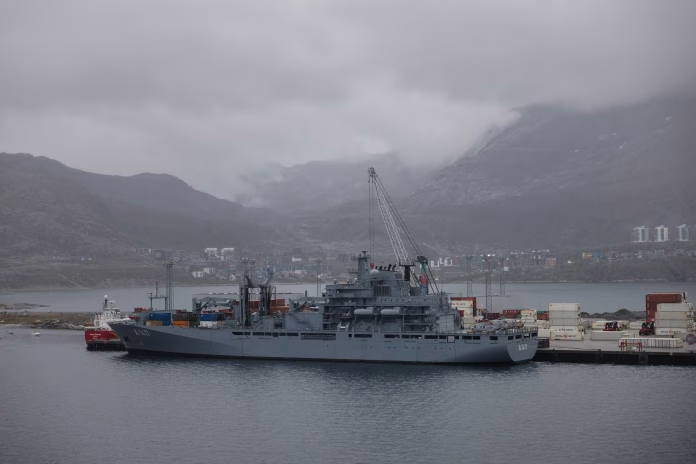
Denmark summoned the U.S. chargé d’affaires on Wednesday following reports of American interference in Greenland, the autonomous Arctic territory within the Danish kingdom.

Since his return to the White House in January, U.S. President Donald Trump has emphasized Greenland’s strategic value and has not ruled out using force to bring the island under U.S. control. However, a recent survey showed that while most of Greenland’s 57,000 inhabitants favor independence from Denmark, they reject any prospect of joining the United States.

Reports from Danish media indicated that at least three U.S. officials linked to Trump recently visited Greenland to examine past controversies straining relations between Denmark and Greenland. These include the historic forced removal of Greenlandic children from their families and cases involving coerced contraception.

Foreign Minister Lars Løkke Rasmussen stressed that foreign interest in Greenland’s future and its place within the Danish kingdom is ongoing. He warned that any effort to interfere in Denmark’s internal affairs would not be tolerated and confirmed that the U.S. envoy had been called in for discussions at the ministry.