
Home Blog Page 200

Morocco Edge Senegal On Penalties To Book CHAN Final Spot

10


The Mandela National Stadium in Kampala witnessed a pulsating clash on Tuesday, August 26, 2025, as Moroccobattled defending champions Senegal in the semi-final of the TotalEnergies African Nations Championship (CHAN 2024).

In what many had billed as a “final before the final,” the two African giants delivered an intense contest that ultimately went all the way to penalties. After a 1–1 draw in regular and extra time, the Atlas Lions held their nerve to win 5–3 on spot-kicks, securing their place in Saturday’s final against Madagascar.

Senegal Strike First

The encounter burst into life early when Joseph Layousse gave Senegal the lead in the 16th minute. Rising highest from a pinpoint corner by Libasse Guèye, Layousse headed the ball into the net, sparking jubilation among the Teranga Lions’ fans. It was a goal that showcased Senegal’s aerial dominance and set the tone for a fierce first half.
But Morocco, twice CHAN champions, responded quickly. Just seven minutes later, Sabir Bougrine produced one of the tournament’s standout moments, rifling a thunderous long-range strike into the top corner. The equaliser stunned Senegal and restored balance, proving Morocco’s resilience under pressure.

Morocco Regain Composure

After pulling level, Morocco began to control possession, slowing down Senegal’s early momentum. Their midfield trio dictated the tempo, while winger Youssef Mehri constantly probed the Senegalese backline. Senegal, however, nearly reclaimed the lead when Moussa Cissé tested Moroccan goalkeeper El Mehdi Al Harrar with a curling shot from distance, which was acrobatically tipped over.
The first half ended 1–1, with both teams showing attacking intent but also clear respect for each other’s defensive organisation.

VAR Drama and Second-Half Tensions

The second half carried the same intensity. Midway through, controversy struck when Moroccan defender Marouane Louadni appeared to foul Vieux Cissé, prompting the referee to issue a straight red card. Yet, after a VAR review, the decision was downgraded to a yellow, allowing Morocco to continue with eleven men. The incident, however, shifted momentum, with Senegal pushing harder for a breakthrough.
Both goalkeepers became heroes as the minutes ticked on. Marc Diouf, between the Senegal posts, denied Morocco twice, first from a Youssef Mehri drive and later from an Oussama Lamlaoui strike. At the other end, Al Harrar remained equally commanding, frustrating Senegal’s forward line with timely saves.

Extra Time: Nerves Take Over

As the match moved into extra time, fatigue crept in. The tempo slowed, and both teams struggled to carve out clear chances. Morocco relied on quick counter-attacks, while Senegal looked more direct, pumping balls into the Moroccan area.
Despite flashes of brilliance, Lamlaoui’s curling effort and Ndiaye’s glancing header, the decisive goal never came. With neither side able to find the net, the semi-final inevitably headed for the drama of penalties.

Penalty Shootout: Morocco’s Calm Prevails

In the shootout, Morocco’s composure proved the difference. The Atlas Lions converted all five of their penalties, with Hrimat, Lamlaoui, Khairi, Bach, and Mehri all scoring confidently. Senegal faltered at the worst possible time—captain Seyni Ndiaye struck the crossbar with their second penalty, leaving his teammates chasing.
Morocco’s perfect record from the spot sealed a 5–3 shootout victory, sending them into their third CHAN final in history and keeping alive their hopes of reclaiming the title they last won in 2021.

Post-Match Reactions

Speaking after the triumph, Moroccan coach Tarik Sektioui hailed his players’ resilience and unity: “This joy warms the heart. I love these players because they carry Morocco in their hearts. Against a great team like Senegal, we showed mental strength and character.”
For Senegal, coach Pape Thiaw acknowledged the pain of the defeat but praised his team’s performance. “We dominated parts of the game and created chances, but football can be cruel. One missed penalty made the difference.”

Morocco will now face Madagascar in the CHAN final on Saturday, August 30, at the Moi International Sports Centre, Kasarani, in Nairobi. It will be a clash of styles—Madagascar’s fairytale run against Morocco’s pedigree and experience. Meanwhile, Senegal will travel to Dar es Salaam to contest the third-place playoff against Sudan.
The final promises fireworks, with Morocco aiming for a record-equalling third CHAN crown, while Madagascar dreams of a historic maiden title.

Nelfund Issues Guidelines For Student Loan Scheme

21

The Nigerian Education Loan Fund (NELFUND) has released guidelines for the implementation of the federal student loan scheme in public universities, polytechnics, and colleges of education.

Applicants must be Nigerian citizens with valid admission and provide NIN, BVN, and JAMB details through the NELFUND portal. Loans will be paid directly to institutions for tuition, with optional upkeep allowances to students. Repayment begins two years after NYSC or exemption, with 10% of income deducted monthly.

Institutions must verify applications within 20 working days, refund where necessary, and comply with reporting rules or risk suspension. NELFUND also pledged fairness, equity, and data protection.

Managing Director Akintunde Sawyerr said the scheme aims to remove financial barriers and expand access to higher education.

Further details are available on www.nelf.gov.ng and NELFUND’s official social media channels.

France Returns Skull of Madagascar’s King After 128 Years

2

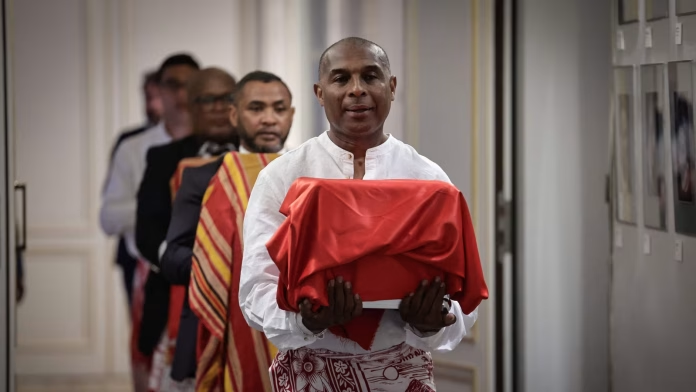
France has returned the skull believed to belong to King Toera, the last ruler of the Sakalava kingdom of Menabe in western Madagascar. Officials also handed over the skulls of two other high-ranking court members.

They made the historic return official during a ceremony on Tuesday, August 26, 2025, in Paris. This gesture closes a 128-year chapter of unresolved colonial injustice and marks the first human remains restitution under France’s 2023 cultural property law.

People across Africa see the event as a major step in addressing the painful legacy of colonialism. It has reignited calls to return other human remains and cultural artifacts to their countries of origin.

Historical Background

In August 1897, during France’s violent colonization of Madagascar, King Toera led armed resistance against French troops in the Menabe region. French forces captured and executed him after a fierce battle.

Historical accounts report that French troops beheaded him. They brought his skull, along with those of two of his advisors, to France and placed them in the Muséum National d’Histoire Naturelle in Paris.

King Toera: The Malagasy King Who Was Beheaded for Resisting French Rule in  1897 - TalkAfricana

For over a century, museum staff stored the remains in archives. Anthropologists used them for studies—a common colonial-era practice now widely condemned as unethical.

In Malagasy culture, the soul cannot rest if the body remains incomplete. The Sakalava people saw the absence of King Toera’s remains as a deep spiritual wound.

Madagascar first requested the return of the skulls in 2003. Descendants, including Princess Marie Francia Kamamy, renewed the appeals in 2024 and placed growing pressure on the French government.

The Return Ceremony

France returns three colonial-era human skulls to Madagascar | Reuters

The French Ministry of Culture hosted the official return ceremony in Paris. French Culture Minister Rachida Dati handed the remains to her Malagasy counterpart, Volamiranty Donna Mara.

Minister Dati acknowledged that France had added the skulls to its national collections “in circumstances that clearly violated human dignity.” She said the return forms part of a broader effort to address colonial-era wrongs.

Minister Mara responded with emotion, saying, “Their absence has been, for more than a century—128 years—an open wound in the heart of our island.” She added that the return helps bring closure to a long and painful history.

Officials will fly the skulls back to Madagascar in the coming days. Sakalava leaders will carry out traditional burial rites to allow King Toera’s spirit to finally rest.

Although DNA tests proved inconclusive due to the skulls’ age and condition, experts from a joint Franco-Malagasy committee concluded that the remains most likely belonged to Sakalava individuals.

The Significance

A Paris Museum Has 18,000 Skulls. It's Reluctant to Say Whose. - The New  York Times

This restitution marks a turning point in how France handles colonial history and African heritage.

French museums still hold more than 20,000 human remains. The return of King Toera’s skull could set a powerful precedent for future restitutions. In response, other African countries—including Senegal, Ghana, and Namibia—have renewed their demands for similar returns.

In Madagascar, the return serves as a unifying moment. It promotes national reflection, cultural revival, and greater youth engagement in preserving ancestral heritage.

This event also follows French President Emmanuel Macron’s April 2025 visit to Antananarivo, where he publicly asked for forgiveness for France’s colonial violence in Madagascar.

As global movements push for decolonization and historical justice, France’s return of King Toera’s skull signals a growing willingness to acknowledge and address long-ignored histories—with dignity and respect.

Upholding Standards: The Role Of Federal Education Quality Assurance Service

27

Nigeria’s vast and complex education system makes it a huge challenge to ensure that every school, whether public or private, meets the required standards. With over 100,000 primary and secondary schools across the country, monitoring and maintaining quality is no small task.

Reports have emerged of some institutions, particularly private schools, operating without proper accreditation, highlighting the need for stricter oversight. The work of the Federal Education Quality Assurance Service (FEQAS) goes beyond simply identifying these gaps; it’s about creating a clear roadmap for improvement and holding institutions accountable.

The challenges facing Nigeria’s education sector are well-known from learning poverty and inadequate funding to poor teacher quality but tackling them demands a coordinated and strategic effort. FEQAS plays a crucial role in this process, ensuring compliance, promoting accountability, and driving initiatives that raise educational standards nationwide. Upholding quality education is not just about regulation; it’s about shaping the future of millions of Nigerian students and providing them with opportunities to thrive.

UNILAG ASUU Rejects FG Loan Scheme, Calls It a ‘Greek Gift’

16

The Academic Staff Union of Universities (ASUU), University of Lagos chapter, has rejected the Federal Government’s proposed loan scheme for lecturers, describing it as a “Greek gift” that its members are unwilling to accept.

The decision was announced during a special congress on Tuesday, where members also restated their support for the union’s national leadership and its ongoing strategies to press home their demands.

According to the resolutions, the UNILAG branch pledged to stand by all steps being taken at the national level to ensure lecturers’ welfare and entitlements are addressed.

Speaking to members who marched around the campus from the Main Gate, the Branch Chairman, Prof. Idowu Kehinde, argued that the government should instead prioritize paying lecturers their rightful entitlements.

“The loans are to be guaranteed by our union. This is not necessary; the Governing Council of each university can give loans to our members based on our conditions of service. If we are paid a living wage and if all our allowances are paid as expected, who would want to go borrowing money? Let them do the needful, and we are okay,” he said.

Nigeria-Brazil Bi-lateral Agreement: What It Means For Nigeria

1

Nigeria and Brazil have entered a new phase of diplomatic and economic partnership following the signing of a bilateral agreement aimed at enhancing direct cooperation across key sectors, including aviation, trade, and cultural exchange.

The accord was formalized during President Bola Tinubu’s official visit to Brazil, from 24 to 25 August 2025, where discussions centered on strengthening ties between Africa’s largest economy and South America’s largest nation. The agreement is designed to open new channels for investment, improve connectivity, and reinforce both nations’ long-standing historical and cultural relationship.

Who was present at the meeting

The signing took place in Brasília, hosted by Brazilian President Luiz Inácio Lula da Silva. President Tinubu was accompanied by senior Nigerian officials, among them Wale Edun, Minister of Finance and Coordinating Minister of the Economy; Festus Keyamo, Minister of Aviation and Aerospace Development; Abubakar Kyari, Minister of Agriculture; and Bianca Onoh Ojukwu, Minister of State for Foreign Affairs.

On the Brazilian side, key figures included Minister of Transport Silvio Costa Filho and other cabinet members responsible for economic and infrastructural development.

What was the outcome of the meeting

The high-level discussions between Nigeria and Brazil produced five major Memoranda of Understanding (MoUs), each tailored to deepen cooperation across critical sectors.

1. Bilateral Air Services Agreement (BASA): Signed between Nigeria’s Minister of Aviation and Aerospace Development, Festus Keyamo, and Brazil’s Minister of Ports and Airports, Silvio Costa Filho. This deal paves the way for direct flights between both countries, aimed at boosting trade, tourism, and people-to-people ties.

2. Diplomatic Training Cooperation: Signed by Nigeria’s Minister of State for Foreign Affairs, Bianca Onoh Ojukwu, and Brazil’s Minister of Foreign Affairs, Mauro Vieira. The agreement establishes frameworks for diplomatic training exchanges and capacity building.

3. Political Consultation Mechanism: Also signed by both Foreign Affairs ministers, this MoU provides a platform for regular consultations on bilateral, regional, and global issues of mutual concern.

4. Science, Technology, and Innovation Partnership: Nigeria’s Minister of Innovation, Science, and Technology, Geoffrey Nnaji, and Brazil’s Minister of Science, Technology, and Innovation, Luciana Santos, endorsed an agreement covering cooperation in biotechnology, ocean science, energy, space development, digital transformation, and raw materials research.

5. Agricultural and Trade Financing Cooperation: The Managing Director of Nigeria’s Bank of Agriculture, Ayo Sotinrin, and Brazil’s Minister for the National Bank for Economic and Social Development (BNDES), Aluísio Mercadante, signed an MoU to strengthen agricultural financing, promote investment, and support joint projects in agribusiness and rural development.

What this agreement means for Nigerians

For Nigeria, the agreements represent more than improved connectivity; they signal new openings for growth in diplomacy, science, agriculture, and trade. The direct air service will ease travel and enhance people-to-people exchange, while diplomatic training and political consultations will strengthen Nigeria’s voice in global affairs.

Cooperation in science and technology is expected to boost research and innovation, offering opportunities in biotechnology, energy, and digital transformation. The agricultural financing deal promises greater access to funding, technology transfer, and investment for Nigerian farmers, potentially improving food security and agribusiness development.

Altogether, these accords lay the foundation for stronger economic integration, deeper cultural ties, and a renewed partnership that places Nigeria at the center of South-South cooperation.

In the words of President Tinubu:

“Nigeria’s future lies in expanding partnerships that deliver real benefits to our people. This agreement with Brazil is a foundation for prosperity, opportunity, and a new era of cooperation across continents.”

Botswana Declares Health Emergency Over Drug Shortage

1

President Duma Boko of Botswana declared a national public health emergency on August 25, 2025, following a critical collapse in the country’s medical supply system. Hospitals and clinics across the nation have run out of essential medicines and equipment.

The crisis has disrupted treatment for cancer, HIV, tuberculosis, and diabetes. Elective surgeries are suspended, and rural clinics face severe shortages. The government has launched an emergency response to stabilise the situation.

Botswana declares health emergency amid critical medicine shortages |  Africanews

P250 Million Emergency Fund Launched as Military Takes Over Distribution

President Boko announced the release of P250 million to fast-track medical procurement. The Finance Ministry approved the funds to address the urgent shortage and restore minimum health services within days.

The Botswana Defence Force has taken control of nationwide distribution. Military teams are prioritising clinics in rural and high-risk areas. Trucks began moving supplies out of Gaborone on the evening of August 25.

Health officials say military-led delivery ensures speed, oversight, and security. Remote clinics in Maun, Francistown, and Gantsi are among the first locations receiving critical supplies.

Diamond Slump and U.S. Aid Cuts Blamed for System Collapse

Botswana’s health crisis was triggered by a steep decline in diamond revenues. The global slowdown in diamond demand has slashed national income, affecting government spending on healthcare.

Additionally, U.S. aid to Botswana’s health programs has decreased substantially. These funding cuts have strained public clinics and delayed essential purchases of drugs and medical tools.

President Boko blamed the country’s central medical stores for operational failure. “The medical supply chain has failed and disrupted health services nationwide,” he said during a national address on August 25.

Poor procurement practices, inflated prices, and weak stock tracking made the problem worse. Audits revealed years of mismanagement in the national supply system.

Why Bread Is Still Expensive Despite Falling Flour Prices

18

Even though flour prices have dropped with a bag falling from over ₦80,000 to around ₦55,000–₦56,000, bread remains costly for many Nigerians. The reason goes beyond flour; other imported ingredients like sugar, yeast, and butter also influence production costs.

There’s also a gap between bakery prices and what consumers pay, as distributors and retailers are often accused of maintaining high profit margins despite reduced costs.

This price disconnect is part of Nigeria’s broader food inflation problem. The average price of a 500g sliced bread jumped 89.48% year-on-year, from ₦553.03 in February 2023 to ₦1,047.86 in February 2024. While food inflation has eased to 22.74% as of July 2025, many households still feel the pinch.

According to NBS, the Nigerian bread market could generate $18.81 billion in 2025, yet without addressing distribution costs and mark-ups, bread may remain out of reach for many families.

Typhoon Kajiki Sweeps Through China, and Laos, Triggering Evacuations

2

Typhoon Kajiki, which has now weakened into a tropical storm, has struck Vietnam, China, and Laos, leaving behind flooding, landslides, and widespread disruption. In Vietnam, authorities reported heavy rainfall that damaged homes, caused dangerous landslides, and forced flight cancellations.

The government ordered tighter monitoring of dams and vulnerable areas, while emergency teams were mobilised with building materials, transport, and rescue equipment to strengthen flood defenses. Officials also enforced evacuation plans for people living in coastal and low-lying regions, warning citizens to avoid travelling near rivers and dams.

Airports in several provinces, including Quang Tri, Thanh Hoa, and Nghe An, were temporarily closed, though no significant damage to the facilities was reported. Airlines began rescheduling flights as the storm passed. Prime Minister Pham Minh Chinh directed emergency measures across provinces such as Thanh Hoa, Nghe An, Ha Tinh, and Quang Tri, urging swift evacuations from high-risk zones to prevent further loss of life.

In China’s Hainan province, local authorities issued a yellow alert, the third-highest warning on the four-tier system. More than 100,000 people were affected by flooding and fallen trees across multiple counties and cities, though officials confirmed there had been no casualties so far.

Kajiki also reached Laos, where it brought intense rainfall. At present, the country has not reported casualties or serious damage to infrastructure, but weather services are continuing to monitor the situation. The storm system is expected to move further westward in the coming days, bringing rainfall to Thailand.

Japan Clarifies No Special Visa Plans for Nigerians Under ‘Hometown’ Initiative

3

The Japanese government has denied reports suggesting that Nigerians, or other African nationals, would receive special visas as part of its “JICA Africa Hometown” initiative.

In a statement issued on Monday, Japan’s Ministry of Foreign Affairs clarified that claims regarding a new visa category for Nigerians moving to Kisarazu city were incorrect.

The ministry explained that during the ninth Tokyo International Conference on African Development, the Japan International Cooperation Agency (JICA) launched the Africa Hometown program, aimed at enhancing exchanges between African nations and Japanese local governments.

“Under this initiative, four cities in Japan have been designated as ‘home towns’ for four African countries. JICA plans to foster interactions between these cities and African nations through various activities, including organizing exchange events with JICA’s overseas cooperation volunteers,” the statement read.

However, Japan emphasized that there are no plans to introduce measures that would promote immigration or issue special visas for African nationals. The Ministry also stated that reports claiming such measures were being considered were false.

“Contrary to recent reports, no special visa programs for African nationals, including Nigerians, are in the works. The Ministry of Foreign Affairs will continue to work towards ensuring that accurate information is disseminated on this matter,” the statement continued.

This clarification comes after PUNCH Online reported last week that Nigeria’s government had announced Japan’s designation of Kisarazu city as the “hometown” for Nigerians. The report suggested that the city would also create a special visa category for skilled Nigerian youth and blue-collar workers.

In the initial statement, Nigeria’s Chargé d’Affaires in Japan, Mrs. Florence Akinyemi Adeseke, and Kisarazu’s Mayor, Yoshikuni Watanabe, were said to have received a certificate marking the city as Nigeria’s designated “hometown.”
