Home Blog Page 25

NDC Defends Primary Elections, Denies Allegations Of Candidate Imposition

0

The Nigeria Democratic Congress (NDC) has defended the conduct of its recently concluded primary elections, insisting that no candidate was imposed by the party’s national leadership.

The party maintained that all aspirants were given equal opportunities to participate in a transparent and democratic process, while emphasizing that candidate selection was based on consultations, consensus-building, and stakeholder engagement across the country.

In a statement released on Thursday, the party’s National Secretary, Barrister Ikenna Enekweizu, dismissed allegations that the NDC National Secretariat influenced the emergence of candidates in any state or constituency.

According to him, the party’s leadership did not interfere in the selection process.

“At no time has the NDC National Secretariat been involved in the business of picking, choosing, or imposing candidates on any constituency or state,” Enekweizu stated.

He explained that aspirants were encouraged to engage with caucus leaders, stakeholders, and grassroots members in their various states, who were responsible for consultations and recommendations based on local political realities.

The party said its candidate selection process relied heavily on established leadership structures and stakeholder consultations at the state level.

According to the NDC, its presidential candidate, Peter Obi, joined the party with a network of respected political leaders and elder statesmen, particularly in the South-East, who currently serve as caucus heads in the region.

Among those mentioned were former governors Sam Egwu, Okwesilieze Nwodo, and Achike Udenwa, alongside other senior political figures.

“These leaders were entrusted with conducting stakeholder consultations, building consensus, and making recommendations to the party based on their understanding of the peculiar political dynamics in their respective states,” the statement said.

The party stressed that aspirants who disagreed with recommendations made by stakeholders or caucus leaders were not shut out of the process.

Instead, they were given the opportunity to participate in grassroots primaries and test their popularity among party members.

“This process was conducted without prejudice to the rights of any aspirant.”

“Where aspirants disagreed with recommendations made by stakeholders or caucus leaders, they were free to test their popularity through the democratic process at the grassroots level, and this was duly accommodated,” the party said.

While acknowledging concerns raised by some aspirants following the primaries, the NDC said reports of premature declarations of victory and complaints regarding aspects of the process had already been forwarded to the party’s appeal panel and leadership for review.

The party reiterated its commitment to fairness, transparency, and internal democracy in resolving any disputes arising from the exercise.

The NDC also highlighted efforts to promote greater female participation in politics through its affirmative action policy.

According to the party, measures were put in place to encourage more women to contest elective positions while balancing the interests of serving lawmakers and other stakeholders.

Looking ahead, the NDC announced plans to commence a broad reconciliation process aimed at fostering unity and healing divisions that may have emerged during the primaries.

“As resolved at yesterday’s NEC meeting, we now look forward to the commencement of a comprehensive reconciliation process,” Enekweizu said.

“We count on our esteemed caucus leaders, state chairmen, stakeholders, and party leaders to engage all aspirants and members in the interest of unity, cohesion, and the continued growth of our party.”

The party stated that its primary role throughout the nomination process was to welcome new members and aspirants, assure them of fairness and transparency, and direct them to the appropriate caucus structures for participation in party affairs.

According to the NDC, its approach reflects a strong commitment to internal democracy, consultation, inclusiveness, and respect for established leadership structures as preparations continue for future elections.

TCN Announces Daily Power Outages In Delta

0

The Transmission Company of Nigeria (TCN) has announced a temporary disruption of electricity supply across several communities in Delta State as it carries out ongoing maintenance work at the Delta 132/33kV Transmission Substation.

In a statement shared on its official X handle on Friday, the company disclosed that the maintenance exercise commenced on June 4 and will run daily from 10:00 a.m. to 5:00 p.m. until June 16, 2026.

According to TCN, the exercise is part of efforts to improve the reliability and efficiency of power infrastructure in the area.

“The maintenance is to facilitate the connection of a bus coupler circuit breaker and the rehabilitation of five isolators on the main busbar,” the statement said.

The company explained that several 33kV feeders supplied from the Effurun and Delta 132/33kV Transmission Substations will be temporarily shut down during the maintenance period.

The affected feeders include “Effurun, Warri, Sapele, Osubi, PTI, PMSL, Refinery I, Refinery II, Enerhen, Isoko/Kwale, Otovwodo/Patani, Ughelli/Shell, Agbarho/Eku, Aladja, Imoniyame and Beta Glass.”

As a result, customers connected to these feeders are expected to experience daily power interruptions throughout the maintenance period.

TCN, however, assured residents and businesses that electricity supply would be restored at the conclusion of each day’s maintenance activities.

“Power supply will be restored daily at 5:00 p.m., enabling Benin DisCo to offtake electricity for its customers, following the completion of each day’s maintenance activities,” TCN stated.

The company also expressed regret over the temporary inconvenience and appealed for understanding from affected electricity consumers.

“TCN apologises for every inconvenience caused by the ongoing maintenance exercise,” the statement added.

Peter Obi, Oby Ezekwesili Urge Nigerians Not To Blame Pastor Adeboye For Insecurity

0

Former Labour Party presidential candidate, Peter Obi, and former Minister of Education, Obiageli Ezekwesili, have appealed to Nigerians to stop directing their frustration over the country’s worsening insecurity and economic difficulties at the General Overseer of the Redeemed Christian Church of God, Enoch Adeboye.

Both leaders argued that while citizens have legitimate concerns about the state of the nation, holding the respected cleric responsible for challenges such as insecurity and economic hardship is misplaced.

In a post shared on his X (formerly Twitter) account on Thursday, Obi likened the criticism directed at Pastor Adeboye to the ethnic and religious tensions that nearly overshadowed issues of governance during the 2023 elections, particularly in Lagos State.

According to Obi, discussions that should have focused on leadership, competence, development, and national progress were gradually redirected toward tribal and ethnic sentiments, creating unnecessary divisions among Nigerians.

He cautioned that similar tactics appear to be resurfacing, with narratives being deliberately amplified and spread by individuals who may genuinely believe they are defending a just cause.

“Pastor Enoch Adeboye remains one of the foremost fathers of faith in our nation. For decades, he has consistently preached the virtues of peace, prayer, love, reconciliation, and national unity. Even when faced with provocation, his response has always reflected humility, restraint, wisdom, and grace. It is unfair to transfer to an 84-year-old man, responsibilities that rightly belong to the younger generation. The task of building a better Nigeria rests primarily on the shoulders of the younger generation. We must be careful not to become instruments in the hands of those who secretly nurture division while publicly preaching unity.”

Echoing Obi’s position, Ezekwesili acknowledged the frustration many Nigerians feel about the country’s challenges but maintained that Pastor Adeboye should not be made a target of public anger.

She described the cleric as a spiritual leader deeply rooted in biblical teachings and noted that his habit of responding to criticism with restraint is a lesson she personally learned from him.

“Pastor Adeboye is not our problem. He speaks. He spoke in the 1990s.He spoke in the early 2000s. He spoke in 2010. He spoke in 2020. He spoke in 2025. He has spoken across administrations, regardless of who governed or governs as President. The real question is: How many of us were listening?”

The remarks from Obi and Ezekwesili come amid growing public concern over rising insecurity, economic hardship, and governance challenges across Nigeria.

Both leaders stressed the need for Nigerians to focus on constructive engagement, accountability, and national unity rather than directing blame at religious leaders who, they argue, have consistently advocated peace and moral values over the years.

Their comments have sparked fresh conversations about leadership responsibilities, citizen engagement, and the role of faith leaders in addressing national issues.

Fear Grows In Nigerian Schools As Stakeholders Demand Urgent Action On Rising Insecurity

0

Nigeria’s education sector is facing renewed concerns as growing insecurity across parts of the country continues to threaten the safety of students, teachers and school communities. Following recent abductions in several states, schools have heightened security measures while education stakeholders are calling on federal and state governments to take swift action to protect learning environments.

Reports indicate that some parents have begun withdrawing their children from schools after receiving security alerts about potential attacks in parts of Northern Nigeria.

One concerned parent, Chief Remi Olokun, expressed his fears on a university platform, saying he remains vigilant about the security situation affecting his children.

“I am on red alert and monitoring the situation in my children’s university and polytechnic. If I get any negative report, I will recall them home,’’ he stated.

Amid the growing concerns, the Pan-Atlantic University (PAU), Lagos, issued a security advisory to staff and students after receiving reports of security-related threats within the Ibeju-Lekki area.

The university stated:

“While normal activities are expected to continue as usual, all members of the community are advised to remain vigilant and exercise caution in their daily movements. The university is actively monitoring the situation and will communicate further updates and guidance as developments warrant.”

The institution further advised students and staff to remain alert, observe their surroundings carefully and promptly report any suspicious activity to security authorities.

NAPPS Calls for Immediate Rescue of Abducted Victims

The National Association of Proprietors of Private Schools (NAPPS) expressed concern over what it described as the slow pace of rescue efforts involving abducted teachers and pupils.

In a statement signed by National President Dr. Samira Jibir and National Secretary Dr. Kayode Adeyemi, the association condemned the kidnappings and called on all levels of government and security agencies to secure the immediate release of those still in captivity.

NAPPS also commended private school owners in Ogbomoso, Oyo State, for temporarily shutting down schools and organizing prayers for the safe return of the victims.

The association pledged continued engagement with government officials and stakeholders while urging authorities to strengthen security around schools nationwide.

Teachers’ Union Warns Schools May Shut Nationwide

The Lagos State chapter of the Nigeria Union of Teachers (NUT) described insecurity as one of the greatest challenges currently facing the education sector.

According to the union’s secretary, Mr. Gbenga Aiyetoba:

“The abduction of children and killing of our members are unacceptable. Our schools are longer safe for teaching and learning. Oyo State schools have been shut and we have told government that if nothing is done, schools nationwide will be closed. Our national leaders have communicated this to the government.’’

ANCOPSS Raises Alarm Over School Safety

The President of the All Nigeria Confederation of Secondary Schools (ANCOPSS), Mr. Masheyi Abayomi, warned that the country risks serious consequences if insecurity in schools is not urgently addressed.

“A nation whose future leaders are in the forest and teachers are afraid to go to school is doomed,” he said.

Abayomi noted that many schools remain vulnerable due to inadequate infrastructure, citing the absence of perimeter fencing in some affected schools.

“We visited the school in Oyo, there is no fence. Safety is the biggest problem in our schools. We need government action to tackle the security challenge. We are moving to a dangerous situation.

“Hope we will not get to a situation when principals and teachers will come to schools with weapons to protect themselves,’’ Abayomi stated.

Education Experts Demand Stronger School Protection

National President of the Association for Formidable Educational Development (AFED), Orji Kanu Emmanuel, described the current security concerns as alarming.

“It is alarming to say the least. Our schools have become central targets for kidnappers, bandits, terrorists and other non-state actors. It is sad and I am worried because this has turned into a lucrative commercial venture for perpetrators who remain largely unchecked.

“No, teachers and pupils are not safe enough. When fear replaces focus in the classroom, learning stops. Safety is not just the absence of attack; it is the presence of confidence. That confidence is missing today.”

He advised school owners to strengthen security through perimeter fencing, controlled access points and stronger collaboration with communities, vigilante groups and law enforcement agencies.

Orji also warned against shutting down schools nationwide, arguing that doing so would hand victory to criminal elements.

“Shutting down schools means absolute surrender. It means ceding governance and sovereignty to enemies. ‘One child out of school is one child for the street’ – and for recruitment by criminals.

“Instead of closure, we need targeted protection. If a specific school has a credible threat, relocate pupils temporarily and deploy security. But closing schools nationwide hands victory to terrorists. Education must not stop because criminals are active,” he stated.

He further urged government to declare an emergency on school security and take urgent measures to restore confidence in the education system.

Calls for Better Security Funding and School Protection Force

Other stakeholders also weighed in on the growing insecurity.

The Director of Corporate Affairs at Nigerian Breweries Plc, Uzodinma Odenigbo, called for stronger collaboration among stakeholders to ensure schools remain safe learning environments while expressing hope for the swift release of abducted students and teachers in Oyo and Borno states.

Executive Director of the African Students Education Support Initiative (ASESI), Chinonso Obasi, described the abductions as evidence of worsening insecurity and leadership failure.

“As an organisation dedicated to advancing education and protecting the welfare of students, we are deeply concerned that innocent children continue to be targeted while pursuing their right to education.”

Obasi stressed that insecurity is discouraging school attendance and worsening Nigeria’s out-of-school children crisis.

NANS Pushes for Local Government Autonomy

National President of the National Association of Nigerian Students (NANS), Akinteye Babatunde Afeez, argued that granting full local government autonomy could help improve security at the grassroots level.

“If local governments are financially empowered, they will be better equipped to respond to these criminals and strengthen security within their jurisdictions,” he said.

Former NANS President Advocates Dedicated School Security Force

Former NANS President Lucky Emonefe called for the creation of a specialized security unit focused solely on protecting schools, particularly those located in rural communities where attacks are more frequent.

“The criminals are not targeting schools in major cities. Their focus is largely on schools in rural communities where security presence is weak. These institutions should be adequately protected because they have become soft targets,” he said.

He also called for more effective use of security budgets and urged governments at all levels to prioritize the protection of schoolchildren.

“Insecurity is a common enemy. Government must strengthen its response measures. When citizens see concrete action, they will have greater confidence that authorities are genuinely committed to addressing the challenge,” he added.

As concerns continue to mount, education stakeholders across Nigeria are united in one message: protecting schools, teachers and students must become an urgent national priority.

Zelensky Proposes Face-To-Face Talks In Open Letter To Putin

0

Ukrainian President Volodymyr Zelensky has publicly invited Russian President Vladimir Putin to hold direct face-to-face talks aimed at ending more than four years of war, issuing a rare open letter that combines a call for peace negotiations with a warning that Ukraine is prepared to continue fighting if diplomacy fails.

The letter, published on June 4 and addressed directly to the Kremlin leader, marks one of the few times Zelensky has publicly appealed to Putin since Russia launched its full-scale invasion of Ukraine in February 2022. In the message, Zelensky proposed a personal meeting in a neutral country and urged Putin to seize what he described as an opportunity to end the conflict.

“Ukraine proposes ending this war through direct engagement between us — and you. I am proposing a meeting,” Zelensky wrote, adding that Ukraine would be prepared to observe a full ceasefire for the duration of negotiations. He suggested potential venues including Switzerland, Turkey or Arab states that could serve as neutral hosts for the talks.

The Ukrainian leader also proposed an “all-for-all” prisoner exchange and the return of civilians and children taken from occupied territories as confidence-building measures that could accompany negotiations. He argued that meaningful progress toward peace can only be achieved through direct engagement between the two leaders.

In the letter, Zelensky contended that Russia is facing growing domestic pressures from the prolonged war, including economic strain, inflation, fuel shortages and the impact of increasingly frequent Ukrainian drone and missile strikes. He suggested that many Russians are becoming weary of the conflict and would welcome a diplomatic resolution.

The appeal comes at a time when international diplomatic efforts to end the war have largely stalled. Previous rounds of negotiations in Istanbul, Geneva and Abu Dhabi failed to produce breakthroughs on key issues such as territory, security guarantees and the future status of occupied regions. U.S.-backed mediation efforts have also slowed as Washington’s attention has increasingly shifted toward tensions in the Middle East.

The Kremlin confirmed that Putin had received and been briefed on the letter. Kremlin spokesman Dmitry Peskov said the Russian president had reviewed the proposal and was expected to address it publicly. However, Moscow gave no indication that it was prepared to accept Zelensky’s offer on the terms proposed by Kyiv.

While acknowledging the possibility of diplomacy, Putin has continued to maintain a hardline position regarding Russia’s war aims. Speaking at an economic forum in St. Petersburg, the Russian leader said Russian forces were continuing to advance along the front line and reiterated Moscow’s demands regarding territory and security arrangements.

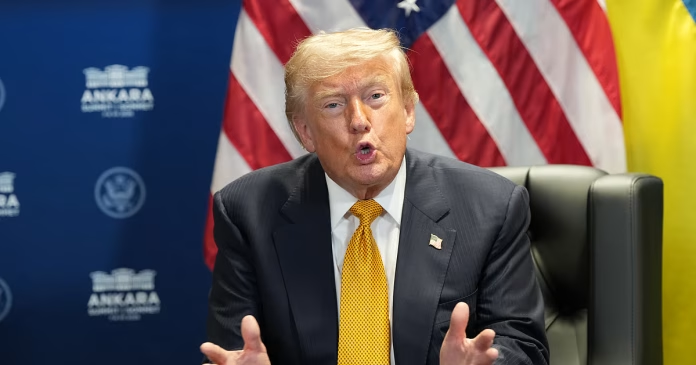
The proposal received a cautiously positive response from U.S. President Donald Trump, who said a face-to-face meeting between Putin and Zelensky would be “great” but stressed that both sides would need to make compromises to reach a settlement.

The open letter was published amid escalating military activity on both sides. Ukraine has recently intensified long-range drone attacks against targets inside Russia, while Moscow has responded with some of the largest missile and drone barrages of the war against Ukrainian cities. The continuing violence has underscored the challenges facing any diplomatic initiative.

Despite the uncertainty surrounding the proposal, analysts say the letter represents Zelensky’s most direct public effort in years to engage Putin personally. Whether it leads to substantive negotiations remains unclear, but it has injected new diplomatic momentum into a conflict that has shown few signs of ending.

For now, Kyiv says it is ready for talks, while Moscow continues to insist that any settlement must address what it calls the “root causes” of the war. With fighting continuing across the front lines and diplomatic positions still far apart, the prospect of a breakthrough remains uncertain, but Zelensky’s public appeal has placed renewed focus on the possibility of direct leader-to-leader negotiations.

Security Tightened Around Aso Rock As Sowore Leads Protest Over Abducted Oyo Schoolchildren

0

Security was significantly reinforced around the Aso Rock Presidential Villa in Abuja on Thursday as activist and African Action Congress (AAC) presidential candidate, Omoyele Sowore, led a protest demanding the rescue of abducted schoolchildren and teachers.

A combined team of anti-riot police officers, military personnel, and other security agencies mounted checkpoints around the State House and the Three-Arms Zone, restricting access to only individuals with valid State House identification.

Security operatives were stationed at major entry points from as early as 8 a.m., conducting thorough vehicle inspections and turning back unauthorised persons. The heightened security presence led to traffic congestion in several parts of the Federal Capital Territory.

The development followed Sowore’s earlier warning to President Bola Tinubu, in which he vowed to lead a march to the Presidential Villa if the abducted pupils and teachers from Oyo State were not rescued.

“We’ll march to Aso Villa on Thursday if abducted Oyo pupils are not rescued.”

Sowore had called on the Federal Government to secure the release of the 46 teachers and pupils kidnapped on May 15 from schools in Oriire Local Government Area of Oyo State.

The former presidential candidate criticised the Tinubu administration over what he described as its failure to tackle growing insecurity across the country.

“You can’t claim to be president, not doing your job.”

According to Sowore, the government has not done enough to protect citizens amid the increasing wave of kidnappings and violent attacks nationwide.

The abduction of the Oyo schoolchildren has generated widespread concern, prompting nationwide protests by the Nigeria Union of Teachers (NUT). Sowore joined residents and teachers who have continued to demand urgent government intervention.

“This is not about hype or social media grandstanding. This is about the life of children,” Sowore said while defending the demonstration against claims that it was politically motivated.

The protest comes amid rising public frustration over insecurity, with many Nigerians calling for stronger measures to safeguard schools and communities.

For the second time, protesters under the banner of the AAC and allied groups marched through major parts of Abuja, calling for the immediate and unconditional release of abducted pupils and teachers.

The demonstrators moved from Eagle Square through key roads including Shehu Shagari Way, Adetokunbo Ademola Crescent, and Aminu Kano Way, carrying placards with messages such as:

“Release our children and teachers unconditionally,”

“Teachers deserve security, not fear,”

“End the reign of fear in our schools,”

“Tinubu, rescue the children,” and

“School should be a sanctuary, not a crime scene.”

Addressing the protesters, Sowore challenged President Tinubu to either ensure the safe return of the victims or take responsibility for failing to protect Nigerians.

“You cannot claim to be president of Nigeria and then refuse to do the job of the Commander-in-Chief of the Armed Forces. We are not here to beg anybody. We are just asking people who claim they are elected to protect Nigerians to do their work.”

He also criticised the large deployment of security personnel to monitor the protest, arguing that similar resources should be directed toward protecting schools and communities.

“Your children are also in schools. If the school becomes a ground for kidnapping, one day your children too will be kidnapped.”

The demonstration was sparked by the May 15, 2026 attack on schools in the Esiele and Yawota communities of Oriire Local Government Area, Oyo State, where about 39 students and seven teachers were abducted from Community Grammar School, Baptist Nursery and Primary School, and L.A. Primary School.

On the same day, another 42 pupils were reportedly kidnapped from Mussa Primary and Junior Secondary School in Askira-Uba, Borno State.

In response to the Oyo incident, the Federal Government recently dispatched a high-level delegation led by Chief of Staff Femi Gbajabiamila to the affected communities. The delegation also included the National Security Adviser, the Inspector-General of Police, and the Chief of Defence Staff.

President Tinubu has additionally approved the recruitment of 1,000 forest guards and the deployment of a specialised rescue unit to strengthen efforts aimed at tackling kidnappings and improving security in vulnerable areas.

US Raises Pressure On Cuba As It Sanctions President Díaz-Canel

0

The United States has intensified its pressure campaign against Cuba by imposing sanctions on President Miguel Díaz-Canel and several members of the country’s political elite, marking one of the most significant actions taken by Washington against Havana’s leadership in recent years. The move comes as the Trump administration expands efforts to isolate Cuba’s communist government amid a worsening economic crisis on the island.

The sanctions, announced by the U.S. Treasury Department on June 4, target Díaz-Canel, his wife Lis Cuesta Peraza, members of the Castro family, and several government-linked entities, including Cuba’s Ministry of the Revolutionary Armed Forces. The measures freeze any assets under U.S. jurisdiction and prohibit Americans from conducting business with those designated.

The action represents the latest step in a broader U.S. strategy aimed at increasing economic and political pressure on Cuba’s leadership. In recent weeks, Washington has sanctioned additional Cuban officials, tightened restrictions on commerce with the island and expanded measures targeting military-controlled sectors of the Cuban economy.

Speaking to reporters at the White House, President Donald Trump said the United States wants Cuba to become “a nicely run country,” while administration officials signaled that further measures could follow if Havana does not implement political and economic reforms.

Cuba reacted angrily to the announcement. Foreign Minister Bruno Rodríguez condemned the sanctions as “despicable” and accused Washington of pursuing interventionist policies designed to create confrontation between the two countries. He insisted that U.S. pressure would not succeed in destabilizing the Cuban government.

The sanctions come at a particularly difficult moment for Cuba, which is grappling with severe fuel shortages, frequent power outages, food scarcity and declining tourism revenues. The island’s economic troubles have deepened as U.S. restrictions have discouraged foreign investment and complicated international trade.

Earlier this week, Cuba’s central bank announced that Visa and Mastercard transactions would be suspended beginning June 6 after a foreign financial partner curtailed services in response to expanded U.S. sanctions. Officials warned that the decision would further hinder tourism and international commerce.

The Trump administration has also targeted GAESA, the military-run conglomerate that controls large portions of Cuba’s tourism, logistics and financial sectors. Washington accuses the organization of channeling profits to the military and political elite, while Cuban authorities argue that GAESA plays a vital role in supporting the country’s economy.

The tightening sanctions regime has already prompted several international companies to scale back operations in Cuba. Reuters reported that hotel operators and shipping firms have reduced or suspended business activities on the island amid concerns about exposure to U.S. penalties.

The latest measures also coincide with broader tensions in U.S.-Cuba relations. Earlier this year, Washington expanded restrictions on oil shipments to Cuba and increased pressure on foreign companies doing business with the island. The two countries have nevertheless maintained limited diplomatic contacts, with Díaz-Canel acknowledging in March that discussions with U.S. officials had taken place regarding Cuba’s energy crisis and economic difficulties.

Díaz-Canel, who succeeded Raúl Castro as president in 2018, has repeatedly accused the United States of attempting to undermine Cuba’s sovereignty through economic coercion. The Cuban government maintains that the decades-old U.S. embargo remains the principal cause of the country’s economic hardships, while Washington argues that Cuba’s centralized political and economic system is responsible for the crisis.

Analysts say the new sanctions are likely to further strain already tense relations between the two countries and could increase economic pressure on Cuba at a time when the island is facing one of its most severe economic challenges in decades. Whether the measures succeed in changing Havana’s policies remains uncertain, but they underscore Washington’s determination to maintain a hardline approach toward Cuba’s leadership.

Chinese President Headed To North Korea In Bid To Shore Up Ties

0

Chinese President Xi Jinping is set to travel to North Korea next week for his first visit to the country in nearly seven years, in a move widely viewed as an effort by Beijing to strengthen ties with its longtime ally and reassert its influence over Pyongyang amid North Korea’s deepening relationship with Russia.

China’s Foreign Ministry announced that Xi will undertake a two-day state visit beginning June 8, during which he will hold talks with North Korean leader Kim Jong Un. Chinese officials said the visit aims to promote the development of bilateral relations and address issues of mutual concern, including regional security and economic cooperation.

The trip will be Xi’s first visit to North Korea since June 2019 and his first overseas journey of 2026. Analysts say the timing reflects Beijing’s desire to reinforce its role as Pyongyang’s principal strategic partner after several years in which North Korea expanded military and political cooperation with Russia.

Relations between China and North Korea cooled during the COVID-19 pandemic as border closures and travel restrictions sharply reduced diplomatic exchanges and trade. However, recent months have seen renewed engagement, including the resumption of passenger rail services between Beijing and Pyongyang and the restoration of some commercial flights between the two capitals.

Xi’s visit comes against a backdrop of shifting geopolitical dynamics in Northeast Asia. North Korea has moved closer to Russia since the outbreak of the war in Ukraine, supplying Moscow with weapons and military support while receiving economic and political backing in return. Beijing is believed to be seeking to ensure that its influence over Pyongyang is not eclipsed by Moscow’s growing presence.

“The message from China is that it remains the principal actor when it comes to North Korea,” said John Delury, a senior fellow at the Asia Society, according to Reuters. Analysts note that one audience for the visit may be Russia, which has emerged as a key partner for Kim’s government in recent years.

The visit follows a busy period of diplomacy for Xi, who recently hosted both U.S. President Donald Trump and Russian President Vladimir Putin in Beijing. Observers say the North Korea trip demonstrates China’s intention to remain a central player in regional security issues despite intensifying competition among major powers.

The announcement also comes just days after Kim Jong Un called for an “exponential” expansion of North Korea’s nuclear arsenal during a visit to a newly operational nuclear-material production facility. State media reported that Kim instructed officials to significantly increase production of weapons-grade nuclear material, arguing that the country faces growing security threats.

Some experts believe the timing of Kim’s nuclear remarks was deliberate and linked to Xi’s upcoming visit. By emphasizing North Korea’s commitment to expanding its nuclear capabilities, Pyongyang may be seeking to strengthen its negotiating position ahead of discussions with Beijing and any future engagement with Washington.

China and North Korea remain bound by a 65-year-old treaty of friendship, cooperation and mutual assistance, which includes provisions for mutual support in the event of external aggression. While Beijing has often expressed concern about North Korea’s nuclear activities, it continues to view stability on the Korean Peninsula as a critical strategic interest.

South Korea has sought to downplay broader geopolitical implications of the visit, describing it as a bilateral matter. Nevertheless, regional governments and international observers will be closely watching the summit for signs of how Beijing intends to balance its relations with Pyongyang, Moscow and Washington amid rising tensions across Northeast Asia.

With North Korea advancing its nuclear program, Russia expanding its influence in the region and competition between China and the United States intensifying, Xi’s visit is expected to be one of the most closely watched diplomatic events in Asia this year.

Court Orders Sowore To Begin Defence In Alleged Defamation Case Involving Tinubu

0

A Federal High Court in Abuja has directed the presidential candidate of the African Action Congress (AAC), Omoyele Sowore, to begin presenting his defence in the ongoing criminal defamation case filed against him over alleged remarks about President Bola Tinubu.

Justice Mohammed Umar gave the order after rejecting a request by Sowore’s lawyer, Marshall Abubakar, to postpone further proceedings until after the court’s annual vacation.

The judge ruled that hearing in the matter would continue on a daily basis, starting Friday, June 5, when Sowore is expected to formally open his defence.

Sowore, who is also an online publisher, is facing prosecution by the Department of State Services (DSS) over allegations that he falsely described President Tinubu as “a criminal” in posts published on his X and Facebook accounts.

During Thursday’s proceedings, the prosecuting counsel, Akinlolu Kehinde (SAN), informed the court that the matter was scheduled for June 4 to receive the response of the Chief Judge to a letter written by Sowore on May 19, 2026, seeking the reassignment of the case to another judge.

Kehinde told the court that he was served with the Chief Judge’s response on May 26. The letter, dated May 22, reportedly declined Sowore’s request and directed that the trial should proceed before the current judge.

Following this, the prosecution asked the court to order the defendant to commence his defence.

In response, Abubakar argued that part of the Chief Judge’s reply suggested that the defendant could file a formal application, which should then be heard in open court.

He further requested that the matter be adjourned until after the court vacation, citing Sowore’s intention to focus on preparations for the next presidential election.

However, Kehinde challenged that interpretation, insisting that the Chief Judge’s response did not direct the defendant to file any application for recusal.

“The letter from the Chief Judge of this court did not ask the defendant or his counsel to file an application for recusal. So, it is disingenuous for counsel to read into the letter an interpretation that the Chief Judge did not include in the letter,” Kehinde said.

Following arguments from both parties, Justice Umar reviewed the Chief Judge’s letter and agreed with the prosecution’s position.

“From the content of the letter, there is nowhere the defendant is asked to file an application before this court.

“This court is not denying the defendant the right to file any application. This can be done anytime before judgment,” Justice Umar said.

The judge noted that the matter had reached the stage where the defendant was required to present his case and subsequently directed Sowore to enter his defence.

Justice Umar also ordered that the proceedings continue on a day-to-day basis in accordance with the provisions of the Administration of Criminal Justice Act (ACJA).

Despite the ruling, Sowore’s counsel again sought an adjournment until after the court vacation. The request was opposed by the prosecution, which maintained that the law required the defence to proceed immediately.

“The law is that the defendant shall proceed with his defence. There is no option. We are ready. There is no room for dilatory practice for a defendant facing a criminal trial,” Kehinde said.

He added that “the option left at this point is for the defence to continue or simply be foreclosed. It is either they continue, or they are foreclosed”.

The court subsequently adjourned the case until June 5, 2026, for Sowore to begin presenting his defence.

South African Rand Holds Steady As Markets Assess New U.S. Tariff Proposal And Gulf Ceasefire

0

The South African rand remained largely unchanged against the U.S. dollar on Thursday as investors evaluated a new U.S. tariff proposal tied to forced labour concerns while also monitoring developments in the Middle East.

The currency traded at 16.3225 rand per dollar in early trading, remaining close to its previous closing level as market participants weighed the potential impact of Washington’s latest trade measures.

South Africa’s Trade Ministry responded after the United States proposed tariffs on imports from around 60 countries, including South Africa, citing concerns related to forced labour. The ministry maintained that the country complies with both domestic and international labour obligations.

Analysts noted that while the proposed 12.5% tariff would be a negative development for South Africa, it is significantly lower than the previously threatened 30% tariff announced earlier this year, offering some relief to investors.

The proposal follows a Section 301 investigation into alleged unfair trade practices as the Trump administration seeks alternative measures after emergency tariffs were struck down by the U.S. Supreme Court in February.

With limited domestic economic data driving markets, the rand continued to take direction from global developments. Investors also kept a close watch on the Middle East after Israel and Lebanon agreed to a ceasefire, raising hopes for a broader diplomatic breakthrough involving Iran and reducing fears of prolonged disruptions to global energy supplies.

Meanwhile, the U.S. House of Representatives approved a resolution aimed at preventing President Donald Trump from continuing military operations against Iran. The move reflects growing concern among lawmakers about the conflict, which has now lasted for several months.

On South Africa’s stock market, the Johannesburg Stock Exchange’s Top-40 index traded flat in early dealings, while the country’s benchmark 2035 government bond weakened slightly, pushing its yield up to 8.525%.

Market analysts say investor sentiment will likely remain sensitive to both international trade developments and geopolitical events as uncertainty continues to influence global financial markets.