Home Blog Page 281

Trump – Musk Feud: What Are The Issues?

0

Once allies who traded mutual praise and political synergy, President Donald Trump and billionaire entrepreneur Elon Musk are now caught in one of the most visible and tense political fallouts in recent U.S. history. What began as a policy disagreement over government spending has gradually turned into a deeply personal and public confrontation — marked by harsh accusations, threats to business partnerships, and a flood of online statements.

The Issues at Hand

At the center of this rift lies the Trump-backed “One Big Beautiful Bill,” a sweeping piece of legislation combining tax relief with massive increases in defense and immigration enforcement spending.

Musk, having just departed a cost-cutting advisory role in the administration, took to his platform X (formerly Twitter) to call the bill a “disgusting abomination” that would “massively increase the already gigantic budget deficit to $2.5 trillion.”

This marked Musk’s first serious public break with Trump, whom he had supported both financially (with more than $250 million in campaign donations) and strategically through policy involvement.

Tensions deepened when it became apparent that the bill also contained provisions eliminating certain tax breaks — including electric vehicle incentives — which could impact Tesla. But sources close to Musk also revealed additional frustration stemming from the government’s rejection of a proposal to shift U.S. air traffic infrastructure to Musk’s satellite network, Starlink.
From there, the friction escalated quickly.

Trump responded swiftly, using Truth Social to mock Musk’s mental state and hint at removing his companies from lucrative federal contracts. He implied that Musk had become unstable after being denied influence over the infrastructure bill. “Elon was ‘wearing thin,’ I asked him to leave,” Trump wrote. “He just went CRAZY!”

But it was Musk who delivered a shock to the system.

On Thursday afternoon, Musk stunned observers by posting:
“Time to drop the really big bomb: @realDonaldTrump is in the Epstein files. That is the real reason they have not been made public. Have a nice day, DJT!”
The implications of the post were explosive — and unsubstantiated. No evidence was provided, and Musk has not explained how he would have access to unreleased files related to Jeffrey Epstein, the disgraced financier who died in 2019 while awaiting sex trafficking charges.

Nonetheless, the accusation marked a new, highly personal phase in the feud, described by one West Wing aide as “a total divorce.”

Social Media Reactions

The internet, predictably, erupted. Here are some notable posts on X
Bill Ackman (@BillAckman)

“I support @realDonaldTrump and @elonmusk and they should make peace for the benefit of our great country.
We are much stronger together than apart.”

Charlie Kirk (@charliekirk11)

“President Trump built this movement over 10 years. His supporters are NOT going anywhere.
I hope Elon and Trump reconcile and do so privately. It would be good for the country and the world if they do.”

Sen. JD Vance (@JDVance)

“President Trump has done more than any person in my lifetime to earn the trust of the movement he leads. I’m proud to stand beside him.”

The Implications

This public clash between two of the most influential figures in business and politics could have serious ripple effects.
From a business standpoint, Tesla’s stock experienced a sharp decline, falling 14.2% on Thursday, which erased about $152 billion from the company’s market capitalization. This downturn reflects investor concern over potential political and regulatory fallout from the feud.

Trump’s suggestion that the federal government review SpaceX and Tesla contracts raises concerns for national security projects and the future of commercial space launches — particularly those involving NASA partnerships and defense-related satellite infrastructure.

On the political side, the Republican Party is now facing pressure to choose between two prominent power brokers. While some lawmakers remain firmly behind Trump, others quietly acknowledge Musk’s influence, especially among younger voters and tech-minded conservatives.
And from the public’s perspective, there are growing concerns about how much power is concentrated in the hands of individuals who can stir national conversations — or derail legislative agendas — with a single post.

What’s Next?

Despite public calls for peace from figures like Bill Ackman, the future of the Trump–Musk relationship remains uncertain.
Musk has already stepped back from at least one controversial threat, to decommission the SpaceX Dragon spacecraft, following a calming post from a user on X. “Good advice,” he replied. “Ok, we won’t decommission Dragon.”
Still, insiders on both sides believe this rupture won’t heal easily. “We thought this might happen around August,” one Trump aide said privately. “It just came earlier than expected.”

One thing is clear: this dispute is no longer about a spending bill. It has become a test of influence, loyalty, and the balance of power between political leadership and billionaire clout in America’s public life.

Akwa Ibom Governor Officially Dumps PDP for APC

0

Governor Umo Eno of Akwa Ibom State has formally resigned from the Peoples Democratic Party (PDP) and joined the All Progressives Congress (APC).

According to Naija News, the defection took place on Friday during a high-profile ceremony in Uyo, the state capital. The event was attended by key figures of the APC, including the Chairman of the APC Governors Forum and Imo State Governor, Hope Uzodinma, Lagos State Governor Babajide Sanwo-Olu, and several other party governors and chieftains.

In his address, Governor Eno stated that his move to the APC was made from a position of strength, not weakness. He emphasized the importance of aligning Akwa Ibom with federal-level politics for better synergy and development.

“We’re not joining the APC from a position of weakness, but from a position of strength. We’re bringing value to Akwa Ibom State. We’ve come into the APC with a ministry of reconciliation,” Eno said.

He explained that the decision followed comprehensive consultations with stakeholders and constituents across the state.

“After completing the rounds of my consultation as your servant whom you have elected to serve, I have therefore decided to progressively move to the APC,” he added.

Eno confirmed that he had formally submitted his resignation to the PDP leadership at all levels — ward, state, and national — before making his public declaration.

With this move, Umo Eno becomes the second PDP governor to switch allegiance to the APC under the current administration. The first was Delta State Governor Sheriff Oborevwori, who defected on April 23, 2025.

Ex-OPEC President Prof. Jibril Aminu, Dies at 85

0

Professor Jibril Aminu, a distinguished Nigerian diplomat, eminent medical scholar, and former Minister of Education and Petroleum, has passed away in Abuja at the age of 85.

According to the family, the former President of the African Petroleum Producers’ Organisation (APPO), and one-time President of the OPEC Conference, died on Thursday, June 5, 2025, after a prolonged illness.

His funeral prayer will be held at 2:00 p.m. today at the Abuja National Mosque. His body will then be flown to Yola, the Adamawa State capital, and later to his hometown in Song Local Government Area for burial.

Prof. Aminu, a trained cardiologist, earned his medical degree from the University of Ibadan in 1965, where he was recognized as the best graduating student at University College Hospital (UCH), Ibadan. He later obtained a PhD in Medicine from the Royal Postgraduate Medical School in London in 1972.

He served Nigeria in numerous high-profile roles, including as the country’s Ambassador to the United States (1999–2003) and as Senator representing Adamawa Central (2003–2011). Earlier, he was appointed as Federal Minister of Education and subsequently Federal Minister of Petroleum and Mineral Resources between 1989 and 1992.

In 1991, while serving as Petroleum Minister, Prof. Aminu became President of OPEC and also led the OPEC Conference until 1992.

His passing marks the end of an era for a man whose contributions to Nigeria’s medical, educational, and petroleum sectors were both historic and impactful.

Ghana’s Gold Production to Hit 5.1 Million Ounces in 2025

0

Ghana’s gold production is expected to rise by 6.25% in 2025, reaching 5.1 million ounces, up from a record-setting 4.8 million ounces in 2024, according to the Ghana Chamber of Mines. This projected growth is being fueled by robust artisanal mining activity and the launch of new large-scale mining operations, which are helping to offset declining output from older mines.

The forecast, detailed in the Chamber’s annual report, follows an impressive 19.3% year-on-year increase in gold production in 2024, further cementing Ghana’s position as Africa’s top gold producer, ahead of South Africa and Mali.

Rising global gold prices have boosted Ghana’s export earnings and supported the cedi, aiding the country’s recovery from a prolonged economic downturn. In addition to gold, Ghana also ranks among the continent’s leading exporters of cocoa and crude oil.

Michael Akafia, President of the Chamber of Mines, highlighted that the increase in 2025 will be largely driven by higher production from Newmont’s Ahafo South Mine and Shandong Gold’s Namdini Mine.

Small-scale miners played a critical role in 2024, contributing a record 39.4% of total gold output. However, uncertainties lie ahead due to regulatory changes. In response, the government launched GoldBod, a new agency tasked with streamlining gold purchases from artisanal miners, increasing their earnings, and reducing illegal smuggling. Additionally, the withholding tax on domestic gold purchases has been abolished.

Godwin Armah, General Secretary of the Ghana National Association of Small-Scale Miners, praised the reforms and projected a 30% to 40% increase in small-scale output in 2024, thanks to improved policies. Nonetheless, the Chamber anticipates that small-scale production in 2025 will range between 1.5 million and 2 million ounces, slightly below 2024’s 1.9 million ounces.

Despite artisanal mining’s growth—much of which remains unregulated (70–80%)—concerns persist over environmental harm and its impact on cocoa farmlands.

Some large-scale mines, including Perseus Mining’s Edikan Mine, Gold Fields’ Damang and Tarkwa mines, and Zijin Mining’s Akyem Mine, are projected to see output decline, which may limit overall industry growth. Akafia emphasized the urgent need for increased exploration investments to sustain Ghana’s gold dominance.

Beyond gold, Ghana’s mining sector is also showing strong potential in other minerals:

  • Manganese output is expected to climb from 5 million to 8 million tonnes,
  • Bauxite production is projected to rise from 1.7 million to 2 million tonnes, and
  • Diamond output is forecast to increase from 330,000 to 400,000 carats by 2025.

South Korea’s President Lee Jae-myung Holds First Cabinet Meeting

0

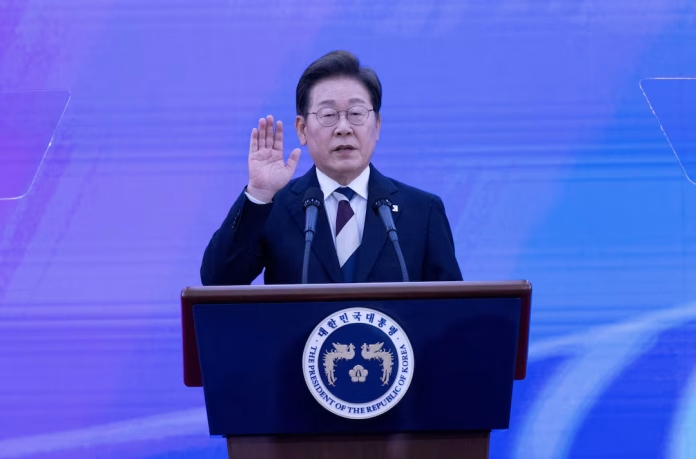
South Korea’s newly sworn-in President, Lee Jae-myung, held his first cabinet meeting on Thursday, unveiling urgent economic relief measures aimed at jumpstarting sluggish growth and supporting struggling households—top priorities from his campaign agenda.

Lee officially assumed office on Wednesday, following a swift victory in a snap election triggered by widespread public outrage over a short-lived martial law imposed by his predecessor, Yoon Suk Yeol. Yoon’s controversial attempt to retain power led to his impeachment and removal, shaking confidence in Asia’s fourth-largest economy.

During the cabinet session—comprised of interim officials from the caretaker government formed after Yoon’s ousting—President Lee stressed the need for swift and decisive action to address mounting economic hardships.

Thus far, Lee has appointed only one key official: Kim Min-seok, a veteran lawmaker and close confidant, as nominee for prime minister. As he scrambles to assemble a full cabinet and reestablish his administration, Lee has prioritized stability and continuity in governance.

He described his initial moments in the presidential office as “surreal,” noting the absence of essential tools like computers, printers, and even pens. “It felt as quiet as a graveyard,” Lee remarked. Most of the staff had been reassigned, though his spokesperson confirmed ongoing efforts to restore the office to full functionality.

Economic revival remains the cornerstone of Lee’s agenda. He has committed to a 30 trillion won (approximately $22 billion) fiscal stimulus package to spur growth. The Bank of Korea recently slashed its growth forecast to 0.8%, down sharply from its February estimate of 1.5%.

Speaking to journalists, Prime Minister nominee Kim Min-seok likened the current economic downturn to the 1997 Asian financial crisis, suggesting it could be even more severe due to unfavorable global conditions. “The economy is stagnant and declining. I believe this crisis may be worse,” Kim warned.

The previous administration struggled to counteract the effects of stiff U.S. tariffs that battered key export industries such as automobiles, electronics, and steel. President Lee now faces a steep uphill battle—not only to repair economic damage but also to heal political divisions left by the failed martial law episode and to navigate intensifying global protectionism, particularly from the United States.

Additionally, President Lee has annulled the appointments of two Constitutional Court judges selected by acting President Han Duck-soo, stating that Han, as an unelected interim leader, lacked the authority to make such nominations.

Meanwhile, the National Assembly—led by the Democratic Party—passed special counsel legislation to investigate former President Yoon for insurrection and his wife, Kim Keon Hee, over corruption allegations. Earlier attempts were repeatedly vetoed by Yoon and acting President Han, but with Yoon now facing trial for insurrection, the newly passed bills are expected to proceed.

FG Seeks ¥15bn Japanese Loan To Boost Food Security

0

The Federal Government has intensified its discussions with the Japan International Cooperation Agency (JICA) to accelerate the implementation of a ¥15bn (approximately $110m) emergency loan aimed at improving food security nationwide.

This development was revealed in a statement issued by the Federal Ministry of Finance and the Coordinating Ministry of the Economy on Wednesday, following a high-level meeting involving the Minister of Finance, Wale Edun; the Minister of Agriculture and Food Security, Senator Abubakar Kyari; and senior officials from JICA.

“The Minister of Finance and Coordinating Minister of the Economy, Mr. Wale Edun, and the Minister of Agriculture and Food Security, Senator Abubakar Kyari, today met with senior representatives of the Japan International Cooperation Agency to advance the implementation of the Food Security Emergency Loan Support Programme,” the ministry said in the statement.

The statement noted that the $110m facility is intended to strengthen Nigeria’s food production systems and increase resilience in the face of ongoing global supply disruptions and domestic inflation.

“The JPY 15bn facility (approximately $110m) aims to support Nigeria’s food production systems and enhance resilience amid ongoing global supply challenges,” the ministry added.

Given that the rainy season is already in progress, the ministers highlighted the need to implement essential components of the programme swiftly to ensure timely support for farmers and rural populations.

“Both ministers emphasised the importance of swift, coordinated action to maximise impact for farmers and rural communities,” it stated.

In response, JICA reaffirmed its commitment to the programme but requested formal clarification on proposed changes to the implementation approach.

“JICA welcomed the government’s commitment to delivery and requested formal clarification on proposed implementation adjustments.

“It was jointly agreed that core production activities would proceed immediately under the existing framework, while additional components, such as aggregation and financing, would be reviewed in line with the original loan agreement,” the statement read.

This development comes shortly after President Bola Tinubu submitted a request to the National Assembly for approval of a new external borrowing plan totaling $21.5bn under the 2025–2026 borrowing framework.

In addition to the $21.5bn proposal, the President is also seeking the legislature’s approval for the ¥15bn emergency loan and a €51m grant to support key development initiatives.

According to Tinubu’s letter to the National Assembly, the proposed funding will focus on job creation, skill acquisition, entrepreneurship promotion, poverty reduction, and strengthening food security.

Meanwhile, figures from the Debt Management Office (DMO) show that as of December 2024, Nigeria owes JICA $53.31m. This represents 0.88% of the country’s total bilateral debt and 0.12% of its overall external debt.

If the new loan is approved, Nigeria’s debt to JICA will rise to $163.31m.

2025 WAEC Exams: 118 Schools Sanctioned Over Malpractice Allegations

12

The West African Examinations Council (WAEC) has taken decisive action against examination malpractice in the 2024 West African Senior School Certificate Examination (WASSCE), issuing warnings to 109 secondary schools and derecognizing nine others for their involvement in fraudulent practices.

The Nigeria Examinations Committee (NEC) of WAEC announced these measures following investigations into reported irregularities during the May/June 2024 examination, which saw 1,805,216 candidates from 25,126 schools participate.

Additionally, WAEC has debunked viral claims of the cancellation of the 2025 WASSCE English Language paper, labeling them as fake news spread by mischief-makers.

The NEC’s actions target 118 public and private secondary schools, including prominent institutions such as Kings College, Lagos; CMS Grammar School, Bariga; Igbobi College, Yaba; and Baptist Girls Academy, Obanikoro. Other schools warned include Lagos State Model Senior College, Kankon; Whitesands School, Lekki; Vetland Senior Grammar School, Ifako-Ijaiye; and Solomon Grace Secondary School, Abule-Egba, among others.

These schools received formal warnings for their roles in examination malpractices, such as facilitating cheating or failing to curb candidate misconduct.

Nine schools faced harsher penalties, with WAEC derecognizing them as examination centers due to severe infractions.

The affected schools are Lagos Baptist Senior High Secondary School, Agege; Assfood International College, Ketu; Greendome High School, Oworoshoki; Community Senior Secondary School, Adeniran Ogunsanya; Eunice College, Odutola; Lagout Ajasa; Command Griffiths College, Igbobi-Ikorodu; Submile College, Ojo; Rose Bethel Comprehensive High School, Mosafejo, Ojo; and Lily Pride Comprehensive High School, Igando.

Of these, two are state-owned, and seven are privately owned. Candidates from these schools were reassigned to other centers for the 2025 WASSCE, as the derecognized schools were barred from presenting candidates.

“The Nigeria Examinations Committee investigated various reported cases of examination malpractice and consequently decided to warn/derecognize the following schools,” said Oluju, L.O., WAEC’s Senior Deputy Registrar.

The council withheld the results of 215,267 candidates (11.92% of total participants) pending further investigation into their alleged involvement in malpractices, underscoring the scale of the issue.

The 2024 WASSCE, conducted from April 30 to June 24, 2024, was marred by significant challenges, including a high-profile leak of the English Language paper, which was reportedly circulated days before the exam.

This incident, described as an “inside job” possibly involving WAEC officials, forced the council to reprint question papers, causing delays and logistical disruptions. In some centers, particularly in Lagos, Ogun, Taraba, and Osun, candidates wrote exams late at night under inadequate conditions, such as using torchlights due to power outages.

These events fueled public outrage and raised concerns about the integrity of the examination process.

WAEC’s crackdown reflects its ongoing efforts to combat systemic malpractice, which includes smuggling mobile devices into exam halls, organized cheating syndicates, and impersonation.

The council has involved police and security agencies to investigate these networks, which profit by distributing exam questions and answers. The Examination Malpractices Act No. 33 of 1999, as amended, supports WAEC’s actions, prescribing penalties like imprisonment and fines for offenders.

WAEC Debunks 2025 English Paper Cancellation Rumors

In a separate development, WAEC has refuted claims that the English Language paper for the 2025 WASSCE, written on May 28, 2025, was canceled. A viral press release dated May 30, 2025, falsely claimed the exam was annulled due to irregularities, sparking confusion among candidates and parents. WAEC’s Acting Head of Public Affairs, Moyosola Adesina, dismissed the release as “fake and the work of mischief-makers” intent on discrediting the council.

“The said examination has not been cancelled,” Adesina stated, emphasizing that WAEC communicates only through verified channels, including its official social media handles and accredited media outlets.

The council attributed delays in the 2025 English Language exam to heightened anti-malpractice measures, particularly efforts to prevent question paper leaks. Despite logistical challenges, WAEC confirmed the exam’s validity and urged stakeholders to disregard unverified information.

Implications and WAEC’s Commitment

The sanctions against 118 schools, including prestigious ones, highlight the pervasive nature of exam malpractice across Nigeria’s educational landscape.

The involvement of elite schools like Kings College and Igbobi College has sparked debate about the pressures to achieve high pass rates, which may drive unethical practices.

Derecognition of schools, particularly private ones, could impact their enrollment and financial viability, while withheld results create uncertainty for thousands of candidates awaiting resolution through WAEC’s complaints portal (https://waecinternational.org/complaints).

WAEC expressed gratitude for public trust over its 73-year history and reaffirmed its commitment to improving service delivery. “We promise to always seek innovative ways to render quality services to the Nigerian child,” the council stated.

To prevent future disruptions, WAEC is exploring technological solutions like Computer-Based Testing (CBT), which has shown promise in reducing malpractice through digital monitoring and personalized question sets.

Call for Reform and Accountability

The 2024 WASSCE scandal has reignited calls for systemic reforms in Nigeria’s examination system. Stakeholders, including former Vice President Atiku Abubakar and the National Association of Nigerian Students, have criticized WAEC’s handling of the 2025 English Language exam, with some demanding a resit due to poor conditions.

The House of Representatives Committee on Basic Education has also summoned WAEC to address logistical failures and exam leaks, reflecting growing public demand for accountability.

As WAEC continues its investigations and conducts the 2025 WASSCE, the council is actively working to restore confidence in its processes.

The sanctions against 118 schools and the debunking of false cancellation rumors underscore WAEC’s determination to uphold educational integrity, but they also highlight the need for stronger oversight, infrastructure improvements, and collaboration with stakeholders to address the root causes of malpractice.

African Centres of Excellence Project Ends with Key Achievements

10

As the 2nd World Bank-sponsored African Centres of Excellence (ACE) projects in select universities conclude their current phase in Nigeria, the National Universities Commission (NUC) has charged stakeholders of beneficiary institutions to look beyond donor support and focus on sustainability, and transitioning from temporary project status to permanent institutional assets.

The Executive Secretary, National Universities Commission, Prof. Abdullahi Ribadu, who gave the charge at a pre-closure retreat in Abuja, lauded the ACE-Impact initiative, noting that it has elevated Nigeria’s academic institutions into globally competitive hubs of knowledge generation, innovation, and development.

Ribadu disclosed that the Africa Centres of Excellence (ACE) project in Nigeria is set to conclude its current phase of funding by June 30, and also revealed that the ACE Centres have produced high-quality master’s and PhD graduates, secured international accreditations, attracted major external funding, and driven innovation across key sectors.

In his remarks, the National Project Coordinator of the ACE Project, Joshua Attah, while highlighting the project’s achievements to include the training of master’s and PhD students, regional academic integration, and significant research output, hinted that “the 17 ACE centres in Nigeria have earned $89.1 million through Disbursement Linked Indicators (DLIs) and generated additional funding from local and international sources.”

The ACE initiative, backed by the World Bank and regional governments, has demonstrated the transformative power of targeted investment in higher education and research on the continent.

As the project concludes its current phase, stakeholders are optimistic about its lasting impact on Nigeria’s academic landscape and its potential to drive growth and regional leadership.

Rivers State Administrator Appoints 11 New Permanent Secretaries Amid Transition

0

In a move that signals ongoing administrative restructuring, the Sole Administrator of Rivers State, Vice Admiral Ibok-Ete Ekwe Ibas (retd), has approved the appointment of 11 new permanent secretaries.

The appointments were announced in a Special Government Announcement issued in Port Harcourt on Tuesday, June 3, and signed by the Acting Head of Service, Dr. (Mrs.) Inyingi Brown. The announcement was shared with newsmen across the state capital.

According to the statement, the swearing-in ceremony for the newly appointed senior civil servants will be conducted by the Sole Administrator at a date that will be communicated in due course.

The statement reads:

“His Excellency, Vice Admiral Ibok-Ete Ekwe Ibas (retd), the Administrator of Rivers State has approved the appointment of the under-listed persons as Permanent Secretaries.”

The list of appointees includes:

Imaonyani Roselin Ephraim-George

Dr. Mina T. Ikuru

Dabite Sokari George

Soibitein Duke Harry

Lauretta Davies Dimkpa

Uche R. Ideozu

Chimenum Mpi

Jeremiah Egwu

Nicholas Iminabo Wokoma

Vera Sam Dike

Aleruchi Akani

“The newly appointed permanent secretaries will be sworn in by His Excellency, the Administrator of Rivers State, on a date to be announced.”

These appointments are expected to bring fresh leadership and administrative direction across the state’s ministries, departments, and agencies. With Rivers State currently under the administration of a federally appointed caretaker, many observers see the move as part of efforts to stabilise governance structures amid ongoing political tensions.

The development is being closely watched both within and outside the state, as questions continue to swirl around how these appointments may shape public service delivery, policy execution, and institutional continuity in Rivers State.

Ademola Lookman: Switching to Nigeria Changed My Life and Career

1

Super Eagles forward and 2024 CAF African Footballer of the Year, Ademola Lookman, has reflected on the pivotal moment that reshaped his football career his decision to represent Nigeria instead of England. 

Born in London and previously part of England’s youth setup, Lookman’s international switch marked a major turning point in his personal and professional life.

“Without doubt, it changed my career and my life,” Lookman said. “People know that. This is my home. This is my place. I enjoy it here. I am the son of the soil.”

Since choosing Nigeria, Lookman’s career has soared. From scoring a historic hat-trick in the Europa League final to helping Atalanta win their first-ever European title, he has become one of Europe’s most feared forwards. He credits his rise to discipline, consistency, and belief in himself: “I think it was just self-belief and working hard every day… eventually, your hard work will pay off.”

Even during tough moments, like a missed penalty at Fulham, his mindset kept him focused. “Every day, I try to improve myself, both on and off the pitch. That consistency and mindset have really helped me,” he added.

Winning the prestigious African Footballer of the Year award was deeply personal for Lookman. “It’s amazing. Honestly, I won’t lie to you, it’s a privilege to have it… For me to be among them is a blessing.”

Returning to Lagos to present the award to President Bola Tinubu and Governor Babajide Sanwo-Olu, Lookman described the moment as a meaningful homecoming. He also visited Phase 2, a community dear to him, where he spent part of his childhood. “It was really important for me to bring this award back home… That’s where I brought it back to, and today, I had the honour of presenting it to the President. That meant a lot.”

When asked about retirement, Lookman’s answer was emphatic: “Definitely not. Retirement is nowhere in my thoughts. Not even close. There’s still a long journey ahead. So much more to achieve.”

With Premier League giants like Arsenal, Chelsea, Liverpool, and Manchester United reportedly interested, and Atalanta slapping a €50 million price tag on their star forward, Lookman’s story is far from over — in fact, it’s just beginning.