
Home Blog Page 283

U.S. Drastically Increases Steel and Aluminum Import Taxes

0

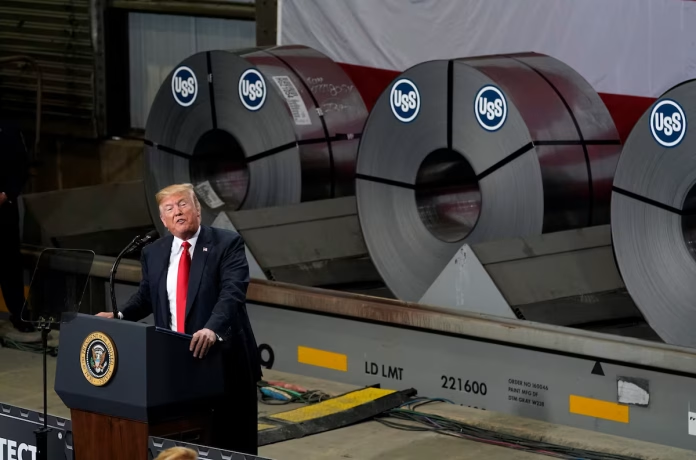
President Donald Trump has approved a sharp rise in tariffs on imported steel and aluminum, pushing the levy from 25% to a new high of 50%.

This policy shift marks the second time tariffs on these metals—integral to industries like automotive and food packaging—have increased since March.

Trump defended the measure, stating on Wednesday that it is designed to bolster the domestic steel sector.

Still, the decision has stirred alarm among critics, who argue it may disrupt overseas metal producers, trigger retaliation from other countries, and place a heavy burden on American companies that depend on these imports.

Many businesses caught in the crossfire were stunned in the lead-up to the move. They hoped the hike might be a bluff or part of a broader negotiation rather than a permanent change.

One notable exception to the hike was the United Kingdom, which retained the previous 25% rate. Trump said this was a result of “ongoing trade discussions” between the two nations.

“Always the question with Mr Trump is, is this a tactic or is this a long-term plan?” said Rick Huether, head of Independent Can Co, a Maryland manufacturer that turns imported European steel into decorative tins and packaging.

Following earlier tariff increases, Huether put expansion plans on hold and raised prices. He feared the rising costs might push his customers toward alternative packaging materials like paper or plastic.

“There’s a lot of chaos,” he said.

Globally, the U.S. is one of the top consumers of steel, ranking just behind the EU. It sources much of its supply from countries including Mexico, Brazil, Canada, and South Korea.

Trump’s administration originally introduced 25% steel and 10% aluminum tariffs during his first term, invoking national security concerns.

However, exemptions were eventually extended to various trade allies and companies, softening the overall impact.

In March, Trump withdrew many of those exemptions, expressing dissatisfaction with how the previous framework had been diluted.

While speaking at a U.S. Steel site on Friday, Trump expressed his intent to make imported steel so expensive that domestic buyers would have no choice but to turn to U.S. suppliers.

“Nobody’s going to get around that,” he said of the 50% rate. “That means that nobody’s going to be able to steal your industry. It’s at 25% – they can get over that fence. At 50%, they can no longer get over the fence.”

International Concerns and Fallout

Despite the increased tariffs, recent data shows little change in the U.S. steel production rate compared to the same time last year. But steel imports dropped sharply—falling 17% between March and April—and more declines are anticipated as the new rates take hold.

Canada and the EU, both affected by previous U.S. tariff moves, have already signaled their readiness to retaliate.

An EU trade official said on Tuesday that “We’re negotiating hard to try and make good deals,” as conversations between the two sides continue.

“We really hope that the Americans will roll back on this latest tariff threat, as they have done on others, but that remains to be seen.”

In the UK, the announcement has intensified pressure to finalize a trade deal with Washington, especially one that would shield British industries from further disruptions.

UK Trade Secretary Jonathan Reynolds recently met with U.S. Trade Representative Jamieson Greer in Paris.

Afterward, his office shared optimism about the talks, saying it was “pleased” that British steel was spared the full tariff.

“We will continue to work with the US to implement our agreement, which will see the 25% US tariffs on steel removed,” he said.

Gareth Stace, who leads UK Steel, noted that many of the organization’s members had already experienced canceled orders due to the 25% tariff set earlier this year.

He warned the newly announced 50% level could devastate the UK’s steel exports to the United States, which currently account for around 7% of their total.

“The introduction of 50% tariffs immediately puts the shutters up,” he said. “Most of our orders, if not all of them, will now be cancelled.”

Backlash at Home

U.S. industries are also bracing for the impact. Analysts predict rising prices across multiple sectors as manufacturers pass on the cost increases to consumers.

A previous study from 2020 estimated that while Trump’s earlier tariffs supported about 1,000 new jobs in steel, they resulted in approximately 75,000 job losses across industries like construction and manufacturing.

Erica York of the Tax Foundation believes the effects this time could be even worse.

“Some of the strongest evidence is against tariffs on intermediate inputs like steel and aluminium, finding they are much more harmful because they increase the cost of production in the United States,” she said. “It’s just very foolish to double down on this type of tariff in particular.”

One of the many American manufacturers now feeling the pinch is Drill Rod & Tool Steels, a small Illinois-based business run by a family.

Chad Bartusek, the company’s supply chain director, said they import around 800,000 pounds of Austrian steel annually—grades that aren’t made domestically.

Earlier this year, he expected to pay roughly $72,000 in tariffs. Now, that bill has nearly doubled to $145,000.

“I woke up Saturday morning, looked at the news and my jaw dropped,” he said of Trump’s announcement.

The company had recently upped prices by between 8% and 14% to stay afloat. As orders began slowing, they were forced to reduce employee hours.

“It’s one punch after the other,” he said. “Hopefully, this settles down quickly.”

Judiciary Strike Suspended After CJN Intervention

0

The Judiciary Staff Union of Nigeria (JUSUN) has officially suspended its indefinite strike following high-level intervention from the Chief Justice of Nigeria (CJN), Justice Kudirat Kekere-Ekun, and other key stakeholders. This comes after several days of court closures across Abuja, including the FCT High Court, Federal High Court, and the Court of Appeal.

In a communiqué signed on Monday by JUSUN National Vice-President, Mustapha Laminu, and other senior judiciary officers, the union instructed all judiciary staff to resume duties by Wednesday, June 4, 2025.

The union cited a one-month commitment period agreed upon by the CJN and the Minister of Labour and Employment, Muhammad Dingyadi, to press the Federal Government for the release of withheld judiciary funds. According to the communiqué:

“That the JUSUN oblige the noble intervention of the Honourable Chief Justice of Nigeria, Justice Kudirat Kekere-Ekun; the Honourable Minister of Labour and Employment, Muhammad Dingyadi; NLC and other stakeholders.”

“Consequent upon the commitment of the Chief Justice of Nigeria, JUSUN and its organs after due consideration agreed to suspend the ongoing industrial strike action.”

JUSUN emphasized that the suspension is conditional. The union expects that once funds are released, the following demands will be implemented immediately:

The new N70,000 minimum wage and arrears

The 25–35% salary increment outlined in the 2025 Appropriation Act

Five months’ worth of unpaid wage awards

What Led to the Strike?

The strike, which commenced on June 2, was driven by judiciary staff’s frustration over the Federal Government’s delay in honoring key wage agreements. According to union leaders, workers across the judiciary—particularly in the FCT—had not received:

  • The approved minimum wage increase
  • The 25/35% salary adjustment
  • And a five-month wage award arrears

These issues were compounded by what JUSUN described as “unproductive meetings” with the Minister of Labour and Employment, culminating in a total shutdown of several courts. The Supreme Court and the National Judicial Council notably did not participate in the strike.

JUSUN leaders insisted the action was not political but a necessary move to compel the government to honor its promises.

What Comes Next?

With a one-month grace period in place, attention now shifts to the CJN and the Labour Ministry’s ability to deliver on their commitment. If no concrete progress is made, the judiciary could face renewed disruptions.

For now, courtrooms will reopen—but the conversation around fair wages and proper funding for Nigeria’s judicial system is far from over.

Novak Djokovic Jokes Zverev Was Spying During His French Open Match

1

Novak Djokovic made a light joke about fellow tennis star Alexander Zverev, saying he might have been spying on him during his win over Cameron Norrie at the French Open on Monday.

Djokovic secured his place in the quarter-finals with a strong performance on Court Philippe Chatrier. The match came shortly after Paris Saint Germain’s big 5-0 win against Inter Milan in the Champions League final on Saturday. The celebration continued at Roland Garros a few days later, as PSG players, including Ousmane Dembele, visited the tennis event and took photos with their Champions League trophy.

Zverev, who had reached the quarter-finals after Tallon Griekspoor withdrew with an injury, also took a photo with the trophy. He shared it on social media with the caption, “Did not expect to see you here @championsleague. Congrats @psg.”

Djokovic then joined in the fun by commenting, “Tell the truth. You were there because you were spying on my game. Seeing the trophy was just an excuse.”

Fans enjoyed the friendly exchange, as it added to the excitement ahead of their upcoming match in the quarter-finals.

Zverev

Zverev, the number 3 seed, has made it clear that Djokovic should never be seen as an underdog.

“The man has won 24 Grand Slam titles. He is never going to be a black horse,” Zverev said.
“He knows how to play tennis and how to perform on the big stage.”

Zverev admitted he had been focused on his own matches so far but would now turn his attention to Djokovic and possibly Cameron Norrie. He added that he planned to watch the match to prepare.

The two players are set to face off in what promises to be a thrilling quarter-final at Roland Garros.

It’d Be Shame If Osimhen Moves To Saudi – Mikel

1

John Obi Mikel has urged Victor Osimhen to prioritise a move to the Premier League over Saudi Arabia, calling a move to the Middle East premature.

“I don’t want to see him in Saudi right now because he still has so much to offer in Europe. It would be a shame to see him go there.

“So maybe Arsenal, United, Juventus and PSG too [are his options]. Let’s see what happens.”

Osimhen, 26, is expected to return to Napoli after a prolific loan spell at Galatasaray, where he scored 37 goals in 41 games. 

However, with his relationship with Napoli strained, Galatasaray want to keep him, while Al-Hilal are keen to lure him to Saudi Arabia.

Mikel, a former Chelsea star, had hoped to see Osimhen at Stamford Bridge but admits the club has gone in another direction with the signing of Liam Delap. 

“Everyone knows who I wanted to see come to the football club… It is a shame he didn’t come to Chelsea, the club he supported as a kid growing up,” Mikel said.

He now believes Arsenal or Manchester United are more likely destinations. 

“I think the likes of Arsenal and Manchester United, they still need a striker. I don’t think [Rasmus] Hojlund is the guy for Manchester United,” Mikel said. “So for me, Manchester United might be the destination.”

While United won’t play in Europe next season, Mikel still thinks they have a chance. “Maybe he would say, ‘I will give it a season’… It is something Victor might consider,” he added.

“I hope there is still a Premier League move for him this summer… I’ve had a few conversations with him… he is working to make sure he ends up at a top, top European league where he can showcase his talent and compete to win the Champions League.”

International Friendly: Chelle Rejigs Super Eagles Squad Ahead Friday’s Clash With Russia

0

Several withdrawals and injuries to some players have combined to alter the list of players who will appear for Nigeria in Friday’s international friendly match in Moscow, from the original list drawn up by Super Eagles’ Head Coach Eric Chelle.

The goalkeeping sector is unaffected as first-choice Stanley Nwabali was not listed for the trip in the first place, as a result of the upcoming burial rites for his late parents. Italy-based Maduka Okoye and Tanzania-based Amas Obasogie will still fight for the goalkeeper’s starting shirt.

In the rearguard, captain William Ekong is in Moscow alongside Bright Osayi-Samuel, joining the Unity Cup trio of Bruno Onyemaechi, Semi Ajayi and Igoh Ogbu.

However, Nottingham Forest’s Ola Aina excused himself from the friendly, and Coach Chelle has had to draft in the Unity Cup duo of Sodiq Ismaila and Benjamin Fredericks.

 Former junior international Fredericks impressed on his debut against Jamaica on Saturday.

The match is set for Friday, June 6, at the iconic Luzhniki Stadium, which boasts a capacity of 78,000 seats.

Below is the updated squad list:

Goalkeepers:

Maduka Okoye (Udinese FC, Italy)

Amas Obasogie (Singida Blackstars, Tanzania)

Defenders

Bright Osayi-Samuel (Fenerbahce SK, Turkey)

Bruno Onyemaechi (Olympiacos FC, Greece)

Oluwasemilogo Ajayi (West Bromwich Albion, England)

Igoh Ogbu (SK Slavia Prague, Czech Republic)

William Troost-Ekong (Al-Kholood FC, Saudi Arabia)

Sodiq Ismaila (Remo Stars, Nigeria)

Benjamin Fredericks (Brentford FC, England)

Midfielders

Saviour Isaac (Enugu Rangers, Nigeria)

Raphael Onyedika (Club Brugge, Belgium)

Fisayo Dele-Bashiru (Lazio FC, Italy)

Chrisantus Uche (Getafe CF, Spain)

Frank Onyeka (Augsburg FC, Germany)

Papa Daniel Mustapha (Niger Tornadoes, Nigeria)

Forwards

Victor Boniface (Bayer Leverkusen, Germany)

Simon Moses (FC Nantes, France)

Tolu Arokodare (KRC Genk, Belgium)

Olakunle Olusegun (Krasnodar FC, Russia)

FIFA’s Inaugural Club World Cup To kick off In US Amid Challenges

1

FIFA’s billion-dollar gamble to revolutionize club football begins a week on Sunday with plenty of cash up for grabs but questionable enthusiasm as 32 teams prepare to contest the expanded Club World Cup in 12 stadiums across the United States.

The tournament – designed as a glittering showcase ahead of the 2026 World Cup – has had to contend with the prospect of empty seats along with controversial qualification rules and player welfare concerns after an exhausting European season.

Lionel Messi’s Inter Miami face Egypt’s Al Ahly in the opening fixture on June 15 at Miami’s Hard Rock Stadium, with tickets still widely available days before kickoff.

A glance at FIFA’s website shows lots of tickets available, including for the July 13 final at New Jersey’s MetLife Stadium.

Messi’s presenceunderscores the tournament’s contentious foundations.

Tinubu’s Economic Reforms Yield Impressive Results As Balofin Scores 85% in Performance Review

1

The Chairman of the All Progressives Congress (APC) USA Chapter, Professor Tai Balofin, has given President Bola Ahmed Tinubu’s administration a high rating of 85% in a performance scorecard. According to Balofin, Tinubu’s economic reforms have yielded remarkable results, including a 111.24% growth in the Nigerian Exchange (NGX) and a nearly 500% increase in external reserves, which grew from $4 billion in 2023 to over $23 billion by the end of 2024.

Speaking while featuring on LN247 Television Network flagship programme This Morning Live, Prof Balofin praised Tinubu’s bold economic policies, describing them as transformative despite short-term challenges. He highlighted the removal of fuel subsidies, which saved ₦4 trillion, and the unification of exchange rates, which attracted $50 billion in foreign direct investment (FDI). According to Balofin, these reforms were necessary to avert a fiscal crisis that could have led to runaway inflation, external debt default, and a collapsing naira.

However, Balofin acknowledged the significant public hardship caused by high inflation, which peaked at 34.19% to 40%, and the naira’s severe depreciation of approximately 245% since Tinubu took office. He urged Nigerians to remain patient, emphasizing that the benefits of Tinubu’s reforms are beginning to take hold.

Balofin compared Tinubu’s performance favorably to his predecessor, Muhammadu Buhari, whose administration grappled with a crippling 2016 recession. He stated that Tinubu’s decisive actions have outperformed Buhari’s era in key metrics like stock market growth and reserve accumulation.

The APC USA Chairman’s remarks come amid mixed reactions to President Tinubu’s mid-term performance, with opposition groups citing persistent inflation and insecurity as major concerns. Nevertheless, Balofin’s scorecard underscores the administration’s focus on economic restructuring, even as it navigates the challenges of public discontent.

Tinubu’s 2027 Endorsement by Wike Triggers Backlash from Opposition

0

President Bola Tinubu’s recent endorsement for a second term by key figures within the All Progressives Congress (APC), including Minister Nyesom Wike, has ignited significant controversy and dissent among opposition parties and within the People’s Democratic Party (PDP).

At the APC National Executive Committee (NEC) meeting, a vote of confidence was passed on President Tinubu, with former party chairman Senator Adams Oshiomhole seconding the motion, citing the President’s economic policies as beginning to yield results.

However, opposition parties argue that such endorsements are mere political theatrics that do not reflect the sentiments of Nigerians grappling with economic hardships. The Labour Party’s National Publicity Secretary, Obiora Ifoh, criticized the early focus on re-election, stating that the government should prioritize governance over electioneering.

Within the PDP, Minister Wike’s support for President Tinubu has been met with sharp criticism. Dare Glintstone Akinniyi, spokesperson for the PDP National Youth Group, described Wike’s stance as embarrassing and questioned his loyalty to the party, urging the PDP leadership to take decisive action against members undermining the party’s integrity.

Further complicating matters, opposition lawmakers allege that the PDP’s National Chairman, Umar Damagun, along with some state governors and the National Working Committee, are planning to endorse President Tinubu ahead of the 2027 elections. Rep. Ikenga Ugochinyere accused these leaders of sabotaging the party and called for internal reforms to prevent such occurrences.

Amid these developments, President Tinubu continues to receive support from various quarters. Elder statesman Tanko Yakasai commended Nigerians for their continued support and highlighted the administration’s efforts in stabilizing the economy, noting reductions in the prices of basic commodities and fuel.

As the political landscape evolves, the opposition faces internal challenges, including factionalism and leadership disputes, which may hinder their ability to present a united front in the upcoming elections. Analysts suggest that unless the opposition can consolidate and address internal rifts, unseating President Tinubu in 2027 may prove difficult.

Oborevwori Urges Commissioners to Prioritise Performance

0

Delta State Governor Sheriff Oborevwori has reiterated his commitment to performance-driven governance, emphasizing that cabinet members must deliver tangible results to retain their positions. This stance was highlighted during the commissioning of new residential buildings at the Commissioners’ Quarters in Asaba, where the governor addressed recent speculations about a potential cabinet reshuffle.

Governor Oborevwori clarified that while there are no immediate plans to dissolve the cabinet, changes based on individual performance are possible. He stressed the importance of commissioners being proactive and visible in their roles, aligning with the administration’s MORE Agenda, which focuses on Mobilizing Opportunities for Resources and Empowerment.

In line with this performance-based approach, the governor has made adjustments within the cabinet. Notably, Mr. Charles Ehiedu Aniagwu, formerly Commissioner for Works (Rural and Riverine Roads), has been reassigned as Commissioner for Works (Rural Roads) and Public Information. Dr. Ifeanyi Osuoza, previously Commissioner for Information, now serves as Commissioner for Special Duties in the Government House.

Furthermore, Governor Oborevwori has taken decisive actions to uphold accountability. On January 31, 2024, he suspended the Commissioner for Agriculture and Natural Resources, Omoun Perez, along with other officials, following a review of the implementation of the Greenhouse project by the ministry .

These measures reflect the governor’s dedication to ensuring that public service in Delta State is characterized by efficiency, transparency, and results-oriented leadership.

Kalu Urges Tinubu to Replace Ineffective Officials

0

Senator Orji Uzor Kalu has called on President Bola Ahmed Tinubu to take bold steps by overhauling his cabinet and replacing underperforming security chiefs, marking the president’s second year in office with decisive leadership changes aimed at tackling insecurity and economic discontent.

The former Abia State governor and Chairman of the Senate Committee on South East Development Commission (SEDC) made these remarks during an interview. Kalu emphasized that the time had come for President Tinubu to prioritize competence over loyalty.

“There are ministers and security leaders who have clearly not met expectations,” Kalu said. “It’s time the President acted with courage and without sentiment to restructure his team and strengthen governance.”

While Kalu stopped short of publicly naming officials he believes should be dismissed, he disclosed that he has had private discussions with President Tinubu about individuals he believes are not contributing meaningfully to national progress.

He linked the deteriorating security situation, especially in agrarian communities, to politically motivated sabotage, alleging that certain elites and business figures are orchestrating instability for political gain. “What we are seeing is not random,” he warned. “There are vested interests who aren’t chasing wealth, chasing power.”

Kalu also took aim at Nigeria’s growing informal use of foreign currencies, especially the US dollar, in everyday real estate and street-level transactions. According to him, such practices undermine national currency stability and must be urgently outlawed.

“Nigeria must reclaim its monetary sovereignty,” he stated. “Other nations like India, the UK, and South Africa don’t permit foreign currencies to dominate local markets. We should follow suit.”

Despite acknowledging the widespread economic hardship currently experienced by Nigerians, Kalu maintained that President Tinubu’s economic strategies are laying the groundwork for long-term improvements. He cited positive signs in exchange rate management and industrial productivity but admitted that the benefits have yet to reach everyday citizens.

“There’s still pain at the grassroots,” he said. “But reforms take time, possibly another year or two—before the average person begins to feel the impact.”

In conclusion, Kalu appealed for unity among Nigeria’s political class, encouraging a collective focus on national development. He urged leaders across party lines to set aside rivalry for the good of the nation. “We’ve all been colleagues (Tinubu, Atiku, Amaechi). This is the time to think beyond politics and work together for the sake of ordinary Nigerians.”
