Home Blog Page 35

Tony Elumelu Corrects Lady For Addressing Him By First Name At Public Event

0

Billionaire businessman and philanthropist Tony Elumelu has corrected a woman who addressed him simply as “Tony” during a public gathering, sparking conversations online about respect, culture and changing social norms.

The exchange, captured in a video that circulated widely on social media on Thursday, took place at an unidentified event. The woman stood up to ask Elumelu a question after what appeared to be a presentation by the businessman.

She began by saying, “Good morning Tony…”

Elumelu appeared surprised by the way he was addressed, smiling and seemingly acting as though he had not heard her clearly.

The woman repeated, “I said good morning Tony…,” again emphasising his first name.

Elumelu then interrupted and asked her to address him differently.

“Okay, no, you won’t call me Tony. I am not that kind of… You will call me Mr Elumelu or T.O.E. You won’t call me Tony, or call me chairman. I don’t subscribe to that kind of oyinbo life, okay?” he said.

The woman subsequently corrected herself and properly addressed the businessman before continuing with her question.

Elumelu, 63, is the chairman of Heirs Holdings and United Bank for Africa (UBA), as well as chairman of Transcorp and founder of the Tony Elumelu Foundation.

The brief exchange has generated mixed reactions on social media. Some Nigerians described the woman’s initial greeting as disrespectful, particularly within African cultures where age, status and authority often influence how people are addressed.

Others saw the incident as an example of evolving social and professional etiquette, noting that addressing colleagues and business leaders by their first names has become increasingly common in international and corporate environments.

Social Reactions

Tinubu Orders Forensic Audit Of Fake Agencies And IPPIS Over Ghost Worker Concerns

0

President Bola Tinubu has ordered a comprehensive forensic investigation into the Federal Government’s administrative and payroll systems following the discovery of fictitious government agencies within the public service.

The directive was disclosed on Wednesday by the Minister of Finance and Coordinating Minister of the Economy, Taiwo Oyedele, after the Federal Executive Council (FEC) meeting at the Presidential Villa in Abuja.

The investigation follows the controversy surrounding the alleged fictitious Presidential Foreign Intervention Promotion Council (PFIPC), which reportedly gained access to parts of the Federal Government’s administrative structure.

ICPC Probe Triggers Wider Government Investigation

According to Oyedele, an investigation by the Independent Corrupt Practices and Other Related Offences Commission (ICPC) showed that the PFIPC case was not an isolated incident.

The findings reportedly raised questions about the internal processes and controls that allowed fictitious entities to gain official recognition within government.

As a result, President Tinubu directed a broader forensic review of the systems involved.

“Mr President gave us the updates about the work the ICPC has done, and as a result of that, the council has directed that we commission a forensic investigation that will look into our processes, our procedures, internal control weaknesses that allow some of these things to happen.”

Tinubu Extends Forensic Audit to IPPIS

The President has also ordered that the investigation cover the Integrated Personnel and Payroll Information System (IPPIS), amid concerns that weaknesses in the system could potentially allow fictitious employees to be added to the government payroll.

Oyedele said the possibility of fake workers entering the payroll was a major concern following the discovery of fictitious agencies.

“If you have fake agencies, you most likely have fake employees,” the minister said.

He noted that the government could not afford to pay non-existent workers, particularly as significant resources are being committed to improving salaries and allowances for legitimate public servants.

Oyedele disclosed that the Federal Government had deployed ₦9.495 trillion generated from subsidy savings and increased revenues towards additional salaries and allowances for civil servants.

How Fake Agencies Obtained Government Codes

Another major concern is how the fictitious entities managed to progress through official government procedures and obtain administrative and Treasury Single Account (TSA) codes.

Oyedele explained that the entities were able to register within the government system and obtain the codes required to establish official accounts.

“They managed to register and obtain an administrative code as well as a TSA code. The only thing that didn’t happen was that we didn’t pay any money to those accounts.”

Although no government funds were ultimately paid into the accounts, the minister said the fact that the fictitious agencies reached that stage exposed weaknesses in the existing administrative and financial controls.

The Attorney-General of the Federation and the Ministry of Finance have consequently been directed to work with relevant institutions to investigate the matter from administrative, accounting and governance perspectives.

Professional audit firms are also expected to participate in the forensic investigation.

ICPC Uncovers More Fictitious Government Agencies

The Minister of Information and National Orientation, Mohammed Idris, said the ICPC investigation uncovered additional fictitious agencies beyond the PFIPC controversy.

According to Idris, investigators identified at least two more fake agencies within the government system.

The discovery has raised further questions about the procedures used to establish and recognise government institutions.

“The President was informed that it is not just about the so-called Presidential Foreign Promotion Council and the fake DG that was there, but that there were at least two additional fake agencies that were in that process.”

Idris said Tinubu had directed the Attorney-General and Finance Minister to jointly assess the Federal Government’s administrative and accounting procedures.

The review is expected to establish how the fictitious entities navigated government processes, identify those responsible and recommend measures to prevent similar incidents.

FG Moves to Close Administrative Loopholes

The controversy has now developed into a wider assessment of vulnerabilities within the Federal Government’s bureaucracy.

Rather than limiting the investigation to the agencies already identified, the administration wants to determine whether similar incidents may have occurred elsewhere.

Idris said the President was concerned about the possibility of other weaknesses within the government system.

“The President is not just looking at this; he is looking at the possibility that this may also have occurred elsewhere.”

The forensic audit is therefore expected to examine government procedures, internal controls, payroll systems and financial processes while identifying potential loopholes that could be exploited to create fictitious institutions or workers.

The outcome could lead to administrative reforms aimed at strengthening verification, accountability and oversight across the Federal Government’s public service systems.

Subsidy Savings: NECA Asks States, Local Governments To Explain How ₦10.4tn Was Spent

0

The Nigeria Employers’ Consultative Association (NECA) has called on state and local governments to provide a clear account of the ₦10.4 trillion they received from resources generated following the removal of the petrol subsidy.

The call followed the disclosure by the Minister of Finance and Coordinating Minister of the Economy, Taiwo Oyedele, that the subsidy removal generated ₦15.8 trillion in resources for the Federation between June 2023 and December 2025.

Oyedele disclosed that the Federal Government received ₦5.4 trillion from the amount, while ₦10.4 trillion was distributed to state and local governments through the Federation Account.

Speaking on Channels Television’s Sunrise Daily on Thursday, NECA Director-General Adewale-Smatt Oyerinde said the disclosure should encourage state governments, particularly their commissioners for finance, to publicly explain how the funds were used.

“Absolutely. I think it should trickle down. The commissioners of finance in states, you come out and also say, this is how much we’ve received; this is how much we have spent,” he said.

Oyerinde compared public-sector accountability to the financial reporting practices of private businesses, where companies are expected to audit their accounts and present their performance to shareholders.

“We believe strongly that as private businesses, at the end of the year you audit your accounts, you present your scorecard to your shareholders to gauge what we have done. The Minister of Finance has led the way now, and the states also should follow,” he said.

He urged state governments to disclose the amounts they received, the challenges they encountered and how the funds were eventually spent.

“And so this is how much we have received. These are the constraints we face, and this is how we have expended this amount. I think we should move progressively towards transparency in government,” he said.

According to the NECA chief, making such information publicly available would give citizens a better understanding of how additional government resources are being managed.

Oyerinde praised the Federal Government for allowing the Finance Minister to publicly provide details about the country’s finances, describing the move as an important step towards greater transparency.

He said the information released by Oyedele would allow Nigerians and other stakeholders to examine government spending more closely and engage state and local authorities on development priorities.

“I also put citizens, and I must say this, citizens are also in a good position now to engage constructively, engage the state governments constructively, and also engage local governments constructively, because that is where development should actually start,” Oyerinde said.

How Much Did Petrol Subsidy Removal Generate?

Oyedele had disclosed that the removal of the petrol subsidy generated ₦15.8 trillion in resources for the Federation between June 2023 and December 2025.

The minister clarified that the amount did not appear as a separate entry in the Federation Account labelled “subsidy savings”. Instead, the savings were reflected in the resources available to the Federal Government, states and local governments.

“Between June 2023 and December 2025, subsidy savings mobilised the sum of ₦15.8 trillion in resources for the Federation,” the minister said.

He explained that ₦5.4 trillion went to the Federal Government, while ₦10.4 trillion was shared among state and local governments through the Federation Account.

Government Reports Additional Revenue and Borrowing

Beyond the subsidy savings, Oyedele said the Federal Government generated ₦3.1 trillion in additional independent revenue during the period.

He attributed much of the additional revenue to remittances from government-owned entities and increased surpluses generated by government agencies.

The Federal Government also borrowed ₦11.9 trillion between June 2023 and December 2025.

Together, the additional revenue and borrowing increased the Federal Government’s incremental resources during the period to ₦20.4 trillion.

However, Oyedele said incremental expenditure during the same period reached ₦30.64 trillion.

Subsidy Removal Remains A Major Economic Reform

The Finance Minister identified the removal of the petrol subsidy and the unification of the foreign exchange market as two of the major economic reforms introduced by President Bola Tinubu’s administration.

The reforms were designed to address longstanding economic distortions and reduce pressure on government finances.

President Tinubu announced the removal of the petrol subsidy during his inauguration on May 29, 2023, declaring that “subsidy is gone”.

How Subsidy Removal Affected Nigerians

The policy immediately triggered a significant increase in petrol prices, with the resulting rise in transportation, logistics and production costs adding to the financial pressure on households and businesses.

The Federal Government has maintained that ending the subsidy was necessary to reduce the burden on public finances and free up resources for other priorities.

Since then, the government has introduced various measures aimed at cushioning the impact of the policy, including wage adjustments, agricultural support programmes and the expansion of Compressed Natural Gas initiatives.

The latest call from NECA places renewed attention on how the resources generated from the subsidy reform have been distributed and spent, particularly at the state and local government levels.

Uber, Bolt Not Banned At Nigerian Airports, FAAN Clarifies E-Hailing Rules

0

The Federal Airports Authority of Nigeria (FAAN) has clarified that Uber, Bolt and other e-hailing services have not been banned from operating at Nigerian airports.

The agency explained that its ongoing discussions with e-hailing companies are aimed at creating a clear system that protects passengers, improves security and ensures smoother airport operations.

In a statement issued on Thursday and signed by its management, FAAN said it was not seeking to prevent passengers from using e-hailing services or undermine the role of platforms such as Uber and Bolt.

“FAAN wishes to clarify that its position is not, and has never been, directed at limiting passengers’ access to transportation options or undermining the important role that e-hailing services play in providing convenient mobility to air travellers,” the authority said.

FAAN noted that airports operate within strict security and operational regulations. It therefore wants commercial transport providers using airport premises to operate under a system that allows vehicles and drivers to be properly identified and monitored.

According to the authority, transport providers must be “identifiable, accountable and properly integrated into the airport’s operational and security framework.”

The clarification follows reports and public concerns about restrictions affecting e-hailing services at some FAAN-managed airports, including Murtala Muhammed International Airport in Lagos and Nnamdi Azikiwe International Airport in Abuja.

FAAN said the discussions with operators are intended to address issues around passenger safety, driver identification, accountability, security and the orderly management of pick-up points.

The authority also pointed to challenges associated with commercial transportation around airport premises, including passenger solicitation and touting.

It said these concerns made it necessary to establish “a clear and effective framework” for commercial transport activities within airports.

FAAN also clarified the purpose of the Airport Car Hire Rank Management System (ACHRAMS), a digital platform introduced to modernise airport ground transportation.

The system is designed to improve operational visibility, vehicle tracking, passenger safety and the management of applicable airport charges.

FAAN stressed that ACHRAMS is not intended to replace existing e-hailing platforms.

“ACHRAMS is not an e-hailing application and is not intended to compete with or replicate the services provided by Uber, Bolt or any other e-hailing platform,” the authority stated.

Instead, the agency said the platform is primarily intended to help it monitor and manage commercial transportation activities within the airport environment.

FAAN said its engagement with Uber, Bolt and other operators should not be interpreted as a decision to prohibit e-hailing services at Nigerian airports.

“The current situation should therefore not be misconstrued as FAAN declaring a blanket prohibition on e-hailing services,” it said.

The authority acknowledged that some passengers may have experienced inconvenience while discussions with operators continue, but said it was working to resolve the outstanding issues as quickly as possible.

FAAN said it is currently engaging affected e-hailing companies to establish “a mutually workable operational framework” that accommodates the convenience provided by these services while meeting airport safety and security requirements.

“The Authority and the affected operators are currently engaged in constructive discussions towards resolving the outstanding issues,” it stated.

The agency said the discussions are focused on passenger safety and security, operational visibility, accountability and the proper management of pick-up activities.

FAAN expressed confidence that an agreement acceptable to all parties would be reached soon.

It reiterated that its primary concern is to provide a “safe, secure, orderly and seamless airport experience” for travellers.

The authority also reaffirmed its willingness to work with Uber, Bolt and other mobility providers to ensure that passengers can continue to access safe, convenient and properly regulated transportation at Nigerian airports.

Russia Strikes Kyiv, Killing At Least 13 As Ukraine Warns Of Air Defence Shortage

0

At least 13 people have been killed and 40 others injured after a fresh wave of Russian missile and drone strikes hit Kyiv, Ukrainian officials said.

The overnight attacks damaged residential buildings, warehouses, a school and a children’s hospital, while power supplies were also disrupted in parts of the capital.

The strikes began around midnight, with air-raid sirens sounding across Kyiv before explosions rocked several parts of the city.

Ukraine’s State Emergency Service said apartment blocks and other buildings were damaged, while emergency workers searched through the rubble for survivors.

The Ukrainian Air Force said Russia used 168 drones and 44 missiles during the attack. Ukrainian air defences reportedly destroyed 146 drones and 39 cruise missiles.

However, Ukrainian officials said the capital remains particularly vulnerable to ballistic missiles because of a shortage of interceptor missiles.

Ukraine Says Air Defence Shortage Is Costing Lives

President Volodymyr Zelensky blamed the shortage of air-defence missiles for the deaths and renewed his appeal to Western allies for additional support.

Ukraine relies heavily on American-made Patriot interceptor systems to defend against Russian ballistic missiles. However, supplies have reportedly become more limited as the United States has also used significant stocks during the war in the Middle East.

Zelensky said on Telegram: “as long as Ukraine does not have enough anti-ballistics, Russia will not seriously think about peace”.

He added: “The interceptors for the Patriots have not yet been replaced, and they are needed every day. Each additional missile saves the lives of our people.”

Kyiv Mayor Vitali Klitschko visited the Solomianskyi district, where emergency workers were still clearing debris from destroyed buildings.

Speaking to BBC News, Klitschko said Ukraine urgently needed “ammunition, anti-missile systems – we need support from our partners”.

Ukrainian MP Oleksiy Goncharenko similarly described the country as “absolutely unprotected” against ballistic missile attacks, saying Ukraine “can’t do anything” without sufficient interceptors.

Speaking to BBC Radio 4’s Today programme, he said: “Russia is using this trying to destroy as much infrastructure as possible.

“For us it’s very painful because we are dying here every day without these interceptors.”

The latest strikes have left many Kyiv residents facing another displacement.

Valeria Bondaruk, who had moved to Kyiv after her home in southern Ukraine was bombed, said she had hoped the capital would provide a safer environment for herself and her daughter.

After the latest attack damaged her apartment, she hid in a hallway overnight because the building had no bomb shelter. She is now considering leaving Ukraine because of concerns about her 13-year-old daughter’s future.

Another resident, primary school teacher Anastasiia Kovtun, described the fear of hearing explosions near her home.

She said her “head was going to blow” when the explosions began while she was in a shelter.

“It’s so frightening to realise it’s your house, you never think you’re going to be next,” she told the BBC.

When asked whether she could return to her apartment, she said: “Even if were able to move back in, we wouldn’t want it after this. If we stayed in the flat for ten minutes more we might have been killed.”

The strikes caused widespread damage across Kyiv.

A missile strike in Solomianskyi destroyed vehicles and damaged a building that supplied heating to nearby apartment blocks. Thousands of properties were also left without power.

At a local school, windows were shattered and debris covered the playing fields. A nearby storeroom was completely destroyed, exposing the basement.

A children’s hospital was also among the facilities damaged during the attacks.

Ukraine has warned that Russia may be deliberately targeting infrastructure ahead of winter in an effort to make conditions increasingly difficult for civilians.

The latest assault was not limited to Kyiv. Ukrainian officials reported casualties and damage elsewhere in the country.

One man was killed and seven others injured in attacks in the Brovary and Boryspil districts of the wider Kyiv region. In Donetsk Oblast, one person was killed and 11 others were wounded, according to a local official.

Russia, meanwhile, said its forces had shot down 726 Ukrainian drones launched towards different regions of the country.

Romania reported that a drone crossed into its territory near the Ukrainian border before crashing in an uninhabited area, while Poland said it had launched “defensive air operations” to protect its airspace.

The latest attacks come amid an escalation in long-range strikes by both sides.

Ukraine has increasingly targeted facilities deep inside Russia, including sites around Moscow. Hundreds of drones were reportedly launched towards the Russian capital over the weekend.

Russia has also continued large-scale missile and drone attacks against Ukrainian cities and infrastructure.

The conflict has now lasted more than four years since Russia launched its full-scale invasion of Ukraine in February 2022. Moscow currently controls roughly one-fifth of Ukrainian territory.

Despite the intensity of the attacks, diplomatic efforts to secure a ceasefire have made limited progress.

Both Russia and Ukraine continue to accuse each other of targeting civilian areas, while the latest strikes have further highlighted the vulnerability of civilians and Ukraine’s urgent need for additional air-defence systems.

For Kyiv residents, the immediate priority remains survival as emergency crews continue clearing the destruction left behind by the latest barrage.

Atiku Challenges Tinubu To Explain How Nearly N30tn In Federation Funds Was Managed

0

Former Vice-President and African Democratic Congress (ADC) presidential candidate Atiku Abubakar has called on President Bola Tinubu’s administration to provide a detailed account of how federation revenues, deductions, savings and transfers have been managed since June 2023.

Atiku made the demand following the release of the July 2026 Federation Account figures, which he said had raised further concerns about the management of public revenue, particularly funds linked to the removal of petroleum and energy subsidies.

In a statement issued by his Senior Special Assistant on Public Communication, Phrank Shaibu, Atiku said his earlier review of publicly available Federation Account figures had identified about N28 trillion that required further explanation as of June 2026.

He said the July figures had pushed the cumulative amount requiring what he described as transparent public accounting to almost N30 trillion.

Atiku challenged the Federal Government to publish a comprehensive reconciliation if it disagreed with his calculations.

“The question President Tinubu must answer remains painfully simple: Where is the money?” Atiku said.

According to the July figures referenced by the former vice-president, gross statutory revenue stood at N4.359 trillion, while the Federation Account Allocation Committee approved N3.007 trillion for distribution among the Federal Government, the 36 states and 774 local government areas.

Atiku said the figures highlighted the need for greater transparency regarding revenues paid into the Federation Account and the deductions made before funds are distributed.

He questioned why significant amounts are deducted under different classifications before the remaining funds are shared among the three tiers of government.

“Our reconciliation previously identified approximately N28 trillion requiring explanation up to June 2026. July shows that the pattern has continued,” he said.

“The cumulative amount of Federation revenues, deductions, savings, transfers and related funds requiring transparent reconciliation is now approaching N30 trillion.

“If the Tinubu administration disputes that figure, the answer is not another press statement. Publish the ledger.”

Atiku also called for a detailed explanation of the financial gains generated following the removal of petroleum and energy subsidies.

He recalled that Nigerians were asked to endure the economic difficulties associated with the reforms with assurances that the resulting savings and additional revenues would eventually be channelled into national development.

The ADC candidate questioned how those funds had been utilised and challenged the Federal Government to provide evidence of their deployment.

“The savings and additional revenues generated by these reforms belong to the Nigerian people,” Atiku said.

He also questioned why the country continues to rely heavily on borrowing despite claims of increased revenues and accumulated savings.

“If these trillions genuinely exist as savings, where are they and why is Nigeria borrowing so aggressively?” he asked.

Atiku further requested clarification on whether the funds had been spent, transferred or retained in government accounts.

The former vice-president urged the Tinubu administration to publish a month-by-month and beneficiary-by-beneficiary reconciliation of Federation Account revenues from June 2023 to date.

He said the document should clearly show the amount deducted, the beneficiary, purpose, date, destination and legal authority for every naira removed before the funds were distributed.

According to Atiku, public accountability cannot be achieved simply by assigning accounting classifications to large sums of money without providing sufficient details about their movement.

“Transparency is not achieved by attaching convenient accounting labels to trillions of naira. It is achieved by opening the books,” he said.

He added that Nigerians who have faced economic hardship following government reforms deserve a clear explanation of how public revenues and savings are being managed.

“If the approximately N30 trillion is properly accounted for, President Tinubu should publish the ledger and show Nigerians where every naira went,” Atiku said.

Xenophobic Attacks: 83 Nigerians Return To Lagos From South Africa

0

Eighty-three Nigerians have returned to Lagos from South Africa following renewed xenophobic attacks targeting African migrants in parts of the country.

The returnees arrived at the Murtala Muhammed International Airport in Lagos on Wednesday aboard a South African Airways flight from Johannesburg.

In a statement issued on Wednesday night, the spokesman for the Ministry of Foreign Affairs, Kimiebi Ebienfa, said the group was accompanied by two officials from the Nigerian Consulate-General in Johannesburg.

Ebienfa reiterated that the “repatriation exercise of this batch of returnees was facilitated through the procurement of flight tickets by good-spirited private individuals, whose generous support enabled their safe return to Nigeria.”

The returnees were received on behalf of the Federal Government by the Director of the African Affairs Department at the Ministry of Foreign Affairs, Ambassador Haruna Ali-Gombe.

Following their arrival, they were handed over to relevant government agencies for documentation and profiling before being reunited with their families.

The Foreign Affairs Ministry reaffirmed the Federal Government’s commitment to protecting the welfare of Nigerians living abroad and supporting citizens who wish to return home safely.

The ministry also expressed appreciation to the Nigerian diplomatic mission in South Africa, the private individuals who supported the repatriation and the government agencies involved in receiving and assisting the returnees.

South Africa has remained a major destination for migrants from across the continent, but the country has experienced repeated incidents of anti-migrant violence for nearly two decades.

Tensions have intensified this year following actions by vigilante groups that reportedly ordered undocumented foreigners to leave the country by June 30.

According to an AFP tally based on figures supplied by African countries that have repatriated their citizens, more than 176,000 people have left South Africa in recent weeks.

South African police have reported that at least four migrants have been killed in the violence, although some foreign governments have given higher estimates.

Ghana has strongly criticised the attacks and called for the African Union to discuss the issue of anti-migrant violence at its next summit early next year.

Nigeria has also raised concerns over repeated attacks against its citizens in South Africa and has pushed for the issue to be considered by the African Union.

Adeleke Receives INEC Certificate After Osun Victory

0

Osun State Governor, Ademola Adeleke, has officially received his Certificate of Return from the Independent National Electoral Commission (INEC), confirming his victory in the August 15 governorship election.

Adeleke, who contested the election under the platform of the Accord Party, appeared excited during the certificate presentation ceremony on Wednesday. He was seen singing and dancing as he celebrated securing another term in office.

The presentation came days after INEC declared Adeleke the winner of the keenly contested election.

Adeleke polled 511,067 votes to defeat his closest challenger, Bola Oyebamiji of the All Progressives Congress (APC), who scored 444,815 votes.

The incumbent governor won in 19 of Osun State’s 30 local government areas, while Oyebamiji secured victory in the remaining 11.

The presentation of the Certificate of Return formally strengthens Adeleke’s mandate following his re-election and marks another important stage in the process of confirming his second term as governor.

Following his victory, Adeleke had thanked the people of Osun State for their support and promised to build on the achievements of his first term.

He also acknowledged areas where his administration could do better, pledging to address them while introducing policies aimed at improving the welfare and living conditions of residents.

His celebration during the certificate presentation comes amid continued political reactions to the election, particularly from the APC and its candidate.

The APC has questioned the outcome of the poll and has been reviewing the election results and relevant electoral documents to determine its next course of action, including the possibility of challenging the result in court.

For Adeleke, however, the receipt of the Certificate of Return represents a formal confirmation of his re-election and clears another major hurdle on the path to serving another four-year term as Osun State governor.

Plateau Killings: Military Moves Operation Safe Haven Headquarters To Mangu

0

The military has relocated the tactical headquarters of the Joint Security Task Force, known as Operation Enduring Peace, from Jos to Mangu Local Government Area of Plateau State as part of efforts to tackle the recent rise in insecurity.

The move follows a series of attacks in Mangu, including the recent assault on Binper Village, where more than 25 people were killed.

Speaking to journalists on Wednesday during the relocation, the Commander of Operation Safe Haven (OPSH) and General Officer Commanding, 3 Division, Nigerian Army, Maj-Gen. Williams Dangana, said establishing the headquarters in Mangu would improve the military’s effectiveness and allow troops to respond more quickly to security threats.

“Establishing a physical presence in Mangu will enable leadership to maintain direct, real-time assessment of the security situation and ensure timely tactical responses,” Dangana stated.

The Army chief also disclosed that the relocation comes with additional troops, equipment and logistical support approved by the Chief of Army Staff, Lt-Gen. Waidi Shaibu.

“My being here is not just in person. I’m here with enablers, additional manpower and all the resources required to execute this mandate,” the GOC said.

As part of the intensified security response, the military has also introduced Operation Hard Nut, an initiative designed to target armed groups and restore stability in Mangu and neighbouring communities.

Dangana assured residents that the military would maintain a continuous presence in the area as operations intensify.

He said troops would “systematically clear hostile elements and guarantee long-term safety for citizens of Mangu and its environs.”

The latest development comes after several weeks of renewed violence in parts of Plateau State, which has resulted in dozens of deaths and displaced residents from affected communities.

By moving its tactical headquarters closer to the affected areas, the military hopes to strengthen coordination with other security agencies and local stakeholders while improving its ability to monitor and respond to threats.

The relocation is expected to form a key part of the military’s wider efforts to restore security in Mangu and surrounding communities through sustained operations under Operation Hard Nut.

Trump Delays New Canada Tariffs For Three Days As US-Canada Trade Deal Nears

0

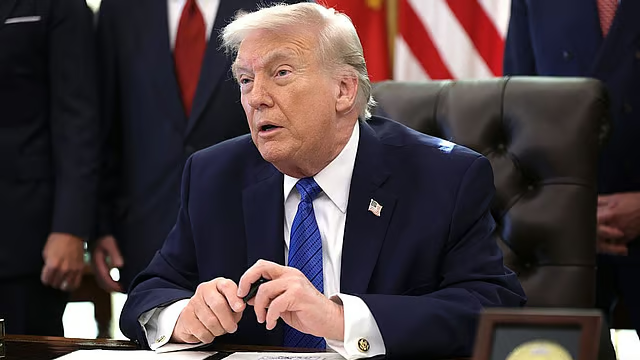
US President Donald Trump has announced a three-day delay to the planned 50% tariffs on a wide range of Canadian goods, saying Washington and Ottawa are close to finalising a new trade agreement.

The announcement came less than two hours before the tariffs, which were expected to affect nearly $20bn (£14.8bn; C$28bn) worth of Canadian imports, were due to take effect.

Trump said the decision was based on progress in negotiations between the two countries.

“I have paused the 50% Tariffs against Canada, that were scheduled to kick in tomorrow morning for a three day period, based on the fact that Canada and the U.S.A., subject to the finalization of documents, have a DEAL!” Trump said in a social media post.

The United States and Canada have been negotiating intensely since July after Trump threatened to introduce the new tariffs by 19 August. The two countries remain divided over several issues, including US duties on Canadian automobiles and restrictions on American alcohol sales in some Canadian provinces.

Canadian Prime Minister Mark Carney confirmed that progress had been made but said negotiations were not yet complete.

“Substantial progress has been made, although there is important work still to be done,” Carney said in a letter posted on X.

Trump also suggested that a final agreement could pave the way for the revival of the Keystone XL pipeline, a long-delayed project that would transport oil from Alberta to the United States.

“The great Keystone XL Pipeline, long ago killed by Sleepy Joe Biden, may be awoken from the grave!” Trump wrote on Truth Social.

The proposed pipeline, which has faced opposition from environmental and Indigenous groups, was previously blocked under the Obama and Biden administrations. Trump has repeatedly expressed support for reviving the project, which was designed to transport about 830,000 barrels of oil per day.

The US Trade Representative’s office said the proposed agreement would include “comprehensive market access for all American goods, economic security commitments, digital trade alignment”.

It would also contain “many important provisions that will continue to protect our market and American workers, along with our Canadian partners”, the office added.

The three-day extension has been welcomed by businesses and Canadian negotiators, who have warned that higher tariffs could increase costs and disrupt trade on both sides of the border.

The threatened tariffs would have covered Canadian products including wine, dairy, cement, clothing and hockey equipment. They would have been added to existing US tariffs on Canadian steel, aluminium, automobiles and lumber.

Canada has been pushing for the removal or reduction of tariffs on key sectors, while Washington has demanded several concessions from Ottawa.

Among the US demands are the removal of Canada’s remaining retaliatory tariffs on American vehicles, greater access for US cheese producers through changes to dairy quotas, and an end to provincial restrictions on American alcohol sales.

In the final hours before the original deadline, negotiators were reportedly considering reducing US tariffs on Canadian automobiles from 25% to 15%. However, disagreements remained over which vehicles would qualify, with Washington pushing for the lower rate to apply only to cars containing a high percentage of American-made components.

Carney also faces the challenge of securing support from Canada’s provincial premiers to restore sales of US alcohol, since liquor distribution is controlled at the provincial level.

Ontario Premier Doug Ford, whose province has been heavily affected by US auto tariffs, said he would consider lifting the alcohol restrictions if Canada secured a “fair deal”.

The US Chamber of Commerce also urged both governments to reach an agreement, warning that “higher tariffs would damage both economies, drive up costs for US families, further disrupt critical supply chains, and risk the 13 million American jobs that depend on trade under the US-Mexico-Canada Trade Agreement”.

The three-day pause now gives negotiators additional time to resolve the remaining disagreements and finalise the documents needed for a broader US-Canada trade deal.