
Home Blog Page 36

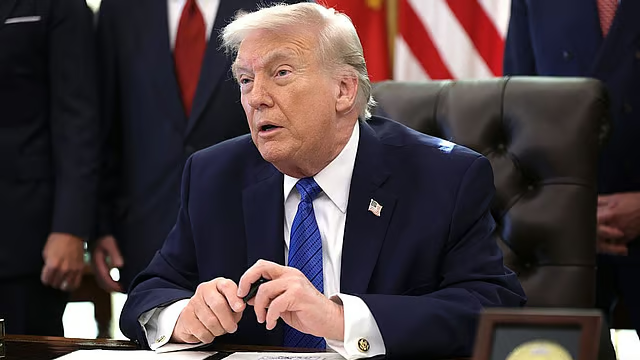
Trump Delays New Canada Tariffs For Three Days As US-Canada Trade Deal Nears

0

US President Donald Trump has announced a three-day delay to the planned 50% tariffs on a wide range of Canadian goods, saying Washington and Ottawa are close to finalising a new trade agreement.

The announcement came less than two hours before the tariffs, which were expected to affect nearly $20bn (£14.8bn; C$28bn) worth of Canadian imports, were due to take effect.

Trump said the decision was based on progress in negotiations between the two countries.

“I have paused the 50% Tariffs against Canada, that were scheduled to kick in tomorrow morning for a three day period, based on the fact that Canada and the U.S.A., subject to the finalization of documents, have a DEAL!” Trump said in a social media post.

The United States and Canada have been negotiating intensely since July after Trump threatened to introduce the new tariffs by 19 August. The two countries remain divided over several issues, including US duties on Canadian automobiles and restrictions on American alcohol sales in some Canadian provinces.

Canadian Prime Minister Mark Carney confirmed that progress had been made but said negotiations were not yet complete.

“Substantial progress has been made, although there is important work still to be done,” Carney said in a letter posted on X.

Trump also suggested that a final agreement could pave the way for the revival of the Keystone XL pipeline, a long-delayed project that would transport oil from Alberta to the United States.

“The great Keystone XL Pipeline, long ago killed by Sleepy Joe Biden, may be awoken from the grave!” Trump wrote on Truth Social.

The proposed pipeline, which has faced opposition from environmental and Indigenous groups, was previously blocked under the Obama and Biden administrations. Trump has repeatedly expressed support for reviving the project, which was designed to transport about 830,000 barrels of oil per day.

The US Trade Representative’s office said the proposed agreement would include “comprehensive market access for all American goods, economic security commitments, digital trade alignment”.

It would also contain “many important provisions that will continue to protect our market and American workers, along with our Canadian partners”, the office added.

The three-day extension has been welcomed by businesses and Canadian negotiators, who have warned that higher tariffs could increase costs and disrupt trade on both sides of the border.

The threatened tariffs would have covered Canadian products including wine, dairy, cement, clothing and hockey equipment. They would have been added to existing US tariffs on Canadian steel, aluminium, automobiles and lumber.

Canada has been pushing for the removal or reduction of tariffs on key sectors, while Washington has demanded several concessions from Ottawa.

Among the US demands are the removal of Canada’s remaining retaliatory tariffs on American vehicles, greater access for US cheese producers through changes to dairy quotas, and an end to provincial restrictions on American alcohol sales.

In the final hours before the original deadline, negotiators were reportedly considering reducing US tariffs on Canadian automobiles from 25% to 15%. However, disagreements remained over which vehicles would qualify, with Washington pushing for the lower rate to apply only to cars containing a high percentage of American-made components.

Carney also faces the challenge of securing support from Canada’s provincial premiers to restore sales of US alcohol, since liquor distribution is controlled at the provincial level.

Ontario Premier Doug Ford, whose province has been heavily affected by US auto tariffs, said he would consider lifting the alcohol restrictions if Canada secured a “fair deal”.

The US Chamber of Commerce also urged both governments to reach an agreement, warning that “higher tariffs would damage both economies, drive up costs for US families, further disrupt critical supply chains, and risk the 13 million American jobs that depend on trade under the US-Mexico-Canada Trade Agreement”.

The three-day pause now gives negotiators additional time to resolve the remaining disagreements and finalise the documents needed for a broader US-Canada trade deal.

Sowore Accuses DSS Of Discrimination At 2027 Peace Accord Signing

0

African Action Congress (AAC) presidential candidate Omoyele Sowore has accused operatives of the Department of State Services (DSS) of discriminatory treatment during the signing of the Peace Accord ahead of Nigeria’s 2027 general elections.

Sowore made the allegation in a statement shared on his verified X account on Wednesday, claiming that DSS officials stopped him at the entrance to the event organised by the National Peace Committee.

According to the former presidential candidate, one of the security operatives asked him to produce his invitation letter despite knowing that he was a presidential candidate participating in the event.

Sowore alleged that he was subjected to additional scrutiny while another presidential candidate who arrived with a large convoy was allowed into the venue without facing similar checks.

He further claimed that security officials initially prevented him from entering with members of his staff and later told him that his camera crew would also not be allowed into the venue.

The AAC candidate said the incident reflected what he described as a broader pattern within Nigeria’s security agencies, where people without large convoys or heavily armed security details are sometimes treated as less important.

Sowore argued that such treatment amounted to intimidation and class discrimination, particularly at an event specifically organised to encourage peaceful and democratic elections.

He said all presidential candidates attending the Peace Accord should receive equal treatment and respect, regardless of their financial resources, political influence or security arrangements.

He said, “If this is supposed to be a peace accord involving presidential candidates, then every candidate must be treated with equal dignity and respect.”

Sowore maintained that the level of security surrounding a candidate should not determine how that individual is treated by security agencies.

He also argued that access to the event should not depend on the number of vehicles in a candidate’s convoy, the size of their security detail or the privileges associated with their political status.

The AAC candidate said he resisted what he considered discriminatory treatment and insisted on his rights before eventually being allowed to participate in the event.

The allegation comes as presidential candidates and political parties step up preparations for the 2027 general elections.

The National Peace Committee organised the accord as part of efforts to encourage candidates and political parties to commit to peaceful campaigns, responsible conduct and respect for the electoral process ahead of the polls.

Osun Election: Adeleke Clarifies ADC Relationship, Denies Any Electoral Deal

0

Osun State Governor, Ademola Adeleke, has dismissed claims that he had an electoral agreement or political partnership with the African Democratic Congress (ADC) before, during or after the August 15 governorship election.

Adeleke made the clarification in a statement shared on his verified X handle on Tuesday, as he reflected on his re-election and acknowledged the role played by God, voters and his political allies in securing victory.

The governor specifically stated that the ADC was not part of the political alliance that campaigned and mobilised support for his re-election.

“I had no electoral deal or partnership with the ADC before, during, or after the governorship election,” Adeleke wrote.

“The credit for our victory goes to God Almighty and the good people of Osun State for their overwhelming support and re-election.

“For the sake of history, it is important to clarify that the ADC was never part of the rainbow coalition that canvassed, mobilised, and supported our campaign in the battle leading to last Saturday’s election.

“I commend all our political partners who sacrificed, worked tirelessly, and went all out to make Saturday a victory day for all Osun people. Their commitment and support were instrumental to our success.

“Now that the election is over, I remain the Governor of all Osun people, irrespective of political affiliation, religion, or tribe. My commitment is to unite our people and continue working for the progress and prosperity of Osun State.”

Adeleke’s comments come amid discussions about the alliances and political calculations surrounding the closely contested Osun governorship election.

The governor defeated the All Progressives Congress (APC) candidate, Bola Oyebamiji, and the ADC candidate, Najeem Salaam, in the August 15 poll.

Adeleke, who contested on the Accord platform, secured 511,067 votes, while Oyebamiji polled 444,815 votes. Salaam finished with 17,180 votes.

The incumbent governor won in 19 of Osun State’s 30 local government areas, while Oyebamiji secured victory in the remaining 11.

Following his re-election, Adeleke said his focus would now shift from electoral politics to governing the state and bringing together residents across political, religious and ethnic lines.

2027 Presidential Election Campaign Begins Today

0

Campaigning for Nigeria’s 2027 presidential election officially begins on Wednesday, setting the stage for a highly competitive contest expected to focus heavily on the economy, cost of living, insecurity and the impact of President Bola Tinubu’s economic reforms.

The election, scheduled for January 16, 2027, is expected to feature a partial repeat of the 2023 presidential contest, with President Bola Tinubu again seeking re-election against major opposition figures including former Anambra State Governor Peter Obi, former Vice President Atiku Abubakar and other candidates.

Nigeria, Africa’s most populous country, enters the campaign season amid persistent economic challenges and insecurity. While Tinubu’s administration has implemented major economic reforms since taking office in 2023, the policies have also contributed to significant pressure on households and businesses.

“The economy is the biggest issue. That’s the one thing that cuts across different parts of the country, and it continues to affect security and development concerns,” said Afolabi Adekaiyaoja, author of the Nigeria politics newsletter The Bellwether.

One of Tinubu’s most significant policies has been the removal of the fuel subsidy, which had kept petrol prices artificially lower for years but placed a heavy financial burden on government finances.

The reform has received support from some economists and investors, but it has also contributed to a sharp increase in living costs. The naira lost significant value, while inflation rose to as high as 34 per cent before headline inflation later eased to 15.4 per cent in July.

The economic difficulties have also compounded an existing poverty problem. According to the World Bank, more than 60 per cent of Nigerians now live below the poverty line, compared with about 40 per cent in 2019.

Security is another major concern heading into the election.

Violence has increased in parts of the country since 2024, according to Ladd Serwat, a senior Africa analyst at the Armed Conflict Location & Event Data Project (ACLED).

He attributed the deterioration to “driven by the spread and intensification of armed banditry across northern and central Nigeria” as well as increased conflict in Borno State, the centre of the country’s long-running jihadist insurgency.

For the opposition, however, presenting a strong alternative to the ruling APC could prove challenging.

“the opposition has been too mired in internal and legal issues to really articulate a difference” between their policies and Tinubu’s, Adekaiyaoja said.

For some voters, the economy remains the defining issue.

“The most important issues for me are the economy and cost of living,” said civil servant Afolayan Abdullahi, 42, who said he intended to vote for Tinubu.

2023 Rivals Return To The Presidential Race

Tinubu enters the campaign with significant political advantages. His All Progressives Congress controls the National Assembly and holds 31 of Nigeria’s 36 governorships.

The 2027 presidential election is expected to partly revisit the political battle of 2023, when Tinubu defeated Atiku Abubakar and Peter Obi.

Tinubu won 36.6 per cent of the vote in that election, while Atiku secured 29 per cent and Obi received 25 per cent.

Rabiu Kwankwaso, who obtained roughly six per cent in 2023, has now joined forces with Obi as his running mate, adding another dimension to the opposition’s strategy.

However, insecurity and the cost of participating in elections could affect voter turnout.

“Nigeria is not safe, terrorists, kidnappers, bandits everywhere,” said Becky Alegbe, a 28-year-old street vendor in Abuja.

Although she is registered to vote in her home village in Edo State, she said, “for me to take the risk to travel… I will not take that,” citing rising transportation costs and concerns about vote-buying.

Voter participation was already low in 2023, when turnout stood at just 27 per cent.

Presidential Candidates Sign Peace Accord Ahead Of Campaigns

The formal start of campaigning comes shortly after President Tinubu, presidential candidates including Peter Obi, Omoyele Sowore and Donald Duke, among others, signed the National Peace Accord ahead of the 2027 elections.

The agreement was signed on Tuesday at the Bola Ahmed Tinubu International Conference Centre in Abuja.

The event brought together representatives of presidential candidates, governorship and National Assembly contestants, political party leaders, the Independent National Electoral Commission (INEC) Chairman Joash Amupitan, Secretary to the Government of the Federation George Akume and other senior political figures.

The National Peace Committee organised the event as part of efforts to encourage peaceful political engagement before, during and after the elections. A second phase of the peace initiative is expected to take place after the polls.

Speaking ahead of the commencement of the campaign season, Peter Obi called for an election in which voters would have confidence that their ballots would determine the outcome.

“I don’t have any fear [going into next year’s election] except to say that, please, for the sake of the children of Nigeria, can we have an election where people’s votes will count?”

Obi also urged Nigerians to reject candidates or political parties that violate the principles contained in the peace agreement.

“Well, the punishment is that Nigerians should not vote for them,” he said when asked what the punishment should be for those who violate the agreement.

He called on politicians to “be exemplary” in their conduct as the election approaches.

“You can’t answer ‘His Excellency’ without being an excellent person,” Obi, 65, said. “So, the process that will make you answer ‘His Excellency’ should be excellent, and the only way to do it is to conduct yourself properly.”

President Tinubu was represented at the ceremony by SGF George Akume, who praised the National Peace Committee for sustaining its peace-building efforts since 2014.

The committee’s leadership includes former Head of State Abdulsalami Abubakar, Sultan of Sokoto Muhammad Sa’ad Abubakar and Bishop Matthew Hassan Kukah.

Tinubu also pointed to improvements in Nigeria’s electoral technology, particularly the Bimodal Voter Accreditation System (BVAS), arguing that the technology has strengthened the ability of voters to influence election outcomes.

He cited recent off-cycle elections in Anambra, Osun and Ekiti as examples of what he described as improvements in electoral transparency.

“Different parties won them, and local and foreign observers described them as free, credible, and transparent. When the process and outcome are manifestly transparent, we see less post-election litigation in our courts,” he said.

Tinubu added that “politicians are now more accountable to the people because votes count.”

With campaigning now underway, the 2027 presidential race is set to move from political positioning into a more direct battle for voters. The central questions are likely to include whether Nigerians believe Tinubu’s economic reforms are beginning to deliver results, how the opposition presents itself as a credible alternative, and whether insecurity and economic hardship will translate into stronger voter participation.

The election will also test the credibility of Nigeria’s electoral institutions, particularly their ability to address concerns around vote-buying, technology, accessibility, security and public confidence.

APC Announces 2026 Primary Election Timetable For Restored Constituencies In Delta, Kogi And Other States

0

The All Progressives Congress (APC) has released its timetable for primary elections to select candidates for several recently restored and vacant legislative constituencies across Nigeria.

The development follows the decision by the Independent National Electoral Commission (INEC) to restore four State House of Assembly constituencies in Delta and Kogi states and schedule party primaries for August 21–25, 2026.

INEC has fixed September 19, 2026 for elections into the affected constituencies.

“This coincides with the period for the conduct of primaries for bye-elections to fill recent vacancies in the Gombe/Kwami/Funakaye Federal Constituency of Gombe State, the Disina and Sakwa State Constituencies of Bauchi State, Udu State Constituency of Delta State, and Dawakin Kudu State Constituency of Kano State. Elections into these constituencies have been fixed for 19th September, 2026,” INEC said in a statement issued last Friday.

INEC National Commissioner and Chairman of the Information and Voter Education Committee, Mohammed Haruna, said the restoration of the constituencies followed court judgments directing the commission to reinstate them.

Following INEC’s announcement, the APC identified the constituencies where its primary elections will take place.

In Delta State, the affected constituencies are:

  • Abraka State Constituency
  • Isoko North II State Constituency
  • Ughelli South II State Constituency
  • Udu State Constituency

In Kogi State, the restored constituency is:

  • Yagba West II State Constituency

The other constituencies covered by the APC timetable are:

  • Gombe/Kwami/Funakaye Federal Constituency, Gombe State
  • Disina State Constituency, Bauchi State
  • Sakwa State Constituency, Bauchi State
  • Dawakin Kudu State Constituency, Kano State

The APC’s primary election process commenced on Tuesday, August 18, 2026, and is scheduled to continue until Monday, August 24.

APC Primary Election Fees

Aspirants seeking the APC ticket for the affected State House of Assembly seats are required to pay N1 million for the expression of interest form and N5 million for the nomination form.

For the House of Representatives seats, aspirants are required to pay N1 million for the expression of interest form and N9 million for the nomination form.

The party also approved a 50 per cent discount on nomination forms for female aspirants, youths and persons living with disabilities.

However, those categories of aspirants are still required to pay the standard N1 million expression of interest fee.

The primary elections are expected to determine the APC candidates who will contest the September 19 legislative elections in the affected constituencies.

Mangu Killings: Police Arrest Suspected Mastermind

0

Police in Plateau State have arrested a key suspect allegedly linked to the deadly attack on Bimper village in Mangu Local Government Area, where 25 people were killed and four others injured.

The attack occurred in the early hours of Tuesday in Kombun District, marking the third reported attack in Mangu within a week and heightening concerns about the security situation in the area.

Plateau State Police Public Relations Officer, SP Alfred Alabo, confirmed the arrest to Channels Television, saying the suspect currently in custody is believed to be the mastermind behind the attack.

He said investigations are ongoing, while security operatives have launched a manhunt for other suspects who reportedly fled the scene.

The police arrest comes as authorities intensify efforts to identify those responsible for the violence and prevent further attacks in the affected communities.

Local sources said the latest incident followed another attack in the area in which one person was shot.

The repeated attacks have increased anxiety among residents, who are calling on the government and security agencies to strengthen their presence in vulnerable communities and take urgent steps to prevent further loss of lives.

Authorities are expected to continue investigations as the search for other alleged perpetrators continues.

Russia Warns UK Of ‘Consequences’ Over British Drones Used In Ukraine Strikes

0

Russia has warned the United Kingdom that it could face unspecified “consequences” after confirmation that British-made drones have been used in recent Ukrainian strikes against military and industrial targets inside Russia.

In a statement, the Russian embassy in the UK accused Britain of “deliberately opting for an escalation of the Ukraine crisis”, warning that “the deeper its involvement in the conflict… the higher the price it will pay”.

The embassy did not specify what measures Moscow could take, but said “London’s actions will inevitably carry consequences for which it will have to answer”.

The warning comes as Ukraine has intensified its attacks deep inside Russian territory, with oil refineries, logistics facilities and other strategic sites among the targets.

The UK Ministry of Defence (MoD), however, reaffirmed Britain’s support for Ukraine, with a spokesperson saying the country stood “shoulder to shoulder” with Kyiv.

“Russia should be in no doubt about the resolve of this government to stand against Russian aggression, in Ukraine and against the UK and our allies,” the spokesperson said.

The MoD also said Britain remained “committed to providing the equipment Ukraine needs to defend itself against [Russian President Vladimir] Putin’s illegal invasion”.

The latest dispute follows confirmation from a military source that British-made drones were used in recent Ukrainian attacks on Russia.

Two British companies are known to have produced drones supplied to Kyiv. According to reports, the attacks involving the technology have contributed to significant damage to Russian economic and industrial infrastructure.

Russia has previously criticised Britain’s involvement in Ukraine’s drone programme and its supply of Storm Shadow missiles to Kyiv.

Russian Foreign Ministry spokeswoman Maria Zakharova also claimed in 2024 that drones using British components and configurations had been involved in attacks on Russian territory, including an attack on a fuel depot in the Rostov region.

The latest Russian warning comes amid a major increase in Ukrainian drone attacks against targets around Moscow and other parts of Russia.

Russian officials said hundreds of drones were directed towards the Moscow region over the past two days.

Regional Governor Andrey Vorobyov said a 10-year-old girl was injured and a Wildberries warehouse was damaged during one of the attacks.

In another overnight assault, Russian authorities said about 620 drones were launched towards the area surrounding Moscow. Russian air defences reportedly destroyed more than 180 of them, although officials said several people were wounded.

Wildberries said one of its logistics facilities had “sustained minor damage”.

The attacks have increasingly focused on logistics infrastructure, energy facilities and other locations considered important to Russia’s military and economy.

The escalation has been accompanied by another wave of Russian missile and drone attacks across Ukraine.

Officials said 17 people were killed in Russian attacks, including 10 residents of the northeastern Ukrainian village of Pechenihy.

Two Russian missiles struck the centre of the village early Tuesday, hitting private homes, a café and a post office and killing 10 people, according to Ukrainian officials.

Other deaths were reported in Sumy, Zaporizhzhia and Kherson, while several people were wounded in Izium near the frontline.

Kyiv also came under several waves of attacks overnight.

Britain has remained one of Ukraine’s strongest international supporters since Russia launched its full-scale invasion in February 2022.

In April, the UK Ministry of Defence announced plans to provide Ukraine with tens of thousands of drones, including long-range strike systems, describing the package as its largest-ever drone support commitment.

Ukraine has also developed its own long-range weapons and drone technology, including the FP-5 Flamingo cruise missile, giving Kyiv greater capacity to strike targets deep inside Russia.

Russia currently controls approximately a fifth of Ukrainian territory, while both sides continue to expand their use of drones and long-range weapons.

The latest warning from Moscow adds another layer of tension to the relationship between Russia and the UK, particularly as Britain’s military assistance to Ukraine continues to expand and Ukrainian forces increasingly conduct strikes against targets inside Russian territory.

Over 20 Feared Dead In Plateau Attack

0

More than 20 people, including women and children, are feared dead following an attack on Aper Village in Mangu Local Government Area of Plateau State.

The incident occurred in the early hours of Tuesday, August 18, and has raised fresh concerns among residents, particularly as it is reportedly the third attack recorded in Mangu within the past week.

Local sources said several people were killed in the latest attack, while others are still reportedly missing. One person was also shot in an earlier attack in the area.

The Plateau State Police Command confirmed the incident but said the casualty figure was still being established.

The command’s Public Relations Officer, Alfred Alabo, said the initial information received by the police indicated that 18 people had been affected.

According to him, however, the number is believed to have increased to more than 20 as information continues to come in from the affected community.

Alabo added that the Plateau State Commissioner of Police, Faniyan Ayodeji, alongside other senior officers, was heading to the scene to assess the situation and obtain a clearer picture of what happened.

The attack has intensified concerns over security in Mangu, with residents urging the government to strengthen security operations and take measures to prevent further attacks on vulnerable communities.

Authorities are expected to provide more details on the casualties and circumstances surrounding the incident as security personnel complete their assessment of the affected area.

UK Commends Peaceful Osun Election, Flags Vote-Buying And BVAS Challenges Ahead Of 2027 Election

0

The United Kingdom has praised the overall conduct of the 15 August 2026 Osun State governorship election, describing the poll as peaceful and congratulating Governor Ademola Adeleke on his re-election. However, the UK also identified vote-buying, voter accessibility and delays involving the Bimodal Voter Accreditation System (BVAS) as areas requiring attention ahead of Nigeria’s 2027 general elections.

In a statement issued by the British High Commission on Monday night, the UK said observations from its accredited representatives and independent monitoring organisations showed several positive signs in the electoral process.

“This includes the opening of polls as scheduled in many locations, the commitment of security personnel to maintaining order, and the effective implementation of electoral procedures by INEC officials. Most of all, we were encouraged by the patience, resilience and participation demonstrated by voters throughout the day,” the statement read.

The UK, however, pointed to several concerns recorded before and during the election. These included isolated incidents that created tension, as well as continued cases of voter interference and vote-buying involving different political parties.

The High Commission also highlighted challenges affecting some voters, particularly persons with disabilities and elderly citizens.

“We also note continued issues with access for people with disabilities and for elderly people, as well as overcrowding due to the speed and limited provision of BVAS devices for accreditation,” the report added.

The UK urged Nigerian authorities and other stakeholders to carefully assess the challenges observed during the election and use recommendations from civil society organisations to improve future elections.

It said addressing such issues would be important in strengthening public confidence in Nigeria’s electoral system while promoting transparency, accountability and inclusiveness.

“As Nigeria looks ahead to the 2027 general elections, we note that off-cycle elections benefit from the availability of additional personnel and resources that may be more difficult to replicate at a nationwide scale. We nevertheless hope that the experience of the Osun election will help inform further improvements that strengthen the integrity, inclusiveness and credibility of future electoral processes,” the statement read.

The British High Commission also commended Osun voters for their conduct throughout the election, describing their participation as a positive indication of democratic engagement.

It also commended the people of Osun State for their “peaceful and active participation” in the 15 August 2026 governorship election.

Henry Seriake Dickson Appoints Steve Nwosu, Two Others To Strengthen NDC Ahead Of 2027 Elections

0

Senator Henry Seriake Dickson, National Leader of the Nigeria Democratic Congress (NDC) and representative of Bayelsa West, has approved the appointment of three senior aides as he moves to strengthen his political, administrative and communication operations.

The appointments take immediate effect and involve veteran journalist and former Sun Newspapers editor Steve Nwosu, Sani Takori and media executive VinMartin Obiora Ilo.

Nwosu has been appointed spokesperson, Takori will serve as a political and administrative adviser, while Ilo takes on the role of Chief Technical Adviser.

Dickson, who previously served as governor of Bayelsa State, said the appointments are intended to improve the coordination of his responsibilities as NDC National Leader and senator.

Nwosu joins the team with more than 30 years of experience spanning print journalism, broadcasting, digital media, political communication and media administration.

He previously held senior editorial positions at The Guardian, ThisDay and The Sun. At The Sun, he rose through several leadership positions, including pioneer editor of Saturday Sun, Editor of Daily Sun, Executive Director of Corporate Services, Deputy Managing Director and Deputy Editor-in-Chief.

He is also the founder of Nigerian Xpress Newspaper and currently serves as Managing Director and Editor-in-Chief of The Edibofa Communication and Publishing Limited, the company behind People’s FM stations in Abuja and Yenagoa, Universal Television Africa and Nigerian Xpress Newspaper.

Nwosu has also served on the editorial boards of ThisDay and The Sun. He spent eight years on the Standing Committee of the Nigerian Guild of Editors, including a period as treasurer.

Takori, a lawyer and experienced public administrator from Gummi Local Government Area of Zamfara State, has held several senior legal and political positions throughout his career.

His previous appointments include Registrar, Magistrate, Solicitor-General, Attorney-General and Commissioner for Justice in Zamfara State. He also represented his constituency in the House of Representatives between 2003 and 2007.

Takori previously served as National Legal Adviser to the Council of Ulamas and Chief Legal Officer of the Nigerian Electoral Commission. He was also secretary of the presidential campaigns of former President Umaru Yar’Adua in 2003 and 2007.

He is a founding member of the NDC and previously served as the party’s Protem National Secretary during its registration process.

Ilo, who has been appointed Chief Technical Adviser, brings nearly four decades of experience in broadcasting, journalism, public service, strategic communication and development consultancy.

An alumnus of Harvard University’s Kennedy School of Government, Ilo holds degrees in Mass Communication, Development Studies, and International Relations and Strategic Studies.

He began his broadcasting career with Radio Nigeria, where he eventually became a network newscaster before moving to Africa Independent Television (AIT).

He retired from AIT in 2013 as Director of Special Duties and South-East Operations.

Ilo has also served as Special Adviser on Media to the Enugu State Governor and was a member of the Governing Board of the National Broadcasting Commission.

Before his latest appointment, he served as President and Chief Executive Officer of Signature TV.

According to the statement announcing the appointments, Dickson selected the three officials based on their professional experience, expertise and track records in their respective fields.

The appointments come as political parties and opposition groups intensify preparations for the 2027 general elections.

The three appointees will support Dickson’s activities in his dual capacity as National Leader of the NDC and a serving senator, with their responsibilities covering political coordination, administration, strategic communication and media engagement.

The appointments therefore give Dickson a team with extensive experience in journalism, law, public administration, political organisation and strategic communication as Nigeria’s political parties position themselves for the 2027 electoral contest.
