Home Blog Page 376

Nigerian Air Force Acquires 63 New Aircraft in 3 Years – CAS

2

The Chief of the Air Staff (CAS), Air Marshal Hasan Abubakar, announced that the Nigerian Air Force (NAF) has successfully acquired 63 new aircraft over the past three years. This significant acquisition was shared during the NAF Training, Operations, and Safety Seminar for 2024, held in Abuja.

According to Abubakar, the fleet modernization and improved operational capabilities were achieved with the strong support of President Bola Tinubu. In the previous year alone, the NAF received 12 advanced aircraft, including two KA-360i, four DA-62, four T-129 helicopters, and two AW-109 Trekker helicopters. Additionally, the NAF expects further deliveries by year-end, including two more T-129 helicopters and one KA-360i.

Looking ahead to 2025, the NAF plans to add 10 AW-109 Trekker helicopters, 24 M-346FA aircraft, three CASA-295 aircraft, and 12 AH-1Z attack helicopters to its fleet. This will bring the total new aircraft to 64 in approximately three years. Moreover, the NAF has acquired 12 pre-owned A-Jet aircraft from the French Air Force through SOFEMA. Of these, six will be refurbished for operational use, while the other six will serve as spare parts for the existing Alpha Jet fleet.

Air Marshal Abubakar referred to this era as a “golden age” for the NAF, emphasizing the importance of consolidating the gains made in enhancing the force’s operational capacity. Between June 2023 and September 2024, the NAF successfully executed 8,665 missions across 9,928 sorties, accumulating 15,915 flying hours.

Abubakar also praised the leadership of the Air Component Commanders and encouraged them to continue building on their successes. In terms of training, the NAF has made significant strides, with 405 airmen and 186 officers completing foreign courses, and 64 currently in progress. Domestically, 5,474 personnel have completed training, with 1,331 more in various stages of training.

In 2024, the NAF trained 54 pilots abroad and 43 pilots locally, alongside 16 UAV operators. A special winging ceremony will take place today for 28 newly trained pilots and operators.

10 Things You Should Know About The Tax Reform Bills

0

On Thursday, Nigeria’s proposed tax reform bills made significant progress, passing their Second Reading in the Senate, despite notable opposition from some lawmakers. Senate Leader, Michael Opeyemi Bamidele, who led the debate on the Executive Bill, hailed the legislation as a crucial step in overhauling the country’s tax system.

“These bills are designed to simplify the tax framework, reduce the burden on small businesses, and streamline tax collection,” Bamidele stated.

The bills, introduced by the Presidential Committee on Fiscal and Tax Reform, chaired by Taiwo Oyedele, have sparked significant debate in recent weeks.

Here are 10 key facts about the proposed tax reforms.

  1. Key Bills Introduced
    The reform package comprises four main bills: the Nigeria Tax Bill, the Nigeria Tax Administration Bill, the Nigeria Revenue Service (Establishment) Bill, and the Joint Revenue Board (Establishment) Bill. Each bill focuses on different aspects of tax administration, compliance, and enforcement.
  2. Major Benefits
    The reforms aim to standardize tax revenue management across Nigeria, eliminate double taxation, incentivize private sector investment in critical sectors, and enhance disposable incomes through targeted tax exemptions.
  3. Reduction in Tax Burden
    A key feature of the reforms is the proposal to reduce the corporate income tax rate from 30% to 25% over the next two years. This reduction is intended to ease financial pressures on businesses and encourage greater investment.
  4. Changes to VAT Revenue Distribution
    The bills propose a shift in VAT revenue distribution, where the funds will be allocated based on where goods and services are consumed, rather than being pooled centrally for redistribution. Federal Inland Revenue Service (FIRS) Chairman, Zacch Adedeji, explained that this aligns VAT with its nature as a consumption tax.
  5. Exemptions for Low-Income Earners
    The reforms aim to exempt individuals earning below the minimum wage from the Pay As You Earn (PAYE) tax. Additionally, small businesses with annual revenues of N50 million or less would also be exempt from paying taxes.
  6. Harmonization of Tax Administration
    The Nigeria Tax Administration Bill seeks to unify tax rules across federal, state, and local governments. This move is designed to reduce confusion for taxpayers, lower compliance costs, and promote greater transparency in tax collection.
  7. Creation of the Nigeria Revenue Service
    The Nigeria Revenue Service (Establishment) Bill proposes restructuring the Federal Inland Revenue Service (FIRS) into a centralized agency responsible for tax collection nationwide. This reorganization is intended to improve accountability and streamline revenue generation.
  8. Joint Revenue Board for Taxpayer Rights
    A new Joint Revenue Board is proposed to replace the existing Joint Tax Board. This body would focus on protecting taxpayer rights and resolving disputes, with representatives from all tax authorities working together to ensure a unified approach to tax administration.
  9. Encouraging Private Sector Investment
    The reforms aim to use tax policies as a strategic tool to attract private sector investment into key industries, supporting Nigeria’s broader economic development objectives.
  10. Second Reading Approved in the Senate
    Despite objections from some lawmakers about stakeholder consultations and the derivation principle, the tax reform bills advanced to their Second Reading in the Senate. The Senate Committee on Finance has been tasked with reviewing the bills and reporting back within six weeks.

Police Clamp Down on Tinted Windows and Covered Number Plates

0

The Federal Capital Territory (FCT) Police Command has announced strict enforcement measures against vehicles with tinted windows and covered number plates in a bid to combat increasing criminal activities, including kidnapping.

In a statement posted on X.com late Tuesday, the command’s spokesperson, SP Josephine Adeh, issued a warning to vehicle owners in the FCT, urging them to remove tinted glass from their vehicles or face the risk of having their cars impounded. She emphasized, “For now, the use of tinted windows on vehicles is prohibited. If your vehicle has tinted windows, please remove them to avoid having your vehicle seized.”

This directive is part of broader efforts to address the rise in criminal activities, including the notorious “one chance” robbery scheme.

FCT Commissioner of Police, Olatunji Disu, reiterated the order during a parade of criminal suspects on Tuesday. In a video posted alongside the statement, he explained that many victims rescued from kidnappers had cited the use of tinted windows as a factor that concealed their distress, making it difficult for people to notice them. He also pointed out that criminals often use vehicles with covered or missing number plates to evade detection and carry out illegal activities.

“We are cracking down on all commercial vehicles and individuals with tinted windows,” Disu said. “We need to be able to see people in their cars. Tinted windows are contributing to lawlessness. Victims we’ve rescued have confirmed that tinted glass made it impossible for people to know they were in distress. Additionally, many criminals cover their number plates or fail to display them altogether.”

The Commissioner issued a firm warning, stating that the police will rigorously enforce laws concerning tinted windows, covered number plates, and unregistered vehicles. “Residents of the FCT should note that from now on, we will strictly enforce these laws. No one is allowed to tint their vehicles or cover their number plates. Vehicles without registration numbers will also be targeted, as these actions are commonly exploited by criminals to carry out robberies,” Disu stressed.

According to reports over 296 vehicles have already been impounded in the FCT since the enforcement began.

South Africa Supports Nigeria’s G20 Bid, Eyes Lithium Reserves

0

South Africa has expressed strong support for Nigeria’s bid to join the G20, with President Cyril Ramaphosa highlighting the country as a “valued sister nation.” This announcement came during the launch of South Africa’s presidency of the G20 in Cape Town, just before Ramaphosa met with Nigerian President Bola Tinubu to co-chair the 11th Bi-National Commission (BNC) between the two nations.

In a statement released by Tinubu’s Special Adviser on Information and Strategy, Bayo Onanuga, it was revealed that South Africa is not only backing Nigeria’s G20 membership but is also eyeing the country’s vast lithium reserves, crucial for the growing electric vehicle (EV) industry.

The G20, formed in 1999, is a key global forum for economic cooperation, bringing together 19 major economies and the European Union, collectively representing about 85% of global GDP, 75% of international trade, and two-thirds of the world’s population. The African Union was granted permanent membership in 2023, with South Africa and the AU being the only African representatives in the group.

Ramaphosa emphasized that South Africa’s support for Nigeria’s membership is vital, as the G20 continues to address global challenges such as economic growth, financial stability, and climate change. He also called for greater African representation within the G20, asserting that the continent’s voice has long been underrepresented in global forums.

“As Africa’s population grows, we are set to become a major economic force,” Ramaphosa stated, adding that more African nations should join the G20 to ensure the continent’s concerns are heard on the world stage. South Africa’s role as the current G20 president strengthens its push for broader African inclusion in shaping global economic policies.

Google, Microsoft, X, and TikTok Remove 65 Million Pieces of Harmful Content in Nigeria – NITDA

0

Major tech companies, including Google, Microsoft, X, and TikTok, have taken down over 65 million pieces of content from their platforms in Nigeria following user complaints, as revealed in a report by the National Information Technology Development Agency (NITDA).

NITDA’s Director of Corporate Communications & Media Relations, Mrs. Hadiza Umar, announced in a statement on Tuesday. This data forms part of the 2023 compliance report on the Code of Practice for Interactive Computer Service Platforms and Internet Intermediaries, which assesses these companies’ efforts to comply with Nigeria’s regulatory framework for online content management.

The Code, a joint initiative by NITDA, the Nigerian Communications Commission (NCC), and the National Broadcasting Commission (NBC), provides clear guidelines aimed at ensuring online safety and limiting the spread of harmful content across digital platforms.

The report shows that a total of 65,853,581 pieces of harmful content were removed from the platforms after being flagged by Nigerian users. In addition, 4,125,283 complaints were filed by Nigerian users, which led to the deactivation of over 12 million user accounts and the removal of the flagged content.

The report also highlights that 379,433 pieces of content were reinstated after successful user appeals, demonstrating that the platforms are responsive to concerns and provide channels for content review.

NITDA praised these companies for their compliance with the Code of Practice, which aims to foster a safer and more accountable digital environment for Nigerian users. The statement emphasized the significance of the 2023 compliance report in showcasing the platforms’ commitment to user safety and the importance of adhering to community guidelines.

Further insights from NITDA’s report revealed that foreign digital companies, including social media platforms, contributed over N2.55 trillion (about $1.5 billion) in taxes during the first half of 2024, underlining the increasing economic influence of the digital sector in Nigeria.

While acknowledging the progress made, NITDA called for ongoing collaboration between tech firms and regulatory bodies to tackle emerging challenges in digital safety, content moderation, and platform transparency.

NAFEM Forex Turnover Soars 61% to $43 Billion

0

The turnover in the Nigerian Foreign Exchange Market (NAFEM) surged by 61.9% year-on-year (YoY), reaching $43.09 billion in the first 11 months of 2024, up from $26.6 billion during the same period in 2023.

Quarterly data from FMDQ revealed that in Q1 2024, NAFEM turnover was $12.64 billion, but it saw a 19% decline to $10.24 billion in Q2 2024. The downward trend persisted in Q3 2024, with turnover dropping by 0.87% to $10.15 billion. However, October saw a sharp recovery, with monthly turnover rising 63% to $5.4 billion, up from $3.31 billion in September. This upward momentum continued in November, with turnover increasing another 13.5% to $6.13 billion.

Despite the positive turnover growth, the naira displayed mixed performance in the forex market in November. In NAFEM, the naira strengthened by N2.8 (0.16%) to N1,672.69 per dollar at the close of November, compared to N1,675.49 per dollar at the end of October. In contrast, the naira weakened by N10 (0.5%) in the parallel market, where the dollar closed at N1,745, up from N1,730 in October. As a result, the gap between the NAFEM and parallel market rates widened to N72.31 per dollar in November, compared to N54.61 in October.

The Central Bank of Nigeria’s Monetary Policy Committee (MPC) expressed concerns over the ongoing pressure on the exchange rate, highlighting the persistent high demand in the market. In its Communique No. 155, the MPC urged the CBN to explore additional measures to enhance foreign exchange market liquidity.

The MPC’s statement noted: “Members expressed concern over persisting exchange rate pressure, reflecting continued high demand in the market. Consequently, the Committee urged the Bank to explore measures to boost market liquidity.”

South Korea President Declares Emergency Martial Law Amid Budget Crisis

0

South Korea’s President, Yoon Suk Yeol, declared a state of emergency martial law on Tuesday, accusing the opposition of being “anti-state forces” attempting to destabilize the government. His remarks came during a national address amid ongoing disputes over the 2024 budget bill.

In a televised speech, Yoon stated, “To protect a liberal South Korea from the threats posed by North Korea’s communist regime and eliminate anti-state forces undermining our people’s freedom and prosperity, I declare emergency martial law.” He further criticized the opposition for prioritizing political agendas over the public interest, claiming they had paralyzed governance by focusing on impeachments, special investigations, and shielding their leader from justice.

The declaration followed intense budgetary conflicts between Yoon’s People Power Party and the opposition-led Democratic Party. Last week, opposition members approved a drastically reduced budget plan, cutting nearly 4.1 trillion won ($2.8 billion) from Yoon’s proposed budget of 677 trillion won. This included slashing the reserve fund and key budgets for government operations, including law enforcement and public security.

Yoon condemned the opposition for undermining vital functions of the state, calling the National Assembly a “haven for criminals” and a “den of legislative dictatorship” that threatens South Korea’s liberal democratic order. He further warned that the cuts would jeopardize national security, such as efforts to combat drug crimes and maintain public safety, describing the opposition’s actions as an attempt to turn the country into a “drug haven” and plunge it into chaos.

With the imposition of martial law, all South Korean military units have been put on high alert, and access to the National Assembly has been sealed off, preventing MPs from entering. Yoon, a former prosecutor, emphasized that the measure was necessary to protect South Korea’s future, assuring the public that foreign policy would not be affected by the move.

This dramatic escalation comes as Yoon’s approval rating plummeted to 19% in a recent Gallup poll, driven by dissatisfaction over economic management and controversies surrounding his wife, Kim Keon Hee.

Anti-Government Protest: Which Georgia is Affected?

0

When news of large anti-government protests in Georgia hits the headlines, many people may assume it refers to Georgia, USA. However, the current unrest is happening in the country of Georgia, a small but geopolitically significant nation located at the intersection of Europe and Asia, bordering Russia, Turkey, Armenia, and Azerbaijan.

Geography: Where is Georgia?

Georgia (the country) is a former Soviet republic that gained independence in 1991 after the collapse of the Soviet Union. It is situated in the Caucasus region, bordered by Russia to the north, Turkey and Armenia to the south, and Azerbaijan to the southeast. The country’s capital and largest city is Tbilisi.

    In contrast, Georgia, USA, is one of the 50 states in the United States of America, located in the southeastern region of the country, bordered by Florida, Alabama, Tennessee, North and South Carolina. Its capital city is Atlanta.

    Political Context: What’s Happening in Georgia (Country)?

    Currently, Georgia, the country, is experiencing significant political unrest, as large-scale protests have erupted against the government’s recent decisions. The Georgian Dream party, which has ruled the country for over a decade, recently announced it would suspend negotiations to join the European Union. This move has sparked outrage, with many citizens fearing it signals a shift toward Russian influence, undermining Georgia’s aspirations to align more closely with the West.

      The protests are driven by opposition parties, civil society groups, and ordinary citizens who demand greater democratic freedoms, human rights, and EU integration. The unrest escalated after the government’s controversial decision to suspend EU accession talks and pass laws critics argue could limit freedoms, such as a foreign agent law similar to Russia’s.

      Why the Confusion?

      Given that Georgia is also the name of a U.S. state, it is easy to see how people might confuse the two. However, it is crucial to distinguish between the two:

      • Georgia (Country): A small nation in the Caucasus region, aiming for closer integration with Europe but facing strong opposition from pro-Russian political forces.
      • Georgia (USA): An American state with no current political unrest related to the issues in the news about the country of Georgia.

      Global Implications of the Protests in Georgia (Country)

      The protests in Georgia (the country) have significant geopolitical implications. This small nation sits on a strategic crossroads between Europe and Asia and has long been a point of contention between Russia and the West. The protests are seen as part of a larger struggle for Georgia’s future, balancing between European integration and Russian influence. The U.S. and the European Union have shown concern over the government’s recent moves, with many accusing the ruling party of undermining democratic progress.

        What Makes Georgia (Country) Unique?

        Georgia has a rich cultural heritage, a history of resisting foreign domination, and a strategic location that places it at the heart of global political tensions. Despite its size, Georgia plays a crucial role in regional security and energy transit routes, making its political direction an important factor in broader international relations.

        The current anti-government protests are taking place in Georgia, the country, not in the U.S. state of Georgia. The protests reflect growing discontent over government policies seen as leaning toward Russia, while many Georgians strive for deeper ties with Europe. Understanding this distinction is key to grasping the geopolitical significance of the ongoing events in Tbilisi and the broader Caucasus region.

        FCT Places 61,384 People on HIV/AIDS Treatment

        0

        The Federal Capital Territory (FCT) has successfully placed 61,384 individuals living with HIV/AIDS on treatment, according to Dr. Adedolapo Fasawe, Mandate Secretary of the Health Services and Environment Secretariat, FCT Administration. The announcement was made during a press conference to mark the 2024 World AIDS Day in Abuja.

        Dr. Fasawe highlighted the theme for this year’s observance, “Take the Right Path: Sustain HIV Response, Stop HIV Among Children,” emphasizing the importance of tackling pediatric HIV and ensuring the rights of all individuals affected by the disease. World AIDS Day, observed annually on December 1, serves as a day to unite efforts, raise awareness, provide support to those living with HIV/AIDS, and honor those lost to the virus.

        Represented by Dr. Olubenga Bello, Director-General of the Hospital Management Board, Fasawe revealed that the 61,384 individuals receiving treatment is 223% of the projected number of people living with HIV (PLHIV) in the FCT. This figure also includes individuals who have migrated from neighboring states. Of the total, 1,048 are children—representing 3.8%—who are receiving life-saving antiretroviral therapy.

        The FCT, with an estimated population of 6.95 million, has an HIV prevalence rate of 1.4%, slightly above the national average of 1.3%. To address the growing need for HIV services, the FCTA has expanded its HIV services network, with 122 service delivery points providing antiretrovirals across the six Area Councils of the FCT. In addition, 285 conventional spoke sites and 37 unconventional sites offer decentralized, community-based care to reach even the most remote populations.

        Fasawe explained that the FCT’s decentralized service model ensures that individuals have access to high-quality care close to home, with special efforts to address pediatric HIV through initiatives like mentor mothers who assist pregnant women in navigating care pathways. Traditional birth attendants have also been trained on the importance of facility births, early infant diagnosis, and HIV prevention.

        In addition to expanding access to antiretroviral therapy, the FCT has increased its focus on Pre-Exposure Prophylaxis (PrEP) for HIV prevention to ensure that individuals at risk remain HIV-free. Fasawe credited these successes to the collaborative efforts of various partners, including the National AIDS and STI Control Programme, the National Agency for the Control of AIDS, and implementing organizations like the Institute of Human Virology Nigeria, AIDS Healthcare Foundation, and YouthRISE.

        Fasawe also stressed the importance of continued efforts to combat HIV-related stigma and discrimination, which remain significant barriers to care. The FCTA remains committed to reaching vulnerable populations and ensuring that everyone living with HIV in the FCT receives the care, dignity, and support they need.

        To conclude the World AIDS Day observance, activities will wrap up on Tuesday with a road walk from Government Secondary School in Garki to the Old Parade Ground in Garki Area 10.

        Georgia Anti-Government Protest: Why it is Happening

        0

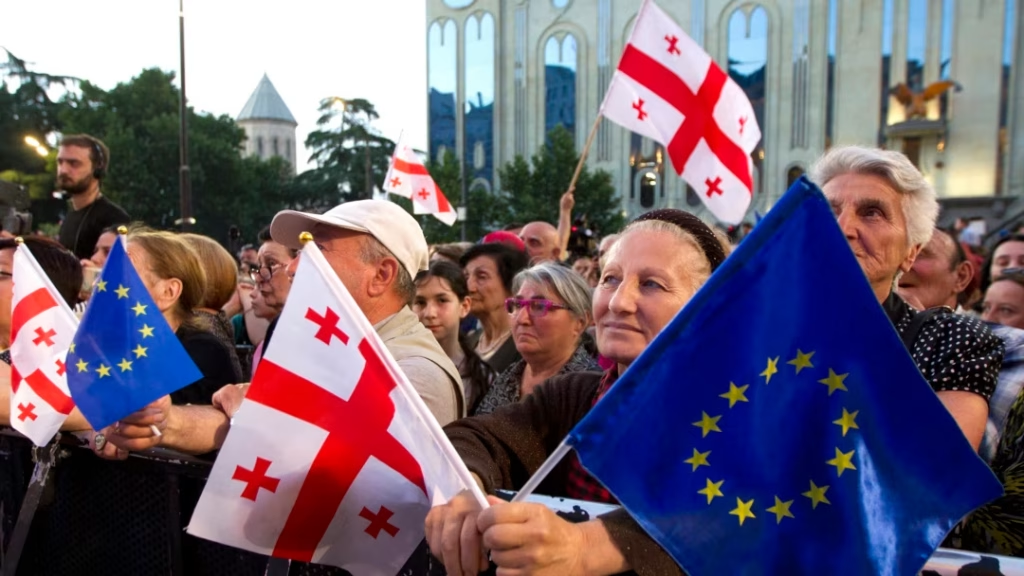
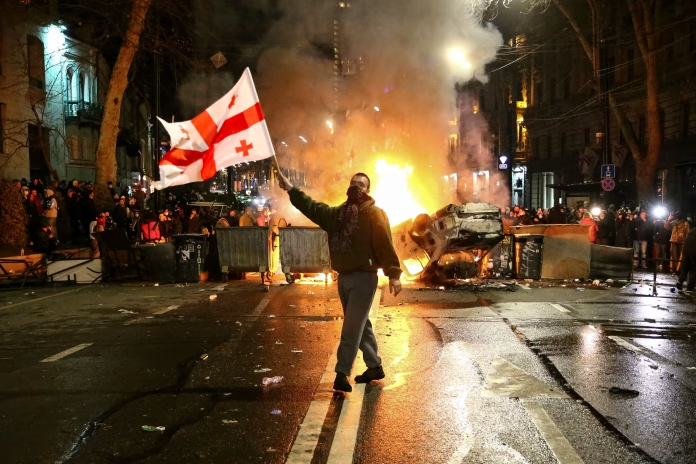
        Recent protests have erupted in Georgia, with tens of thousands of demonstrators filling Tbilisi’s historic Rustaveli Avenue. Waving the national flag and clashing with riot police, the protesters are voicing their outrage over the ruling Georgian Dream party’s decision to suspend talks on European Union membership.

        This move has sparked accusations from opposition groups that the ruling party is succumbing to Russian influence, further distancing Georgia from the West.

        The protests come on the heels of the controversial “foreign agent law” passed by the Georgian Parliament earlier this year, which critics argue mirrors Russia’s repressive legislation against independent media, civil society organizations, and political dissent.

        Footage from Tbilisi shows violent clashes between protesters and police, with riot control measures such as tear gas and water cannons deployed in an attempt to disperse the crowds. A fire broke out in the Georgian Parliament building after protestors threw incendiary objects, leading to at least 42 injuries among police officers.

        The United States has expressed support for the demonstrators, condemning the use of excessive force by Georgian authorities. More than 200 protesters have been arrested since the unrest began.

        Why the Protests Matter: Political Tensions and Russian Influence

        The protests began after the Georgian Dream party, which has been in power since 2012, announced that it would suspend its European Union accession talks until 2028. This decision has been widely interpreted as a shift away from the EU and toward closer ties with Russia, a concern for many Georgians who see membership in the EU as a path to greater security and economic stability. The move comes at a time of heightened geopolitical tensions in the region, as Russia’s war in Ukraine continues to impact neighboring countries.

        Georgia, a former Soviet republic located at the crossroads of Europe and Asia, has long harbored aspirations to join the European Union. Despite its strategic location, the country remains under the shadow of Russian influence, with approximately 20% of its internationally recognized territory under Russian control. Public support for EU membership remains high, with recent surveys showing that nearly 80% of Georgians favor joining the bloc.

        The Geopolitical Stakes: Why Georgia Wants to Join the EU

        Georgia’s aspirations for EU membership are rooted in security concerns and a desire for greater integration with Western democracies. Joining the EU would offer Georgia access to economic assistance, increased trade, and enhanced security through the EU’s collective defense agreements. This is particularly important in the context of Russia’s ongoing aggression in Ukraine and memories of Georgia’s 2008 war with Russia, which resulted in significant civilian casualties and territorial losses.

        In addition to security benefits, EU membership would also align Georgia with Western values such as free speech, human rights, and democratic governance—principles many protestors believe are under threat from the ruling Georgian Dream party. The growing economy and international standing of Georgia would also benefit from closer ties to the EU, providing access to financial aid and trade opportunities that could help strengthen the nation’s development.

        As protests continue to unfold, the situation in Georgia is drawing international attention, with global leaders urging the government to respect citizens’ rights and consider the long-term implications of its decisions on the country’s future.