The Nigerian National Petroleum Company Limited (NNPC) has renewed its commitment to reducing methane emissions in the oil and gas sector by 60% by 2031. This ambitious target aligns with the company’s broader goal of achieving net-zero emissions by 2060, solidifying Nigeria’s leadership role in Africa’s fight against climate change under the Global Methane Pledge initiative.
Announcing the pledge via its X platform, NNPC described it as a strategic move to combat climate change and advance the nation’s energy transition goals. Speaking at a meeting in Abuja with Robert Leahman, the U.S. State Department’s Global Methane Program Manager, and a team from Deloitte, NNPC’s Group Chief Executive Officer, Mele Kyari, emphasized the importance of partnerships in achieving these objectives.
“Reducing methane emissions is not only an environmental necessity but a strategic imperative for Nigeria’s energy sector. We are working with global partners to implement best practices and innovative solutions,” Kyari stated.
The discussions focused on collaborative methane abatement initiatives, including a pilot project in the Niger Delta. This initiative seeks to establish methane emissions baselines, mitigate leaks, and foster sustainable practices across Nigeria’s energy landscape.
Robert Leahman praised Nigeria’s proactive leadership, noting its impact on global methane reduction efforts. “Nigeria’s leadership under the Global Methane Pledge serves as a model for Africa. These initiatives will reduce emissions and enhance sustainable development within the energy sector,” he remarked.
The pilot project, a joint effort involving NNPC, Deloitte, and the U.S. Bureau of Energy Resources, aims to use advanced, data-driven methodologies to detect and address methane hotspots. This aligns with Nigeria’s bold environmental objectives.
Kyari highlighted the initiative’s significance in meeting the nation’s climate goals. “This collaboration is transformative. Tackling methane leaks means reducing waste, lowering costs, and protecting our environment. It’s a win-win for our economy and the planet,” he added.
The National Senior Secondary Education Commission (NSSEC) has announced plans to introduce a ranking system for senior secondary schools across Nigeria.
The rankings will be based on the minimum benchmark standards established for senior secondary schools, ensuring compliance and quality.
In an interview in Abuja on Friday, the Executive Secretary of NSSEC, Dr. Iyela Ajayi, explained that the initiative aims to monitor adherence to these standards and assist parents and guardians in choosing the best schools for their children and wards.
“Similar to how the National Universities Commission ranks universities, NSSEC will begin ranking senior secondary schools in the country next year,” Ajayi stated. “The rankings will evaluate factors such as teacher qualifications, infrastructure, adherence to the curriculum, and overall compliance with the federal government’s standards. This will provide parents and guardians with valuable information for selecting schools.”
Dr. Ajayi also revealed the Commission’s plans to revitalize 50 senior secondary schools nationwide. The National Assembly’s special intervention supports this initiative.
“The revitalization effort targets 50 schools across the country, marking a significant step forward. As the only education agency yet to receive the two percent Consolidated Revenue Fund (CRF), we are grateful for the National Assembly’s intervention, which has already set the revitalization process in motion,” he added.
This ranking initiative and revitalization plan underline NSSEC’s commitment to improving the quality of senior secondary education in Nigeria.
French President Emmanuel Macron has announced plans to appoint a new prime minister “in the coming days” following the resignation of Michel Barnier, who stepped down after losing a no-confidence vote in parliament.
In a televised 10-minute address on Thursday, Macron dismissed opposition calls for his resignation, reaffirming his commitment to remain in office “fully, until the end of the mandate” in 2027. He expressed gratitude to Barnier for his service during his brief tenure and criticized the far-right and hard-left for what he called an “anti-republican front” that ousted the government.
The no-confidence vote on Wednesday, which garnered 331 votes in favor—well above the 288 required—marked the first such dismissal of a French government in over six decades. Macron called the move “unprecedented.” The motion was jointly tabled by the left-wing New Popular Front (NFP) alliance and Marine Le Pen’s far-right National Rally (RN).
Le Pen defended the vote, stating on social media, “Censure is not anti-republican; it is enshrined in the Constitution of the Fifth Republic.” The vote followed Barnier’s controversial use of special powers to pass the budget without parliamentary approval.
After his resignation on Thursday, Barnier will serve as a caretaker prime minister along with his cabinet until a new government is formed. Macron’s presidency remains unaffected.
The political turmoil comes amid criticism of Macron’s decision to call snap elections in July, which created a parliamentary deadlock. Addressing the nation, Macron admitted the decision was “misunderstood” and took responsibility for the resulting crisis. He accused opposition parties of prioritizing “chaos over responsibility” and focusing on the next presidential race rather than the needs of voters.
Speculation over Barnier’s successor includes names such as Defence Minister Sébastien Lecornu, Interior Minister Bruno Retailleau, and centrist François Bayrou. However, forming a government supported by the fractured parliament may prove challenging.
Macron emphasized that the new prime minister’s immediate task would be drafting the 2025 budget. The appointment could occur before Saturday, when global leaders, including US President-elect Donald Trump, are set to attend the opening ceremony of the restored Notre-Dame Cathedral in Paris.
The cathedral, devastated by a fire in April 2019, has been rebuilt in just over five years, earning international acclaim. Macron highlighted this achievement, alongside France’s successful hosting of the 2024 Olympics, as proof of the nation’s resilience.
“We can achieve the impossible,” Macron declared. “The world admires us for that.”
The Lagos State Government has called on residents to fully utilize the ILERA EKO Health Insurance Scheme, emphasizing that it was designed to provide easy access to quality healthcare services across the state.
Earlier this year, Governor Babajide Sanwo-Olu signed an Executive Order to domesticate the National Health Insurance Authority (NHIA) Act and bolster the Lagos State Health Scheme Law of 2015. This move made enrollment in the ILERA EKO scheme mandatory for all residents, ensuring more people can access essential healthcare services.
Speaking at a press briefing in Ikeja to mark Universal Health Coverage (UHC) Day 2024, themed “Health: It’s on the (house) Government,” Dr. Emmanuella Zamba, Permanent Secretary of the Lagos State Health Management Agency (LASHMA), revealed that 1,152,455 residents are now enrolled in the scheme. This marks an increase of 229,455 enrollees compared to December 2023, when the number stood at 923,000.
Dr. Zamba urged individuals familiar with the health insurance program to educate others about its benefits. She announced plans for the Ministry of Health to establish a dedicated radio station to raise awareness of the scheme’s importance.
She also encouraged residents to report any issues they face with the health scheme, noting that a team of 30 customer care staff is available to address complaints and improve user experience.
“This year’s theme highlights the critical role of government leadership in ensuring healthcare remains accessible, affordable, and equitable for everyone,” Zamba said. “Universal Health Coverage is a global ideal and a fundamental human right. Everyone deserves access to quality healthcare services without financial burden.”
She praised the strides made by Lagos State toward Universal Health Coverage, driven by the ILERA EKO scheme, which reflects the government’s commitment to health equity.
Since the Lagos State Health Scheme Law was enacted in 2015, LASHMA has worked to protect residents from financial hardships caused by health expenses while guaranteeing access to quality care.
“Investing in health strengthens our society and economy. A healthy population leads to a more productive workforce, stronger communities, and greater national resilience. Achieving Universal Health Coverage requires strong political will, strategic funding, and policies that prioritize vulnerable populations,” she added.
Dr. Zamba also highlighted the agency’s partnership with healthcare provider networks, which are integral to the scheme’s success by providing channels for inquiries and complaints.
The agency is actively addressing the needs of vulnerable groups through the Eko Social Health Alliance (EKOSHA), an initiative ensuring no Lagosian is left behind in the pursuit of Universal Health Coverage.
Additionally, Adetoro Tayo Adetoro, Head of Monitoring and Evaluation at LASHMA, confirmed the enrollment figures and noted ongoing collaborations with other agencies to expand the scheme’s reach and impact.
Residents are encouraged to fulfill their obligation to enroll in the ILERA EKO scheme, a vital step toward achieving the shared goal of Universal Health Coverage for all.
The Nigerian Senate has made changes to the membership of the 10-man committee formed to address the contentious aspects of the Tax Reform Bills. On Thursday, during the plenary session, the name of Chief Whip Senator Mohammed Tahir Monguno (APC, Borno North) was removed from the committee, just 24 hours after its formation.
The Senate Leader, Senator Michael Opeyemi Bamidele (APC, Ekiti Central), announced the change, replacing Senator Monguno with Senator Shehu Kaka (APC, Borno Central). Despite this shift, the Senate Minority Leader, Senator Abba Moro (PDP, Benue South), remains the committee’s leader. Other members include Senators Adamu Ailero (PDP, Kebbi Central), Orji Kalu (APC, Abia North), Seriake Dickson (PDP, Bayelsa West), Titus Zam (APC, Benue South), Abdullahi Yahaya (PDP, Kebbi North), Adeola Olamilekan (APC, Ogun West), Sani Musa (APC, Niger East), and Adetokunbo Abiru (APC, Lagos East).
This move follows widespread criticism of the Tax Reform Bills sent by President Bola Tinubu to the National Assembly. The Senate suspended further legislative action on the bills last Wednesday and resolved to hold a public hearing. As part of the process, the Senate set up the 10-man committee to liaise with the Attorney General of the Federation and the Minister of Justice to resolve the issues raised with the tax reforms.
The committee’s goal is to address contentious clauses in the bills. The Senate had earlier mandated its Committee on Finance to halt any further action on the tax bills, which had passed their second reading the previous week.
In early September 2024, President Tinubu transmitted four tax reform bills to the National Assembly, following recommendations from the Presidential Committee on Fiscal and Tax Reforms, led by Taiwo Oyedele. These bills include the Nigeria Tax Bill 2024, the Tax Administration Bill, the Nigeria Revenue Service Establishment Bill, and the Joint Revenue Board Establishment Bill. Together, they aim to overhaul the country’s tax framework, improve tax administration, and reduce disputes.
The National Economic Council (NEC), chaired by Vice President Kashim Shettima, previously recommended withdrawing the tax bills for broader consultation. However, President Tinubu, on October 31, 2024, confirmed that the bills would proceed through the legislative process, including public hearings, to allow for more extensive input from stakeholders.
The Nigerian Senate has approved the Investments and Securities (Repeal and Enactment) Bill 2024 for its third reading, following a review and adoption of recommendations from the Senate Committee on Capital Market. The committee, led by Senator Osita Izunaso (APC, Imo West), presented a report outlining the bill’s key provisions.
Once enacted, the bill will designate the Securities and Exchange Commission (SEC) as the primary regulatory authority overseeing Nigeria’s capital market. Designed to align with global best practices in investment and securities, the legislation aims to enhance the integrity of the securities market, prevent market abuse, and combat insider trading and other fraudulent activities, ensuring fair and lawful market operations.
The committee highlighted that while the current law initially had a transformative impact, it now requires significant updates to keep pace with evolving financial markets and international regulatory standards. The proposed bill is expected to attract both local and international investors, driving growth and diversification in Nigeria’s capital market.
Key provisions of the bill include enhanced investor protection through stronger regulations against market abuse and insider trading, as well as improved governance for publicly traded companies. The bill also introduces a regulatory framework for digital currencies, fintech activities, and technologies like blockchain and cryptocurrency, ensuring their integration into the capital market.
Additional measures in the bill outline clearer roles for regulatory bodies to reduce overlaps and improve the operational efficiency of the SEC. It also supports the regulation of diverse financial instruments, including derivatives and Exchange Traded Funds (ETFs), to deepen the market and meet the varied needs of investors.
With its passage through the third reading, the bill is poised to significantly contribute to the growth and diversification of Nigeria’s capital market, promoting economic expansion and job creation.
Super Falcons goalkeeper Chiamaka Nnadozie has secured a spot on the final shortlist for the prestigious 2024 CAF Women’s Player of the Year award.
The Paris FC star will face fierce competition from Morocco’s Sanna Msoudy, Zambia’s Barbara Banda, and Malawian sisters Tabitha Chawinga and Themwa Chawinga.
In addition to the Player of the Year nomination, Nnadozie is also in contention for the Women’s Goalkeeper of the Year award. The 24-year-old, who won the inaugural goalkeeper title in 2023, is determined to defend her crown this year.
The highly anticipated CAF Awards ceremony will be held on December 16, 2024, in Marrakech, Morocco.
In Nigeria, discussions surrounding tax reform have increasingly dominated national conversations, particularly in light of proposed tax bills aimed at increasing revenue for the government. While the overall objective of these reforms is to diversify the country’s income sources beyond oil, one region, the northern part of the country has voiced concerns that these changes could disproportionately harm their economic development. What exactly is the North afraid of when it comes to these tax reforms?
To understand this, we need to consider several aspects of the proposed tax reform bills, how they impact different regions of Nigeria, and the historical and economic context of the northern states.
The Proposed Tax Reforms
The tax reforms bills currently being discussed in Nigeria are designed to overhaul the country’s tax system, making it more efficient and increasing revenue generation for the federal government. Some key aspects of the bills include:
Increase in VAT (Value-Added Tax): One of the central elements of the reform is raising VAT from 5% to 7.5%. This move is aimed at boosting government revenue, particularly as the country faces economic challenges and declining oil earnings.
Expanded Tax Base: The reforms propose broadening the tax net, with a particular focus on taxing the informal sector, which in Nigeria represents a significant portion of the economy. This includes small businesses and self-employed individuals, many of whom are based in the North.
Digital Economy Taxation: There is also a proposal to introduce taxation on the growing digital economy, with tech giants like Google, Facebook, and Twitter being targeted for taxation. While this might seem like a step forward in a digital world, its implementation may have varying implications for different regions.
Wealth and Property Tax: The bills include provisions for taxing wealth and property, potentially targeting high-net-worth individuals who possess real estate, luxury goods, and large-scale assets.
These changes have raised concerns in the northern region, where economic dynamics are distinctly different from the southern part of the country.
Why the North Is Concerned: Economic Imbalance and Structural Challenges
The northern states of Nigeria have traditionally faced significant economic challenges, including a reliance on agriculture, limited industrial development, and a relatively smaller contribution to the country’s oil revenue. The region is also more reliant on federal allocations and government support, as opposed to the more industrialized and oil-rich southern states.
Disproportionate Burden on Agriculture
The northern economy is heavily based on agriculture, with millions depending on farming for their livelihood. Any tax reform that seeks to broaden the tax net to include smallholder farmers, traders, and informal businesses could have a detrimental effect on their ability to earn a living. For instance, the VAT increase on goods and services may result in higher prices for agricultural products and raw materials, thus hurting the purchasing power of northern Nigerians, who already face a high rate of poverty.
In addition, much of the agricultural value chain in the North operates in the informal sector, meaning these businesses may be unaware of or unable to comply with new tax requirements. The proposed push to formalize the informal sector could be seen as an imposition, and many in the North may view this as a move that will exacerbate the economic divide between the North and the more formalized, wealthier Southern states.
Potential Negative Impact on Northern Business and Industrialization
Historically, the North has lagged behind the South in terms of industrialization. While the South boasts large manufacturing hubs, thriving port cities, and substantial foreign direct investment, the North remains dependent on agriculture, mining, and, to a lesser extent, services. The imposition of wealth taxes and increased VAT could potentially discourage investment in northern industries that are still in the early stages of development.
The tax system could disproportionately burden small and medium-sized enterprises (SMEs) in the North, which are often family-owned and have limited access to capital. Many northern entrepreneurs already face significant barriers to accessing credit and financing, and higher taxes could further discourage business expansion.
Regional Imbalance in Tax Revenue Generation
One of the most significant concerns of the northern region regarding tax reform is the perceived inequity in how tax revenue is generated and distributed. The northern states have a lower tax compliance rate compared to the South, and there are fewer high-income earners in the region. The tax reforms, particularly those targeting high-net-worth individuals, may not generate the same level of revenue in the North as they would in the South. This could lead to a feeling that the North is shouldering a disproportionate burden for the benefit of other regions.
The introduction of taxes aimed at wealth and property could disproportionately impact the more affluent southern states, which have a higher concentration of wealthy individuals and businesses. In contrast, the North, with its less industrialized economy, might not generate sufficient revenue from these taxes, leading to an increased reliance on federal allocations.
Fear of Increased Poverty and Economic Hardship
The northern states already face higher rates of poverty compared to the South, with vast sections of the population living below the poverty line. A tax reform that increases the financial burden on individuals and businesses, without providing adequate social safety nets or developmental programs, could exacerbate this inequality. For many northerners, the fear is that the tax reforms may worsen economic conditions and deepen regional disparities.
Additionally, the North already faces challenges related to insecurity, poor infrastructure, and inadequate access to education and healthcare. The imposition of higher taxes could divert funds away from essential social services and infrastructure development, further depriving the region of the resources it needs to grow and thrive.
The North’s Political and Historical Concerns
Aside from the economic concerns, there are also political and historical factors at play. The North has historically felt marginalized in Nigeria’s federal system, particularly regarding the allocation of resources and the implementation of policies that disproportionately favor the South. For example, the South has long been the center of Nigeria’s oil wealth, and many in the North feel that oil revenue is not equitably shared.
In this context, tax reform can be viewed as another tool in the hands of the central government to impose policies that may not align with the region’s interests. The fear is that the tax reforms, by broadening the tax base, will strip the North of much-needed revenue without adequate compensation or resources to address the region’s development needs.
Bridging the Gap
While tax reforms in Nigeria are undeniably necessary to improve revenue generation and reduce the country’s dependence on oil, the concerns from the northern region are valid and must be addressed. There needs to be a careful, inclusive approach that takes into account the unique challenges and economic realities faced by the North.
If the tax reforms are to succeed in fostering national development, they must be accompanied by policies that promote industrialization, improve access to finance, and address the structural disparities between the North and South. In addition, the federal government must ensure that the benefits of increased tax revenue are equitably distributed across all regions, with special attention paid to the developmental needs of the northern states.
Without such measures, the North’s fear of being left behind could turn into a reality, undermining the success of the entire tax reform process. It is only through inclusive and regionally balanced reforms that Nigeria can hope to build a more sustainable and equitable economy.
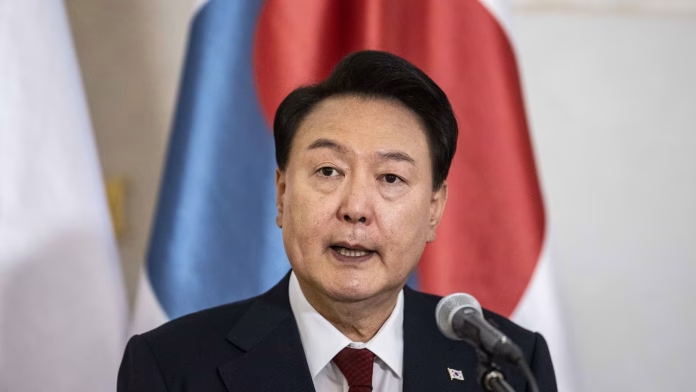
South Korea’s political landscape is in turmoil after President Yoon Suk Yeol’s controversial declaration of martial law, which he attempted to impose to prevent criminal investigations into himself and his family. The declaration, the first of its kind in over four decades, was swiftly overturned by lawmakers in a dramatic session overnight, but it has sparked widespread alarm and political chaos.
Opposition lawmakers, who swiftly moved to file a motion to impeach Yoon, accuse him of violating the constitution and unlawfully declaring martial law to evade investigations into alleged illegal activities. The impeachment motion alleges that Yoon’s actions were unconstitutional and aimed at shielding himself and his family from imminent scrutiny.
The situation is now critical for Yoon, whose political future appears uncertain. The opposition holds a significant majority in the 300-member National Assembly, and with just a few defections from Yoon’s party, they could secure the two-thirds majority required for impeachment. Lawmakers could vote on the motion as early as Friday.
This political crisis is further exacerbated by the opposition’s filing of a complaint for “insurrection” against the president, his ministers, and top military and police officials. The charge, which could carry severe penalties, highlights the gravity of the situation. Even members of Yoon’s own ruling party have expressed outrage over the martial law declaration, calling it “tragic.”
Public anger also reached a boiling point, with thousands of protesters gathering outside Yoon’s office in Seoul, demanding his resignation. As a result of the political unrest, South Korea’s stock market also experienced a sharp decline, dropping more than one percent.
Martial Law Crisis: Key Events and Reactions
The drama began when President Yoon, in a late-night television address, cited North Korean threats and “anti-state forces” as justification for martial law. Over 280 military personnel, including troops flown in by helicopters, were stationed at parliament to enforce the declaration. However, around 190 lawmakers defied the military presence, entering parliament and voting to reject the martial law.
The South Korean constitution mandates that martial law be lifted if the majority of parliamentarians demand it, which led to Yoon retracting his order just six hours after its imposition. This reversal was met with celebrations from protesters who had gathered outside the National Assembly, celebrating the victory of restoring democratic procedures.
Senior officials, including Yoon’s defense minister, offered to resign, taking responsibility for the confusion and the national security concerns raised by the martial law order. Despite this, Yoon did not make any public appearances throughout the day, which only fueled further public outrage.
Political Fallout and Impeachment Efforts
The impeachment motion claims that Yoon’s actions were a direct violation of South Korea’s laws and constitution. It accuses him of acting with the illegal intent of evading investigations into alleged misconduct involving his family. In addition to the impeachment proceedings, opposition lawmakers have lodged a formal complaint of “insurrection” against Yoon and his administration, with the potential for severe penalties should the charges be proven.
Protests have erupted in several locations across Seoul, with demonstrators calling for Yoon’s immediate resignation. Many believe that his unconstitutional actions, particularly the martial law declaration, have irrevocably damaged his presidency and warrant immediate removal from office.
The International Response
Yoon’s declaration of martial law also drew criticism from South Korea’s international allies. The United States, which has nearly 30,000 troops stationed in South Korea to guard against the North Korean threat, expressed surprise at Yoon’s decision, as they had not been notified beforehand. Washington welcomed Yoon’s reversal, but the incident raised concerns about the stability of South Korea’s leadership during a time of heightened tensions with North Korea.
China, while refraining from direct comments on the internal political crisis, urged Seoul to ensure the safety of Chinese citizens in South Korea amid the escalating situation.
The Chief of the Air Staff (CAS), Air Marshal Hasan Abubakar, announced that the Nigerian Air Force (NAF) has successfully acquired 63 new aircraft over the past three years. This significant acquisition was shared during the NAF Training, Operations, and Safety Seminar for 2024, held in Abuja.
According to Abubakar, the fleet modernization and improved operational capabilities were achieved with the strong support of President Bola Tinubu. In the previous year alone, the NAF received 12 advanced aircraft, including two KA-360i, four DA-62, four T-129 helicopters, and two AW-109 Trekker helicopters. Additionally, the NAF expects further deliveries by year-end, including two more T-129 helicopters and one KA-360i.
Looking ahead to 2025, the NAF plans to add 10 AW-109 Trekker helicopters, 24 M-346FA aircraft, three CASA-295 aircraft, and 12 AH-1Z attack helicopters to its fleet. This will bring the total new aircraft to 64 in approximately three years. Moreover, the NAF has acquired 12 pre-owned A-Jet aircraft from the French Air Force through SOFEMA. Of these, six will be refurbished for operational use, while the other six will serve as spare parts for the existing Alpha Jet fleet.
Air Marshal Abubakar referred to this era as a “golden age” for the NAF, emphasizing the importance of consolidating the gains made in enhancing the force’s operational capacity. Between June 2023 and September 2024, the NAF successfully executed 8,665 missions across 9,928 sorties, accumulating 15,915 flying hours.
Abubakar also praised the leadership of the Air Component Commanders and encouraged them to continue building on their successes. In terms of training, the NAF has made significant strides, with 405 airmen and 186 officers completing foreign courses, and 64 currently in progress. Domestically, 5,474 personnel have completed training, with 1,331 more in various stages of training.
In 2024, the NAF trained 54 pilots abroad and 43 pilots locally, alongside 16 UAV operators. A special winging ceremony will take place today for 28 newly trained pilots and operators.
To provide the best experiences, we use technologies like cookies to store and/or access device information. Consenting to these technologies will allow us to process data such as browsing behaviour or unique IDs on this site. Not consenting or withdrawing consent, may adversely affect certain features and functions.
Functional
Always active
The technical storage or access is strictly necessary for the legitimate purpose of enabling the use of a specific service explicitly requested by the subscriber or user, or for the sole purpose of carrying out the transmission of a communication over an electronic communications network.
Preferences
The technical storage or access is necessary for the legitimate purpose of storing preferences that are not requested by the subscriber or user.
Statistics
The technical storage or access that is used exclusively for statistical purposes.The technical storage or access that is used exclusively for anonymous statistical purposes. Without a subpoena, voluntary compliance on the part of your Internet Service Provider, or additional records from a third party, information stored or retrieved for this purpose alone cannot usually be used to identify you.
Marketing
The technical storage or access is required to create user profiles to send advertising, or to track the user on a website or across several websites for similar marketing purposes.