
Home Blog Page 38

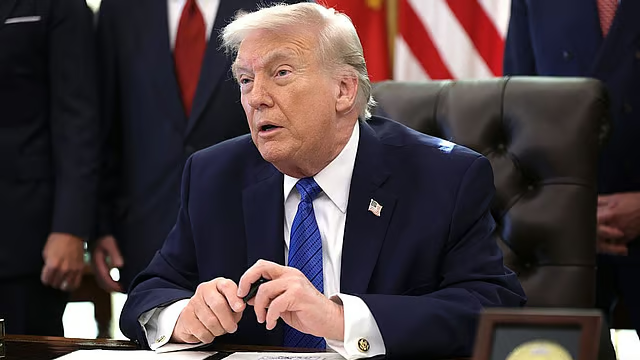
Trump Orders Cut To US-South Korea Military Drills

0

US President Donald Trump has instructed the Pentagon to “substantially reduce” joint military exercises with South Korea, citing the cost of the drills, Seoul’s position on the US conflict with Iran and his relationship with North Korean leader Kim Jong Un.

The announcement came as the annual Ulchi Freedom Shield exercises began on Monday, August 17, despite Trump’s call for them to be scaled back. South Korea’s Joint Chiefs of Staff confirmed that the drills had started as scheduled and are expected to run until August 27, with about 18,000 South Korean troops participating.

Trump said on Truth Social that the exercises were expensive and argued that they sent an inappropriate and hostile signal to North Korea, while pointing to what he described as his “very good relationship” with Kim.

“These exercises are not only costly, with much of these costs paid for by the United States of America (as usual!), but send a signal that is totally inappropriate and hostile,” Trump posted.

He also linked his decision to South Korea’s refusal to participate in US efforts concerning Iran.

“While somewhat unrelated (?), I recently asked the President of South Korea if they would like to join us in the Denuclearization of the Islamic Republic of Iran, and they said, ‘No thanks!’”

South Korea’s government said it was reviewing Trump’s remarks but indicated that it wanted to preserve close military coordination with Washington. The presidential Blue House also expressed hope that Trump’s relationship with Kim could eventually create an opportunity for meaningful dialogue between Washington and Pyongyang.

Ulchi Freedom Shield is designed to strengthen the ability of US and South Korean forces to operate together in the event of a conflict on the Korean Peninsula. This year’s exercises incorporate training for threats including drones, GPS disruption, cyberattacks and other capabilities that have become increasingly important in modern warfare.

The exercises are not simply about large-scale troop movements. Over recent years, the allies have increasingly shifted towards computer-simulated exercises and scenarios designed to test command, communication and responses to missile and cyber threats.

About 28,500 US troops remain stationed in South Korea, making the American military presence an important part of Seoul’s defence strategy.

North Korea, meanwhile, routinely describes the exercises as preparations for an invasion. Pyongyang recently condemned the latest drills as particularly provocative and warned that it would strengthen its nuclear deterrence.

Trump’s announcement comes against a backdrop of heightened military activity from Pyongyang.

North Korea launched a ballistic missile from the Wonsan area towards the sea off its eastern coast on August 11, just days before the US-South Korea exercises. The launch followed another missile test from the same area on August 6.

North Korea has also continued developing its nuclear and missile programmes and has strengthened military ties with Russia, including sending troops to support Moscow’s war in Ukraine. US officials have warned that North Korean forces returning from the conflict may bring battlefield experience that could influence Pyongyang’s military capabilities.

Trump’s latest position is not entirely new.

During his first presidency, Trump suspended major US-South Korean military exercises following his 2018 summit with Kim Jong Un. At the time, he described the drills as “provocative” and argued that cancelling them would save the United States money.

The exercises were later scaled back during the COVID-19 pandemic before eventually returning in a larger form as diplomacy with North Korea stalled.

Trump has continued to emphasise his personal relationship with Kim since returning to office. His latest comments suggest that he may once again see reductions in military exercises as a possible way to create space for negotiations with Pyongyang.

However, analysts have questioned whether reducing the exercises would actually produce meaningful diplomatic gains.

“US-South Korea combined defence exercises are essential for military forces to be ready and capable of doing their jobs,” said Leif-Eric Easley, a professor at Ewha University in Seoul.

“Scaling them back can damage alliance coordination, slow the process of South Korea taking on greater responsibility for its own defence, and weaken deterrence against possible conflicts in Asia.

“The cost savings from downsizing drills are marginal, while the diplomatic benefits for relations with North Korea are doubtful.”

For President Lee Jae Myung’s government, Trump’s announcement presents both an opportunity and a challenge.

Seoul has previously encouraged greater engagement with Pyongyang, and Lee recently called for renewed talks aimed at replacing the Korean War armistice with a lasting peace arrangement.

That means Trump’s willingness to use his relationship with Kim could potentially support Seoul’s push for dialogue.

At the same time, South Korea remains heavily dependent on the US security alliance and has to ensure that any reduction in exercises does not undermine its military readiness.

South Korean officials have therefore signalled that they intend to continue consultations with Washington on the combined defence posture and military exercises.

Trump’s reference to Iran adds another layer to the disagreement.

The president said South Korea had declined to participate in US efforts aimed at the “denuclearisation” of Iran. Seoul, however, has indicated that discussions over possible military contributions need to take into account its defence responsibilities on the Korean Peninsula as well as domestic legal procedures.

Trump has also criticised other US allies for being reluctant to become directly involved in the Iran conflict.

This suggests that Washington’s expectations of its allies are increasingly being tied not only to their commitments in their respective regions but also to whether they support broader US military priorities.

The immediate question is how far the proposed reduction will go. The current exercises began as planned, and it remains unclear what specific elements of future drills the Pentagon would cut.

Any significant reduction could affect the readiness and coordination of US and South Korean forces, particularly at a time when North Korea is expanding its missile and nuclear capabilities and adapting lessons from modern conflicts.

There is also a diplomatic calculation. Trump may believe that reducing what Pyongyang considers hostile military activity could make Kim more willing to return to negotiations.

But North Korea has so far shown little indication that it is prepared to abandon its nuclear ambitions. Its recent criticism of the exercises and threats to strengthen nuclear deterrence suggest that Pyongyang continues to view military strength as central to its security strategy.

For Seoul, the challenge will be to pursue Trump’s preferred diplomatic approach without weakening the military alliance that has underpinned South Korea’s security for decades.

The latest development therefore leaves the US-South Korea relationship at an important crossroads: Trump is signalling greater emphasis on diplomacy with Kim Jong Un and a reduced appetite for expensive military exercises, while South Korea must balance the prospect of renewed dialogue with the continuing security threat posed by North Korea.

Somali Forces Recapture Baidoa After Deadly Clashes

0

Somali federal troops pushed opposition fighters out of Baidoa, one of the country’s largest cities, on Monday, following hours of intense fighting that left a significant number of people dead, according to residents who spoke to Reuters.

Baidoa, home to hundreds of thousands displaced by conflict and hunger elsewhere in Somalia, endured hours of combat between federal forces and fighters loyal to Abdiaziz Hassan Mohamed Laftagareen, the former president of South West state. Residents described the city-centre battle as the most intense since March, when federal forces took control of Baidoa after Laftagareen’s administration announced it was cutting ties with Mogadishu — a move that led to his resignation.

The clashes reflect mounting pressure on Somalia’s federal government, which is already battling a two-decade insurgency by al Shabaab militants and working to prevent famine, while facing growing armed pushback from regional state authorities. Several states have rejected the federal government’s involvement in state-level elections and opposed constitutional amendments they argue would centralize power under the executive.

Somalia’s defence ministry said its troops in Baidoa were attacked before dawn by fighters using explosive-laden vehicles, and that federal forces repelled the assault, killing roughly 30 attackers. Four residents confirmed that federal troops had driven opposition fighters out of the city and said they had seen bodies in the streets. Local elder Farah Ibrahim told Reuters he counted ten dead, including four civilians and six fighters from both sides.

Laftagareen’s camp, which had claimed early Monday on Facebook that its forces had seized the city centre, could not immediately be reached for comment.

The humanitarian toll in Baidoa remains severe, a July survey by Médecins Sans Frontières found that one in four children at the city’s displacement sites is severely malnourished.

DR Congo Records Deadliest-Ever Ebola Outbreak As Death Toll Rises To 2,325

0

An Ebola outbreak in the Democratic Republic of Congo (DRC) has become the country’s deadliest on record, with government figures showing that 2,325 people have died from the disease.

The figures, released on Monday, show that the outbreak has recorded 4,945 confirmed cases, surpassing the previous record set during the 2018–2020 outbreak, which claimed 2,299 lives from 3,381 confirmed cases.

The United Nations has described the current outbreak as “the fastest-growing on record”, with the disease reportedly killing a victim every 30 minutes in the DRC.

The latest outbreak began in Ituri Province, a conflict-affected area in northeastern DRC, before spreading to five additional provinces across the vast Central African country, which has a population of more than 100 million.

The outbreak was officially declared on May 15, although health authorities believe the virus had already been circulating for several weeks before the announcement. It is the 17th Ebola outbreak recorded in the DRC.

The development has renewed concerns among health authorities and international organisations over the rapid spread of the virus and the challenges of containing it in areas affected by conflict and limited access to healthcare.

The World Health Organization (WHO) said last week that it hoped to bring the spread of the disease under control in the DRC within three months.

The current outbreak has now overtaken the 2018–2020 Ebola outbreak in the DRC in terms of deaths. That earlier outbreak was previously considered the country’s deadliest, killing 2,299 people.

However, the DRC outbreak is not the deadliest Ebola outbreak recorded globally. The 2013–2016 West Africa epidemic remains the most devastating, killing more than 11,300 people, mainly in Liberia, Sierra Leone and Guinea.

Ebola is a highly infectious viral disease that can spread through direct contact with the blood or other bodily fluids of an infected person. It can cause severe haemorrhagic fever and, without appropriate medical care, can be fatal.

The disease has killed more than 15,000 people across Africa over the past five decades, underscoring the continuing threat posed by repeated outbreaks on the continent.

The scale and speed of the latest outbreak have placed renewed pressure on health authorities to strengthen surveillance, treatment and containment efforts, particularly in communities where insecurity and limited healthcare access could make controlling transmission more difficult.

Osun Election: Police Arrest 295 Suspects As Security Agencies Intensify Crackdown On Electoral Offences

0

Security agencies arrested 295 suspects in connection with incidents recorded during the Osun State governorship election held on Saturday, August 15, 2026.

Of the 295 suspects arrested, 293 were released on bail after undergoing screening, while two remained in custody for further investigation and possible prosecution.

The arrests were part of the security measures deployed across the state to prevent violence, vote-buying and other activities capable of disrupting the electoral process.

The Force spokesman, Ani Iniedu, confirmed the arrests and provided details of the outcome of the screening exercise.

He said, “295 suspects were arrested during the election, and 293 have been released on bail after screening. So we have two of them in custody for prosecution.”

Ahead of the election, the police had warned political parties, candidates, supporters and other stakeholders against actions that could threaten peace or undermine the credibility of the poll.

The arrests highlight the level of security enforcement deployed across Osun as authorities sought to deter electoral offences and respond to incidents reported during the voting process.

However, the Nigeria Security and Civil Defence Corps (NSCDC) said none of its personnel arrested any suspect during the election.

According to the NSCDC spokesman, Afolabi Babawale, the corps concentrated on maintaining security through a layered deployment covering polling centres, wards and local government areas.

He explained that the strategy was designed to provide a visible security presence while ensuring that personnel could respond quickly to major incidents when necessary.

He said, “Three fully armed patrol teams, equipped with Hilux vehicles, were stationed in every local government area to maintain a visible deterrent and respond to major incidents.”

Babawale added that NSCDC personnel were also deployed directly to polling centres to maintain order and monitor activities throughout the election.

He said, “Also, three unarmed personnel were directly deployed to every polling centre to maintain order and monitor activities on-site.”

Explaining the broader security arrangement, the NSCDC spokesman said additional armed personnel were positioned away from polling centres to provide backup and strengthen the security network.

He said, “Two armed personnel were positioned 500 metres away from each polling centre, bringing the total deployment to five officers assigned to cover each polling unit.”

The security operations came as authorities placed significant emphasis on maintaining peace throughout the election, with security agencies deployed across the state to prevent violence and respond to possible electoral offences.

Adeleke Orders Withdrawal Of EFCC Suit After Tinubu Intervention Over Frozen Osun Account

0

Re-elected Osun State Governor Ademola Adeleke has said he has directed the state’s Attorney General to withdraw the lawsuit filed against the Economic and Financial Crimes Commission (EFCC) over the freezing of the state government’s bank account.

Adeleke disclosed this in an interview with Channels Television’s Sunday Politics, shortly after he was declared the winner of the August 15 Osun governorship election.

The governor said he was ready to move past the dispute after President Bola Tinubu intervened in the matter.

Asked whether he intended to put the political disagreements and the EFCC case behind him, Adeleke said he had instructed the state’s Attorney General to discontinue the legal action.

“I’m putting them behind. What else do I want? I have instructed my Attorney General to drop it. Mr President has done well. He called me. What more do I want?” Adeleke said.

The dispute began after the EFCC obtained an order to freeze an Osun State Government bank account in early August, about 10 days before the governorship election.

Adeleke had criticised the action, describing it as politically motivated and disruptive to the operations of his administration. He subsequently approached the court to challenge the freezing order.

President Tinubu later directed the EFCC to return to court to vacate the order and discontinue the related legal proceedings, amid concerns about the timing of the action so close to the election.

The development followed the EFCC’s investigation into the handling of about ₦11 billion in Ecology Funds, intervention funds and Federation Account Allocation Committee (FAAC) allocations.

The commission had said it detected suspicious movements involving the funds and restricted the account to prevent further transactions while its investigation continued.

Adeleke also spoke about reports that some of his aides and supporters had been invited by the EFCC for questioning. He said he had instructed his lawyers to assist those affected.

“Well, we have been talking. I have been calling all my lawyers to go there. I’m sure the APC in Osun, according to them, they are telling us they are using federal might,” he said.

The governor further suggested that President Tinubu might not have been aware of some of the actions attributed to federal agencies.

“Most of these things, the President doesn’t know. The President has a lot of foreign work and jobs to do,” he said.

According to Adeleke, some of his aides were questioned by the EFCC and released after the agency found no wrongdoing.

“I told my people, go there. We haven’t got anything to hide. And when they go there, they ask them questions, and then they will say, ‘Go on.’ Can you imagine my spokesperson? You are inviting my spokesperson — is my spokesperson a finance minister or accountant?” Adeleke asked.

He described the invitations as distractions and alleged that former Osun State Governor Gboyega Oyetola was behind the EFCC-related developments because of his relationship with President Tinubu.

“All these things is Oyetola because he is the cousin to the President. He is dropping the President’s name. I know that the President didn’t know about the EFCC one. That is why he had to call me and stop it,” Adeleke said.

The EFCC has maintained that its actions were connected to an ongoing investigation into the management of public funds and not the Osun governorship election.

With Adeleke now directing the withdrawal of the lawsuit, the immediate legal confrontation between the Osun State Government and the EFCC appears set to ease, following the President’s intervention.

Cameroon Wins First-Ever WAFCON Title With Commanding Win Over Malawi

0

Cameroon claimed their maiden Women’s Africa Cup of Nations title with a comfortable 3-0 victory over tournament debutants Malawi in Rabat, Morocco.

Marie Ngah Manga opened the scoring with a close-range header in the 20th minute, before Naomi Eto doubled Cameroon’s advantage with a spectacular volley just before the half-hour mark. The Indomitable Lionesses added a third in first-half stoppage time when Eto rounded Malawi goalkeeper Mercy Sikelo and squared the ball for Ngah Manga to net her fifth goal of the tournament.

Malawi, the lowest-ranked team in the competition at 153rd in the world, had reached the final riding on the attacking threat of sisters Tabitha and Temwa Chawinga. But Cameroon’s defence kept both players largely quiet, denying the Scorchers a fairy-tale finish to their surprise run. Ngah Manga squandered a chance to complete her hat-trick early in the second half, firing wide from close range, while Malawi’s best opportunity came just after the hour mark when goalkeeper Michaely Bihina denied Tabitha Chawinga before Temwa fired the rebound wide.

The triumph is especially notable given Cameroon missed the 2024 tournament entirely after failing to qualify, losing to Algeria in the second round. They only made it to this year’s finals after the Confederation of African Football expanded the competition from 12 to 16 teams, allowing them in on ranking.

FIFA president Gianni Infantino presented the trophy alongside CAF president Patrice Motsepe, as Cameroon pocketed $2 million in prize money and became just the fourth nation to win the title, joining Nigeria, Equatorial Guinea and South Africa. The Indomitable Lionesses had previously lost three WAFCON finals, in 2004, 2014 and 2016, all to Nigeria.

“We have been working so hard over all these years to get here. To finally be champions we are very proud,” Ngah Manga said afterward.

Cameroon coach Valentine Nguele, who only took charge in June, guided the side past Nigeria in the quarter-finals and host nation Morocco on penalties in the semi-finals. Goalkeeper Bihina was instrumental in both wins, making nine saves against the Super Falcons before saving four spot-kicks in the shootout against Morocco.

Both Cameroon and Malawi will feature at the 2027 Women’s FIFA World Cup in Brazil, alongside fellow semi-finalists Morocco and Algeria.

Osun Election: What It Means For The 2027 General Election

0

Governor Ademola Adeleke of the Accord Party has won the August 15, 2026 Osun State governorship election, defeating the All Progressives Congress (APC) candidate, Munirudeen Bola Oyebamiji.

The Independent National Electoral Commission (INEC) declared Adeleke the winner after he secured 511,067 votes, while Oyebamiji polled 444,815 votes, giving the incumbent a winning margin of 66,252 votes.

The result gives Adeleke another four years in office and makes Osun one of the most closely watched political developments in Nigeria ahead of the 2027 general elections.

The significance of the result extends beyond who will occupy the Osun State Government House. It provides an early indication of how voters in a politically important South-West state may respond to party realignments, incumbency, campaign structures, economic concerns and the growing battle between the APC and emerging opposition forces.

What You Should Know About The Osun 2026 Governorship Election

The election was held on Saturday, August 15, across 30 local government areas, 332 wards and 3,763 polling units.

INEC had registered 2,339,233 voters for the election, representing a significant increase from the 1,954,800 registered for the 2023 general elections. The increase was driven largely by the 2025/2026 Continuous Voter Registration exercise and voter transfers.

Fourteen political parties participated in the contest, although the election effectively became a major battle between Adeleke of Accord, Oyebamiji of the APC and Najeem Salaam of the African Democratic Congress (ADC).

Adeleke entered the election as the incumbent, while Oyebamiji represented the APC’s attempt to regain control of a state that has remained one of the most competitive political territories in the South-West.

The contest was also notable because Adeleke had left the PDP before seeking re-election under the Accord platform, making his victory an important test of whether his personal political structure could survive outside the party on which he previously built his electoral career.

By late Saturday, thousands of polling-unit results had already been uploaded, with the process continuing into the early hours of Sunday.

Yiaga Africa subsequently said the official results announced by INEC were consistent with its independent statistical estimates and the ballots counted at polling units. That assessment strengthened confidence in the declared outcome, although the organisation also raised concerns about vote buying, voter inducement and gaps associated with electoral technology.

This distinction is important: an election can produce results that accurately reflect the votes counted while still having problems that affect the quality of voters’ choices.

Why Adeleke’s Victory Matters Beyond Osun

The immediate political interpretation of the result has been straightforward: Adeleke has defeated the APC in a state that will be strategically important to the 2027 presidential contest.

But the broader picture is more complicated.
The election does not automatically mean that the APC will lose Osun or the South-West in 2027, nor does Adeleke’s victory automatically translate into an opposition victory at the national level.

What it does show is that the APC cannot simply assume that its control of the Federal Government will translate into automatic electoral dominance in every South-West state.
Osun remains electorally competitive.

That makes the state’s result potentially valuable as a warning sign, a mobilisation tool and a strategic lesson for all the major parties.

What Adeleke’s Victory Could Mean For The 2027 General Election

The first major implication is that the opposition now has a psychological boost.
Some opposition figures and groups have already presented Adeleke’s victory as evidence that the APC can be defeated at the ballot box.

A political pressure group, the G-100, described the result as a possible template for opposition parties ahead of 2027 and called for greater unity among opposition forces.

That argument is politically attractive, but there is an important qualification.
Adeleke did not win as part of a single nationwide opposition coalition. He won under the Accord Party, with his own political structure, incumbency advantage and a campaign built around Osun-specific dynamics.

So opposition parties seeking to reproduce the Osun result in 2027 will have to answer a much harder question:
Can they reproduce Adeleke’s level of candidate appeal, grassroots organisation and voter mobilisation while operating under one national platform?
That remains unresolved.

Tinubu’s Relationship With Adeleke Could Become Important

Perhaps one of the most interesting consequences of the election is the political relationship between Adeleke and President Bola Tinubu.

Despite winning against the APC candidate, Adeleke has publicly reaffirmed his support for Tinubu’s bid for a second presidential term in 2027. He described the President as a son of Osun.

That creates an unusual political situation.
Adeleke is now an elected governor under Accord, while Tinubu is seeking re-election under the APC. Yet the two politicians have publicly expressed political alignment on the presidential race.

This means Adeleke’s victory cannot simply be interpreted as a rejection of Tinubu or the APC at the presidential level.

The Osun governorship election was primarily about who would govern Osun State.
How Osun voters behave when they are simultaneously choosing a president, National Assembly members and other elected officials in 2027 could be different.
That distinction will be crucial.

IReV and Election Technology Will Remain Under Scrutiny

The Osun election also provides another lesson for INEC: technology can improve transparency, but only when voters and stakeholders can trust that it is functioning properly and consistently.

Yiaga Africa credited technology and citizen participation with strengthening electoral transparency, while other observers raised concerns about delays and technical difficulties.

The delay in uploading some results to IReV also generated questions from public commentators, including Atedo Peterside, who asked INEC to explain the pace of electronic transmission.

For 2027, INEC will therefore face pressure to demonstrate that its electronic systems can cope with a much larger nationwide election without creating unnecessary uncertainty during collation.

El-Rufai Files Fresh ₦10bn Suit Against ICPC Over Alleged Denial Of Family Access

0

Former Kaduna State Governor Nasir El-Rufai has filed a fresh ₦10 billion lawsuit against the Independent Corrupt Practices and Other Related Offences Commission (ICPC), alleging that the anti-corruption agency denied his wife and son access to him while he was in custody.

The suit, filed at the Federal High Court in Abuja on August 13, 2026, also names the ICPC Chairman and the Attorney-General of the Federation as defendants.

El-Rufai, through his lawyer, Ubong Akpan, is asking the court to affirm that his fundamental rights under Part IV of the 1999 Constitution remain enforceable despite his detention by the commission.

According to the court filing, the former governor alleges that ICPC officials repeatedly prevented his wife, Aichatou Asabe, and his son, Abba El-Rufai, from visiting him.

He claims that the restrictions affected his ability to receive food, medication and other essential items from his family and were imposed without lawful justification or a court order.

El-Rufai further alleges that ICPC officials physically restrained and intimidated his wife and son during an incident on July 7. He argues that the alleged conduct interfered with his family relationships and violated his constitutional protections.

The former governor is relying on Sections 34 and 37 of the Nigerian Constitution, as well as Articles 5 and 18 of the African Charter on Human and Peoples’ Rights, in challenging the alleged restrictions.

He wants the court to declare that the alleged treatment violated his rights to dignity and private and family life.

El-Rufai is also asking the court to declare unconstitutional the continued denial of access to his family members without lawful authority.

The suit contains nine separate reliefs, including a claim for ₦10 billion in damages over the alleged violations.

The new case is the latest development in a wider dispute between the former governor and the anti-corruption agency.

In July, the ICPC accused El-Rufai of breaching conditions attached to a court-approved medical visit and also announced the arrest of his personal physician, Professor Bello Abubakar. The commission alleged that the doctor made false statements connected to the medical visit.

The ICPC said the medical visit to the National Hospital in Abuja on July 7 had been facilitated in accordance with a court directive and that its officers respected El-Rufai’s privacy during the consultation.

El-Rufai, however, rejected the commission’s account, arguing through his media adviser that the circumstances surrounding his health, court appearance and medical treatment had been misrepresented.

His family had also publicly raised concerns about his access to medical care, lawyers and relatives while in custody.

The latest ₦10 billion suit therefore adds a separate constitutional-rights dispute to the broader legal proceedings involving the former governor.

Important: The allegations in the new suit are claims made by El-Rufai and have not been established by the court. The ICPC’s response to this latest suit will be important in determining how the competing accounts are presented before the court.

NEITI Report: Senate Gives Seplat, Network E&P And Two Oil Firms 48 Hours To Respond

0

The Senate Public Accounts Committee (PAC) has issued a 48-hour ultimatum to Seplat Energy, Network E&P Nigeria Limited and two other oil companies to appear before the committee and respond to queries raised in the 2021, 2022 and 2023 audit reports of the Nigeria Extractive Industries Transparency Initiative (NEITI).

The committee, chaired by Senator Ibrahim Hassan Dankwambo, warned that the affected companies could face the full force of the National Assembly’s legislative powers if they fail to honour the invitation.

The decision was taken after committee members expressed concern over the companies’ failure to appear before the Senate panel to provide explanations on issues identified in the NEITI audit reports.

Senate Questions Companies’ Failure to Appear

The committee’s action followed the continued absence of representatives of the companies from its proceedings.

Senator Abdul Ningi was the first to call for sanctions against the companies, particularly after Network E&P Nigeria Limited wrote to the committee explaining that it was accountable to the Nigerian Upstream Petroleum Regulatory Commission (NUPRC).

Ningi described the letter as “disturbing and provocative”, arguing that the company could not use its regulatory relationship with the NUPRC as a reason to disregard a summons from the National Assembly.

Senate Cites Constitutional Powers

Ningi reminded the committee that the National Assembly has constitutional authority to summon individuals, organisations and government agencies when seeking information on matters under investigation.

‘Sections 88 and 89 of the 1999 Constitution empower the National Assembly to invite anybody or agency for explanations on issues raised against them’.

The provisions cited by the senator give the National Assembly powers to conduct investigations and require persons or organisations relevant to an inquiry to provide information and explanations.

Network E&P Ordered To Appear

Following the deliberations, the committee specifically directed the Managing Director of Network E&P Nigeria Limited to appear before it on Thursday.

The committee warned that failure to comply with the directive could result in the invocation of its legislative powers against the company.

The order came after lawmakers rejected the explanation contained in the company’s correspondence regarding its accountability to the NUPRC.

Seplat And Other Oil Firms Also Summoned

Similar directives were issued to the managements of All Grace Energy Limited, Aradel Energy Limited and Seplat Energy.

The committee noted that representatives of the three companies had also failed to appear before the panel to address questions arising from the NEITI audit reports.

The companies have therefore been given the same opportunity to appear before the committee and respond to the issues raised against them.

Why The NEITI Reports Matter

The NEITI reports examine activities and financial transactions within Nigeria’s extractive industries, including the oil and gas sector.

The Senate committee’s interest in the reports reflects its responsibility to examine public-sector financial accountability and ensure that issues identified through official audits receive appropriate explanations from the organisations concerned.

In this case, the PAC is seeking direct responses from the affected oil companies rather than relying solely on written submissions.

What Happens If The Companies Fail To Appear?

The Senate committee has warned that companies that ignore the 48-hour ultimatum could face legislative action.

Senator Shehu Kaka Lawan, representing Borno Central, supported the move and urged the committee to use its constitutional powers against the managements of companies that had failed to honour previous invitations.

For Network E&P, the committee has already fixed Thursday for the Managing Director’s appearance, while similar directives have been issued to the managements of All Grace Energy, Aradel Energy and Seplat Energy.

The immediate focus is now on whether the four companies will appear before the Senate Public Accounts Committee and provide explanations to the queries contained in the NEITI audit reports.

NANS Innovate 2026: How Nigerian Students Can Apply For The NANS Business Grant

0

The National Association of Nigerian Students (NANS) has opened applications for the 2026 edition of its entrepreneurship initiative, NANSInnovate, giving Nigerian student entrepreneurs an opportunity to showcase their businesses and compete for funding.

The programme is aimed at students who already run businesses as well as those with business ideas they want to develop. According to NANS, the initiative will support student entrepreneurs across universities, polytechnics and colleges of education in Nigeria.

NANS National President, Akinteye Babatunde, announced the opening of applications in a statement on Monday.

The programme is expected to give participating students an opportunity to present their ideas to investors, business leaders and industry experts.

Afeez said, “Across our campuses are brilliant young Nigerians with ideas that can solve problems, create jobs and build successful businesses. Unfortunately, many of these ideas never go beyond the classroom because of limited opportunities and access to funding.”

He added, “NANSInnovate 2026 is our response to that challenge. We are providing a national platform where innovation will be rewarded, creativity will be encouraged and promising student entrepreneurs will receive the support they need to grow.”

The initiative will end with a national pitch competition involving the top 20 finalists, who will compete for cash prizes worth millions of naira.

Afeez urged qualified students to apply for the programme, saying, “At the end of the competition, the top 20 student entrepreneurs will go home with cash prizes worth millions of naira to support and expand their businesses.”

Who Can Apply for NANSInnovate 2026?

The programme is open to Nigerian citizens who are currently enrolled in a recognised university, polytechnic or college of education in any of Nigeria’s 36 states or the Federal Capital Territory.

Applicants must have either an existing business or a business idea they intend to develop.

Students will also need a valid student identity card and must prepare a business proposal in Microsoft Word format.

Documents Needed For The NANS Business Grant Application

Applicants are expected to submit the following:

  • A valid student ID card in JPG, PNG or PDF format.
  • A business proposal in Microsoft Word (.docx) format.
  • A proposal of not more than 10 pages.
  • Times New Roman font, size 12.
  • Single-line spacing.
  • A file size not exceeding 5MB.

CAC or SMEDAN certificates may also be submitted, although NANS says these documents are optional.

How To Apply For NANSInnovate 2026

Interested students are required to visit the NANSInnovate application portal at grants.nanshq.org.

Applicants will first provide their personal and school information before entering details about their business.

They will then select the category that best describes their venture and indicate whether they are applying with an existing business or a new business idea.

The available categories are:

  • Production/Manufacturing
  • Trading/Merchandise
  • Services
  • Agriculture

Students must upload their valid student ID and business proposal before submitting the application.

Applicants will also be asked to provide a 100-word pitch explaining their business, why the idea is important and how they plan to use the funding.

Once an application has been submitted, the applicant will receive a unique entry code that can be used to track the application.

NANS advised applicants to save or screenshot the code for future reference.

Is The NANSInnovate Application Free?

Yes. The application is free.

NANS warned students not to make payments to anyone in connection with the programme. According to the association, anyone demanding money for entry into NANSInnovate should be treated as a potential scam and reported.

What Does NANSInnovate 2026 Offer?

According to NANS, the programme will run for one week and feature learning sessions, networking opportunities and mentorship for participating student entrepreneurs.

Participants will have opportunities to connect with investors, industry leaders and other young entrepreneurs.

The programme will also include one-on-one mentorship and a national pitch competition, where the top 20 finalists will compete for business funding.

NANS said the initiative is intended to support students who are already building businesses while giving them access to opportunities that can help them develop and expand their ventures.

Afeez said, “On behalf of the National Association of Nigerian Students (NANS) National Headquarters, I invite every eligible student to register and be part of this historic initiative.”

“The next great Nigerian business could begin here, and the next successful entrepreneur could be you,” he added.

Students interested in the programme can submit their applications through grants.nanshq.org.
