
The Nigerian Air Force (NAF) Headquarters Logistics Command has notified the public of the temporary closure of a portion of Murtala Muhammed Airport Road in Lagos on Saturday, October 18, 2025, to facilitate a 10-kilometre walk and jog exercise.
According to the Command’s Public Relations Officer, Squadron Leader Abigail Ologun, the exercise will begin at 6 a.m. and end at 8 a.m. as part of the Command’s regular physical fitness programme designed to enhance the health, wellness, and operational efficiency of NAF personnel.
Ologun noted that vehicular traffic will be restricted along parts of Airport Road and nearby routes, particularly the stretch between Murtala Muhammed Airport 2 (MMA2) and Murtala Muhammed International Airport.
She appealed to the public to make use of alternative routes and comply with directions from NAF officials and security personnel who will be on the ground to control traffic.
“The Command assures the public that all necessary arrangements have been made to ensure a smooth, safe, and hitch-free exercise,” Ologun said, adding that normal traffic movement will resume immediately after the event.
She also apologised for any inconvenience the temporary closure might cause and expressed appreciation to Lagos residents for their patience and cooperation.
The announcement reflects the NAF’s continued dedication to maintaining operational fitness while ensuring minimal disruption to public movement around major transportation routes in Lagos.
NAF To Temporarily Close Lagos Airport Road For Fitness Exercise

Rivers State Revokes N134bn Secretariat Contract, Orders N20bn Refund

The Rivers State Executive Council has revoked the ₦134 billion contract awarded to the China Civil Engineering Construction Corporation (CCECC) for the renovation and furnishing of the state secretariat complex.
The decision was reached on Thursday during a council meeting presided over by Governor Siminalayi Fubara at the Government House in Port Harcourt.
In a statement issued by Nelson Chukwudi, Chief Press Secretary to the governor, the council also directed the contractor to refund the ₦20 billion mobilisation fee it had earlier received.
According to the statement, the contract was awarded by Ikot-Ete Ibas, the former Sole Administrator of Rivers State, during the six-month emergency rule declared by President Bola Tinubu.
Speaking to journalists after the meeting, Austin Ezekiel-Hart, Permanent Secretary of the Ministry of Works, described the project as one “awarded in haste” and “without due process.”
He disclosed that the council had approved the revalidation of the bidding process for four previously advertised projects, including the secretariat renovation and major shoreline protection works in Opobo/Nkoro and Ogba/Egbema/Ndoni Local Government Areas.
Ezekiel-Hart added that fresh bidding would be opened for qualified and experienced contractors to submit technical and financial proposals for consideration.
He listed the affected projects as:
- “The construction of 4.8km reinforced concrete shoreline protection and reclamation of Queenstown, Epellema, Oloma, and Minima communities in Opobo/Nkoro Local Government Area in Rivers State.”
- “The construction of 2.5km shoreline protection and reclamation in Ndoni-Onukwu, Isikwu, and Aziazagi communities in Ogba/Egbema/Ndoni Local Government Area.”
- “The construction of 2.5km shoreline protection and reclamation in Utuechi, Obiofu, Isala, Ani-Eze, and Odugri communities in Ogba/Egbema/Ndoni Local Government Area.”
- “The renovation, retrofitting, and furnishing of the Rivers State Secretariat Complex.”
The council emphasised that the new bidding process would ensure transparency, accountability, and adherence to due process in the execution of state projects.
Madagascar’s New Military Leader Sworn In, Acknowledges Gen Z Protesters for Role In Uprising

Colonel Michael Randrianirina has officially assumed office as Madagascar’s new president, days after the military seized power in the Indian Ocean nation.
At a ceremony held at the Constitutional Court in Antananarivo, Col Randrianirina exchanged his military uniform for a formal suit and expressed gratitude to the country’s youth, particularly the Generation Z movement, whose weeks of demonstrations led to the downfall of former President Andry Rajoelina.
“Today marks a historic turning point for our country,” he said during his inaugural speech. “With a united and determined people, we open a new chapter in Madagascar’s history.”
The swearing-in was witnessed by a large crowd, including many young protesters who had led the campaign for political change.
Col Randrianirina’s rise to power follows prolonged unrest over water and electricity shortages that began last month. The demonstrations, initially organised by a youth coalition known as Gen Z Mada, escalated as frustrations mounted over governance failures.
Rajoelina’s attempt to maintain control through government dissolution and dialogue sessions failed to quell public anger, eventually forcing him to flee and face impeachment.
The new president, formerly the head of the elite CAPSAT army unit, declared earlier in the week that the military would take charge of the government temporarily and oversee elections within two years.
During the ceremony, Col Randrianirina pledged to uphold national unity and human rights, while promising major reforms. “We will work hand in hand with all sectors of society to draft a new constitution and implement necessary electoral reforms,” he said. “Our mission is to rebuild Madagascar’s political, social, and administrative systems.”
He also outlined three immediate priorities: reviewing the operations of the state-owned utility firm Jirama, addressing challenges in rice production as the planting season begins, and appointing a new prime minister to form a transitional government.
While the Constitutional Court has rejected claims that the takeover amounts to a coup, citing constitutional ambiguities, the international community remains cautious. Court President Florent Rakotoarisoa said that institutional weaknesses—not deliberate violations—led to the crisis.
Observers note that Madagascar’s shift mirrors political changes seen in other former French colonies in Africa. In a move seen as symbolic, Col Randrianirina met with Russian officials on Thursday to discuss “deepened cooperation,” following public displays of Russian flags during the protests.
Despite uncertainty ahead, many in Madagascar remain cautiously optimistic about the possibility of reform under the new leadership.
Bomb Blast Targets Home Of Prominent Italian Investigative Journalist

A bomb detonated late Thursday outside the residence of renowned Italian investigative journalist Sigfrido Ranucci, damaging two vehicles belonging to his family and sparking widespread condemnation across Italy’s media and political circles.
Ranucci, the long-time host of RAI’s investigative programme “Report”, has been under police protection for years due to threats linked to his reporting. He confirmed that both he and his newsroom had repeatedly received intimidation messages, including mailed bullets.
According to Ranucci, the improvised explosive device—estimated to weigh about one kilogram—was planted near the gate of his home in Campo Ascolano, roughly 30 kilometres south of Rome. The explosion occurred at 10:17 p.m., about twenty minutes after he returned home. The blast destroyed his car and another belonging to his daughter.
“Thankfully, no one was hurt,” Ranucci told local media. “Apart from the shock, everything is fine.”
Italy’s anti-Mafia prosecutors have opened an investigation into what they described as a case of criminal damage aggravated by mafia-style tactics.
Recent figures from the Italian Journalists’ Federation (FNSI) reveal a surge in attacks on reporters—81 incidents of intimidation were recorded in the first half of 2025, including 16 physical assaults, compared to 46 cases during the same period last year.
Prime Minister Giorgia Meloni condemned the explosion as a “grave act of intimidation,” reaffirming her government’s commitment to safeguarding press freedom. “Freedom and independence of information are essential values of our democracy,” she said in a statement.
Interior Minister Matteo Piantedosi announced that Ranucci’s police protection would be reinforced, adding that the journalist would now be provided with an armoured vehicle.
The International Federation of Journalists (IFJ) also denounced the attack, describing it as “deeply disturbing,” particularly as it coincided with the anniversary of the 2017 assassination of Maltese investigative reporter Daphne Caruana Galizia.
“We strongly condemn this attempt on a journalist’s life—it is a direct assault on media freedom,” the IFJ said, urging authorities to swiftly identify and prosecute those responsible.
Ranucci’s programme, Report, is Italy’s most prominent investigative broadcast and has frequently drawn criticism from political figures. Several allies of Prime Minister Meloni, including Finance Minister Giancarlo Giorgetti, Industry Minister Adolfo Urso, and her chief of staff Gaetano Caputi, have previously filed lawsuits against the show.
Trump Admits Tariffs On China Unsustainable
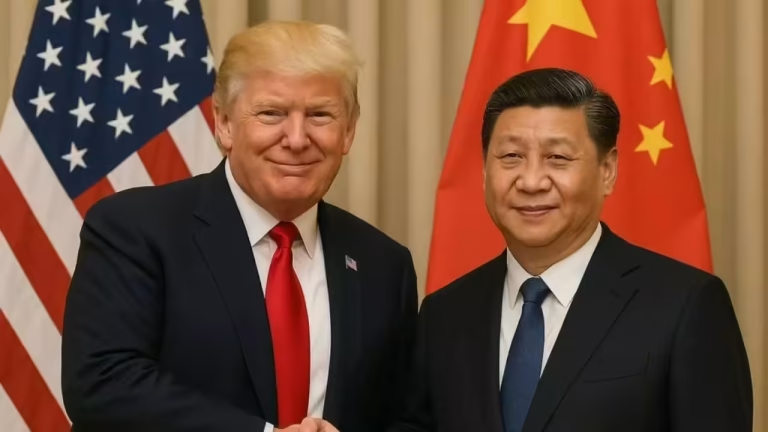
U.S. President Donald Trump has acknowledged that his proposed 100% tariff on Chinese goods would be difficult to sustain in the long term, even as he attributed the latest breakdown in trade discussions to Beijing’s tightening grip on rare earth exports.
When asked about the economic impact of such steep tariffs, Trump admitted, “It’s not sustainable, but that’s what the number is,” adding that China’s recent actions had “forced” his administration to respond.
The president unveiled the new round of 100% tariffs last week, alongside additional export restrictions on critical software set to take effect on November 1, just days before existing tariff relief measures were due to expire. The move came after China expanded its export controls on rare earth elements — materials essential to the production of advanced technology and electronics — intensifying trade tensions between the two global powers.
Despite the escalation, Trump confirmed that he still plans to meet Chinese President Xi Jinping in South Korea within the next two weeks, a meeting he had previously suggested might not happen. Expressing respect for Xi, Trump stated, “I think we’re going to be fine with China, but we have to have a fair deal. It’s got to be fair.”
The president’s comments, signaling a slightly softer stance, helped ease investor anxiety following a turbulent week on Wall Street. Markets had been unsettled by both the sudden tariff hikes and growing concerns over regional banking stability.
In a related development, U.S. Treasury Secretary Scott Bessent and Chinese Vice Premier He Lifeng are expected to hold a virtual discussion on Friday to advance ongoing trade negotiations. The meeting follows a week of heated exchanges between both sides, with U.S. officials accusing some Chinese counterparts of being overly confrontational — a claim Beijing has dismissed.
Reshaping African Storytelling With Superheroes Rooted In Culture

A new generation of African storytellers is redefining what it means to be a hero, moving beyond capes and skyscrapers to celebrate power, heritage, and identity. In Nigeria, filmmaker James Omokwe is leading this movement with Osamede, a superhero film inspired by the 1897 British invasion of the Benin Kingdom.
The film tells the story of a young woman, Osamede, who discovers her ancestral warrior powers amid colonial conflict, symbolizing the strength and spirit of her people.
Omokwe, who worked closely with Benin cultural historians, said the project aims to ground modern storytelling in authentic African history.
As filmmakers across the continent embrace their roots, African superheroes are becoming more than fantasy, they’re guardians of culture, pride, and the enduring story of resilience.
Nigeria’s Rising Debt And The Urgent Need For Revenue Reform

Nigeria’s public debt has risen to ₦152.40 trillion as of June 30, 2025, an increase of ₦3.01 trillion in just three months, according to the Debt Management Office. The weakening naira, pegged at ₦1,529.21 to the dollar, has further inflated the debt burden, with external obligations hitting $46.98 billion.
The World Bank remains Nigeria’s largest creditor, while domestic debt has grown to ₦80.55 trillion, dominated by federal bonds and securitised Ways and Means advances, a reflection of deepening fiscal strain.
This steady rise in borrowing underscores the urgent need for stronger revenue mobilization. Although Nigeria’s debt-to-GDP ratio is still within limits, the soaring cost of debt servicing poses sustainability risks. Experts say boosting non-oil revenue, improving tax collection, and curbing excessive borrowing are key to easing pressure on public finances and securing long-term economic stability.
Did FG Scrap JAMB Requirement For University Admissions? What You Should Know

The Federal Government has dismissed reports circulating online claiming that the Joint Admissions and Matriculation Board (JAMB) is no longer required for admission into Nigerian tertiary institutions.
In recent days, viral posts on social media alleged that the Federal Government had abolished the use of JAMB for university, polytechnic, and college of education admissions, suggesting that institutions would henceforth conduct their own entrance examinations.
However, the Ministry of Education has clarified that the reports are false and misleading.
Government’s Clarification

In an official statement issued on Thursday by the Ministry’s Director of Press and Public Relations, Boriowo Folasade, the Minister of Education, Dr. Tunji Alausa, described the claims as “false, baseless, and misleading.”
He stated clearly that at no point did the Ministry of Education issue or authorise any statement suggesting that JAMB’s role had been removed.
“At no point did the Ministry issue or authorise any statement suggesting that JAMB is no longer mandatory for admission into tertiary institutions,” Alausa said.
“JAMB remains the statutory and legally empowered body responsible for conducting entrance examinations and coordinating admissions into all tertiary institutions across the country.”
The minister reaffirmed that the existing admission structure through JAMB remains fully operational and advised the public to disregard any contrary information.
“The established admission processes through JAMB remain fully operational, and any contrary information should be disregarded in its entirety,” he added.
What’s True and What’s False
The clarification puts to rest the confusion caused by the viral misinformation.
True: JAMB continues to oversee all entrance examinations and admission processes into Nigeria’s universities, polytechnics, and colleges of education.
False: No policy has been introduced to allow individual institutions to conduct independent entrance exams outside JAMB’s supervision.
The Education Minister also emphasised that the Ministry maintains a close working relationship with JAMB and other relevant education agencies to ensure fairness, transparency, and credibility in the country’s tertiary admission system.
“We remain committed to protecting the integrity of the admission process and ensuring that merit and due process guide all admissions into higher institutions,” Alausa noted.
Implications for Admission Seekers
For candidates awaiting admission or planning to apply in future years, this clarification means that JAMB remains the only recognised and legitimate pathway to gaining entry into tertiary institutions in Nigeria.
The Ministry advised prospective students, parents, and education stakeholders to:
Rely solely on verified announcements from the Ministry of Education or JAMB;
Ignore unofficial publications and social media posts making unverified claims;
Continue to follow standard admission procedures through JAMB’s Central Admission Processing System (CAPS).
A Call for Responsible Reporting
The Minister further cautioned media outlets, bloggers, and online platforms against spreading unverified information capable of causing panic or confusion in the education sector.
“Misinformation capable of causing unnecessary confusion within the education sector must be avoided,” he warned.
He reiterated that there has been no change in JAMB’s role, which remains central and indispensable to Nigeria’s tertiary education framework.
Are AI Actors The Future Or A Threat To Creatives?

Hollywood’s latest debate isn’t about scripts or stars, it’s about artificial intelligence. Tilly Norwood, the world’s first AI-generated actress, was created by UK-based Particle 6 Productions.
Her creator, Eline van der Velden, says, “We want Tilly to be the next Scarlett Johansson or Natalie Portman,” describing her as the perfect, tireless performer.
Unions such as SAG-AFTRA, argue that “Tilly Norwood is not an actor… but a computer program trained on the work of real performers without permission or compensation.”
As AI reshapes film, one question remains, can machines ever capture the true heart of acting?
FG Reviews Presidential Pardon List Amid Public Backlash

The Federal Government of Nigeria has announced a review of President Bola Tinubu’s recently approved presidential pardon list, which covers 175 individuals convicted of various offenses, including high-profile cases of murder, drug trafficking, and terrorism.
The move comes in the wake of intense public backlash and calls for greater transparency in the clemency process, with no inmates released as of yet.
Attorney-General of the Federation and Minister of Justice, Lateef Fagbemi (SAN), issued a statement on Thursday clarifying that the list remains in the “final administrative stage,” undergoing thorough legal and procedural checks to ensure compliance with the Constitution.
”There is no delay in the process; it is simply following the law to the letter to ensure that only those duly qualified benefit from the President’s mercy,” Fagbemi said, emphasizing that public feedback is valued as a sign of Nigerians’ commitment to justice and good governance.
The pardon exercise, endorsed by the Council of State on the recommendation of the Prerogative of Mercy Committee chaired by Fagbemi, was intended to decongest overcrowded prisons, promote national reconciliation, and honor historical figures.
Among the beneficiaries are posthumous pardons for nationalist Herbert Macaulay, executed poet and Major General Mamman Vatsa, and the Ogoni Nine, including environmental activist Ken Saro-Wiwa, whose 1995 convictions for alleged treason have long been contested as politically motivated.
Other notable names include former House of Representatives member Farouk Lawan, convicted in a bribery scandal, and inmates like Nweke Francis Chibueze, serving life for cocaine trafficking, whose sentences have been commuted.
However, the inclusion of individuals convicted of grave crimes has ignited widespread condemnation.
Prominent human rights lawyer Femi Falana (SAN) demanded an immediate withdrawal and re-examination of the list “in the interest of justice and national morality.”
In a strongly worded statement, Falana highlighted the presence of “convicted politically exposed persons, drug addicts and barons, armed robbers, and terrorists,” as well as those charged with state offenses like culpable homicide and obtaining by false pretenses, which fall under governors’ purview per Section 212 of the 1999 Constitution.
He urged the Prerogative of Mercy Committee to defer such cases to state executives rather than bundling them into the federal process.
Critics, including civil society groups and online commentators, have decried the list as undermining public trust in the justice system.
Maryam Sanda, sentenced to death in 2020 for the murder of her husband, former Bank PHB Managing Director Halilu Sanda, has become a focal point of outrage, with many arguing her inclusion trivializes domestic violence and fails to reflect remorse or rehabilitation.
Amnesty International echoed these sentiments, calling on Tinubu to reconsider pardons for those convicted of serious human rights violations, insisting that mercy should not eclipse accountability.
Government officials, however, defend the initiative as a humane step forward. The pardon categories encompass full pardons, sentence reductions, and clemency for ex-convicts who have shown rehabilitation, with the ultimate goal of reintegrating reformed individuals into society.
Fagbemi noted that the issuance of implementation instruments would authorize the Controller-General of the Nigerian Correctional Service to proceed, but only after all reviews are complete—a phase expected imminently but subject to adjustments based on ongoing scrutiny.
The review has reignited debate over the president’s power of mercy under Section 175 of the Constitution, which allows pardons for federal offenses.
With 175 names still under consideration, Nigerians await the outcome amid pressure from Falana, activists, and the public. The Attorney-General’s office has pledged updates, stressing that “the rule of law does not rush; it ensures fairness.”
Whether the process restores trust or reveals deeper issues, it has placed the balance between mercy and justice at the center of national attention.
