Home Blog Page 43

Senate Urges Swift Repatriation Of Nigerians Stranded In Libya

18

The Senate has urged the Federal Government to intensify efforts to repatriate and rehabilitate Nigerians trapped in Libya amid rising reports of human trafficking and abuse.

This followed the adoption of a motion titled “Urgent Need to Protect Nigerians from Trafficking, Slavery, and Human Rights Abuses in Libya” sponsored by Senator Aniekan Bassey (Akwa Ibom North-East) during Tuesday’s plenary session.

Senator Bassey expressed concern over the deteriorating conditions of Nigerians held in Libyan detention camps, revealing that more than 1,000 citizens were repatriated in the first quarter of 2025, many of them victims of torture, sexual assault, and organ harvesting.

He cited the distressing case of Mercy Olugbenga, a young woman who sold her family’s property to travel abroad but ended up detained in Libya for over a year, during which “her blood was repeatedly extracted against her will.”

Adopting the motion, lawmakers called on the Federal Government, through the National Agency for the Prohibition of Trafficking in Persons (NAPTIP), the Ministry of Humanitarian Affairs, and state governments, to develop a comprehensive reintegration programme for returnees. The initiative, they said, should include psychosocial support, vocational training, and start-up grants to help survivors rebuild their lives.

The Senate further directed the Ministry of Foreign Affairs to strengthen diplomatic efforts with Libyan authorities and work with the African Union (AU), ECOWAS, and the United Nations to secure the release of Nigerians still detained in Libya.

Supporting the motion, Senator Anthony Ani (Ebonyi South) described the repeated abuses as “a recurring decimal in our national life,” urging stronger institutional action against trafficking and exploitation.

Senator Adams Oshiomhole (Edo North) emphasised the need for public awareness campaigns, noting that “after Gaddafi’s fall, Libya is no longer what it used to be.” He said the National Orientation Agency and other relevant bodies must intensify education on the dangers of irregular migration.

Senator Natasha Akpoti-Uduaghan (Kogi Central) proposed an amendment urging the Nigerian Immigration Service and the Nigerian Correctional Service to collaborate with Libyan authorities in repatriating Nigerian women and children born in detention. “These women were victims twice over—first of traffickers, then of a broken system,” she said.

Senator Victor Umeh (Anambra Central) condemned the inhumane treatment of Nigerians in parts of Africa, describing it as “a betrayal of Africa’s shared humanity,” and called for stronger protection of citizens abroad.

In his closing remarks, Senate President Godswill Akpabio appealed to young Nigerians to resist the lure of irregular migration.
“Home is home. Let us build our nation together, for there is no greater pride than being safe and free in one’s homeland,” he said.

IMF: Africa’s Growth Remains Strong As Inflation Eases And Reforms Advance

16

Africa’s economy continues to show resilience despite persistent global headwinds, supported by moderating inflation, stronger policy frameworks, and ongoing structural reforms, according to the International Monetary Fund (IMF).

The IMF’s outlook followed a high-level meeting with African finance ministers and central bank governors in Washington during the 2025 African Caucus session, held alongside the IMF-World Bank Annual Meetings.

In a joint statement, IMF Managing Director Kristalina Georgieva and Hervé Ndoba, Central African Republic’s Finance Minister and Chair of the African Caucus, noted that Africa’s growth is projected to remain steady at 4.2% in 2025, the same rate recorded in 2024. Inflation is expected to ease to an average of about 4%, while debt levels have stabilised at roughly 65% of GDP.

The IMF acknowledged that the continent continues to operate in a challenging global environment marked by slowing global growth, protectionist trade policies, geopolitical tensions, and limited access to affordable financing. Climate shocks have also intensified, cutting output by as much as two percentage points annually in some of Africa’s most vulnerable economies.

Despite these pressures, the Fund observed progress in fiscal and structural reforms. Governments have maintained policy discipline while pursuing initiatives to strengthen fiscal transparency, expand tax revenues, and improve public financial management. Many countries are implementing medium-term strategies that balance fiscal consolidation with growth-oriented investments.

The African Caucus reaffirmed its commitment to preserving macroeconomic and financial stability, while advancing policies aimed at improving living standards through job creation, social inclusion, and sustainable growth.

Efforts to boost domestic revenue mobilisation remain central to these reforms, driven by tax digitalisation, better governance, and anti-corruption initiatives. These measures are designed to enhance efficiency, improve revenue collection, and ensure public spending achieves measurable results.

The IMF also highlighted the mounting financial pressure on low-income countries, where interest payments now consume around 15% of government revenues. Fragile and conflict-affected states continue to face deep economic strains, with several yet to recover to pre-pandemic income levels.

To address financing constraints, the IMF has restructured its Poverty Reduction and Growth Trust (PRGT) to expand concessional lending capacity—estimated at SDR 5.2 billion (US$7.1 billion) annually, including zero-interest loans for the poorest nations. Additionally, the Resilience and Sustainability Trust (RST) has approved 26 programs, nearly half of them in Africa, to support structural transformation, climate resilience, and health system preparedness.

The statement called for continued global support to ensure that both trust facilities remain adequately funded.

Reaffirming the Fund’s commitment, Georgieva said the IMF remains dedicated to helping African nations create fiscal space for investments in infrastructure and human capital. She added that the Fund would continue adjusting its tools and policy advice to help countries navigate economic challenges while advancing long-term development goals.

US Revokes Six Visas Over Charlie Kirk’s Assassination Comments

17

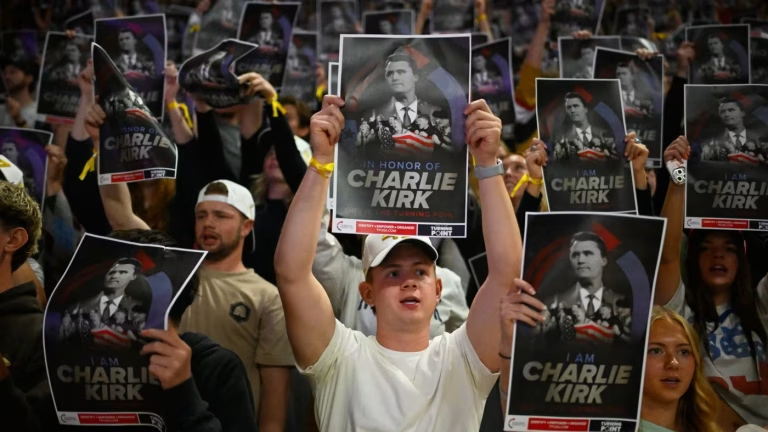
The United States Department of State has revoked the visas of at least six foreign nationals after they posted messages on social media celebrating or justifying the assassination of conservative activist Charlie Kirk.

In a statement posted on X (formerly Twitter) Tuesday evening, the Department wrote, “The United States has no obligation to host foreigners who wish death on Americans.”

According to the statement, the revoked visas belonged to individuals from South Africa, Mexico, Brazil, Paraguay, Germany, and Argentina, all of whom made remarks described as “disturbing” and “deeply offensive.”

The Department shared examples of the now-banned individuals’ comments, writing:

“The State Department continues to identify visa holders who celebrated the heinous assassination of Charlie Kirk. Here are just a few examples of aliens who are no longer welcome in the US: An Argentine national said that Kirk ‘devoted his entire life spreading racist, xenophobic, misogynistic rhetoric’ and deserves to burn in hell. Visa revoked. 

“A South African national mocked Americans grieving the loss of Kirk, saying ‘they’re hurt that the racist rally ended in attempted martyrdom’ and alleging ‘he was used to astroturf a movement of white nationalist trailer trash.’ Visa revoked.

“A Mexican national said that Kirk ‘died being a racist, he died being a misogynist,’ and stated that ‘there are people who deserve to die. There are people who would make the world better off dead.’ Visa revoked.

“A Brazilian national charged that ‘Charlie Kirk was the reason for a Nazi rally where they marched in homage to him’ and that Kirk ‘DIED TOO LATE.’ Visa revoked.

“A German national celebrated Kirk’s death and attempted to justify his murder, writing, ‘when fascists die, democrats don’t complain.’ Visa revoked.

“A Paraguayan national charged that ‘Charlie Kirk was a son of a b** and he died by his own rules.’ Visa revoked.”

The post concluded with a strong warning:

“#POTUS and #SecRubio will defend our borders, our culture, and our citizens by enforcing our immigration laws. Aliens who take advantage of America’s hospitality while celebrating the assassination of our citizens will be removed.”

The announcement comes days after Charlie Kirk, the 31-year-old co-founder of Turning Point USA, was posthumously awarded the Presidential Medal of Freedom by former President Donald Trump, who described him as a “martyr for truth.” Kirk was widely credited with mobilizing young conservative voters during Trump’s campaigns.

Following his assassination, social media platforms were flooded with both tributes and vitriol. A New York Timesinvestigation revealed that over 145 Americans were fired, suspended, or forced to resign for online posts referencing Kirk’s death.

Secretary of State Marco Rubio and Deputy Secretary Christopher Landau had previously hinted at visa revocations for foreigners who “celebrate or excuse acts of violence against Americans.” Landau stated:

“I have been disgusted to see some on social media praising, rationalising, or making light of the event, and have directed our consular officials to undertake appropriate action… Please feel free to bring such comments by foreigners to my attention so that the [State Department] can protect the American people.”

The visa revocations come amid a broader tightening of U.S. immigration and visa policies, including new vetting measures that require applicants to disclose their social media accounts.

According to Fox News, more than 6,000 student visas have been revoked this year, with hundreds reportedly cancelled due to alleged links to terrorism or pro-Hamas fundraising activity.

The move underscores the U.S. government’s stance that freedom of expression for foreign nationals does not extend to endorsing or celebrating violence against Americans.

Bayelsa Governor Douye Diri Resigns From PDP With 23 Assembly

12

‎Bayelsa State Governor Douye Diri has officially resigned from the Peoples Democratic Party (PDP), dealing another major blow to the opposition amid a wave of high-profile defections across Nigeria.

‎The announcement, made during a State Executive Council meeting at the Government House on Wednesday, was accompanied by the resignations of 23 out of 24 House of Assembly members, led by Speaker Abraham Ngobere, further eroding PDP’s influence in the oil-rich South-South state.

‎In his address, Diri cited “very obvious reasons” tied to internal party crises and frustrations over governance, but stopped short of naming his next destination, though sources close to him suggest a move to the ruling All Progressives Congress (APC) is imminent.

‎”Today, I have formally resigned my membership of the Peoples Democratic Party for very obvious reasons,” Diri stated, emphasizing that the decision was collective and aimed at advancing Bayelsa’s prosperity.

‎He added that all local government chairmen would join him in the transition, ensuring broad-based support. Deputy Governor Lawrence Ewhrudjakpo was absent, but Diri clarified that those not present were on official duties.

‎The mass resignation included the Speaker and 18 PDP lawmakers present at the meeting, with the remaining PDP members aligning shortly after.

‎The 24-member assembly, previously comprising 20 PDP, three APC, and one APGA legislator, now sees PDP’s grip shattered.

‎Ngobere, speaking on behalf of the lawmakers, declared that the PDP lacks the capacity to field a viable presidential candidate for the 2027 elections, calling the exit a step toward “a stronger Nigeria.”

‎Chief Press Secretary Daniel Alabrah confirmed the development in a statement, noting Diri’s gratitude to supporters and his commitment to continuity in projects like infrastructure and youth empowerment.

‎This move follows closely on the heels of Enugu Governor Peter Mbah’s defection to the APC on Tuesday, October 14, during a statewide broadcast where he described the switch as essential for serving his people’s interests without betrayal.

‎Mbah, who argued the PDP had disregarded Southeast voices, was joined by his entire cabinet and most lawmakers.

‎Earlier in 2025, Delta’s Sheriff Oborevwori and Akwa Ibom’s Umo Eno had similarly crossed over with their teams, leaving PDP with just one governor in the South-South, Rivers’ Siminalayi Fubara and eight nationwide.

‎PDP spokesperson Umar Sani expressed deep disappointment, urging remaining governors to uphold their roles as opposition leaders entrusted by voters. .

‎”This is a desecration of public trust,” Sani said, echoing the party’s earlier reaction to Mbah’s exit.

‎ As Bayelsa navigates this political earthquake, Diri vowed, “Together, we will continue to build a strong and prosperous Bayelsa State.”

Enugu State Governor Peter Mbah Joins APC

35

‎Enugu State Governor Peter Ndubuisi Mbah has defected from the Peoples Democratic Party (PDP) to the All Progressives Congress (APC), ending the PDP’s 26-year dominance in the southeastern state and bolstering the ruling party’s push in the region ahead of the 2027 elections.

‎In a television address on Tuesday, October 14, Mbah announced the switch, calling it a “collective decision” to align Enugu with President Bola Tinubu’s “Renewed Hope” agenda.

‎“Today, we have decided to leave the PDP and join the APC,” Mbah said, joined by his predecessor Ifeanyi Ugwuanyi, state and federal lawmakers, and supporters.

‎He praised Tinubu’s reforms, like fuel subsidy removal, and criticized the PDP for neglecting Southeast interests.

‎“Our voices were too often disregarded,” Mbah said, vowing to amplify Enugu’s role in Nigeria’s $1 trillion economy goal.

‎The defection included Mbah’s entire cabinet, all 17 local government chairmen, councillors, and most PDP executives and lawmakers. A video shared by Mbah’s aide Dan Nwomeh on Monday showed officials chanting “APC all the way” and hailing Tinubu as “Jagaban.”

‎APC leaders, including Vice President Kashim Shettima, Senate President Godswill Akpabio, and Speaker Tajudeen Abbas, attended the ceremony, with Shettima naming Mbah the party’s state leader and promising “renewed possibilities.”

‎The APC had dissolved Enugu’s state executive last week to accommodate the defectors. National Chairman Abdullahi Ganduje called it a “historic milestone,” strengthening APC’s grip in the Southeast, where it holds only Imo State.

‎Mbah, elected on PDP in 2023, said the move would boost infrastructure, healthcare, and youth empowerment.

‎PDP leaders condemned the defection as a “desecration of public trust.” Prof. Udenta Udenta argued, “Peter Mbah did not win; PDP did.”

‎The defections follow similar switches by Delta’s Sheriff Oborevwori and Akwa Ibom’s Umo Eno, with Bayelsa’s Douye Diri resigning from PDP the same day.

‎Mbah assured continuity in governance, emphasizing federal collaboration. The shift redefines Southeast politics, raising questions about PDP’s resilience.

TCN Begins 10-Day Maintenance On Gombe Transmission Substation

11

The Transmission Company of Nigeria (TCN) has announced the commencement of a 10-day maintenance exerciseon its major transmission substation in Gombe State, a move that may result in temporary disruptions to electricity supply across parts of the state.

In a statement released on Tuesday by its spokesperson, Ndidi Mbah, the company described the project as a routine preventive maintenance operation designed to strengthen the transmission network and enhance power reliability across the North-East region.

According to TCN, the maintenance work scheduled to take place from October 14 to 24, 2025, between 9 a.m. and 4 p.m. daily will involve the replacement of critical protection and control panels at the Gombe 132/33kV Transmission Substation.

“The planned maintenance will enable our engineers to carry out replacement of protection and control panels on the Shongo 33kV Feeder 8,” the company stated.

While the maintenance may lead to power interruptions in some areas, TCN assured that it has implemented measures to limit the inconvenience to residents and businesses.

“To minimise inconvenience, load from the Shongo 33kV feeder will be transferred to the Darazo 33kV feeder, while that of Mallam Sidi will be moved to the Doma 33kV feeder,” the statement added.

The company also noted that the Jos Electricity Distribution Company (JEDC) will continue to receive bulk power supply throughout the maintenance period.

Reassuring residents of Gombe and surrounding areas, Mbah said the operation is vital to ensuring long-term network efficiency and preventing system breakdowns.

“Preventive maintenance remains a key part of our operations. We appeal for public understanding and cooperation as we work to improve the quality and stability of electricity supply in Gombe and its environs,” she added.

The exercise underscores TCN’s ongoing efforts to modernize Nigeria’s transmission infrastructure and enhance service delivery across the national grid.

Donors Contribute $4.5 Billion To Czech Ammunition Initiative For Ukraine

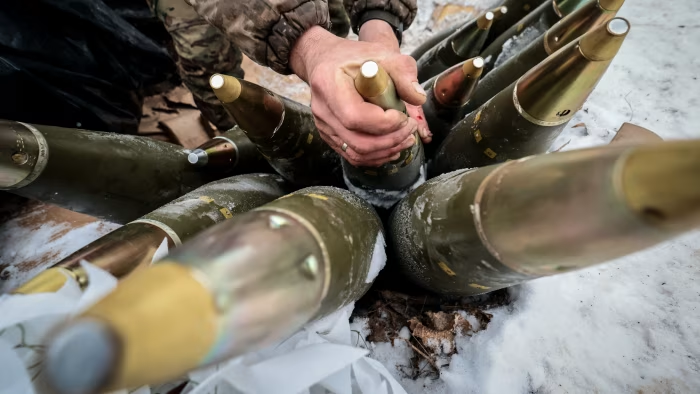
Foreign donors have contributed around 93.3 billion crowns ($4.5 billion) to a Czech-led initiative aimed at sourcing and supplying large-calibre ammunition to Ukraine, Czech Defence Minister Jana Cernochova announced on Wednesday. The Czech Republic itself has added 1.7 billion crowns to the project.

According to officials, the initiative has significantly boosted ammunition supplies in 2024 and 2025, helping to reduce Ukraine’s disadvantage on the frontline against Russia. However, questions remain over the future of the program as a new Czech government prepares to take office.

Prime Minister Petr Fiala said the Czech Republic has coordinated the delivery of 3.7 million artillery shells to Ukraine, with 1.3 million supplied so far this year. He noted that funding has come from the donor initiative, returns from frozen Russian assets, bilateral partnerships, and Ukraine’s own purchases. By the end of the year, total deliveries are expected to reach 1.8 million rounds.

The programme connects Czech arms manufacturers and traders with international donors and suppliers, many of whom prefer to remain anonymous.

Opposition leader Andrej Babis, whose ANO party won the October 3–4 elections, has criticised the initiative, calling it non-transparent and overpriced. He also claimed that arms dealers have benefited excessively, though the outgoing government insists the project is fully transparent to donors.

Babis has also pledged to halt any Czech-funded military support to Ukraine, but his position on the ammunition programme remains uncertain following the elections.

Government figures show that the Czech Republic’s total military assistance to Ukraine has reached 17.4 billion crowns. This includes the donation of 390 pieces of older military equipment such as tanks and helicopters, contributions to international support funds, and participation in the ammunition programme.

In exchange, the Czech Republic has received compensation worth about 25 billion crowns through allied support schemes, including U.S. helicopters and German Leopard 2A4 tanks.

Will Nigeria Qualify for the World Cup?

16

Nigeria’s Super Eagles reignited their World Cup dreams with a resounding 4–0 victory over Benin Republic on Tuesday, October 14, 2025, at the Godswill Akpabio International Stadium, Uyo. The emphatic win not only delighted home fans but also ensured Nigeria’s progression to the CAF playoff stage, keeping their hopes of qualifying for the 2026 FIFA World Cup alive.

Osimhen Leads From the Front

Napoli striker Victor Osimhen was the star of the night, scoring a brilliant hat-trick in the 3rd, 37th, and 51st minutes to put Nigeria firmly in control. Midfielder Frank Onyeka completed the rout with a thunderous strike in stoppage time, sealing a result that sent the stadium into raptures.

From the first whistle, the Super Eagles looked determined to erase the memories of earlier qualification struggles. Osimhen’s early opener set the tone, and the team never looked back. The attack was sharp, the midfield dominant, and the defense compact, a significant improvement from previous matches where lapses cost Nigeria crucial points.

Playoff Qualification Secured

With South Africa defeating Rwanda 3–0 in Johannesburg, the Bafana Bafana clinched top spot in Group C and earned automatic qualification for the 2026 World Cup. Nigeria, finishing second on 17 points, level with Benin but ahead on goal difference, grabbed one of the coveted CAF playoff spots reserved for the best runners-up across Africa’s nine qualification groups.

The result was a relief for fans who had feared elimination before the final matchday. The Super Eagles’ commanding win in Uyo means they will now head into the playoff mini-tournament slated for November 2025.

What Lies Ahead: CAF Playoff Showdown

Nigeria joins Cameroon, Gabon, and DR Congo in the four-nation playoff series. Based on FIFA rankings, the Super Eagles are expected to face Gabon in the semifinal, while Cameroon will take on DR Congo in the other tie.

Winners from both semifinals will meet in the playoff final, and the eventual champion will advance to the inter-confederation playoff in March 2026, where they will battle for one of the final World Cup slots against teams from other continents.

Nigeria’s Strengths and Hurdles

On paper, Nigeria remains one of the strongest teams heading into the playoffs. With Osimhen in lethal form, Ademola Lookman providing creativity, and Wilfred Ndidi anchoring the midfield, the squad has the talent to overcome any of their African rivals.

The Super Eagles’ performance against Benin showcased their attacking flair and defensive discipline, a balance that had been missing in earlier qualifiers. The clean sheet in Uyo offered a glimpse of renewed stability under coach Finidi George, whose tactical adjustments appear to be paying off.

However, the road ahead is anything but easy. The playoffs are single-elimination matches, leaving no room for mistakes. A single defensive lapse, a moment of complacency, or an untimely red card could end Nigeria’s campaign abruptly.

Cameroon and DR Congo both possess experienced squads capable of upsetting any team on their day. Moreover, even if Nigeria wins the CAF playoff, they must still face an opponent from Asia, Oceania, or the Americas in the intercontinental playoff, making qualification an uphill battle.

Momentum and Belief

Despite the challenges, there’s renewed optimism among Nigerian supporters. Tuesday’s victory was the team’s best performance of the qualification series — fluid in attack, organized in defense, and inspired in spirit.

For the first time in months, fans are daring to dream again. With momentum now on their side and the country’s best talents firing, the Super Eagles appear ready to fight their way to the World Cup.

Verdict

Nigeria’s path to the 2026 FIFA World Cup remains difficult but possible. The Super Eagles have done the hard part by staying alive in the qualifiers. What comes next will test their resolve, consistency, and mental strength.

If they can replicate the intensity and precision displayed against Benin, the dream of seeing Nigeria on the world stage in 2026 may yet become a reality.

Russia Urges Restraint As Military Seizes Power In Madagascar

16

Russia on Wednesday said it is closely monitoring the situation in Madagascar following the military’s takeover, expressing hope that the country will avoid bloodshed amid escalating unrest.

Protests erupted in Madagascar on September 25 over water and electricity shortages and quickly evolved into a broader movement against corruption, poor governance, and the lack of basic services.

Colonel Michael Randrianirina announced on Tuesday that he had assumed control of the government, stating that a military committee would oversee the country for up to two years alongside a transitional administration before new elections are conducted.

“We are following the development of the situation in Madagascar with anxiety,” Russian Foreign Ministry spokeswoman Maria Zakharova said in Moscow. “We believe that what is happening is an internal matter of this country.”

Zakharova urged restraint and called for the prevention of violence, adding that Russia hopes Madagascar will “return to the path of democratic development” as soon as possible.

In recent years, Russia has expanded its presence across Africa, including through security cooperation and advisory roles in several countries, Madagascar among them.

Trump Warns Of Tariffs On Spain For Rejecting NATO’s 5% Defense Spending Target

9

President Donald Trump on Tuesday issued a stern warning to Spain, threatening to impose trade tariffs in response to the country’s refusal to raise its defense spending to 5% of GDP, a move he described as an insult to NATO.

“I’m very unhappy with Spain. They’re the only country that didn’t raise their number up to 5%… so I’m not happy with Spain,” Trump told reporters at the White House.

“I was thinking of giving them trade punishment through tariffs because of what they did, and I think I may do that,” he added.

Trump, who has consistently pressed NATO members to take on greater financial responsibility for their defense, reiterated his frustration with what he views as an imbalance in the alliance’s contributions. During a meeting last week with Finland’s president, he suggested that NATO should consider expelling Spain for refusing to adopt the higher spending target.

Spanish Foreign Minister Jose Manuel Albares responded on Wednesday, affirming Madrid’s continued commitment to the alliance. “There is no doubt about Spain’s commitment and contribution to (transatlantic) security,” he told reporters during an official trip to Hangzhou, China.

Spain currently has around 3,000 troops serving under NATO operations. However, it remains the only one among the alliance’s 32 members that declined to meet the newly proposed 5% defense expenditure benchmark.

NATO allies have argued that the ongoing threat posed by Russia following its 2022 invasion of Ukraine requires significantly higher defense budgets, making the previous 2% spending goal insufficient.

Spanish Prime Minister Pedro Sánchez negotiated an exemption during the talks, pledging instead to allocate up to 2.1% of GDP toward defense — a figure he described as “sufficient and realistic.”

Spain, which joined NATO in 1982, maintains that its robust participation in alliance missions offsets its lower defense spending. The country continues to contribute troops to NATO operations in Latvia, Slovakia, Romania, Bulgaria, and Turkey.