Home Blog Page 62

Nigeria, Colombia Explore Direct Flight Agreement To Strengthen Ties

8

Colombia’s Vice-President, Francia Márquez, says discussions are underway with Nigerian aviation stakeholders on the possibility of starting direct flights between both countries as part of efforts to expand bilateral relations.

Márquez made this known on Monday during a visit to the Presidential Villa in Abuja, where she was received by President Bola Tinubu, according to a statement by Bayo Onanuga, Special Adviser to the President on Information and Strategy.

The visit coincided with the signing of a memorandum of understanding (MoU) on political consultations, formalised during the Nigeria–Colombia bilateral meeting and business forum in Abuja. The agreement was signed by Nigeria’s Minister of Foreign Affairs, Yusuf Tuggar, and Colombia’s Deputy Minister for Multilateral Affairs, Mauricio Jaramillo Jassir.

Speaking at the forum, Márquez said aviation was one of several key areas identified for strengthening cooperation between the two nations, while noting that Nigeria and Colombia share significant cultural and historical similarities.

“We have had a meeting with the business leaders in aviation on the need to start direct flights to Colombia,” she said, adding that the partnership would also advance social justice, gender equality, and inclusivity in both countries.

President Tinubu, while addressing the Colombian delegation of senior officials and business leaders, pledged Nigeria’s commitment to deepening ties. He said agreements already reached with Brazil in aviation and consular matters could be replicated with Colombia to strengthen diplomatic and economic engagement.

“Our business opportunities with Colombia have already been enhanced. I support every aspect that you have agreed on,” Tinubu said. “Particularly for Colombia, the agreement we entered with Brazil can easily be replicated in aviation, and our diplomatic relations can be enhanced. The Ministry of Foreign Affairs will accelerate that.”

Among Nigerian officials present at the meeting were Femi Gbajabiamila, Chief of Staff to the President; Wale Edun, Minister of Finance and Coordinating Minister of the Economy; Jumoke Oduwole, Minister of Industry, Trade and Investment; and Imaan Sulaiman-Ibrahim, Minister of Women Affairs and Social Development.

Concrete Roads Emerging as Game Changer for Emergency Response and Security in Nigeria

0

As Nigeria continues to battle insecurity across various regions, particularly in rural and forested areas, poor infrastructure has remained a significant obstacle to timely and effective security responses. However, new federal road projects under the administration of President Bola Ahmed Tinubu are being hailed as a transformative step toward strengthening national security and emergency response.

For years, ungoverned spaces, ranging from dense forests in the South to rugged terrains in the North, have provided safe havens for kidnappers, bandits, and terrorists. These criminals often exploit Nigeria’s inadequate road networks, making it difficult for security forces to reach affected communities or track down armed groups in remote locations.

Despite increased investment in security operations, operatives are frequently delayed by impassable roads, giving criminals the upper hand in launching attacks and escaping undetected.

“The key to defeating these threats lies in the physical presence of security personnel in these hard-to-reach areas,” said a senior security official. “But without proper roads, we are always one step behind.”

In response, the Federal Government has intensified efforts to revamp and expand Nigeria’s road infrastructure using durable concrete technology, which offers longer-lasting solutions to the country’s infrastructure deficit.

Among the flagship projects are:

  • 1,068-km Sokoto–Badagry Superhighway (connecting North West to South West)
  • 750-km Lagos–Calabar Coastal Highway (linking the South West, South-South, and South East)
  • 477-km Trans-Saharan Highway (Calabar–Ebonyi–Kogi–Benue–Nasarawa–FCT corridor)
  • 422-km Akwanga–Jos–Bauchi–Gombe Expressway (North Central to North East)

According to the Minister of Works, Senator David Umahi, these road projects are not just about improving transportation—they are about national security. “Concrete roads will enhance access to communities previously cut off from government presence, reduce transportation costs, and most importantly, allow for faster emergency and security response,” he said.

Experts say the new roads will integrate advanced technologies, including AI-powered traffic cameras, GPS tracking systems, IoT sensors, and satellite imaging to support real-time monitoring and operational coordination.

Complementing Roads with Security Infrastructure

Alongside road development, the Ministry of Police Affairs, led by Senator Ibrahim Gaidam, is rolling out a complementary security architecture. This includes:

  • National Criminal Data Fusion Centre (NCDFC): Now 90% complete, designed to promote inter-agency intelligence collaboration.
  • National Crime and Incident Database Centres (NCIDB): Already operational and aggregating biometric data of suspects and witnesses across police divisions.

Some divisional police stations are now piloting biometric data collection to prevent criminals from evading justice by simply relocating.

States and Local Governments Urged to Act

While the Federal Government handles major trunk A roads, state and local governments are being urged to rehabilitate trunk B and C roads to ensure seamless movement of security personnel within local jurisdictions.

States like Lagos, Kano, Edo, and Oyo have already established Command and Control Centres, enabling real-time surveillance and faster incident response. In addition, the National Public Security Project, now under concession, has launched toll-free emergency lines and is rolling out smart divisional police stations in locations such as Mpape (Abuja), Akaeze (Ebonyi), and Ekinrin-Adde (Kogi).

A New Dawn for Security in Nigeria?

The convergence of improved road networks, smart policing technologies, and centralized criminal databases marks a significant shift in Nigeria’s approach to national security. Analysts believe that criminals will find it increasingly difficult to hide or operate freely, as improved infrastructure tightens the security net.

More importantly, citizens in previously neglected regions can now look forward to greater government presence, quicker emergency response, and safer communities.

As Nigeria turns a corner in its battle against insecurity, concrete roads may very well be paving the way, both literally and strategically, towards a more secure and prosperous nation.

Resident Doctors Issue 10-Day Deadline, Threaten Nationwide Strike

8

The Nigerian Association of Resident Doctors (NARD) has given the Federal Government 10 days to address its pending welfare demands or face a nationwide strike.

In a communiqué released on Monday and signed by NARD President, Dr. Tope Osundara; General Secretary, Dr. Oluwasola Odunbaku; and Publicity and Social Secretary, Dr. Omoha Amobi, the doctors said the decision followed an Extraordinary National Executive Council (E-NEC) meeting held virtually on Sunday.

The association recalled that in July it had initially given a three-week deadline, but later extended it by another three weeks to allow further dialogue with relevant stakeholders. Despite this, it said the government had failed to deliver on its promises.

According to the communiqué, “The E-NEC condemned the failure of the Federal Government to fulfil its promises, noting with dismay that a substantial number of resident doctors remain unpaid for their 2025 Medical Residency Training Fund. The government has also refused to pay the outstanding five months’ arrears arising from the 25 per cent/35 per cent Consolidated Medical Salary Structure review, as well as other longstanding salary arrears.”

The doctors also faulted the Medical and Dental Council of Nigeria for “unjustly” downgrading the membership certificates of the West African Colleges of Physicians and Surgeons, and criticised the National Postgraduate Medical College of Nigeria over the “persistent non-issuance” of membership certificates.

Other grievances included non-payment of the 2024 Accoutrement Allowance and what NARD described as negligence by some state governments towards their doctors.

Specifically, the association accused the Kaduna State Government of failing to honour agreements with its members at ARD Kaduna and Barau Dikko Teaching Hospital. It also berated the Oyo State Government for ignoring issues affecting doctors at LAUTECH Teaching Hospital, Ogbomosho, despite an ongoing indefinite strike.

However, NARD commended state governors who have already paid the 2025 Medical Residency Training Fund, describing the move as a sign of commitment to doctors’ welfare.

The association demanded immediate settlement of all outstanding entitlements, reinstatement of full recognition for postgraduate membership certificates, and urgent resolution of welfare challenges in Kaduna and Oyo states.

It warned: “The E-NEC extends the ultimatum by a final 10 days to all relevant government agencies to meet these demands. Failure to do so within this period (expiring on Wednesday, 10th September 2025) will leave the NEC with no other option than to embark on a nationwide strike action.”

Nigerian Missions Abroad Struggle With Unpaid Rents And Salary Backlogs

5

The Federal Government has admitted that Nigerian embassies and consulates around the world are facing serious financial difficulties, with staff salaries, allowances, and rents left unpaid.

In a statement issued on Monday, the Ministry of Foreign Affairs, through its spokesperson Kimiebi Ebienfa, attributed the problems to years of budget shortfalls and the recent impact of foreign exchange policy changes.

According to the ministry, the financial strain has disrupted the effective running of several missions, leaving locally recruited staff unpaid, home-based officers without their allowances, and missions indebted to landlords and service providers.

“The ministry is aware of the challenges that limited funding has placed on the operations of our missions, ranging from delayed staff salaries to unpaid rents and unsettled obligations to service providers,” the statement explained.

It added that Nigerian diplomatic posts are not exempt from the country’s economic realities, noting that inadequate funding over time has undermined their ability to fully discharge their diplomatic responsibilities.

Despite this, the ministry assured Nigerians that the welfare of foreign service officers and their families remains a priority for President Bola Tinubu’s administration. It disclosed that special intervention funds had already been released to ease the situation, with over 80 per cent of available resources directed to settling staff salaries, claims, and service provider arrears.

To ensure accountability, the government has set up a verification committee to review the debt records of missions and confirm the legitimacy of payments.

The ministry also revealed ongoing collaboration with the Office of the Accountant-General to recover 2024 budget shortfalls linked to exchange rate fluctuations under recent monetary reforms. The first tranche of relief funds has already been disbursed, with some missions confirming receipt, while a second tranche is being processed with the Ministry of Finance and the Central Bank of Nigeria.

Looking forward, the ministry said efforts are underway to establish a more sustainable funding model for embassies and consulates, aligning with wider fiscal reforms to strengthen resource management and governance.

While acknowledging the patience of diplomatic staff, service providers, and host countries, the ministry expressed optimism that the financial setbacks are temporary.

“We are confident these challenges will be overcome through the ongoing reforms. The Ministry of Foreign Affairs remains committed to safeguarding the welfare of Nigerian citizens abroad and upholding the country’s diplomatic presence globally,” the statement concluded.

Houthi Prime Minister Killed in Israeli Airstrike

66

The conflict in the Middle East intensified after an Israeli airstrike struck Yemen’s capital, Sanaa, killing Ahmed al-Rahawi, the prime minister of the Houthi-controlled government, along with several ministers and senior officials. The strike hit a villa in Beit Baws where a government workshop was being held. At the time, Houthi leader Abdul-Malik al-Houthi’s speech was being broadcast on television.

Following the attack, senior Houthi leader Mahdi al-Mashat declared that the group would retaliate, calling al-Rahawi a martyr and urging foreign companies to leave Israel. The funeral in Sanaa drew thousands of mourners who denounced Israel and its allies.

Israeli officials described the strike as a major blow against the Houthis, emphasizing that this marked the beginning of a campaign aimed at dismantling their leadership. Analysts noted that Israel’s shift from targeting infrastructure to striking at the command structure shows an escalation in strategy.

In response to the killing, the Houthis detained multiple United Nations personnel during raids on UN offices in the capital, signaling growing hostility toward international institutions. The rebels also fired a missile at an Israeli-owned tanker in the Red Sea, though no casualties were reported.

Two days later, the Houthis confirmed al-Rahawi’s death and named Deputy Prime Minister Muhammad Ahmed Miftah as acting prime minister, signaling continuity in their political leadership even as tensions in the region continue to rise.

Woman Burnt Alive In Niger Over Alleged Blasphemy

0

A shocking incident occurred in Niger State where a female food vendor, identified as Amaye, was attacked and burnt alive after being accused of making blasphemous comments against Prophet Muhammad. The tragedy unfolded on August 30 in Kasuwan-Garba, Mariga Local Government Area, following a verbal exchange that spiraled out of control.

According to eyewitnesses, the altercation began in Igwama community when a young man, said to be Amaye’s nephew, jokingly told her he intended to marry her to “fulfil the Sunnah.” Reports suggest Amaye responded with remarks that some locals deemed insulting to the Prophet.

The issue was subsequently taken before the District Head of Kasuwan-Garba. During questioning, the woman allegedly repeated the remarks, leading the traditional ruler to hand her over to security operatives for further action. However, tensions escalated rapidly.

As security officers attempted to escort her, a mob of enraged youths demanded her execution. Despite the intervention of security personnel, the crowd reportedly overpowered them, stoned the woman, and eventually set her ablaze. Witnesses described the scene as chaotic and deeply disturbing.

The Niger State Police Command condemned the act, describing it as an unlawful resort to jungle justice. Police spokesman, Superintendent Wasi’u Abiodun, confirmed that officers had received reports of the alleged blasphemy around 2pm and rushed to the scene, but the mob carried out the attack before reinforcements could restore order.

He stressed that investigations are ongoing and promised that those behind the killing would be tracked down and prosecuted. The command also appealed for calm, urging residents to avoid taking laws into their own hands.

Niger State police command says it has intensified efforts and investigations to arrest the perpetrators of the recent alleged blasphemy that led to the gruesome death of food vendor, Amaye.

Through its spokesman, SP Wasi’u Abiodun, the police reiterated their stance against jungle justice and assured that every effort is being made to apprehend, investigate, and prosecute the culprits, while restoring peace and normalcy to the affected area.

Ukraine Vows New Strikes Inside Russia After Massive Drone Attack

12

Ukraine has announced plans to carry out new strikes deep into Russian territory following a wave of overnight drone attacks that cut power to 60,000 people across the country. President Volodymyr Zelenskyy revealed the decision on Sunday after meeting with his top commander, Oleksandr Syrskii, stressing that Ukraine would respond to Moscow’s growing assaults on energy and civilian infrastructure.

In recent weeks, both Kyiv and Moscow have escalated their air campaigns. Russia has intensified attacks on Ukraine’s energy grid, transportation network, and major cities, while Ukraine has targeted oil refineries and pipelines inside Russia.

According to private energy company DTEK, Russian drones struck four facilities in Ukraine’s Odesa region overnight, leaving 29,000 people without electricity. Chornomorsk, a port city near Odesa, was the hardest hit, with one reported injury and vital infrastructure now relying on generators, said regional Governor Oleh Kiper. Ukraine’s military reported that Russia launched 142 drones in total, with 132 intercepted.

On the other side, the Russian Defense Ministry claimed on Sunday that its forces had downed 112 Ukrainian drones within 24 hours.

Kremlin spokesperson Dmitry Peskov shifted blame to Europe, accusing the EU of prolonging the war and obstructing peace efforts proposed by U.S. President Donald Trump. His remarks followed a recent Russian strike in Kyiv that killed at least 23 people and damaged EU diplomatic facilities.

As diplomatic pressure mounts, German Chancellor Friedrich Merz warned that the war, now stretching into its fourth year, could drag on for a long time. He insisted that peace negotiations must not come at the cost of Ukraine surrendering.

European Commission President Ursula von der Leyen, speaking from Poland alongside Prime Minister Donald Tusk, branded Vladimir Putin a “predator” who could only be restrained through strong deterrence. She also pledged additional EU funding for border states facing direct threats from Russia and Belarus, calling border defense a “shared responsibility.”

Meanwhile, Russia continues to inflate its battlefield claims. General Valery Gerasimov asserted that Russian forces had captured 3,500 square kilometers and 149 settlements since March. However, the U.S.-based Institute for the Study of War disputed these figures, saying Moscow exaggerated its territorial gains by about 1,200 square kilometers and 19 settlements.

Afghanistan Earthquake Kills Over 800, Leaves Thousands Injured

15

A devastating earthquake struck eastern Afghanistan late Sunday night, followed by powerful aftershocks that ripped through mountainous regions. The tremors, felt as far as Kabul and even Islamabad, reduced entire villages to rubble and sparked a massive rescue effort.

In Kunar province, more than 800 people were confirmed dead, with about 2,500 others injured. Nangarhar province also reported fatalities, including at least 12 deaths and over 250 injuries. Officials warn the toll could climb as rescuers reach remote areas cut off by landslides and blocked roads.

Traditional mud-brick homes, common in the region, collapsed under the quake’s force, leaving families buried beneath the debris. Survivors have been forced into the open air, facing harsh conditions without shelter, food, or clean water. Many hospitals are overwhelmed as injured victims continue to pour in.

Authorities declared a state of emergency and launched large-scale rescue operations. The defence ministry confirmed that helicopters have been deployed to evacuate the injured and deliver supplies. Local residents are also clearing blocked roads to allow aid to reach stranded villages. Witnesses described scenes of terror, with people screaming as buildings crumbled around them.

The disaster has intensified calls for urgent international assistance. Aid agencies are mobilizing emergency relief, but access to remote regions remains a major challenge. Survivors continue to plead for food, tents, and medical supplies, as fears grow of disease outbreaks among the displaced population.

The earthquake has once again exposed Afghanistan’s vulnerability to natural disasters, worsened by fragile infrastructure and limited resources. Rebuilding efforts are expected to take months, if not years, as families mourn their dead and communities struggle to recover.

Biafra Agitator, Simon Ekpa Gets Six-Year Sentence In Finland

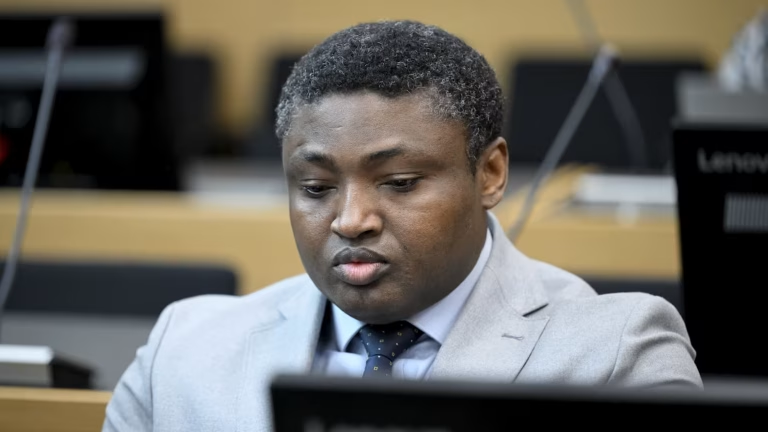
A Finnish court has sentenced Simon Ekpa, a Finnish citizen of Nigerian descent, to six years in prison after convicting him of multiple terrorism-related offences on Monday, August 26, 2025. The court found that Ekpa attempted to promote the independence of Biafra—Nigeria’s south-eastern secessionist region—through illegal means.

Between August 2021 and November 2024, Ekpa used his social media platforms to incite violence and urge followers to commit crimes in Nigeria. According to the court’s unanimous ruling, he also equipped armed groups with weapons and explosives through a network of contacts.

In addition to terrorism charges, Ekpa was convicted of aggravated tax fraud. He has denied all charges, and it remains unclear whether he will appeal the ruling.

Diplomatic Tensions Rise as Nigeria Seeks Extradition

The Nigerian government has repeatedly demanded Ekpa’s extradition to face justice at home, labeling him a key figure behind a wave of deadly unrest in the country’s southeast. While Finnish authorities arrested him at his home in Lahti in February 2023, they have yet to approve any extradition request.

Ekpa, a former local councillor in Finland, previously claimed leadership of a faction within the Indigenous People of Biafra (IPOB), a separatist group banned in Nigeria. IPOB was initially formed in 2012 as a peaceful movement but launched an armed wing in 2020, citing a need to defend the Igbo ethnic group.

A Legacy of Violence and a Nation Still Divided

Since IPOB’s shift to militancy, Nigeria’s south-east has suffered widespread violence, including attacks on government institutions and civilians. Critics accuse the group of causing enormous suffering, while supporters view it as a response to decades of marginalization.

Ekpa rose to prominence in 2022 as an online propagandist for the movement, often calling for civil disobedience and armed resistance. His conviction in Finland could mark a turning point in how countries handle diaspora-based activism that crosses into incitement and extremism.

As the Nigerian government awaits a decision on his possible extradition, families affected by the violence continue to seek justice, and Finland finds itself at the center of a diplomatic and legal storm.

How Phyna’s Sister, Ruth Otabor, Died After Leg Amputation

0

The family of Big Brother Naija Season 7 winner, Ijeoma Josephina Otabor, popularly known as Phyna, has been thrown into mourning following the death of her younger sister, Ruth Otabor.

Ruth passed away in the early hours of Sunday, August 31, 2025, at about 6:30 a.m., weeks after she was involved in a tragic accident in Auchi, Edo State. 

Her death was confirmed in a statement issued by Eko Solicitors & Advocates on behalf of the family and later shared by Phyna on her Instagram handle.

“With a heavy heart, the family regrets to announce the passing on to glory of their daughter, sister, and mother on this 31st Day of August, 2025, at about 06:30Hrs,” the statement read. The family also requested privacy while they grieve, adding that burial arrangements would be announced in due course.

Ruth’s death came just over two weeks after she was hit by a truck linked to the Dangote Group near Auchi Polytechnic, an incident that left her critically injured.

Ruth’s Condition Before Her Passing

Before her death, Phyna had repeatedly taken to Instagram Live to cry out about the worsening health of her sister and delays in her evacuation abroad for treatment.

She revealed that beyond her amputated leg, Ruth had suffered extensive internal injuries that left her in a fragile condition.

“Her lungs have fluid. Her reproductive organ is crushed. Her bladder is busted. We are praying every day for her to get to the next day. And you’re trying to outsmart me… I cannot use my sister’s life to gamble,” Phyna lamented.

In another video, she criticized the perceived delays in getting swift medical intervention for Ruth. 

 “If Dangote’s child is sick, do they wait for medical reports to say she cannot be treated in Nigeria before flying her out? Why then are they stressing me? My sister’s lungs have fluid, her bladder is busted, and her reproductive organ is crushed. We are praying for her to survive each day, and they are wasting precious time with paperwork. This is heartbreaking.”

Family’s Reaction to Her Death

Confirming the sad development, the family expressed heartbreak at the loss, describing Ruth as not just a daughter and sister but also a loving mother.

“The family is presently grieving and will appreciate being given a private moment to mourn the departed. The funeral arrangement will be communicated to the public in due course,” the family said in their statement.

Relatives also shared memories of Ruth, recalling her warmth and affectionate nature. A family source told reporters:

“We will miss her. We had thought she would survive after she started recuperating. She was very loving to be with. We used to call her Bobo, which was her nickname.”

Dangote Group’s Position

Following the accident, Dangote Group had taken responsibility for Ruth’s medical expenses, stating that it was committed to her care in line with its welfare policy.

After her passing, representatives of the company were contacted and reportedly evacuated her remains to the mortuary. A family source disclosed that they expect the company to also handle her burial expenses.

The group, in earlier statements, noted that its team engaged with law enforcement officials, visited the accident scene, and supported the family during her treatment. It pledged full medical assistance and compensation while investigations into the incident continue.

Ruth Otabor’s death closes a heartbreaking chapter for the Otabor family, who had held on to hope despite her critical condition. 

For many, her story also raises renewed conversations about emergency medical responses, corporate accountability, and the need for urgent reform in Nigeria’s  road safety systems.