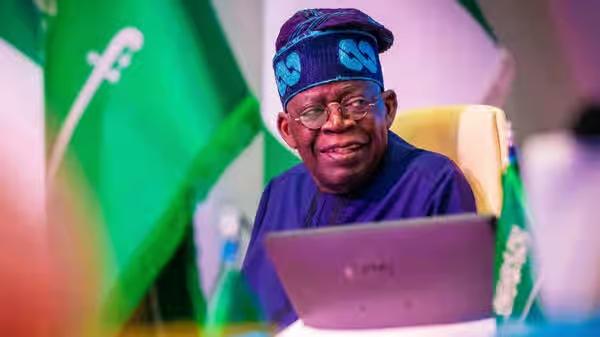
The Federal Government, states and local government councils have shared a total of ₦1.928 trillion as Federation Account revenue for November 2025.
The Federation Account Allocation Committee (FAAC) disclosed this in a statement after its December 2025 meeting held in Abuja.
The ₦1.928 trillion shared comprised ₦1.403 trillion in distributable statutory revenue, ₦485.838 billion from Value Added Tax (VAT), and ₦39.646 billion from the Electronic Money Transfer Levy (EMTL).
A FAAC communiqué revealed that total gross revenue available for November 2025 stood at ₦2.343 trillion.
From this amount, ₦84.251 billion was deducted as the cost of collection, while ₦330.625 billion went to transfers, interventions, refunds and savings.
The communiqué stated that gross statutory revenue for November 2025 amounted to ₦1.736 trillion. This figure represented a decline of ₦427.969 billion compared with the ₦2.164 trillion recorded in October 2025.
VAT generated a gross revenue of ₦563.042 billion in November 2025. This was ₦156.785 billion lower than the ₦719.827 billion recorded in October 2025.
According to the communiqué, of the total ₦1.928 trillion distributable revenue, the Federal Government received ₦747.159 billion. State governments received a total allocation of ₦601.731 billion, Local government councils were allocated ₦445.266 billion.
In addition, ₦134.355 billion, representing 13 per cent of mineral revenue, was shared among beneficiary states as derivation revenue.
From the ₦1.403 trillion distributable statutory revenue, the Federal Government received ₦668.336 billion.
States received ₦338.989 billion from the statutory revenue allocation.
Local government councils got ₦261.346 billion, while ₦134.355 billion was distributed to beneficiary states as derivation revenue.
Out of the ₦485.838 billion distributable VAT revenue, the Federal Government received ₦72.876 billion.
State governments received ₦242.919 billion from VAT proceeds. Local government councils were allocated ₦170.043 billion from VAT revenue.
From the ₦39.646 billion EMTL revenue, the Federal Government received ₦5.947 billion. State governments received ₦19.823 billion, while local government councils got ₦13.876 billion.
The communiqué further noted that excise duty recorded a moderate increase in November 2025.
However, Petroleum Profit Tax (PPT), Hydrocarbon Tax (HT), CIT on upstream activities, Companies Income Tax (CIT), Capital Gains Tax (CGT), Stamp Duties Tax (SDT), oil and gas royalties, import duty, CET levies, VAT, EMTL and fees experienced significant declines.
The Central Bank of Nigeria (CBN) has withdrawn the operating licences of two mortgage banks.
The apex bank explained that the move is part of renewed efforts to clean up the mortgage sub-sector and ensure strict adherence to banking laws and regulatory standards.
The two banks affected are Aso Savings and Loans Plc and Union Homes Savings and Loans Plc.
According to the CBN, the action was taken under the powers granted by Section 12 of the Banks and Other Financial Institutions Act (BOFIA) 2020 and Section 7.3 of the Revised Guidelines for Mortgage Banks in Nigeria.
In a statement released on Tuesday, the Acting Director of the Corporate Communications Department of the CBN, Hakama Sidi Ali (Mrs.), said the decision followed repeated regulatory violations by the affected institutions, which weakened their stability and ability to meet obligations to depositors and other stakeholders.
The CBN disclosed that both mortgage banks failed to meet the minimum paid-up share capital required for their licence categories.
The regulator also found that the institutions lacked sufficient assets to cover their liabilities, raising serious concerns about their solvency.
The statement further revealed that the banks were critically undercapitalised, with capital adequacy ratios below the prudential minimum set by the CBN.
In addition, the institutions were found to have disregarded several regulatory directives and obligations issued by the apex bank over time.
“The affected institutions violated various provisions of BOFIA 2020 and the Revised Guidelines for Mortgage Banks in Nigeria,” Sidi Ali said. “These include failure to meet the minimum paid-up share capital requirement, having insufficient assets to meet liabilities, being critically undercapitalised with capital adequacy ratios below the prescribed prudential minimum, and non-compliance with several regulatory directives.”
The CBN stated that the licence revocations form part of a broader strategy to reposition the mortgage banking segment, boost confidence in the sector and ensure that only institutions capable of operating safely and soundly remain in the system.
Sidi Ali said the apex bank remains firm in enforcing regulatory standards across all areas of the financial system in line with its statutory responsibilities. “The Central Bank of Nigeria remains committed to its core mandate of ensuring financial system stability,” she stated.
In recent years, the CBN has repeatedly cautioned operators in the mortgage sub-sector to strengthen their capital base, enhance governance and fully comply with regulatory requirements, warning that failure to do so would result in decisive supervisory action.
Barring any last-minute changes, MRS Oil and other partners of the Dangote Petroleum Refinery are set to begin selling petrol at ₦739 per litre from Tuesday, following a major reduction in the refinery’s ex-depot price.
The Dangote Petroleum Refinery recently slashed its gantry price for Premium Motor Spirit (PMS) from ₦828 to ₦699 per litre.
Speaking at a press briefing at the Lekki refinery on Sunday, President of the Dangote Group, Alhaji Aliko Dangote, said the price cut was aimed at ensuring Nigerians benefit from locally refined fuel.
Dangote disclosed that MRS filling stations would be the first to reflect the new pump price in Lagos, with other partner stations expected to follow nationwide.
He expressed concern that despite reductions at the depot level, some filling stations deliberately keep pump prices high, frustrating efforts to ease the burden on consumers.
According to him, reports indicated that some marketers had been encouraged by certain officials to maintain high prices.
Dangote said the refinery would resist such moves and enforce the new pricing regime, stressing that petrol selling at ₦970 per litre would soon be a thing of the past.
He explained that marketers willing to lift products directly from the refinery could purchase petrol at ₦699 per litre, noting that the minimum purchase requirement had been reduced from two million litres to 500,000 litres to accommodate more marketers, including members of the Independent Petroleum Marketers Association of Nigeria (IPMAN).
Dangote stated that the refinery would deploy its fleet of Compressed Natural Gas (CNG) trucks to support nationwide distribution and was ready to acquire more trucks beyond the initial 4,000 units if necessary.
He added that for December and January, petrol should not sell above ₦740 per litre anywhere in the country.
Questioning the justification for high pump prices, Dangote said the cost of transporting petrol within Lagos is between ₦10 and ₦15 per litre, bringing the total cost to about ₦715. He wondered why petrol would then be sold for as much as ₦900 per litre.
He also accused the Nigerian Midstream and Downstream Petroleum Regulatory Authority (NMDPRA) of issuing 47 import licences covering over seven billion litres of petrol for the first quarter of 2026, despite the refinery’s capacity to meet local demand.
According to him, continued fuel importation is undermining local refining and pushing modular refineries toward collapse.
Dangote insisted that the refinery is not a monopoly, noting that no operator is barred from building refineries or acquiring existing ones. He said the refinery was established primarily for Nigerians’ benefit, even if it means operating at reduced margins.
Highlighting product quality, Dangote said petrol supplied from his refinery is straight-run fuel, unlike blended imported products. He added that Nigerians now have the option of buying better-quality fuel at a lower price.
The refinery is also offering a 10-day credit facility to marketers to improve liquidity and widen participation.
Currently, the facility produces about 70 million litres of refined products daily, including 45 million litres of petrol and 25 million litres of diesel—exceeding Nigeria’s estimated daily fuel consumption.
Dangote further revealed plans to list the refinery on the Nigerian Exchange, allowing Nigerians to own shares in the facility.
Discussions are ongoing with the Securities and Exchange Commission to enable share purchases in naira, with dividends paid in dollars.
The latest price reduction, which took effect on December 11, 2025, marks the 20th petrol price adjustment by the refinery this year, reinforcing its growing influence on Nigeria’s downstream petroleum market.
Australian police say the deadly shooting at a Hanukkah gathering in Sydney’s Bondi Beach was carried out by two men who were influenced by the extremist group ISIL.
Authorities confirmed that the attack, which claimed the lives of 15 people, is being treated as an act of terrorism. Investigators are also looking into a recent overseas trip taken by the suspects to the Philippines as part of efforts to establish the full scope of their actions and possible links.
Australian Federal Police Commissioner Krissy Barrett said preliminary findings suggest the incident was ideologically motivated, describing it as an attack inspired by Islamic State thinking. She emphasized that the case should not be linked to any faith, but rather to individuals who had embraced violent extremist beliefs.
Police identified one of the suspects as 50-year-old Sajid Akram, who was killed by officers responding to the scene. His 24-year-old son, reported by local media to be Naveed Akram, was also shot and remains in critical condition in hospital.
Investigators said the two men fired indiscriminately at a large crowd gathered for the beachside celebration. The shooting unfolded over roughly 10 minutes, triggering panic at one of the country’s busiest and most well-known public locations.
Security officials disclosed that items found in the attackers’ vehicle included homemade ISIL flags and an improvised explosive device. The discovery has intensified scrutiny of the suspects’ recent movements, including their trip to the Philippines, the purpose of which has yet to be determined.
Police said they are still working to establish where the men travelled during that visit and whether it had any connection to extremist networks. Authorities in the Philippines are also conducting parallel investigations.
Armed groups aligned with ISIL have previously operated in parts of southern Philippines, particularly on Mindanao island. Although their influence has declined significantly, remnants of these groups are believed to remain active in smaller formations.
Their presence is far weaker than during the 2017 siege of Marawi, when ISIL-linked fighters took control of the city, leading to months of fighting that left more than 1,000 people dead.
The Bondi Beach shooting is the deadliest mass gun attack recorded in Australia in almost three decades. In addition to those killed, about 25 people were wounded, several of them sustaining life-threatening injuries.
On Tuesday, the Senate moved to safeguard Nigerian farmers from plunging produce prices and rising input costs, calling on the Federal Government to subsidise fertilisers and reinstate commodity boards to stabilise agricultural markets.
The resolutions followed a motion by Senator Mohammed Danjuma Goje (Gombe Central), which highlighted the growing gap between declining farm-gate prices and persistently high costs of inputs such as fertilisers, pesticides, and insecticides. Goje warned that this widening disparity threatens the livelihoods of millions of farmers across the country.
While acknowledging the government’s efforts to lower consumer food prices through import waivers and special import permissions, Goje pointed out a significant unintended consequence: cheaper imports have depressed domestic produce prices, squeezing farmers’ profits and causing substantial post-harvest losses.
Lawmakers emphasized that continued declines in farm-gate prices could discourage farmers from planting in future seasons, weakening domestic food production and rural economies. They also cautioned that excessive reliance on imported food could undermine Nigeria’s food sovereignty and expose the economy to global price shocks.
To tackle these issues, the Senate called for an emergency intervention package to support affected farmers, the establishment of benchmark minimum prices for key commodities, and a guaranteed off-take programme in which public agencies would purchase produce at agreed rates.
The resolutions additionally recommended investment in storage facilities, irrigation systems, processing centres, and rural roads, while enhancing coordination among ministries, state governments, commodity boards, and cooperatives to ensure fair pricing, efficient transport, and improved market access.
Senators also proposed a review of import waiver policies to enable local produce to compete fairly with imported goods, thereby safeguarding the sustainability of Nigeria’s agricultural sector.
In a separate development, the Senate on Tuesday approved the nomination of three ambassadorial nominees—Ayodele Oke, Colonel Kayode Are (rtd), and Amin Dalhatu—for appointment as envoys.
The approval followed the consideration and adoption of a report by the Senate Committee on Foreign Affairs, presented during plenary by its chairman, Senator Abubakar Sani Bello.
Oke, a former Director-General of the National Intelligence Agency (NIA) and ex-Nigerian Ambassador to the Commonwealth Secretariat in London; Are, a former Director-General of the Department of State Services (DSS); and Dalhatu, Nigeria’s immediate past Ambassador to South Korea, were unanimously endorsed by lawmakers after Senate President Godswill Akpabio put their nominations to a voice vote.
In his remarks, Akpabio urged the ambassadors-designate to draw on their extensive experience in performing their diplomatic responsibilities.
American armed forces say they launched attacks on three boats in the Pacific Ocean that they allege were being used for drug smuggling, resulting in the deaths of eight people.
According to the military, video evidence of the operations was shared online, with officials stating that the boats were “transiting along known narco-trafficking routes… and were engaged in narco-trafficking”.
These incidents are part of a broader series of maritime strikes carried out across the Pacific and Caribbean in recent months. More than 20 vessels have been hit, and at least 90 people have been killed as President Donald Trump intensifies efforts against groups he claims are moving narcotics through the region.
Critics and analysts have warned that such actions may breach international rules that regulate the conduct of armed conflict.
Particular attention has focused on the first US operation on 2 September, during which two separate strikes were carried out, with those who survived the initial attack later killed in a second one.
Multiple legal specialists have argued that this follow-up strike on a boat alleged to be linked to Venezuela was likely unlawful and could be classified under international law as an extrajudicial killing.
Earlier, a former international war crimes prosecutor said the broader military effort amounted to a deliberate and organised assault on civilians outside a wartime context.
The White House rejected those claims, insisting the actions complied with the laws of armed conflict and were necessary to defend the country from cartels “trying to bring poison to our shores… destroying American lives”.
US Defence Secretary Pete Hegseth is expected to brief lawmakers from both chambers of Congress on Tuesday, alongside Secretary of State Marco Rubio.
Officials familiar with the plans said members of the House and Senate armed services committees are due to be shown footage of the disputed “double-tap” operation later this week, amid growing calls for the video to be released publicly.
At the same time, the administration has stepped up accusations that Venezuela is helping channel illegal drugs into the United States, increasing diplomatic and economic pressure on President Nicolás Maduro.
Two Venezuelan criminal networks, Tren de Aragua and Cartel de los Soles, have been formally labelled foreign terrorist organisations.
In support of this posture, thousands of US troops and the USS Gerald Ford, the world’s largest aircraft carrier, have been deployed within operational range of Venezuela.
On 10 December, American forces also intercepted an oil tanker near the Venezuelan coastline, alleging it was part of an “illicit oil shipping network supporting foreign terrorist organisations” by moving sanctioned crude from Venezuela and Iran.
Venezuela’s foreign minister, Yván Gil, condemned the action as “international piracy” and accused Trump of seeking control over the country’s extensive oil wealth.
As part of the administration’s broader strategy to curb drug inflows, Trump has formally classified fentanyl — the substance most closely linked to fatal overdoses in the US — as a “weapon of mass destruction”.
The Nigeria Police Force has announced plans to recommence nationwide enforcement of the tinted glass permit policy from January 2, 2026, attributing the move to rising security threats associated with the abuse of unauthorised tinted vehicle glass.
This was disclosed in a statement released on Monday by the Force Public Relations Officer, Chief Superintendent of Police Benjamin Hundeyin.
According to the police, the decision followed an assessment of evolving security challenges and the need to strengthen public safety, while awaiting the final outcome of a related case currently before the court.
The Force clarified that no court order exists preventing it from enforcing the law regulating the use of tinted glass on vehicles.
It explained that the earlier suspension of enforcement was done in the interest of transparency and public convenience, giving motorists ample time to regularise their documents and complete the permit application process without undue pressure.
The statement noted that recent security patterns have shown an increase in criminal activities involving vehicles fitted with unauthorised tinted glass.
The police said such vehicles are often used by criminals to hide their identities while carrying out crimes such as armed robbery, kidnapping, and other violent offences.
In light of these developments, the Force said resuming enforcement has become both necessary and urgent as a proactive measure to protect lives and property nationwide.
“Recent trends, however, reveal a disturbing rise in criminal activities perpetrated with the aid of vehicles fitted with unauthorised tinted glass.
“Some individuals and organised criminal groups have exploited this gap to conceal their identities and facilitate crimes ranging from armed robbery to kidnapping and other violent crimes.
“In view of this, the Nigeria Police Force has found it both necessary and urgent to resume full enforcement as a proactive measure to safeguard our communities. Consequently, enforcement of Tinted Glass Permit will resume on 2nd January, 2026,” the statement read.
In what will surely go down as one of the most entertaining Premier League nights in the season, Manchester United and Bournemouth served up an absolute goal-fest at Old Trafford on Monday. Neither side was willing to give an inch in a match that saw eight goals, attacking intent from minute one, and a roller-coaster of emotions for fans.
United struck first just after the quarter-hour mark through Amad Diallo’s header, and it seemed like the hosts were in control early on. But Bournemouth hit right back before half-time through Antoine Semenyo, keeping the score pegged at 1-1 heading into the break.
The second half was even crazier:
Bournemouth struck twice in quick succession through Evanilson and Marcus Tavernier to go 3-2 up.
Manchester United refused to lie down, with Bruno Fernandes curling in a stunning free kick, followed two minutes later by Matheus Cunha, to swing the lead back to the Red Devils.
Just when United fans thought the three points were theirs, 19-year-old Eli Junior Kroupi popped up in the 84th minute to make it 4-4 and secure a point for the visitors.
The result means United drop valuable points in the chase for the top four, while Bournemouth will take huge pride from a performance that stunned fans and pundits alike
Highest-Scoring Premier League Matches (2020–2025)
The Premier League has never been short of drama, but the last five years have produced an unusual surge in goal-heavy encounters — matches where defending collapsed, tactics unravelled, and attackers ran riot. From historic thrashings to breathless comebacks, these games redefined entertainment in English football.
Aston Villa 7–2 Liverpool (2020) — 9 Goals
Few results shocked the football world like this one. Reigning champions Liverpool arrived at Villa Park expecting routine business, only to be torn apart by relentless Villa counter-attacks. Ollie Watkins scored a stunning hat-trick, while Jack Grealish ran the show in one of the most memorable individual performances of the modern Premier League era. It wasn’t just a defeat — it was a reality check for Jurgen Klopp’s side.
Manchester United 9–0 Southampton (2021) — 9 Goals
Old Trafford witnessed Premier League history as United equalled the league’s biggest ever win. Southampton were reduced to ten men inside two minutes and later nine, and United showed no mercy. The scoreline highlighted the league’s brutal nature — one bad night can turn into a catastrophe. For United, it was dominance. For Southampton, a night to forget.
Manchester City 6–3 Manchester United (2022) — 9 Goals
The Manchester derby exploded into life as Erling Haaland and Phil Foden both scored hat-tricks. City were so dominant that the match felt over by half-time, with Pep Guardiola’s side slicing through United’s defence at will. Although United pulled back a few consolation goals late on, the scoreline reflected City’s superiority and attacking ruthlessness.
Newcastle United 8–0 Sheffield United (2023) — 8 Goals
This was not just a win, it was a statement of Newcastle’s rise under new ownership. Eight different players scored, making it one of the most extraordinary team performances in league history. Sheffield United simply collapsed under relentless pressure, as Newcastle recorded the biggest away win the Premier League has ever seen.
Chelsea 4–4 Manchester City (2023) — 8 Goals
Chelsea twice came from behind against the defending champions, with Cole Palmer converting a dramatic late penalty to seal a thrilling draw. The match had everything: tactical battles, individual brilliance, controversy, and late drama, and it remains one of the finest adverts for Premier League football.
Tottenham Hotspur 6–2 Manchester United (2020) — 8 Goals
A chaotic match defined by defensive collapse and tactical confusion. United were reduced to ten men early, and Spurs, inspired by Son Heung-min and Harry Kane, exploited every weakness. It was a result that intensified pressure on United’s manager at the time and highlighted Spurs’ devastating attacking potential.
Liverpool 7–0 Manchester United (2023) — 7 Goals
Anfield hosted one of the most humiliating defeats in Manchester United’s history. Liverpool scored seven unanswered goals, with Mohamed Salah becoming the club’s all-time leading Premier League scorer. Despite not reaching eight or nine goals total, the magnitude and dominance of the win earn it a place among the league’s most brutal high-scoring encounters.
Arsenal 4–3 Luton Town (2023) — 7 Goals
A reminder that high-scoring games are not only about heavyweights. Luton stunned Arsenal with their resilience, but the Gunners showed title-winning mentality by snatching a last-minute winner. It was end-to-end, emotional, and showcased the Premier League’s competitive depth.
Manchester United 4–4 AFC Bournemouth (2025) — 8 Goals
Played on 15 December 2025, this match had constant momentum swings, late goals, and youthful brilliance. Bournemouth’s refusal to give up and United’s defensive fragility combined to produce a match that instantly joined Premier League folklore.
Why These Games Matter
High-scoring matches are more than just numbers; they define seasons. From title races to relegation battles, games with seven, eight, or nine goals often include stunning comebacks, tactical battles, and moments that live long in Premier League folklore.
The 4–4 draw between United and Bournemouth will be remembered not just for its goals, but for the emotions, ebb and flow, and sheer entertainment, the kind of match that makes football the world’s game.
The Independent Corrupt Practices and Other Related Offences Commission (ICPC) has described 2025 as a defining year in Nigeria’s anti-corruption campaign, following unprecedented recoveries and expanded enforcement actions. In its 2025 annual report, the Commission announced the recovery of ₦37.44 billion and $2.353 million through asset seizures and forfeitures—one of the largest hauls in its history.
Speaking at the Commission’s End-of-Year Engagement, Send-Forth for Retiring Staff, and Annual Merit Awards Ceremony held in Abuja on December 14, ICPC Chairman, Dr. Musa Adamu Aliyu (SAN), said the achievements reflect renewed resolve across enforcement, prevention, and public enlightenment.
The Latest Report
According to the report, the ICPC investigated 263 cases in 2025, surpassing its annual target of 250. Out of these, 61 cases were filed in court, resulting in a conviction rate of 55.74 per cent.
Dr. Aliyu noted that the asset recoveries were driven largely by high-impact forfeitures, representing a significant increase from the over ₦20 billion recovered in 2024.
Last year’s recoveries also included proceeds from the auction of 23 forfeited assets valued at ₦1.87 billion.
Beyond enforcement, the Commission intensified its preventive work across the public sector. Preventive assessments were carried out in 344 Ministries, Departments, and Agencies (MDAs) using the Ethics and Integrity Compliance Scorecard.
In addition, the ICPC conducted 66 corruption-monitoring exercises, tracked 1,490 projects nationwide, and completed Systems Study and Corruption Risk Assessments in 12 MDAs to address structural weaknesses.
Public enlightenment remained a key focus, with 644 sensitisation programmes reaching more than 235,000 Nigerians and generating about 3.5 million digital engagements.
The Commission also established 86 Anti-Corruption Clubs and Vanguards, trained 2,707 participants at its Academy, and launched 15 collaborative initiatives with partners, while civil society organisations contributed 57 complementary engagements.
The High Profile convictions and ongoing probe
A major highlight of the 2025 report was the securing of high-profile convictions and the advancement of several landmark corruption cases.
Among the most prominent was the conviction of Professor Cyril Ndifon, former Dean of the Faculty of Law at the University of Calabar, who was sentenced to five years’ imprisonment for offences linked to sexual harassment and cyberbullying.
Dr. Aliyu described the judgment as a strong signal of the Commission’s determination to confront abuse of office in all sectors, including academia.
The report also detailed ongoing investigations and prosecutions involving several high-ranking public figures.
Former Minister of Petroleum Resources, Diezani Alison-Madueke, remains under investigation over alleged $20 billion fraud, with efforts continuing to forfeit assets traced to the United States, including luxury properties and a superyacht.
Former Central Bank Governor, Godwin Emefiele, is facing multiple corruption-related charges in courts in Lagos and Abuja, involving alleged unauthorised financial allocations running into billions of naira.
Other notable cases include the prosecution of former Minister of Power and Steel, Olu Agunloye, over the alleged $6 billion Mambilla Hydroelectric Power Project scam, and former Minister of Aviation, Hadi Sirika, who is facing graft-related allegations.
Several former governors—Yahaya Bello (Kogi), Darius Ishaku (Taraba), Theodore Orji (Abia), Willie Obiano (Anambra), and Abdulfatah Ahmed (Kwara), are also standing trial or under investigation for alleged large-scale fraud and money laundering involving tens of billions of naira.
In Plateau State, former Governor Jonah David Jang is reportedly wanted by the ICPC for allegedly evading interrogation over a ₦5.6 billion diversion case.
The report further revealed investigations involving military retirees, including Vice Admiral Usman Jibrin and former Brigadier General Ishaya Bauka Gangum, who are accused of diverting public funds through 92 alleged shell companies.
Many of these cases are being pursued alongside the Economic and Financial Crimes Commission (EFCC), reflecting a strategy focused on high-impact prosecutions.
Implications for Governance
The size of the funds recovered and the prominence of those facing investigation highlight a significant shift in governance and accountability in Nigeria.
Analysts note that these outcomes send a clear message that no public office is beyond scrutiny, irrespective of rank, influence, or sector.
The successful prosecution of senior officials and professionals reflects a declining tolerance for impunity and is likely to discourage abuse of office, particularly within the public service.
However, the report also highlights the depth of systemic corruption, particularly in sectors involving large public expenditures such as energy, infrastructure, finance, and defence.
While recoveries strengthen public finances, experts note that corruption prevention remains critical, as funds lost to graft often translate into delayed projects, poor service delivery, and weakened public confidence in institutions.
Civil society groups have welcomed the increased transparency reflected in the report, but stress that sustained convictions, timely trials, and consistent asset recovery are essential to restoring trust and ensuring long-term impact.
The Way Forward
Looking ahead to 2026, the ICPC says it will deepen its focus on prevention, institutional reforms, and strategic partnerships. Dr. Aliyu urged staff to uphold ethical conduct, professionalism, and unity of purpose, while calling for stronger inter-agency collaboration to fast-track prosecutions and asset forfeiture processes.
Stakeholders have also called for enhanced judicial efficiency, improved whistleblower protection, and expanded use of technology in tracking public spending.
Strengthening public awareness, particularly at the grassroots level, is expected to remain central to the Commission’s strategy, alongside continuous engagement with MDAs to close corruption-prone loopholes.
Amid Nigeria’s ongoing challenges with corruption, the 2025 ICPC report highlights progress while reminding that sustained political will, independent institutions, and active citizen involvement remain crucial in the fight against graft.
President Bola Tinubu has sanctioned a major boost to the Code of Conduct Bureau’s budget, elevating it from approximately ₦3 billion to close to ₦20 billion.
Dr. Abubakar Bello, Chairman of the Code of Conduct Bureau, shared this development during an interview with the News Agency of Nigeria on Sunday in Abuja.
Bello explained that the funding hike aims to modernize the country’s obsolete asset declaration process, enhance verification mechanisms, and improve enforcement capabilities, thereby increasing the bureau’s overall efficiency.
He stated that the additional resources are essential for financing technological advancements, upgrading the bureau’s operational facilities, bolstering verification procedures, and expanding enforcement abilities.
The CCB chairman reflected that upon taking office, he found the asset declaration process was predominantly manual, dependent on physical paper forms that were in short supply, costly to produce, and challenging to store, analyze, and verify.
He pointed out that public servants from various ministries, departments, and agencies frequently demanded tens of thousands of forms, which the bureau was unable to supply.
According to him, the situation was worsened by the fact that the 2025 budget made provision of only about ₦70 million for printing forms.He said the amount could only produce about 50,000 to 60,000 forms for more than 4.5 million public servants nationwide.
To tackle this issue, Bello noted that the bureau implemented a provisional solution modeled after Kenya’s approach, by making asset declaration forms available for download on its website.
However, he emphasized that this method merely resolved the issue of accessibility and did not address the fundamental limitations of a primarily manual process.
Bello announced that the bureau has progressed significantly in creating a comprehensive online asset declaration system, after thorough discussions with relevant parties.
He mentioned that the platform, anticipated to launch in the first quarter of 2026, will enable public servants to submit their asset declarations remotely from any location worldwide.
The CCB chairman described the digital platform as a “game changer” because it would be linked directly to key databases.
According to him, the platform would be linked to the Corporate Affairs Commission, Federal Inland Revenue Service, Bank Verification Number system, land registries and other government records to enable instant verification.
He further stated that artificial intelligence will be utilized to examine asset declarations and assess changes in net worth between the start and end of a public servant’s term in office.
The AI platform, according to him, would flag unexplained wealth or possible breaches of the Code of Conduct for further review.
Within these ongoing reforms, Bello indicated that the bureau has started summoning ministers, permanent secretaries, and other high-ranking officials for asset verification, emphasizing that “verification is not investigation.”
He revealed that the Attorney-General of the Federation and Minister of Justice, Lateef Fagbemi, personally appeared to verify his assets, sending what he described as a strong signal of leadership by example.
The CCB chairman reported that the verification exercises have resulted in interim forfeiture orders for instances where public servants either omitted asset declarations or failed to justify their origins, encompassing properties both domestically and abroad.
According to him, some recovered funds had already been transferred to the Central Bank of Nigeria.
He cautioned public servants that non-declaration of assets or ignoring verification summons may lead to probes and potential trials at the Code of Conduct Tribunal.
Bello encouraged adherence to the bureau’s core motto, “Declare or Forfeit.”
To provide the best experiences, we use technologies like cookies to store and/or access device information. Consenting to these technologies will allow us to process data such as browsing behaviour or unique IDs on this site. Not consenting or withdrawing consent, may adversely affect certain features and functions.
Functional
Always active
The technical storage or access is strictly necessary for the legitimate purpose of enabling the use of a specific service explicitly requested by the subscriber or user, or for the sole purpose of carrying out the transmission of a communication over an electronic communications network.
Preferences
The technical storage or access is necessary for the legitimate purpose of storing preferences that are not requested by the subscriber or user.
Statistics
The technical storage or access that is used exclusively for statistical purposes.The technical storage or access that is used exclusively for anonymous statistical purposes. Without a subpoena, voluntary compliance on the part of your Internet Service Provider, or additional records from a third party, information stored or retrieved for this purpose alone cannot usually be used to identify you.
Marketing
The technical storage or access is required to create user profiles to send advertising, or to track the user on a website or across several websites for similar marketing purposes.