At least eight people have been killed and 275 others injured after powerful thunderstorms, tornadoes and strong winds swept through parts of central China, while heavy rainfall and flooding claimed two additional lives in the country’s south.
According to Chinese state media on Tuesday, several areas in Hubei Province were hit by what authorities described as “severe convective weather” on Monday.
State broadcaster CCTV reported that “thunderstorms and strong winds swept” through cities including Huangshi and Huanggang, leaving eight people dead.
Authorities also confirmed that tornadoes were recorded in some affected areas, while one person remains missing.
The state-run Xinhua News Agency reported that the “severe weather” left 275 people injured in Huangzhou District of Huanggang as of Tuesday morning, although details about the severity of the injuries were not disclosed.
Emergency officials also evacuated 408 residents to safer locations as rescue operations continued.
“Rescue and relief efforts are underway,” Xinhua reported.
Meanwhile, in southern China’s Guangxi region, heavy rainfall triggered by Typhoon Maysak caused severe flooding that killed at least two people and forced authorities to evacuate more than 48,000 residents by Monday evening.
In the regional capital, Nanning, officials raised the flood emergency response to its highest level after torrential rains caused water levels to rise dangerously and breached dam structures.
Footage aired by CCTV showed muddy floodwaters rushing through a collapsed reservoir wall after the dam gave way under intense pressure.
Floodwaters also submerged homes, vehicles and other infrastructure across several communities.
Rescue teams wearing life jackets and helmets were deployed to the affected areas, with some navigating flooded communities in inflatable boats while searching for stranded residents.
Climate experts have repeatedly warned that global warming is increasing both the frequency and intensity of extreme weather events worldwide as greenhouse gas emissions continue to rise.
Although China remains the world’s largest emitter of greenhouse gases, it has also become one of the world’s leading investors in renewable energy and has pledged to achieve carbon neutrality by 2060.
The Trump administration is once again offering African countries hundreds of millions of dollars to strengthen their healthcare systems and combat disease, following last year’s dismantling of the main US foreign aid agency, USAID. But this new wave of funding comes with strings attached, and several governments are pushing back.
Kenya’s President William Ruto signed the first of these agreements in Washington last December, a $2.5 billion deal that Secretary of State Marco Rubio hoped would become a template for dozens more across the continent. Even that flagship deal faced delays after activists took legal action to block it over privacy concerns, though it was eventually approved by Kenyan cabinet ministers.
Trump ordered USAID’s closure shortly after taking office, citing wastefulness, a move that gutted health programs across Africa that had depended on US funding. The State Department’s new approach requires partner governments to increase their own health spending, aiming to build self-sufficient systems rather than reliance on foreign aid. In Kenya’s case, the US is contributing $1.6 billion while Kenya commits $850 million over five years.
Rubio has argued this model avoids the pitfalls of the old NGO-based aid system, which he says fostered dependency and wasted money on overhead. He’s framed the new deals as helping countries build lasting capacity rather than simply handing out money.
This marks a broader shift away from coordinated global health efforts through the World Health Organization toward individual agreements tied directly to US strategic and business interests. The US exited the WHO earlier this year, criticizing funding imbalances and the organization’s handling of Covid-19. Notably, the bilateral deals include commitments to favor American pharmaceutical companies in developing and supplying treatments — something US policy documents describe explicitly as a strategic tool for advancing bilateral interests, not simply charity.
By mid-May, 32 countries had signed on, including roughly 20 in Africa. But Ghana, Zimbabwe, and Zambia have all declined, each citing different concerns.
Zambia’s Foreign Minister Mulambo Haimbe said the US tried to bundle the health agreement with a separate deal granting America access to critical minerals, insisting the two should be negotiated independently. The State Department didn’t directly deny the linkage but reaffirmed that US aid functions as strategic investment tied to American interests, expecting partner nations to prioritize US priorities in return.
Further underscoring this approach, the US recently announced a full withdrawal from HIV/AIDS funding in South Africa, which an administration official linked to Pretoria’s failure to act on certain policy demands — including issues related to the country’s Afrikaner minority, tied to widely disputed claims of a “white genocide.”
For other nations, the sticking point has been data. The agreements require sharing patient information and biological samples, including disease-causing pathogens. Kenya’s courts initially paused its deal over patient privacy concerns. Ghana’s Data Protection Commission said it objected to the scope of data required without any reciprocal protections once that information left Ghanaian control. Zimbabwe raised similar objections, worried that any resulting vaccines or treatments developed from shared data wouldn’t necessarily be made available to its own citizens — noting the WHO already has systems in place for equitable data-sharing.
The US maintains this exchange is essential for scientific progress and says the data involved is the same de-identified information that’s long been used to fight infectious disease. But experts note the political context has shifted. One global health governance researcher observed that earlier unequal arrangements could at least be framed publicly as altruistic, whereas today’s deals are far more transactional. Africa’s experience during Covid — where pathogen data helped produce vaccines the continent then struggled to access — has made many governments more cautious this time. Civil society groups, along with South Africa’s health minister, have warned that the US terms don’t reflect African interests, with Pretoria’s health minister bluntly saying no self-respecting nation should agree to share pathogen data for research while receiving only short-term funding in return.
The debate has taken on new urgency amid a fresh Ebola outbreak in the Democratic Republic of Congo. DR Congo was among the first nations to accept a US health deal, and Washington says the arrangement is helping coordinate the country’s outbreak response. But aid workers and former US officials argue that earlier funding cuts to both DR Congo and the WHO weakened frontline readiness. Care’s country director in DR Congo said he was forced to lay off a third of his staff due to USAID cuts, eliminating community health education and outbreak-prevention teams — leaving the country without prepositioned supplies when the outbreak began and costing roughly ten critical days in response time. A former USAID Ebola response leader argued the earlier, more robust aid network likely would have caught the outbreak sooner.
The US disputes that its cuts hurt the response, saying the current approach is more efficient and pointing to $270 million already donated toward the outbreak.
Critics, however, argue the Ebola crisis illustrates the danger of abandoning coordinated global health strategy altogether, since infectious disease doesn’t respect borders and requires collective international action. Still, some analysts have urged patience with the new approach, suggesting it represents a legitimate test of whether targeted, condition-based partnerships can outperform reliance on an international body many see as slow to reform.
So far, adoption remains uneven — Tanzania recently joined the program, but with multiple nations declining, the ultimate reach of Washington’s revamped health strategy remains uncertain.
Kylian Mbappe has hit back at a Paraguayan senator, calling her “despicable” and unfit for public office after she posted racist comments targeting his background and education following France’s last-16 win over Paraguay.
Celeste Amarilla, a member of Paraguay’s Liberal Radical Party, made the remarks on X in the aftermath of her country’s World Cup elimination. Mbappe didn’t hold back in his response, saying Amarilla failed to represent the passion and honor Paraguay’s players had shown throughout the tournament. He argued her comments overshadowed the historic run of Paraguay’s squad and vowed not to let people like her spread hatred unchecked.
The French Football Federation (FFF) announced it will pursue criminal charges, calling the comments abhorrent and stating that such remarks must face prosecution. The federation emphasized that the insult extended beyond the players to France itself.
Paraguay’s government distanced itself from Amarilla’s statements, saying they contradict the values of respect and peaceful coexistence the country promotes.
On-Field Heroics Amid Off-Field Controversy
Mbappe scored the winning penalty in the second half of Saturday’s match, sending France through to face Morocco in the quarter-finals in Boston. The goal also pushed his tournament tally to seven, tying him with Lionel Messi and Erling Haaland for the Golden Boot race.
French President Emmanuel Macron voiced his support, framing Mbappe’s response as a symbolic victory against racism, standing alongside the values of dignity and unity.
Second Incident Involving Paraguayan Football Figure
Amarilla’s comments came shortly after former Paraguay goalkeeper Jose Luis Chilavert made his own controversial remark ahead of the match, describing France’s team dismissively in a way that referenced their African heritage. FFF president Philippe Diallo condemned Chilavert as well, saying his statement betrayed the principles of respect and diversity in football and tarnished his legacy as a former top-level goalkeeper.
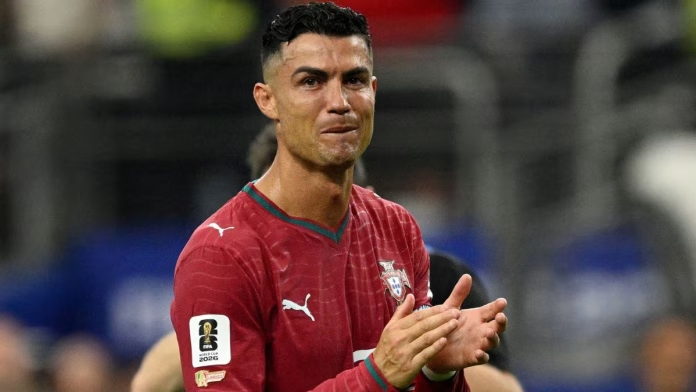
Cristiano Ronaldo’s long pursuit of a World Cup title has come to a close after Portugal fell 1-0 to Spain in the last 16, with Mikel Merino netting a stoppage-time winner in Dallas. The 41-year-old forward was visibly emotional as the final whistle confirmed Portugal’s exit.
Ronaldo, a five-time Ballon d’Or winner and five-time Champions League champion, holds the record for most career goals in football history. He has now featured in a record six World Cups, but his best result remains reaching the semi-finals back in 2006. He had already confirmed this would be his last World Cup appearance, though he stopped short of announcing international retirement, saying he’d discuss his future with family first.
Debate has intensified over whether manager Roberto Martinez should have continued starting Ronaldo throughout the tournament. BBC pundit Chris Sutton was particularly scathing, accusing Martinez of favoritism toward the veteran star and suggesting Ronaldo’s declining mobility contributed directly to Portugal’s early exit.
Martinez, however, defended his approach, announcing his resignation after the match and describing Ronaldo as a footballing icon who deserved gratitude for his efforts at the tournament.
A Squad Full of Talent, Questions Over Selection
Portugal’s roster featured several Champions League winners from PSG’s recent title runs, Nuno Mendes, Vitinha, Joao Neves plus Manchester United’s Bruno Fernandes, the Premier League’s reigning Player of the Year. Critics questioned why striker Goncalo Ramos saw limited playing time given the depth of talent available.
Statistically, Ronaldo remained productive in front of goal finishing with three goals and 18 shots, more than all but four other players in the tournament. But his overall involvement dropped sharply elsewhere: he created just one chance for a teammate across five matches, and hundreds of players touched the ball more often than he did despite him playing almost every available minute.
Messi Comparisons Resurface
With Ronaldo’s World Cup story now finished without a title, comparisons to long-time rival Lionel Messi have resurfaced. Messi lifted the trophy in 2022 and currently sits as this tournament’s joint top scorer. Ronaldo’s former Manchester United teammate Wayne Rooney praised his legacy, acknowledging his disappointment but calling him one of the game’s true greats.
Ronaldo leaves the World Cup stage holding a few historic marks the only player to score in six different tournaments, and one of just two (alongside Messi) to appear in six. His 11 career World Cup goals place him ninth all-time.
Martinez Exits Following World Cup Failure
Martinez, who previously led Belgium to a World Cup semi-final in 2018 before a group-stage exit in 2022, took charge of Portugal in 2023 and won the Nations League last year. He confirmed his departure immediately after the loss to Spain, stating his contract had concluded and that continuing without achieving his stated goal of winning the World Cup didn’t make sense. Sutton was highly critical of Martinez’s overall tenure, arguing he failed to maximize the talent at his disposal with both Belgium and Portugal.
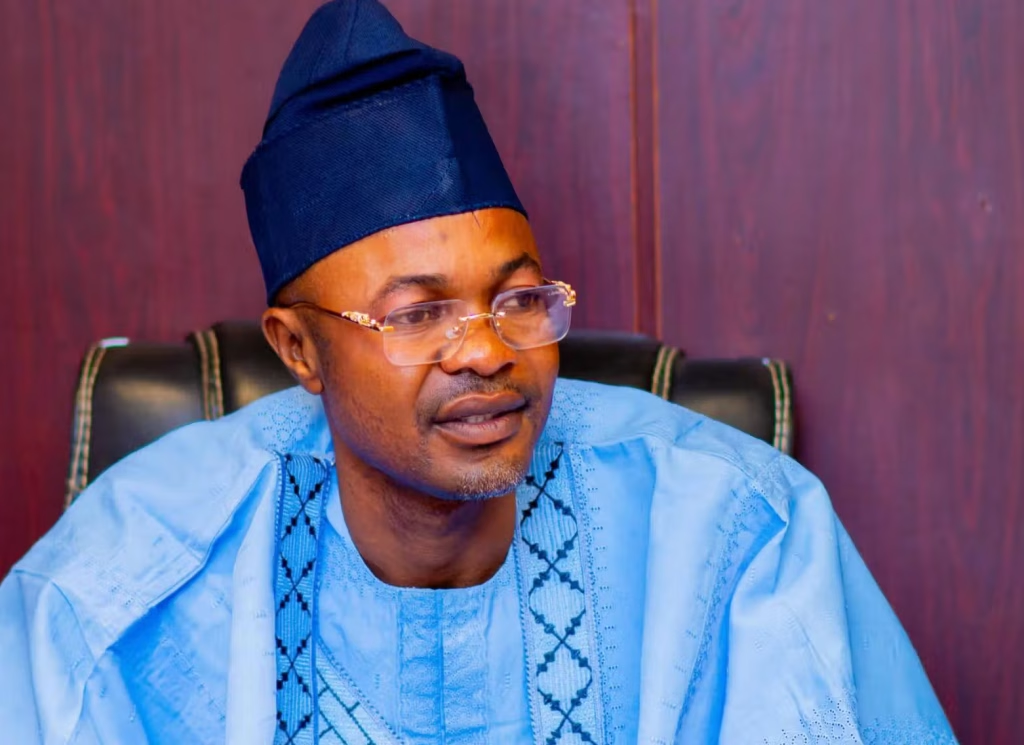
The Nigeria Police Force has arrested the father of Prince Adeniyi Adeyemi Matthew, the man at the centre of the alleged fake Presidential Foreign Intervention Promotion Council (PFIPC) scandal that has continued to generate controversy across the country.
The arrest, carried out on Monday at the family’s residence in Ogbomoso, Oyo State, has sparked concerns among legal practitioners and human rights advocates over the legality of detaining relatives of criminal suspects.
Senior Advocate of Nigeria (SAN), Femi Falana, confirmed the development, alleging that police officers stormed the residence and took Adeyemi’s father into custody. Falana argued that there was no legal justification for the arrest, especially as the suspect had already indicated his readiness to appear before the court.
The latest development comes as Adeyemi is standing trial before the Federal High Court in Abuja on charges bordering on conspiracy, forgery and impersonation.
The Federal Government alleges that Adeyemi falsely presented himself as the Director-General of the Presidential Foreign Intervention Promotion Council (PFIPC) and the Presidential Economic Advisory Council (PEAC), organisations it insists were never legally established.
The case has attracted renewed public attention following reports that the disputed council appeared in the 2026 Appropriation Act despite earlier statements by government officials disowning the organisation.
The revelation has raised fresh questions about how the alleged council was able to operate within government circles and reportedly obtain official recognition.
Investigators allege that Adeyemi used forged government documents to secure official privileges, including the opening of bank accounts and access to government facilities. Authorities maintain that the agencies he claimed to represent never existed under Nigerian law.
The arrest of Adeyemi’s father has further intensified the controversy, with legal experts questioning the action of the police.
The President of the Nigerian Bar Association (NBA), Afam Osigwe, alongside other legal practitioners, has maintained that Nigerian law does not permit the arrest or detention of family members solely to compel a suspect to surrender unless such relatives are directly linked to the alleged offence or are themselves under investigation.
As court proceedings continue, the controversy surrounding the alleged fake agency is expected to remain in the spotlight, with increasing calls for a thorough investigation into how the organisation allegedly operated and whether any public officials played a role in its activities.
The death toll from the devastating twin earthquakes that struck Venezuela has climbed to 3,535, while more than 16,700 people have been injured, according to updated figures released by authorities on Monday.
The powerful earthquakes, which struck on June 24, caused widespread destruction across La Guaira State, north of the capital, Caracas, reducing entire communities to rubble and leaving thousands of families displaced.
Government officials said 16,740 people sustained injuries during the disaster, while more than 17,000 residents have been left homeless.
Although authorities have yet to release an official figure for those still trapped or missing beneath the rubble, the United Nations estimates that as many as 50,000 people remain unaccounted for.
Thousands of survivors are currently taking shelter in temporary camps established on streets, public parks and parking lots as relief efforts continue.
Search and Recovery Operations Continue
As emergency operations transition from rescue efforts to recovery and rebuilding, several international search-and-rescue teams have begun concluding their missions and departing Venezuela.
Meanwhile, families continue searching for the remains of loved ones in hopes of giving them proper burials.
Authorities Begin Mass Burial of Unidentified Victims
On Sunday, officials commenced the burial of dozens of unidentified victims in a mass grave at La Esperanza Cemetery in La Guaira.
Rows of simple white crosses, each decorated with small bouquets, now mark the individual graves of those whose identities remain unknown.
Every grave bears the same date of death: June 24, 2026.
Adeniyi Adeyemi Matthew is at the centre of the controversy surrounding the alleged Presidential Foreign Intervention Promotion Council (PFIPC), one of Nigeria’s most unusual governance scandals in recent years. The Presidency has maintained that the council was never established by the Federal Government, despite Adeyemi publicly presenting himself as its Director-General.
Court documents, official correspondence and statements released by government agencies indicate that the alleged council interacted with several federal institutions, secured office accommodation, obtained a budget code, received provisional self-accounting status and even had requests processed by government agencies before questions emerged about its legitimacy.
The Presidency has accused Adeyemi of forging official documents and falsely presenting himself as the head of a federal agency. He has since been arraigned on multiple criminal charges, including forgery and impersonation. Adeyemi, however, has consistently denied the allegations, insisting he acted lawfully and would clear his name before the court.
As legal proceedings continue, the case has drawn national attention because of the number of government institutions that allegedly processed requests linked to the organisation before it was eventually disowned.
Who Is Prince Adeniyi Adeyemi Matthew?
Prince Adeniyi Adeyemi Matthew became known nationally after introducing himself as the Director-General of the Presidential Foreign Intervention Promotion Council (PFIPC), an organisation he claimed had presidential approval to promote foreign investment and coordinate international economic engagements on behalf of Nigeria.
Before the controversy became public, Adeyemi attended official meetings, interacted with diplomats, met senior government officials and represented the purported council at several engagements.
According to publicly available records, he held meetings with diplomatic missions and also interacted with senior officials, including the then Minister of Foreign Affairs, Yusuf Tuggar, Minister of State for Education, Suwaiba Ahmed, and the Chairman of the Economic and Financial Crimes Commission (EFCC), Ola Olukoyede.
His public activities eventually attracted scrutiny after the Ministry of Foreign Affairs sought clarification from the Presidency regarding his status.
How The Alleged PFIPC Gained Government Recognition
One of the biggest questions raised by the controversy is how an organisation the Presidency says never existed was able to process official requests through several federal institutions.
Available records show that government agencies acted on correspondence they believed originated from a legitimate federal agency.
Among the agencies that reportedly processed requests linked to the PFIPC were:
Office of the Secretary to the Government of the Federation (OSGF)
Office of the Accountant-General of the Federation (OAGF)
Central Bank of Nigeria (CBN)
According to official records, requests linked to the organisation included office accommodation, financial approvals, staff deployment and banking arrangements.
The developments have sparked wider conversations about document verification procedures within government institutions.
The Foreign Affairs Ministry Raised The Alarm
The controversy began to unravel in October 2025 after the Federal Ministry of Foreign Affairs requested clarification regarding Adeyemi’s status.
The ministry’s request followed his meeting with members of the diplomatic community without the involvement of the ministry.
The ministry stated:
“It should be noted that this act contravenes extant rules and regulations guiding diplomatic practices globally.”
It further added:
“Consequently,y it has become necessary to seek clarification on the status of Prince Adeyemi to enable the ministry to appropriately respond to some diplomatic missions requesting information on the council and the Director-General, following the receipt of the invitation extended to the members of the diplomatic community.”
The request prompted an official response from the Office of the Chief of Staff to the President.
Presidency Disowns The PFIPC
Responding to the enquiry, Chief of Staff Femi Gbajabiamila informed the Ministry of Foreign Affairs that the council being referenced was not recognised by the Presidency.
He wrote:
“In future, it is advised that any letter supposedly issued by the Chief of Staff to the President should be cleared from this Office before further action is taken.”
Following the response, security agencies commenced investigations into the activities surrounding the organisation.
Questions Over The Appointment Letter
A major aspect of the investigation concerns an appointment letter dated March 8, 2024, which allegedly conveyed Adeyemi’s appointment as Director-General.
The letter reportedly stated:
“His Excellency, as well as the good people of Nigeria, expects that you will discharge your duties with absolute loyalty, dedication and diligence.”
The Presidency has maintained that the appointment was never approved and has alleged that the document was forged.
Government officials also stated that presidential appointment letters are ordinarily issued through the Office of the Secretary to the Government of the Federation rather than the Office of the Chief of Staff.
Office Space, Budget Code And Self-Accounting Status
Official records show that requests linked to the PFIPC extended beyond correspondence.
The organisation reportedly requested office accommodation within the Federal Secretariat.
It also sought self-accounting status from the Office of the Accountant-General of the Federation.
One of the letters stated:
“The institution has been assigned the Administrative Code Number 0111062001 in the National Chart of Accounts for budgeting, accounting and reporting of financial returns to the office of the Accountant-General of the Federation and other relevant agencies.”
Following subsequent correspondence, provisional self-accounting status was reportedly granted.
CBN Banking Arrangements
Another significant aspect of the controversy involved banking facilities.
Correspondence between the OAGF and the Central Bank of Nigeria reportedly led to the creation of domiciliary accounts linked to the organisation.
Records indicate the accounts were opened under:
“Presidential Economic Advisory Council/Presidential Foreign Intervention Promotion Council World Investment Summit.”
The existence of the accounts has become one of the issues under investigation.
Recruitment And Staff Deployment
Documents also show that requests were made for the deployment of accountants, auditors and other personnel to the organisation.
Additional correspondence reportedly requested officers from the Office of the Chief Economic Adviser to the President.
The controversy later deepened after some civil servants confirmed they had indeed been posted to work with the organisation.
The Criminal Charges
Following investigations, the Federal Government filed multiple criminal charges against Adeyemi.
The Presidency alleges that he forged official documents, falsely represented himself as the head of a federal agency and used allegedly fabricated correspondence to obtain official approvals.
The charges are currently before the Federal High Court.
If convicted on all counts, the penalties could be substantial under Nigerian law.
Adeyemi Maintains His Innocence
Despite the allegations, Prince Adeniyi Adeyemi Matthew has consistently denied wrongdoing.
He insists the allegations are politically motivated and has accused senior government officials of attempting to silence him.
He has repeatedly stated that the courts not public opinion should determine the facts of the case.
With the matter now before the Federal High Court, the legal process is expected to determine whether the allegations against him can be proven beyond reasonable doubt.
Until then, the PFIPC controversy remains one of the most closely watched governance and document-authentication cases in recent Nigerian history.
Belgium ended the United States’ FIFA World Cup campaign in emphatic fashion on Monday with a commanding 4-1 victory, booking a place in the quarter-finals where they will face Spain.
Charles De Ketelaere starred with a brace, while Hans Vanaken capitalised on a costly goalkeeping error before substitute Romelu Lukaku added a late fourth goal. The result ended the hopes of the tournament co-hosts of reaching their first World Cup quarter-final in 24 years.
The encounter at Seattle’s Lumen Field was also overshadowed by the controversy surrounding US striker Folarin Balogun, whose surprise reinstatement by FIFA after an initial one-match suspension sparked widespread debate before kick-off.
Balogun, who was named in the starting line-up by US coach Mauricio Pochettino after FIFA overturned the suspension following lobbying by US President Donald Trump, struggled to make an impact throughout the match.
Belgium captain Youri Tielemans admitted the controversy served as motivation for his teammates.
“Let’s be honest: we held a meeting when we heard the news,” Tielemans said.
“We told ourselves we needed to do our talking on the pitch. That’s what we did today. I’m very proud of the team,” the Aston Villa midfielder told Belgium’s RTBF broadcaster.
Pochettino acknowledged that the United States failed to perform at the required level.
“Today we were not the same team that we have been during the tournament,” Pochettino said. “It was a very bad day — it wasn’t our day in a collective and individual way.”
Belgium made a dream start when De Ketelaere opened the scoring after just nine minutes. The United States briefly restored hope when Malik Tillman’s deflected free-kick found the net in the 31st minute.
However, Belgium regained the lead only two minutes later through De Ketelaere’s header before Vanaken extended the advantage in the 57th minute after US goalkeeper Matt Freese lost possession while attempting to clear the ball outside his area.
Lukaku completed the rout deep into stoppage time to seal a convincing victory.
The defeat concluded a dramatic 24 hours for the United States after FIFA’s decision to reverse Balogun’s suspension generated criticism across the football world.
Belgium football authorities also challenged Balogun’s eligibility shortly before kick-off, but FIFA dismissed the appeal.
“There was a sense of injustice within the squad,” Belgium’s Nicolas Raskin said. “We were determined to respond on the field.”
Belgium to Face Spain in Quarter-Finals
Belgium will now meet Spain in Los Angeles on Friday after the European champions edged Portugal 1-0 in another last-16 encounter.
Spain secured victory through substitute Mikel Merino, who scored in the first minute of stoppage time to eliminate Portugal at the AT&T Stadium in Arlington, Texas.
The defeat marked the end of Cristiano Ronaldo’s World Cup journey, with the 41-year-old making his sixth and final appearance at the tournament.
Although Ronaldo had hoped to crown his illustrious career with a World Cup title, Portugal struggled to threaten Spain, managing only two shots on target compared to Spain’s six.
Speaking after the match, Ronaldo confirmed it was his final World Cup while leaving his international future open.
“It was my last World Cup, yes, but I’ll have time to think about the rest, to be with my family, not make rash decisions, and just get on with life,” Ronaldo said.
“That’s football, that’s the life of a footballer. Sometimes you win, sometimes you lose, and you have to move on.”
Spain coach Luis de la Fuente praised his side’s display despite the narrow scoreline.
“It was a fantastic match — a final played early — and, inevitably, we had to sweat it out until the very end,” de la Fuente said. “We put in a complete performance.”
Oil prices fell Monday after OPEC+ agreed to further increase its output targets from August.
Exports from key producers via the Strait of Hormuz are also recovering, potentially adding to global supplies.
Brent crude futures fell 41 cents, or 0.57%, to $71.71 a barrel in early trading after settling 0.45% higher on friday. U.S. West Texas intermediate crude was at $68.32 a barrel, down 37 cents, or 0.54%. There was no settlement for WTI on Friday as U.S. markets were closed ahead of the independence day holiday on Saturday.
Both contracts were little changed last week after mostly falling over the past few weeks, as investors kept a close eye on talks between the U.S. and Iran over the fate of shipping through the Strait of Hormuz while keeping tabs on the recovery in gulf oil exports.
OPEC and their allies including Russia agreed on Sunday to further increase output targets by 188,000 barrels per day from August, on top of similar increases for June and July.
On Sherbo Island off Sierra Leone’s coast, local fishermen haul in their nets the traditional way — with a dozen or more hands pulling together to bring the catch ashore. But residents say hauls have been shrinking for years, and they point to one consistent cause: large foreign fishing vessels encroaching on their waters.
Marie Pierre, who sorts sardines on the beach, says international trawlers are entering an officially protected coastal zone in growing numbers despite rules meant to keep them out. Fisherman Musa Gassimo goes further, alleging that trawlers deliberately sabotage local gear at night, cutting fishing lines that cost as much as $250 to replace.
A Regional Crisis
The problem extends well beyond Sierra Leone. West Africa is considered the world’s hotspot for illegal fishing, with roughly 40% of the globe’s unlicensed catch traced back to the region, according to a 2024 study. That report estimated the practice costs West African countries a combined $10 billion in lost revenue and threatens the food security of millions — and observers say little has changed since.
Thomas Turay, head of Sierra Leone’s Fishermen’s Union, says catches among his members have dropped by around 40%. Speaking near Freetown, he described trawlers anchoring just outside the seven-mile exclusion zone before moving in nearly every night. Fishermen he introduced shared accounts of cut nets and a collision with a larger vessel that damaged a local boat.
Chinese Vessels Named as the Main Culprits
Steve Trent, head of the Environmental Justice Foundation, says that while vessels from South Korea, Taiwan, and Europe have been implicated in the past, the ships now dominating the waters off West Africa are overwhelmingly Chinese. Local fishermen say their complaints to Sierra Leone’s Fisheries Ministry go unanswered, with Turay alleging that officials are being bribed to look the other way.
Government Pushes Back
Sheku Sei of Sierra Leone’s Ministry of Fisheries rejected the corruption claims, saying illegal fishing was once a major issue but has since been curbed through measures like mandatory transponders on foreign vessels and regular inspections. He maintained that penalties for entering the exclusion zone act as a real deterrent, though he could not cite a single case of that penalty being enforced in the past ten years, and he denied that vessels in Sierra Leone’s waters switch off their transponders to avoid detection — a tactic seen elsewhere in global shipping.
China’s Chamber of Commerce in Sierra Leone did not respond to requests for comment, but Beijing’s Foreign Ministry issued a broad denial last month after similar illegal-fishing accusations surfaced in Latin America, describing China as a responsible fishing nation that strictly regulates its distant-water fleet.
Calls for Greater Accountability
Trent dismissed China’s position as untenable, arguing that subsidies and weak oversight are effectively enabling the very overfishing Beijing denies responsibility for. He argues the fix lies in better vessel tracking and stronger international pressure, including from everyday consumers who ultimately buy the fish taken from West African waters — often without realizing where or how it was caught.
To provide the best experiences, we use technologies like cookies to store and/or access device information. Consenting to these technologies will allow us to process data such as browsing behaviour or unique IDs on this site. Not consenting or withdrawing consent, may adversely affect certain features and functions.
Functional
Always active
The technical storage or access is strictly necessary for the legitimate purpose of enabling the use of a specific service explicitly requested by the subscriber or user, or for the sole purpose of carrying out the transmission of a communication over an electronic communications network.
Preferences
The technical storage or access is necessary for the legitimate purpose of storing preferences that are not requested by the subscriber or user.
Statistics
The technical storage or access that is used exclusively for statistical purposes.The technical storage or access that is used exclusively for anonymous statistical purposes. Without a subpoena, voluntary compliance on the part of your Internet Service Provider, or additional records from a third party, information stored or retrieved for this purpose alone cannot usually be used to identify you.
Marketing
The technical storage or access is required to create user profiles to send advertising, or to track the user on a website or across several websites for similar marketing purposes.